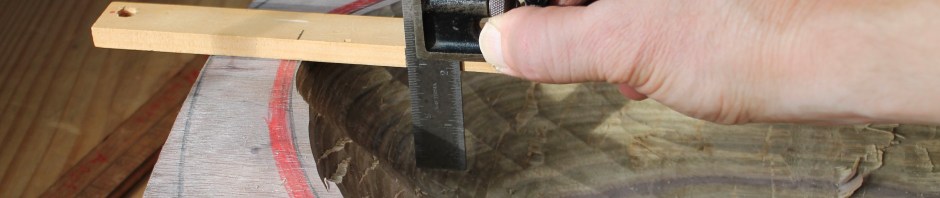

Sometimes, after you’ve hogged away most of the wood and the hollow is nearing the final shape, your hands and eyes tell you that one end/side of the bowl has a steeper slope than the other. Your hands and eyes are usually right. But if you want to verify, here’s a simple technique that I started playing around with this year.

Place a slat of wood across the rim of the bowl. A yardstick works well, but it can be any straight stick. Make/choose a reference mark on the stick to line up with the rim of the bowl. Set an adjustable square so that the blade is somewhere about half of the overall depth of the bowl (It doesn’t matter as long as you keep the same setting when checking both ends). Register the shoulder of the square against the stick and slide it forward until the corner of the blade just touches the slope of the bowl hollow. Make a tick mark on the stick at the edge of the blade (or note the measurement if using a yard stick). Now do the same on the opposite end of the bowl. If the slopes are the same, then the blade of the square will register at the same tick mark. Adjust for any differences by shaving more wood away from the appropriate end until the slopes match. You can check different points on the curve by adjusting the blade of the square, but one reference point in the middle is probably plenty.
This same technique can be adjusted in many ways to check the exterior of a bowl and so on. None of this is necessary, but, especially on larger bowls, it can put your mind at ease that you’re where you want to be. Essentially, it’s a very simplified version of a “pointing machine” used for centuries to assure consistency between a sculpted model and a carving in progress. You can see one in use by a master stone carver in a short film called The Stone Carvers. Filmed in 1984, it documents the carving done for the National Cathedral in Washington D.C. The few minutes with the pointing machine begins at 3:45, but you’ll likely want to watch the whole 28 minute film. It won the Academy Award for Best Documentary Short. The Folkstreams website is a trove of unique films on a variety of subjects, and they have a category dedicated to Traditional Arts and Crafts.
I’ll end this post with a couple short video clips of my own. I set up the camera as I used the adze to do the last bit of shaping on the hollow of an oval walnut bowl a couple days ago. It looks a lot different when the same tool is roughing out big chunks earlier in the process. This isn’t a matter of 10,000 hours of practice or anything. It’s simply about referencing/feeling the bevel against the surface and making minor adjustments as the cut proceeds. The bevel provides control by registering against the surface it has just cut.
In the first (one-minute) clip, below, I’m working on the quadrant to my left. I do that with the bowl sitting flat. Notice, near the end, that the final chips will release at the cross-grain trench where the grain direction reverses. The intended boundary of the hollow is marked by a pencil line. Beyond the pencil line, I’ve scribbled with some red pencil to avoid any potential confusion for myself with any other layout lines.
In this final clip, I’m working on the right quadrant. Rather than try to hold the adze awkwardly (sort of backhanded), I hold the bowl up to allow for a more natural swing. This means I can’t quite see the line at times, thus I tilt the bowl back now and then to see how it’s going. After I make the pass inside the edge of the rim, I use that new surface as a landing zone as the adze begins each series of rows/passes that bring the surface of the rest of the quadrant to shape. Each of these passes ends near the bottom of the cross-grain trench. I don’t bother talking in this clip, either. It simply sounds like somebody knocking on your door for three minutes straight. Zero Academy Award nominations.
 David Fisher, Carving Explorations
Good evening my friend , my girlfriend gave me this tool a few years back, find it most helpful in keeping the inside and outside consistent.
https://www.homedepot.com/p/Saker-5-in-and-10-in-Contour-Gauge-Profile-Tool-and-Duplicator-SAK5106-C012-X0147/319815499
LikeLiked by 1 person
David, these teaching points are great. Do you consistently use mark out lines in pencil/crayon or is it for the reader? After this adz work do you go to a gouge or other surface finish technique?
Also the “Carvers” video was good.
LikeLiked by 1 person
Always at least in pencil, sometimes around the hollow I’ll use a colored pencil just to make it absolutely clear when I’m really swinging the adze. I don’t want to be mid-swing and wonder where the line is! It all gets carved away eventually.
LikeLiked by 1 person
Just realized I forgot your second question, Skip. After the adze work, I’m usually ready to let the bowl dry. Then after drying, yes, I finish the surface of the hollow with paring (pushing) cuts from a gouge. On larger bowls, I sometimes follow the adze work by doing some shaving with a travisher that I modified: https://davidffisher.com/2019/01/12/travisher/. Regardless, I finish with a gouge.
LikeLike
A great, common sense tip. Thanks! The video also reinforces the importance of removing as much material as possible at this stage. I still have some of my early efforts laying around for final work because I left them too thick – I promise I will get around to them eventually. 😉
LikeLiked by 2 people
Such amazing control of the adze. I have a long way to go!
LikeLiked by 1 person
Pingback: First bowl of 2025 | David Fisher, Carving Explorations