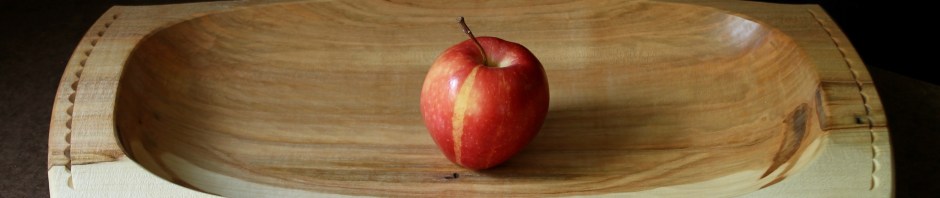

I like this silver maple bowl that I just finished, and I liked making it even more. Part of the reason is that it gave me an opportunity to use a curved (cooper’s hollowing) drawknife that I had picked it up on eBay a couple years ago.

Whenever you’re working with a good drawknife, it seems like the birds sing more sweetly. That held true once again after I honed it up and used this cooper’s hollowing drawknife to shave a series of concave facets on the sides and ends of the bowl. Above, I’m shaving the uppermost facet. I started next to the foot, concentrating on leaving a good line on the left edge of the facet. Then same with the adjacent one after that, and so on.

Here’s a photo of the drawknife. The edge is about 6″ long. The outer edges of the handles are about 15″ apart. I can’t see any stamp on it, but I’m nearly certain it was made by D. R. Barton. They made great tools in Rochester, NY beginning in 1832. I have a couple other drawknives by them and this one shares the characteristics.

Here’s an edge-on shot. A relatively gentle curve compared to some others. Probably made for hollowing the staves of larger barrels, with less curvature than those of smaller containers.

And there’s the back side.

After working on the sides, I adjusted the bowl horse to hold the bowl sideways as I worked across the end grain, skewing the knife to get a cleaner cut. The last row, right under the handles, was a little tighter, so I used a gouge there.

I rotated the bowl up almost vertical and shaved the ends of the handles with a regular drawknife.

Again, skewing the blade eases the end grain cuts.

Then, more fun easing the sharp edges by shaving chamfers with the drawknife.

For the edge of the hollow, I switched to a sloyd knife. I’m guiding it with both hands here.

Above is the outside of the finished bowl. The dimensions are 16 3/4″ x 9″ x 2″. This silver maple had some ambrosia streaks in it, a reaction of the tree to fungus carried by boring beetles. The dark spots on the bottom there are beetle holes. The lighter wood is sapwood (near the bark) and the darker wood is heartwood. This blank is a radially-split blank, so, like quarter sawn. That meant the broad foot stayed flat even as it dried.

And there’s the view from the top. A broad shallow bowl useful for all sorts of things.

From this low angle, the hollow facets from the drawknife can be seen. And an apple for scale.


The line of gouge chips on the end emphasizes the curve of the handle, but is subtle enough to not compete with the strong character of the color and figure in the wood. Those of you from the class at Pete’s might recognize this pattern from our sample boards.
This bowl is available for purchase. If you’re interested please email me at dandkfish@gmail.com. The price of $600 includes shipping. SOLD
 David Fisher, Carving Explorations
Nice work! Nice photos and good explanations regarding the different steps and the tools used for them. Thanks.
LikeLike
Sent from Samsung Mobile on O2
LikeLike
Dave- this turned out beautifully! Now I will be keeping my eye out for a cooper’s drawknife! But in the meantime, maybe an inshave might suffice..?
LikeLike
Sure, Joe, an inshave would do the same thing if you have good control over it. You might have to put a booster seat on the bowl horse to get up higher due to the handle orientation. With your height, it’s probably been a long time since you’ve sat in a booster seat.
LikeLiked by 1 person