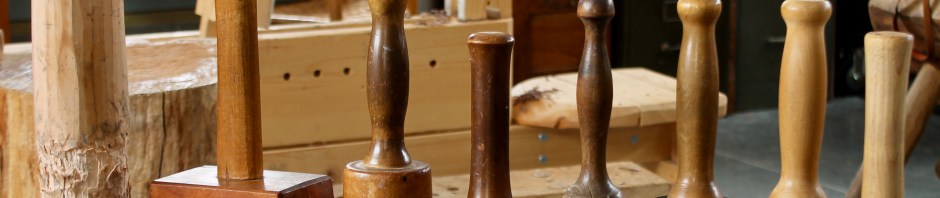
Mallets are indispensable, and are made principally from the wood of the apple tree, plum tree, beech, and elm.
Paul N. Hasluck, Manual of Traditional Woodcarving (1911)
If you’re going to carve, you should have a mullet mallet. Sometimes they’re needed because you want to remove bigger chunks of wood much more quickly than you could with hand pressure. But, just as often, it will be appreciated for the additional control that mallet taps provide, such as when you’re negotiating a tight curve or you want to make sure you don’t push the cutting edge too far. A mallet delivers momentum in prescribed packages.

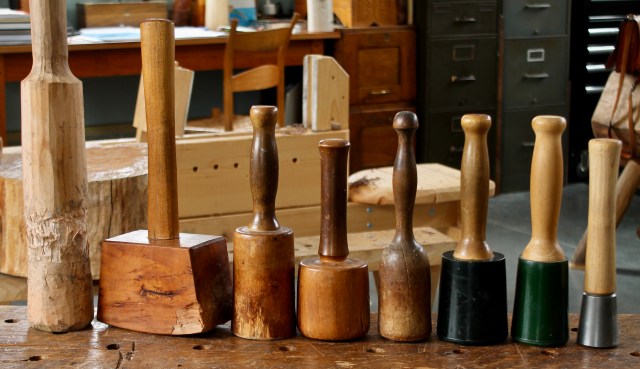
I reach for mine often. As I did so a couple days ago, it hit me (not the mallet) that I had never dedicated a blog post to these important carving tools. So I lined up my mallets and snapped a few photos. There they are again, above, labeled A-H. I’ve been using some of these for thirty years. I’ll mention a few things about each below:
- A: Froe club or beetle. Hewn and shaved from green apple wood. 48oz. (1360g) Froe clubs usually last me a few years. Eventually all of that striking on the back of the fro blade wears ’em out. It’s easy and fun to make another.
- B: Mallet with a sugar maple handle and an apple head. 40oz. (1134g) I don’t use this for general carving. But it comes in handy at those times when there’s a little more wood to remove or the cutting edge is extra wide. Not nearly as comfortable and to use as a round mallet.
- C: Sugar Maple. 20oz. (567g) I think this was my first carving mallet, and the one that has seen the most use over the years. Thirty years ago, I turned it on my brother-in-law’s basement on his Shopsmith Mark 5 set up for lathe work. I made the blank by face-gluing two pieces of a thick maple plank. I was surprised just now to discover that Shop Smith is still making machines — now the Mark 7. Anyway, this is evidence that you don’t have to be a skilled turner to make a good mallet.
- D: Apple. 17oz. (482g) I turned this from a piece I split from an apple log. Note, none of these round mallets have the pith (center of the tree) in them.
- E. Maple (I think). 11 oz. (312g) Bought it at a yard sale. I think it might have been made to be a potato masher or something. Works well as a light mallet.
- Wood is Good Mallet. Maple and Urethane. Labeled as 20oz., but mine weighs 23oz. (652g) . I got this several years ago. It has a solid maple core/handle wrapped with a thick shell of urethane. With apologies to my beloved first mallet (B), this is the one I reach for the most. It is just about perfect. Well-balanced, just the right amount of heft for most carving, easy on my joints, ears, and tool handles. The other mallets get less use now, but I still love them.
- Wood is Good Mallet. Maple and Urethane. Labeled as 12oz., but mine weighs 14 oz. (397g) Doesn’t get used anywhere near as much as it’s bigger brother, but it’s nice when I’m doing something very delicate.
- Trow and Holden “round hand hammer” (traditionally called a dummy). Ash and annealed steel. 24oz. (680g) I use this on those rare occasions when I do some letter carving in stone. It could also be used for wood carving though.
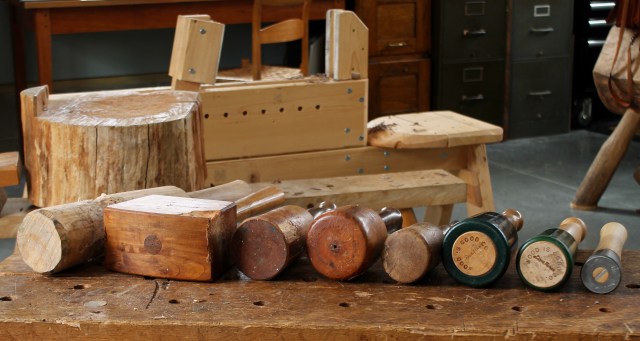
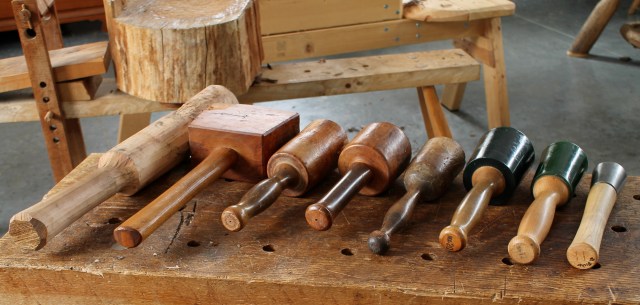
Above and below are different shots of the mallets in the same order.
So, use a mallet or push with your hands, but do not use your hand as a mallet (not often at least). Paul Hasluck warned about this back in 1911:
It is a general practice of wood carvers to use the half-closed palm of the hand as a sort of mallet…. most experienced wood carvers have a large hoof in the middle of the palm as a result thereof, and, unfortunately, cannot open their right hands quite straight. In course of time the habit causes the fingers to become rigidly bent inwards, although the flexor tendons and joints are unaffected. Subcutaneous division of the contracted bands sets the fingers free, but a relapse is nearly sure to occur. An eminent surgeon states that there are quite half-a-dozen different operations for this deformity, but he does not know one that is really successful — that is to say, which results in a permanent cure.
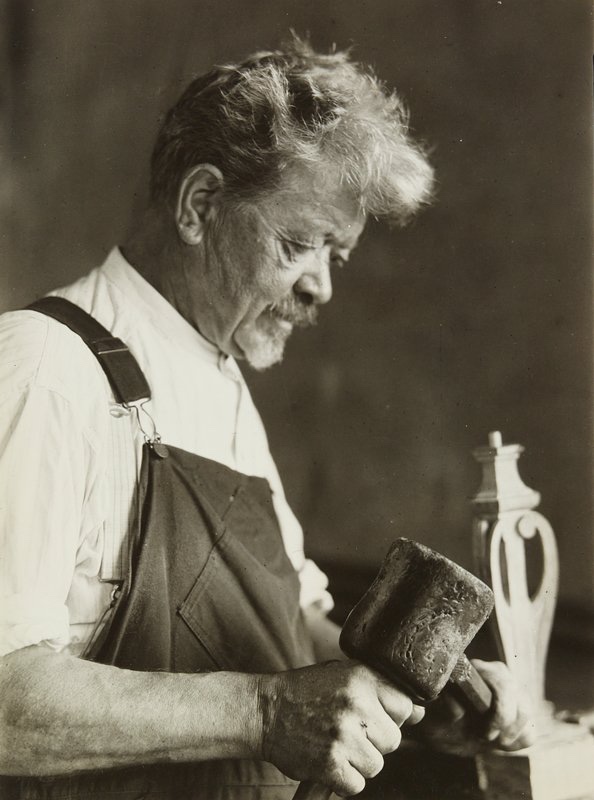
The photo above was taken in the decade after Hasluck’s book was published. Nice Mallet.
Historical note: the photograph was taken by Lewis Hine, especially known for his series of photographs of young factory workers (unlike this carver). His photographs raised consciousness and were influential in bringing about child labor laws in the United States.
 David Fisher, Carving Explorations
Ahh! Another chapter for the book, Dave…..Thanks for sharing.
LikeLike
Hi Drew. I suppose it could be!
LikeLike
Love the wood is good mallets.
I have had the 30oz for 2 years and just got the 18oz a few weeks ago. I found the 30oz would subtly fatigue my forearms and shoulders over the course of a session.
The 18oz worked great as i was chopping out mortises for a frame and panel door and I had no fatigue issues.
So now the 18oz will become the mainstay on the bench and the 30oz will be reserved for when things require extra “persuasion”.
Cheers,
Dave from Oz
LikeLiked by 1 person
Interesting! Thanks for sharing that, Dave. I noticed that they make the Wood is Good mallets in 12, 18, 20, and 30 oz. It’s puzzling that the 18 and 20 are so close together, but I guess that’s an indication of them both being in the mallet sweet-spot range. I think most people would be happy with either one of those for most of their work.
LikeLike
Thanks Dave. Reading Hasluck’s caution on using the palm of the hand as mallet, I think of U.K’s master woodworker Paul Sellers and his hand surgery last year to release subcutaneous, palmar scarring. It was very successful, but I have often watched him on his videos intermittently use his hand as a mallet on the end of a chisel. So that makes me wonder if this “hand mallet” was the cause of the issue.
I liked this post.
Cheers, Michael
LikeLike
Interesting, Michael. I’m glad Paul’s surgery has been so successful. I wonder if the surgical procedure itself differs much from what would have been done in 1911?
LikeLiked by 1 person
I believe it was quite different. The surgeon used a simple needle (according to Paul it was the same needle used to deliver the local anesthetic as was used to conduct the surgery) to sever the fibers.
As I recall he spent a month or so recovery afterwards with some device worn at night to keep his hand flat. Paul suggested that it was caused by the gripping of tools for long periods of time over a lifetime of work that caused the issue rather than the striking of his palm.
He spent some time discussing it on his blog if you are curious to learn more about it.
LikeLike
Thanks. I’m sure it was incredibly stressful, whatever combination of specific causes. I’m just glad to know that the procedure fixed the problem and that he’s back to making shavings!
LikeLike
As a teenage apprentice I just copied the older joiners and used my hand as a mallet constantly. Then in my mid twenties a foreman in a different workshop banned me from doing it saying I’d suffer in the future. I completely broke the habit and now at 60 after reading the article am so thankful for the foreman’s advice.
LikeLike
This reminds me of an another quote, “Charity towards all and mallets toward none.” Wisdom of the ancients.
LikeLike
Thanks for that, Phil! That’s also one of Roy Underhill’s classic mallet-related references! You’re in good company.
LikeLike
Thanks for the post David, I think I’ll get me one of those urethane mallets. Your post reminded of some thoughts I’ve had about Applewood recently. I have friends in the orchard business here in NW Wisconsin, worked part time at a friends greenhouse and I have used a lot of Applewood in the past. Nowadays nearly all Apple trees planted at orchards and even residentially are dwarf or semi-dwarf trees. They won’t grow large enough to produce useable wood (someone correct if I’m wrong please) Applewood in the future will be scarce, pruned trees can have issues, so we need to watch for those older trees that go down or are being removed and rescue that wood. The best wood I’ve experienced was in a friends pasture, never pruned, growing wild, probably 50-75 years old. JReed
LikeLike
Yes Dave. He had micro needle scar revision under local anesthesia as an out patient. It was completely successful and he now has full range of motion in his hand and fingers and is back to his bench work as usual.
Cheers, Michael
LikeLike
That’s interesting, and certainly something to keep in mind. I’ll have to look into the possibility — if possible — of finding a non-dwarf apple tree to plant.
LikeLike
You can, in fact a gentleman not far from my home tours the countryside looking for old apple trees, gets permission to take a cutting, then grafts and plants them, he sells almost everyone he starts. Many times he has no idea of the variety, but because they have long survived they are very disease hardy trees.
LikeLiked by 1 person
I’m sure there are still full size apple trees available at a nursery if you ask.
LikeLike
Thanks for that information. I’ll ask around this spring.
LikeLike
I’m glad you changed it from mullet to mallet. I’ve never had a mullet and I don’t want to have to start now.
LikeLike
You’d rock a mullet, Jay. I thought you might be hiding one under your hat.
LikeLike
I’ve spent an embarrassing amount of time researching mallets just in the last week. If only I had waiting until today, I could have saved that time!
As always, grateful for your writing and your work.
LikeLike
Well, I’m sure your research was fruitful anyway, and mine is certainly not the final word. But I know how those research rabbit holes can go with all of the information available today!
LikeLike
A carving mallet was the very first thing I ever turned, and I still have and use that madrone mallet. While at a class, I realized I needed a mallet and didn’t have mine, so quickly turned another, slightly lighter one, that I also use and love. There’s a real pleasure in making one’s own tools.
LikeLike
It is a real pleasure indeed, Kalia. It’s a special satisfaction each time you use the tool. With your turning skill, I’ll bet both of them are wonderful mallets.
LikeLike
Well, the first one was before I had any turning skill to speak of, but it’s still a pretty good mallet :>) The handle shape is similar to your maple mallet (C in the photo). When I made the second mallet I found that a handle that smoothly flares toward the end rather than having the bulge in the middle is a bit easier to control. It doesn’t rock in my hand as much. It’s got a shorter and more exaggerated flare than the handle on your steel mallet. The easy grip together with the lighter weight makes that second one a superb carving mallet.
LikeLike
Great post. My father was a sculptor from 1960 until he passed away in 2016, I grew up with the sound of his Lignum Vitae mallets echoing around the farm. He purchased most of them from Sculptor Associates along with the gouges, then Woodcraft when they were still in Ma. Once the Wood is Good ones hit the market he only used them. You forget about the constant pounding on your ear drum from a wood mallet striking a wood handle.
I have a few of his mallets, a Wood is Good one and a couple from Blue Spruce for light work. They are more than a mallet needs to be but are well balance and make a lovely paper weight on my desk!
LikeLike
Jay, thanks for relating these stories about your father, David Hostetler. I noticed there are a couple photos of him with mallets right near the top of his website: https://www.davidhostetler.com/artist/
Yes, Lignum Vitae. I’ve never had a LV mallet, but I’m surprised Hasluck didn’t mention it as a typical species for mallets. In Chris Pye’s great book “Woodcarving: Tools, Materials, and Equipment”, he demonstrates making a LV mallet from an old boules (bocce) ball. He turns the ball to mallet head shape on the lathe, then inserts and turns an ash handle.
LikeLiked by 1 person
Wow imagine my excitement when the mallet I’ve owned for years is the same brand as my favorite carver and inspirer.
Much love
LikeLiked by 1 person
Also I have some information that may help. I loved the excerpt that you included about the surgeries. You really know how to make a blog interesting.
A 5 gallon bucket half full of rice (or as full as you like) can be a great rehabilitation tool. Carvers especially use their finger flexor muscles very often; I have heard of this warping hands over time by itself, when not balanced with finger extensor muscles.
With a bucket o’ rice you can reach a fist down into the rice, and do a few minutes of extending your hand in different ways, pushing the rice aside. The deeper you go the greater the resistance. Feels so good for the hands.
God bless
LikeLiked by 1 person
That’s a great idea, Evan. Thanks. And it sounds like fun!
LikeLike