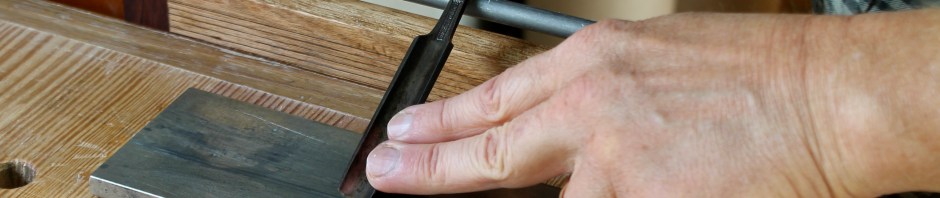

A couple months ago, I wrote a post that included an explanation of a honing method using a board secured vertically in a vise as an aid to honing gouges and chisels. I don’t know what to call it. Honing ledger? Sharpening shelf? I’ll go with alliteration.

Anyway, it allows the gouge to be slid side-to-side across the stone while maintaining a consistent sharpening angle. There’s a photo from the original post above. Call it what you want, but it’s just a scrap board.

A couple weeks ago, this showed up in my mailbox, a gift from Bill Skinner. Bill took the idea and made a deluxe version with a 1/2″ diameter steel rod at the top.

Here’s a shot of the other side. The uprights are joined to the body with a half-lap joint. Overall dimensions are 13″ x 6″ x 7/8″. Bar length between uprights is 11″. There’s a 1/2″ gap between the bottom of the rod and the top of the body.

I tried it out just like it is and it works great, especially with a drop of oil or a little wax rubbed onto the bar.

So, it works just like a board, but the special benefit of Bill’s configuration is that it can be used with the Tormek SVS 38 clamp. I don’t have one, but Bill says it keeps the tool square but still allows the rotation to sharpen the gouge. Above are photos that Bill sent. On the right is a depth setting block to allow for a consistent angle when setting the clamp on a gouge. Again, I don’t have a Tormek or one of these clamps, but Bill says you can get one (the clamp, not the Tormek) used on Ebay for around $20.
 David Fisher, Carving Explorations
Dave, thanks for the followup high lighting Bill’s generosity and improvements. The steel bar should make it easier to rotate and not wear out the wood guide. Also being able to use the Tormek SVS 38 clamp, which I don’t own, and the depth gauge is a plus. Sure shows what a terrific “community” we have!
LikeLiked by 1 person
Dave, I forgot to ask what grade of diamond stone is that? I assume 1000 or 1200.
LikeLiked by 1 person
Skip, the stone in the top photo is a DMT “extra extra fine” Dia-Sharp diamond stone. It’s listed as 8000 or 3 micron.
LikeLike
Hi Dave,
great post that got my wheels moving.
I do have a tormek I bought when arthritis set in and also a SVS-38 and an SVS -50 jig which allows the precise honing of skew chisels as well as regular gouges which would work just as well.
I just went down to the shop and just clamped the Tormek honing guide ( the “F” shaped bar the Tormek jigs fit on ) in my shoulder vise and was able to use it on my bench with no additional parts. Works great! It was a bit fiddley to adjust the guide to be level, though.
it occurred to me that a tormek XB-100 horizontal clamp for the honing guide clamped to a block of wood in my tail vise would allow for micro adjustment of the bar. I also bought one of those a while back to use with my high speed grinder but never bothered to set up. That will eliminate the fiddley adjustment. They cost about $35 at sharpening supplies and other places.
Larry
LikeLiked by 1 person
Good thinking, Larry! Thanks for sharing that idea with everyone.
LikeLike
What a great gift! It looks like those horizontal graduation lines on the (butternut?) allow you to make sure you have it perfectly horizontal to the bench. Am I seeing that correctly?
Cheers,
Dan
LikeLike
Yep, a very thoughtful from Bill! And that is the purpose of the lines. Bill had a pencil line or two on there when he sent it. I added the series of lines with black pen.
LikeLike
This gouge sharpening fixture and especially with the gouge clamp sounds great. One possible addition would be to inlay a 6″ ruler at each end of the board to use instead of the parallel lines. That might make it easier to sharpen at a certain angle, say at 2″, write down the ruler height and then next time get pretty close to the same height.
LikeLike
Great idea! If the tool is just registered by the bolster (without a Tormek clamp), you could make a mark on the board for each gouge you sharpen. That would take account of the fact that each gouge will have a different length from bolster to edge.
Using Bill’s clamp and setting jig, the height of the shelf could remain standard I think. You could even glue a registration strip to the board that sits on top of the vise jaw.
LikeLike
I just knocked out a sharpening shelf this morning, and got the first coat of oil on it this afternoon. Will need to build a jig to set the Tormek clamp at the proper place and such tomorrow, but I’m hopeful I can get my gouge sharpening much more consistent soon. Aside from never having enough time in the shop, dull tools are one of the bigger curses I face.
Thanks for posting this! It was the noodzh I needed to up my sharpening game.
LikeLiked by 1 person
I posted my finished sharpening shelf and showed the results I got sharpening a veiner. I’m dang happy with the results.
LikeLike
I wrote up my finished sharpening shelf and the results I got with it. I’m a happy camper!
LikeLiked by 1 person
Beautiful job and a great write up on your experience!
LikeLike
Hi Dave,
I’ve been going through your blogs and this one really has been a focus of mine of late. I’m signed up for your Bird Bowls class in June and I’m focused on honing my sharpening skills (as much as possible!) before the class. I came across this idea recently in Fine Woodworking and thought I’d share with you. I’ve made a couple of these to try them out and they work very well with straight gouges and such. Long bent gouges are a different thing though. https://www.finewoodworking.com/2023/09/27/easy-effective-sharpening-guide-for-carving-gouges. What I really like is these allow you to fine tune your exact angle by coloring the bevel with a marker and screwing the eye bolt in or out. I’m one of those woodworkers who relies on honing guides (maybe too much!) for my plane irons, chisels and turning tools. I’m curious if utilizing some sort of guide is a regular step in your process, or do you do all your honing freehand? Thanks for any insight
Gary
LikeLike
Hi Gary,
I’ll be looking forward to carving, and sharpening, with you in June! I like Mr. Fyie’s idea for the I-bolt sharpening guide. The sharpening shelf works on the same principle, but you have to make sure the shelf is parallel to the work surface. The eye bolt rig rides on the work surface, so stays parallel. But I would think you’d have to have a significant amount of adjustability in the eye bolt height (or a few different eye bolts set up) to account for different lengths of gouges (from the bolster to the cutting edge). That difference in length directly affects the angle of sharpening. The eye bolt would certainly allow for easier fine tuning of the angle (easier than the sharpening shelf). I haven’t tried the eye bolt method, but I can certainly see its merits and I’m glad to hear it’s working well for you. Whatever method works for you, keep on with it.
For those that may be unable to open your link to Fine Woodworking (I don’t know if it is restricted to FWW subscribers) here is a link to a YouTube video from Mr. Fyie about the jig: https://www.youtube.com/watch?v=0Nfxyg3lbe8
Except for a very rare occasion, I do all of my honing freehand, but that’s not to be seen as a badge of honor. Indeed, there may be times I’d be better off using a honing guide.
LikeLiked by 1 person