
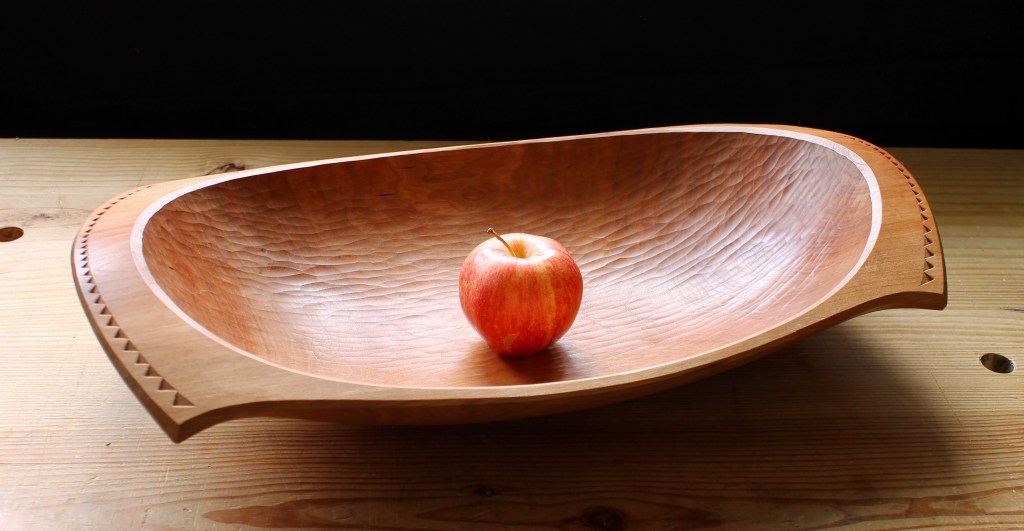
I’ve finished the cherry bowl that I mentioned in my recent Drying Revisited post. The oil has cured and it’s ready to serve. I’ll share a few more shots of the finished bowl below, but first some photos of some of the after-drying carving, which I spend much more time at than the green carving.
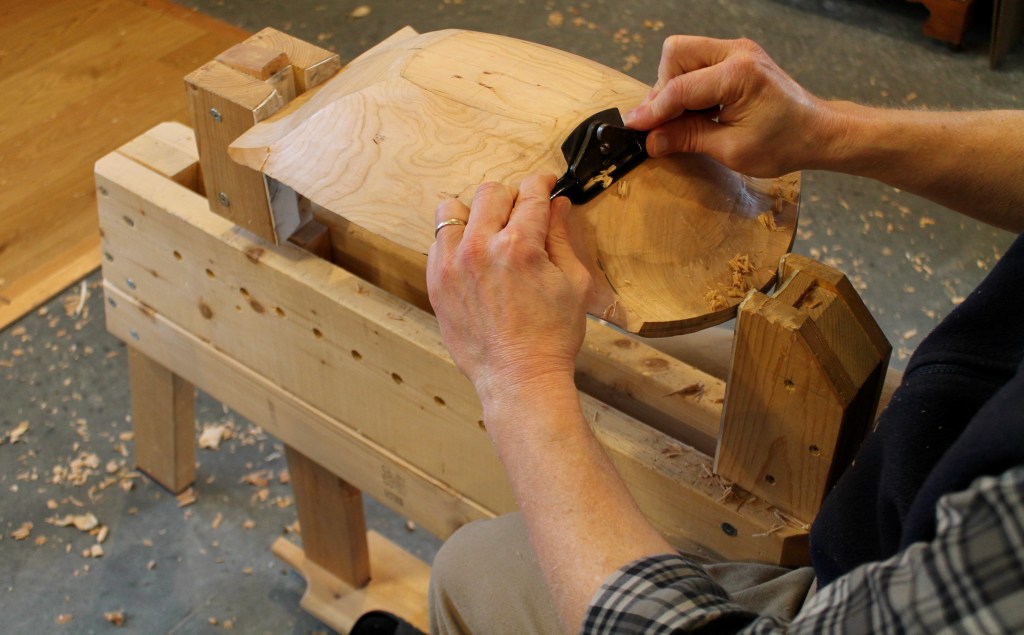
After paring the final surface of the hollow, I plane the foot flat since it moves during drying. Then I redraw the perimeter of the foot and do the final shaping of the exterior from that edge. This bowl design has four distinct exterior surfaces or “panels” as I sometimes call them. In the photo above, I’m using a spokeshave to finalize the form of the end panels. The junction between the side panels and the ends are a key visual feature.

For this bowl, the side panels were left from the drawknife. The grain direction reverses at the handles, and a knife is particularly nimble for managing the transition.
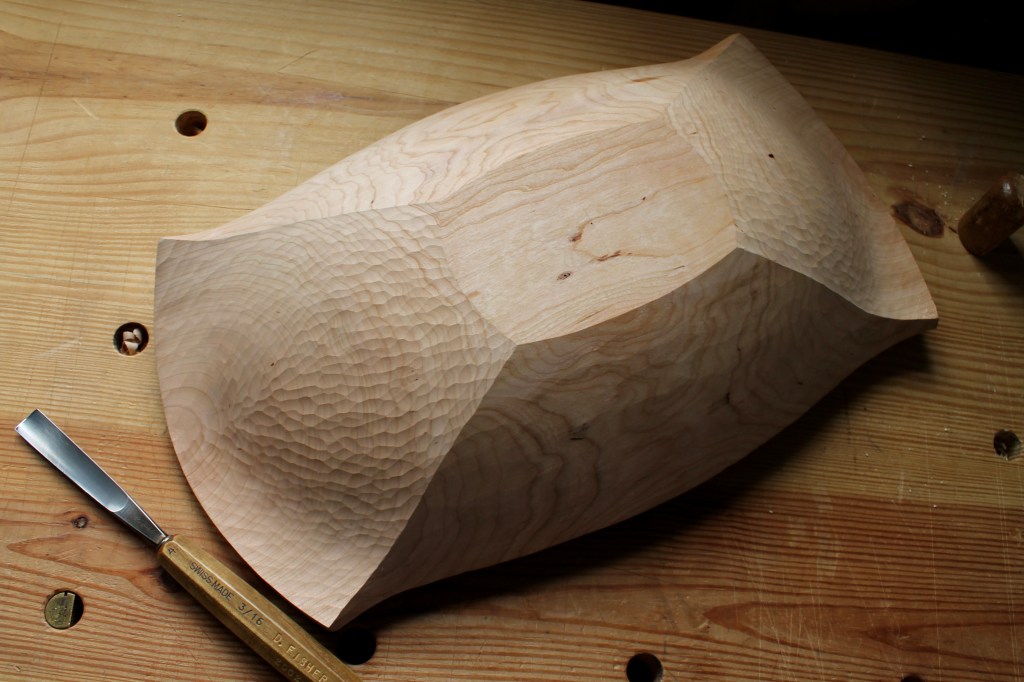
The end panels were finished with a dappled texture from a shallow gouge.
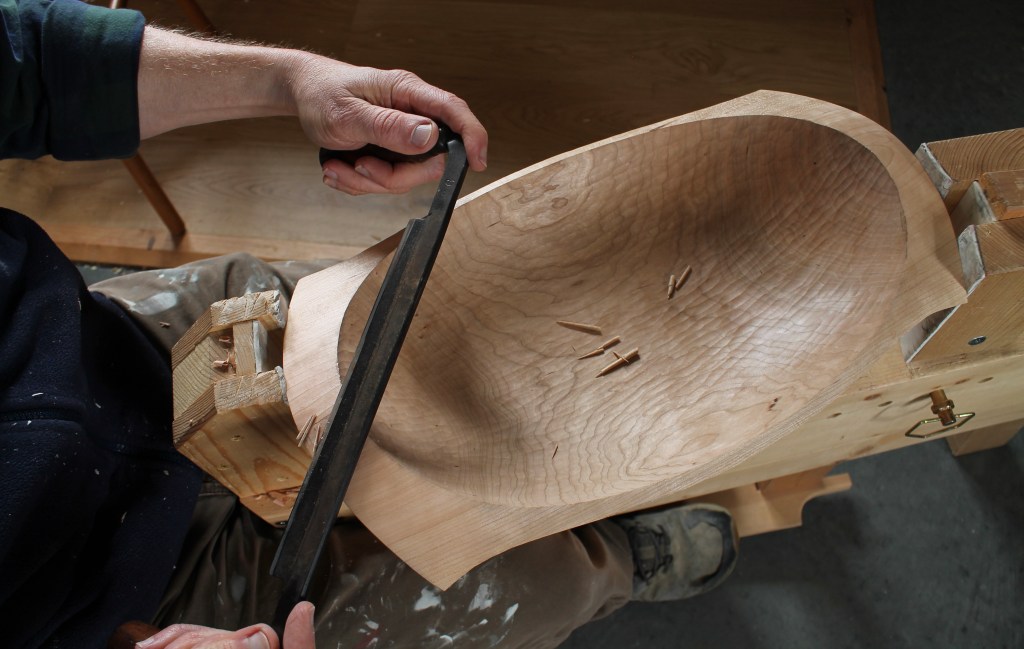
I worked the upper surface with very fine cuts from a sharp drawknife.
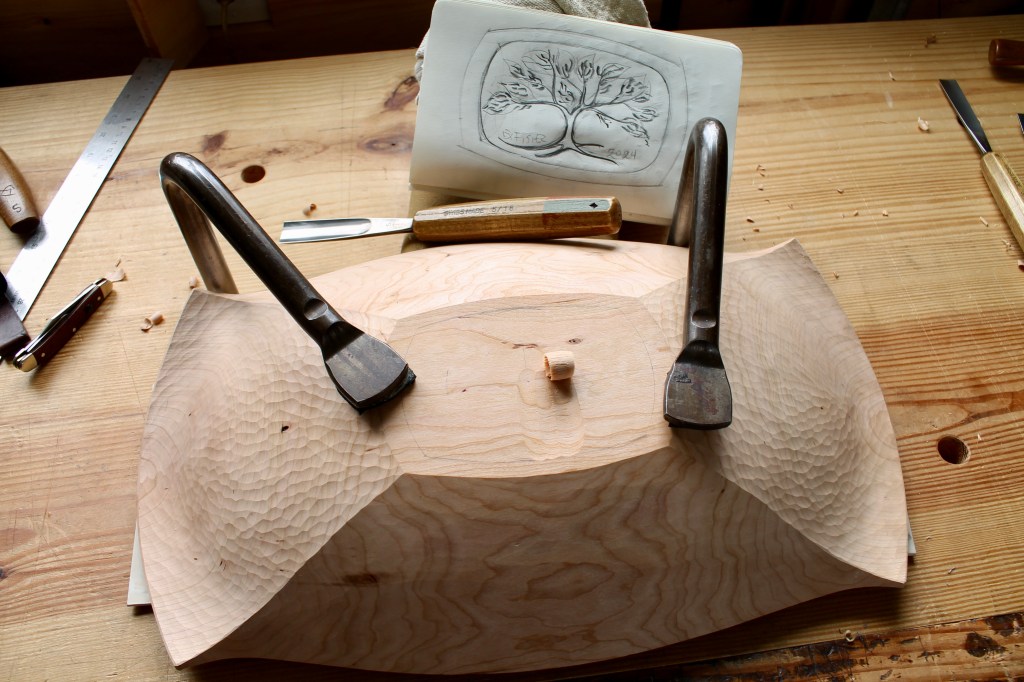
I sketched a little tree design then began excavating a shallow hollow in the foot as a canvas. I’ve written about them before, but I don’t know what I’d do without holdfasts.
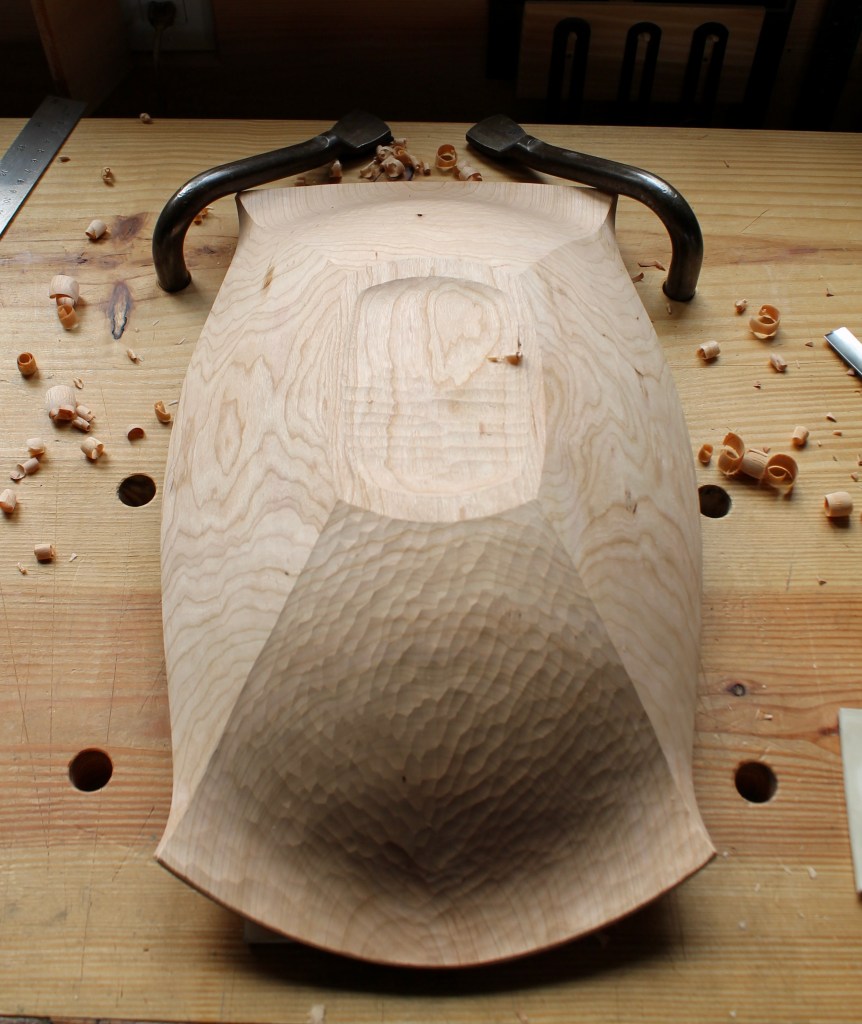
I finished the foot hollow by carving with the grain. By arranging the holdfasts like this, I was able to push forward while also keeping the forward edge of the bowl from lifting up.

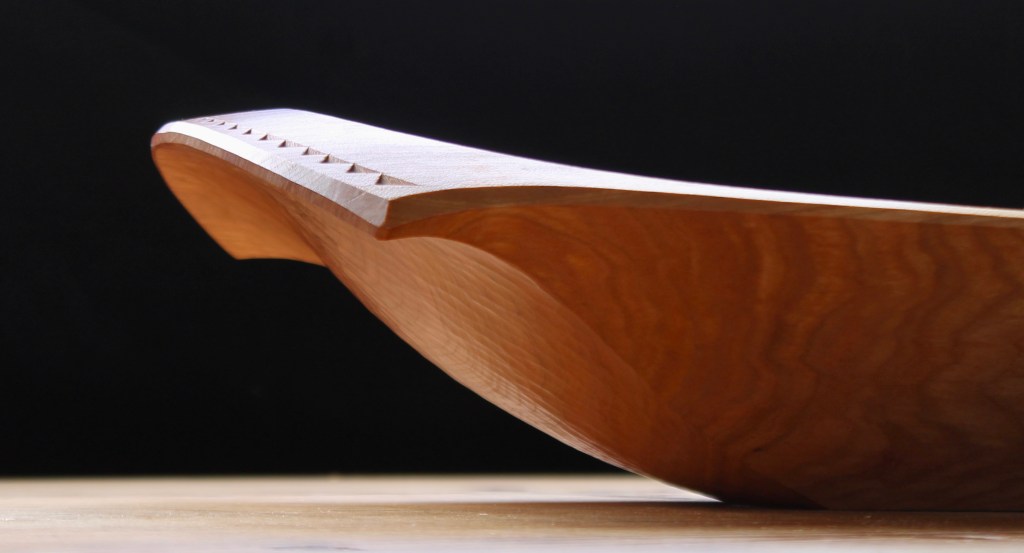
There’s the finished, oiled, bowl from the bottom. There are a few more photos of the bowl below. Of course, being cherry, the color will deepen over time. It’s available for purchase. 18.5″ long x 10.5″ wide x 4″ high. If you’re interested, email me at dandkfish@gmail.com. $975 includes shipping. SOLD Thanks for looking.



 David Fisher, Carving Explorations
Beautiful!!
LikeLiked by 1 person
Absolutely Magnificent !
LikeLiked by 1 person
Wow!
LikeLiked by 1 person
Dave……Holy smokes that’s beautiful!
Thank you for sharing your work and thoughts.
LikeLike
Holy smokes that’s beautiful!
Dave, thanks for sharing your work and thoughts on crafting these works of art.
LikeLiked by 1 person
Really a wonderful bowl Dave! The dappled finish and bottom “canvas” really add to the artistic appeal. What size gouge did you use?
LikeLiked by 1 person
Thanks Skip. For most of the convex portions (most of the end panel surface) I used a #3/16mm. For the concave areas under the handle, I switched to a slightly steeper sweep. Maybe a #5 or #6, to prevent the corners from catching and maintain the same sort of texture.
LikeLike
Beautiful! I’m sure it will be really cherished by it’s new owner!
LikeLiked by 1 person
What an amazingly beautiful bowl, Dave! Very impressive and thank you for sharing.
LikeLike
Just perfect David, from every angle you photograph. The tone of the Cherry fits your style so well, thanks for sharing and inspiring all of us!
LikeLiked by 1 person
another beauty and we expect no less–so keep ’em coming–
LikeLiked by 1 person
Really beautiful, Dave. Perfect. But I wanted to ask you for your feelings about that perfection.
Your edges and some of your surfaces are smooth, with no deviations, cut as closely as possible to an abstract line with no individual movements of the hand made visible. Please don’t think that’s a criticism. It certainly isn’t. They couldn’t be more beautiful, I think. But, as you know, there’s another kind of perfection – equally, but not more, beautiful. Where the curves and surfaces are boadly the same, but comprise individual movements not perfectly in a line or on a smooth surface. Where the curve is an intention – even an intuition – executed in a series of individual cuts each with its own facet. The perfection here is in the balance and confidence of these individual cuts in relation to the whole. The individual surface gouge facets in your work express this aspect. Both approaches need consumate skill. They are different expressions of crafstmanship. That’s not in doubt. I admire your work so much, but I wondered if you recognise the distinction I’m making and wondered if you think about these things when you’re making your bowls.
LikeLiked by 1 person
Sorry for the delay. Your comment had gone to the spam folder for some reason.
Yes, I think I understand the distinction you’ve expressed here. And no worries at all; I appreciate your thoughtful comment and question.
I think, to some extent, it’s a matter of degrees. In the photos of the bowl in this post, it may appear that the upper surface of the handles is absolutely smooth. But that surface is directly from a straight-bladed drawknife. Running a hand over that surface reveals the individual cuts, but they don’t speak loudly from a distance. That said, I don’t think about these things much while I’m working. I just do what comes naturally or intuitively to me, for better or worse! I really do admire work done in the more vigorous, looser aesthetic that you’ve described. I certainly don’t see it as any less impressive than more “refined” pieces.
I don’t know that I can express it any better than you did in your question; there is beauty in all sorts of work. I delight in it all! I think a comparison can made to the potential of both a loose sketch and a more developed drawing or painting. Both can be equally brilliant; look at Rembrandt’s quick sketches and finished paintings. The most important thing is to pick up one’s pencil, brush, knife…
LikeLike
Thanks Dave. Your comment makes me wish even more that I could hold the bowl in my hands! I’m off to the bowl horse….
LikeLike
David,
Another truly amazing bowl! Thank you for sharing, especially your work processes.
I also appreciate your ingenious methods for holding /working on your workpieces. I am using several of your ideas, either direct copies or modified.
Pete Magoon
LikeLiked by 1 person