
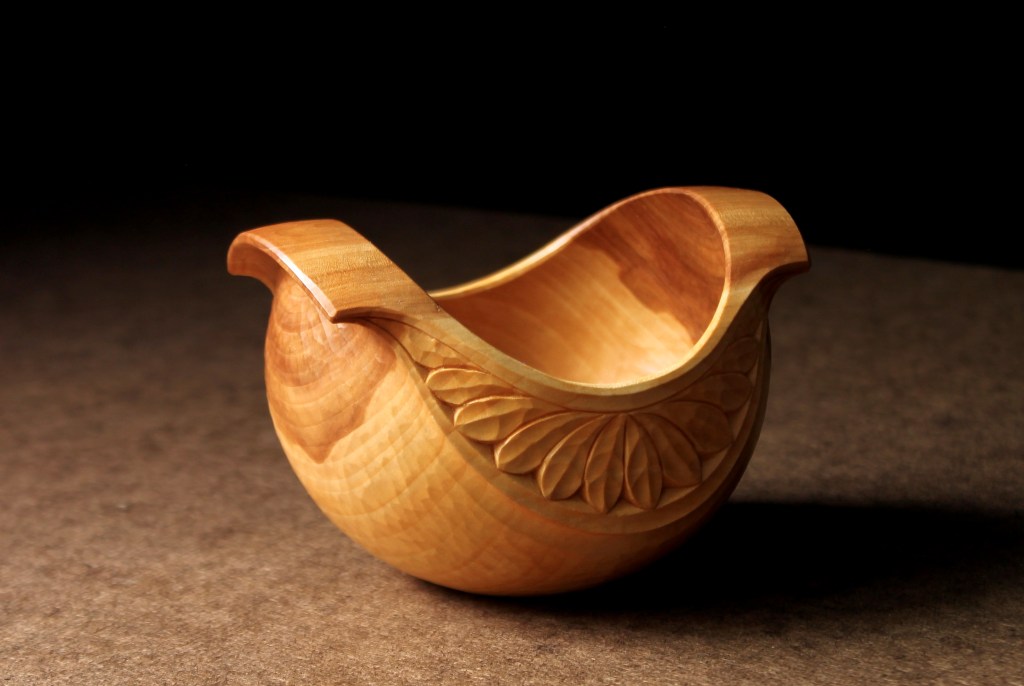
A few months ago, I wrote a post about the early stages of carving this little apple bowl. After it dried, I was trying to sort out how to go about carving the leaf design on the side panel. I referred back to an earlier post showing how I carved the same design on a similar bowl in black walnut and just followed along. There’s a sequence slideshow there.
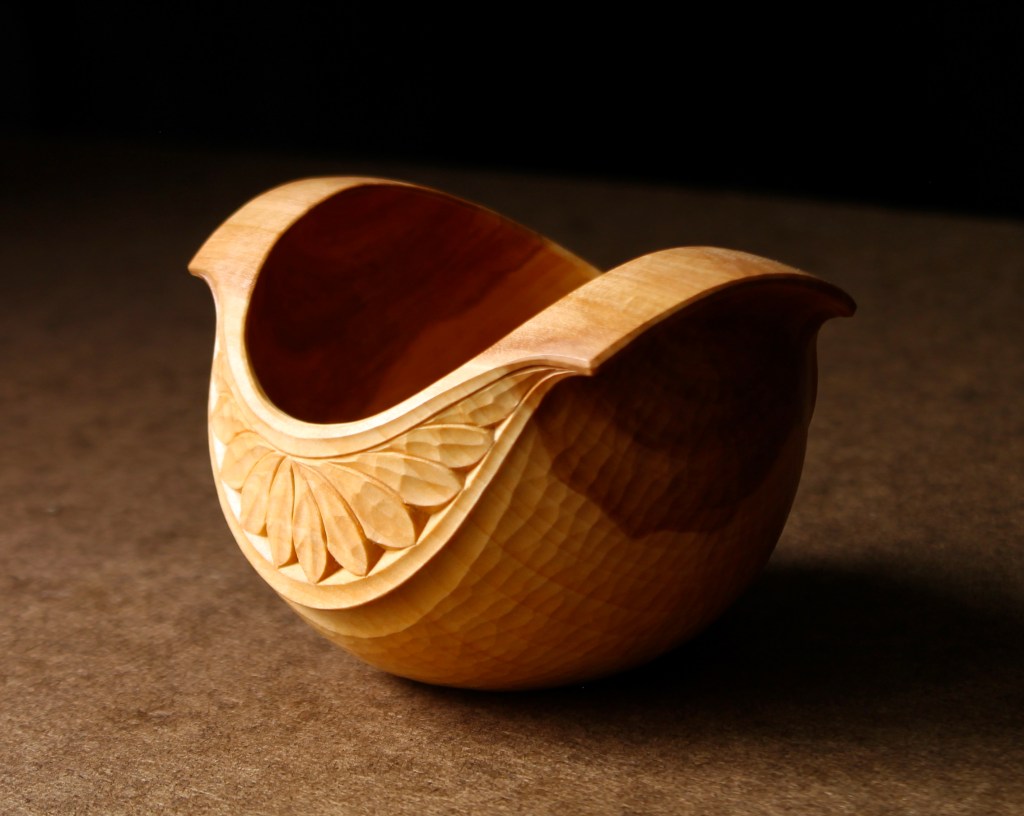
At just 4 5/8″ long and 4″ wide, this version in apple wood is even smaller than the walnut one. It sits right in the palm of your hand. Even at that scale, applewood is so fine-grained and firm that it holds the carved detail crisply.

I’m going to play around with some more of these with some variations in carving and size.
This one is on display now at the InGrained Exhibition which opens today and runs through January 20, 2024.
 David Fisher, Carving Explorations
I like the deep shadow lines in the sides that’s truly a hand held carving bet it was a handful if you get my drift.
LikeLiked by 1 person
Radical! Well done again Dave, pushing the boundaries as usual 🙂
How did you hollow it so small and steep? Adze and/or gouge(s)?
I’d like to make something like that, size and shape but perhaps without the impressive decorative carving,!
LikeLike
The only thing I used the adze for on this one was to cut across the opening between the handles. For the actual hollowing, I started my boring a hole straight down in the center, then worked a bent gouge progressively around, pushing the chips toward that hole. Then a hook knife to expand and shape the hollow. For these steep round hollows I find double-edged hook knives the most useful. This post from a few years ago has the one I use most often: https://davidffisher.com/2016/04/04/almost-ready-for-ale/
Get as much as you can out of there while the wood is green! After drying I went over the hollow again with the hook knife to clean it up.
LikeLike
it’s another beauty–
LikeLiked by 1 person
Completely splendid and Utterly Gorgeous Dave
LikeLiked by 1 person
Thank you, Martin!
LikeLike
Beautiful!!!! I’ve always envied apple wood. But I do realize pecan is wonderful as well, and I haven’t taken full advantage of it. It is abundant here. It’s a brittle tree like cherry, so storms, nut overload and pruning bring down a bunch of it. The imaginary barriers we build in front of ourselves!
LikeLiked by 1 person
Very true, Jed. Not many pecan trees up here as far as I know, so I have no experience with it. it’s related to hickory though, I think, so maybe similar in some ways.
LikeLike
It looks amazing!!! I’m inspired.
LikeLiked by 1 person
Hi Dave, great work!! I just had to remove a pear tree that was severely cracking and lifting a concrete slab and hope to get to work on that wood when I get a chance.
Will you be at the InGrained Exhibition?
LikeLiked by 1 person
Pearwood is wonderful to work with. Enjoy!
I hope to make it to the Exhibition sometime before it closes. It’s in Pennsylvania and so am I, but we’re 350 miles apart. A good reason for a train ride I hope.
LikeLike
If someone took a picture of me looking at your bowl it would show a 60 + year old with a mouth agape and eyes glazed over. Wow, just Wow!
LikeLiked by 2 people
Thanks Dave. Useful insights :). Although I have 2 good Swedish hook/spoon knives (Mora and HK) and occasionally use them to make a spoon, I tend to avoid them as I often end up cutting myself (on fingers)! (So using a double-sided one does not appeal :D.). I know, I really need to get grip with those Sunqvist grips! (Been re-reading about some of those recently, time to see if I learnt anything I suppose :)).
Have been tempted to try using a gouge instead of a hook recently, as demonstrated by Willie Sunqvist in his book and in Drew Langsner’s classic book.
LikeLike
Gobsmacked!
LikeLike