

I love to watch tree branches dance in a breeze. If the wind really gets up, even the heavier limbs rock and sway. What a ride it must be; one that can shape the limbs themselves over time.
This bowl was carved from a black cherry limb with a curve that spoke of it’s time riding the wind. Eventually that same force brought it to the ground. I wanted to carve a bowl from it that evoked a sense of that movement.

The finished bowl is just shy of 18″ long, 7″ wide, and 5 3/4″ high. I’ll be sending this bowl, along with a few other pieces (more on those later) to an upcoming exhibition at the Wayne Art Center just outside of Philadelphia — way over on the other side of “Penn’s Woods.” The exhibition is called InGrained: Furniture, Sculpture, and Woodturning by Pennsylvania Artists, and it will run from December 2, 2023 through January 20, 2024. It’s an honor to have been invited by curator Mark Sfirri.
More will follow as the specifics of the exhibition take shape, but here’s a link to the general information, including the lineup. In addition to the pieces by current makers, there will be pieces in the exhibition by Wharton Esherick and George Nakashima.
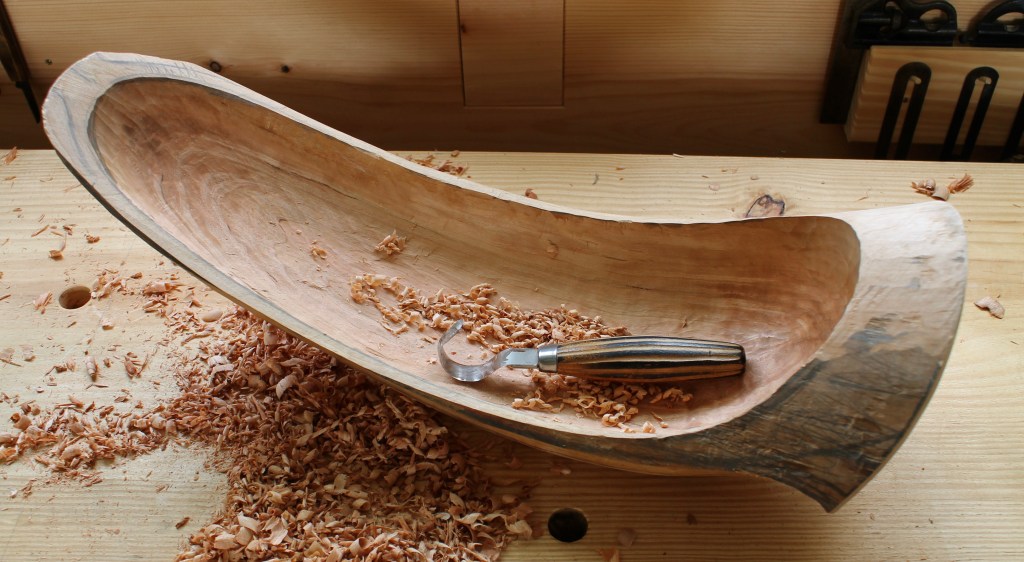
When it came to carving this piece, the figured grain and rapidly-changing fiber direction of this limb was a challenge. I found that the best method for refining the shape of the hollow was using a hook knife, heavily skewed, with many light cuts in quick succession. The wood was thoroughly dry by this stage.
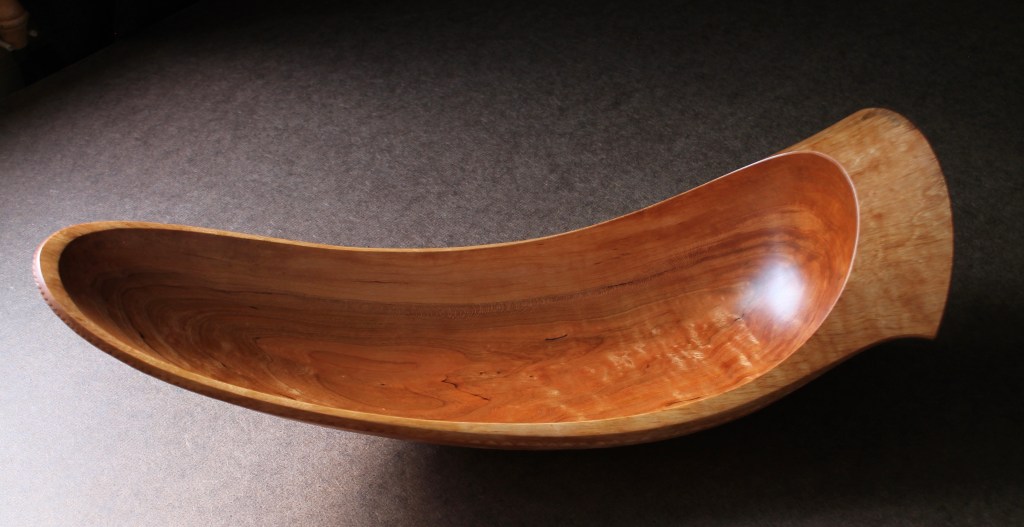
To do justice to the figure in the wood, I decided to smooth the hollow of this one with a card scraper, followed by hand sanding with very fine sandpaper. This contrasts with the dappled texture of the gouge-cut exterior surface. A shape like this can be a challenge to support while working, which brings me to a bag of beans.
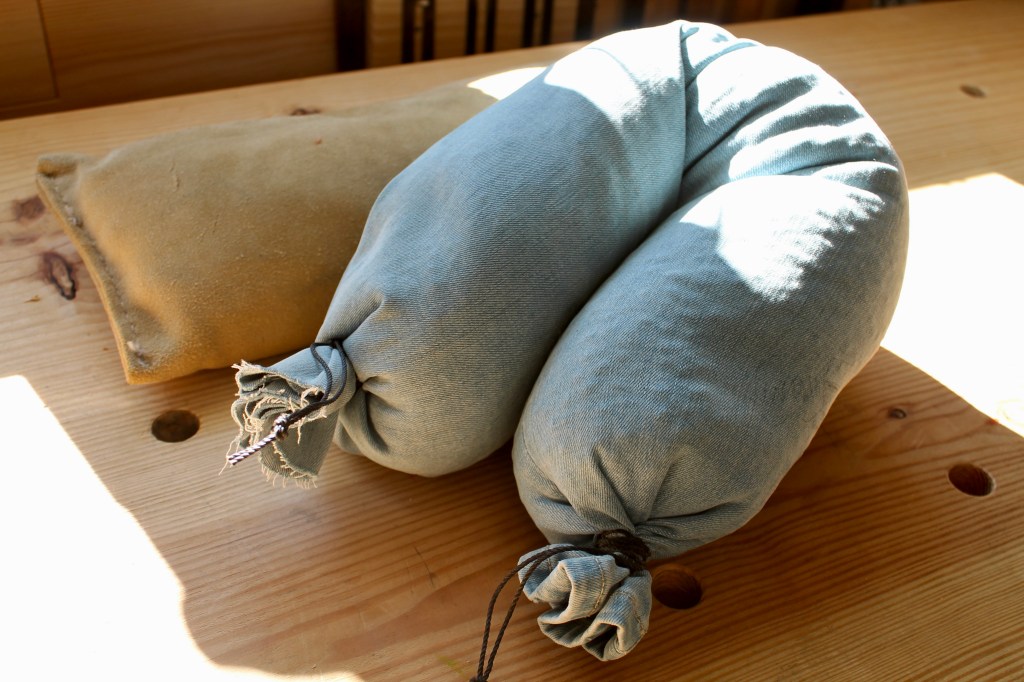
Several years ago, I made a sandbag from heavy suede leather. That’s it in the back in the photo above. It’s very useful for supporting odd shapes, especially. I use it in all sorts of ways. It is a bit of trouble to make, requiring the leather and a good bit of heavy stitching time.
Maybe a year ago, I wanted another one. This time I took a leg off of a pair of jeans and filled it with dried beans. Dried beans are pretty cheap and they won’t make much of a mess if they should break free. I used my son’s old jeans, which turned out to be a good choice. His jeans are skinny and stretchy. Mine are neither. The flexibility of the material allows it to take various configurations, while still holding the beans firmly.
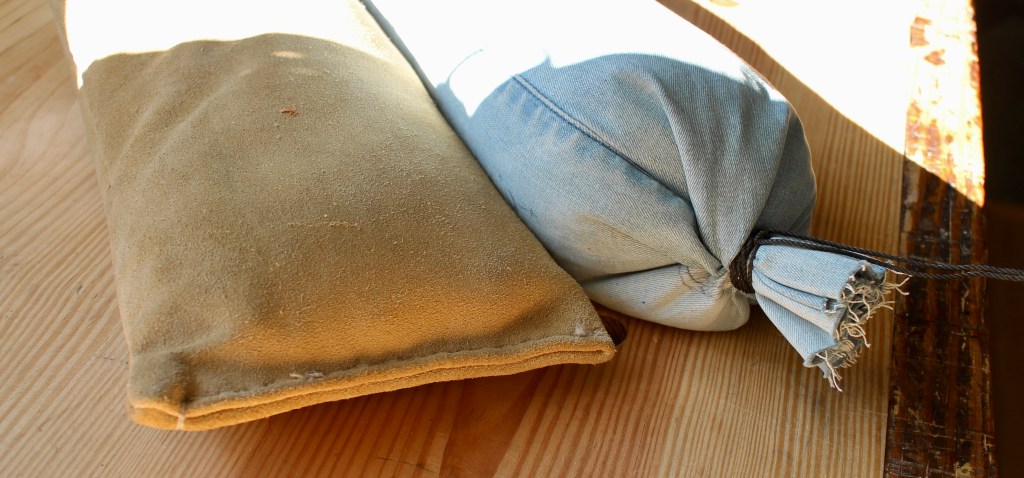
The bean bag took a fraction of the time to make compared to the sandbag. Mainly because there was no stitching involved. I just wrapped and tied one end tightly with strong cord, poured in the beans, then secured the other end with cord the same way. I’ve heard that some folks have also used rice with good results.
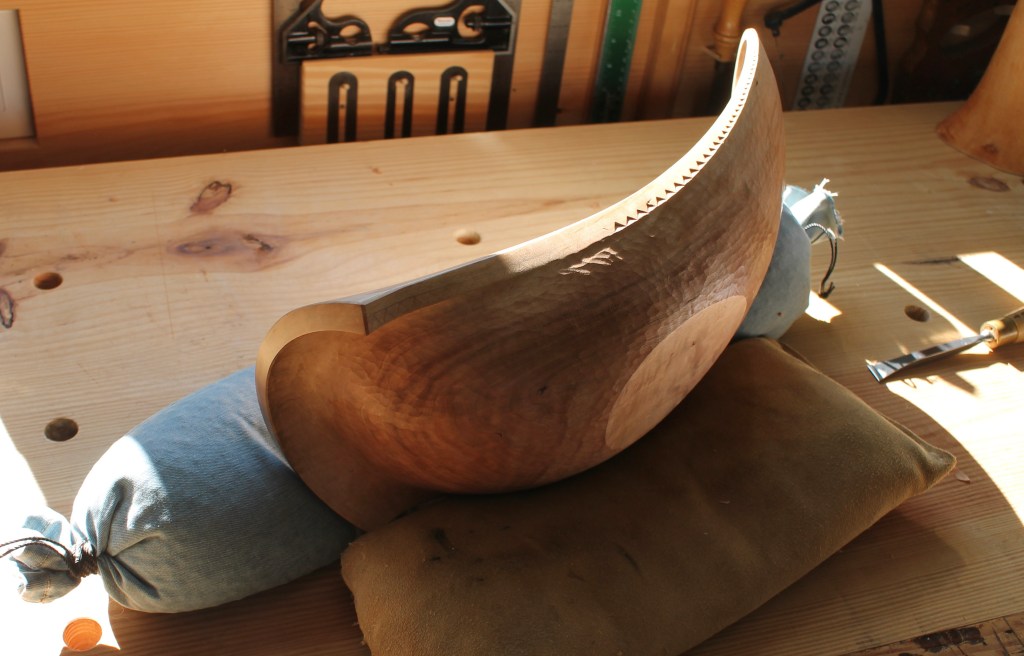
I used the bags to support this bowl for the chip carving, but there are all sorts of other uses combined with holdfasts, etc. I missed some photo opportunities with this one.

I don’t always carve a design on the foot, but this one seemed to call for it.
I’ll share the other pieces that will be heading to the exhibition over the next couple months. I have to finish some of them first! All of the pieces I submit will be for sale during the exhibition.
 David Fisher, Carving Explorations
another beauty
LikeLiked by 1 person
Always stunning!
LikeLiked by 1 person
If/when this bowl is for sale please let me know, it is unique and beautiful. Just like the trees that grow in the woods.
LikeLiked by 1 person
Thanks for your interest, Anne. This bowl will be for sale through the exhibition. When I find out how Wayne Art Center handles sales at the exhibition, including possible remote sales, I’ll provide more information in an upcoming blog post.
LikeLike
Dave, it looks beautiful! The asymmetric shape does give a hint to its windy origin. The carving along the sides really add to this piece.
LikeLiked by 1 person
Dave,
As always, amazing! The 1st and 2nd photos seem to be a ship on the high, rolling seas.
I am looking forward to how you are going to construct your “cantilevered” carving plank for lettering. Or maybe you have a better design.
I zipped to the Big Box’s to try and find the basswood shims-SYP rules supreme down here-SE GA. Thanks for the idea, will keep looking.
Speaking of drawknives, I was looking for one like your long red handled one to be able to work on wide boards.
I finally decided to try Lee Valley #64K1310, so far I really am impressed! The bottom is not flat so it will not need to be ground. Great balance for such a long knife, very easy to see where the blade is.
Thank you!
Pete Magoon
LikeLike
Thanks, Pete. I like your thought of the ship, and I guess it goes right along with the effect of the wind!
I brought my “carving plank” to the new shop. I just plan on extending it out from the end vise just like in the old shop.
Southern Yellow Pine! A far cry from basswood. I hope they change the labels to not read “resists splitting.”
Thanks for the feedback on the drawknife. I haven’t tried that one, but it does look promising. My only concern is that there are nuts securing the blade to the handle. I hook my index finger over most of the time and that would be rough. Is that the situation? I can’t tell for sure from the photo at their site.
LikeLike
Dave,
The drawknife “nuts” actually resemble two piece rivets, with a round head instead of a flat one.
These rivets have flats underneath, which fasten down onto a convex washer (picture an upside down s. steel bowl) that provides a lot of holding power for the round knobs.
Looking carefully I think I can see small dings on the heads, telling me they are hand assembled , as copper rivets are. All of the rivets and washers are countersunk, and there is no irritation whatsoever to my pinkies. The round knobs seem easier to grasp, and easier to turn the knife than traditional handles.
As a newbie to all of this fun, I do not have any preconceived ideas about drawknives.
I inherited a Greenlee knife from my Dad, and I am learning faster using the LV one.
Thanks again!
Pete Magoon
LikeLike
Thanks for sharing those details, Pete. Very helpful. Maybe I’ll pick one up sometime.
LikeLike
Another Outstanding Piece – Very Nice Indeed
LikeLiked by 1 person
David,
<
div>You are a constant source of inspiration. Congratulations
LikeLiked by 1 person
Dave, it’s always a pleasure to read your posts and enjoy the beauty of your work. The tips on the leather and jeans supports are especially useful.
LikeLiked by 2 people
At last!
A practical use for diabolical stretch denim!
…….and another excellent bowl. Great work.
LikeLiked by 1 person
Beautiful piece and lovely writing to go with it. Will try to make it up from Virginia to see the exhibition. Made the “pilgrimage “ years ago to New Hope to the Nakashima compound. You remain an inspiration. Thanks. Steve
LikeLiked by 1 person
I’d love to see Nakashima’s land and buildings as well as Wharton Esherick’s studio. Terrible that I’ve never been to that corner of Pennsylvania at all. It’s possible that you’re closer to it in Virginia. I hope you make it to the exhibition. It should really be something.
LikeLike
Cool bowl. Looks like half of 2 bowls I’ve carved, but magically joined together 😀 I like the decorations on the base, I did something similar, inspired by you: a willow tree and small bird on a bowl I made for a friend of my son. Happily surprised by the result; mainly used a V-tool.
Thanks for the very helpful info on making and using a bean bag 🙂
LikeLiked by 1 person
BTW I’ve carved at least 3 “ship-like” bowls of different sizes and depths but none like this one! Nice work, as always, Dave 🙂
LikeLiked by 1 person
Lovely work and descriptions of the process (thought and tool) as always. I really like the carving on the foot—looks like the tree is in a storm of grain. And congrats on the well deserved recognition—Nakashima and Esherick are pretty nice company! 😳 😎
LikeLiked by 1 person
Pingback: Barefoot Shrink Pot | David Fisher, Carving Explorations
Pingback: Spoon of Indecision | David Fisher, Carving Explorations
Pingback: Bowl Redesign | David Fisher, Carving Explorations