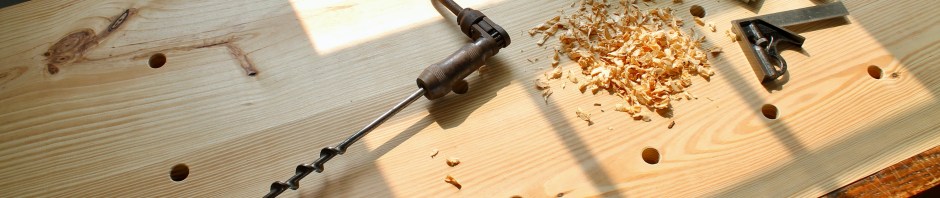

I like holes in my benchtop. I use them for holdfasts, bench dogs, pegs of one sort or another, and for securing a carving vise. I’ve written many posts over the years that show me using these techniques in one way or another. Anyway, with my workbench built, it was time to bore some 3/4″ diameter holes in my pristine benchtop.

I found a full set of these long (17″) auger bits at a flea market years ago. I certainly don’t need them to drill through a 3″ thick benchtop, but they do make it convenient for a long reference to a square. I marked the locations of the dog holes on masking tape, propped up a couple squares, and bored each hole. Hearing the crunch of the cutter and watching those chips rise to the surface is one of the simple pleasures of woodworking that I never tire of.
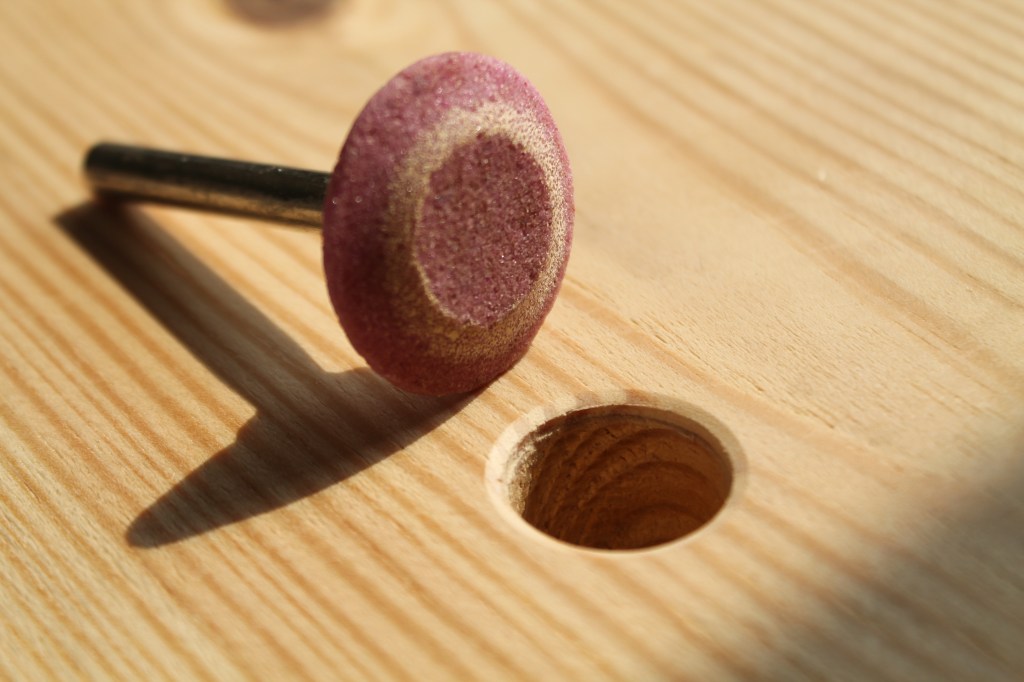
I had one of these little grindstones for a drill in a box of sharpening stuff. It worked surprisingly well to make a clean small chamfer at the top edge of each hole.

Based on my experience with my old bench, I arranged the dog holes in the pattern you can see above. The closest row is lined up with the center of the end vise (more on that later), so 5 1/2″ in from the front of the bench. The holes are 6″ apart side-to-side. The rear two rows of holes are 12″ side-to-side, and 6″ apart front-to-back. Given the reach of my holdfasts and vise range, I find that this arrangement allows me to adjust to any circumstance. Note that there are some slight departures from the pattern to avoid framing or whatever.

Now, onto those vise jaws. When I first built my old bench, I bought a 7″ Record quick-release bench vise and installed it on the right end of the bench to clamp stuff between the jaws and also act as an end vise to clamp things between dogs on the bench. Later, I added a wooden jaw that extended a foot or so beyond the right edge of the vise, so that I could clamp things in it free of the guide bars of the vise itself. In theory, there should be all sorts of potential racking issues and such, but in reality it worked out fine for my needs. So I wanted to do that same sort of thing with the new bench, so I decided to make new jaws that would be fit to the new benchtop.
I had this wide quarter-sawn piece of white oak, a cast off from a local sawmill that had been air drying in my shed for a couple years. It was just long enough for the job.
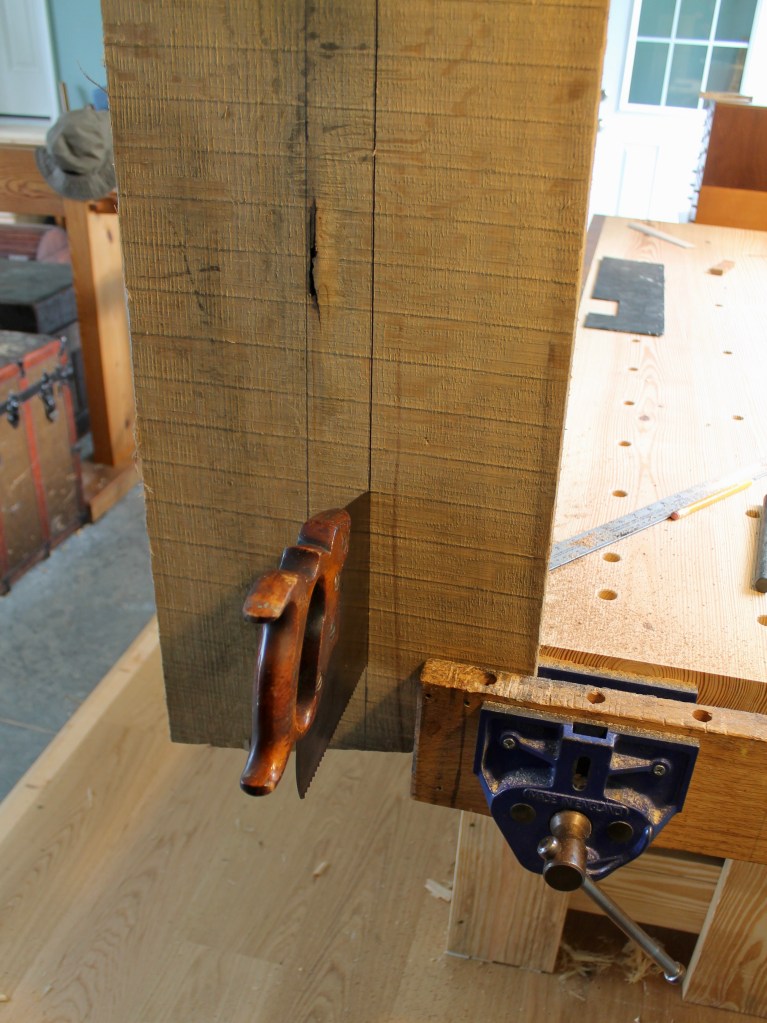
I clamped it in the incomplete vise and ripped two boards from it, cutting away the middle portion that had a big gash from something.

The vise is mounted to the benchtop from beneath with four 3/8″ diameter lag bolts. Rather than mortise the metal face into the bench top, I morticed the white oak jaw that would also cap the end of the bench completely.
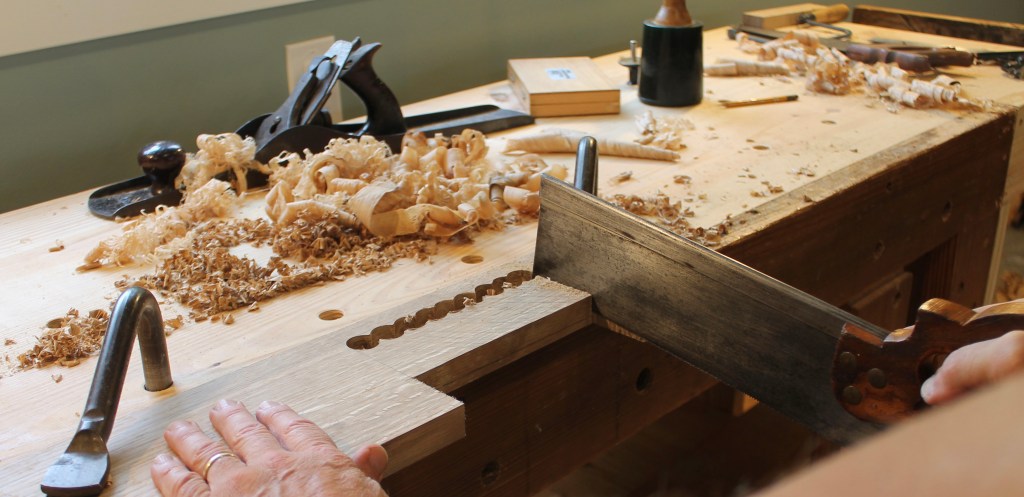
After planing the jaw stock to thickness, I bored a series of holes to depth at the top of the mortise. This provided a little room for the end of the saw as I cut a series of kerfs down to the depth of the mortise.

I knocked out the chunks between with a mallet and chisel.

Then cleaned up with paring cuts and test fitting. I also chiseled the peaks away at the top left by the original boring.

I secured that jaw to the end of the bench with screws, elongating the holes on the right side to allow for movement of the top. Fitting the front jaw was much more simple. I added the rib to stiffen the extended jaw.

I left the top of both jaws proud then planed them down even with the benchtop. I’m all ready to make some wall-hung shelves for books and more, so I’ll have some shots of the bench in action soon.
 David Fisher, Carving Explorations
“ Hole lotta drilling going on”. Better one too many, than too few.
Cheers.
LikeLike
It’s turning out terrific Dave! Congratulations!
LikeLiked by 1 person
Nice!
LikeLiked by 1 person
nice to see the progress, fun to follow.
LikeLiked by 1 person
Dave,
The members of the WoodClub, where I work, would tell me: There are power tools which will drill those holes easier. They just don’t get the allure of hand tools.
Nice bench top.
<
div>Bob Simmons
Sent from my iPad
<
div dir=”ltr”>
<
blockquote type=”cite”>
LikeLiked by 1 person
Using the grindstone to put a chamfer on the holes is a great idea! Thanks for sharing.
LikeLiked by 1 person
Boring!
🙂
LikeLiked by 1 person
I’m replacing the top on my current bench (oak solid core door now) I like the design of your end vise and the stiffener, I could see a couple holes in it to hold a chisel or two, nice work David.
LikeLike
Good luck with the bench top replacement, John.
LikeLike
Cool. Out of curiosity, did you need to touch up/resharpen the bit with this many holes? It’s soft wood so I’m guessing that works in your favor.
LikeLike
No touch up required, Joe. The southern yellow pine is significantly harder than white pine or spruce, but it’s still not white oak.
LikeLike
The sound when boring holes with a brace and auger bit is pure joy! And clever way to chamfer the holes! I’m currently building a new workbench, so I’ll remember that. Although I’ll probably make a chamfer bit for my drill using a dowel and some sandpaper.
LikeLiked by 1 person