
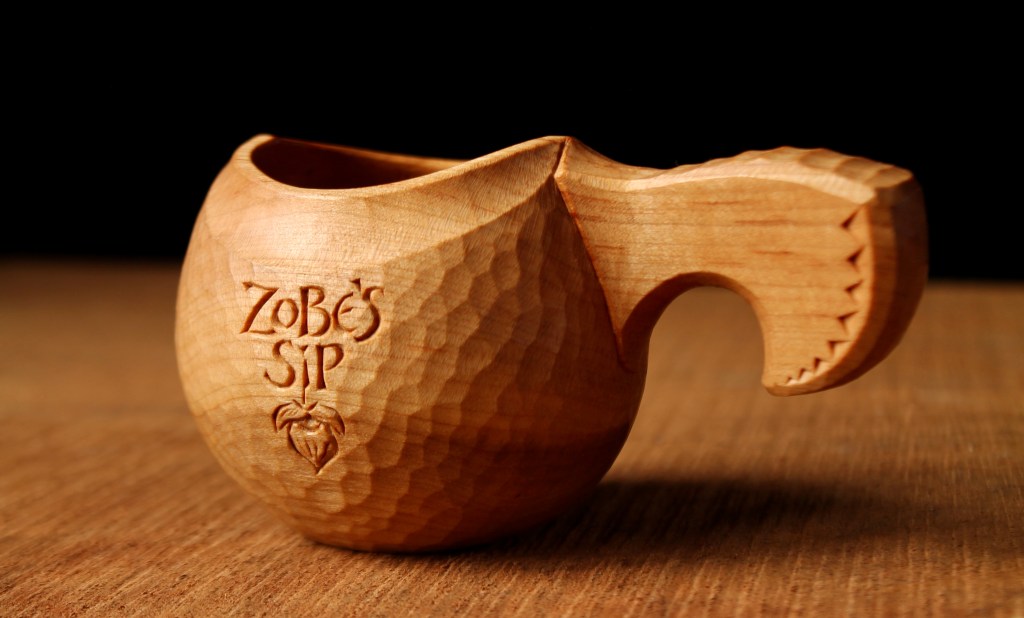
I just finished this little cherry whiskey cup (or kuksa or whatever you want to call it) requested by a friend. It holds about four ounces, more than enough to toast the new year. After making some big bowls recently, it was nice to just sit down and carve something this size. I was having so much fun, I didn’t interrupt myself to take any progress photos.
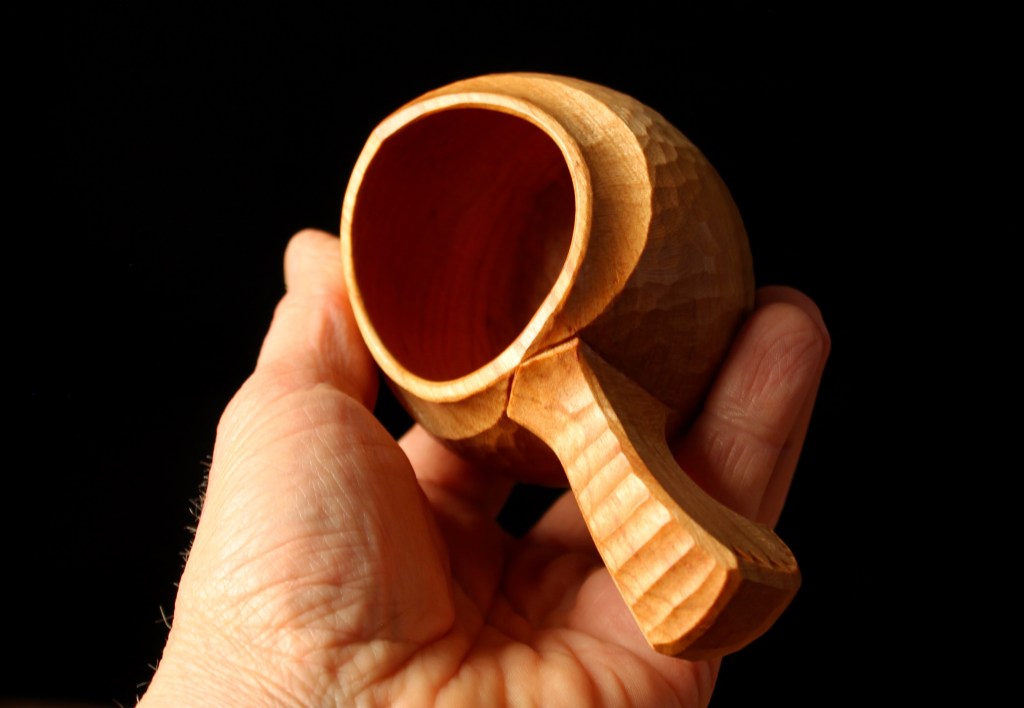
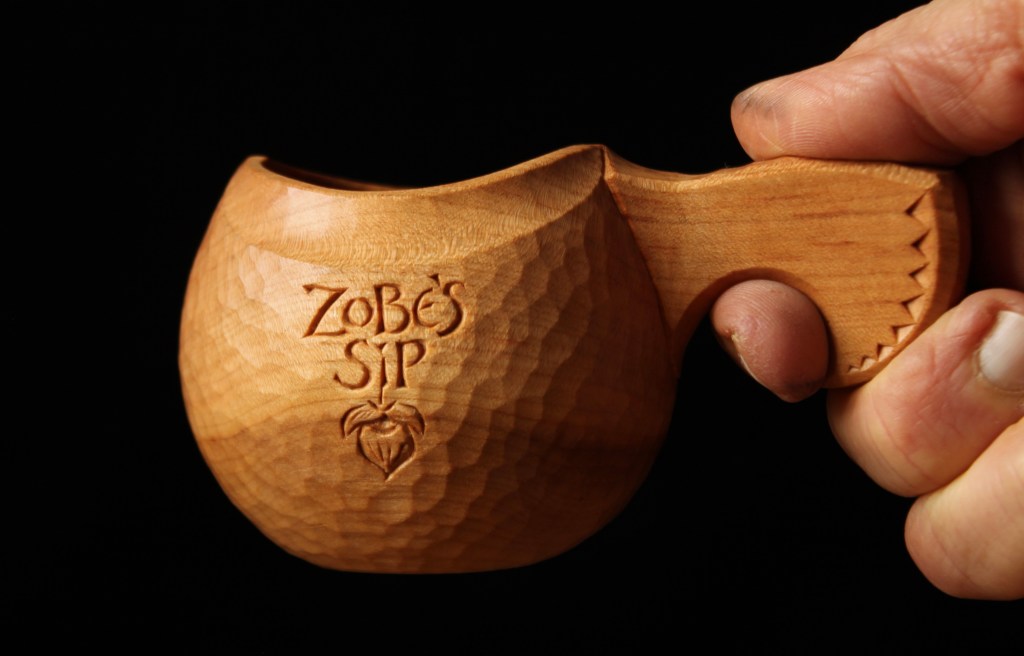
But I did take some shots when it was all done. They’re in the slideshow below with different angles in case you’d like to carve your own; a good project for New Year’s Day. This one is 5 1/4″ x 3″ x 3″, but it could be scaled up.



Library of Birmingham, Public domain, via Wikimedia Commons
I’ll end this last post of 2024 with an image of a wonderful Victorian card I stumbled onto. An axe, greenwood, and letter carving! Couldn’t be more appropriate.
Happy New Year! May your troubles be no greater than torn grain and nicked edges.
 David Fisher, Carving Explorations

Best wishes for the New Year, Dave, and thank you for sharing your latest works of art!
LikeLiked by 1 person
Happy New Year, Drew!
LikeLike
Bet the liquid would taste a little better from that cup. Luck and health in the New Year.
LikeLiked by 1 person
I hope so, Ed. Thanks!
LikeLike
Thanks for sharing, Dave! I’m curious how you hollow a cup like that. Forstner bit and then finish with bent gouges? I’ll sometimes hollow things like that on the lathe (and make sure to stay clear of the handle!) and sometimes with a bit, but I’m not entirely happy with either method.
LikeLiked by 1 person
Boring a hole in the center is a good idea, and that’s what I did with this one. It gives a place for the chips to go as you continue with a bent gouge. This post shows how I proceeded with a similarly shaped hollow: https://davidffisher.com/2022/02/28/bowl-from-dry-walnut/
For this little cup I started with the hole in the middle, then a little with a bent gouge to expand out to the inner edge of the rim, then a couple different bent/spoon knives for the rest of the undercut hollow. Definitely needed to use the bent/spoon knives.
LikeLike
A friend bought a little pear-wood cup from me last year, took it back to his camp for a sip of whiskey, but when he poured it in, the cup exploded! Lost both cup and whiskey!
LikeLiked by 1 person
Whoa! That must have been SOME whiskey! Probably lucky he didn’t drink it.
LikeLike
Nicely done David. My next two carving projects are locked in (Bellamy eagle that I started, then Bellamy Knight’s of Columbus clock if I can find a good photo of one). Hopeing then to carve some things in the style that you do. Sincerely, Joe.
LikeLiked by 1 person
Two exciting projects, Joe. Good luck!
LikeLike
Joe, Hi! I would like to know more about the Bellamy Knight’s of Columbus clock. I am a big fan of John Bellamy’s work. If you have anything you can share I would appreciate it very much. Thanks. Patrick Wenzel
LikeLike
If you reach out to me I would be happy to send the MS Word Doc I’ve been creating on this topic. I have a used book en route to me that might actually show an image of the KoC (I’m also a member which is why this carving has fascination for me). It’s been easy to find images of the Masonic clock carvings Bellamy has done as well as some other one. I’ve yet to see the KoC one. The patent image I have that Bellamy applied for the KoC clock face is such a dark scan by US patent office that I can’t see any detail. I’m hoping the book will have an image. If not, I will reach out the Knights National council and see if they have an image. Best way to get ahold of me is on Instagram joeleonetti1 . If you provide your email, I can send you an email with the doc which has links to online I’ve found on Bellamy clocks.
LikeLike
The book came today. No picture of the Knights of Columbus clock on mirror frame; they show just the Mason’s versions. Looks like I am going to have to reach out to the National KoC and see if they have any images. If they don’t, I’m not sure where to go next.
LikeLike
Joe…thanks for the response and info. If you find out anything else please let me know. I’ve seen the Masonic one. That one is dear to me. Nice crossing paths with you.
LikeLike
Hey Dave,
The lettering appears to be on the quartersawn surface of the blank. Correct? Do you find generally that in most species the quartersawn surface yields the best carving? Thanks for taking the time to reply.
Robert
LikeLiked by 1 person
There’s not much practical difference between carving on a quartersawn (radial plane) or flatsawn (tangental plane) surface in terms of working with the tools. In many situations a quartersawn surface may be preferred for decorative carving or lettering because the appearance of the grain is usually more consistent (less distracting/competing) than a bunch of cathedrals and wild grain, depending on the species. Letter carving into end grain is the real difference. I’ve done it, but it’s a whole different ballgame.
LikeLike
Lovely work on the Kuksa Dave. Thanks for sharing. Happy New Year.
Cheers,
Michael
LikeLiked by 1 person
Happy New Year, Mike.
LikeLike
Dave, Another beautiful piece. Best wishes to you and your family for the New Year.
LikeLiked by 1 person
Beautiful as always Dave. Anything different for finish on this one?
Best of the New Year and thanks again for the inspiration!
LikeLiked by 1 person
I used pure tung oil on this one, Rick. Same process. I cured the oil in the kiln at 130 degrees F.
LikeLiked by 1 person
Wow! Nice job, as always!
LikeLiked by 1 person
Another beautiful form and how lovely it must be to sip from. Happy New Year Dave.
LikeLiked by 1 person
Thanks Joe. Happy New Year.
LikeLike