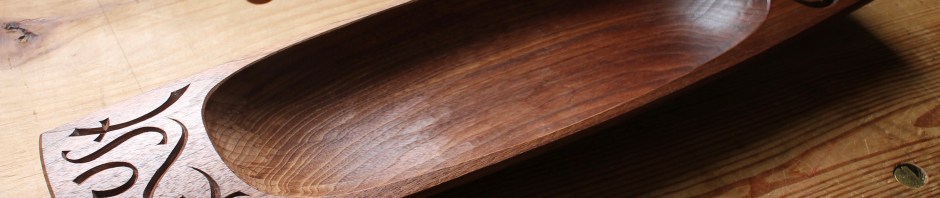
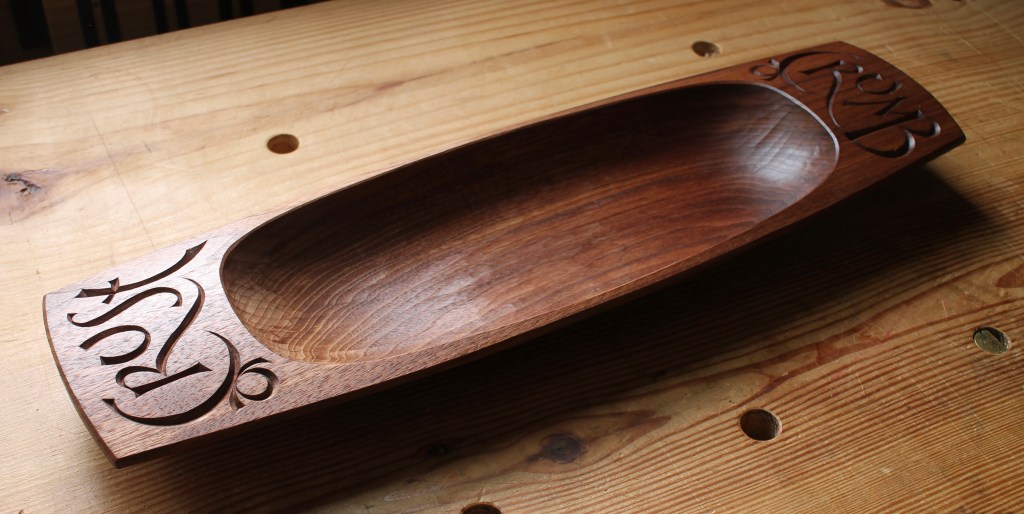
It’s been a week since I’ve returned from teaching an October class at Peter Galbert Workshops. I carved this walnut bowl in July and took it along as an example for the students. I’ve decided to offer it for sale now, since I’ll have one or two new ones before the class in March. That class is full, but it’s a good idea to get on the waiting list if you’re interested. Even if nothing opens up for March, you’ll get first dibs on the next one.
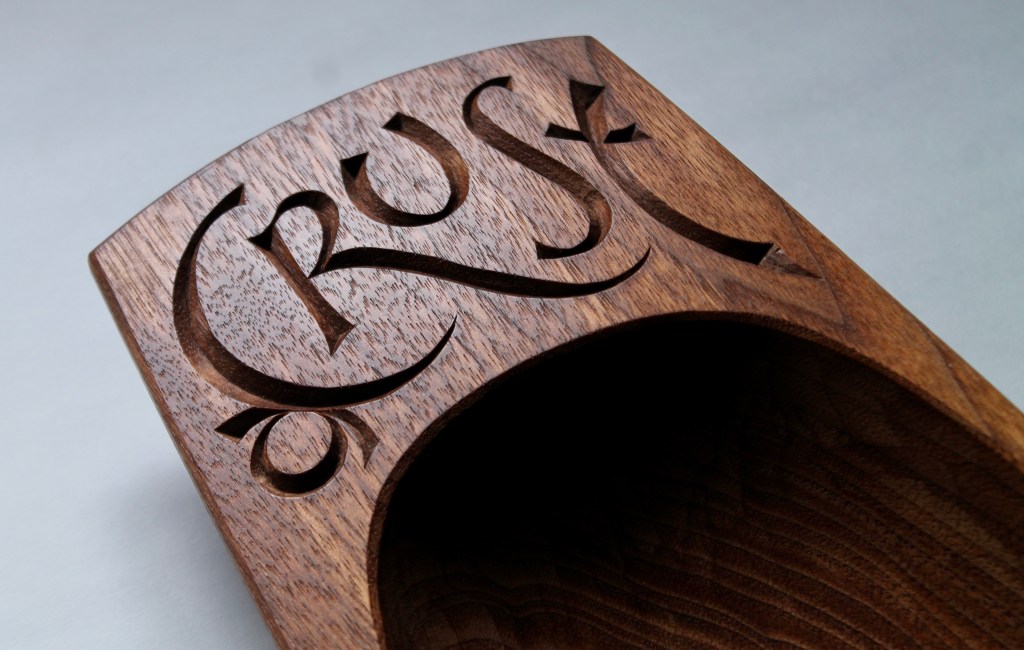
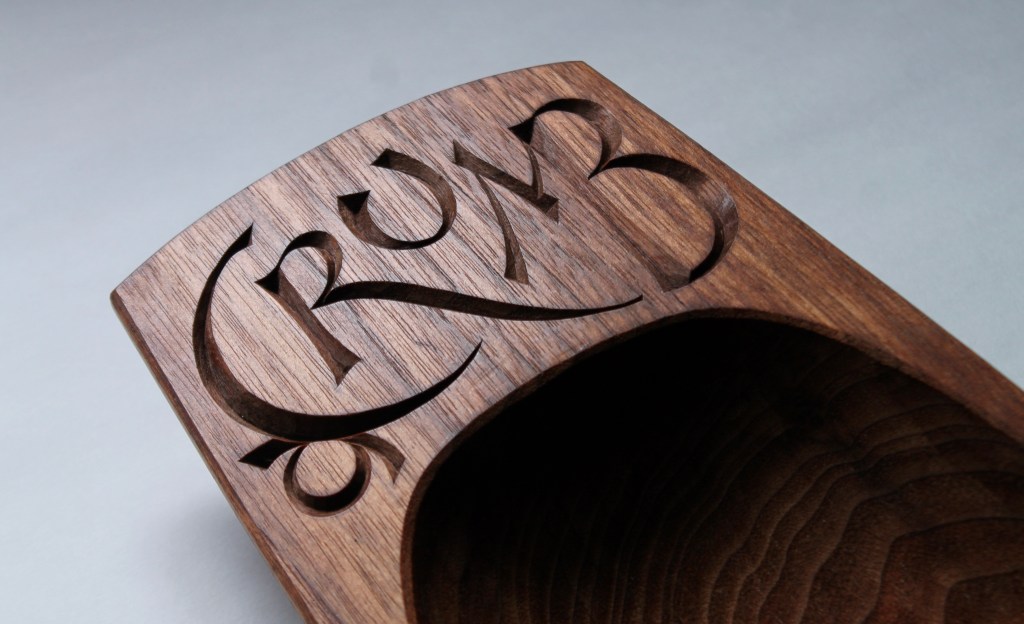
Departing from the tree design I’ve carved on the other Bowls-from-Planks, I carved an excerpt from an Emily Dickinson poem on the handles.
A little bread—a crust—a crumb—
A little trust—a demijohn—
Can keep the soul alive—— Emily Dickinson, from Poem 159 (1896)
I adjust my letter carving technique depending on the size and style of the letters as well as according to the hardness of the wood. In the case of this walnut, I began with a v-tool after transferring my drawing to the wood with graphite paper.
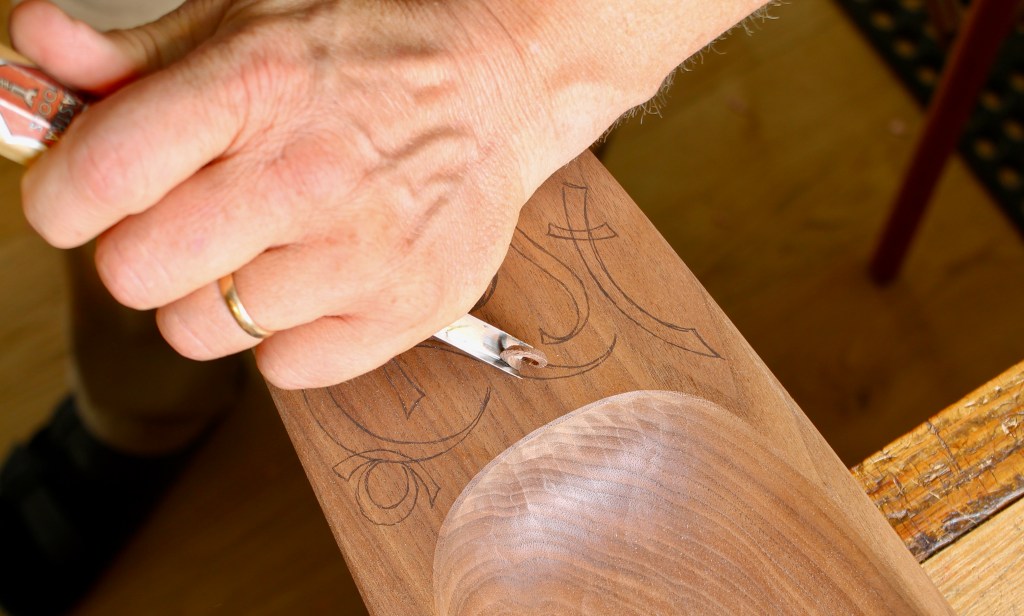
I use a mallet for this v-tool work. The little taps provide controlled bursts that provide a lot of control.

I leave the lines and then some. Every wall and junction will be carved over. This just gets rid of the majority of the waste and goes relatively quickly.

There’s what it looks like after the v-tool work. Ready for the more painstaking knife and gouge stage.

There’s a shot of the foot and underside of the bowl. I carved flutes under the handles of this one, a technique I demonstrate in class that can be used in many other circumstances.
If you’re interested in purchasing this walnut bowl, please email me at dandkfish@gmail.com. It is 21″ long, 6″ wide, and 2″ high. The price of $950 includes shipping. SOLD
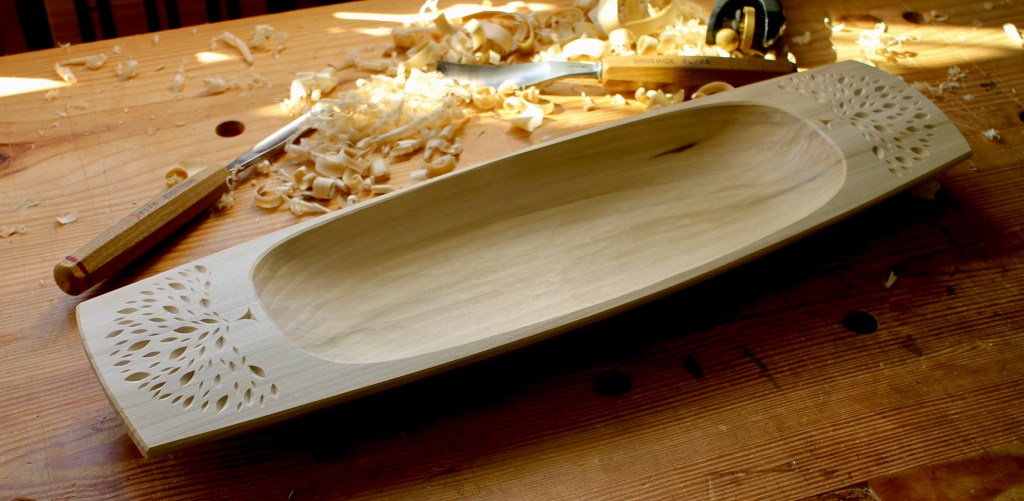
During class, I demonstrated each step on my own blank, but often only on half or a quarter of it. I brought it home with me and finished it up to take with me in March for an example. There it is, above. We used tulip poplar for this class, which is ideal in many ways. Softer than cherry and walnut, but harder than basswood (linden) and butternut, it works easily enough (even as a dry plank) while still holding crisp detail. It makes sense that it was such a traditional choice for bowls.
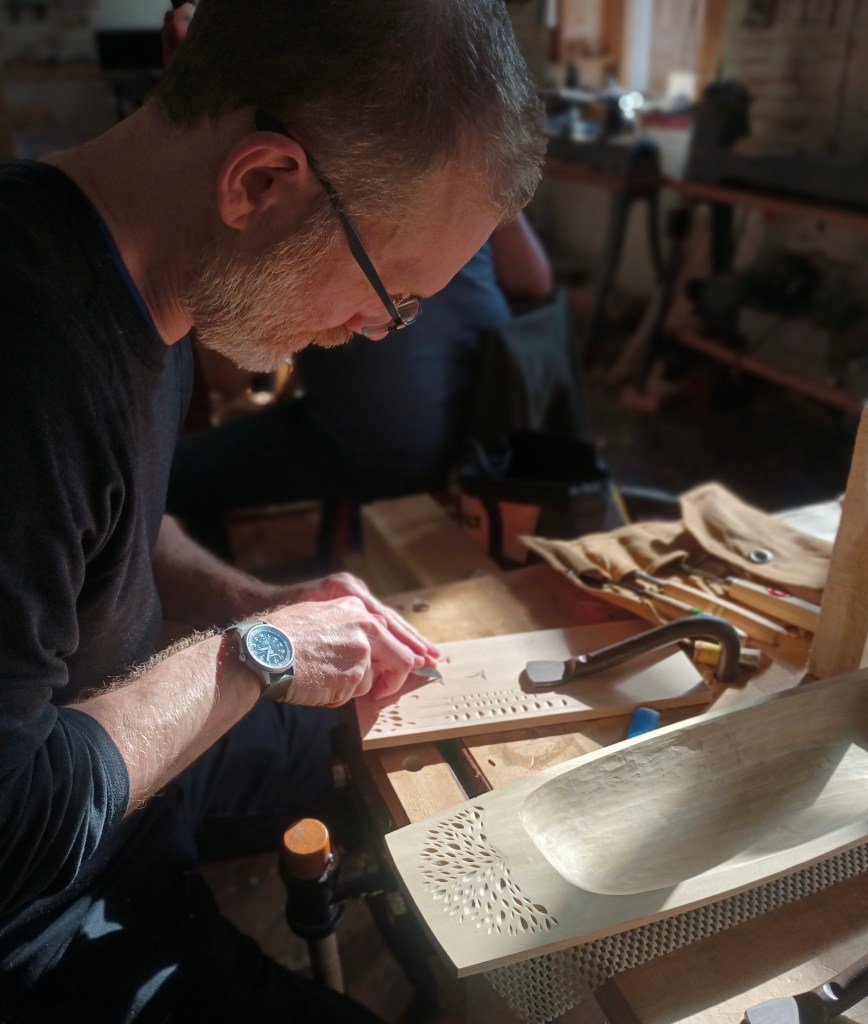
There’s one of the students, Jon, practicing his decorative carving on a sample board with his tulip poplar bowl, almost finished, beside him. Pete’s shop gets wonderful afternoon light coming through the windows. Ideal for carving. It was another wonderful group and we had a great week together.

The pale greenish hue of tulip poplar wood will mellow to a pleasing soft brown with subtle variations in the grain.

The tulip poplar leaves around here are mellowing pretty nicely as well.
 David Fisher, Carving Explorations
Beautiful bowl, as usual! Well done 🙂
(Not sure about the beard though :D)
LikeLiked by 1 person
Thanks! I’ll pass along the beard thoughts to Jon (one of the students in the October class). That’s him in the photo, but there is a slight resemblance. I wasn’t graced with the ability to grow a good beard, so I’ve always been jealous of guys like Jon — and Peter Follansbee, of course.
LikeLike
I would be interested
LikeLike
I’m just catching up here, Bruce. Thank you for your interest, but an email request came in before your comment. I’ll keep carving!
LikeLike
And I love a craftsman who quotes Emily Dickinson–
LikeLiked by 1 person
David, another beautiful walnut bowl! I really like the lettering and other embelishments you add to your works, plus the teaching points
LikeLiked by 1 person
Hi Dave
Would that we all mellow peacefully allowing our subtle variations in grain and spots to shine nicely.
Your comment on using a mallet serves a good reminder. It seems mallet work is too often viewed as brute work rather than finesse. I hadn’t thought of using a mallet with the v-tool for lettering.
It seems like you classes are a success and well received. Congratulations.
LikeLiked by 1 person
Hi Phil.
Beautifully expressed; yes, indeed.
The classes have worked our well, thanks. Mainly because the students have been patient with me!
LikeLike