

Anybody that wants to get somewhere quickly doesn’t want to ride with me. One of the annoying things I do is pull the car over every half-hour or so to take a 10 minute stroll. This is difficult to do on interstate highways, so I stay off of them when I can. There are all sorts of interesting places on smaller roads. Little cemeteries, shaded and quiet, are good spots.
While I’m meandering around a cemetery, I’m on the lookout for hand-cut stones among the ubiquitous sandblasted granite ones. In other areas, slate is a common material for hand-cut stones. It holds up very well, with crisp edges and fine lines after centuries. It’s the best, but I hardly ever see it in cemeteries around here, even among old stones. Around here, most of the hand-cut stones are marble from the 19th century. Sadly, just about all of them look like they have melted due to the effects of acid rain. Many are completely illegible now. So, the hand-cut stones still in good shape were typically cut from some variety of local sandstone. Apparently silicates typically aren’t effected drastically by acid rain.

I found a gem recently while stretching my legs in a cemetery beside a rural road about an hour west of me, in eastern Ohio. The whole lovely cemetery is no larger than a football field. The stone is in memory of Jacob Welsh who, it records, died on April 19th, 1822, age 67.
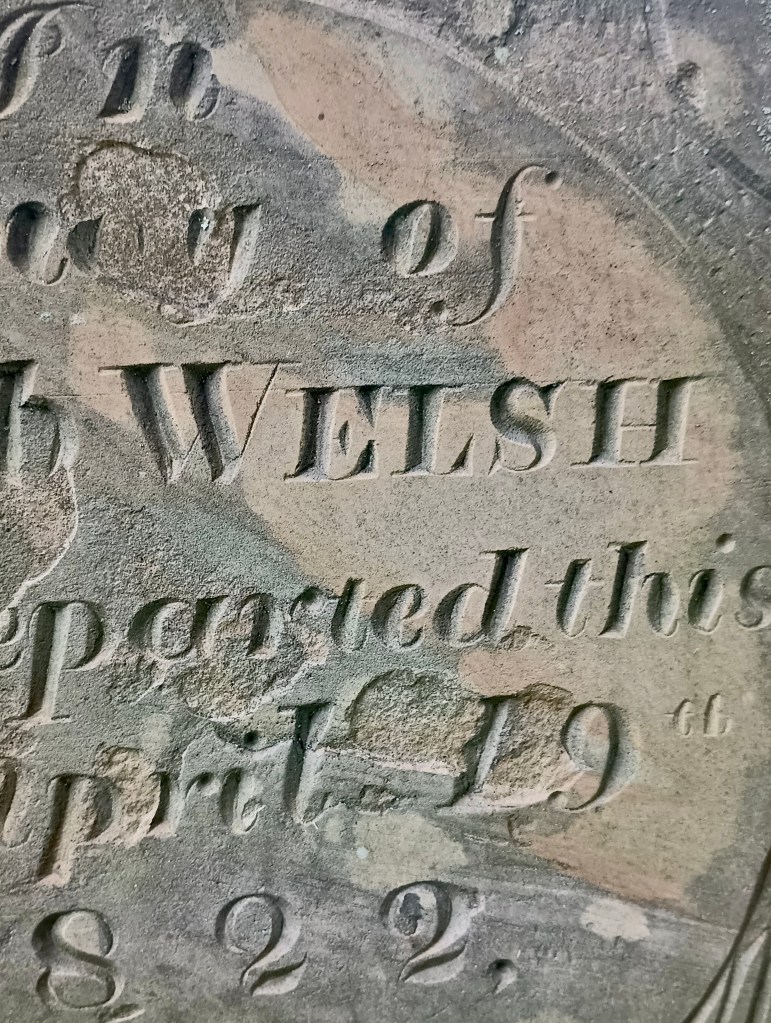
The lettering, clearly influenced by the popular typefaces of the time, was skillfully cut. But in this case it was something other than the lettering that most captivated me.

It was that angel’s head at the top of the stone. “Angel’s Head” stones have a long history. The image is thought to represent the soul of the departed ascending to a heavenly reward. This site features many of them found around Hartford, Connecticut. And this site documents hundreds, going further back, located in the Bale of Belvoir in England.
To my eye, there’s something special about this one. It is so animated and delightful, even with the little frown on the face. I love how the carver has merged the frame surrounding the inscription up and into the angel’s face. It seems that he wanted to say that this angel is indeed intended to represent Jacob Welsh. The carver has used texturing effectively on the background and also added interest to the wings. The curves are lovely, and how about that bouffant?
Whoever the carver was, he created a memorial with personality, meaning, and charm with his or her thoughtfulness and craftsmanship. I don’t know much about the funeral industry, but it seems to me that folks are usually directed toward the standard packages while there are lesser-known alternatives that might be a better fit and may even cost less. The cost of machine cut stones is so high that it may well be possible to get a special hand-cut stone in slate or a local sandstone for less. The Lettering Arts Trust in the UK is one organization that is dedicated to helping people navigate that possibility. And their site features gobs of incredible lettering art inspiration.
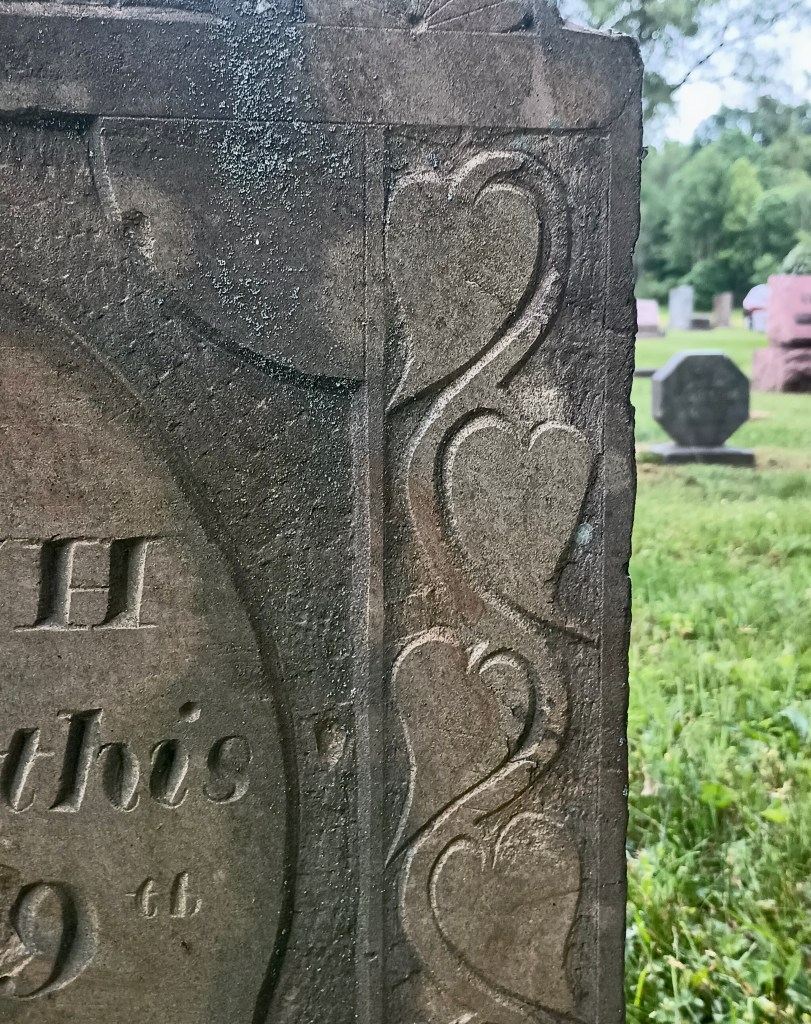
Returning to Jacob’s stone, the vine pattern with heart-shaped leaves is eye-catching. Looks like something that should be on the stiles of one of Peter Follansbee’s chests.

The shoulders of the stone are decorated with these little compass-derived epaulettes.

Here’s a shot of the back of the stone.
As I was writing this post, I decided to see if I could find anything out about Jacob Welsh. Surprisingly, some information popped up after just a few clicks. It turns out Jacob Welsh had a pretty interesting life.
Born in Boston in 1755, he graduated from Harvard at age 19 and fought as an officer in the American Revolutionary War in his early twenties, during which he corresponded with George Washington. He followed this service with some industrial espionage, traveling to Europe and somehow smuggling out a carding and spinning machine and bringing it back to Massachusetts. In 1809, at the age of 54, Jacob left the comforts of Lunenburg, Massachusetts and ventured to what could be considered the Wild West of the time — the eastern Ohio/western Pennsylvania frontier. He donated 50 acres of his newly acquired land (which the government had recently taken from Native Americans through forced treaties and such) to establish “Welshfield”, Ohio. He died there of tuberculosis ten years later, just shy of his 67th birthday.
Yet, none of that is mentioned on his modest hand-cut stone in the little cemetery. It was the hand-carving that drew me in.
 David Fisher, Carving Explorations
I loved this article David! Very interesting and beautiful art work.
LikeLiked by 1 person
Wonderful, David! Thsnk you for this post. I enjoy wandering (and wondering) through old graveyards and cemeteries. Many carvings and letterings, usually on older stones, are beautiful. Such is this one!
LikeLiked by 1 person
That is an interesting blog Dave. Thank you. I have shared it with my wife who is very much into genealogy and old graveyard research.
Cheers, Michael
LikeLiked by 1 person
Beautiful and thoughtful, as always, You may find Graven Images an interesting read: https://www.weslpress.org/9780819560407/graven-images/. Sadly, I think I gave my copy away.
LikeLiked by 1 person
Thanks Todd. Graven Images is a good one.
LikeLike
Sounds like you were on 422. My wife grew up in Troy, OH. Very cool. I’d love to see this in person.
LikeLike
Yep, 422, a mile or two west of the Welshfield Inn, across from Mulligan’s Pub and Driving Range. And I highly recommend a meal at the Welshfield Inn! I have yet to visit Mulligan’s Pub. Maybe next time.
LikeLike
Thank you Dave. This one resonates with me very much, as I always find inspiration on gravestones, especially well designed from the 17- 19 century everywhere in Europe. Off the big roads are the treasures…
Once I came across a “funny” graveyard in Rumania (Sapinta) with very personalised graves and beautiful colourfully carved crosses which tell the story of the deceased.
[43188031-sapanta-rumänien-04-juli-2015-der-fröhliche-friedhof-von-sapanta-maramures-rumänien.jpg]
Have a nice summer! Jens
Sicher versendet mit Proton Mail.
LikeLiked by 1 person
Thank you, Jens! I copied your link into a web browser and was able to see all of your incredible photographs. About 3/4 of the way down, I saw the gravestones. Beautiful!
LikeLike
Oh dear, David the pictures are not mine, I took them from the internet. I have been some 30 years ago in Romania, but I thought the pictures would illustrate my experience. Sorry for that. Jens
Sicher versendet mit Proton Mail.
LikeLike
My fault, Jens! No matter; I enjoyed the photos regardless. But I no longer picture you on a cool motorcycle!
LikeLike
I like the way you travel. My wife and I are also fascinated by graveyards. She is from a Southern family and it is a traditional ritual that one always places flowers at the gravestones of departed loved ones. We recently picnicked at a cemetery with friends to observe the eclipse here in Central Texas. That was definitely different. Thanks, as always.
LikeLiked by 1 person
Hi Dave. Here on Cape Cod we are blessed with so many angel head stones. The ones I’ve seen are all dated from the early and middle 18th century. They are amazing and I become entranced just staring at them. Lucky that a lot of them are still in great shape. Thanks. Peace. Kevin
LikeLiked by 1 person
I think this is one of my favorite posts, Dave. Unlike you, I am, unfortunately, almost always focused on the destination rather than the journey when I’m traveling and so I miss these little hidden treasures along the way that can wind up being a highlight of the journey. Thank you for sharing gems like this post along with your expertise and artistry. I always look forward to what you have to say.
LikeLiked by 1 person
10 years ago I would’ve lost my mind on a road trip with you stopping that frequently. Now I would consider it a nice cruising road trip. Really great post and kudos for going the extra mile looking into him!
LikeLiked by 1 person
Thanks for this. I too am a gravestone enthusiast. Here is a lecture I have a few years ago. https://youtu.be/bUvsl-GAn0A?si=z1LHiYG78ixSG0Ur
LikeLiked by 1 person
Just catching up on this, Jon. Thanks for the link to your talk; I enjoyed it. Really interesting to see the variety of carving, especially the sculptural stones with the workbenches, anvils, tools…. Does the limestone resist the acid rain better than marble?
LikeLike
Hi Dave, there is a preserved historic stone masons in the small Wiltshire village of Great Bedwyn, about an hour west of London by train via Paddington.
https://wessexsociety.com/blog/2021/09/13/wessex-attractions-bedwyn-stone-museum/
I think inside is now one of a small number of village stores. Old headstones have decorated the walls since I was a boy, and probably long before that. I think the surprisingly large nearby church was the site for the re-burial of some local aristocrats, hundreds of years ago, moved from a smaller church several miles away.
LikeLiked by 1 person
BTW Great Bedwyn is a few miles from the site of the now famous “Wolf Hall”, made famous by Hilary Mantel’s Booker Prize-winning book of the same name and the subsequent excellent TV series. Although there is not much left to see there now, just a dairy farmyard and a Georgian manor house.
LikeLiked by 1 person
Also Great Bedwyn about 2 miles or so from Tyler Hardwoods, a supplier of timber for those that need to buy processed wood for furniture, etc.
And, about the same distance in the opposite direction to Savernake forest, the last private forest in England? (And location of some US troops in WW2).
LikeLike
Apparently the stone Mason in Bedwyn is/was had the surname Lloyd (Welsh?), and had been there for 7 generations (about 140 years?). [Saw on an old TV program last week.]
LikeLike
FYI The stone mason’s surname Lloyd shows up 9x in this old 1851 census for Bedwyn: https://www.wiltshire-opc.org.uk/Items/Great%20Bedwyn/Great%20Bedwyn%20-%20Census%201851.pdf
LikeLike
Wonderful writeup! This is one of the many “winged effigy” stones carved by Roswell Hubbard, a Massachusetts-born gravestone carver active in Northeast Ohio during the 1830s. He removed to the southern tier of New York at a young age and then once as an established carver, came west to Ohio, settling in Burton, Geauga County. Out of all the carvers in Northeast Ohio, he was the only one to employ winged effigies on his stones, a clear stylistic holdover from New England (no surprise considering many of the people who settled Northeast Ohio were from New England, mainly Connecticut). Stones of his are predominantly found in Geauga County, but nearby Lake, and to a lesser extent Trumbull and Ashtabula as well. I’ve seen some as far away as Warren County, Pennsylvania, almost 100 miles away! He left the area around 1838 for Kentucky where his son Ambrose lived, but continued to carve, and died 20 years later in 1858.
LikeLiked by 1 person
How satisfying to put a name and a story with this wonderful carving! Thanks for sharing that information along with the “winged effigy” terminology.
LikeLike
Interesting story and a good reminder that masons are carvers too. I do find old cemeteries are great places to wander and occasionally there are interesting stories too. I haven’t bothered to chase many names, maybe I should. As I type this in Geraldine, NZ, 100m from me is a gravestone from the 19C (old for here) that tells the story in rhyme of a man and boy caught in the biggest blizzard to date since settlement. 200m further on is a contemporary (boring) stone memorialising an NZ pilot awarded the USDFC for action in Vietnam United States Distinguished Flying Cross (vietnamwar.govt.nz) Untimely death is a common theme, drowning was once the most common form of death for men in NZ. Place of origin is always interesting on these old stones.
LikeLiked by 1 person