Roughing It

IMG_5333

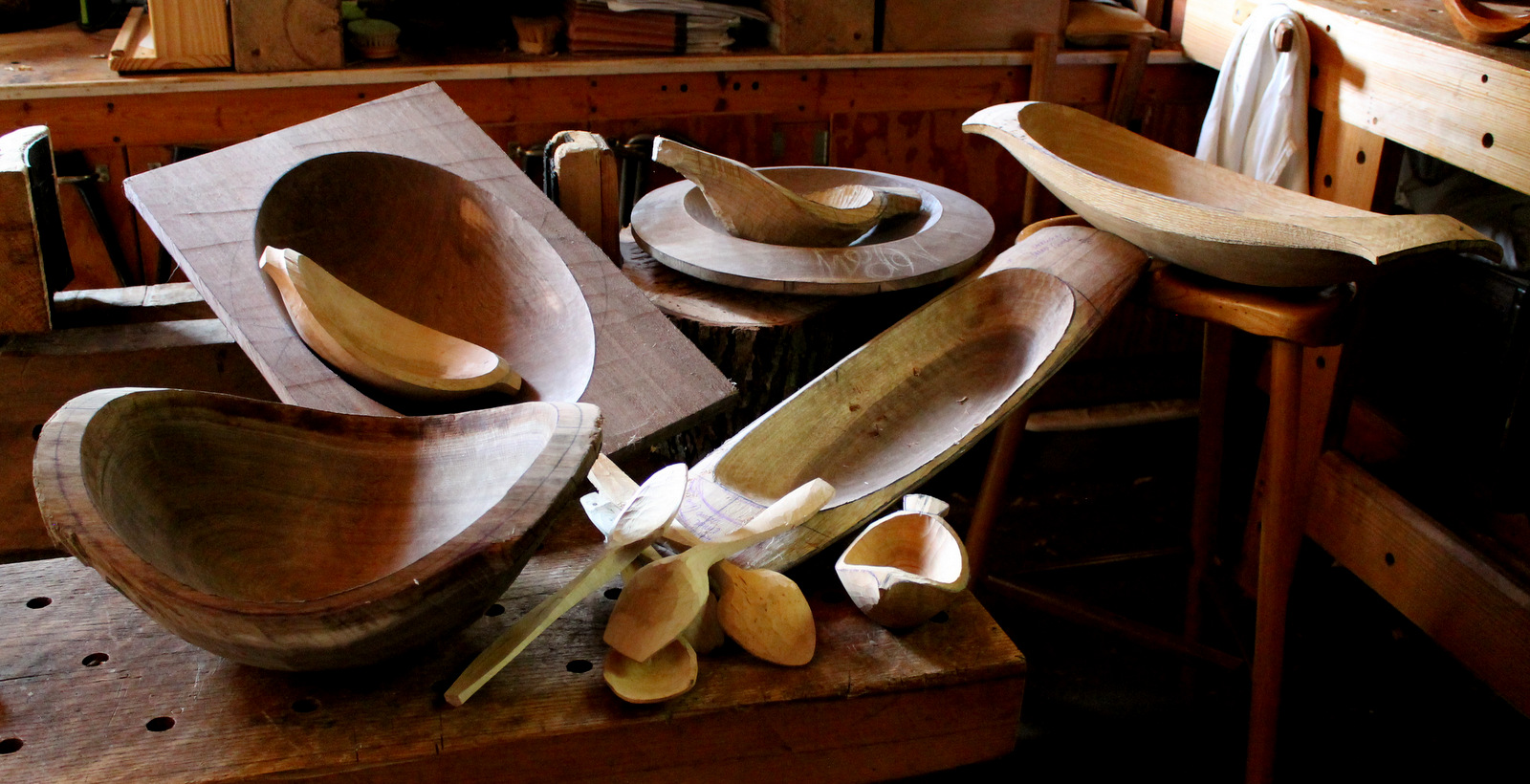
I’ve been roughing out bowls.  Rather than store logs for long periods in the summer heat, I try to do the green carving and let the roughed bowls dry.  Then they can patiently wait for further carving until I get to them, whether it is a month or a year later.

Among the ones in the photo is the white oak bowl that was featured in the videos on layout and hollowing (upper right).  I also planned on a video showing the hewing of the exterior, but I had technical problems that put an end to that idea.  The good news is that I already have two videos on my website that show that process.  Here is one, and here is the other.

I’d much rather carve than mess around with an ipad anyway, and I need to get to it.  As Peter Follansbee shockingly reminded me in his latest post, there will soon be an intrusion on my carving time and other summer projects I’ve postponed.  Time to make hay while the sun shines.

Come fall, those dry bowls will be patiently and pleasantly waiting for me in the evenings.

Posted in bowls, carving, drying, Uncategorized | Tagged , , , | 3 Comments

White Oak Bowl — Hollowing with an Adze

IMG_5297

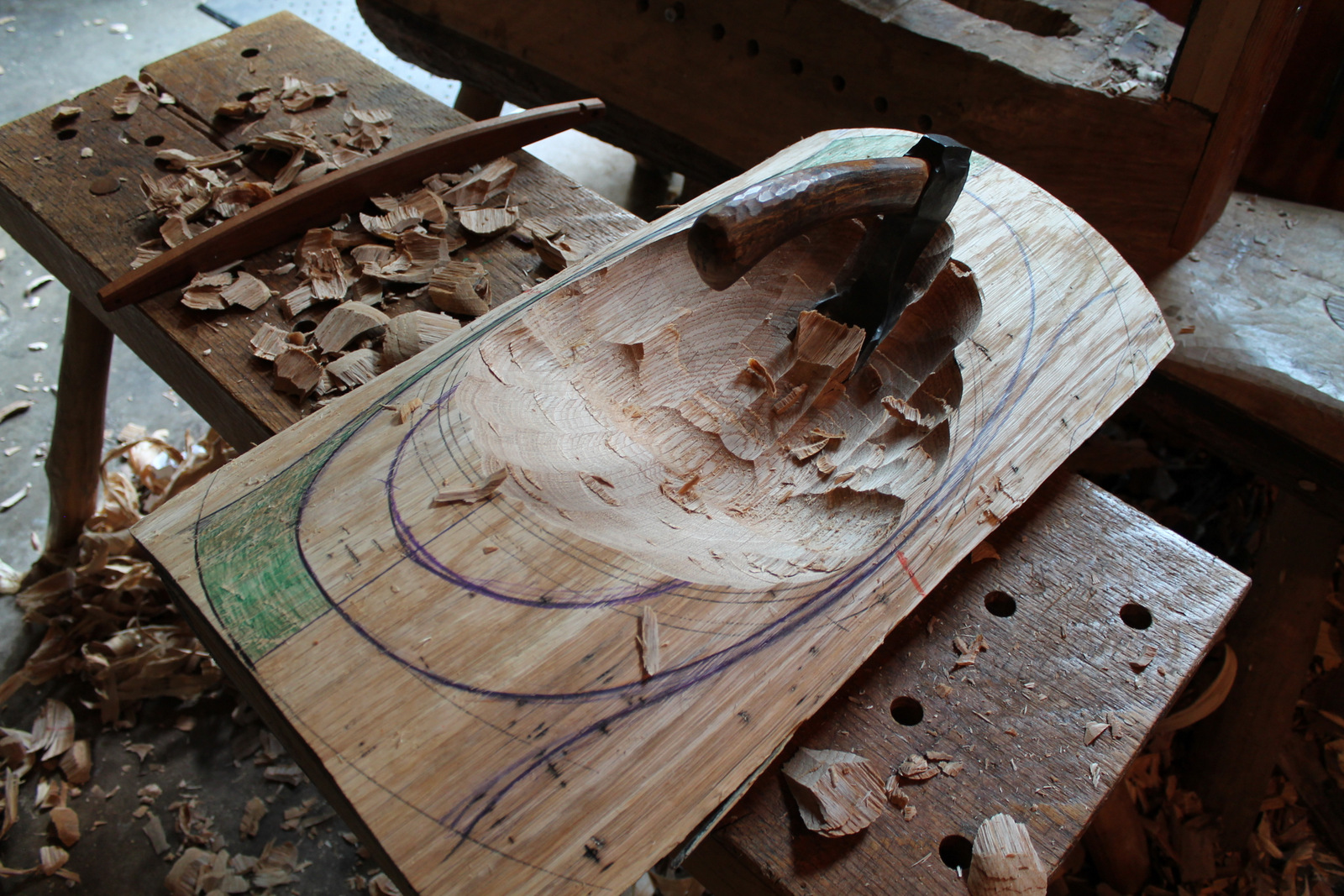
The hollow in-progress

The hollow in-progress

When I have demonstrated at festivals, I have noticed several different types of reactions and comments among observers.  By far, the most common reaction is sincere interest and curiosity that elicits good questions from open minds and enjoyable conversation. However, a few scoff openly with suggestions of chainsaws and routers.  Others view it as an exercise in extreme patience or penance.  These look upon me either in odd wonder as they might view a disciplined monk, or with pity as upon a kind of Sisyphus charged with an endless task. Still others simply think it’s quaint.

They misunderstand.  They look upon the great mass of wood to be removed as the main challenge of carving a bowl.  In reality, the bulk of the material is removed relatively quickly.  I spend much more time on subtle refinements of form and surface, as well as on design.  I probably spend no more than ten percent of my time removing ninety percent of the material, and the other ninety percent of my time on the final ten percent.  The folks that watch long enough, develop an appreciation for what an adze can do.  It ain’t quaint.  It is both powerful and sensitive.  When it comes to hollowing bowls, chainsaws and routers lie awake at night wishing they were adzes.

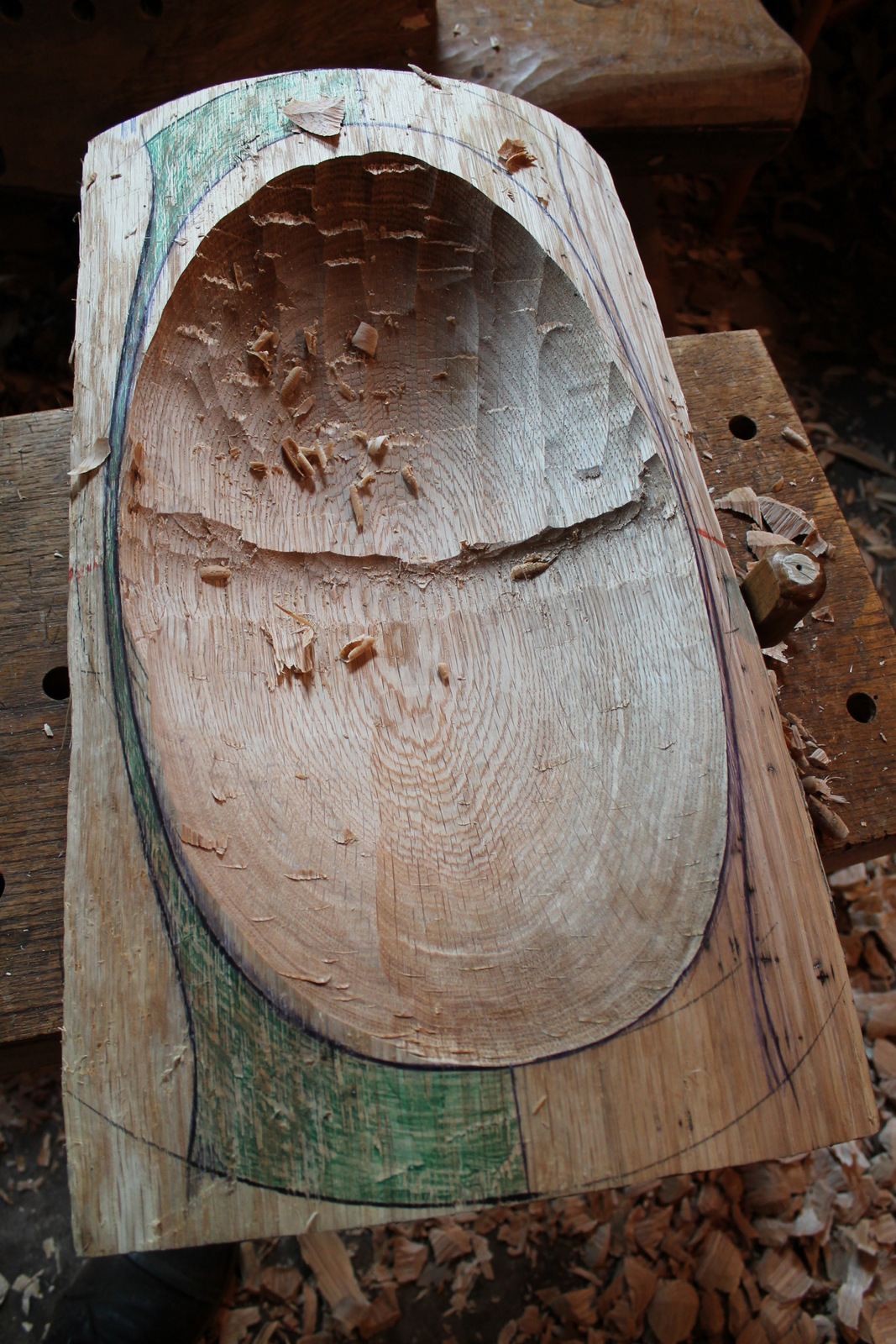
After hollowing with the adze.  I'll refine the surface further with a gouge.

After hollowing with the adze. I’ll refine the surface further with a gouge.

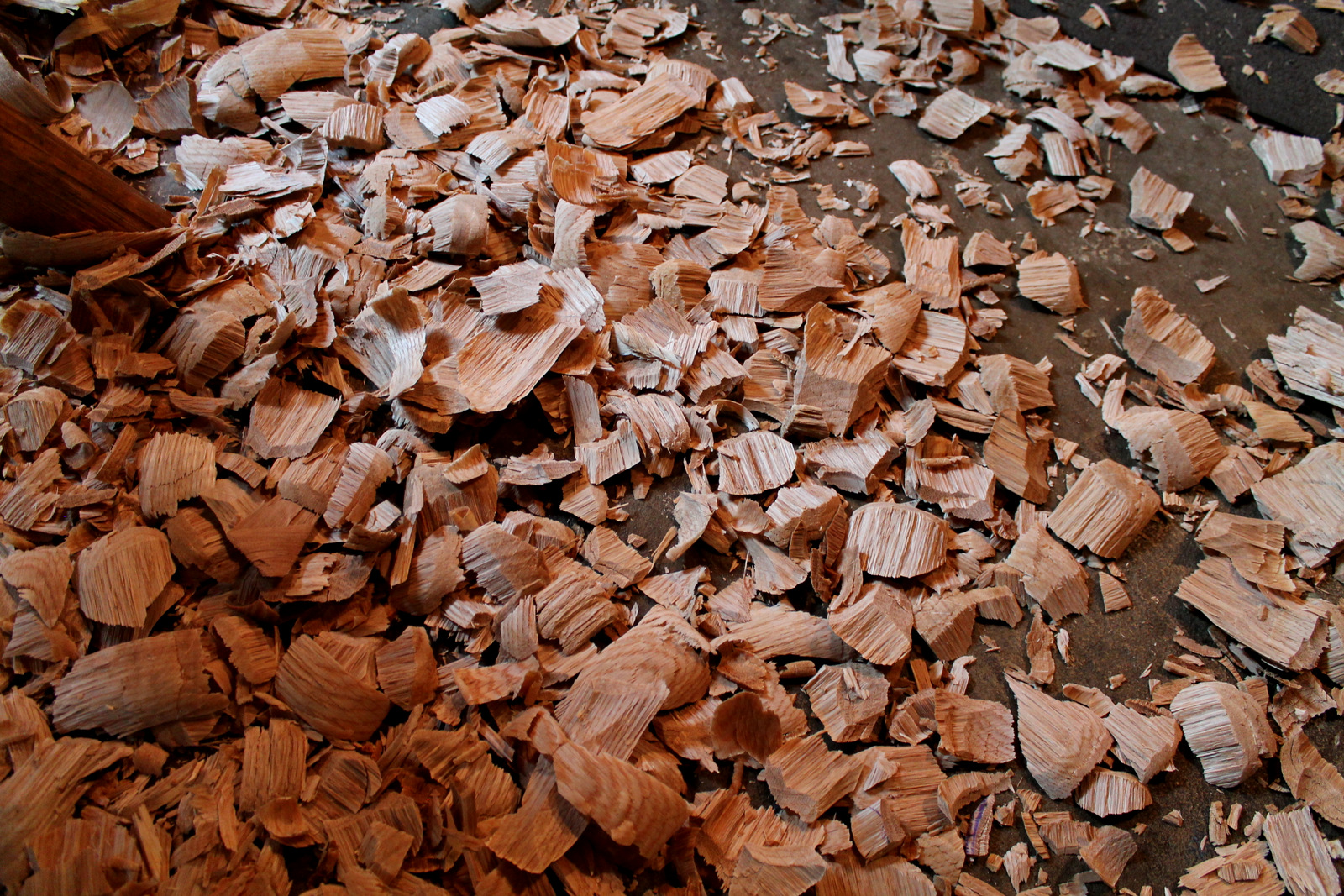
Great cooking chips

Great cooking chips straight from the adze

I shot some video while I hollowed this white 0ak bowl.  Lot’s of talking in this one too, but accompanied by flying chips:


Posted in adze, bowls, carving, holding, Uncategorized | Tagged , , , | 15 Comments

White Oak Bowl — Layout


IMG_5293

This past winter I made a couple rocking chairs from white oak.  An extra bolt from the white oak log had been sitting around since then, and I decided to carve a bowl from it.  I guess I’m a glutton for punishment.

2014 Cherry leaf bowl in progressAfter studying what the piece had to offer, I decided upon an overall form with some side panels that serve as a canvas for some decorative carving.  I’ve done some bowls similar to this before, such as the one, in cherry, to the left.  Depending on the log and/or preference, the form can be altered in many ways.

I also thought it might be a good opportunity to discuss some options for bowl layout. And who doesn’t love to discuss bowl layout?!  Okay, you can put down your hand now.

Granted, there are more exciting aspects to hewing a bowl.  No chips are flying around during layout.  And the best layout can certainly go astray.  But carefully considered aesthetic judgement at the beginning of the process usually pays off in the end.  In other words, there is a lot that goes on between the lines, but good lines are an important start.

Establishing the arc representing the top surface of the bowl

Establishing the arc representing the top surface of the bowl

My first step is to establish the bottom and top surfaces of the future bowl.  In the case of any bowl, the bottom is a flat plane, and the top can be as well.  But on this bowl, the upper surface is an arc, which creates a sweeping rim.  I’ve discussed this at greater length at this previous post.  On this piece, I wanted to remove the sapwood that the bugs had been enjoying.


Layout on the upper surface of the bowl blank

Layout on the upper surface of the bowl blank

I extend the vertical center lines across the top and bottom of the blank, then begin layout on the upper surface.  I rely on a compass or two during this process.  The series of circles represent my playing around with possible widths of the bowl to allow for the depth of the side panels.  Ultimately the two lines surrounding the green area, representing the upper rim of the bowl are all I need before carving.

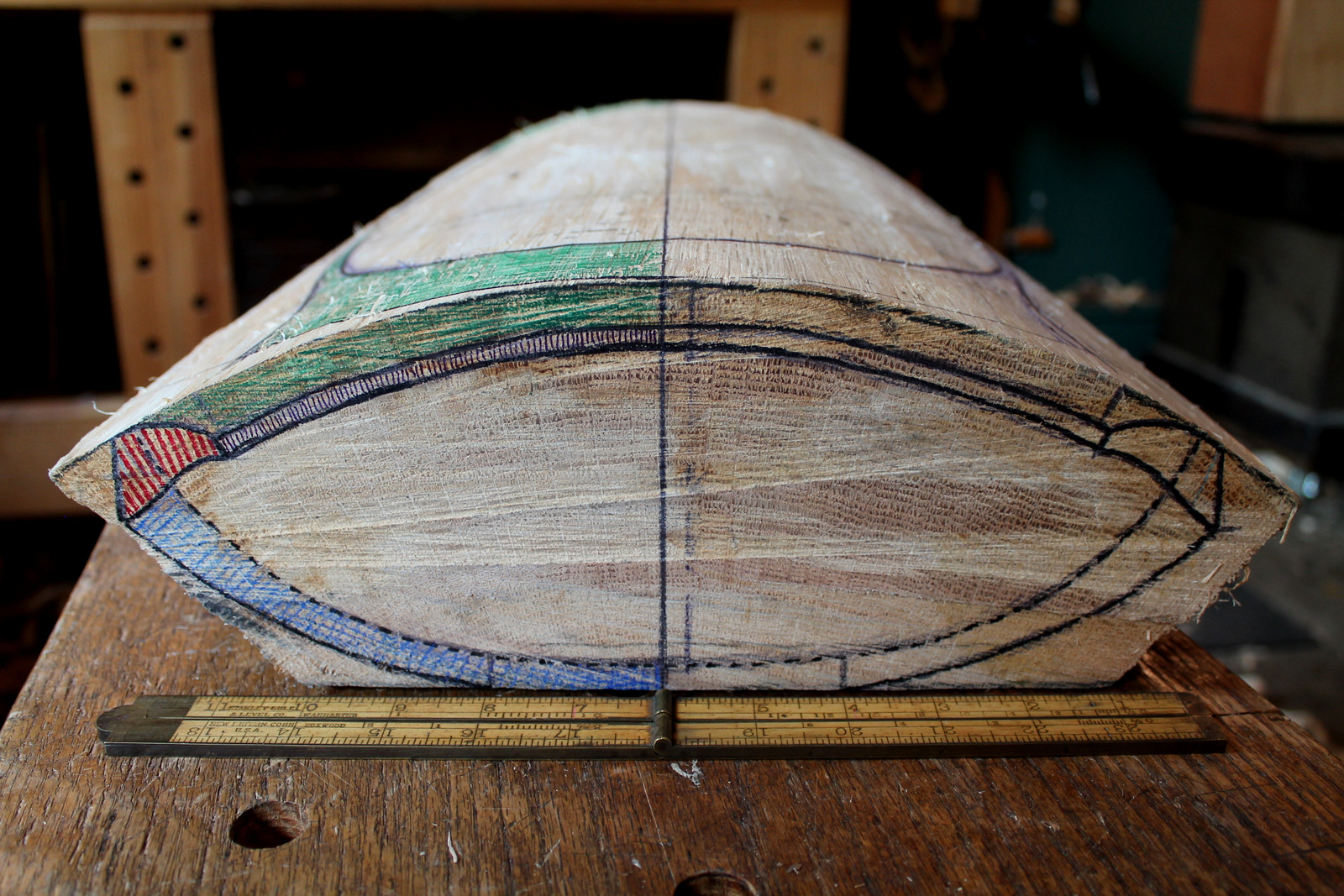
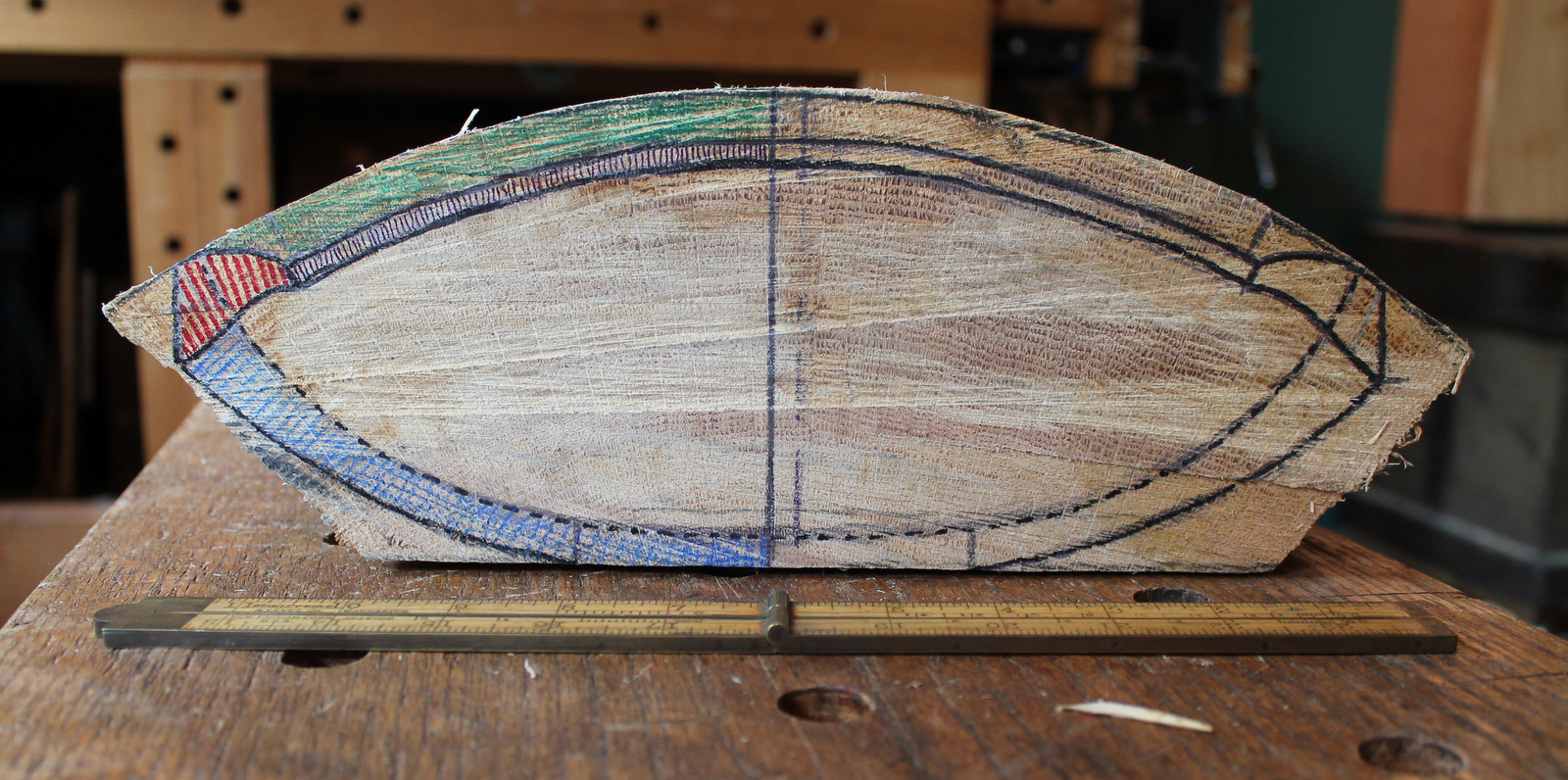
Normally just understood rather than drawn, these lines represent an end-on view of the layout for the bowl.

Normally just understood rather than drawn, these lines represent an end-on view of the layout for the bowl.

However, to help with visualization, I added an illustration on the end grain of this log.  The green area represents the upper surface of the rim and the handles that will drop down to the purple area at the ends.  The blue area represents a cross-section of the bowl at it’s widest point.  The red area represents the side panel surface when viewed from the end.  Due to the shape of this bolt, the vertical depth of these side panels was limited.  Different logs will allow for many other variations.

After the bowl cavity has been hollowed, I will hew the surface of these side panels.  Upon that new surface, I can then draw the bottom edge of the side panels (represented by the lower line) and sculpt the underside of the bowl.


Posted in bowls, layout, proportions, Uncategorized, video | Tagged , , | 10 Comments

Good in Everything

SAM_2235

And this our life, exempt from public haunt,
Finds tongues in trees, books in the running brooks,
Sermons in stones, and good in everything.

— William Shakespeare, “As You Like It”, Act II Scene 1

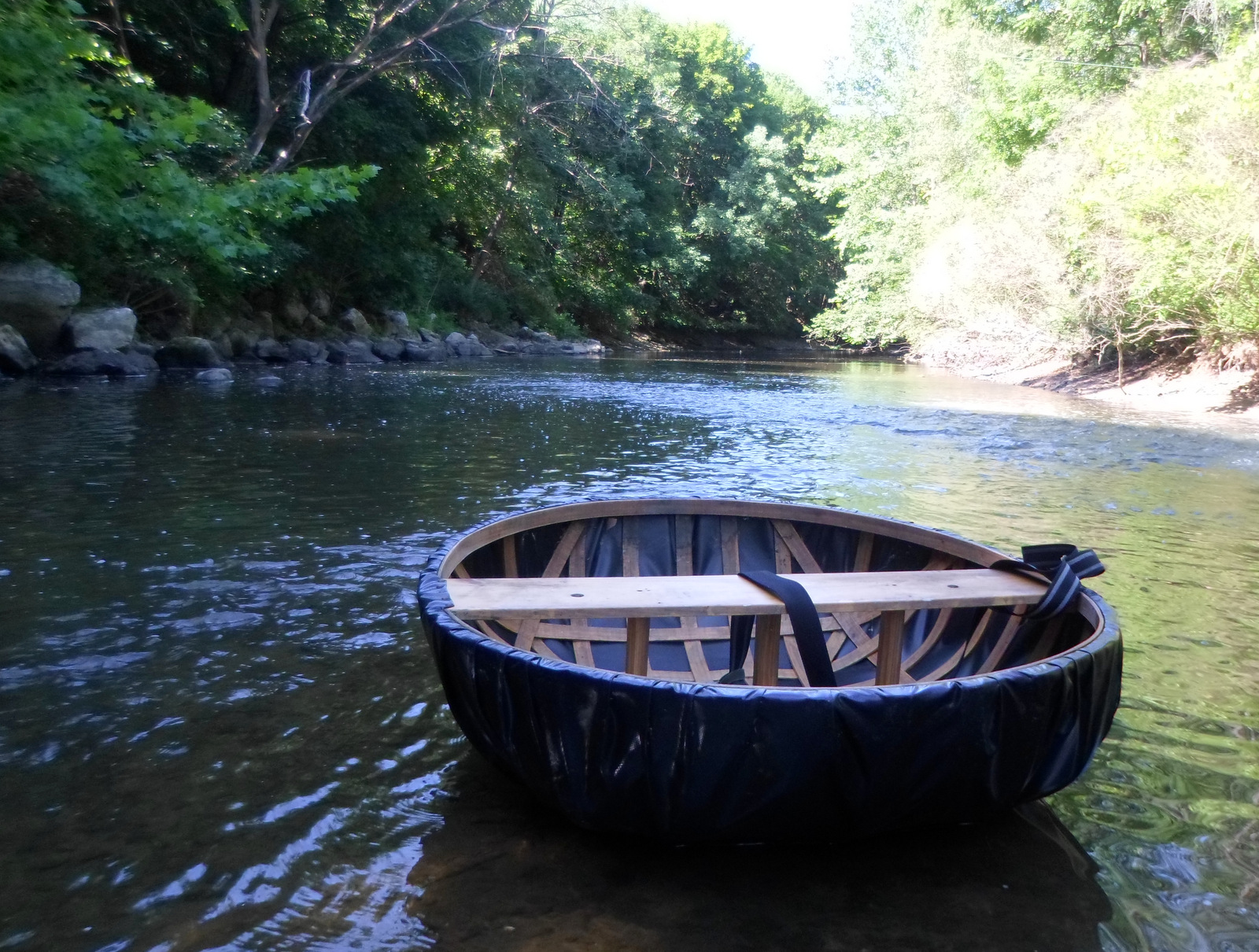
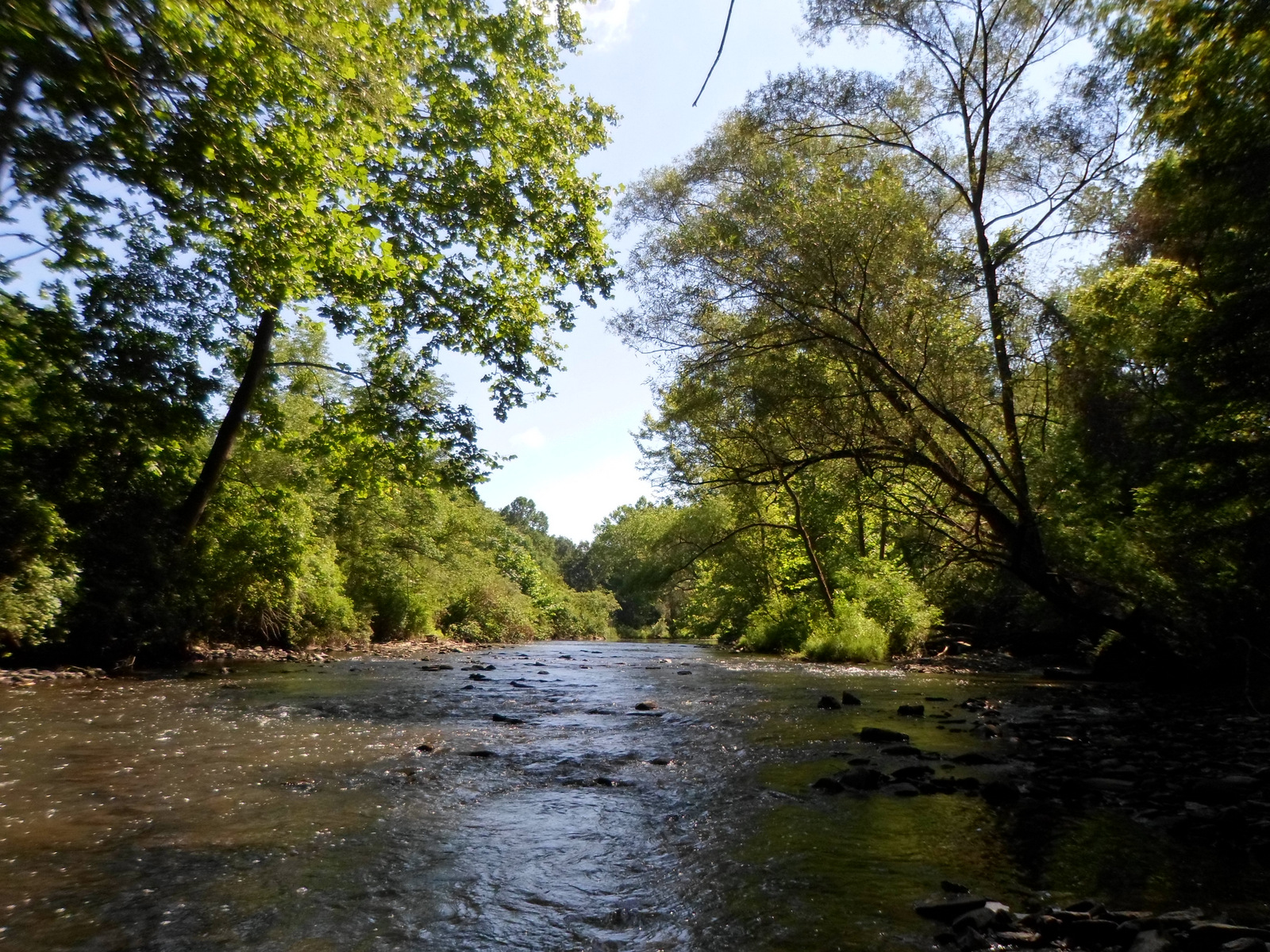
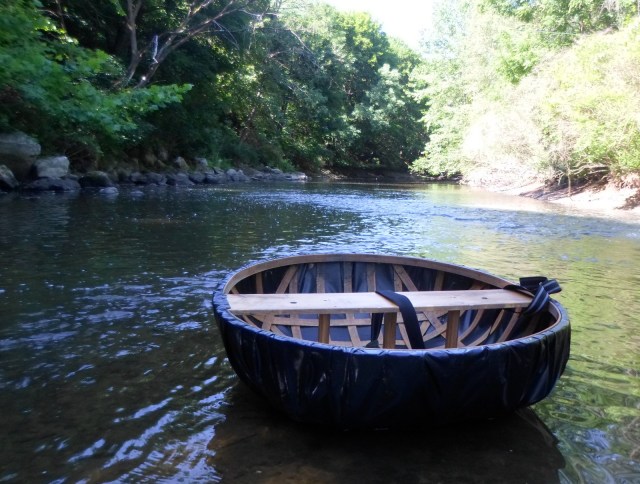
For a couple hours earlier this week, I literally stepped away with my coracle into the cooling waters of the Little Shenango.  I wrote of the virtues of the coracle back in April when I was re-covering mine.  The new skin is holding up well, and carried me along this blissful trail just beyond the trees from the public.
Shallow stretch of the Little Shenango in summer

Shallow stretch of the Little Shenango in summer

In summer, this little stream is far too low for convenient canoe or kayak travel.  Navigable stretches are broken up by shallow rocky areas.  Arriving at these spots in the coracle, I simply step out and walk along beside it.  If necessary, I can pop it onto my shoulder for a minute.  Then as the water begins to deepen again, I step back in and continue to bob along in the gentle current.

I usually see more wildlife when floating than when walking.  It is so silent, and the animals don’t quite seem to know what to make of the situation.  Humans as well, judging by the response of the four boys on the river bank as I floated past.
SAM_2261

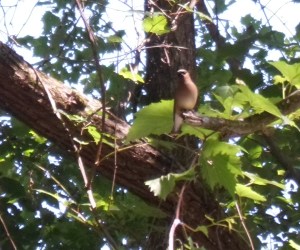
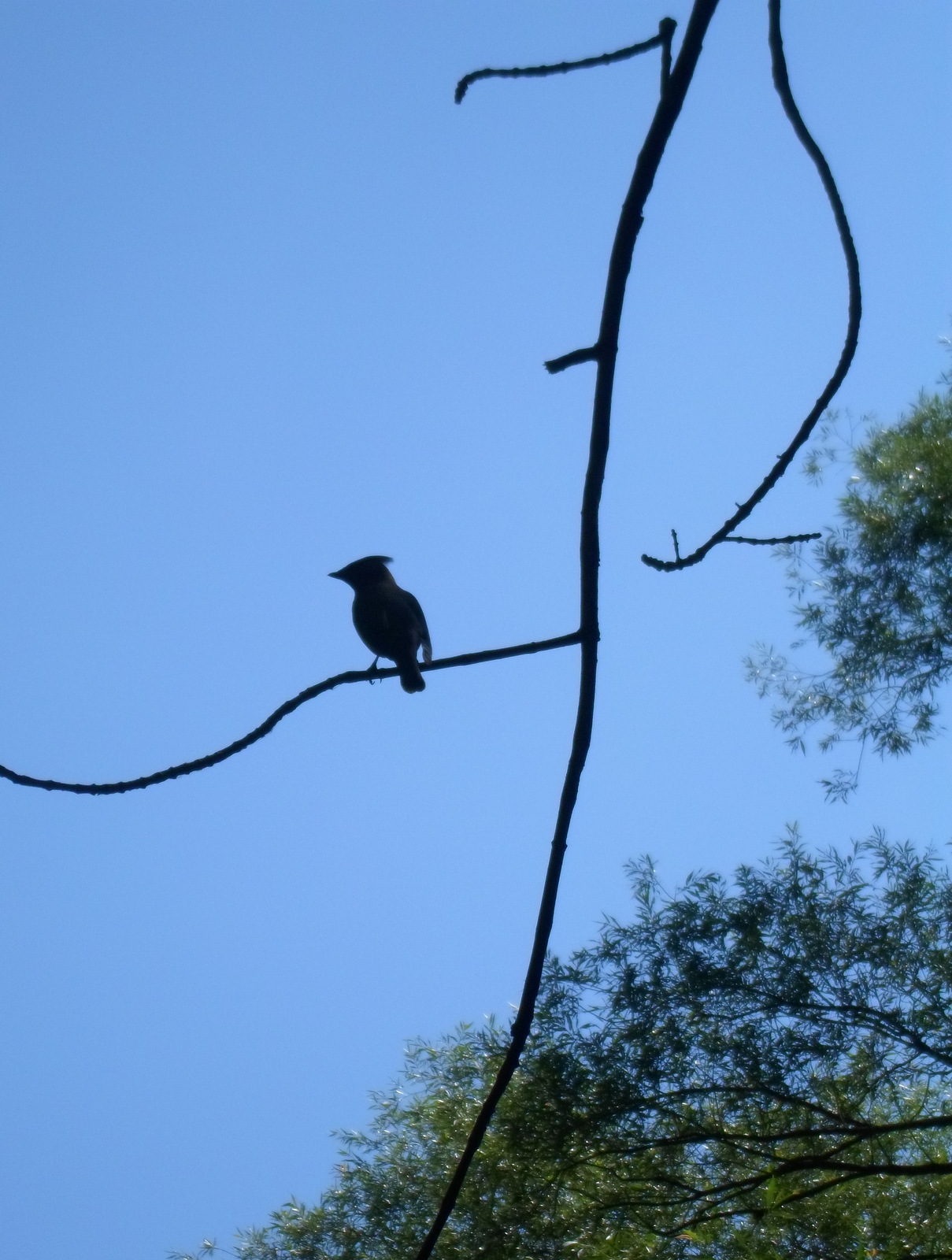
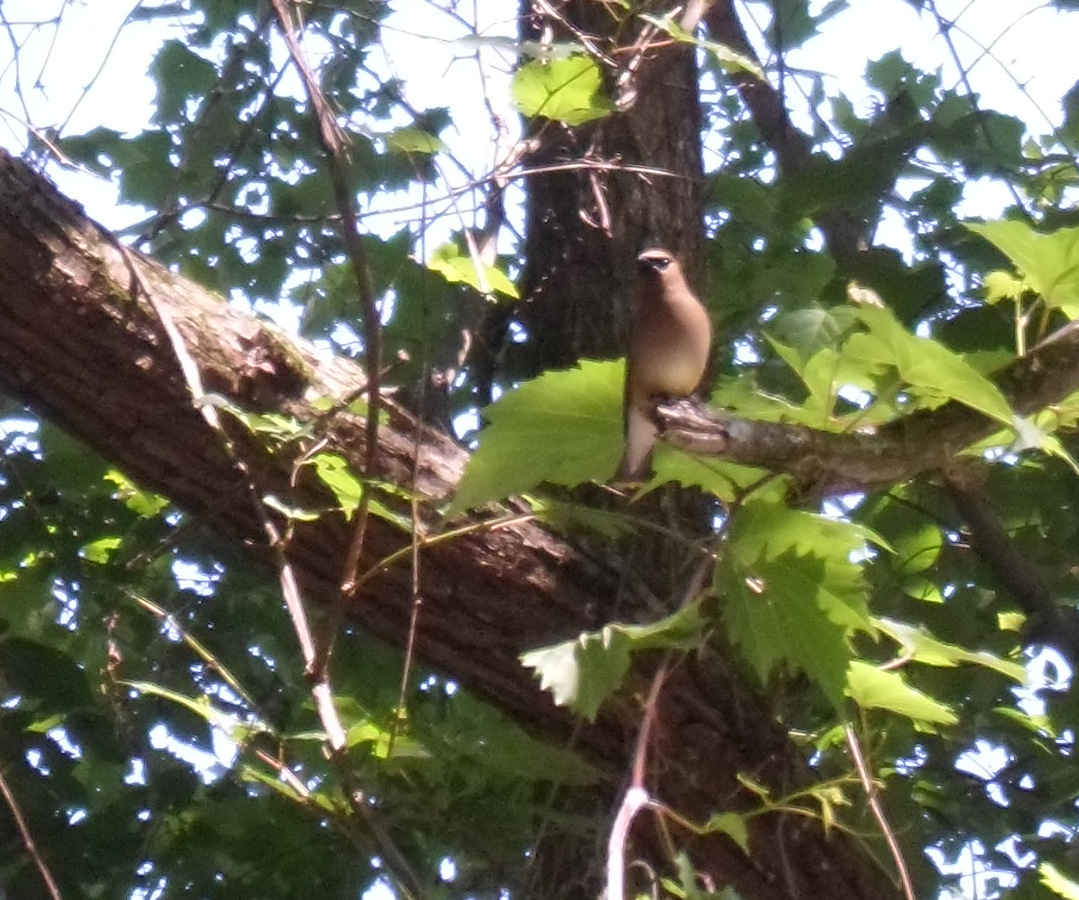
Cedar waxwing watching for flies on a streamside branch.

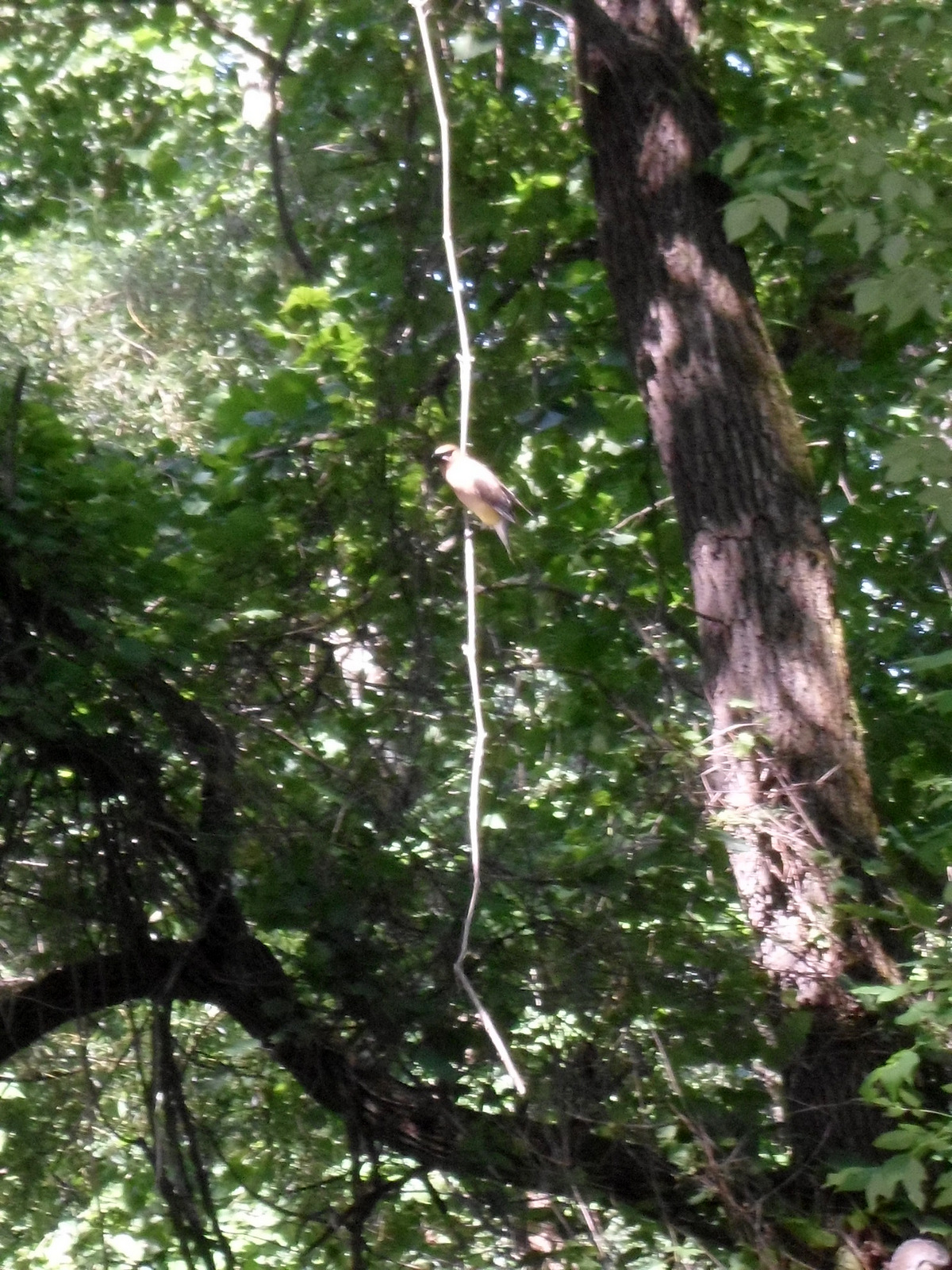
The cedar waxwings certainly didn’t seem to  mind.  They were a thrill to watch as they darted out into the sunlight above the river to prey upon flying insects.  With just a little point-and-shoot camera along, I couldn’t capture much detail, but  my eyes could take it in.

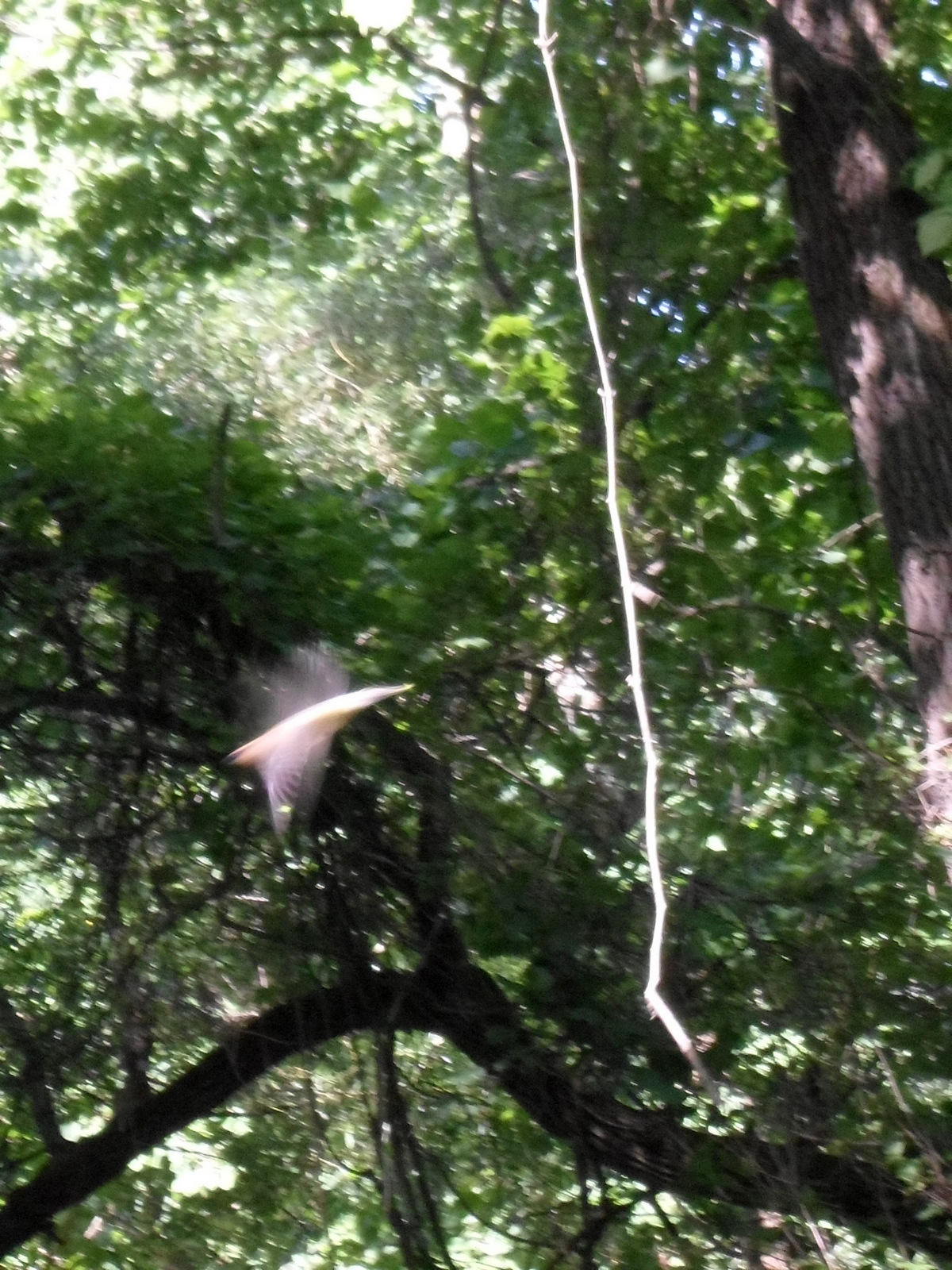
Looking very mischievous with their masked faces, their tufted heads moved sharply back and forth as they looked for their next opportunities.  Their aerial attack maneuvers revealed flashes of bright yellow and red, before they settled back again on a streamside branches or dangling vines.  I seemed to be their last concern and they may have enjoyed the chance to perform before a small audience.
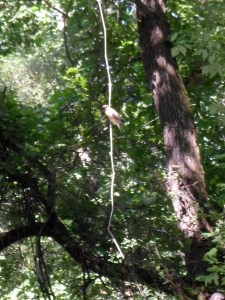
Cedar waxwing hunting from a streamside vine.
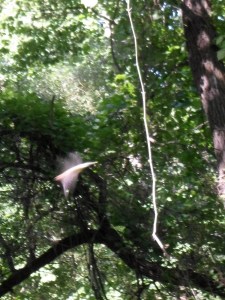
Cedar waxwing hunting from a streamside vine.

Off in a blur

Off in a blur…

...and back to await the next chance.

…and back to await the next chance.

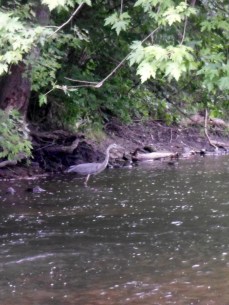
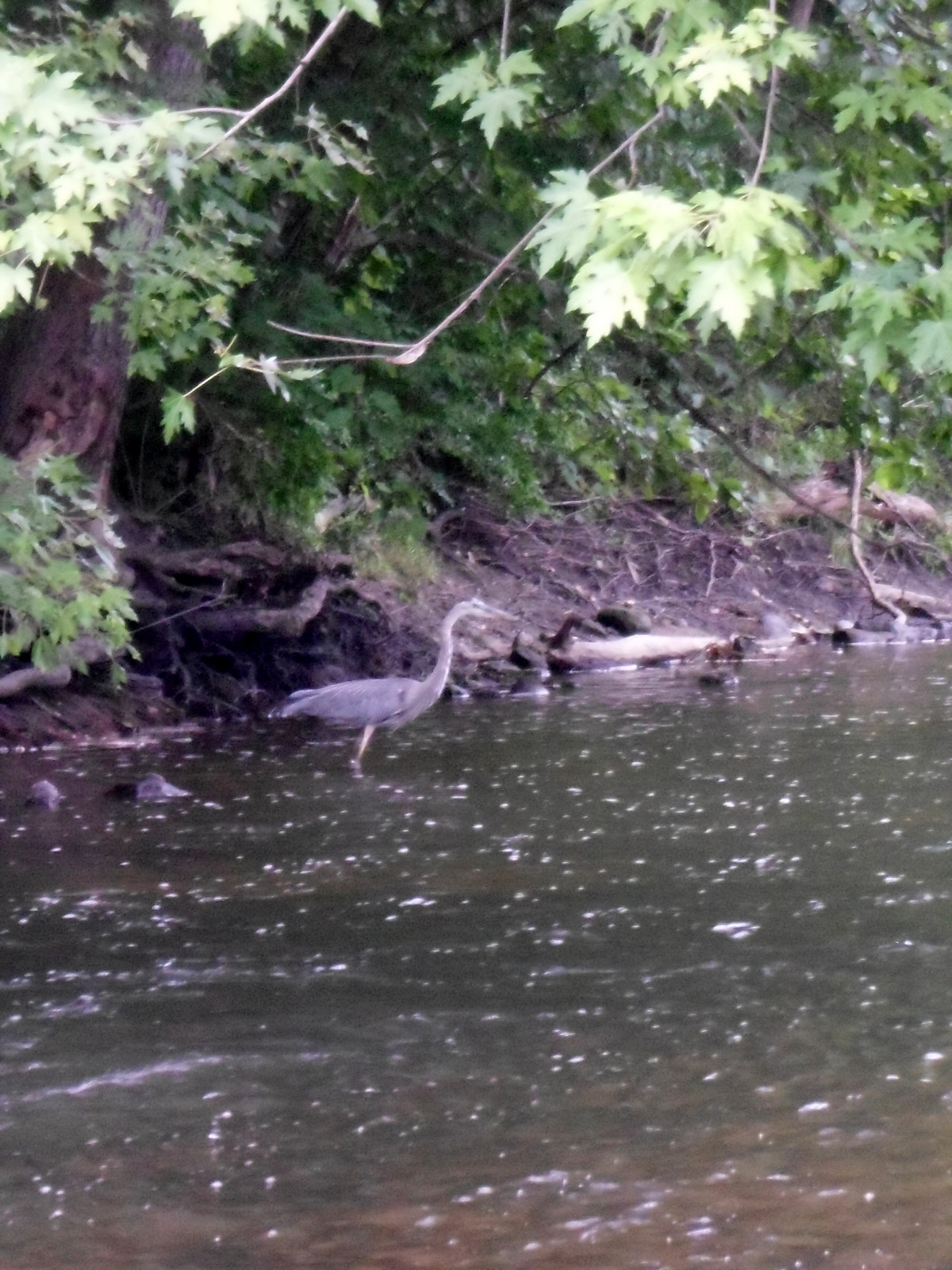
Great blue heron in the Little Shenango

Great blue heron in the Little Shenango

I encountered deer browsing on the river bank and an osprey carrying a fish in her talons.  I often see a bald eagle.  He didn’t show up this time, but the great blue herons are more reliable.  I love the sinuous forms of their necks and their almost prehistoric appearance.  Their patient personalities are a quiet contrast to the waxwings.

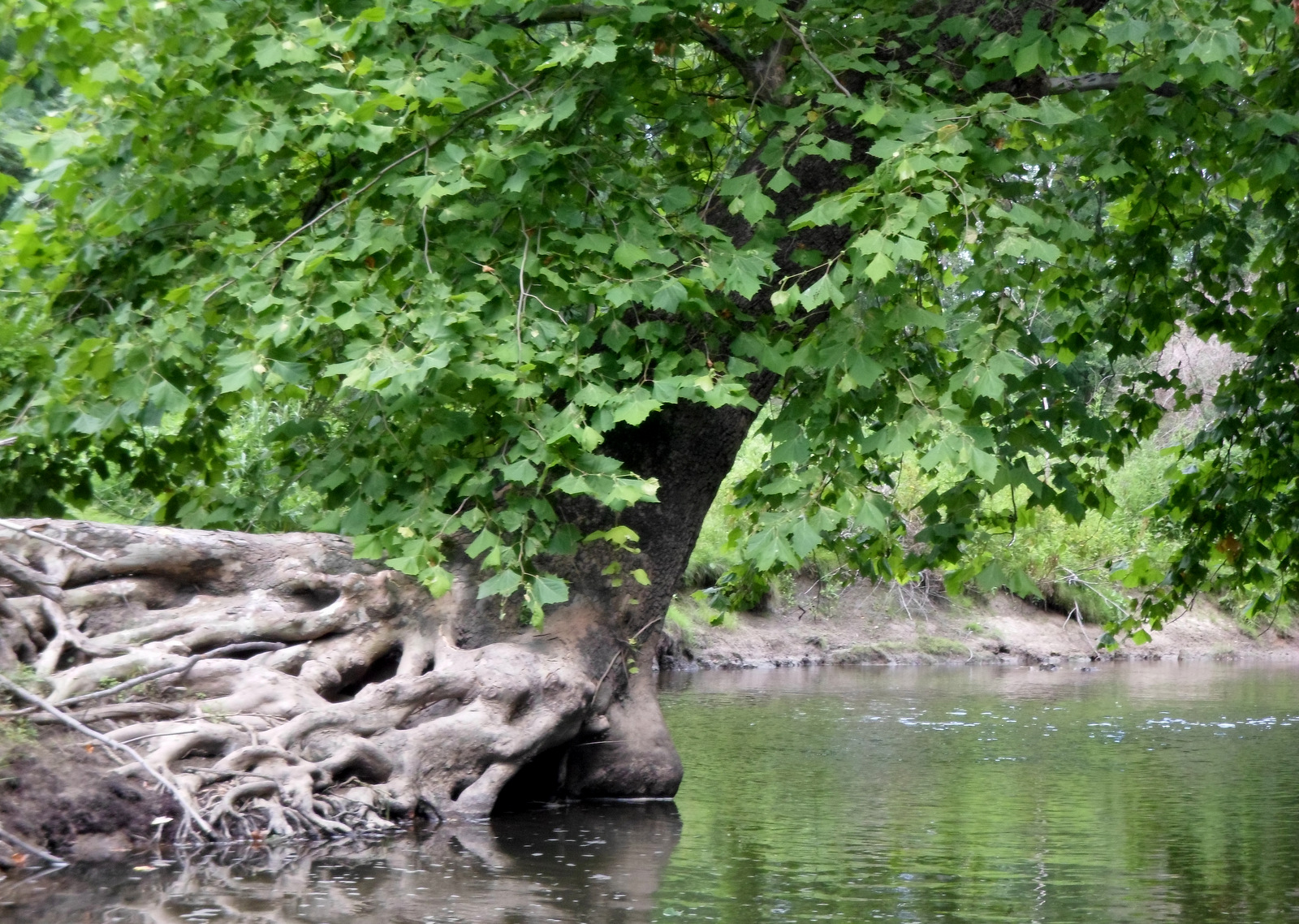
And, of course, the trees are always there, arching over to shelter the stream.  I love the beautiful, powerful roots of the sycamore in the photo below.
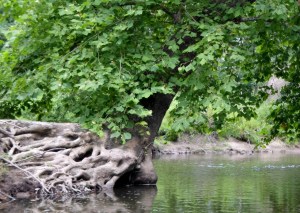


Sycamore on the Little Shenango

Sycamore on the Little Shenango

In his book, The Little Grey Men, Denys Watkins-Pitchford wrote, “Adults are always so busy with the dull and dusty affairs of life which have nothing to do with grass, trees, and running streams.”  Of course, much of these “dull and dusty affairs” are necessary and unavoidable, but, once in awhile, an opportunity to step into a running stream ought to be taken — with or without a coracle.
Posted in nature, trees, Uncategorized | Tagged , , | 3 Comments

And Now for Something Completely Different….Chestnut

IMG_5247

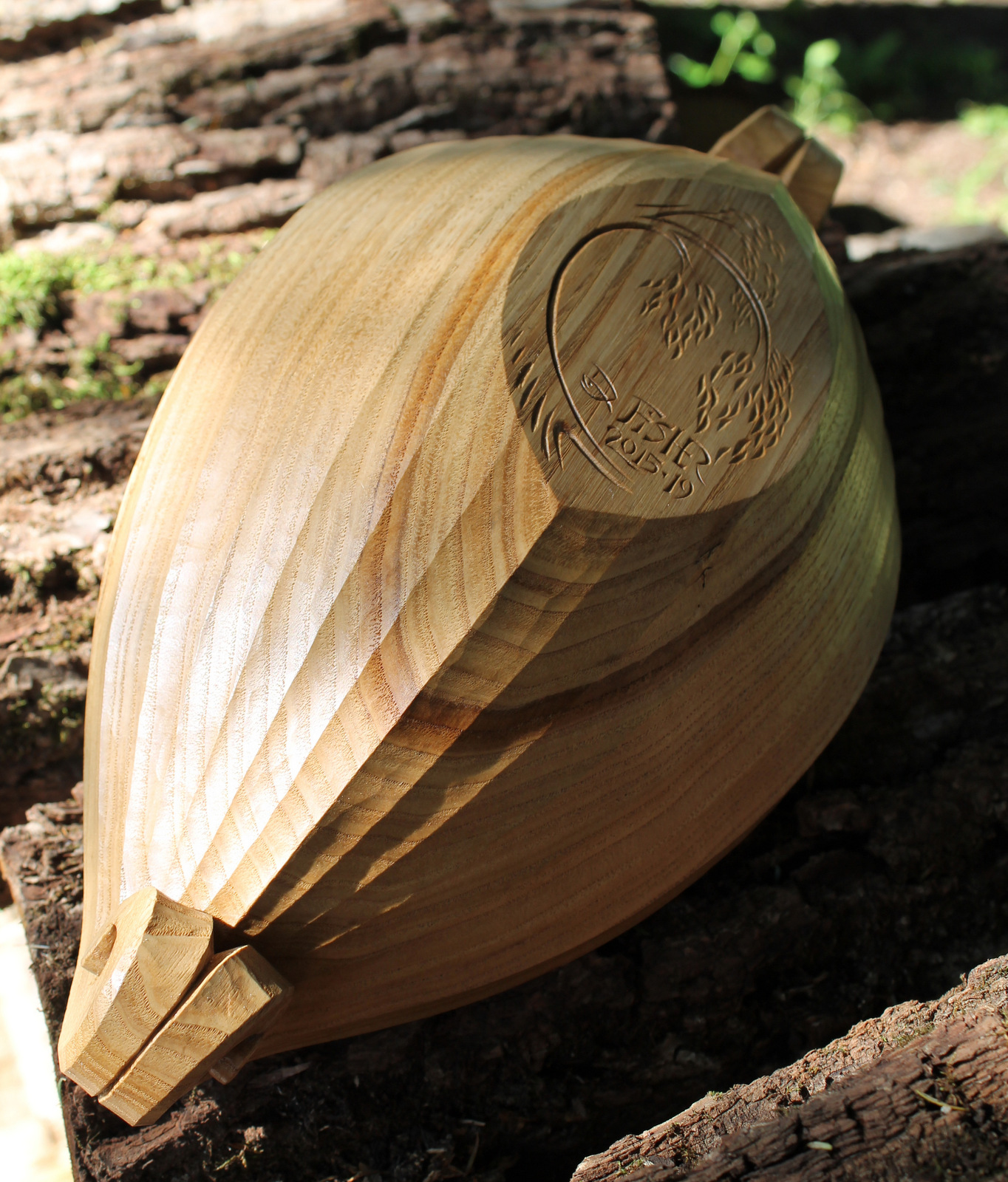
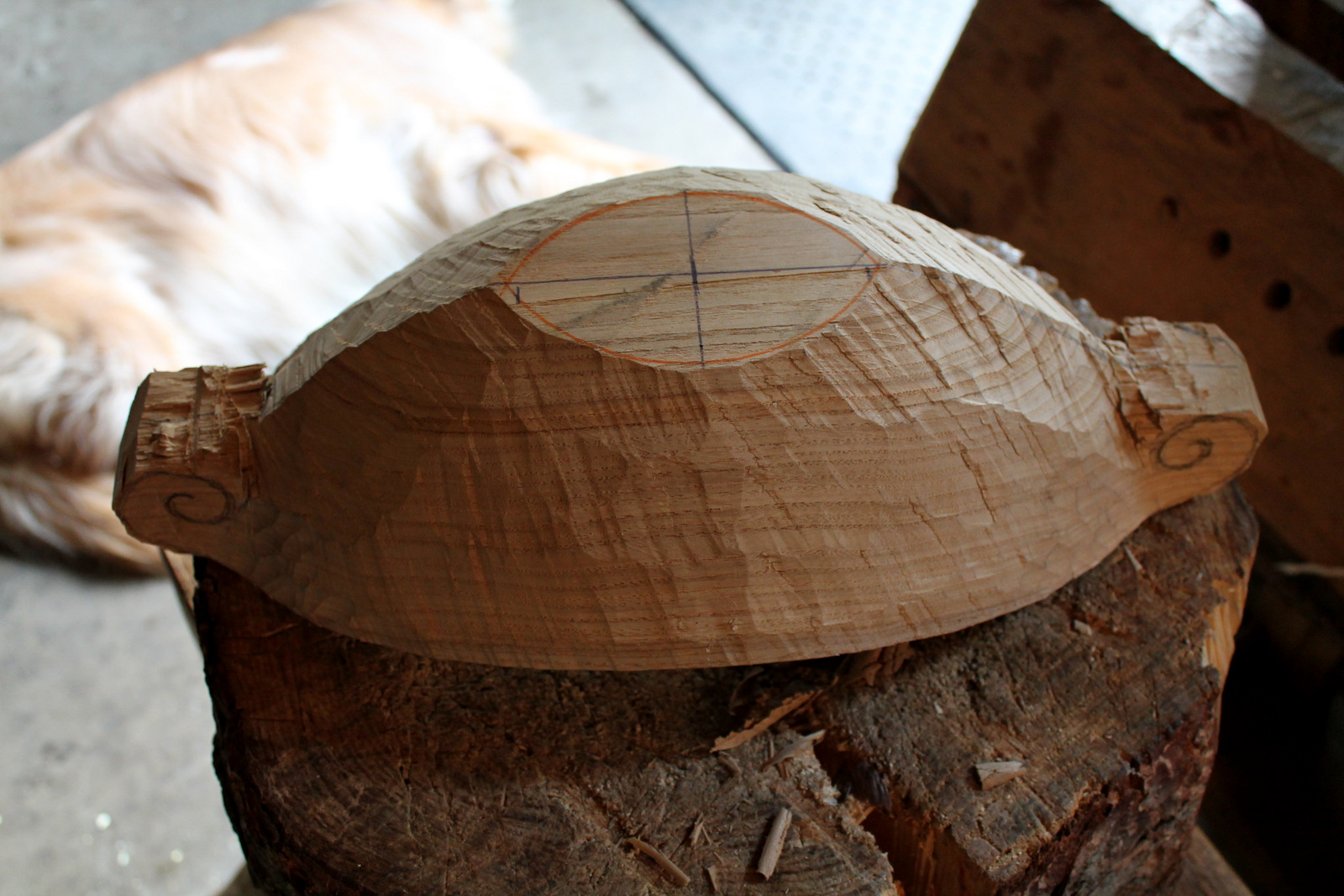
My latest bowl, this boat-inspired piece, came from a Chinese chestnut (Castanea mollissima) tree that grew a couple miles from my home.  In the photo, it is riding on waves of walnut bark on the wood stack.  I’ve got more photos, including some of the process, below.

The carved flutes terminate beneath the volutes.

The carved flutes terminate beneath the volutes.

16 3/4 inches long, 8 inches wide, and 4 1/2 inches high.  Dwarfed by my most recent walnut bowl, but can still hold its own.

16 3/4 inches long, 8 inches wide, and 4 1/2 inches high; a foot shorter than my most recent big walnut bowl, but it can still hold its own.

This chestnut tree had a lovely dark growth ring that stands out.  Counting back the rings on the log, it was 1992.  Weather historians?

This chestnut tree had a lovely dark growth ring that stands out. Counting back the rings on the log, it was 1992. Weather historians?

IMG_5250

Bon Voyage

I’ve posted to the available page at my website.  For those interested in the carving process, I did remember to take a few shots along the way…

At the chopping block, after the axe work.  The volutes have been sketched, but the lines will be carved away and redrawn as the work progresses.

At the chopping block, after the axe work. The volutes have been sketched, but the lines will be carved away and redrawn as the work progresses.

At the bowl horse, I was using a drawknife to establish the plane that continues along the sides of the volutes.

At the bowl horse. I was using a drawknife to establish the plane that continues along the sides of the volutes.

The vise also came in handy.

The vise also came in handy.

For carving the outer flutes, it took some creative arranging of pegs, holdfasts, even T-shirts.

For carving the outer flutes (a painstaking process), it took some creative arranging of pegs, holdfasts, even T-shirts.


Posted in bowls, holding, layout, patterns, Uncategorized | Tagged , , , | 19 Comments

Start Where You Stand


Plane sketch C_NEW

Do not wait; the time will never be “just right.”  Start where you stand, and work with whatever tools you may have at your command, and better tools will be found as you go along.”

— George Herbert, “Jacula Prudentum” 1651


Posted in quotes and excerpts, sketch, tools | Tagged , | 10 Comments

The Great Adze Shortage of ’15

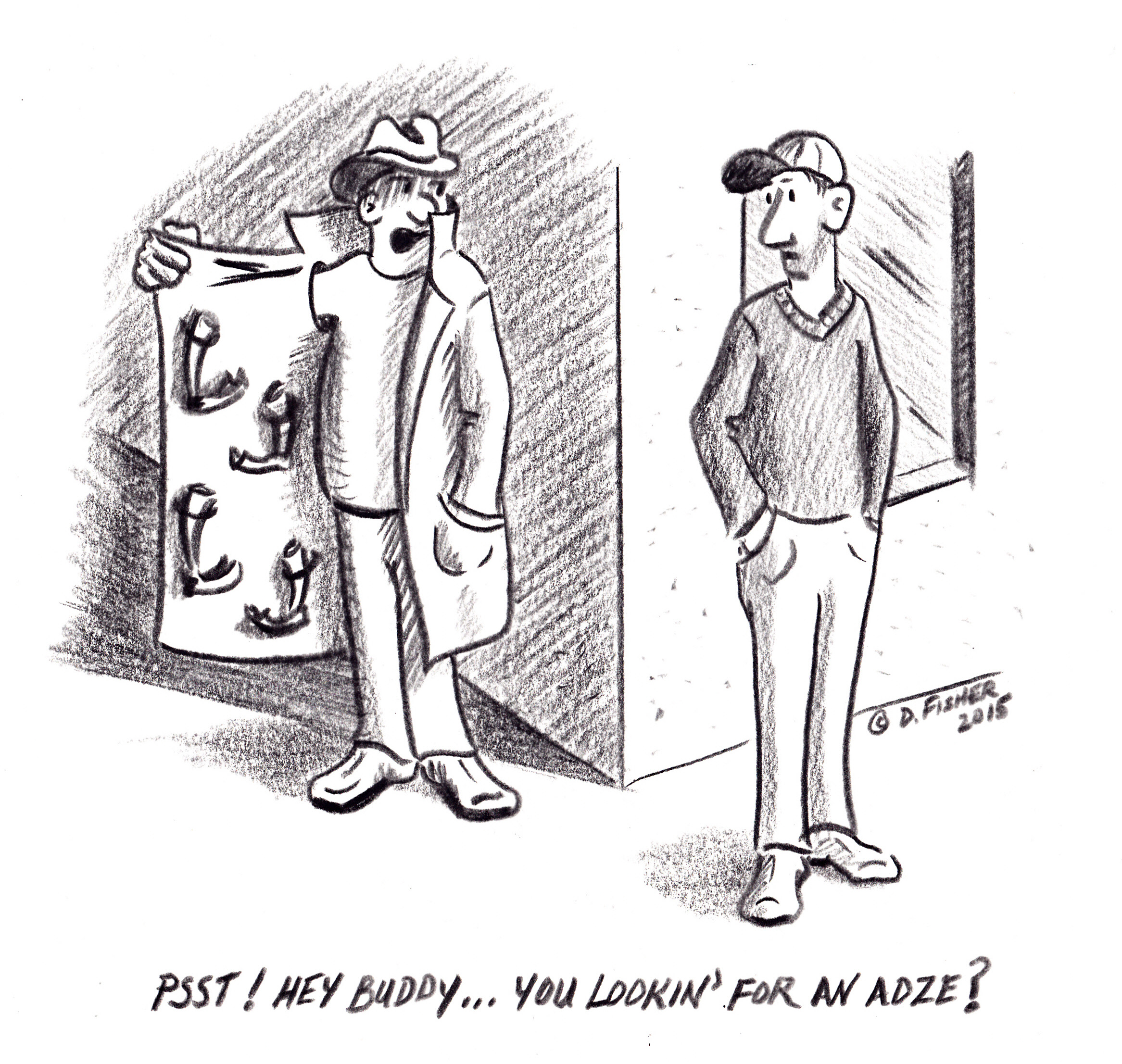
Adze cartoon_NEWIt seems that it is difficult to acquire a good adze these days.  I’m not looking, but I have been getting emails seeking advice on what to do about it.  These folks wish to carve bowls, and are willing to pay for a good adze, but they simply aren’t available.  It seems that the demand has outpaced the supply.  Think about that; in 2015 the demand for hand forged bowl adzes has outpaced the rate at which the makers can produce them! That is both somewhat amazing and quite encouraging.
Drew Langsner addressed this phenomenon in his most-recent newsletter from Country Workshops (scroll down just a bit).  And this is not simply a problem of importing Swedish adzes into the U.S.  Look at the adze page at Woodsmith, a tool retailer in the U.K.

Just to be clear, it is not that nobody knows how to make a good adze for bowl hollowing.  Just look at those made by Hans Karlsson, Svante Djarv, or Gransfors Bruks.  The formula is there.  They all feature the same basic components of a well-designed bowl adze:  good steel, a dense heavy head, thoughtful geometry with some degree of outer bevel, raised lips that won’t catch when taking a heavy cut, and a well-hung handle.  (Again, the Woodsmith page shows a clear comparison).  I discussed some of my thoughts on adze selection in this post back in February.  So this isn’t like a search for the Fountain of Youth.  This is attainable, but you’ll have to wait until the Swedish smiths can catch up; and don’t expect to find a used one on ebay.
By the way, let me explain the “well-hung handle.”  The process of putting a handle on an axe bit is called “hanging.”  This involves many variables that are well explained here.  As one can see, an axe can be hung more open or more closed, which effects how well it works.  This principle is, I believe, even more important when hanging an adze handle.  Since the cutting edge is perpendicular to the plane of the swinging motion (rather than in line with it, as with an axe), the relationship of the bit and bevel to the pivot point (usually near the end of the handle) of the swing is important.  If the hang is too open or too closed, the cutting edge will not enter the wood sweetly.

This is important to consider if one is planning to hang their own handle or replace one. A longer handle, for example, changes the hang (possibly making it too closed) unless the handle is shaped to account for this.  This is why, in the top photo here at Country Workshops, you can see how they have bent the longer handle back, letting the cutting edge enter the wood sweetly with the natural swing of the handle.

But back to the quest for a good bowl adze: I guess for now the only good answer is patience.  Lack of that may lead you to purchase a bad adze, and there are many being made, even by makers that otherwise make excellent tools.  These adzes may have light heads that cause fatigue and pain, bad geometry, bad bevels, or very poorly designed handles — possibly all of the above!  With a great deal of effort and time, these can be made somewhat serviceable, but they will never be great like the ones for which you now, apparently, must wait.

Posted in adze, cartoons, sketch, tools, Uncategorized | Tagged , , , , , , | 43 Comments

New Walnut Bowl

IMG_5174

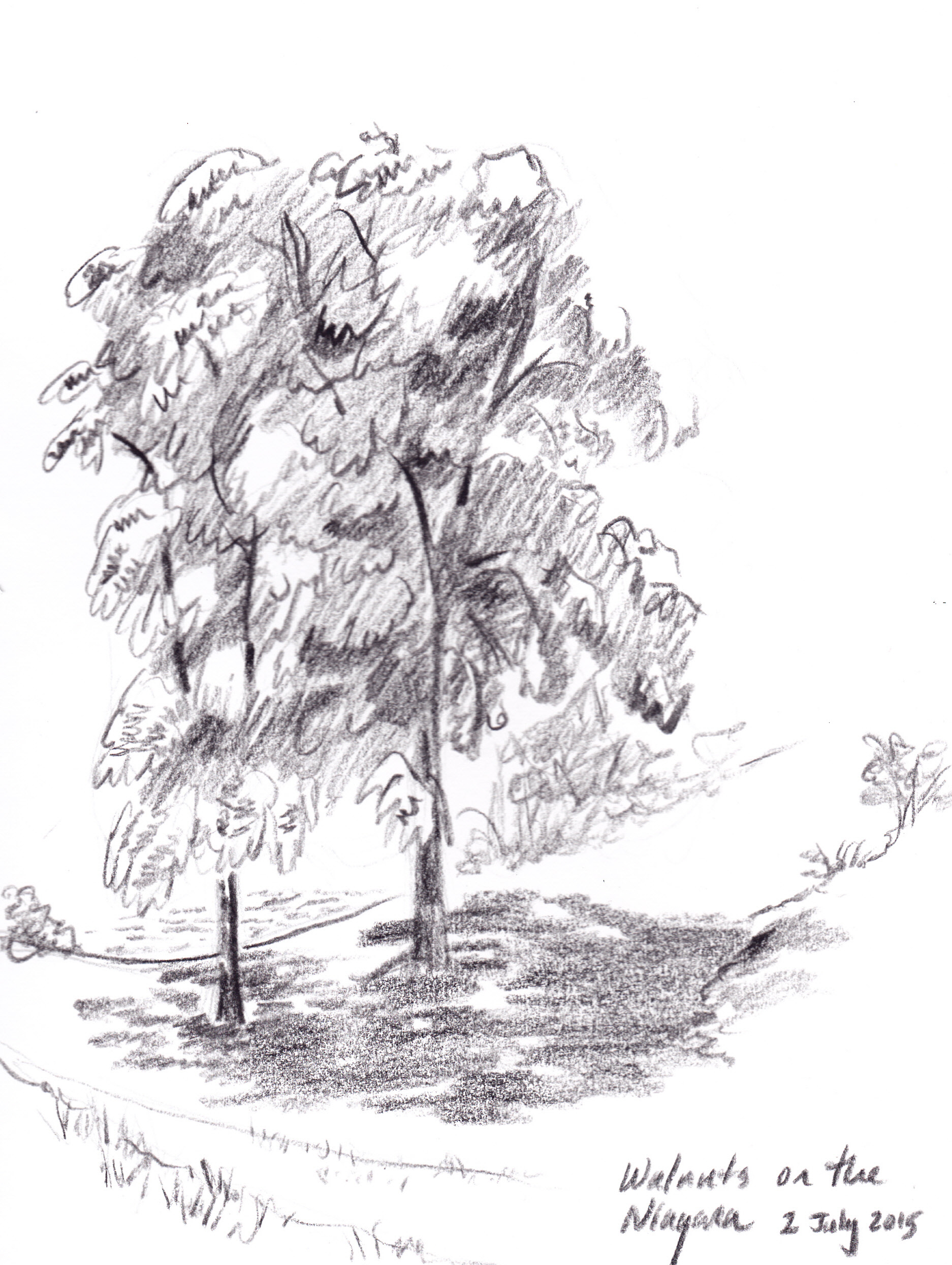
Walnut Trees Sketch_NEW_0001Last week, I spent some time along the Niagara River.  I saw the Falls again (I live only three hours away), and they are still thrilling.  But what I noticed more than ever before were the beautiful trees on my walks around, especially the abundance of lovely walnut trees.  They are stately like oaks, yet softened by their long slender leaf stalks drooping like willows, the leaflets fluttering in the breeze.

I tried to do many quick sketches on the trip, simply because it reminds me to stop and see for a moment.

Since returning, I’ve finished my efforts to do justice to the inner beauty of a walnut tree that fell closer to home.

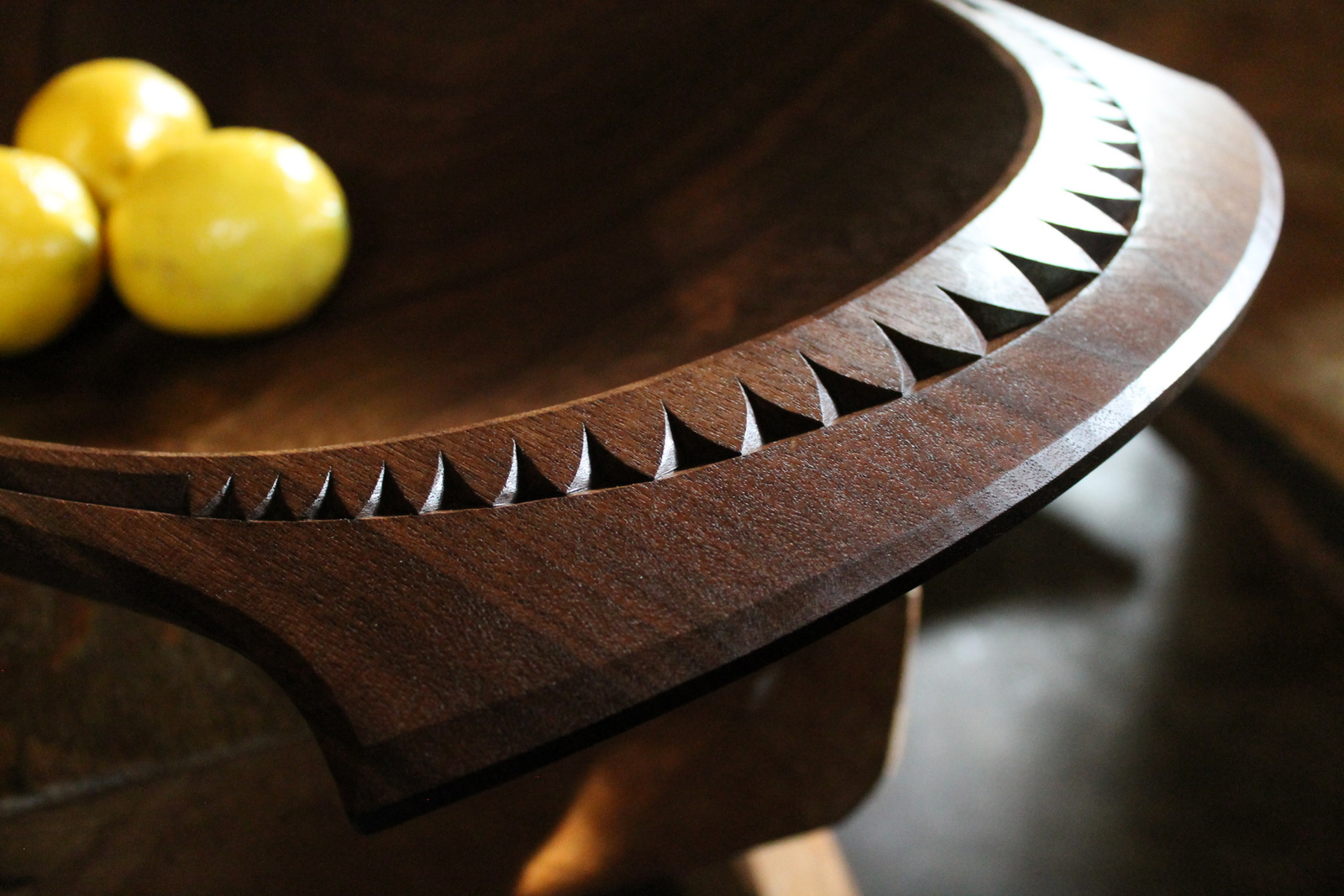
Detail of handle end and curved recesses.

Detail of handle end and curved recesses.

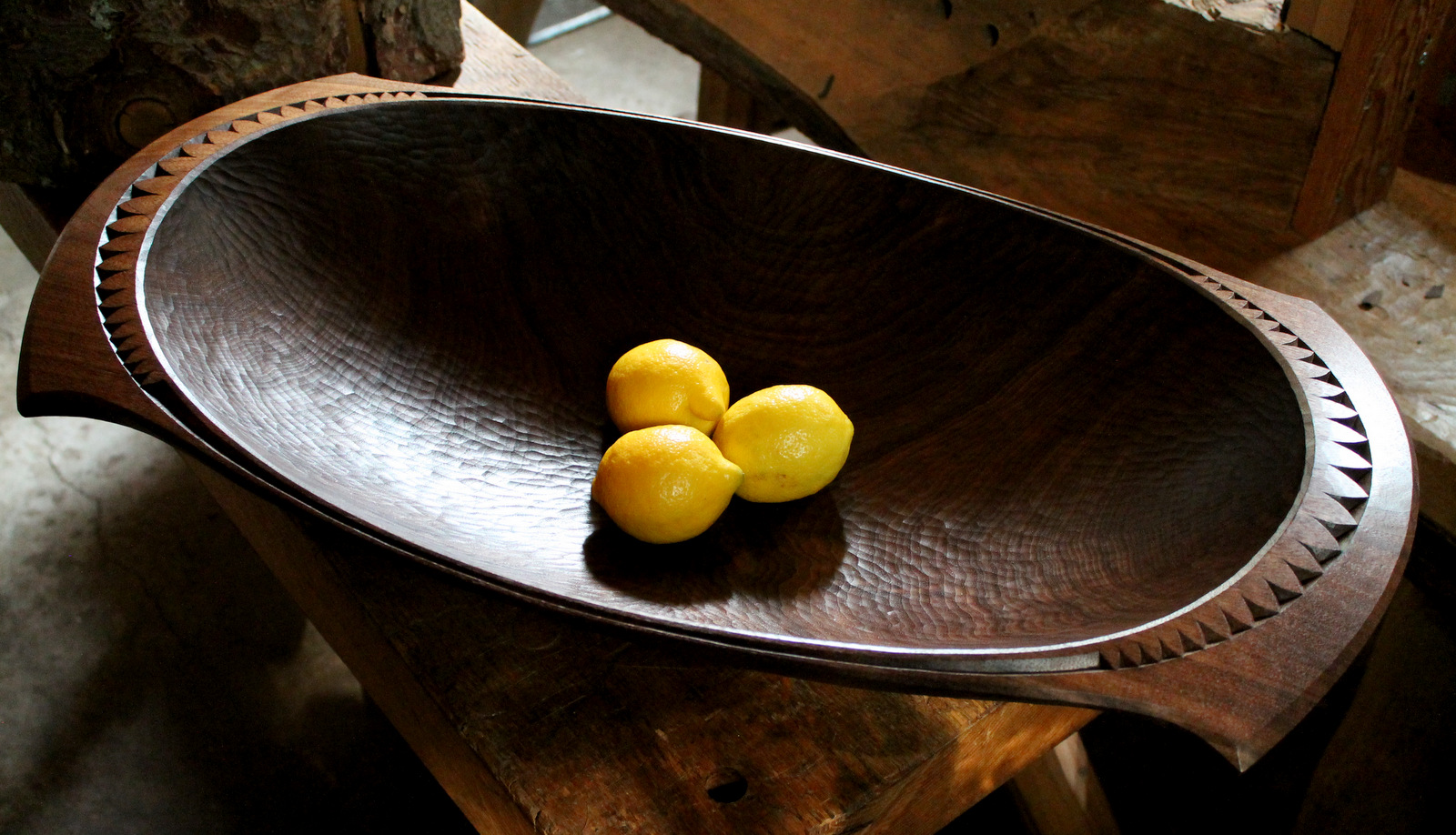
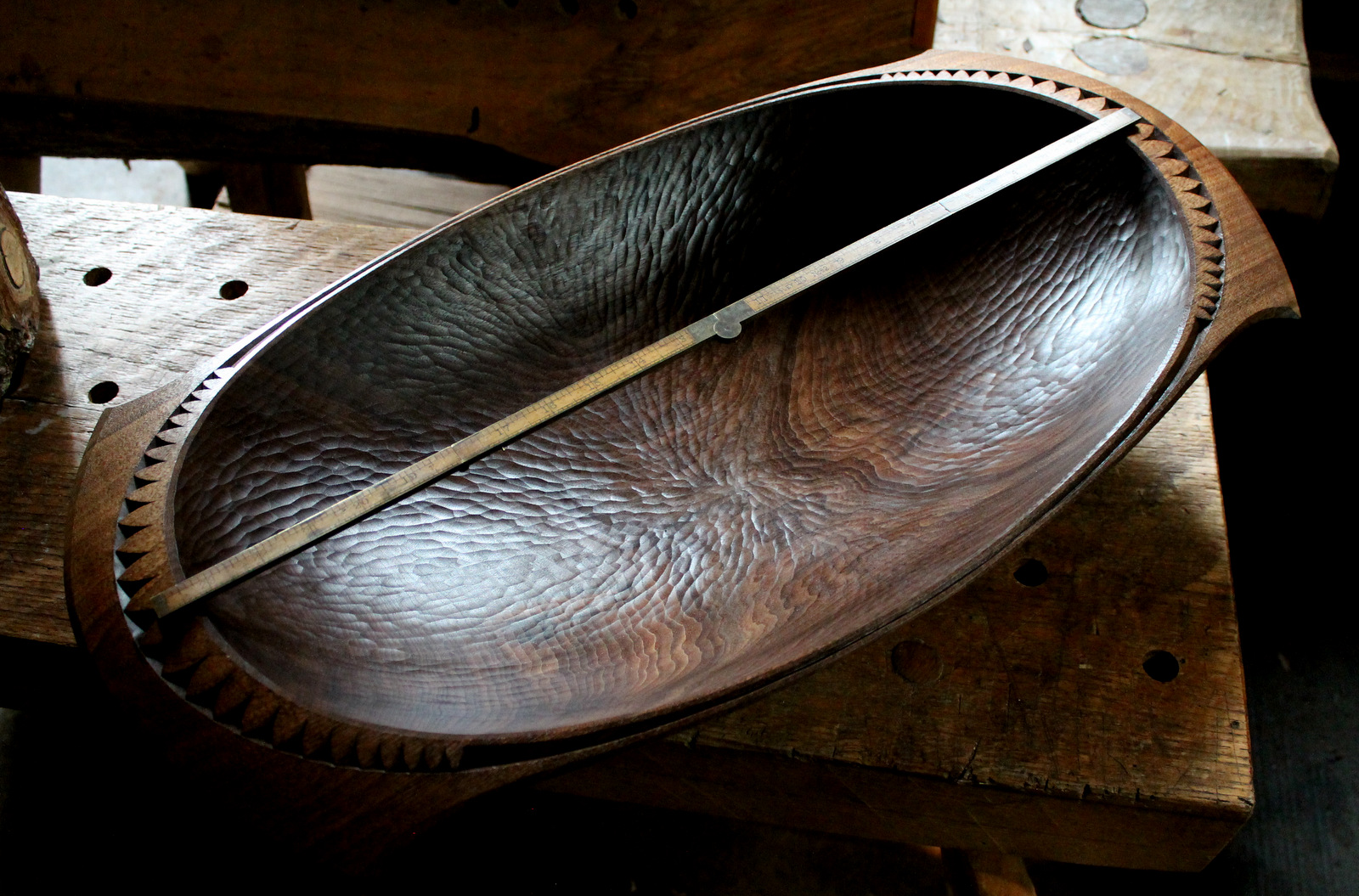
In terms of overall size, this is probably the largest bowl I’ve made.  It is 27 inches long, 14 1/4 inches wide, and 5 1/4 inches high.  The decorative carving around the rim is similar to the large triangular recesses I’ve carved on a couple bowls before, but the sides of these recesses are curved, creating a series of Gothic arches of sorts, or maybe petals.

This subtle difference is a bit more challenging to lay out and carve.  I find it best to draw the outline by eye, since the recesses get progressively smaller toward the side of the bowl.  After drawing, I use a v-chisel to remove some of the bulk, then I do the rest of the cutting with a skew chisel.

The upper surface of the bowl is arched, with the rim flowing downward from the handles.

IMG_5189

Exterior view showing the texture, lines, and lovely walnut grain.

On the exterior, a raised ridge line carries the line of the handles along the bowl.  I reflected the texture of the exterior surface on the interior as well.  What a privilege I have to work with this beautiful wood.

Below are a few more assorted photos.

IMG_5165

handle detail

IMG_5187

exterior view

IMG_5162

with a two-foot ruler spanning the hollow


Posted in bowls, patterns, sketch, trees, Uncategorized, walnut | Tagged , , | 6 Comments

Close Encounters of the Wood Kind

IMG_4737

For those of you that recognize what that is: no, I have not turned to turning.  My turning experience is limited to doing a little spindle turning, mainly on the spring-pole lathe.  But I did make the easy hour-and-a-half trip to Pittsburgh on Friday to check out the work at the American Association of Woodturners International Symposium, and I brought that little piece home with me.

There were two main rooms, one for exhibiting the works, and another for vendors of tools and such. My experience in the room of exhibited pieces was pleasant and contemplative.  The work was stunning, and I enjoyed some enlightening conversations.

IMG_4739In the trade show room, I felt a bit like a fish out of water as I meandered among precision-engineered lathes, computer-guided routers and a turning tool that featured a laser light.  But then I spied a basket full of these.  As I mentioned, I’m not a turner, yet there was instant recognition — cores from bowls turned on a pole lathe.

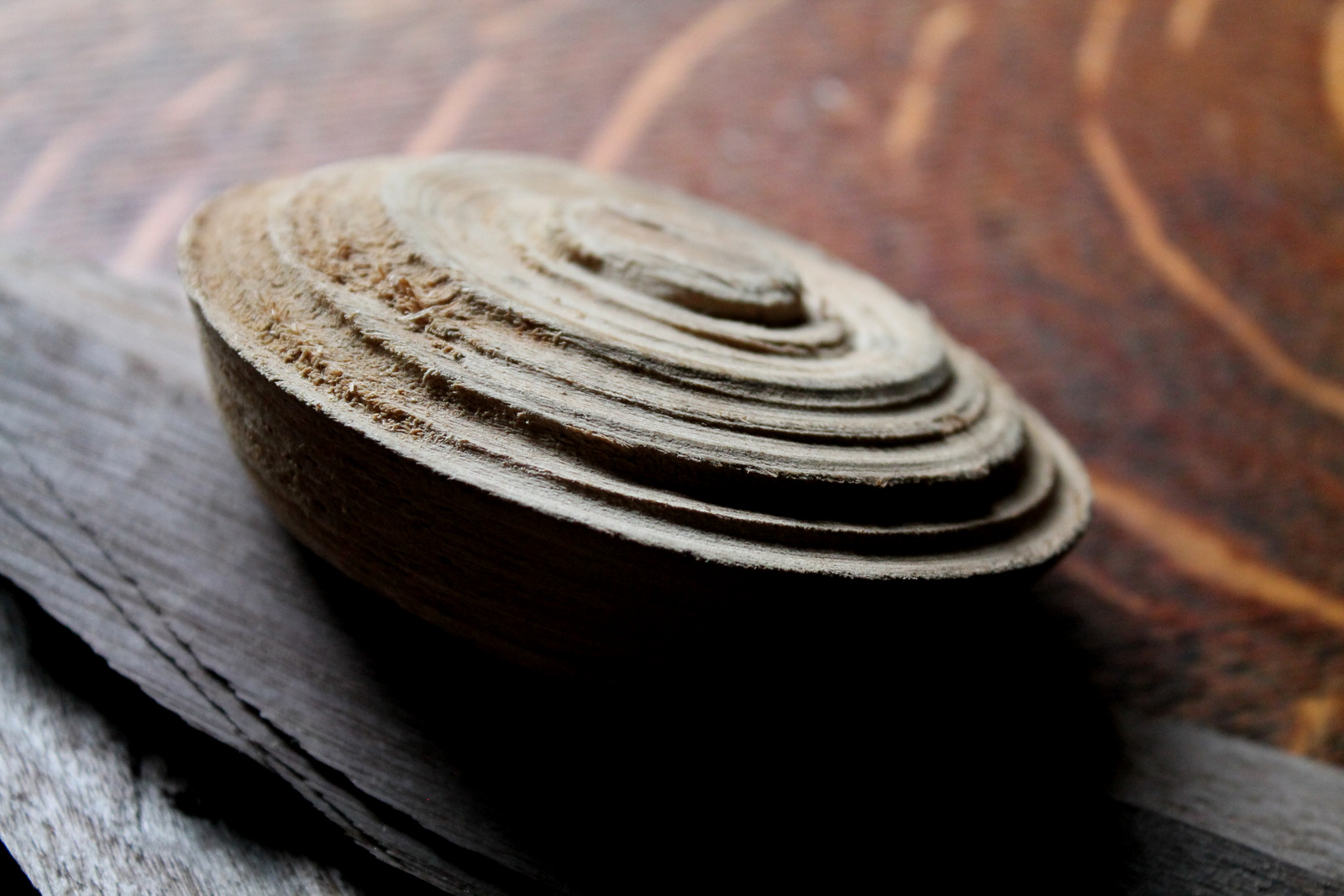
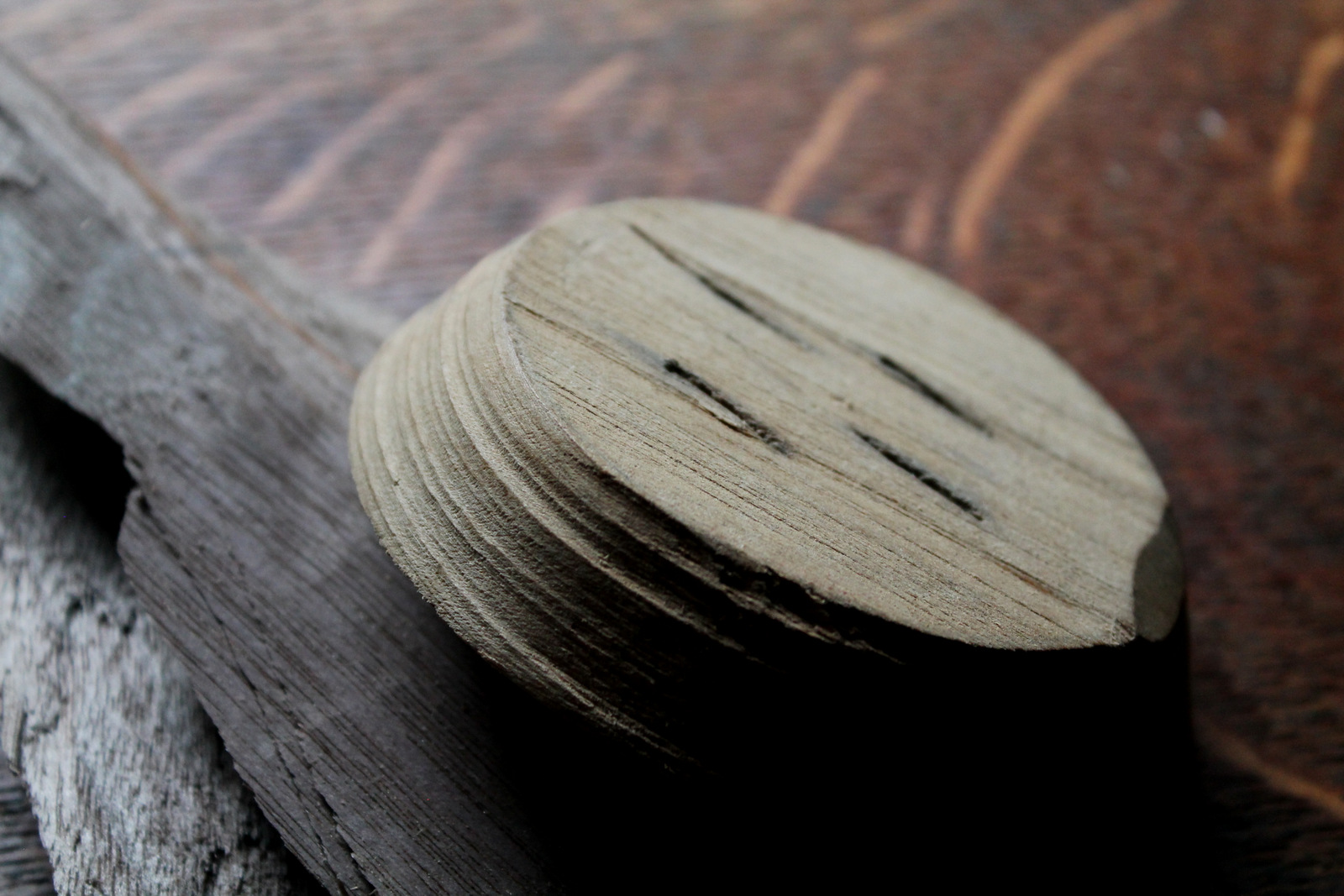
These cores were part of a display by the Center for Art in Wood (located out east, in Philadelphia), formerly part of an exhibit and collaborative project that featured the “waste” cores from Robin Wood’s bowl turning.  It was a pleasure to talk with CAW’s representative, Levi, and he threw in one of the cores when I purchased a book about the project.

An object like this tells a story and provides much food for thought.  As I ponder it in the shop, I am putting the finishing touches on a big walnut bowl I mentioned a few weeks ago in this post.  I’ve worked on it much more including carving a design around the rim.  I should be posting the final results in another week or so.


Posted in bowls, Uncategorized | Tagged , | 2 Comments

Moth-Inspired Curves

IMG_4688

Nature will bear the closest inspection.  She invites us to lay our eye level with the smallest leaf, and take an insect view of its plain.  She has no interstices; every part is full of life.

–– Henry David Thoreau, “Natural History of Massachusetts”

Nature is our model.  It is replete with curves that effortlessly carry the eye and have a sense of life.

–– George R. Walker, “Design Matters” column, Popular Woodworking Magazine #219 — August 2015.

IMG_4690

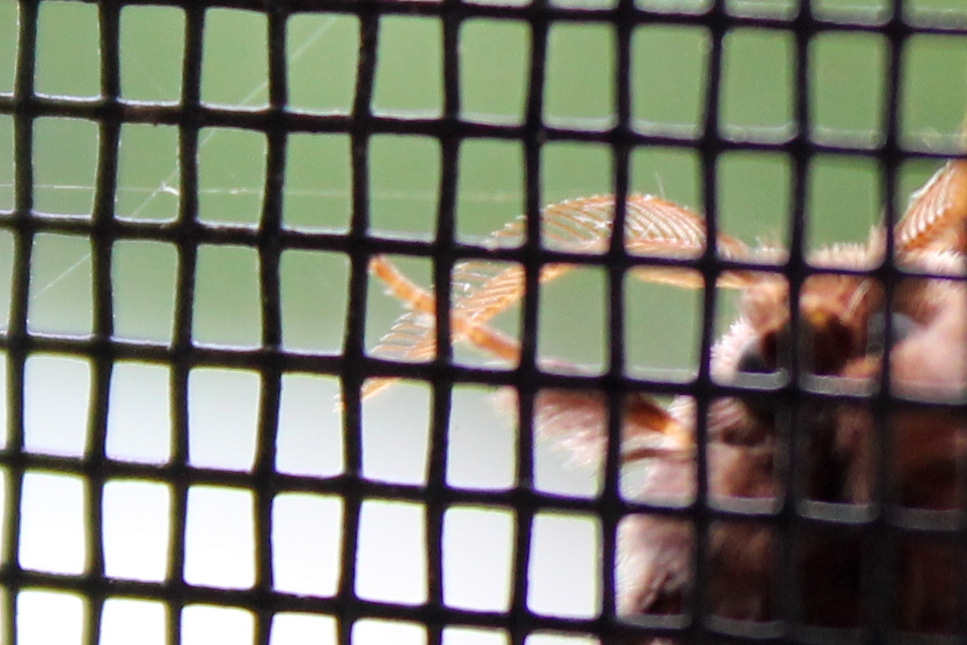
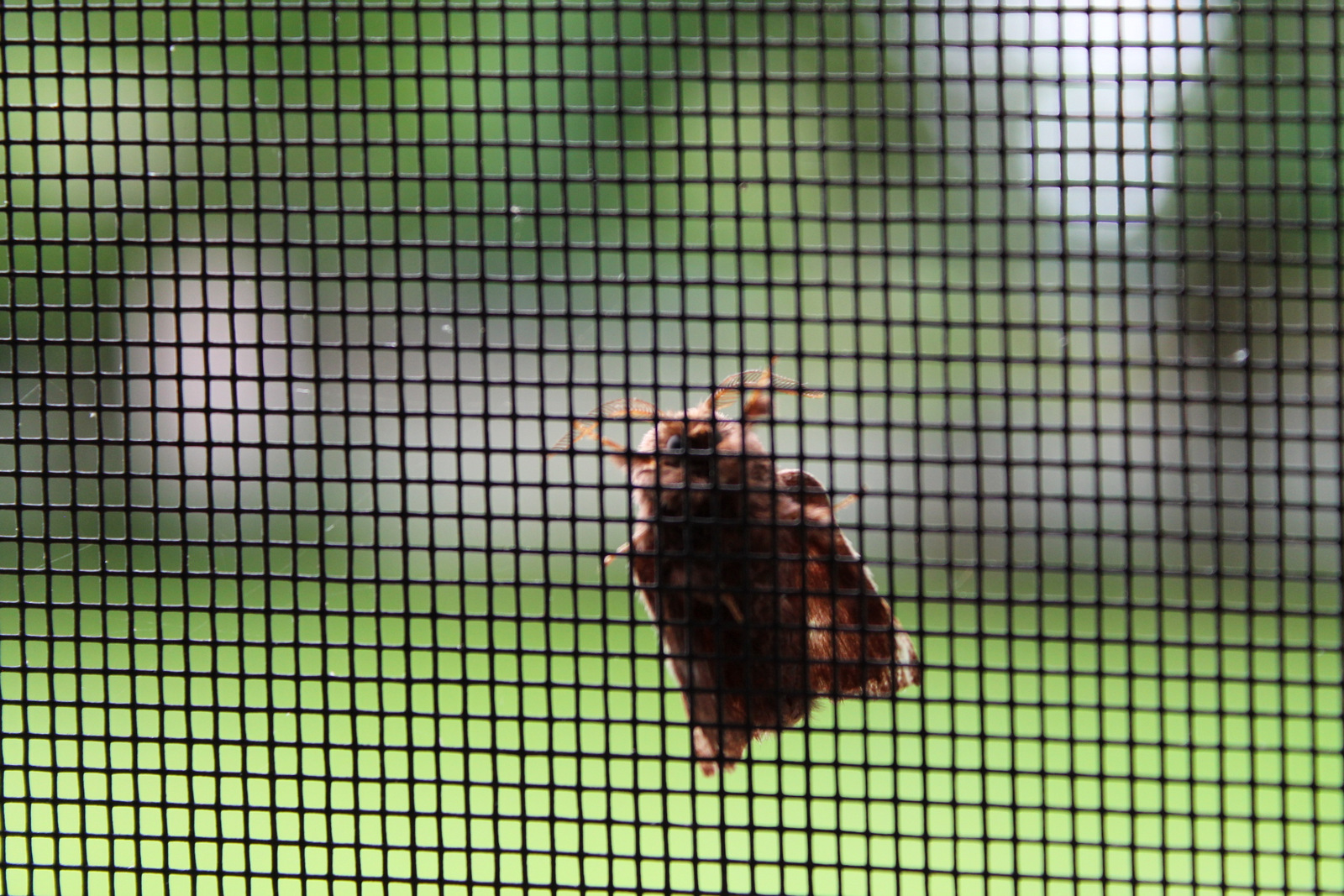
A recent visitor looking in my shop window

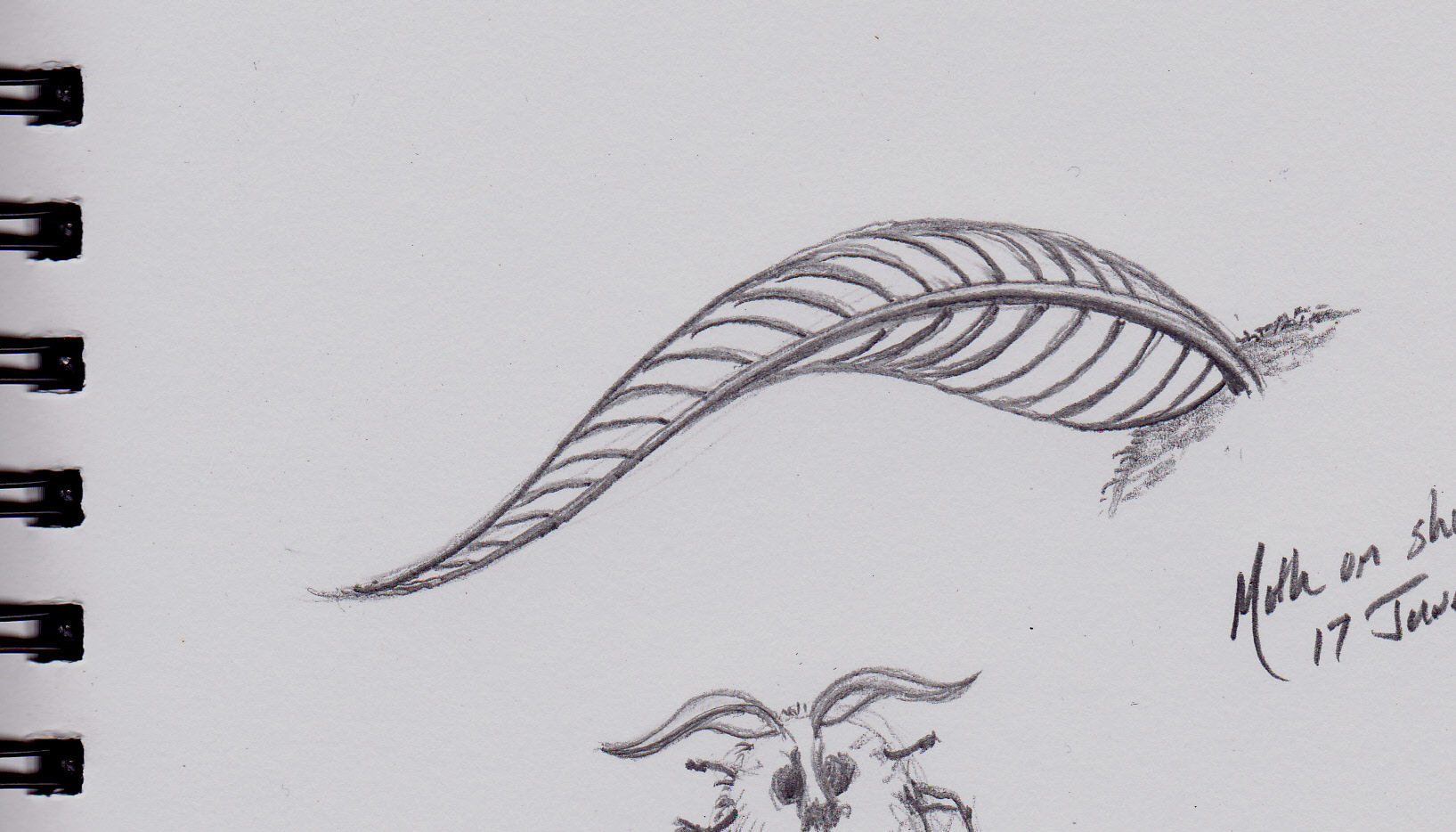
Moth sketch_NEW

My somewhat idealized view of the curves when looking from a particular angle.  Moth inspiration.

Posted in layout, quotes and excerpts, sketch, Uncategorized | Tagged , , | 1 Comment