Shrink Pots, Paint and Lettering

IMG_8057   IMG_8059

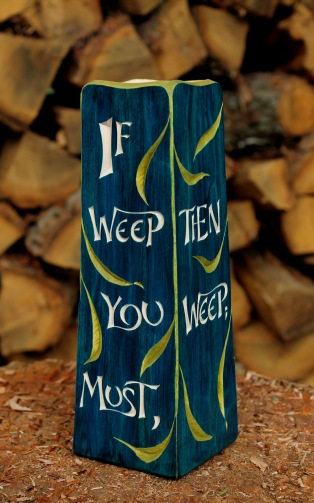
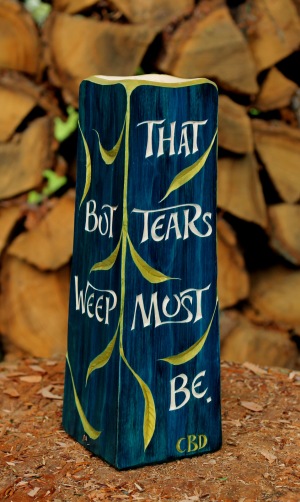
If weep you must, then weep; but weep that tears must be, and be

Gentle and grow as, weeping to the ground, the willow tree;

And grace will come, lighting the eyes of heaven, after thee.

Catherine Breese Davis, Be Graced

The shrink pot above is the result of being asked to design and make a shrink pot to feature a portion of a beloved poem.   This pot, as well as a couple others, will let me share some brief thoughts on lettering and painting ideas I’ve been exploring.

The CBD shrink pot above has a square base; as long as the pith was in the middle, the pot walls will shrink around a square as well.  This is the same idea as the rectangular base of the book style shrink pots like the one you can see part way down this post.  After boring a 2″ hole through, I used a long gouge to shape the tapering square hollow of the interior.

The outside was textured with long loose cuts with a wide shallow gouge, then painted with a couple different layers of glazes of thinned artist oil paints.  After carving the willow leaves, I added another layer of thin green, and wiped it off the surface of the rest of the pot.  Then I cut the letters, leaving them the natural color of the aspen wood.
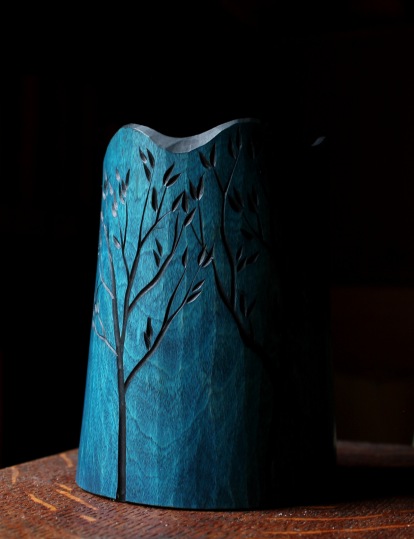
IMG_6717I used a similar technique on this shrink pot to the right.  After painting a very thin, and relatively bright, blue over the pot, I carved the trees and the undulating rim.  Then I painted a thin black over all, wiping the surface completely right after; like applying and wiping off wood stain.  The black pigment was accepted readily by the bare wood of the trees and rim.  However, on the surface that had been painted a bright blue, it only deepened the color of the blue to a sort of twilight blue.

There are many other ways to play around with different color combinations and carving sequences.

Of course, there are still many occasions where I want the character of the wood to speak for itself.  The slide show below shows a cherry shrink pot made by request for a wedding gift.  The couple was married in the mountains of Indonesia, and the words refer to how the couple met.

This slideshow requires JavaScript.

IMG_6278

Sharpen your knife and make some chips.


Posted in Lettering, paint, patterns, quotes and excerpts, shrink box, Uncategorized | Tagged , , | 24 Comments

Before-and-After Dragon

IMG_7933

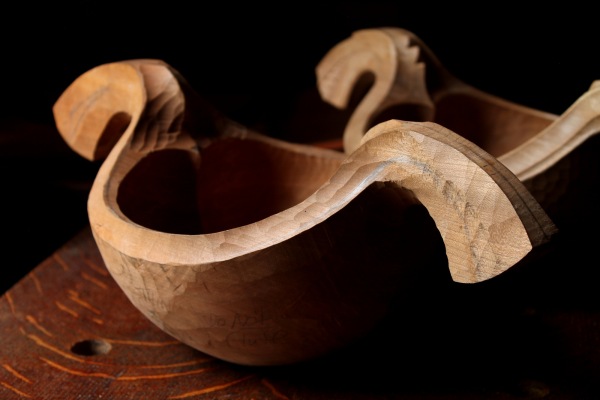
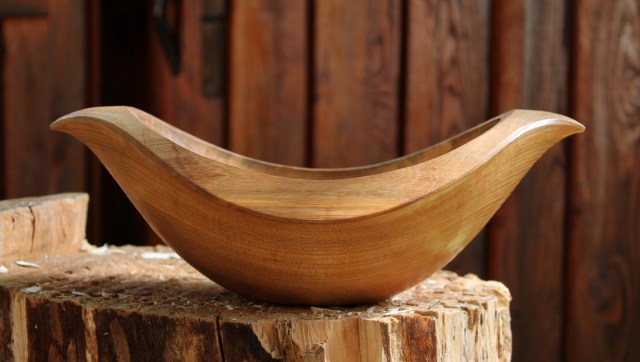
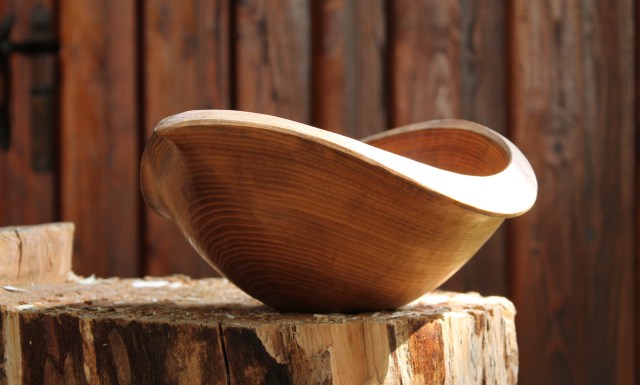
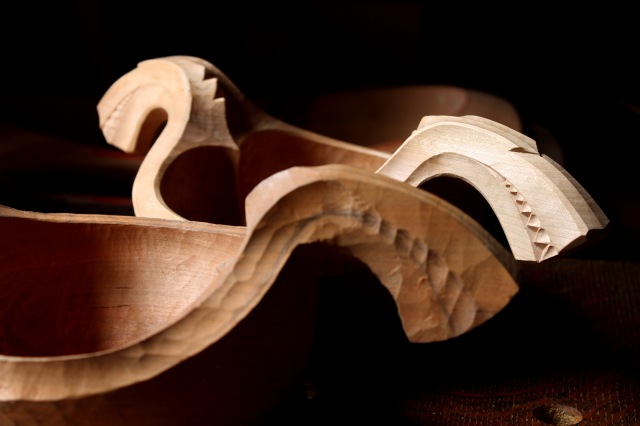
I’ve completed the carving on one of the cherry dragon ale bowls I roughed out a month ago, and thought I’d share a few photos to contrast the piece after the final carving with its unfinished twin.  The same ideas carry over to other bowl designs as well.

In the photo above, the rough cuts left from the green carving stage are evident in the dragon in the foreground, as well as the darker color that develops through oxidation as the piece dries.  The cuts of the dry carving stage reveal a fresh surface, the color of which will deepen with the application of oil, time and sunlight to a rich reddish brown.

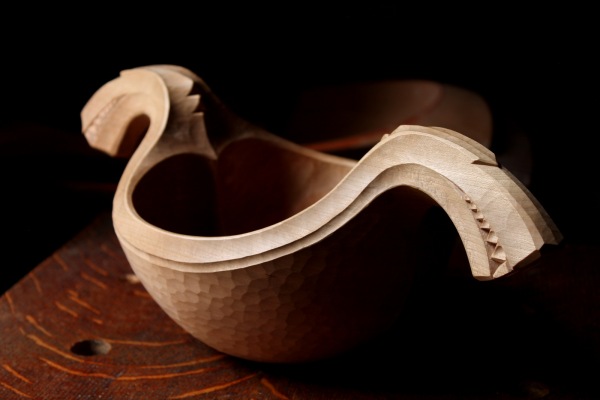
In the photos below, you can see various surface and form refinements as well as added details such as the teeth.  The wood is significantly harder after drying, so I remove as much as I can while it’s green.  The dry wood responds with crisp cuts and a burnished surface.

IMG_7940

Cherry dragon ale bowl roughed green, waiting for finish carving.

IMG_7939

Cherry dragon ale bowl after finish carving, waiting for oil — and ale.


IMG_7943

Spokeshave marks on the left, gouge texture on the right.

IMG_7955

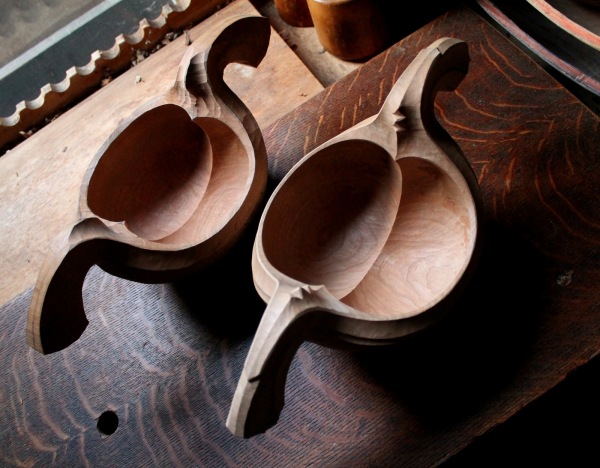
View from above. I’m even more diligent to remove all I can in the hollow when green, leaving just a light surface carving in there after drying.

It’s 13 1/2 inches long and will hold 24 ounces.  Now to oil it and get it on its way to a very patient and thirsty person.


Posted in ale bowls, cherry, drying, Uncategorized | Tagged , | 23 Comments

Florida in February

Florida postcardIf you want to drop in for three days at the Florida School of Woodworking in Tampa, I’ll be teaching a bowl carving class there as part of Fine Woodworking’s Hands On Tampa event February 1-3, 2019.  I’ve never spent a single day of winter where there’s no winter, but I’ll manage somehow.  They tell me we may even get to carve outside — in February!
There are seven other classes as well, with a list of instructors that I would love to learn from, including Mary May and Peter Galbert. Registration has now opened.  Check it out at the link above.

I’ll be in Plymouth again too — after things warm up next year.  More on that and other possibilities later as things take shape.


Posted in classes, events, Uncategorized | Tagged | 4 Comments

Three Bears’ Bowls

IMG_7766

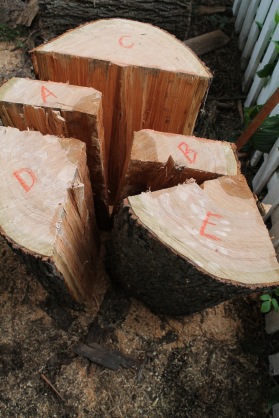
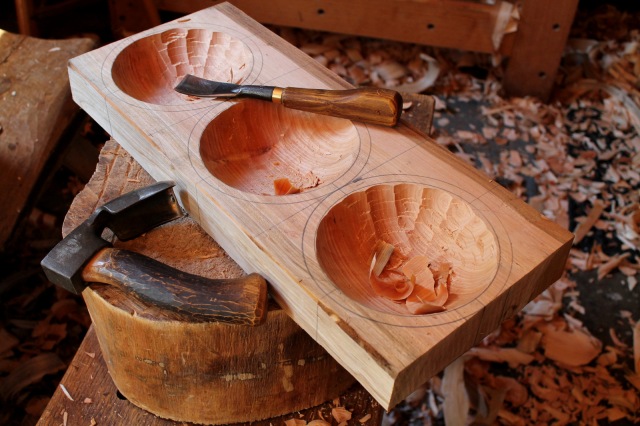
Among the projects I’ve got underway are these three bowls that Goldilocks might find just right for pilfered porridge.  I made use of a central section of the big cherry log I split up a few weeks ago.  I wrote about that process in this post.  This is the section labeled “A” in the photo below.

IMG_7104

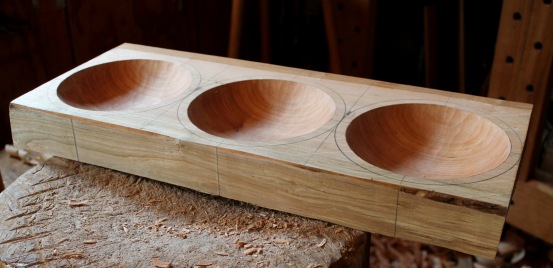
I wanted three bowls of the same size, so I hewed and planed this billet, then laid out the three bowls in a row along its length.  After some adze chopping, I cleaned up the hollows with a bent gouge.

IMG_7779

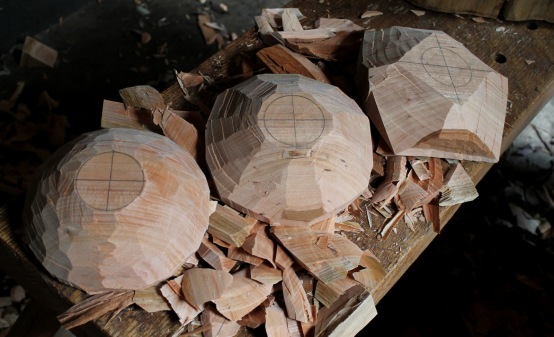
Then I sawed them apart before hewing the outsides with an axe.  Three stages of that process can be seen below from right to left.

IMG_7792

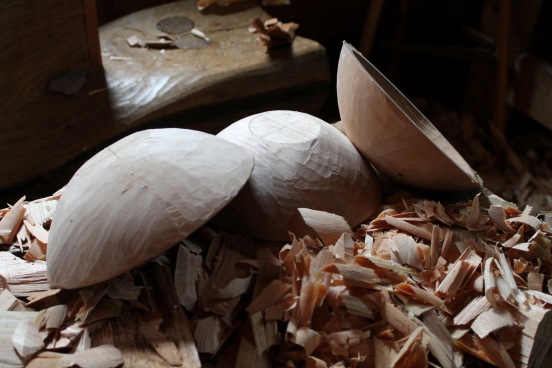
After a little work with a spokeshave, they’re ready to dry.

IMG_7806

After drying, I’ll re-carve all of the inner and outer surfaces, including three different texture patterns on the exteriors.  If all goes as planned, these will appear again, finished, in a future article.  There, I’ll write at greater length about the process, and we’ll see which one turns out “just right.”


Posted in axe, bowls, cherry, holding, layout, Uncategorized, writing | Tagged | 7 Comments

Dan Dustin and the Spoon Auction

IMG_7808

Today, I was exploring the rich variety of spoons up for bid in the online auction to benefit the Wille Sundqvist and Bill Coperthwaite Slöjd Fellowship Fund.  Many more spoons had been posted over the last couple weeks.  The auction just opened for bidding, so check it out.

As I looked through the inspiring and wonderful variety of donated items from around the world, my mind settled on a long twisted ladle by Dan Dustin.  I’ve not met Mr. Dustin, and that, along with his philosophy and unconventional life and methods makes him a sort of mythical character in my mind.  Yet, I’m assured he’s quite real and has been continuously making wonderful spoons in the mountains of New Hampshire since the Nixon administration.

Seeing Dan’s ladle reminds me of his book Spoon Tales.  I acquired a copy a few years back, and beautiful photographs by Clive Russ accompany the sparse but meaningful text.

Having evolved as tool users, we know when we see something that will serve us.  That knowledge called beauty, is felt below the ribs and confirmed by touch.

— Dan Dustin, Spoon Tales

And if you might enjoy some spoon carving wrapped into a novel, Dan’s work inspired author Ernest Hebert to write Spoonwood .  It’s a gripping and touching story with lots of juicy spoon carving scenes!

Posted in books, events, quotes and excerpts, spoons, Uncategorized | Tagged , , | 4 Comments

Three in the Rough

IMG_7743-002

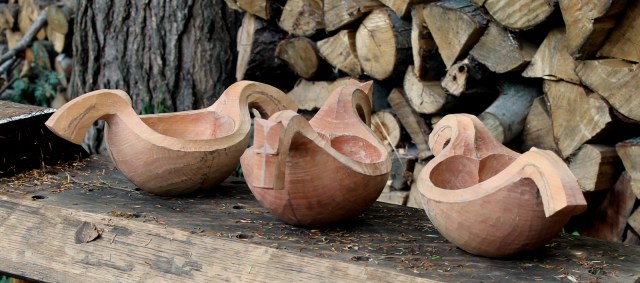
I’ve had some ale bowl requests on the backburner for far too long now, so while I had some cooperative cherry around I decided to rough out three at once.  That makes it sound much more straightforward than it is.  I’ve already written over a dozen posts about ale bowls, including some featuring these dragon and horse designs, but maybe there are a couple fresh thoughts to share from this latest exploration.

As can be seen in the top photo, these three are just in the rough right now, at the end of the green carving stage.  It’s always a relief to get them to this point where I can confirm the resolution of the design.  There’s still plenty of room for refinement, but the various curves and surfaces are established.  At this point, I can sense that it may actually all come together harmoniously.

It makes me think of an excerpt from the book Emil Milan: Midcentury Master:

“Don’t make a potato” was a design mantra that Emil repeated throughout his courses.  The curves, bumps, and hollows of a potato are resolved too, Emil would say, just not in an aesthetically pleasing way.  It is just an amorphous lump.  The difference between a potato and a work of sculpture lies in the areas where the curves and planes come together.  Properly resolved, two intersecting areas of a three-dimensional work will create a line that is visually prominent in the final piece.  If that line creates a pleasing curve, the piece will look aesthetically refined and “sculptural.”  If not, it will look like a potato.

Who wants to make an ale potato?  Avoiding it, begins with removing big bits of wood in the right places early on.  I saw shoulder cuts across the grain of the cylindrical blank (with no pith remaining), then split away material on both sides of the central bit for the head — like forming a tenon.

IMG_7653

Then after some more chopping and sawing things start to become slightly recognizable, but still quite blocky.

IMG_7677

After shaping the outside some more, I start removing material to form the deep hollow of the bowl.  I hack out a little bit with an adze, but quickly have to switch to gouges.  A standard long-bent gouge won’t reach in there, so much of the hollowing is done with a spoon-bent gouge.  This one is a #8 sweep.

IMG_7731

Here’s one way to hold the bowl for hollowing.  Hand screw clamp held upright in the vise.  The bottom of the bowl can be supported on the bench itself or, as in the photo below, by a stick extending beyond the bench.  It’s many cuts and thin chips.  I’ll finish the hollowing with hook knives.

IMG_7730

After some drying, it will be time for lots of refinement and finishing cuts and, hopefully, they won’t look like potatoes.

Posted in ale bowls, cherry, holding, layout, quotes and excerpts, Uncategorized | Tagged , | 15 Comments

Big September at North House

show-rhythm-and-sloyd-surolle-20-x-30-cm

Jögge Sundqvist will present Rhythm & Slöjd at North House Folk School on September 14.

Grand Marais, Minnesota will be a hotbed of craft celebration next month.  Spoons  have been showing up on the doorstep of North House Folk School for the fundraising auction that I wrote about in this post.  There is a rich variety, with some arriving from as far away as Australia and Lithuania.  The auction will run from September 7 through September 16, so there’s still time to send a spoon.  Here is the address:

North House Folk School
P.O. Box 759
500 W. Highway 61
Grand Marais, MN 55604, USA

If you’d like to preview some of the items and plan your bids, click this link to the site for the online auction and click on “view all items.”  There are some unexpected surprises like a donated bowl made by Emil Milan.  The recently published book honoring Emil is stunningly beautiful and an inspiring read.

If you can make it to Grand Marais in person, you won’t want to miss the “Unplugged” events over the weekend of Sep. 14-16th, including Jögge Sundqvist live and in action with his Rhythm & Slöjd performance as well as his teaching.

I also wanted to pass along some very special and unique opportunities available at North House where they are accepting applications for Craft Education Internships and their Artisan Development Program.  Check out those links for more exciting information.

Posted in classes, events, Uncategorized | Tagged , | 7 Comments

Bee Still

img_7450.jpg

Bees do have a smell, you know, and if they don’t they should, for their feet are dusted with spices from a million flowers.

— Ray Bradbury, Introduction to Dandelion Wine (1957)

IMG_7444-001

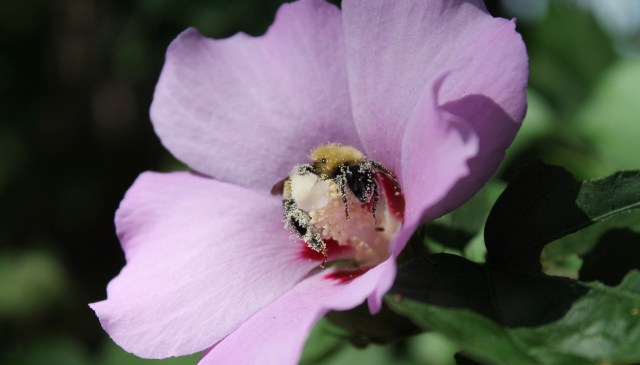
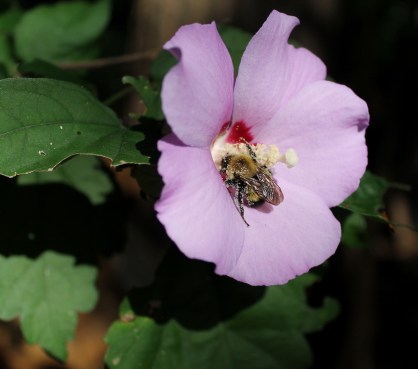
Bumblebee on rose of Sharon (Hibiscus syriacus)

Setting down my carving knife, I marveled at the bumblebee intently exploring a rose of Sharon.  Then, breaking from his busyness,  he draped himself over the stamen and rested (top photo).

Knowing next to nothing about bees, I was free to take anthropomorphic delight in the idea that he was overwhelmed by the abundance of summer, or maybe had paused in gratitude.   It’s nice to feel a connection with a bee.

I did not try to smell the bee; I like Ray Bradbury’s notion, untested.

Posted in nature, quotes and excerpts, Uncategorized | Tagged , , , | 6 Comments

Slippery Elm Bowls

IMG_7515

There’s no better way to understand the working properties of a wood species than to carve a chunk of it.  Its character is revealed through experience with it,  including subtle nuances that are difficult to communicate.  Different trees within the same species also have their individual personalities.

A couple months ago, I was offered a log from a slippery elm tree (Ulmus rubra), also known as red elm.  A little research explains a few things about the tree, its lumber, and its medicinal qualities, but I had to give carving it a whirl to really know the wood.

I carved two bowls from it.  The fact that it is ring-porous makes it a less than ideal choice for liquid-holding bowls, but isn’t an issue for most uses.  It can be a challenge to get good finishing cuts due to the strong contrast between the dense latewood and the porous earlywood.  I like the rich, reddish-brown color.

Designing with the character of the wood in mind, the first bowl I carved from it highlights the prominent growth ring pattern that was very even and concentric in this log.  I carved a bowl that brings a double bird to mind, with sweeping undercut wing forms.  14 inches long, 9 3/4 inches wide and 5 inches high.

IMG_7519

I carved a large round bowl as well.  The elm moved quite a bit as it dried, leaving a flowing roller-coaster rim with the high portions at the end grain.

IMG_7494

The open grain of this wood was also a golden opportunity to try the shou sugi ban technique of charring wood.  My friend Eric Goodson had written an intriguing and instructive blog post (that’s a link) about it early this year.  I followed Eric’s recommended procedure and it worked great.

IMG_7505

Not only did the outside become a rich black, but the grain patterns were enhanced as the earlywood burned away easily, leaving the latewood raised.  The outside had been left subtly faceted by the drawknife before torching.  You can still feel them a bit, but without exact edges between the broad facets.

IMG_7503

I decided to carve a vigorous loose texture on the inside of this one.

IMG_7509

Now back to cherry…

Posted in bowls, finding wood, paint, trees, Uncategorized | Tagged , , | 13 Comments

Roughing Spoons from Straight Blanks

img_7376.jpg

Spoons are cranky.  Take a close look at just about any spoon, whatever the material, and you’ll find that the rim of the bowl of the spoon is not in the same plane as the handle.  The angle between them is not typically a flat 180°.  It’s more ergonomic to have the handle raised up to some degree relative to the bowl.  The angle varies depending on the intended purpose of the spoon.  A stirring/cooking spoon might have a handle raised up just 10°-15°.  Most eating spoons are a bit higher, in the neighborhood of 15°-20°.  Servers can vary all the way up to a deep ladle approaching 90°.  Don’t get caught up in the numbers, though.  Curves through the handle and bowl rim make measuring any actual angle pleasantly fuzzy, and I don’t measure when I’m making them.  Trust the feedback that comes from your hands and eyes as the spoon takes shape.

IMG_7533

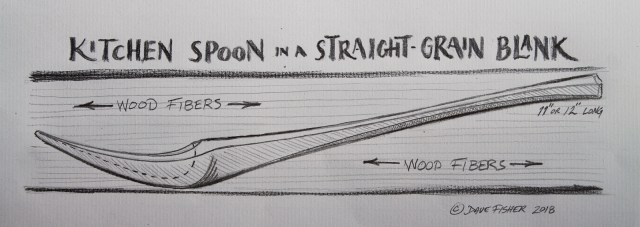
Not an exact plan as much as a general idea of orientation.

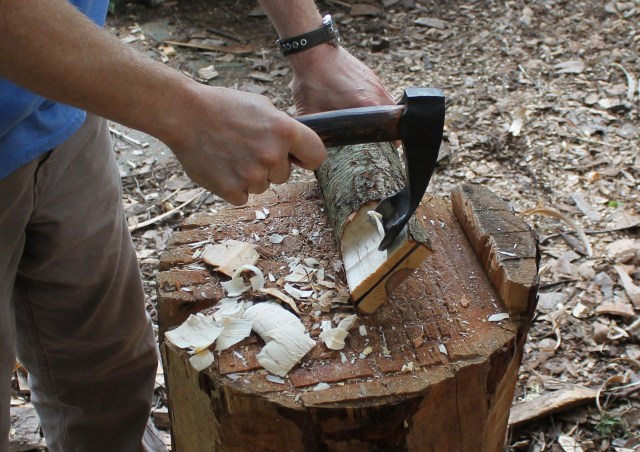
Crooked branches establish much of their own crank when they are split, and they often allow for significant bend while still maintaining strength through the long fibers of the wood.  And even when the bend in the spoon is relatively shallow, if carved from a crook, it can be carved thinner than the same spoon from a straight-grained blank.  While crank can still be achieved from straight-grained blanks,  I don’t push the bend too far or make the bowls too deep.

IMG_7372

While roughing out a spoon yesterday from a straight piece of cherry, I took some photos through the process, this slideshow shows how I go about it, including achieving the crank in a straight-grained blank.

This slideshow requires JavaScript.

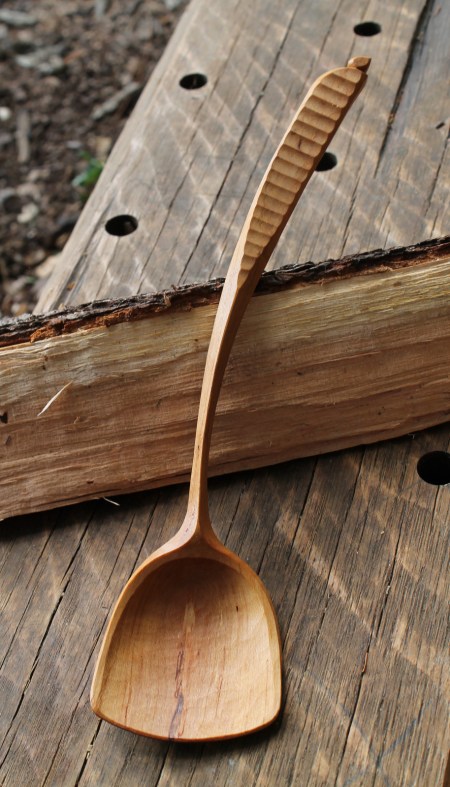
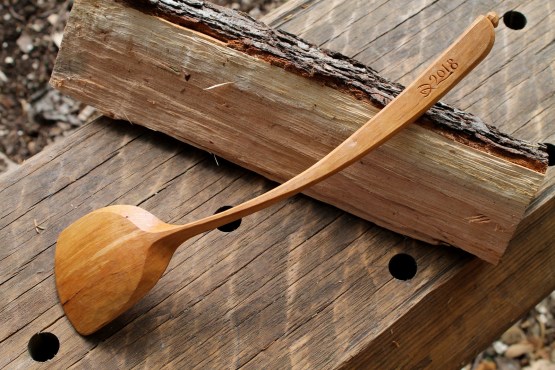
The procedure is similar for crooks, while taking into consideration the unique flow of the grain in each one.  Here’s a serving spoon from a cherry crook that I just finished.  14″ long, 3″ wide.  I’ll be boxing it up to send to North House Folk School for the auction coming up soon.  I know there will be lots of others as well.  Still time to carve yours!

IMG_7477

IMG_7474

Posted in carving, layout, sketch, spoons, Uncategorized | Tagged , , | 13 Comments