Axe Work

img_9501

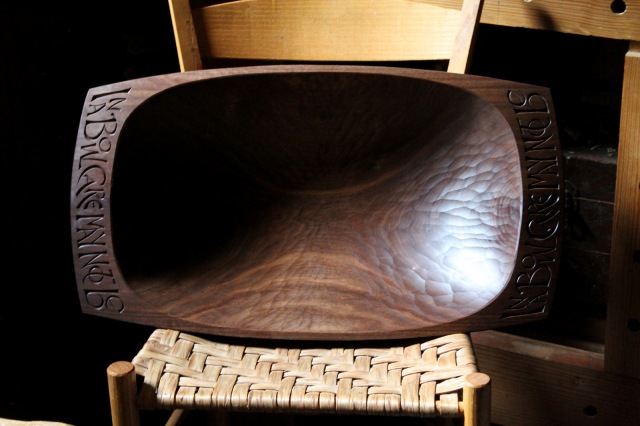
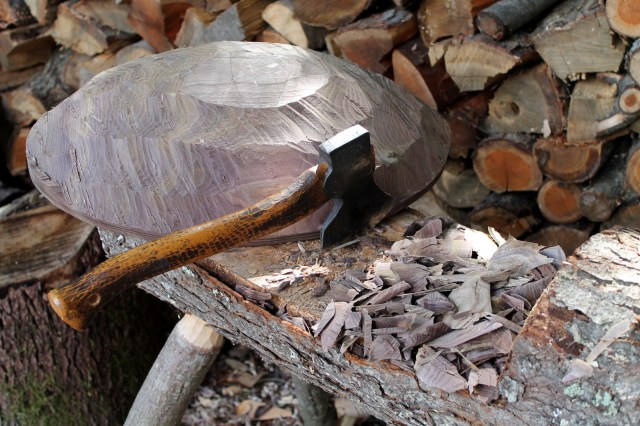
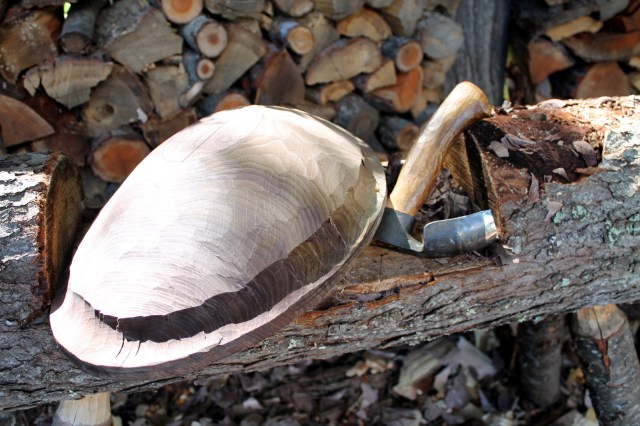
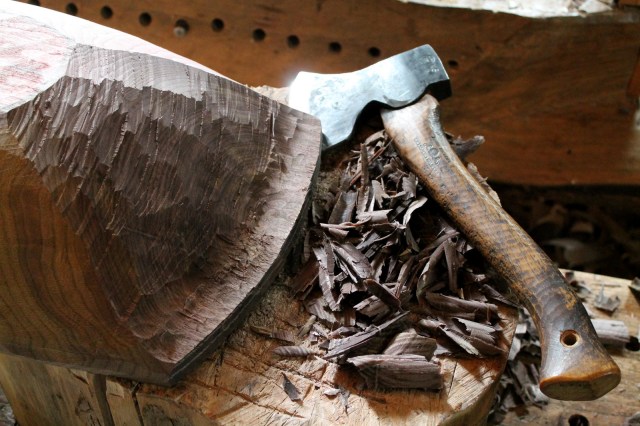
I’ve been roughing out a couple walnut bowls, which means plenty of fun axe work.  One of the more challenging aspects is shaping the end grain area S curve; the bowl will be convex as it leaves the bottom, then return in a concave area beneath the handles.  Essentially, I handle this in three steps:  Hew away the bulk of material in one convex arc from bottom to handle, hollow beneath the handle across the grain with an adze, then hew again with the axe down to the newly created hollow.  You can see these same stages in the series of three photos below, but on an oval bowl that features that returning curve all the way around.

img_9459-001

I have hewn a roughly convex surface all around the bowl from the bottom perimeter to the lower edge of the rim.

img_9473-001

With the adze, I’ve created a hollow beneath the rim all around.

img_9474

And here, I’m in the process of merging the convex portion with the new hollow.

img_9499

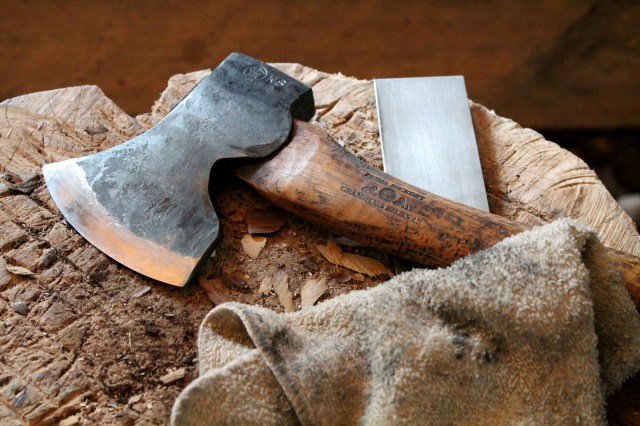
Of course, all of this is much more fun with a sharp axe.  It may sound boring, but the ability to get your tools properly sharpened can transform your carving experience and the final product.

Tim Manney

One guy that eat, drinks, and breathes all things related to tool design and sharpening is Tim Manney. I experienced this first-hand in some of the conversations Tim and I enjoyed in Plymouth. Tim has put a lot of time, thought, and unique experience into developing practical sharpening methods that work and don’t require expensive fancy equipment, and I noticed that he’s going to share his skills and ideas with folks at at an upcoming Plymouth CRAFT class in November. Looks like PC has redesigned the website and it looks great. Check out Tim’s class here, as well as other upcoming classes with Peter Follansbee and Amelia Poole.


Posted in axe, classes, green woodworking, tools, Uncategorized | Tagged , | 6 Comments

If Yinz* are Ever in Pittsburgh

sam_3036

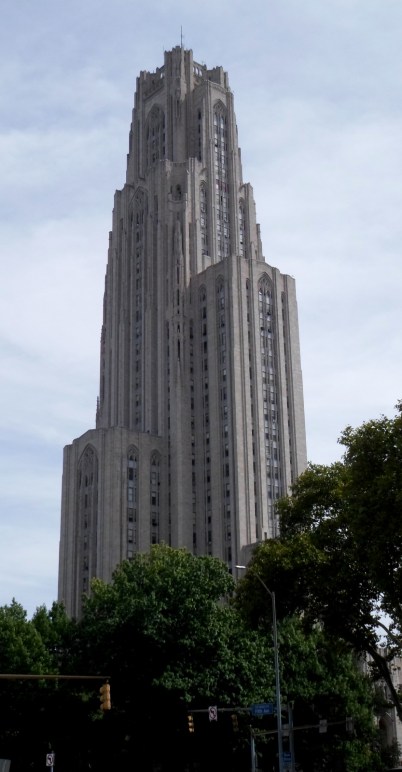
The Cathedral of Learning

Earlier this week, I found myself with a few hours to walk around the Oakland neighborhood of Pittsburgh.  There was no chance of getting lost; all I had to do to orient myself was look for the centerpiece of the University of Pittsburgh’s campus, the Cathedral of Learning.  Towering 535 feet into the air, it can’t be missed.  I’ve admired its Gothic Revival facade on several excursions to Pittsburgh, but it was the chance to see the inside that thrilled me on this trip.

I like museums, but the Cathedral of Learning has its own unique appeal.  Just a block away are the fantastic Carnegie museums of Art and Natural History.  They are gems in their own right and I enjoyed another visit on that day as well, seeing too many things to begin to mention here.  I understand the need to keep certain objects out of reach or behind glass in a public museum setting, but the Cathedral of learning is not behind glass; it is used every day.

sam_3060

A portion of the vaulted ceiling of the main hall


Pitt students were hurrying into classrooms when I went in, classrooms like no others I’ve ever seen.  Surrounding the main hall with its sixty-foot- high vaulted ceilings are the international rooms, a celebration of the city’s rich immigrant heritage.  The ethnic communities were invited to have their skilled craftsmen and craftswomen design and outfit rooms dedicated to their respective homelands.   For nearly 80 years, these rooms have been living tributes and are still used as everyday classrooms at the University.

As I wandered the hallways past open classroom doors, students were taking notes in  carved oak chairs as breezes blew through open leaded glass windows.  Dozens of other students were studying or talking quietly in the main hall, surrounded by hand carved oak and stone, a bit of a surreal scene that might have been imagined by J. K. Rowling.  Every door hinge and latch was unique and created by the hand of a smith — and you could touch them.

sam_3184

The door latch in the Norwegian Room

Off of the main hall, stone passageways lead to all sorts of quiet study or reading nooks.  The limestone stairs in these passages have been beautifully worn by countless steps.  I could have sworn I heard a voice whisper, “Carpe Diem.”

sam_3058

I only had a little point-and-shoot camera with me, but here are a few other assorted photos:

This slideshow requires JavaScript.

If you’re interested in seeing and hearing more about the Cathedral of Learning and the International Rooms (of which more continue to be added), I’ll include a few good resources below.  But don’t let that stop you from showing up in-person; just another great reason to visit Pittsburgh and western Pennsylvania.

This page from the University of Pittsburgh provides some general information and links to more about the Cathedral.  And here is a page from the same site that features a short narrated video tour of each of the International Rooms.

Here’s a tour and story of the Cathedral of Learning hosted by John Ratzenberger (a.k.a. Cliff Clavin).

*Oh — and finally —  if the “yinz” in my title threw you off, this will clear things up.  And if you really want to explore Pittsburghese in more depth, check out this article and have some fun on this website n’at.


Posted in carving, historical reference, patterns, Uncategorized | Tagged , , | 2 Comments

Iron Horse?

It’s been a long time since I followed new products and gadgets in the non-traditional tool world, which is fine with me.   Today there was an email from Woodcraft in my inbox announcing a special on a new product, something called the King Portable Work Station.  Normally, I wouldn’t click, but the picture accompanying the email caught my eye; I noticed that it seemed to be a metal cousin of sorts to the bowl horse — sans seat.  Although it probably developed more along the lines of a saw horse that incorporates a clamp.

The name is a little lackluster, but then I noticed in the related products section at the bottom of the page, that Rockwell had already taken the cool name of “The Jawhorse” with their version (that, I would guess, is pretty new to the market as well), but what do I know.

From what I was able to learn in a few minutes, it seems that you engage the clamp with the foot pedal, then lock it/release it with the switch in front.  Would it be useful for bowls?  Beats me, but I’ll admit I can see some possibilities for certain operations.  I do know I’ll stick with my wooden bowl horse and bench; all that shiny metal scares me.


Posted in holding, tools, Uncategorized | 10 Comments

Dark Horse

img_9280

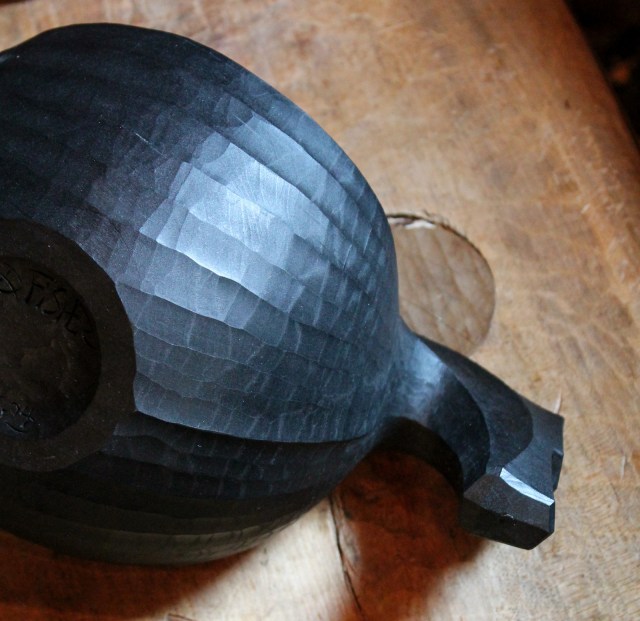
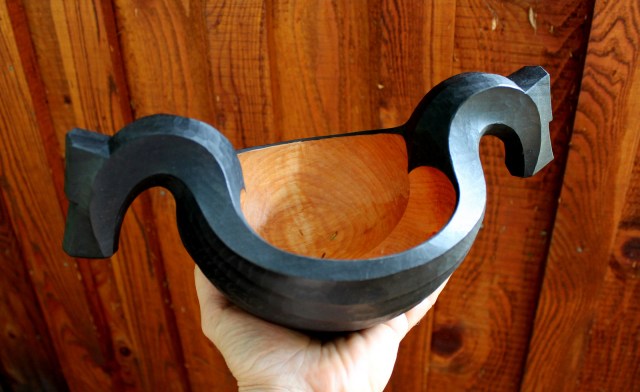
I carved this ale bowl from some more of the red alder I mentioned in my last post.  Then I tried something new for me: I painted (ebonized I suppose) the outside  with waterproof black India ink.  I like how it completely absorbs into the wood, allowing the lines of the grain to still remain evident.

img_9363

The ink is water-based, but I didn’t notice much grain raising.  I think this is mainly because the surfaces were straight from the knife.  Had it been sanded, all of those torn fibers would have absorbed the water from the ink and raised up on the surface.

img_9369

I like the contrast between the black and the natural reddish brown interior.  I even like the solid hard black knot area on the interior.

img_9371

When carving the exterior, I left a series of loose, shallow faceted flutes that merge and fade beneath the neck of the horse.  After the ink dried for a couple days, I treated the entire piece with flax seed oil, followed by a flax oil/beeswax blend.

img_9307

It feels nice with the web of your hands under the necks, and it’s big enough to share, easily holding 24 ounces of ale.  The dimensions are 12 3/4 inches long, 7 inches wide, and 5 1/2 inches high.

img_9393

Posted in ale bowls, bowls, green woodworking, paint, trees, Uncategorized | Tagged , , , | 12 Comments

Around the Shop

IMG_9140

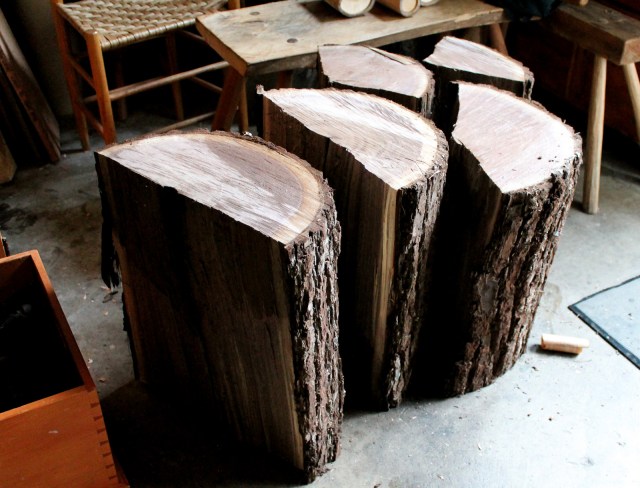
A look around the shop this morning, beginning with sections of a big walnut log I busted up which should become walnut bowls before too long.  And a requested set of cherry shrink boxes in the rough, drying:

IMG_9154

My dogwood froe club finally bit the dust.  It served well for over a decade, but cracked apart yesterday.  I’ve got another waiting in the wings.

Another ale bowl nearly finished.

IMG_9148

A drying haft.

IMG_9159

Found odds and ends awaiting inspiration.

IMG_9161

A just-finished bowl from a log that shouldn’t be around this area — red alder.  I tried a new design idea that brings to mind different things depending on how I view it: a leaf, a boat, or a bird.

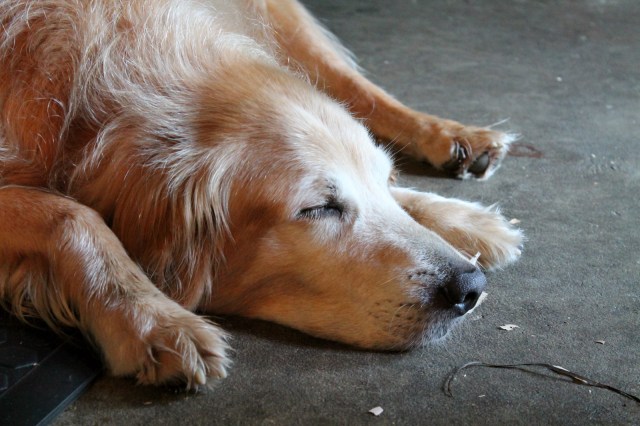
And, lastly, a sleeping Sam.  Happy Labor Day.

IMG_9165


Posted in ale bowls, bowls, tools, Uncategorized | Tagged | 10 Comments

Going with the Flow

IMG_9027

Back in June, I wrote a post about splitting a large maple crook.  Here it is again, sitting on a rock in the Little Shenango River.  The arch from head through tail follows the grain of the crook, and the wood revealed an interesting S-curve in the other plane.  I went with that general flow as can be seen in the next two photos, altering the symmetry to account for the movement as well.

IMG_9060IMG_9064

IMG_9112The curl through the piece is lovely, but makes for tricky surface carving.  Patience, sharp tools, and light cuts are key.  All surfaces are straight from the gouge and knife.

15 inches long, 4 3/4 inches wide, and 9 inches high.


IMG_9089My buddy, Sam, and I took the photos this morning during a walk along the river.  Today is his ninth birthday.  He enjoyed exploring,…


…although he did look a little surprised that I put the bowl in the river:

IMG_9080

The river is so low that we were basically able to take our walk in it.  We saw some cool things, including this clam out for a stroll:

IMG_9093

IMG_9028

Posted in bird bowls, bowls, finding wood, green woodworking, nature, photography, Uncategorized | Tagged , , | 7 Comments

This may not Work

IMG_9002

IMG_8996

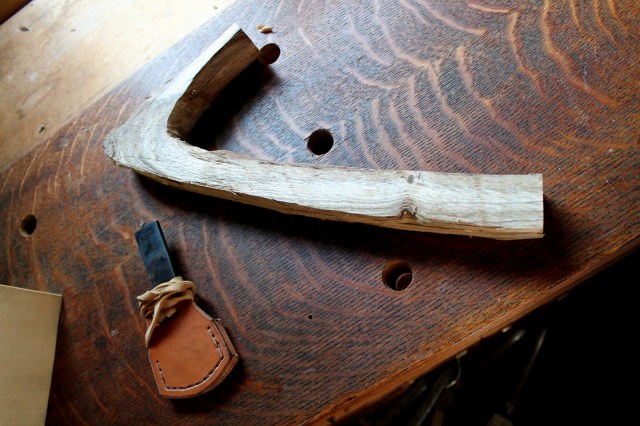
I cut off the bit to the right, and the rest was the handle.

The title of this post may have crossed the mind of John Damian in 1507 as he was about to jump from the walls of Scotland’s Sterling Castle fitted with wings made of chicken feathers.  I’m thinking the same thing about this new handle, but I’ve got much less at stake.


As I’ve mentioned before, in carving ale bowls and other forms with hollows that are undercut, hook knives of one form or another are pretty versatile.  With a little skewing and experimentation, it is amazing what areas can be reached  and cut with them. Last night, I took another Kestrel E-bend blade and attached it to one of the strangest handles I’ve ever made.  It started as an extremely bent branch piece that I had saved awhile back.

IMG_8997

same blade, different handles

It was a pretty quick and operation, and I’ll see how handy it is for those unusual spots in which the standard handle can get in the way.  It may turn out to be a bad or unnecessary idea, we’ll see as I try it out.  It will be easy to drill out the rivets and make a different handle if it comes to that — I know the blade is good. But maybe it stays; I kind of like the thought of some folks standing around a flea market table someday wondering what it was for and why it exists.  In the meantime it just might work out and it has to be more useful than, say, this:

Image result for fork pizza cutter

This may not Work.


Posted in ale bowls, bowls, carving, tools, trees, Uncategorized | 6 Comments

Singing in the Shop

IMG_8993

The crickets felt it was their duty to warn everybody that summertime cannot last forever.

— E.B. White, Charlotte’s Web

IMG_8980

I know nothing about crickets, other than there is one hanging out in my workshop and I like the way he sings.  I find his song soothing and the perfect carving accompaniment.

He’s been here the past few evenings.  On the second night, I spotted him on a board leaning against the wall — along with what I’ll assume was his intended audience.  I haven’t seen her since, and to be honest, I am assuming it was a her.  The night after that he sang again, using my pack as a stage.  He didn’t seem to mind me looking closely.  And as I write this, he is perched on a shelf full of odd chunks of wood, chirping away.  He’s helping me finish a bowl from a large maple crook, and I should be able to share the results soon.  I keep the door open, so he must want to see the project through to the end.

So, cheers to crickets.


Posted in carving, quotes and excerpts, Uncategorized | Tagged | Leave a comment

In a Bowl Care May Not Be

IMG_8888The inspiration for this bowl goes back to the Middle Ages.  It seems that the unpopular English King John (the same that inspired the legend of Robin Hood) planned to build a hunting lodge (another version suggests a royal road) near Gotham, a little village not far from Nottingham.  That was a little too close for comfort as far as the residents of Gotham were concerned, but how to dissuade the King?

The villagers agreed to a plan by which they would, in various ways, act like mad fools engaged in crazy pursuits.  When the royal scouts reported the scene in Gotham to King John, he decided to build elsewhere, frightened and duped by the “Wise Men of Gotham.”

_71499746_ff4309ad-370b-4c67-aa0a-96a01c2dabb2

A later version of the Gotham Tales

Although these stories are believed to have existed in the oral tradition as early as the 12th century, they were first published in the 16th century as “The Merry Tales of the Mad Men of Gotham.”  Among the tales is that of a man carrying sacks of grain over his shoulders as he rides his horse so as not to overburden the horse.  We also learn of the villagers’ attempts at drowning an eel as punishment for eating so many fish, and the man who lights his smithy on fire to remove a wasp nest from the thatch. Maybe the best known story is that of the failed attempt to fence in the cuckoo bird; it seems they built the fence too low.  The “Cuckoo Bush Mound” can still be visited in modern-day Gotham — population 1800.


These stories have inspired many creative efforts over the centuries since.  In fact they inspired Washington Irving to satirically nickname New York City “Gotham” back in 1807 in the magazine Salmagundi.  And if you want to look more deeply into the Batman connection, you can start here.

Well, I’m no Washington Irving (like Yossarian in Catch 22), but this bowl too was inspired by one of the Men of Gotham tales.

The particular tale is of three wise men of Gotham setting off in a bowl to rake or net the moon from the sea.  But of course, each time they engage their tools the moon scatters into pieces and eludes their grasp, only to reappear whole as before.  This episode led to a simple nursery rhyme in the 1765 edition of Mother Goose, printed below from the 1901 edition:

IMG_8869

My daughter’s decade-old Three Men of Gotham toy/bowl.  Complete with dings and stray nail polish, as it should be.  We’ll find the net one day…

The same story seems to have captured the attention of English writer Thomas Love Peacock (1785-1866).  He wrote a couple poems based upon it, one beginning with the line, “In a bowl to sea went wise men three, on a brilliant night in June: They carried a net, and their hearts were set on fishing up the moon.”  Years ago, when my daughter was a little girl, I carved and painted a bowl, three figures, and a net for her based on that one. The lines I carved on this walnut bowl, however, came from another, more thoughtful, of his poems titled Three Men of Gotham:
 

IMG_8892-001
Gotham’s three wise men we be.
Whither in your bowl so free?
To rake the moon from out the sea.
The bowl goes trim. The moon doth shine.
And our ballast is old wine.–
And your ballast is old wine.

Who art thou, so fast adrift?
I am he they call Old Care.
Here on board we will thee lift.
No: I may not enter there.
Wherefore so? ‘Tis Jove’s decree,
In a bowl Care may not be.–
In a bowl Care may not be.

Fear ye not the waves that roll?
No: in charmed bowl we swim.
What the charm that floats the bowl?
Water may not pass the brim.
The bowl goes trim. The moon doth shine.
And our ballast is old wine.–
And your ballast is old wine.

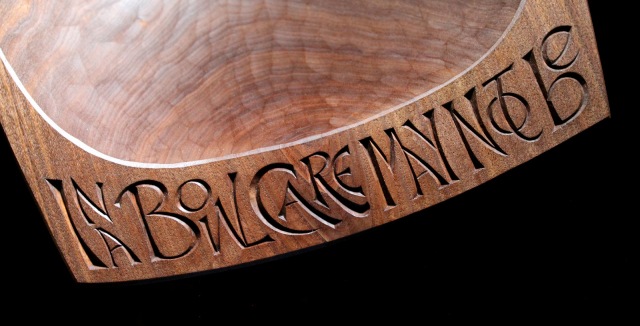
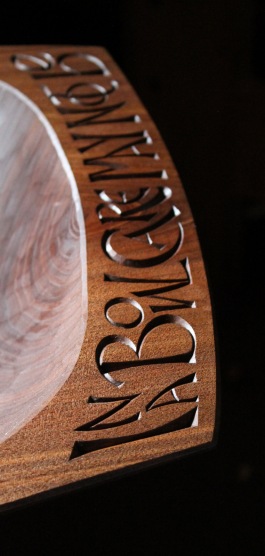
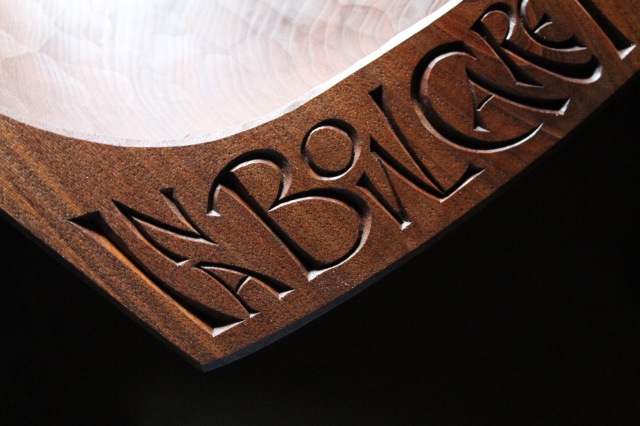
I find it interesting how he has taken this centuries old fun tale of feigned madness, and infused it with deeper meaning.  Captivated with the idea of the bowl as a sort of sanctuary from care and worry, I decided to carve the repeated line, “In a bowl Care may not be.” on the handles of this bowl.
IMG_8934

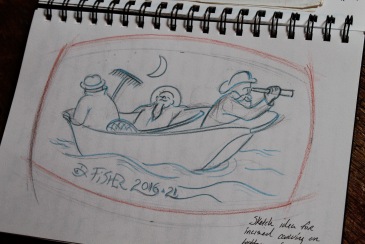
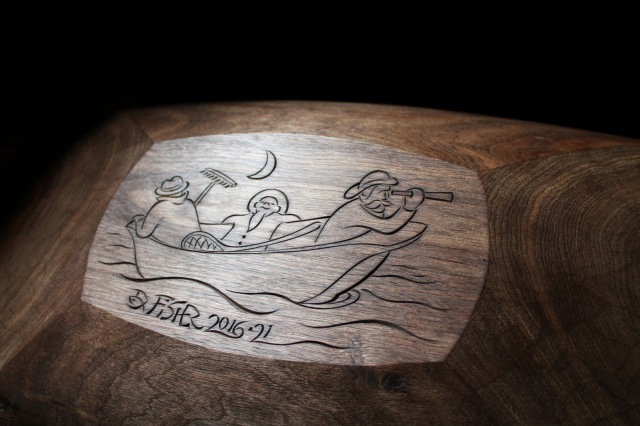
I wanted the bottom of the bowl to provide a hint of context for the excerpt, so I sketched an illustration that captures the scene as I imagine it.  It features a representation of this particular bowl carrying the three wise men of Gotham.  This was then transferred to the bottom of the bowl and v-incised with a knife.

Below are some more photos of the bowl, including the incised carving on the bottom.

IMG_8875

IMG_8907

The chair provides a sense of scale; this bowl is big and deep: 24 inches long, 13 1/2 inches wide, and 4 3/4 inches high, all heartwood black walnut.
IMG_8895

This work was done with the pen knife blade.

IMG_8841

A pre-oil shot.  I think I’ve seen a beard like that before.
IMG_8922

Letters this size in walnut require some chisel and gouge work, but the knife blade still bears much of the duty.
IMG_8953

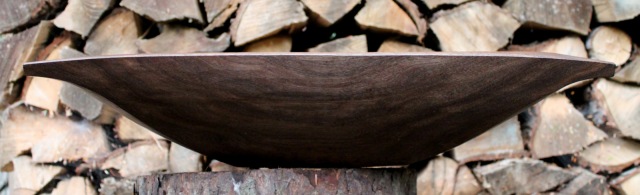
And a few outside shots after the rain ended to better indicate some of the exterior form, consisting mainly of four sculpted facets.  These outer surfaces were left from the drawknife with a little gouge work just under the handles.
 

Posted in Uncategorized | 12 Comments

Reflections on the Marsh

OLYMPUS DIGITAL CAMERA

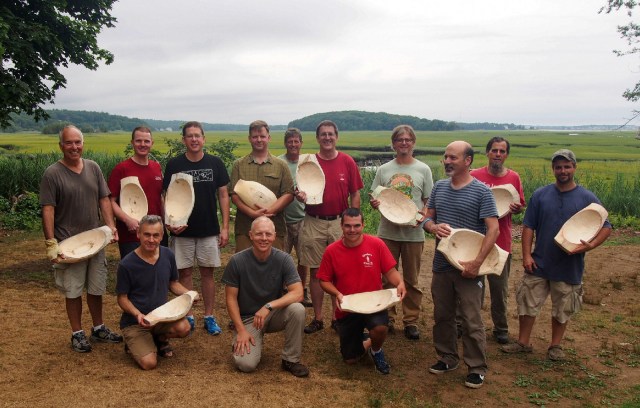
The Marshfield Baker’s Dozen:  (Front row L-R): Tom, me, Lucas, Nat (Back row L-R): Gene, David, Jonathan, Matt, Joel, Gordon, Sean, Pret, and Chris – a.k.a. Plymouth’s Paul Bunyan.  Their bowls were already looking great, with a couple more hours left to refine things.  Photo by Marie Pelletier

If you ever are part of a class with Plymouth CRAFT, be prepared to employ all of your senses beyond the work itself.  Between the beautiful venues, the mouthwatering flavors of Paula Marcoux’s hand crafted lunches, and the sense of comradery, the whole experience is one to be savored.

A couple weekends ago, I taught a class in bowlcarving in Marshfield, Massachusetts.  As we were busily setting up for the class Friday evening, I was shaken from my mental to-do list by the unique beauty of my surroundings.   As I walked around the corner from the barn, the fog was rolling in over the river that meanders among the marsh grasslands.  The effect was otherworldly — especially to a guy from Western Pennsylvania.  Heck, I still can’t get over the idea that those rivers keep filling and draining every day; back and forth, up and down, flowing this way then that…!  Where I’m from, the rivers have pretty much made up their minds.

OLYMPUS DIGITAL CAMERA

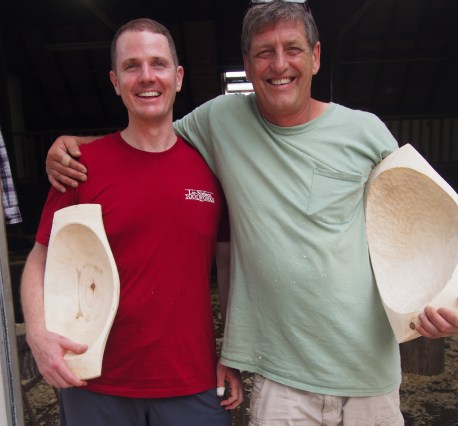
David and Joel with their bowls…and band-aids!

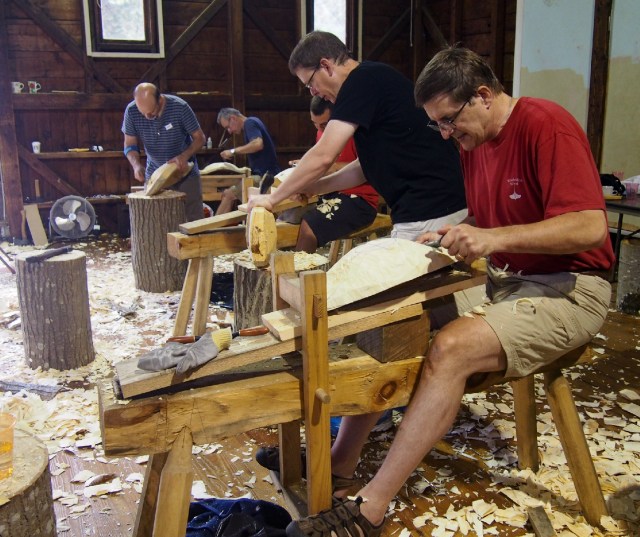
I had a great time reconnecting with a few folks met at Greenwood Fest and spending two days with a great group of guys armed with axes.  If you’ve never experienced the sight and sound of twelve adzes making chips fly through a barn, put it on your list.  By the end of the second day, everyone had transformed a log into a bowl, all in the same general design, but each unique due to choices made by the individual students and the nature of the logs.

I’d like to thank Marie Pelletier (a P.C. board member and all-around big help) for all of the photos in this post.  I am a terrible multi-tasker, so I failed to take a single photo during the class.  But Marie came to the rescue and shared some of her photos with me.  Thanks Marie.  Here’s a few more:

OLYMPUS DIGITAL CAMERA

Gordon, Jonathan, Lucas, Nat, and Tom working among the chips.

OLYMPUS DIGITAL CAMERA

Me (the guy who learned the most) admiring the lines of Joel’s bowl.

OLYMPUS DIGITAL CAMERA

We also had a chance to discuss things like lettering.

OLYMPUS DIGITAL CAMERA

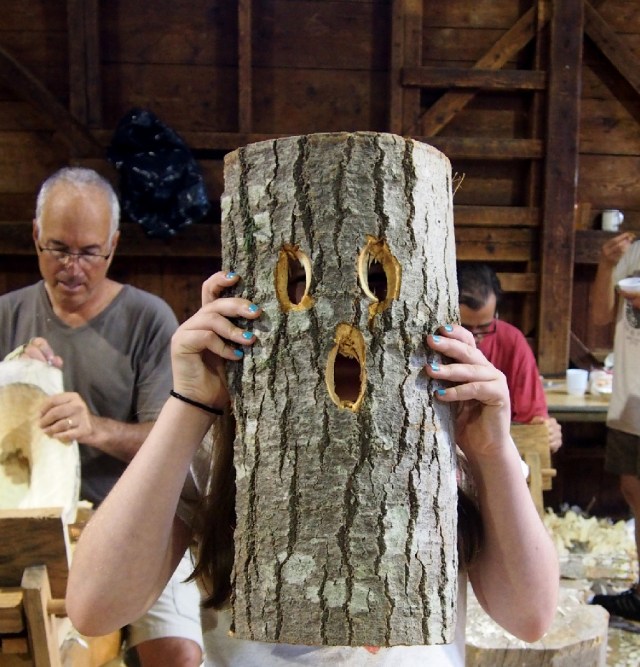
Peter Follansbee and his family took time out to visit the class both days, even though Peter was preparing to leave Sunday night for his trip to England and Sweden.  He showed us a quick trick learned from Roy Underhill in making a mask from a fresh piece of bark.  That’s Peter’s daughter, Rose, behind the mask.  Of course, you know it’s not Peter because he doesn’t wear blue nail polish.


Posted in bowls, classes, events, nature, teaching, Uncategorized | Tagged , , | 1 Comment