I had a plan in my mind for a square tapering shrink pot. As I smacked the froe and watched the waste from the first side fall away, I realized this log had other plans. This cherry tree had grown with a spiraling grain, now revealed in each of the four newly-split winding surfaces.
The opening lines of a poem I had read and copied into my sketchbook came to mind:
What has bent you,
Warped and twisted you,
Torn and crippled you?
What has embittered you,
O lonely tree?
— from The Pine at Timberline by Harriet Monroe
Here was an ideal lettering opportunity.
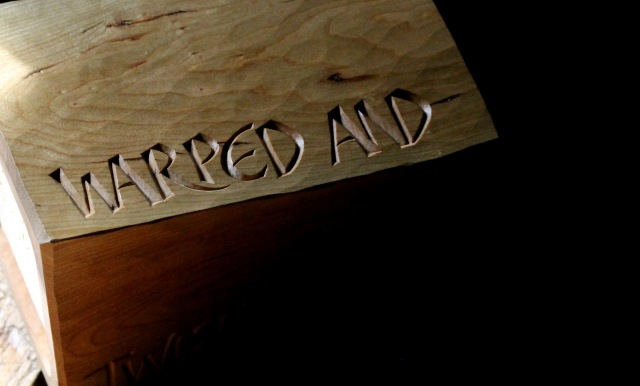
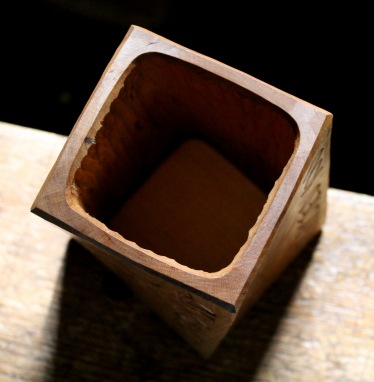
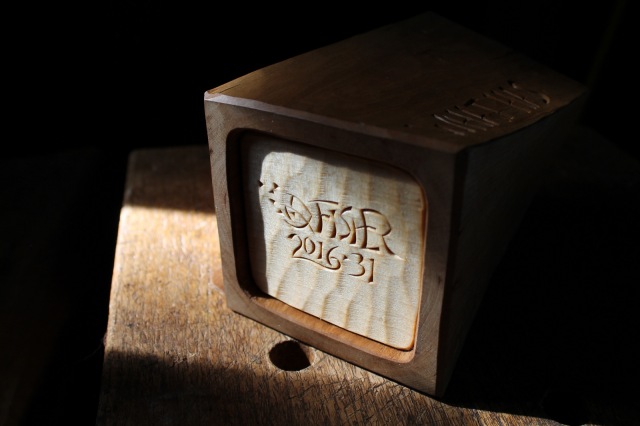
I followed the grain and carved a tapering, twisting, square shrink pot, leaving bold gouge marks on the interior, and a more subtle texture on the outside. The first two lines of the poem were carved, in part, near the edge of each side.
This slideshow requires JavaScript.
The square opening shrinks around the bottom just as it does with a circular form:
6 1/2 inches high and 4 1/4 inches square at the base, cherry.
Here are a couple more recently completed shrink pots; both in aspen, but in very different styles:
When I write about trees and birds and the view from a hilltop, I wonder if they are important in the face of elections, and foreign aid, and taxes, and missiles and satellites. Then I know that arguments end, men die, and nations rise and fall, but that so long as there is an earth and a procession of the seasons there will be trees and birds and vistas from hilltops. And unless we are all incredibly stupid and recklessly wicked, there will be men here to see these things in Autumn and to feel, if never wholly to understand, what they signify.
Hal Borland, Countryman: A Summary of Belief (1965)
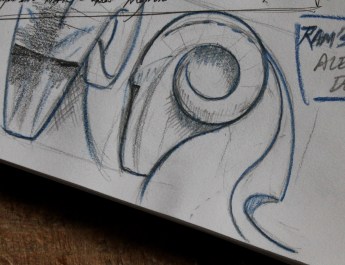
We carvers are fortunate to have the opportunity to both conceive a design and execute it with nothing more than a chunk of wood and a few sharp tools, and it’s a thrill when the idea becomes a reality before our eyes. I find that sketching helps the design process, forcing me to work through some of the practical elements of an idea by taking it out of my mind and onto the page. I also think that drawing in general, anything, helps to develop our design intuition, beckoning us to look closely and notice things that we may otherwise overlook.
I’ve been reading a book recommended to me by David Berman of Trustworth Studios: By Chance I Did Rove by Norman Jewson. In it, Jewson recollects his formative experience of hiking through the Cotswolds with a donkey and a sketchbook; the sketchbook proving more reliable than the donkey. He describes many memorable encounters, including his first with Arts and Crafts icon Ernest Gimson who went on to teach and employ the young architect and designer.
Intermixed with fond recollections of a place and a way of life that would soon be changed forever by the turmoil of the First World War are lessons learned from Gimson, including this one about sketching and design:
“…so at Gimson’s suggestion I picked and brought with me a different wild flower each day and made a drawing of it. This was part of his training of me in design and I soon found how differently one must look at a flower, or any other natural object, for this purpose. At first my drawings were as realistic as I could make them, with the accidental peculiarities of leaf and flower of the sprig I had brought with me, but he soon taught me to note only its special characteristics, making a simplified analysis of the basic peculiarities of the plant and then adapting this to a pattern suitable for modelled plaster, wood-carving or needlework as the case might be.”
Jewson himself was capable of executing the design, including those that called for wood carving. If I ever find myself in the Cotswolds, I’d like to find a donkey, rove a bit and possibly check out Norman Jewson’s sketchbooks. It seems that they have one here.
Here is a link to a previous post about the value of reference sketching.
…but Sigurd himself steered the dragon-keel which was the greatest and noblest; richly wrought were the sails, and glorious to look on.
— The Story of Sigurd from The Völsunga saga, 13th century
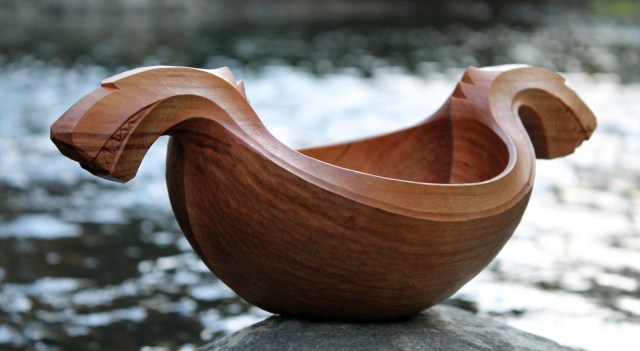
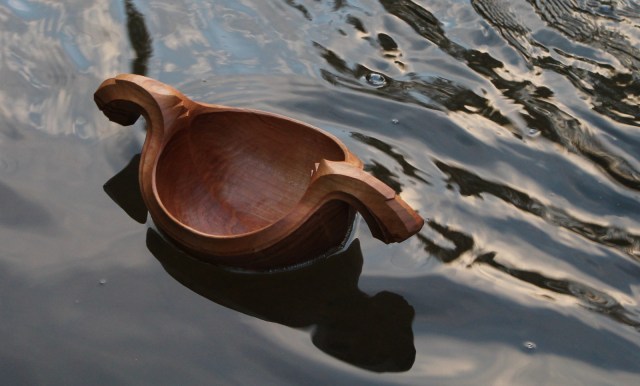
Ok, so that’s obviously not a photo of Sigurd’s ship on the north Atlantic. Rather, it is an ale bowl briefly launched on the Little Shenango River last evening.
Since receiving the commission along with a suggested possibility of a dragon design, I had been sketching some potential ideas and finally started in on the carving.
I carved this one from cherry. The grain direction does some funny things through those flutes flowing across the head. A hook knife comes in handy for dealing with it.
It’s 13 inches long, 6 1/2 inches wide, and 4 3/4 inches high, and it will hold up to 24 ounces of ale.
If only the river flowed toward the bowl’s destination…
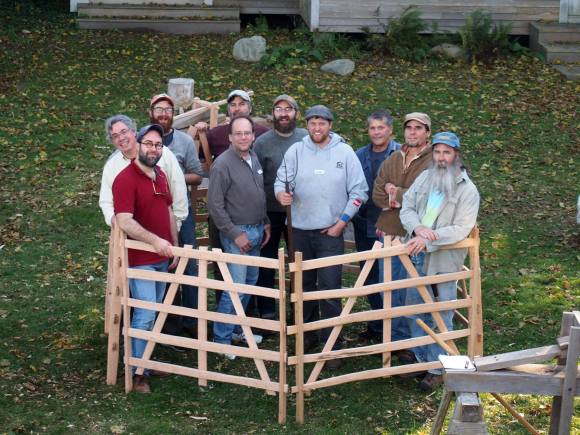
Well, I think that’s how they say it in eastern Mass. anyway. Just in case you may not be aware, there’s a pretty unique riving and hurdlemaking opportunity coming up with Plymouth CRAFT; a chance to spend a weekend working with at least a couple of those guys in the fold above. You may not have any sheep to corral, but the deceptively simple skills involved in making these riven oak hurdles will transfer to the making of all sorts of things. Plus, I can think of many practical uses for these around a yard or in a garden. Sure to be a good time as well.
Check out Rick’s poetic post to learn more. (And thanks for the use of the photo, Rick and Marie).
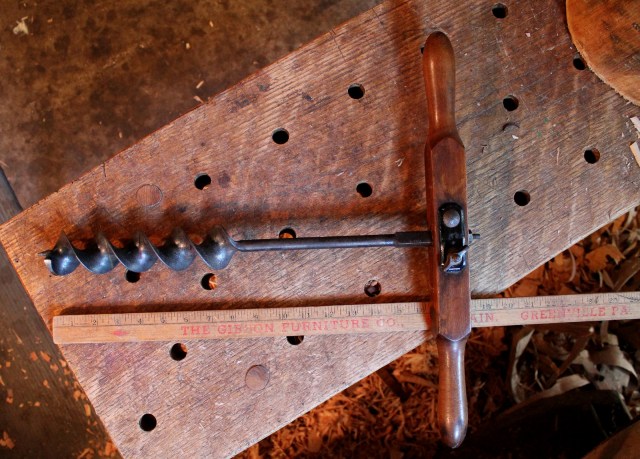
To bore the initial hole in a shrink pot, I use an auger, typically this two-inch diameter T-handle auger. I found mine at flea market years ago. Large augers like this aren’t rare, but there are a few things to keep in mind when choosing one for boring into hardwood end grain.
The image below shows the edge configuration of this auger. There are many variations that will do the job well. This style has no scoring spurs, and for cutting into end grain none are needed. (This auger performs well on side grain as well, as when boring out timber frame mortises.) The two horizontal cutting edges slice wood from the bottom of the hole and the vertical cutting lips clean up the sides. The lead screw is not too aggressive and not too fine. If the threads were more widely spaced, it would take a deeper bite, maybe too much to expect in end grain. If the lead screw were too fine, it might not grip enough in end grain to pull the auger into the piece. In any case, more forward force is usually required to keep the screw engaged in end grain.
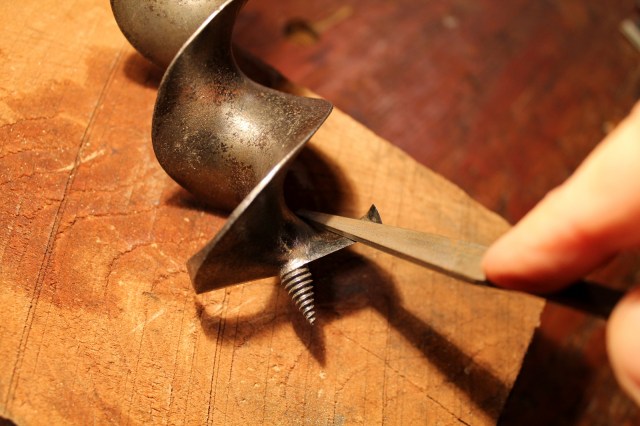
It would be tough to turn a two inch auger bit with a brace; much more torque can be applied with a t-handle auger. And like most tools, if it’s sharp it’s a pleasure to use. Sharpening is pretty straightforward. Auger bit files do a nice job, but lacking one, you may also get by with a narrow diamond paddle or a slip stone.
Remove material from the upper side of both cutters. I only use a light touch with the fine diamond paddle on the lower side to remove any burr.
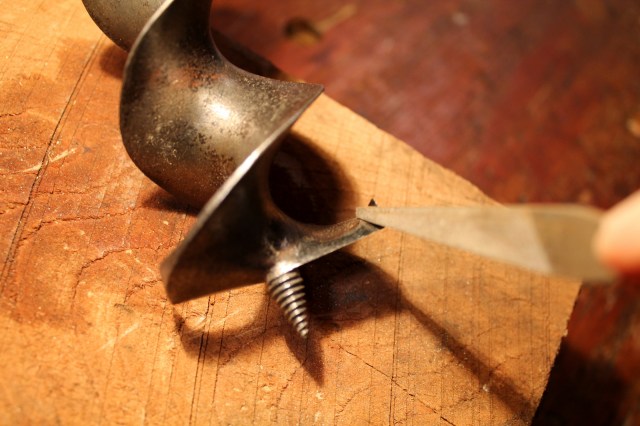
Do the same with the vertical edge, keeping the junction well-formed and honed.
Here, I am ever-so-lightly removing the burr from the outside of the cutter. The most common problem I’ve seen on used auger bits of all sizes is sharpening that has been done on the outside edges. These edges cut the hole and establish the diameter. If the edges are rounded inward, a smaller diameter is cut and the rest of the bit can jam as it tries to follow into the narrow opening.
Here are three lengths of a cherry log that will become shrink pots. I still have to broaden the hollows (which I’ll probably make oval to use the natural shape of the rings in these pieces). The auger just provides a start. A narrower auger can be used. It will just leave more material to be removed otherwise. I usually leave the piece long for ease of holding in a vise. I bore a hole a little beyond what I need, saw off a length, then continue boring. I repeat the sequence until I bore through the last chunk.
I recorded a little video footage while I bored these a couple days ago; just simply the sights and sounds of the auger boring into cherry end grain:
I have some other posts about shrink pots. Just click “shrink boxes” in the category list to the right.
We’re all familiar with the idea of sighting down the length of a board to check for straightness of line. It is amazing how well our eyes can pick up even slight deviations in the flow of a line when viewed from such a vantage point. I use this concept all of the time when carving bowls, sighting along curves to check for fairness and flow.
When we look down a curving road, we can sense the flow of the curves through imagined movement along them. Likewise, when I look along the lines and surfaces of a bowl, I find my head and shoulders moving as if I am in miniature gliding along the surface. Maybe that’s weird, but I don’t have to stand in an amusement park line, and somehow it helps me to understand the forms.
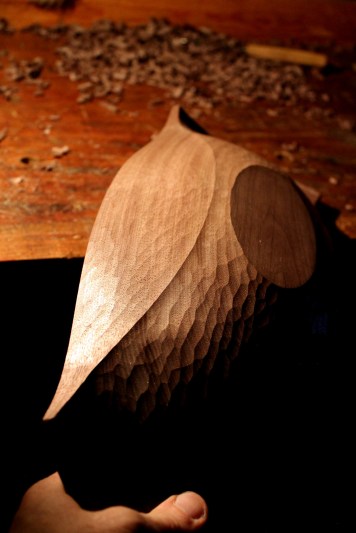
I just finished a walnut bowl that features several flowing lines and surfaces, the one I was working on in the top photo. Here are a few other photos of the finished bowl:
A longing to wander tears my heart when I hear trees rustling in the wind at evening… Trees have long thoughts, long-breathing and restful, just as they have longer lives than ours. They are wiser than we are, as long as we do not listen to them.
— Hermann Hesse, Wandering (1920) [translation by James Wright, 1972]
Evening Trees Shrink Pot
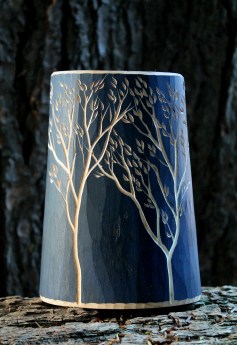
I especially like to see trees in the evening after they’ve transformed into silhouettes against the western sky. That image has inspired me to play around with some designs on shrink pots (a.k.a. shrink boxes) in the past, and I’ve got several related ideas stirring around in my noggin lately. I carved one of those ideas into this shrink pot this week — one of a set of three carved from cherry.
oblong bottom
I still need to carve the design in the other two, which differ in height, shape, and size. The one in the photo is a rough oval in shape — there’s no rule that says they must always be round.
After letting a thinned mix of artist oil colors dry, I carved through it to create the design.
If you’re interested in etymology, trees, and truth, this short Ted Ed video is worth a few minutes of your time. Not only does it provide a linguistic link to our timeless reverence for trees, but the animation is also very cool; reminds me of woodblock prints.
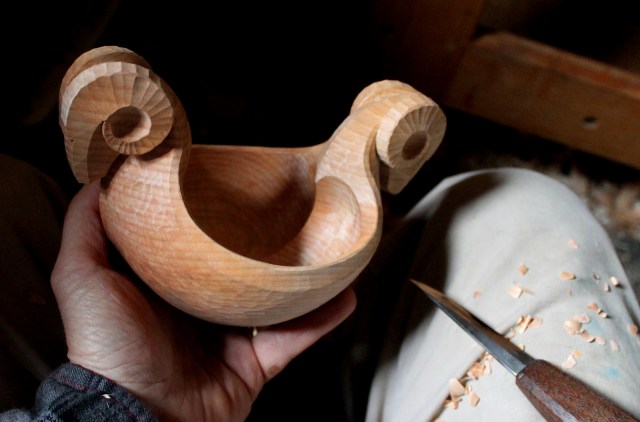
I was working a couple different cherry ale bowls over the weekend and was struck again by how different they are to carve compared to “regular” bowls. First of all, especially in this roughing-out stage, I find myself staring a lot more, wrapping my head around the complex form and where everything is in there.
Ready to remove the chunks behind the head of a duck ale bowl.
Another difference is the use of a saw. Other than for cutting the log to length, I normally don’t use a saw for any part of a bowl. However, ale bowls are different animals. In the early stages, it makes the most sense to split away some large portions of the blank by making several relief cuts (I use a larger folding saw), then splitting off these chunks with a chisel and mallet.
In the photos above you can see a couple points along this “chunking away” stage. In the one on the left, I’ve sawn and split away the ends, leaving the general area for the heads. On the right, I’ve continued by relieving the area between the heads. Although there is still much to visualize and sculpt, the major masses and proportions are established at this point. I then hew the outer form with and axe and hollow what I can with an adze.
After the chopping, I move on to lots of focused shaping with gouges and knives. As with other bowls, I remove all I can while the wood is still green leaving less to carve away after drying. I’ll revisit these when I get a chance (after waiting at least a week or two) and complete the carving.



 We carvers are fortunate to have the opportunity to both conceive a design and execute it with nothing more than a chunk of wood and a few sharp tools, and it’s a thrill when the idea becomes a reality before our eyes. I find that sketching helps the design process, forcing me to work through some of the practical elements of an idea by taking it out of my mind and onto the page. I also think that drawing in general, anything, helps to develop our design intuition, beckoning us to look closely and notice things that we may otherwise overlook.