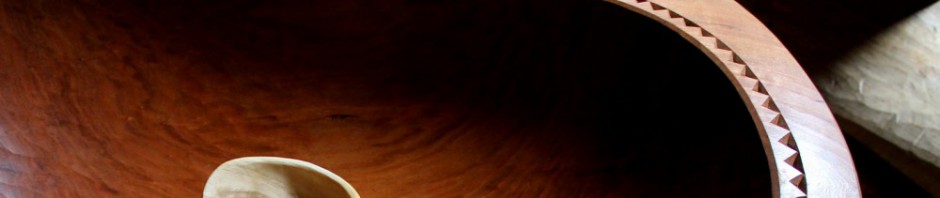

A few years ago, I made a shrink pot for my daughter in the the form of a book (photo below). I think I had first seen an example made by Jögge Sundqvist. It is simply a shrink pot with a rectangular bottom and a sliding dovetailed lid. Wonderful fun.
Wanting to make one for my son, I experimented with a different construction technique using dry wood and multiple pieces.

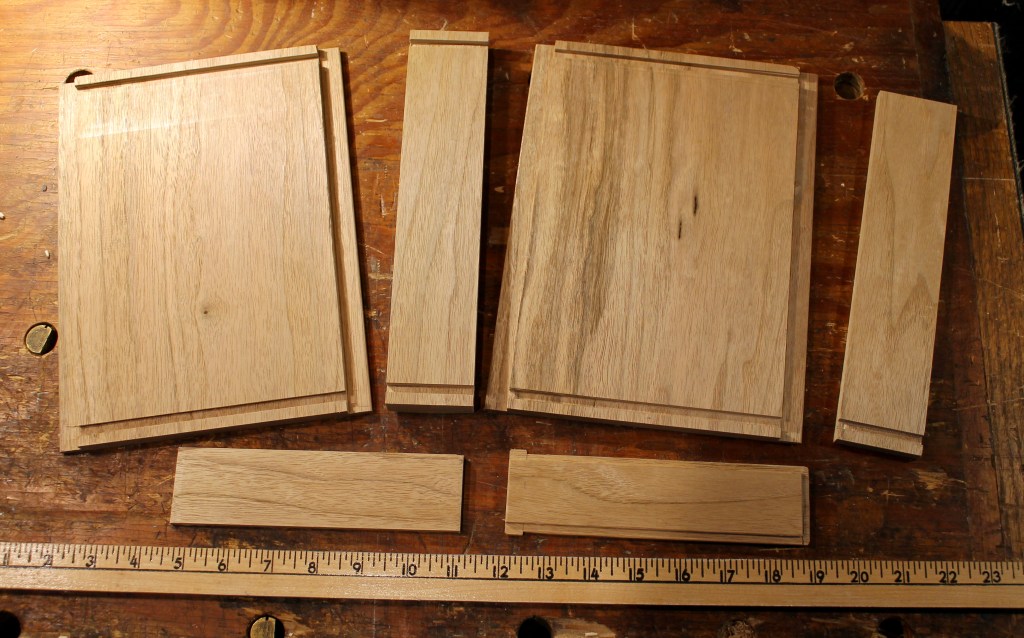
Here are the six pieces for Noah’s book. The wood is butternut. The joinery is a simply a combination of dadoes and rabbets cut with a knife, chisel, and rabbet plane. I made sure all was square and such by following the sawing with some work with a sharp plane and a shooting board. The overall finished box dimensions are 9 3/4″ x 7 1/2″ x 2 3/8″, but anything is possible. The dadoes are 3/16″ wide and the bottom panel is trapped in them. I made the front and back covers 7/16″ thick to allow for the depth of carving. The spine is 3/4″ thick and the opposite side is 3/8″.
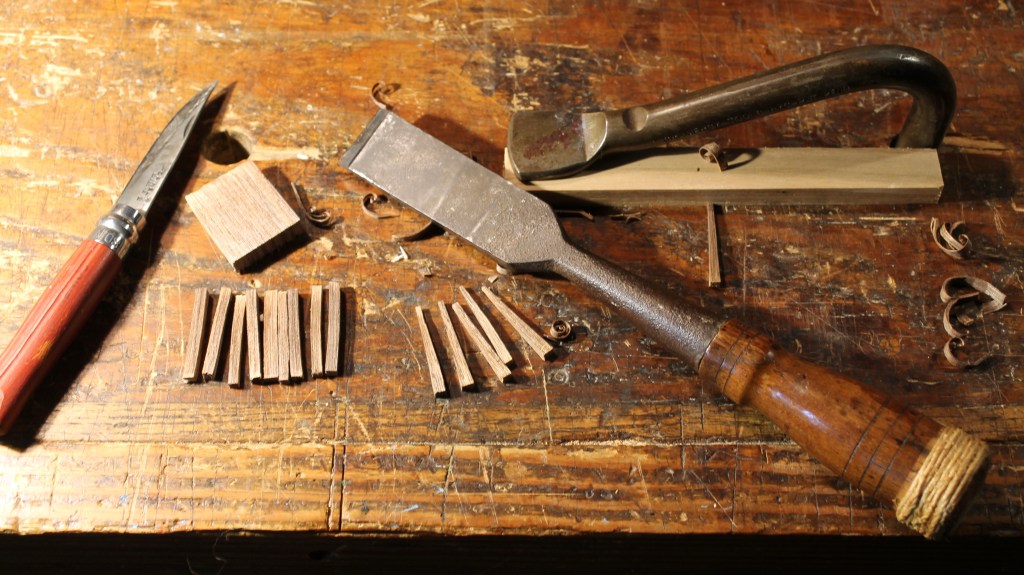
I made tapered square pegs to secure the glued rabbet joints, first splitting square pieces from dry walnut stock, then shaving them down with a chisel against a stop. Something like 3/16 square at the fat end.
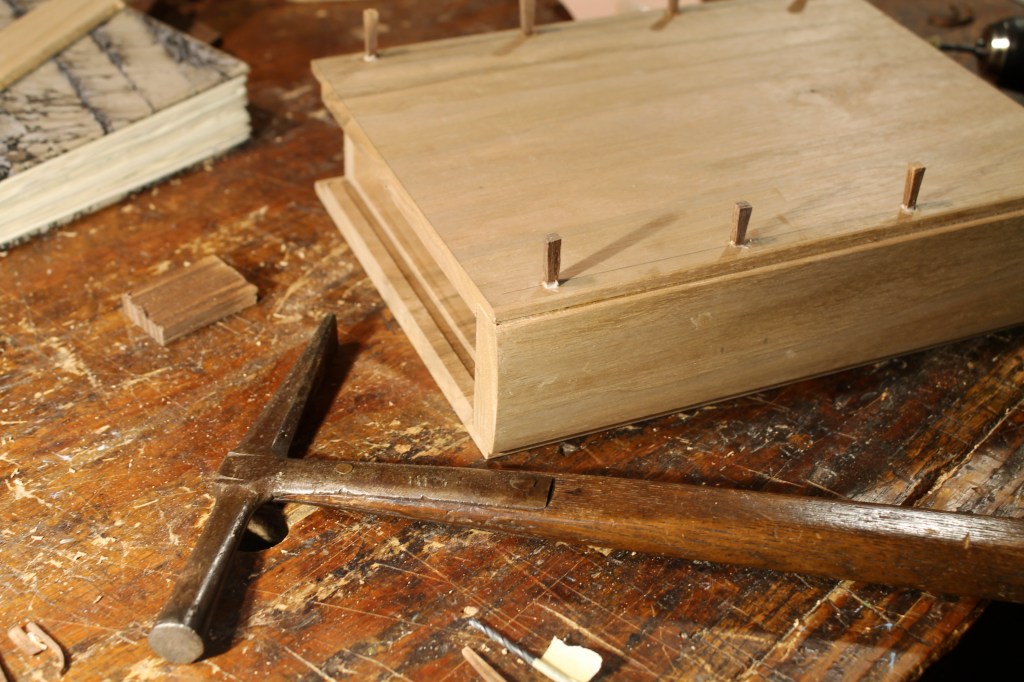
I drilled holes — maybe 5/32″ diameter — through the rabbet joint and hammered in the pins along with some glue. The corners of the pegs had no problem cutting into the softer butternut wood.

Of course, the sky’s the limit as for decoration. I was inspired by a photograph of Noah from a hike we had taken. After outlining the foreground silhouette in black India ink with a brush, I cut grooves around the border with a V-tool.

I also did some carved texturing of the background and sky. In the photo above, I had begun to add some color to the background fields with thinned artist oil paint.

Then I went nuts. Color is daunting for me, but why not give it a shot? Play around. Experiment. Make mistakes and learn. There are advantages to being a woodworker rather than a heart surgeon.

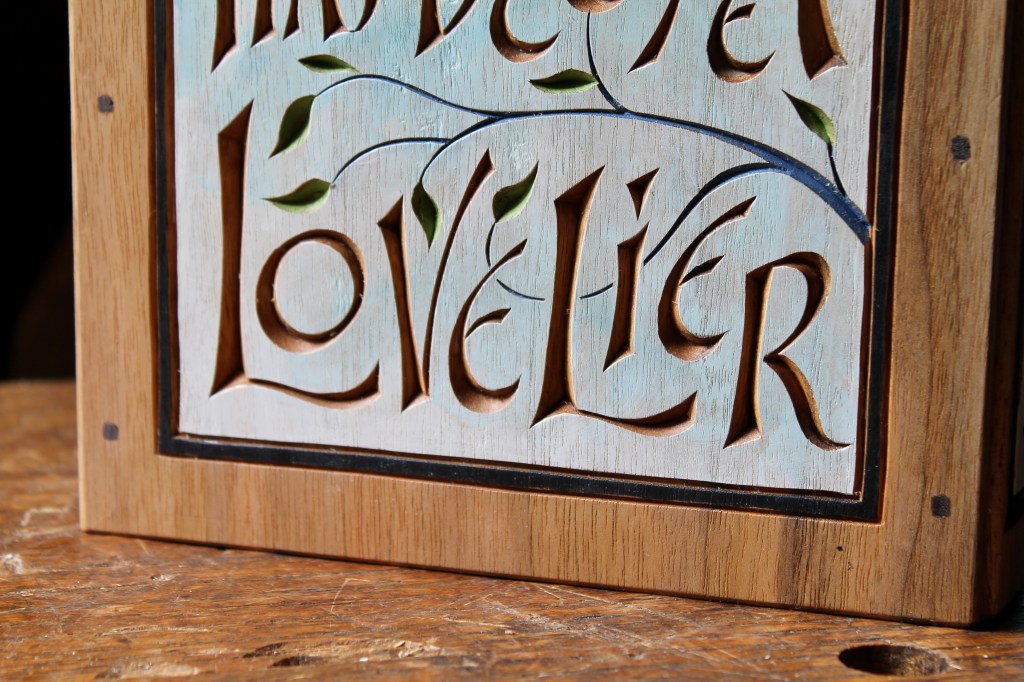
One of Noah’s favorite authors is Hermann Hesse. Hesse’s book Wandering: Notes and Sketches is a commentary on the author’s re-exploration of a land from his youth. Considering Noah’s love for the book, I carved a quote emphasized in Wandering into the back cover.


Here’s a shot of the spine.

I used a toothing plane iron like a scraper to make grooves in this surface to suggest pages.
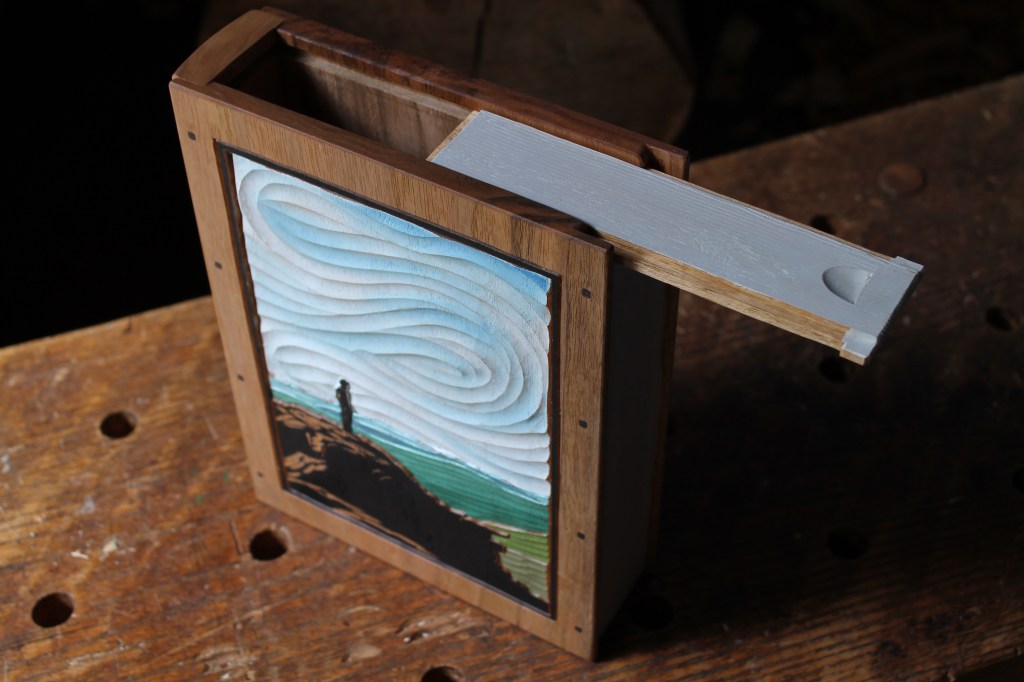
The rabbeted lid slides in grooves made up of dadoes cut into the covers and spine. After all of the carving was finished, I put a coat of linseed oil over the book box, paint and all.
Whether made like a shrink pot or through joinery, these book boxes are a lot of fun to make and provide a special place to stash special stuff.
“Trees have long thoughts, long—breathing and restful, just as they have longer lives than ours. They are wiser than we are, as long as we do not listen to them. But when we have learned how to listen to trees, then the brevity and the quickness and the childlike hastiness of our thoughts achieve an incomparable joy. Whoever has learned how to listen to trees no longer wants to be a tree. He wants to be nothing except what he is.“
Hermann Hesse, Wandering: Notes and Sketches (1920), [translation by James Wright, 1972]