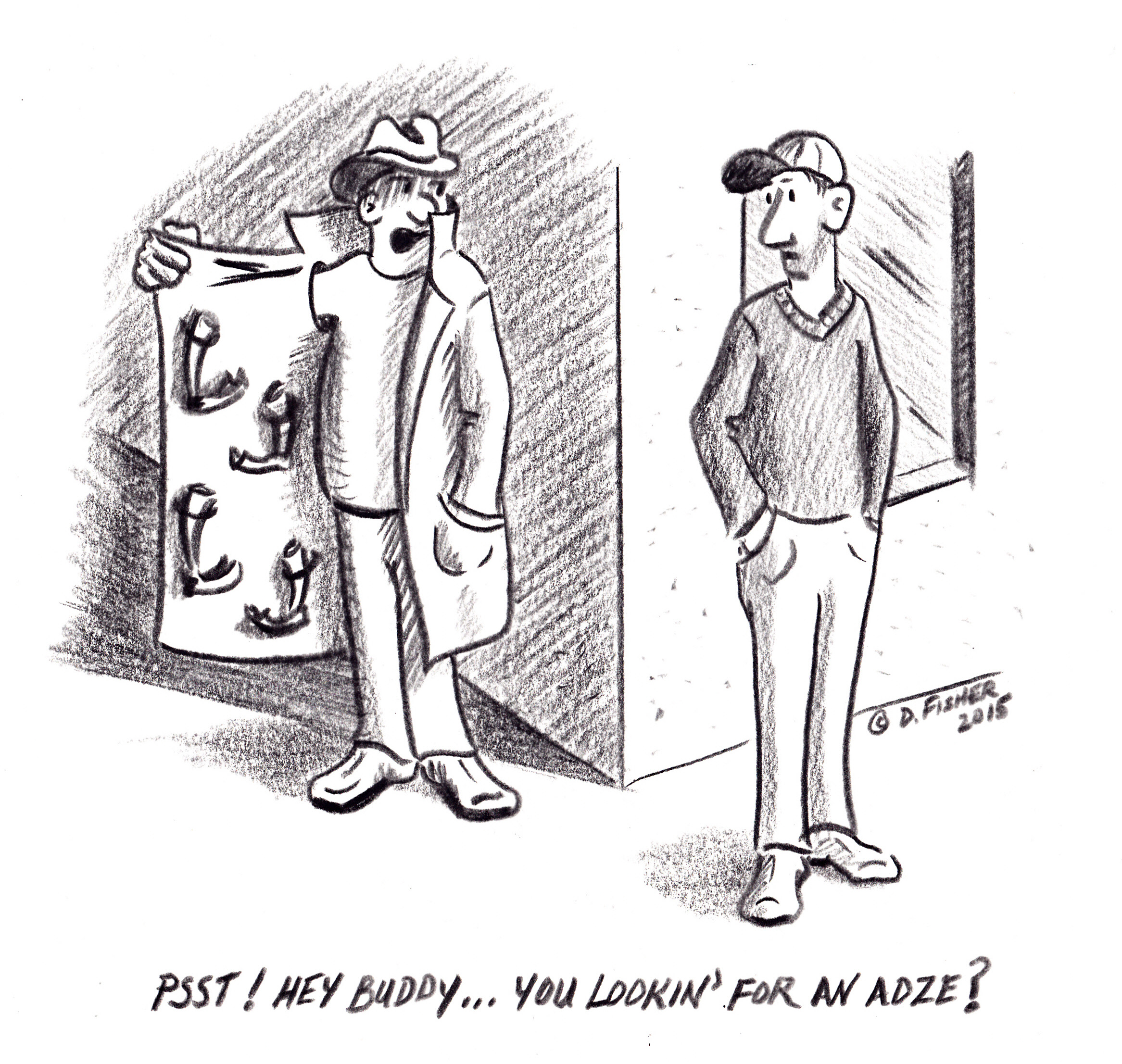
 It seems that it is difficult to acquire a good adze these days. I’m not looking, but I have been getting emails seeking advice on what to do about it. These folks wish to carve bowls, and are willing to pay for a good adze, but they simply aren’t available. It seems that the demand has outpaced the supply. Think about that; in 2015 the demand for hand forged bowl adzes has outpaced the rate at which the makers can produce them! That is both somewhat amazing and quite encouraging.
Drew Langsner addressed this phenomenon in his most-recent newsletter from Country Workshops (scroll down just a bit). And this is not simply a problem of importing Swedish adzes into the U.S. Look at the adze page at Woodsmith, a tool retailer in the U.K.
Just to be clear, it is not that nobody knows how to make a good adze for bowl hollowing. Just look at those made by Hans Karlsson, Svante Djarv, or Gransfors Bruks. The formula is there. They all feature the same basic components of a well-designed bowl adze: good steel, a dense heavy head, thoughtful geometry with some degree of outer bevel, raised lips that won’t catch when taking a heavy cut, and a well-hung handle. (Again, the Woodsmith page shows a clear comparison). I discussed some of my thoughts on adze selection in this post back in February. So this isn’t like a search for the Fountain of Youth. This is attainable, but you’ll have to wait until the Swedish smiths can catch up; and don’t expect to find a used one on ebay.
By the way, let me explain the “well-hung handle.” The process of putting a handle on an axe bit is called “hanging.” This involves many variables that are well explained here. As one can see, an axe can be hung more open or more closed, which effects how well it works. This principle is, I believe, even more important when hanging an adze handle. Since the cutting edge is perpendicular to the plane of the swinging motion (rather than in line with it, as with an axe), the relationship of the bit and bevel to the pivot point (usually near the end of the handle) of the swing is important. If the hang is too open or too closed, the cutting edge will not enter the wood sweetly.
This is important to consider if one is planning to hang their own handle or replace one. A longer handle, for example, changes the hang (possibly making it too closed) unless the handle is shaped to account for this. This is why, in the top photo here at Country Workshops, you can see how they have bent the longer handle back, letting the cutting edge enter the wood sweetly with the natural swing of the handle.
But back to the quest for a good bowl adze: I guess for now the only good answer is patience. Lack of that may lead you to purchase a bad adze, and there are many being made, even by makers that otherwise make excellent tools. These adzes may have light heads that cause fatigue and pain, bad geometry, bad bevels, or very poorly designed handles — possibly all of the above! With a great deal of effort and time, these can be made somewhat serviceable, but they will never be great like the ones for which you now, apparently, must wait.












 David Fisher, Carving Explorations