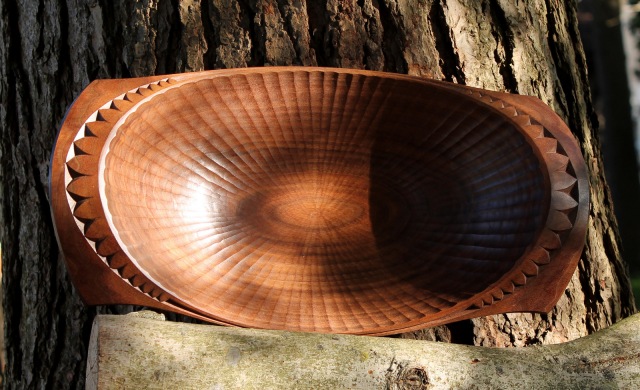
Sign, Sign, Everywhere a Sign

IMG_6620

“Please, do not touch.”  There are certain posted signs that disappoint me, but perhaps none more than that.  I can deal with “Stay off the Grass.”  In fact, I may have had no desire to walk on the grass, at least until I saw the sign.  “No shirt, no shoes, no service.”  Well, that’s just enforcing what everyone’s thinking if they find me shirtless.  I can happily endure the flashing of a “Don’t Walk” signal, even when no traffic is coming.  But a “Do not touch” sign hits me like a ton of bricks.

Several years ago, I was visiting a small art museum with my family.  Outside on the museum grounds was a large abstract granite sculpture.  Outside.  Granite.  Birds poop on it.  My instinct was to touch it, to sense its texture as a way of understanding it and appreciating it.  And there was no sign.

Please understand, I’m not completely out of control.  I don’t go running my fingers over paintings nor do I advocate allowing thousands of people to run their hands over the carvings of a curated piece of furniture.  But I did touch this outdoor granite sculpture.  Sure enough, as if I had sprung a trap, a museum docent stepped outside and admonished me.  “No sign…” I whimpered.  Sign implied, moron.  They reluctantly and watchfully allowed us to explore the museum.
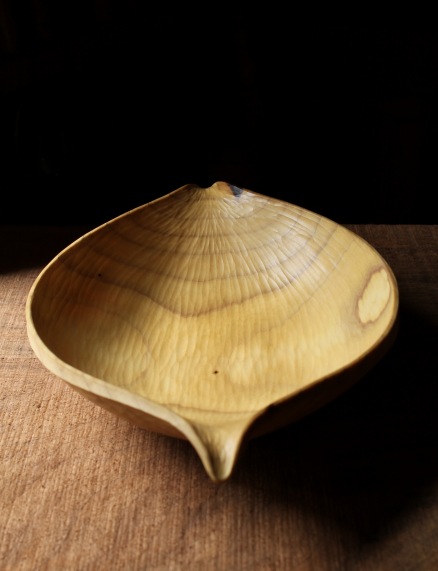
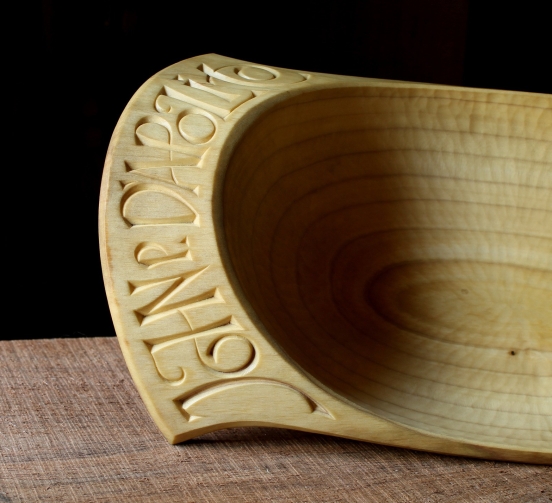
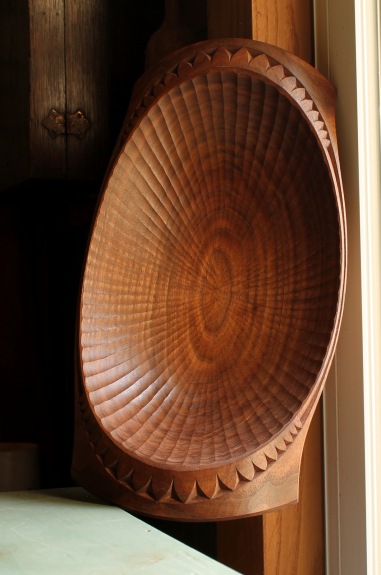
IMG_6641I’d like to include a sign with each bowl that reads, “Please touch.”  Then again, I hope that the invitation is implied and the wish to do so is instinctive.  The warmth of wood and the varying textures left from the tools tend to draw the hand.


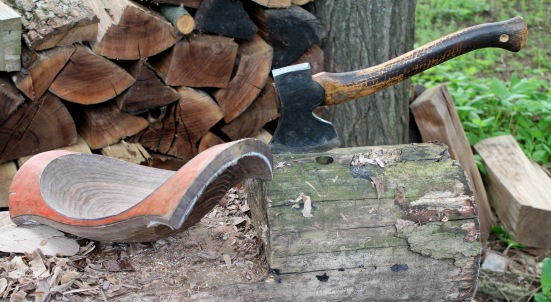
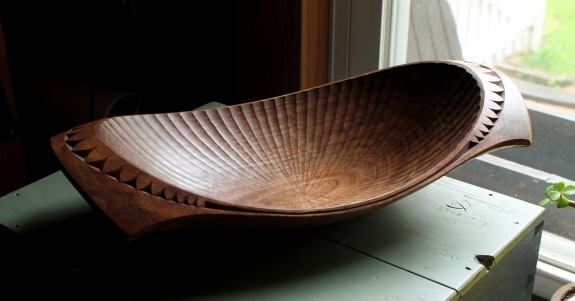
On this just-finished poplar bowl, I used the gouge on the interior in a way that is meant to create a sense of flow and movement.  The slick slicing of the gouge also makes the bowl easy to clean and use.  No scratched wood fibers to fuzz up and rise with water, as can occur with a sanded surface.
 

IMG_6624

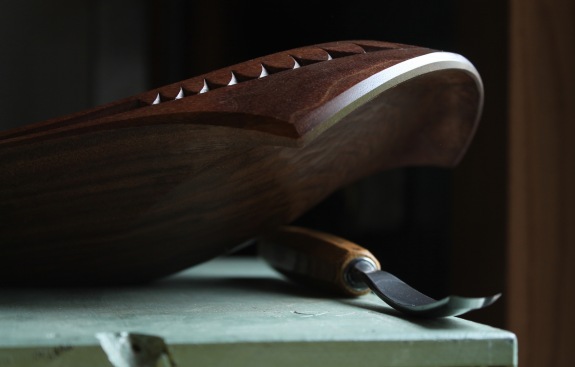
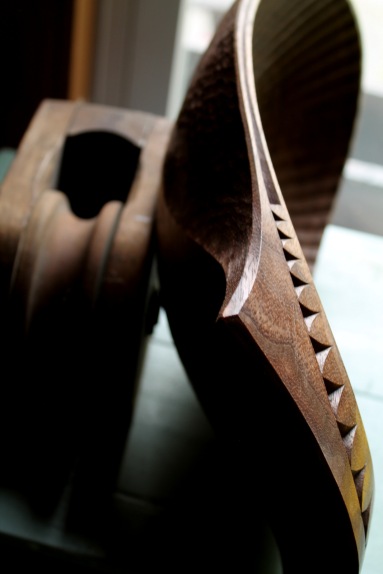
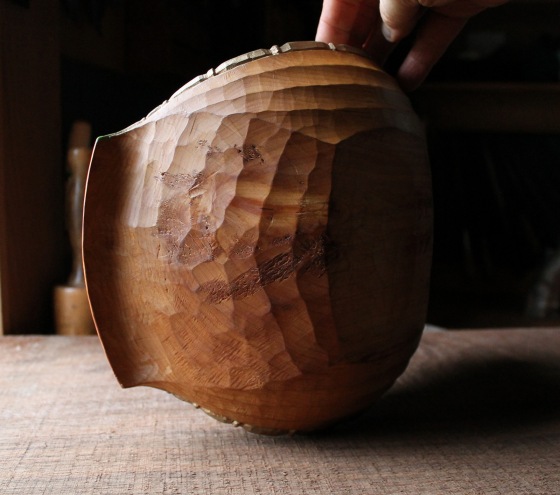
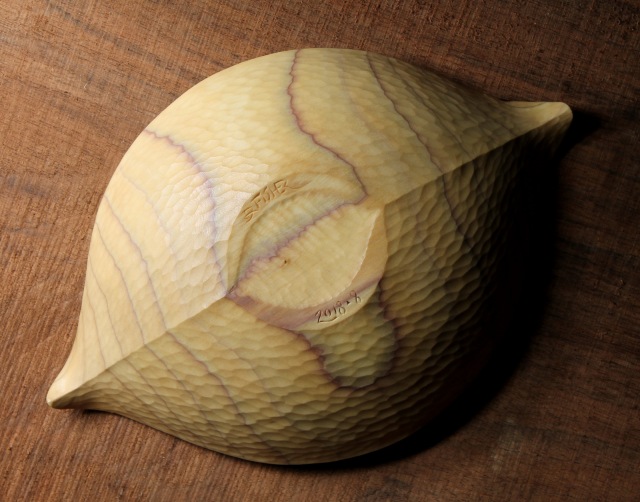
The exterior of the bowl was worked with the gouge in a different way, leaving a different texture.

IMG_6649

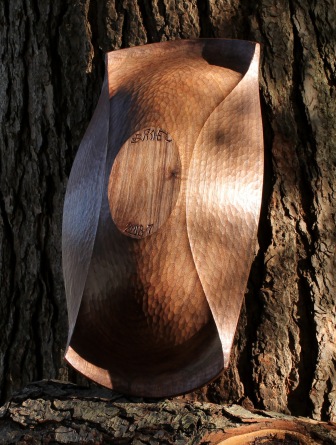
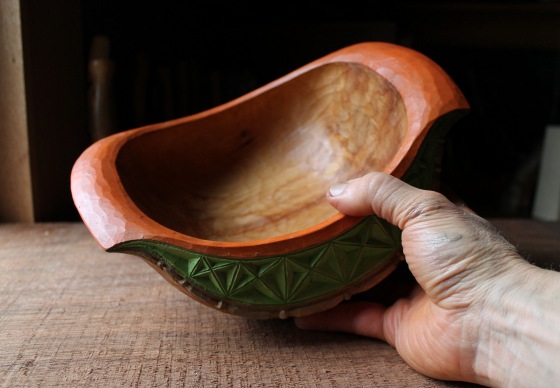
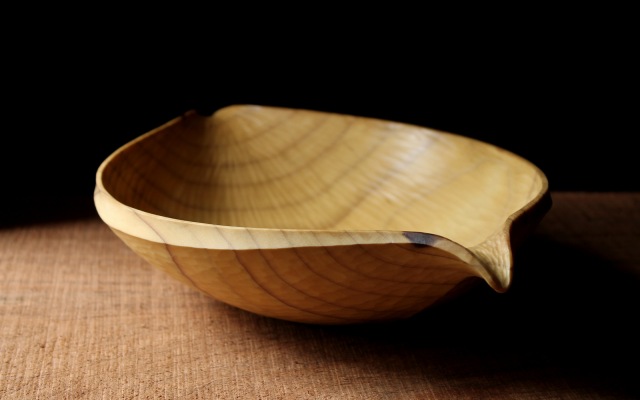
Bowls are meant to be picked up, and fingertips will sense the bowl as well as eyes can see the striking pattern of growth rings in this tulip poplar.
IMG_6637

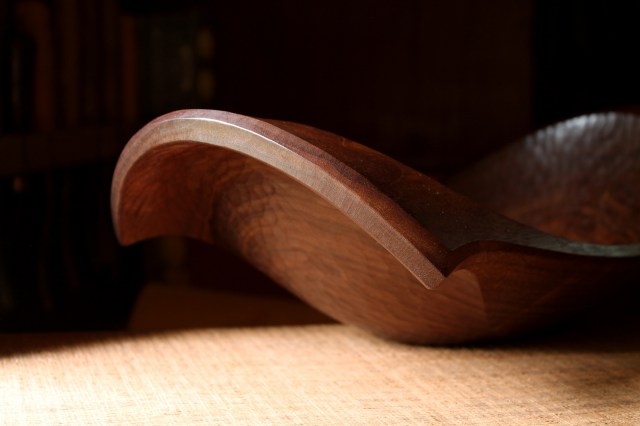
This one was carved from another piece of the same log as the memorial bowl I wrote about in this post, so it is off to the same family.  No signs attached.
Posted in bowls, figure, patterns, Uncategorized | Tagged , | 20 Comments

Raise Your Handles

IMG_6661

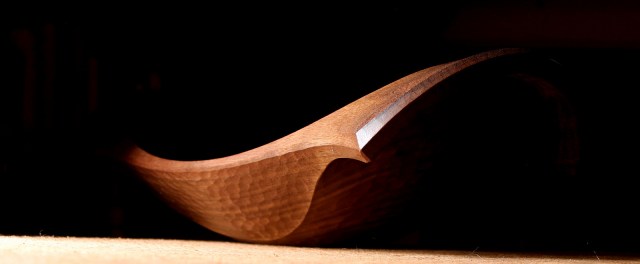
The handles on this just-finished walnut bowl really grab me.  They rise up from the edge of the hollow and extend broadly in a sweeping arc.

IMG_6665

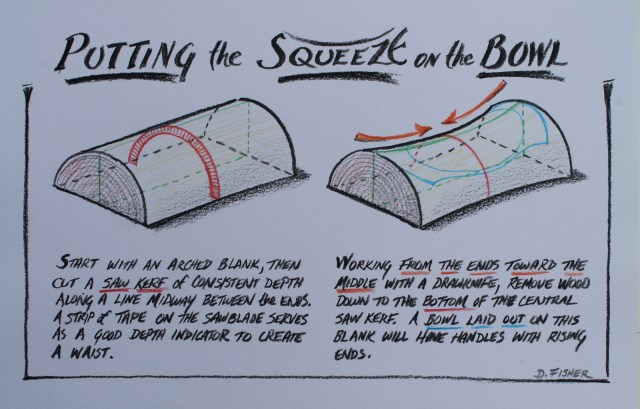
Here’s a sketch to explain how I create a waist in the arched blank to allow for the rise at the back of the handles relative to the edge of the hollow.

IMG_6729


Posted in bowls, layout, sketch, Uncategorized, walnut | Tagged | 6 Comments

Five Spoons

IMG_6584

I’ve finished five big spoons from big crooks, three in black cherry, two in hard (sugar) maple.  I’ll post them here below.  They’re all straight from the knife and treated with flaxseed (linseed) oil.  I had fun experimenting with some different designs on these.  They’re all serving/cooking spoons, way too big for eating spoons.  I’ll mention each spoon’s unique characteristics with the photos below.  Rather than listing them separately on my website, I’ll offer them right here in the blog post.  If you’d like to purchase one, send me an email at dandkfish@gmail.com.  All prices include shipping in the U.S.  Orders outside of the U.S. will require an additional shipping charge, but it’s not usually too high for spoons.  I’ll get back to you to confirm, and you can pay by mailing a check or through paypal.

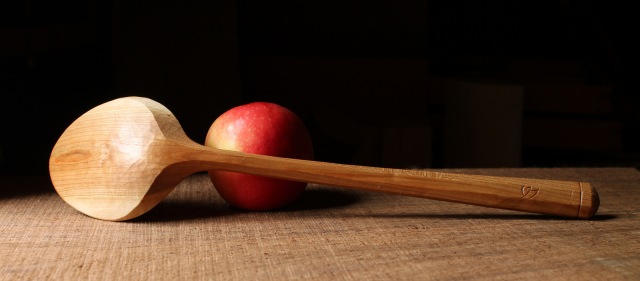
Spoon #1 (below):  Black Cherry, 13″ x 3″.  This spoon would be great for general use — cooking, stirring, serving.  The facets of the octagonal handle each flow onto and around the bowl of the spoon. $135 includes shipping.  SOLD

IMG_6547IMG_6549IMG_6576IMG_6577

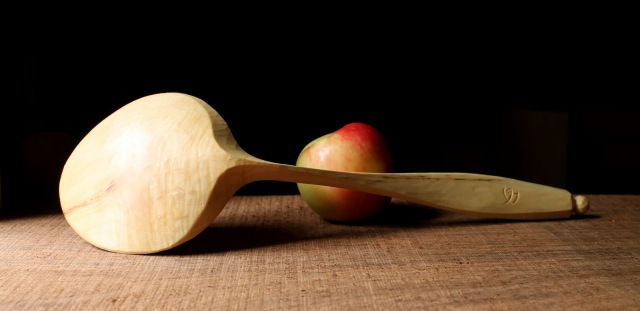
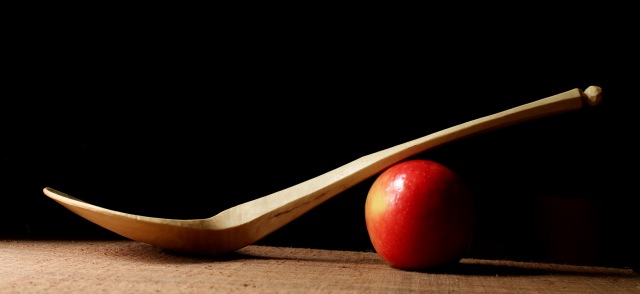
Spoon #2 (below): Sugar Maple, 14″ x 4″.  This spoon came from a large sugar maple crook that was a bear to carve, but will make an incredibly long-lasting serving spoon.  With a bowl that is 4″ x 5″, your grandchildren will still be serving their grandchildren mountains of mashed potatoes!  I cut across the handle with my hook knife to create the irregular pattern, and finished with a ball finial.  $165 includes shipping.  SOLD

IMG_6532IMG_6535IMG_6570

Spoon #3 (below): Black Cherry, 12 1/4″ x 2 1/4″.  This cherry cooking/stirring spoon will reach deep into the pot.  The heartwood runs along the back side of the octagonal handle and up through the center of the bowl.  $85 includes shipping.  SOLD

IMG_6553IMG_6580

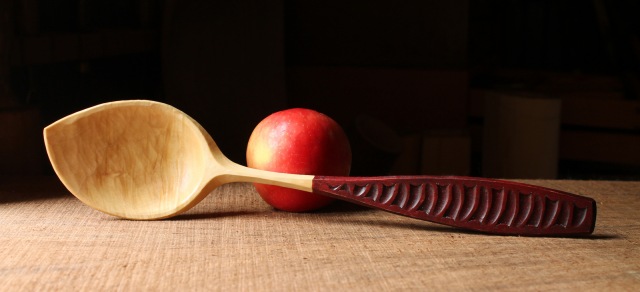
Spoon #4 (below): Sugar Maple, 12 3/4″ x 2 7/8″.  Carved from the upper portion of the same crook as the maple spoon above, this is a hardy cooking and stirring spoon with lovely figure through the bowl.  After carving the handle pattern with cuts from a gouge, I painted it with thinned artist-oil paint that allows the grain to read through.  With a little use, the paint will naturally begin to rub off on the edges and raised areas creating a beautiful patina of use.  $130 includes shipping.  SOLD

IMG_6555IMG_6556IMG_6563

Spoon #5 (below): Black Cherry, 13 1/2″ x 3 1/4″.  I just love this big spoon from a crook that was curved in both directions.  The fibers flow unbroken through the handle and up through the bottom of the bowl.  Very comfortable to use as a serving spoon — for righties anyway.  Again, I carved across the handle with my hook knife, but more regularly in this case.  That little sap pocket in the bowl of the spoon actually has a little opening that passes through, but you won’t lose much food!  $180 includes shipping.  SOLD

IMG_6538IMG_6539

Posted in patterns, spoons, Uncategorized | Tagged , , , | 13 Comments

Greenwood Fest 2018

SAM_4026

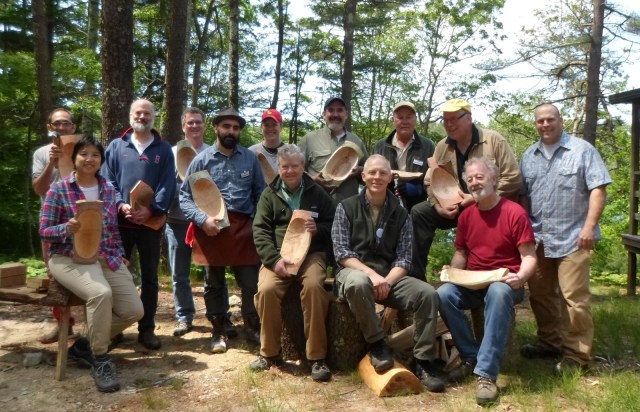
Pre-Fest bowl class 2018. Seated L-R: Jane, Drew, me, Ron.  Standing L-R: Joe, Phil, Steve, Josh, Katie, Martin, Jack, Ed, and Brian.

Carved utensils and other objects are a joy to use and to live with.  They are the lasting result of meaningful work.  Beyond this, carving is a way to have fun together…. I am optimistic that there is still a chance to pass the art of carving on to future generations.

Wille Sunqvist, Swedish Carving Techniques(1990)

Wille Sundqvist passed away earlier this month.  His vision and influence lives on, and was celebrated at the 2018 Greenwood Fest last week, which was dedicated to Wille.  Peter Follansbee posted some group photos on his blog today, and he posted a nice dedication to Wille in this post previously.

As seen in the top photo, twelve carvers and I had a lot of fun together as we shaped birch logs into bowls during the Pre-Fest.  Not even a downpour dampened their spirits.

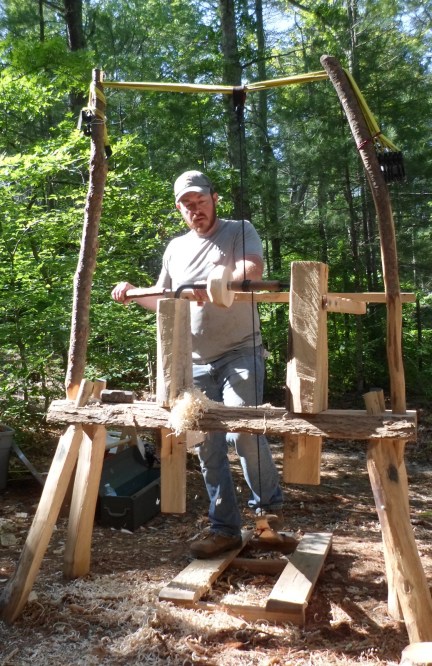
During my free session, I was able to wander around and learn from the presentations of some of the other instructors and snap a few photos.

SAM_4035

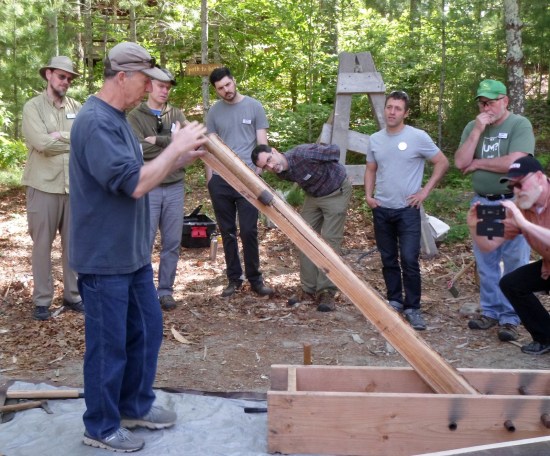
In fifteen minutes of watching Curtis Buchanan and Tim Manney (third from right), I learned more about riving with a froe than I had in twenty five years. 

SAM_4029

Darrick Sanderson opened my eyes to the subtleties of bowl turning through his skilled demonstration and clear explanations. 

SAM_4042

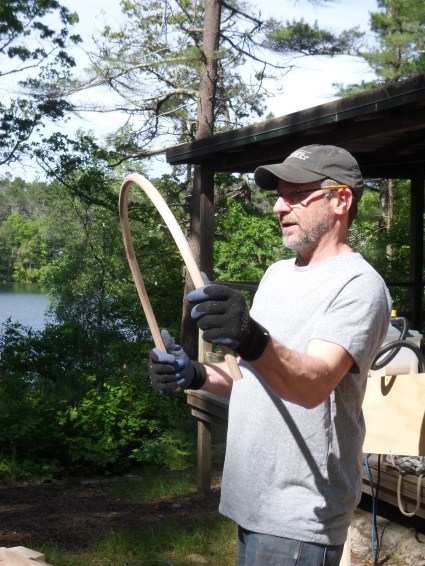
Peter Galbert wowed the crowd with feats of strength, a.k.a. steam-bending white oak chair parts.

SAM_4051

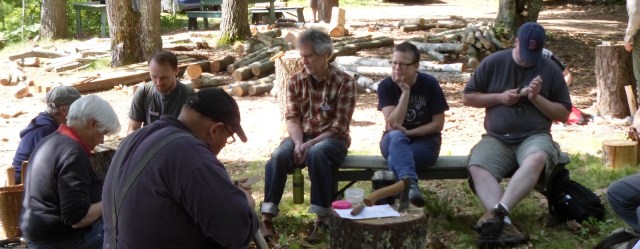
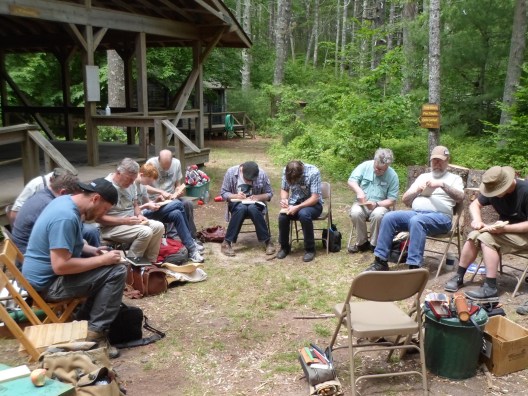
Jane Mickelborough and Barn “the spoon” Carder were overseeing a relaxing group spoon carving session.

SAM_4054

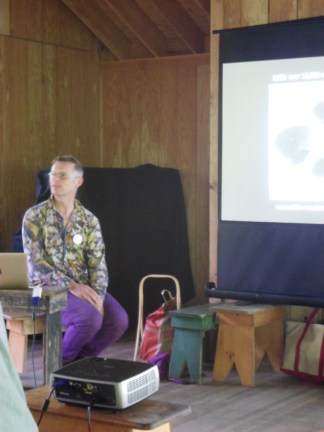
And I was also able to catch much of Robin Wood’s fascinating talk and slide-show about the many woodworking projects he’s been involved in around the world.

I didn’t have a chance to photograph all of the instructors, but I got a few other shots through the event.

SAM_4059

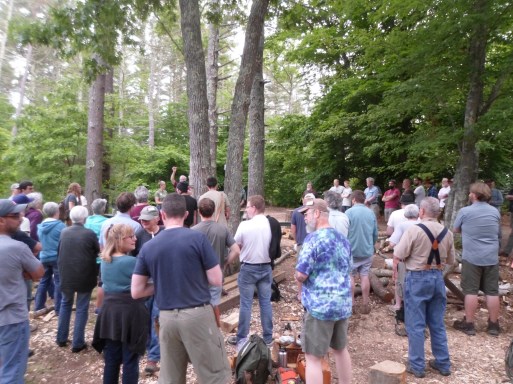
Part of the crowd gathers in hopes of winning one of the many donated items in the fundraising raffle.

SAM_4055

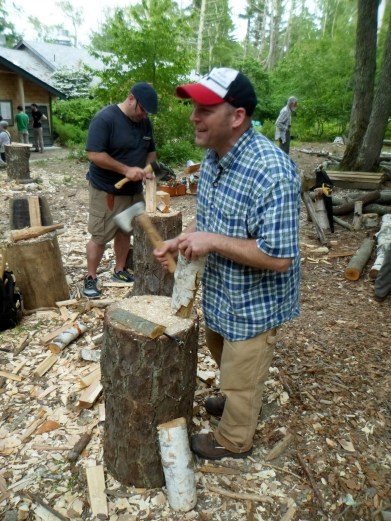
Brian and Nathan at the chopping blocks in the central carving area.

SAM_4063

During the Fest, I demonstrated bowl carving and led a couple short workshops, including this one on letter carving. 

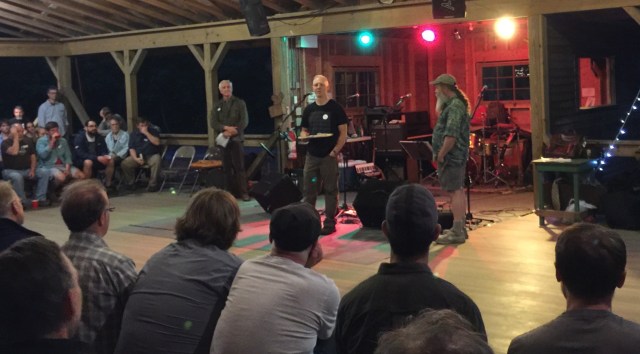
For me, the biggest surprise of the Fest came Saturday night when Peter Lamb presented me with one of the two Wille Sundqvist and Bill Coperthwaite Slöjd Fellowships for 2018.  The other was awarded to Robin Wood, one of my woodworking heroes and a fantastic guy.  What a pleasure to get to know him. It was all a bit surreal to receive such an honor.  Or maybe it was the disco lights behind me.

Wille Sundqvist Bill Coperthwaite Fellowship

Peter Follansbee is to my left.  Without his influence, I’d still be under my rock.

I have tremendous respect for Peter Lamb and Jögge Sundqvist, and I look forward to the opportunity to further learn, explore, and share the joy of handwork.  What a journey it has already been, one guided by many whom I’ve never directly met, including Wille and Bill.

IMG_6518

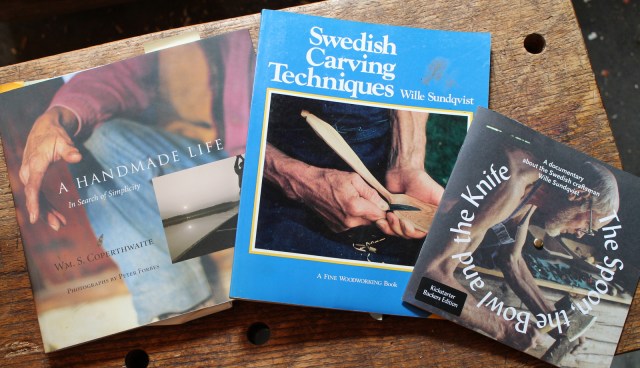
Their books continue to be a strong influence.  And If you haven’t seen the video The Spoon, the Bowl and the Knife, treat yourself to an inspiring exploration of Wille’s life, work and techniques.

In his book, A Handmade Life, Bill Coperthwaite wrote, “I want to live in a society where people are intoxicated with the joy of making things.”  There are more and more people sharing that vision, and I had the privilege of being with many of them at Greenwood Fest.

It was Bill that first arranged for Wille to come to the United States back in 1978.  At the Fest and many other gatherings, large and small around the world, the efforts of both men continue to bear fruit.

SAM_4066

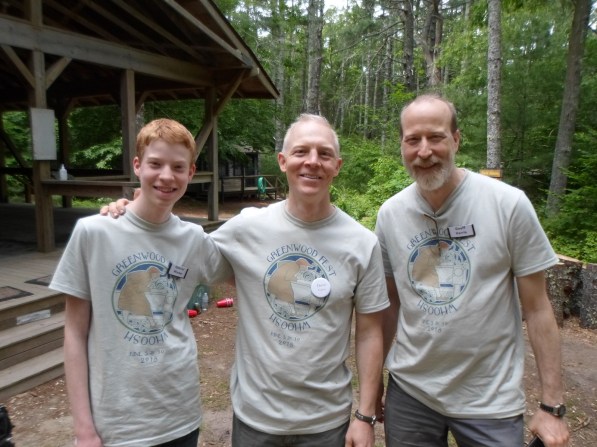
Sixteen-year-old Gabriel and his father, Geoff, at the Fest for the second time — all the way from Vancouver.


Posted in books, classes, events, teaching, Uncategorized, video | Tagged , , | 4 Comments

Lettering on Flat Boards

IMG_6506

Cutting lettering into a bowl or spoon can be daunting.  You’ve already invested a lot of time and effort into a project and it could all go down the tubes with one slip of the knife during the lettering.  Even if all goes as planned, what if the design doesn’t look like you thought it would?  Grab some flatwood and dig in.

img_6304.jpg

Risky Business: If the lettering goes wrong here, there’s a lot more at stake than with a board. The curved, irregular surface is also an added challenge.

Small flat boards and scraps are an ideal platform for working on your lettering designs and techniques.  This is low risk; if things aren’t working out, you don’t have to scrap a bowl or other project, just grab another hunk of wood.  A relatively soft cooperative wood like basswood is ideal for the situation.

IMG_5728

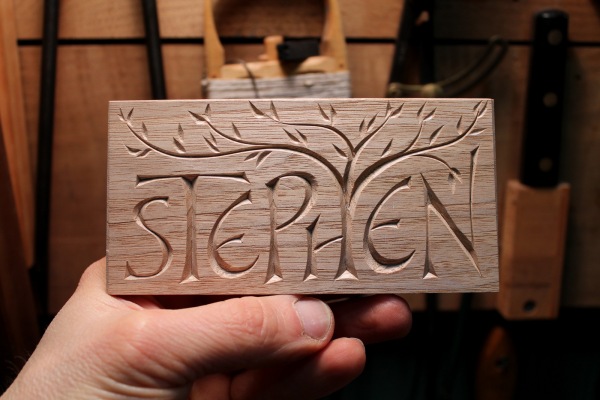
These boards aren’t just for practice.  They can be fun projects in their own right.  I enjoy making little name signs and things like that.  The “Stephen” sign above was carved in butternut.

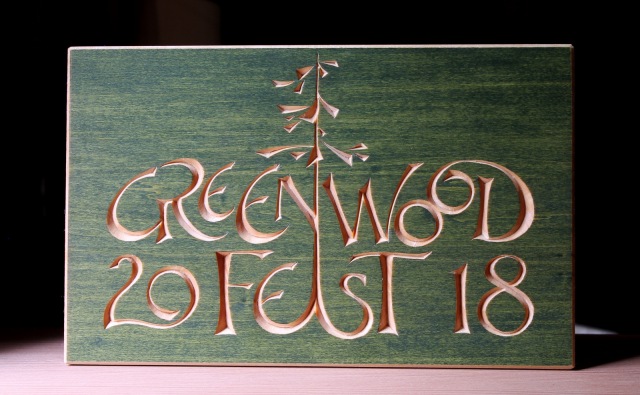
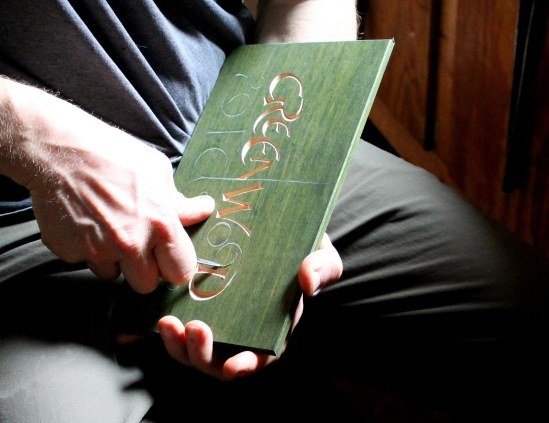
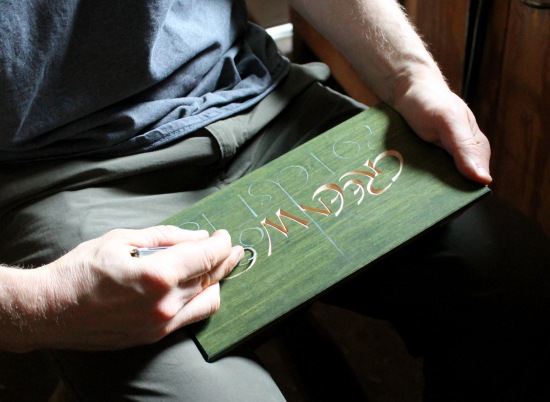
The photo at the top of this post is a 6 1/2″ x 10″ sign freshly carved to take with me to Plymouth tomorrow.  I’ll use it as an example for my lettering workshop and then it will be raffled off in the Greenwood Fest fundraising raffle.  I just planed the surface of a basswood board, then painted it with some thinned artist’s oil paints.  After the paint dried, I sketched on the letters and cut them with my pen knife.  The two photos below show two of the most common grips I use with the knife.

IMG_6488

IMG_6490

When I have a choice, I prefer to work with light coming from my left, but the light filtering through the pines in Plymouth will suit me fine.

Posted in finding wood, Lettering, paint, patterns, Uncategorized | Tagged , , | 29 Comments

Carving Outside

IMG_6372

My craving to be outdoors only seems to be intensifying over the years, as does my love for carving.  It’s a good thing, then, that these two desires are sometimes compatible.  On Sunday afternoon, I found myself carving a walnut bowl under hemlock trees while cardinals called to each other overhead.

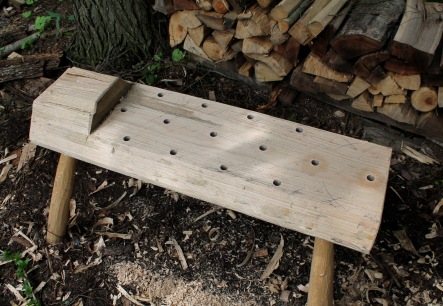
Before digging into the walnut, I finished the oak low bench that I wrote about starting during snowy March in this post.

IMG_6349

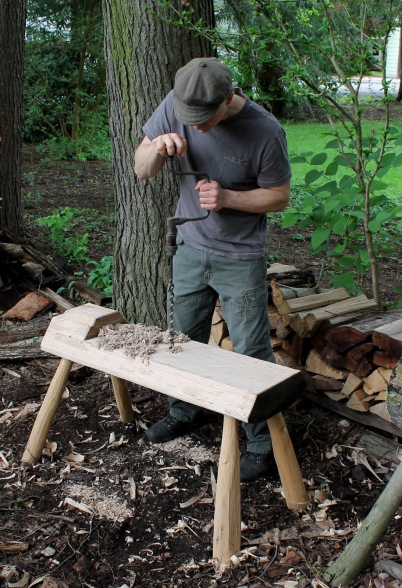
After cutting the legs to length and flattening the top a bit with a plane, I bored some holes for pegs and holdfasts.  I used a 13/16″ bit rather than 3/4″ because the oak is still green and the holes will shrink slightly over time.  Also, the holdfasts work just as well in a 13/16″ hole, especially in material this thick.  I bought an old set of extra long auger bits at a flea market years ago; I popped one into my oatmeal-powered cordless drill and bored the holes.

There’s no special pattern for the holes that works better than another.  I run a center line along the length with holes every six inches, then I mark holes off to the side midway between those holes.  No need to measure for those side holes, just strike some compass arcs from each central hole location and bore where the arcs cross.

I marked all of the side holes the same way, but didn’t actually bore the ones I’m marking in the photos since they were right over the legs.

IMG_6361

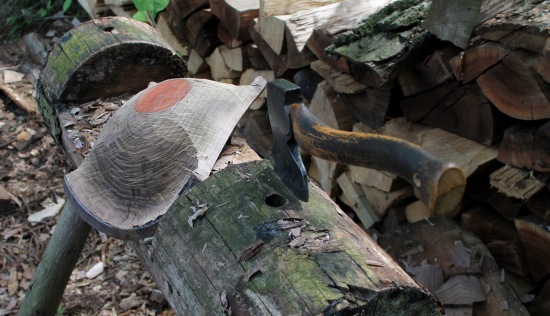
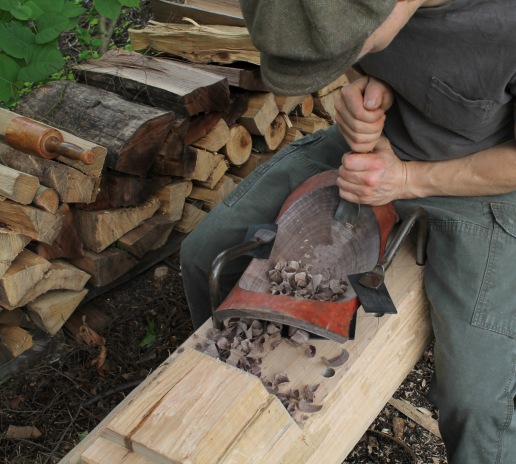
Then I got to work with the axe on a walnut bowl I had worked on a bit at FWW Live.

IMG_6330

Wide steeply-arched handles on this one, sculpted with the adze and the axe.

IMG_6342


Then I used the new low bench as I did some further shaping with gouges.  Here’s a slideshow with a few photos:

This slideshow requires JavaScript.

I’ll let it dry for awhile, then get back to it.

I’ve been outside in the May weather as much as I can.  Carved lettering and spoons don’t require anything other than a place to sit.  More on these later.  Can you hear the birds calling?


Posted in carving, holding, nature, Uncategorized, walnut | Tagged , , | 12 Comments

Pre-Fest in the Pinewoods

SAM_3582

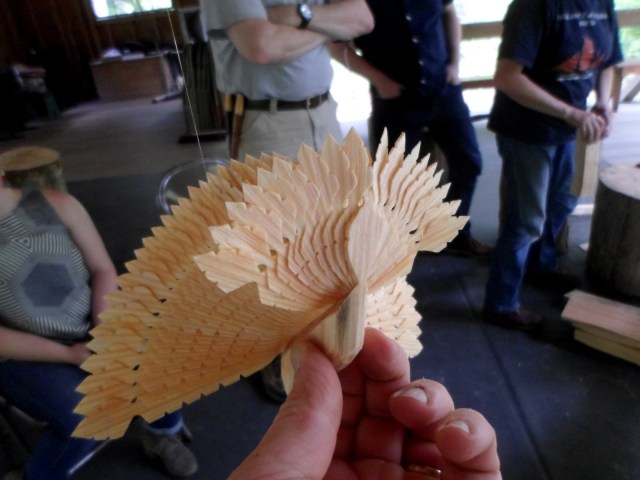
Underside of a fan bird carved from pine by Jane Mickelborough.

Ah, dear nature, the mere remembrance, after a short forgetfulness, of the pine woods!  I come to it as a hungry man to a crust of bread.

— Henry David Thoreau, Journal Entry, 1851

Less than three weeks now until Plymouth CRAFT’s Greenwood Fest.  The event is really divided into two parts, the Pre-Fest (Tuesday–Thursday) and, well, the Fest (Thursday–Sunday).  The Pre-Fest is like a smaller, more intimate, affair that focuses on specific classes during the day with plenty of time for everyone to share ideas, hang out, swim, carve, or whatever one wishes to do in the evening.  All in the beautiful pinewoods surrounded by crystal clear ponds.

SAM_3510-001

Henry attended the Pre-Fest last year, bringing his enthusiasm, skill, and rose-flavored Turkish delight all the way from Istanbul.

While the Fest proper has sold out, there are just a few spots remaining in a some of the Pre-Fest classes, including Jane Mickelborough’s on carving folding Breton spoons, including wax-inlay technique.  I’d snap it up myself if I weren’t otherwise occupied.  I’ve written about Jane before, most recently in this post about her porte-cuillères.

Maybe one evening, Jane will remind me of how to make the fantastic fan birds.  I didn’t pay close-enough attention last year during one of her impromptu demonstrations.

SAM_3572

Jane with a pine fan bird ready to unfold its wings.

I can smell the pines already.

Posted in classes, events, green woodworking, quotes and excerpts, Uncategorized | Tagged , | 4 Comments

Convergence

IMG_6195

Each life converges to some centre
Expressed or still;
Exists in every human nature
A goal,

Admitted scarcely to itself, it may be,
Too fair
For credibility’s temerity
To dare.

— Emily Dickinson, from Each Life Converges to some Centre

Whether the flutes of this walnut bowl radiate outward or converge inward may depend upon your point-of-view or mood, but from the perspective of a carving gouge, they converge.  To work into supported fibers, the cutting edge begins at the rim of the bowl and sweeps downward to the center.  I carved the same design not long ago in cherry.  You can see it in this post.  I forgot to take any process shots with this one, but I’ll include various photos of the bowl as I discuss the procedure a bit.

IMG_6219

In both cases, the flutes were carved with a long-bent gouge, #5 sweep 16mm wide.  A steeper sweep would make the ridges between flutes a little too pronounced and possibly vulnerable in use.  While a shallower sweep like a #3 makes it more difficult to distinguish the ridges and define the flutes.

IMG_6239

I don’t draw any guidelines before carving the flutes.  The width of the gouge itself keeps the width of the flutes at the rim reasonably similar.  I do like to put a little pencil mark in the center of the hollow.  That is my target point as the gouge makes its way downward and toward the center.  As the edge proceeds from rim to center, I ease up on the downward pressure exerted by my left hand on the shank of the tool, allowing the flute to simultaneously decrease in width and become more shallow.  This creates a tapering flute.

IMG_6224

I work my way around the bowl in a rough pass, then go back around once again more carefully.  When I see I have around six or seven flutes to go on the first pass, I adjust the spacing for the remaining flutes just a touch to make sure I carve a full flute next to where I began.  After a couple passes, I try to leave it alone.  I want the subtle variations and tool marks from the hand process to remain.

IMG_6236

I think on another bowl with converging flutes someday, I may incorporate Emily Dickinson’s thoughts with some carved lettering.  Lot’s of ideas for that and other pieces, I know I haven’t posted much for sale lately, but soon.

IMG_6187

Posted in bowls, carving, patterns, quotes and excerpts, Uncategorized, walnut | Tagged , , , | 25 Comments

Learning at FWW Live

IMG_6152

It’s classic advice to surround yourself with interesting, inspiring, uplifting people.  Sometimes you can create that environment, and sometimes you just get lucky and find yourself in such a situation like I did last weekend.  I had been invited to demonstrate and discuss bowl  carving at Fine Woodworking Live in Southbridge, Massachusetts.  So, I demonstrated and discussed, which was a wonderful experience thanks to the enthusiasm and great questions from the attendees.  However, what I did most at the event was learn.

My education started Friday morning when I assisted Peter Follansbee as he taught fifteen students spoon carving.  At Greenwood Fest, Peter and I are usually presenting simultaneously, so this was a golden opportunity to watch him teach.   I learned a lot from that, as well as from Peter’s auditorium presentation on the “Green Woodworking Renaissance.”  Watch a presentation by Peter and you’ll achieve a deeper understanding, laughing all along the way.  Although he humbly downplayed his significant role in this renaissance, Peter shared his broad and valuable perspective on how we’ve reached a point where adzes are a hot commodity and fresh shavings are falling to the feet of more and more woodworkers.

The trend continued with an intensely thought-provoking keynote address by Peter Galbert, entitled “A Chairmaker’s Journey.”  Pete’s talk was a fascinating story of a voyage of discovery, richly illustrated.  He shared practical wisdom on aesthetics and techniques, as well as insight into the philosophical approach that has made Pete’s journey as a maker so meaningful.

I continued to learn from Pete’s demo on spindle turning.  Although I have no woodturning ambitions, it was a good indication of how transferable knowledge and skills are.  I gained so much perspective from Pete’s demonstration regarding aesthetics, sharpening, material considerations, even courage.  Same goes for my experience with Mary May’s demonstration of carving a ball-and-claw foot.  I don’t anticipate a ball-and-claw footed bowl, but that’s beside the point.  I was able to gain a new perspective on many things from tool choice to methods of layout to envisioning a design.

I’ve just scratched the surface, but that will have to do.  The line-up of presenters was incredible, and I was fortunate to get to talk with many of them.  I was inspired by them as well as the attendees and students.  Just a rich environment of people sharing knowledge, ideas, and laughs with one another.

I was so involved in taking things in that I never thought to take even a single photo.  That’s poor discipline for a guy with a blog.  So I’ve included a couple sketches of  a spoon that Peter Follansbee gave me at the event.  I was compelled to sketch it to learn more about it and because I like it.  Already looking forward to hanging out with Peter again, and a whole host of characters at Greenwood Fest in just over a month.

IMG_6129


Posted in carving, classes, events, sketch, spoons, teaching, Uncategorized | Tagged | 2 Comments

Transferred Touch

IMG_5828

Things men have made with wakened hands
are awake through years with transferred touch, and go on glowing
for long years.
And for this reason, some old things are lovely

warm still with the life of forgotten men who made them.

— D. H. Lawrence, “Things Men Have Made”, from Pansies (1929)

Not long ago, a person who has been a great influence on my woodworking informed me that I’d be receiving a carved wooden bowl in the mail; had had it for years and was passing it along to me.   I’ll write more about that person in a special post to come.

A couple weeks ago, the package arrived on my porch.  I can’t fully explain what I felt upon opening the box and holding a bowl carved twenty years ago by Bengt Lidstrom, but to say the least, I was thrilled and overwhelmed.

IMG_5830

I wrote a post about Bengt Lidstrom over two years ago, including a link to an extensive article about him from a Swedish museum.  Bengt’s work has been inspirational to me.   To now have a piece made by his hands, to hold it and learn from it, is an incredible gift.  As D. H. Lawrence suggests about such objects, this bowl is “warm still” with Bengt’s life and will continue to be for years to come.

I’ve rolled this bowl over in my hands every day, and I thought I’d share a few things I’ve noticed about it, and learned from it.

IMG_5843

At about 11 inches long, 10 inches wide, and 5 inches high, it did not require a grand piece of wood, in terms of size or quality.  The birch log he used was far from perfect.  It has a knot running along one end wall, for example.  Don’t let the limitations of available material stop you from making the best of it.  The strength of Bengt’s design just brushes those issues aside.  He considered the unique nature of the piece he was working with and made it sing.

IMG_5835

All surfaces of the bowl come alive with Bengt’s confident cuts.  No need to drive yourself crazy with the “perfection” of every facet.  The surface is vigorous yet soft.  The bowl beckons to be touched.  The flow of the form is a feast for the eyes as the light changes throughout the day, but to me the bowl reveals the most by being held.  To feel the texture, the thinness of the undercut sidewall — just enough to allow for the depth of decorative carving on the side panel.  Even the sounds of tapping fingertips resonating through the wood…   Again, to quote Lawrence, this bowl is “awake through years with transferred touch.”
IMG_5839

This bowl has many more stories to tell and lessons to teach, but I’ll mention just one more for now.  The bottom of the bowl is carved with “BL 99.”  He was 83 when he carved this bowl, and there’s a lesson and encouragement in that for us all.

IMG_5832


Posted in bowls, finding wood, historical reference, patterns, proportions, quotes and excerpts, Uncategorized | Tagged , | 31 Comments