A Little Bread

IMG_6066-001

A little bread—a crust—a crumb—
A little trust—a demijohn—
Can keep the soul alive—
Not portly, mind! but breathing—warm—
Conscious—as old Napoleon,
The night before the Crown!

A modest lot—A fame petite—
A brief Campaign of sting and sweet
Is plenty! Is enough!
A Sailor’s business is the shore!
A Soldier’s—balls! Who asketh more,
Must seek the neighboring life!

— Emily Dickinson, Poem 159 (1896)

IMG_6076-001A few months ago, I almost threw this crust of walnut log onto the firewood pile.  It only had a bit of heartwood on the bottom, a remnant from the core of the log on which I was focused.  But the glaring white sapwood had already started to deepen to a beautiful brown, and I took a closer look.  This was enough.
IMG_6075-001I popped it into a garbage bag to keep it from drying out, and to allow the sapwood more time to deepen in color.  I’ve noticed that this process continues as long as the log remains moist.  Wait too long and you have rotten sapwood.    The process stops once the bowl has been roughed-out and allowed to dry.
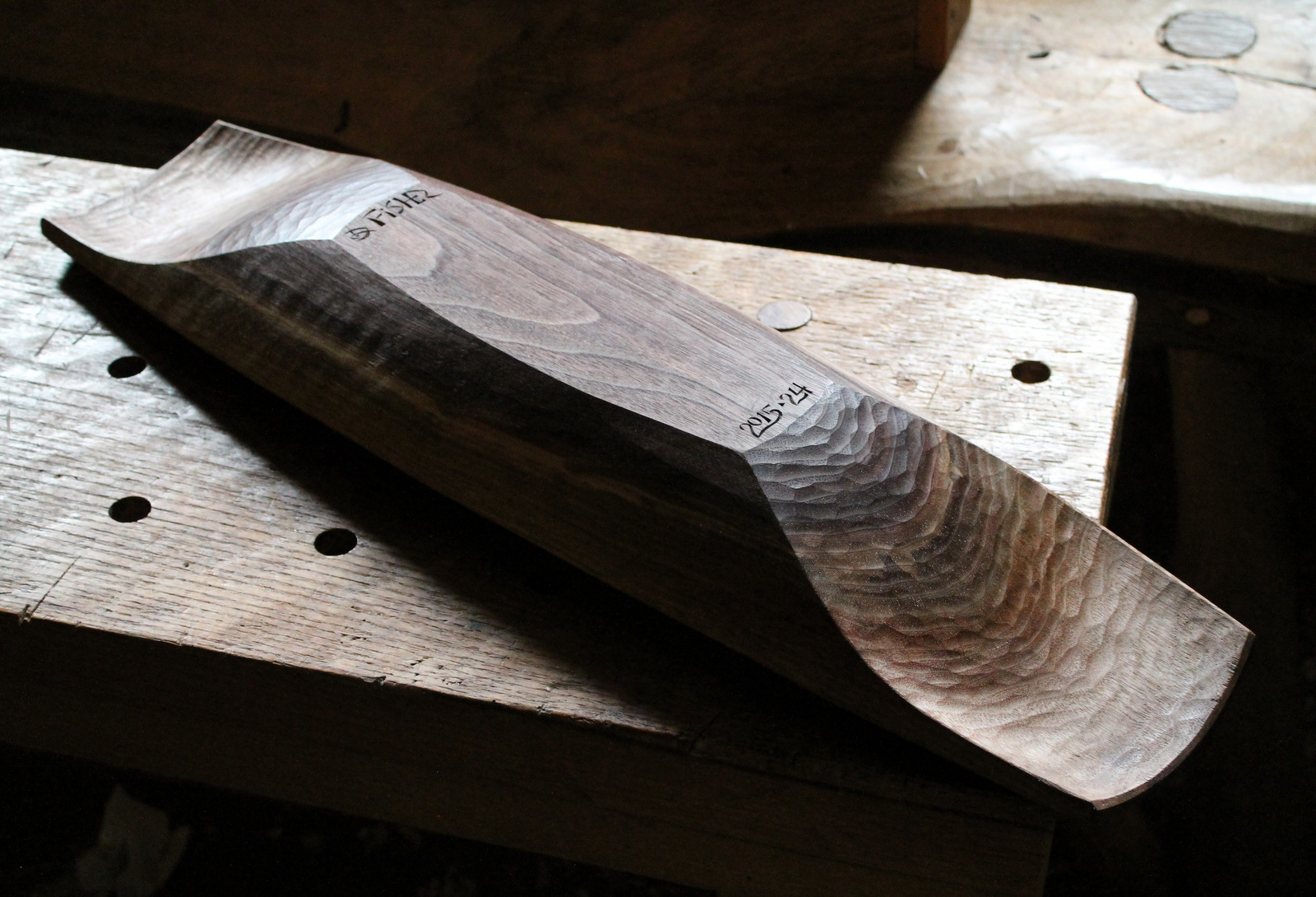
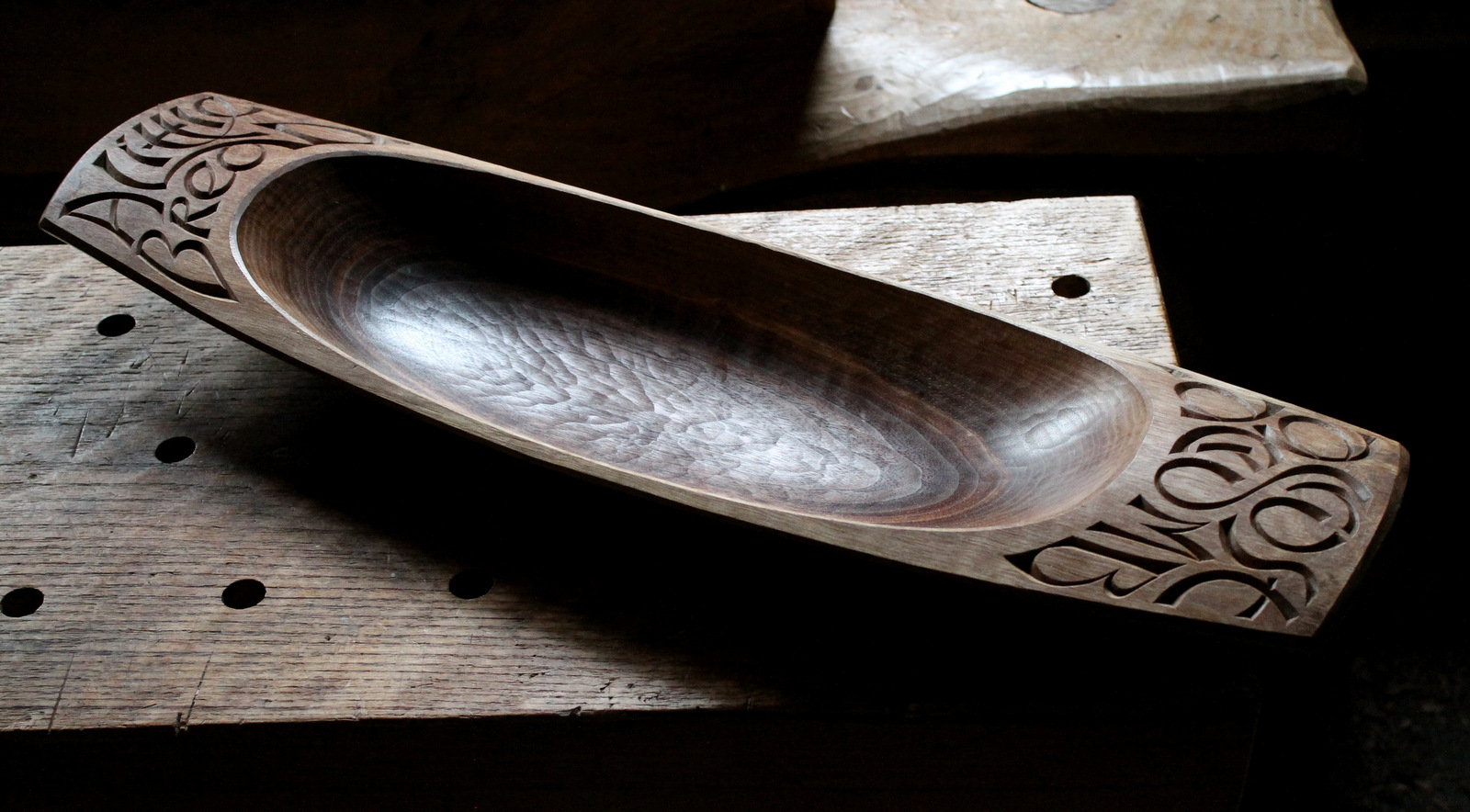
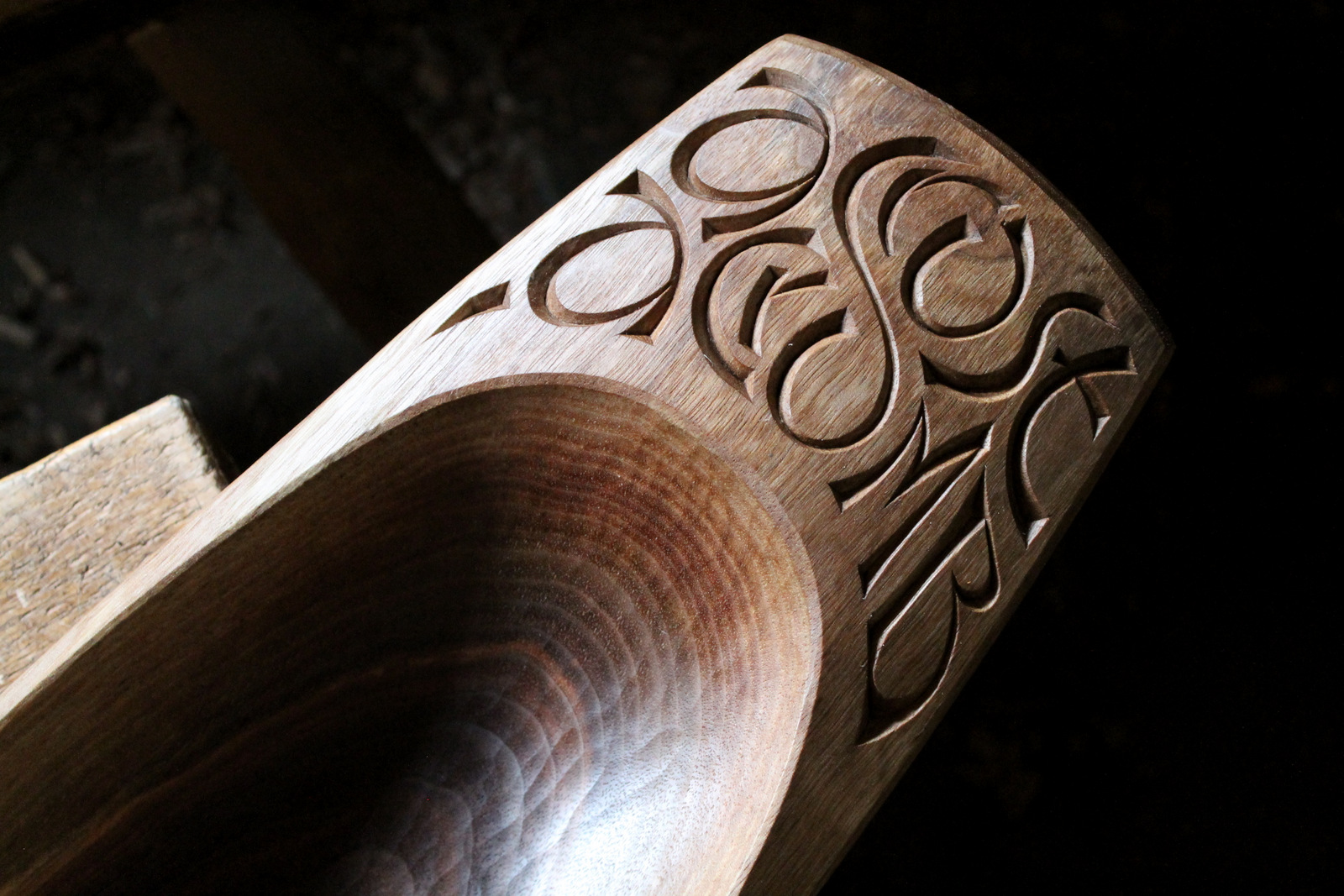
IMG_6069-001Considering the long narrow piece of wood, I carved a traditional trough style bowl (26 1/2″ long) that retained the naturally arched upper surface under the bark.  The handles are deep and undercut far back from the ends.  The broad surfaces of the handles were an ideal canvas for another exploration of letter carving, but I waited for inspiration.
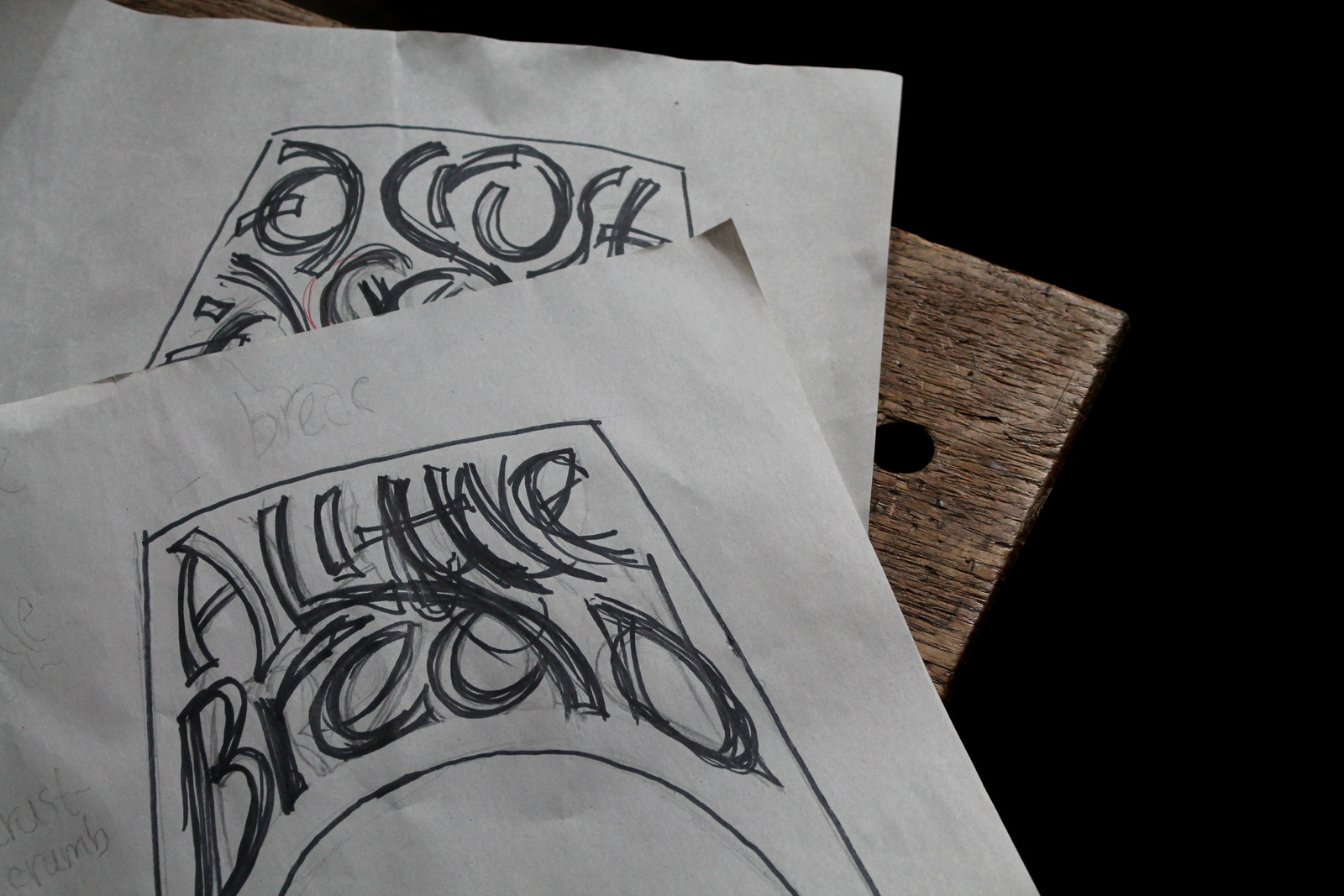
IMG_6064-001It came through Emily Dickinson.

I explored ideas for the lettering design on paper, first with lots of pencil scribbles, then over that with marker, still keeping it loose.  It still had to be drawn on to the surface of the wood freehand anyway.  That is done more precisely.  Even then, it is the final cuts that matter, not the pencil lines.

IMG_6052-001For letters this large in walnut, I used a combination of a few carving chisels as well as the pen knife blade.  It takes time, but I enjoy the process.  It is a nice contrast to some of the heavier work done with the axe and adze.


Posted in bowls, Lettering, quotes and excerpts, Uncategorized, walnut | Tagged , , , | 7 Comments

The Secret Sits


IMG_5884We dance round in a ring and suppose,

But the Secret sits in the middle and knows.

     — Robert Frost, The Secret Sits

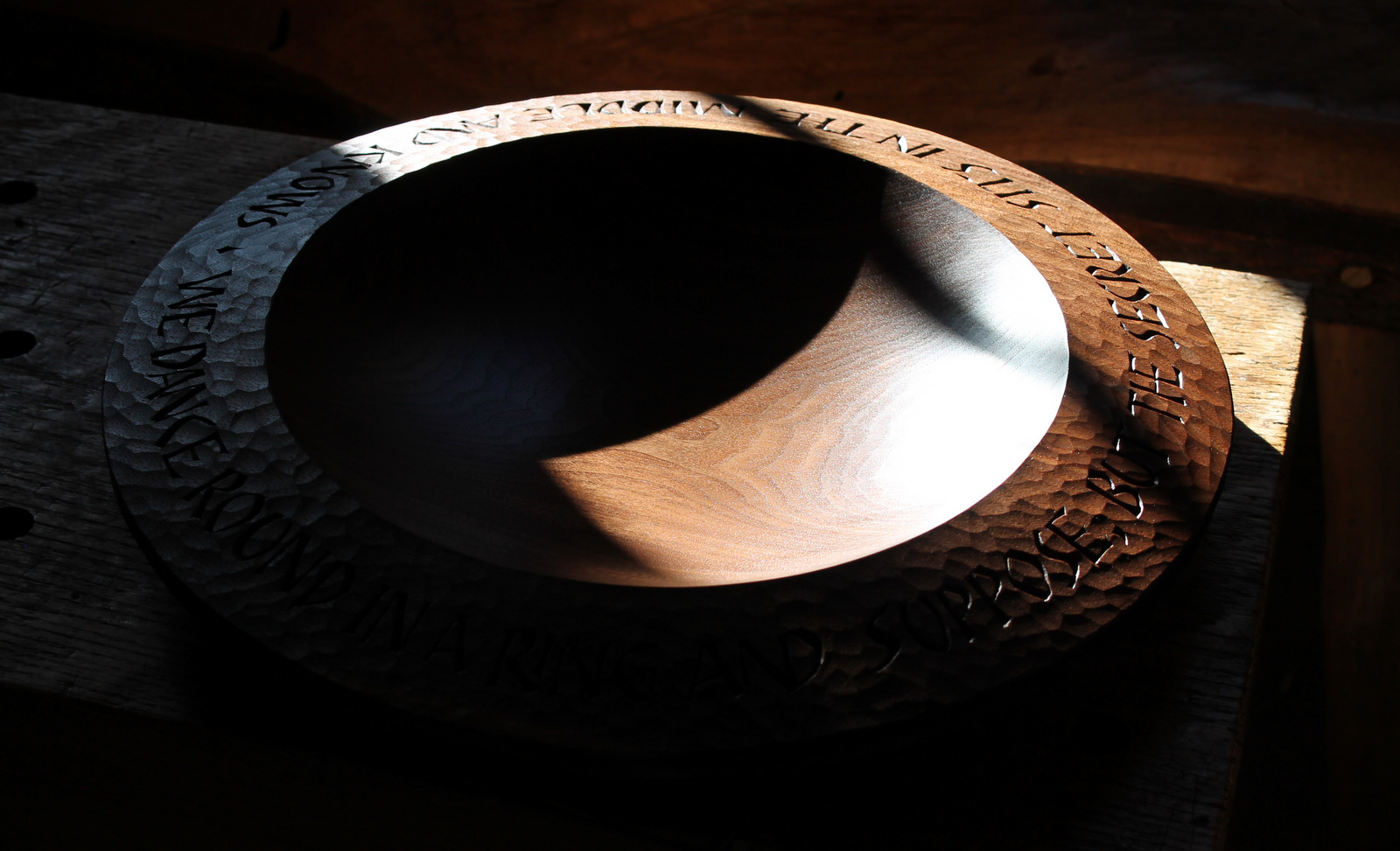
I thought I’d share some photos of my most recent bowl, inspired by Robert Frost’s poetry. In my last post, I discussed the process of carving the bowl itself.   Through the photos below, I’ll show some of the more recent steps, as well as a few shots of the completed bowl. The wood is walnut, and the bowl is 16 inches in diameter and 2 3/8 inches high, more of a platter I guess.

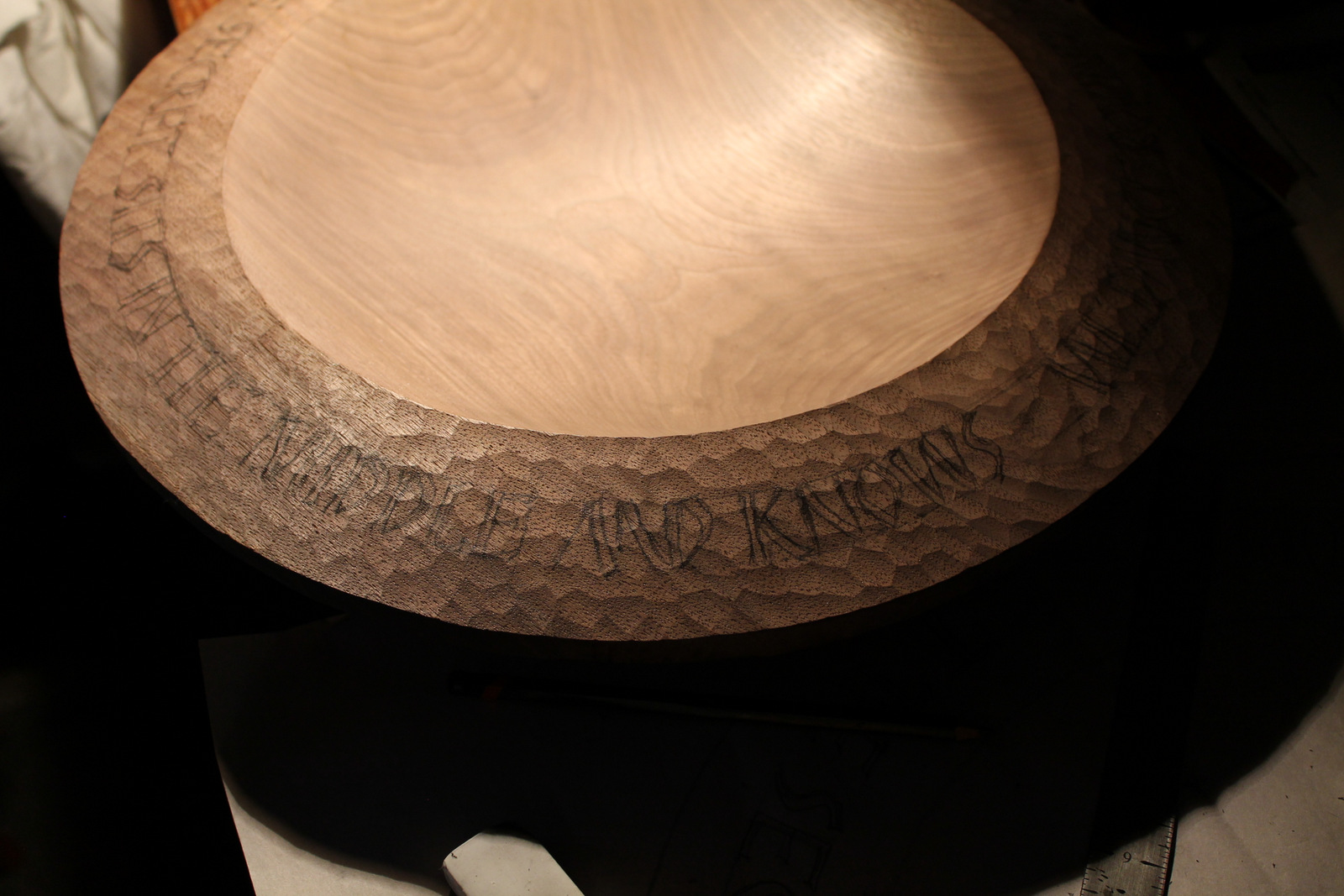
After texturing the wide rim with a gouge , I drew the letters on paper to work out spacing issues, then drew them again onto the bowl with a soft pencil.

After texturing the wide rim with a gouge , I drew the letters on paper to work out spacing issues, then drew them again onto the bowl with a soft pencil.

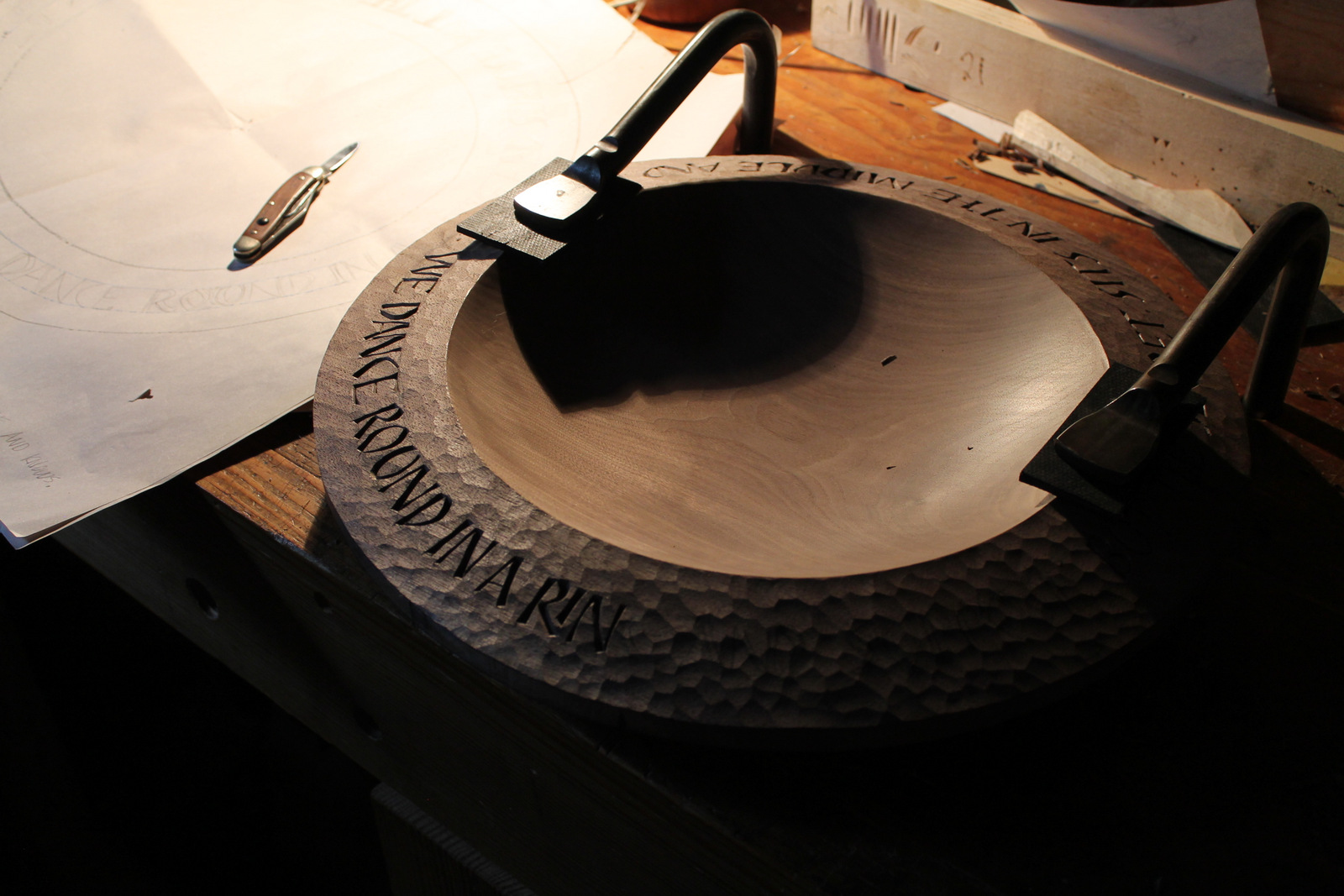
I used a small gouge or two at times, but the bulk of the lettering was done with the pen knife blade.

I used a small gouge or two at times, but the bulk of the lettering was done with the pen knife blade.

IMG_5886

Here, the grain pattern in the hollow is visible, along with the contrast in texture between the rim and the hollow.

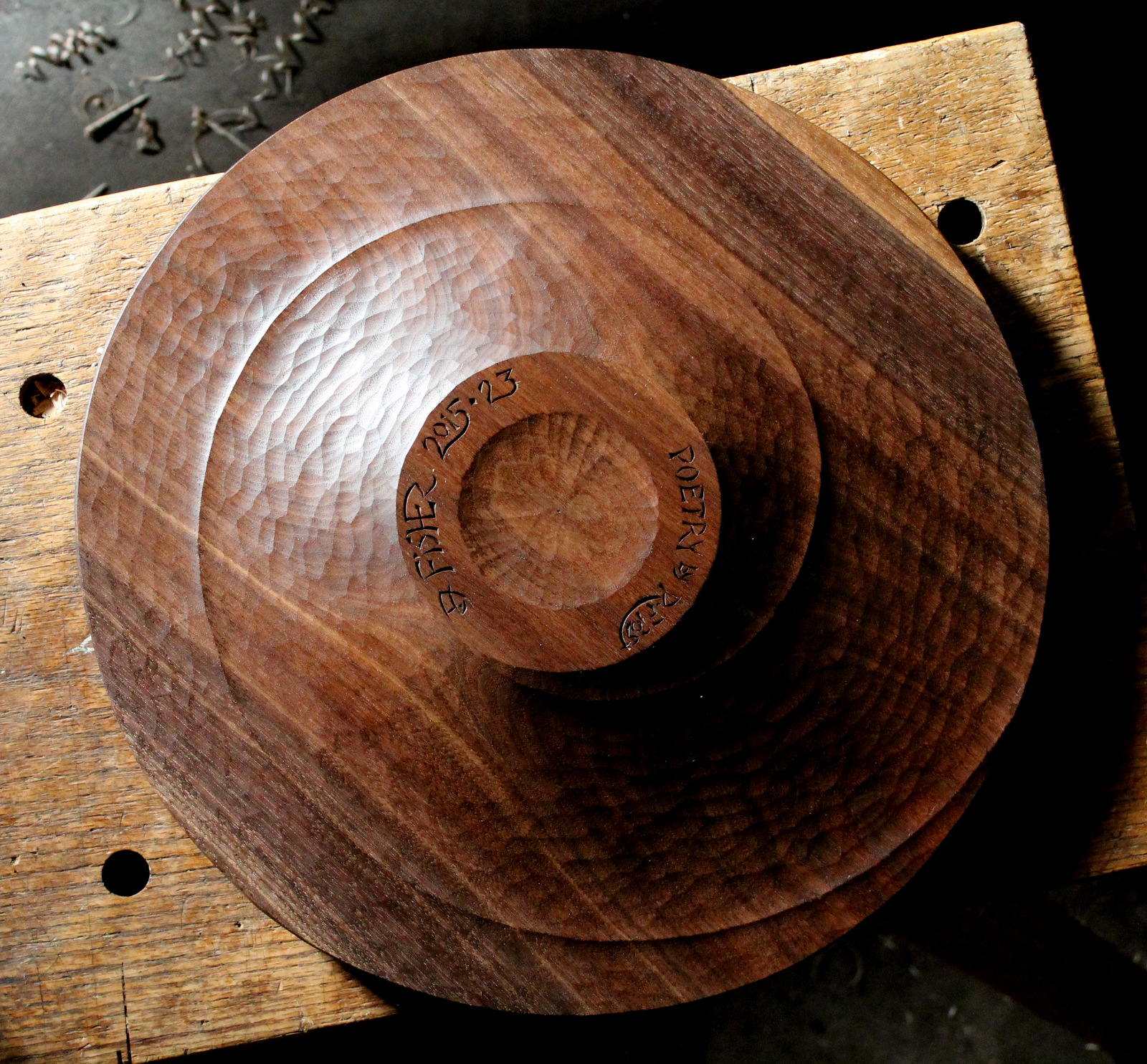
The underside is textured with a spiral connecting the rim and the bottom

The underside is textured with a spiral connecting the rim and the bottom

IMG_5828

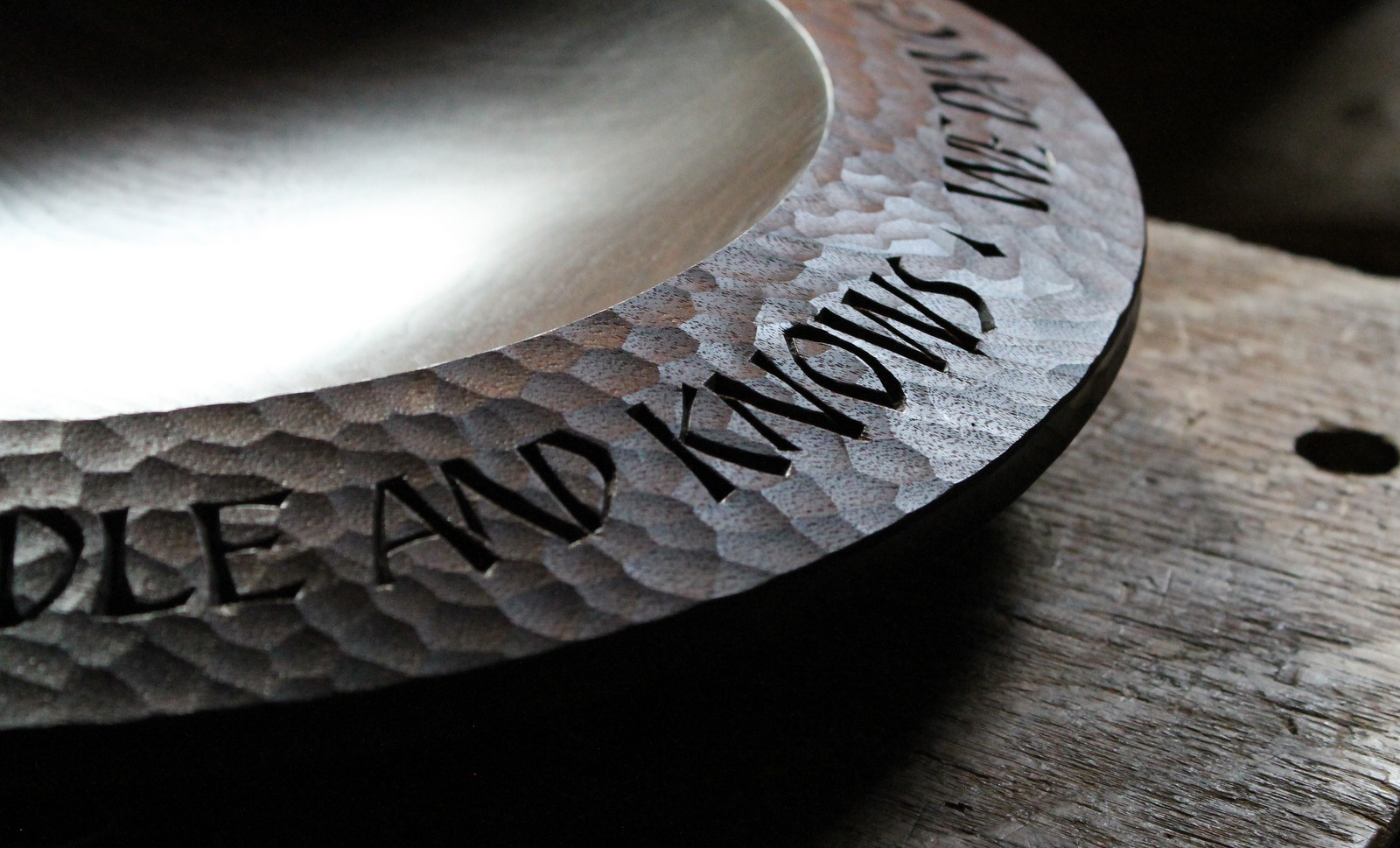
The edge of the rim is slightly hollowed. As the bowl dried, natural warping left the edge a bit wavy as it proceeds around the bowl — a welcome addition to the dancing theme of the rim.

I thought the chair might provide a sense of scale.

And, to provide a sense of scale, there it sits.

Thanks for looking.  I’ve also posted it to my website.


Posted in bowls, Lettering, quotes and excerpts, Uncategorized, walnut | Tagged , , | 13 Comments

“Turning” Without a Lathe

IMG_5314Months ago, I had a certain passage of poetry tumbling around in my head, and I envisioned it on a bowl.  But the bowl had to be round, and here I sat without a lathe — sort of.

Actually, I do have a couple.  Years ago, I built a a spring-pole lathe after reading Mike Abbott’s Green Woodwork — Working Wood the Natural Way.  I’ve had a lot of fun doing some spindle turning with it, but it sits disassembled in the basement, lacking the space to keep it set up in the shop. Plus, it’s not set up for bowls, let alone something 16 inches in diameter, like this bowl.  My other lathe is a mini-lathe I got for my son to use, but he is on to other things and it sits in the corner gathering dust.  So no lathe, or turning skills, up to the task.

IMG_5281-001

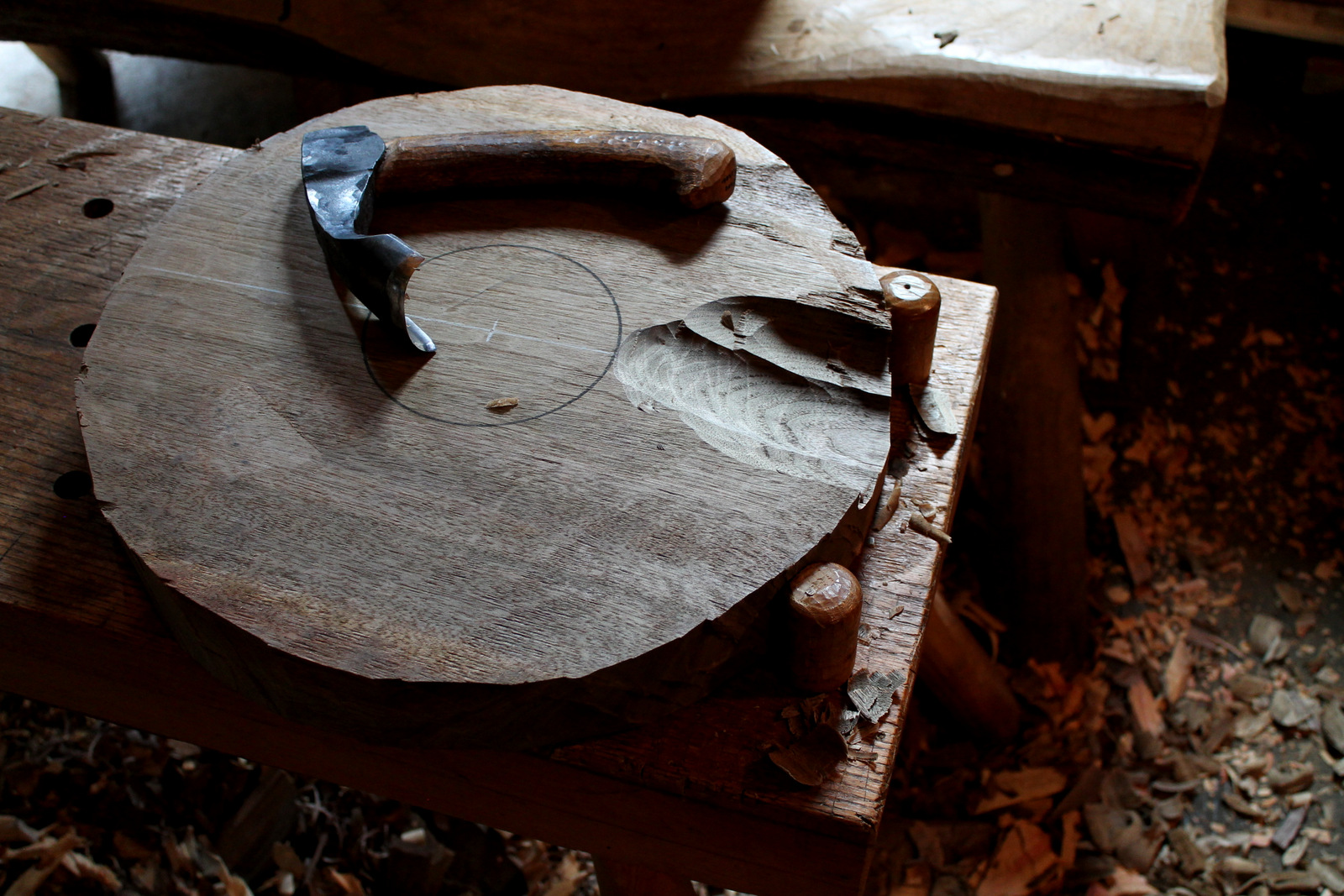
Sculpting the exterior of the walnut bowl with an adze. The small circle represents the bottom.
So, I stuck with what I know best, and started chopping away at a walnut log with an axe. After hewing the upper and lower surfaces flat, I struck a circle with the compass and hewed to it with the axe. Then I hollowed the bowl portion and sculpted the exterior with the adze.
IMG_5282

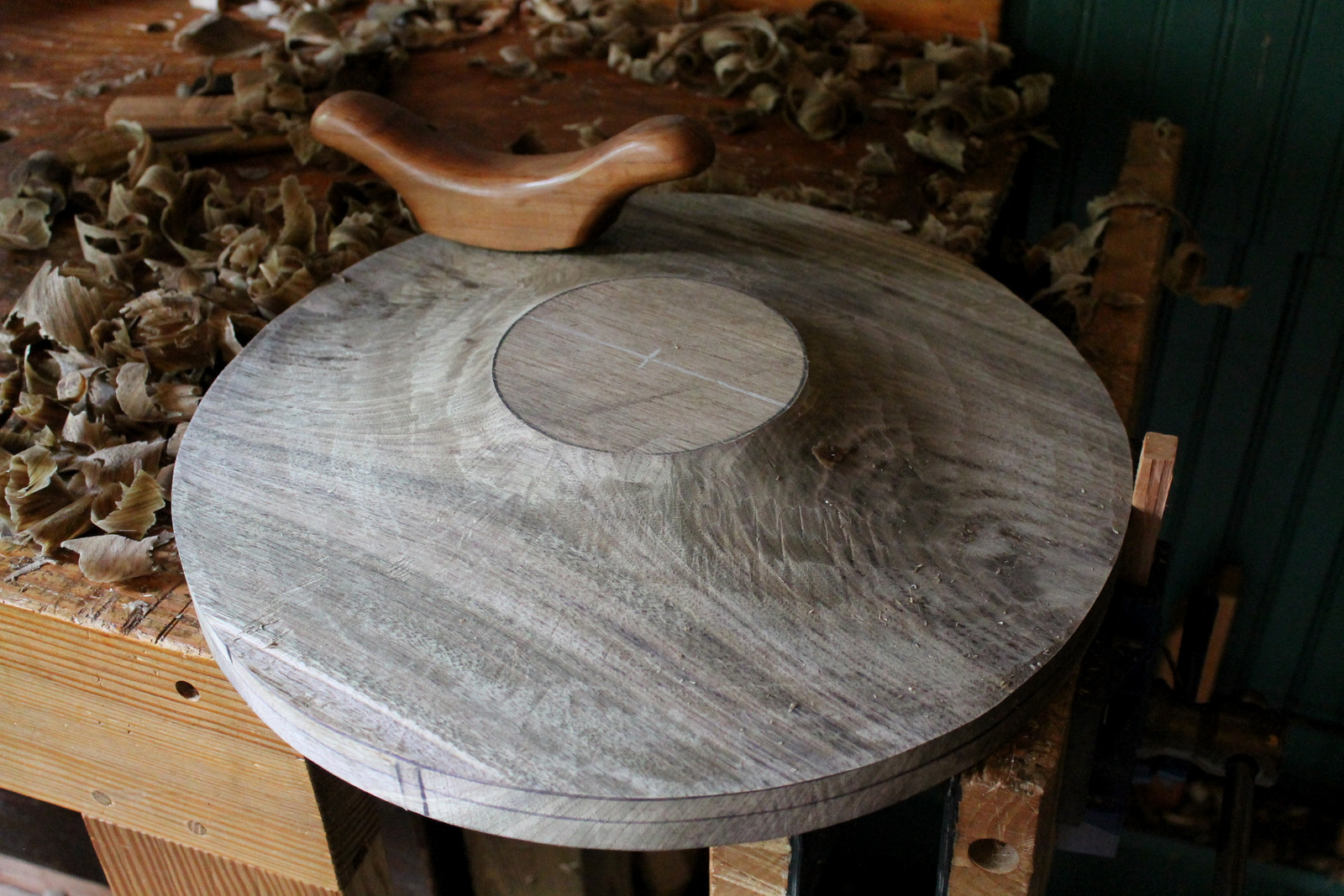
The bottom of the bowl after working with the travisher.


I refined the adze work with a travisher that I made years ago.  If I recall, I bought the blade from Country Workshops, but they don’t sell them anymore. Of course, the wood is still green at this point.

IMG_5283

Sculpting the wide rim with a drawknife.


The wide upper rim was easy to shape with a drawknife.

After leaving the bowl to dry wrapped in an old sheet for a few weeks, additional refinements could be made.  Due to the nature of the poetry passage, I wanted a strong tooled texture to the rim, but an absolutely smooth, even surface to the interior of the bowl.  An unusual task for me.  Time for a card scraper.

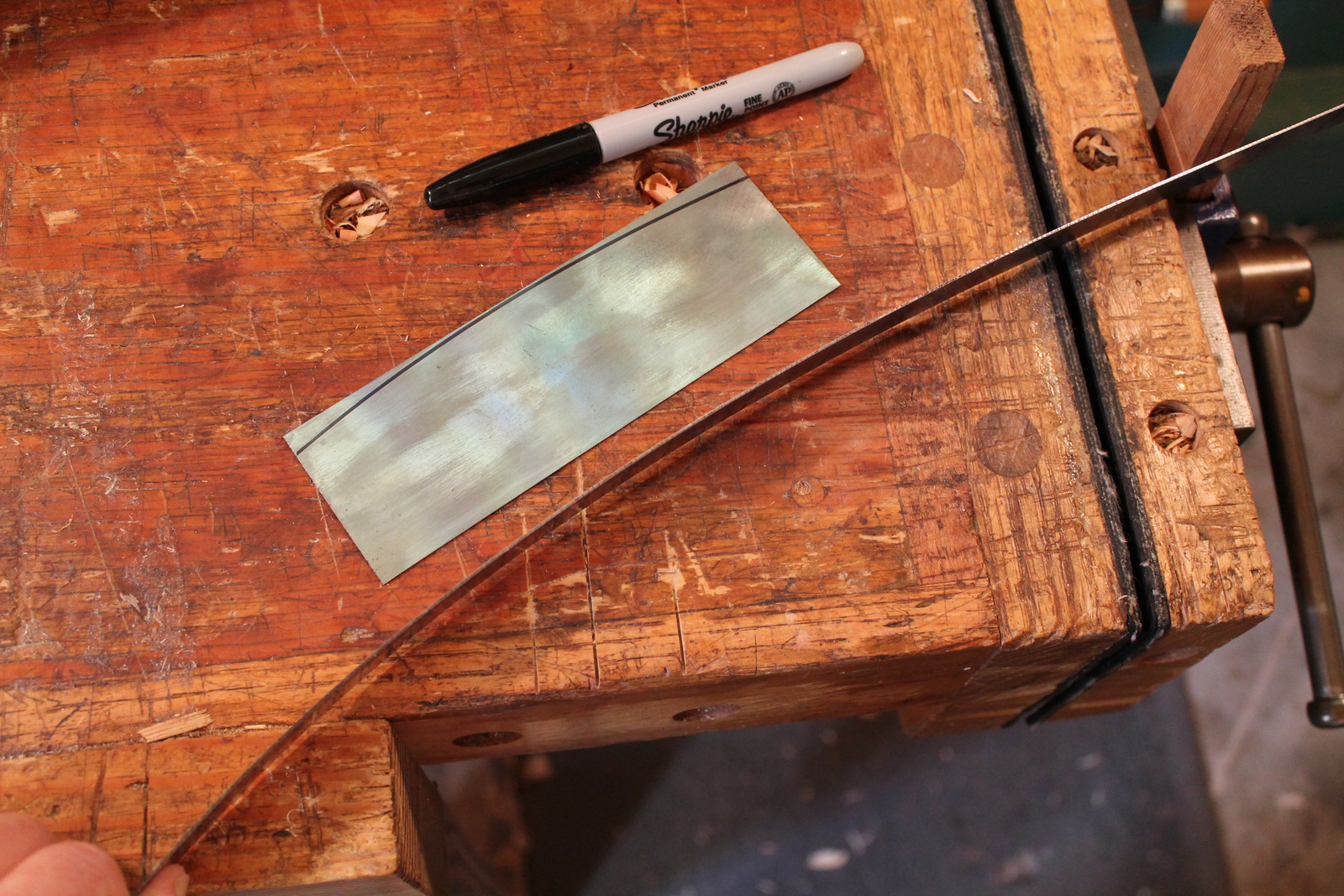
Marking a curve on a scraper.

Marking a curve on a scraper.


I started by grinding a curve to the edge of a square scraper after marking a line with a Sharpie and a flexed ruler.  I actually made three in increasingly tighter curves while I was at it.  This one is a more shallow arc than the one I used for the bowl.

IMG_5317

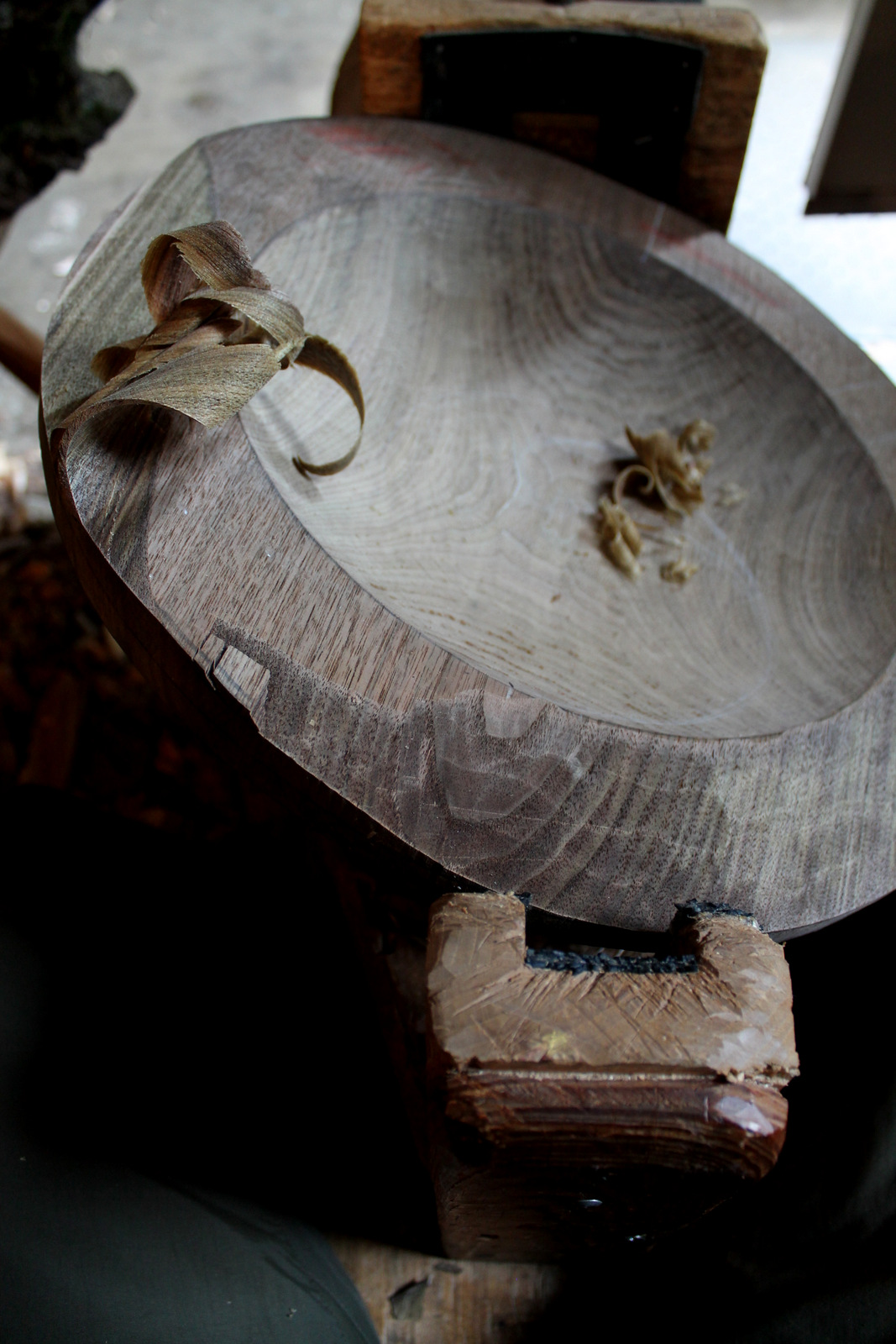
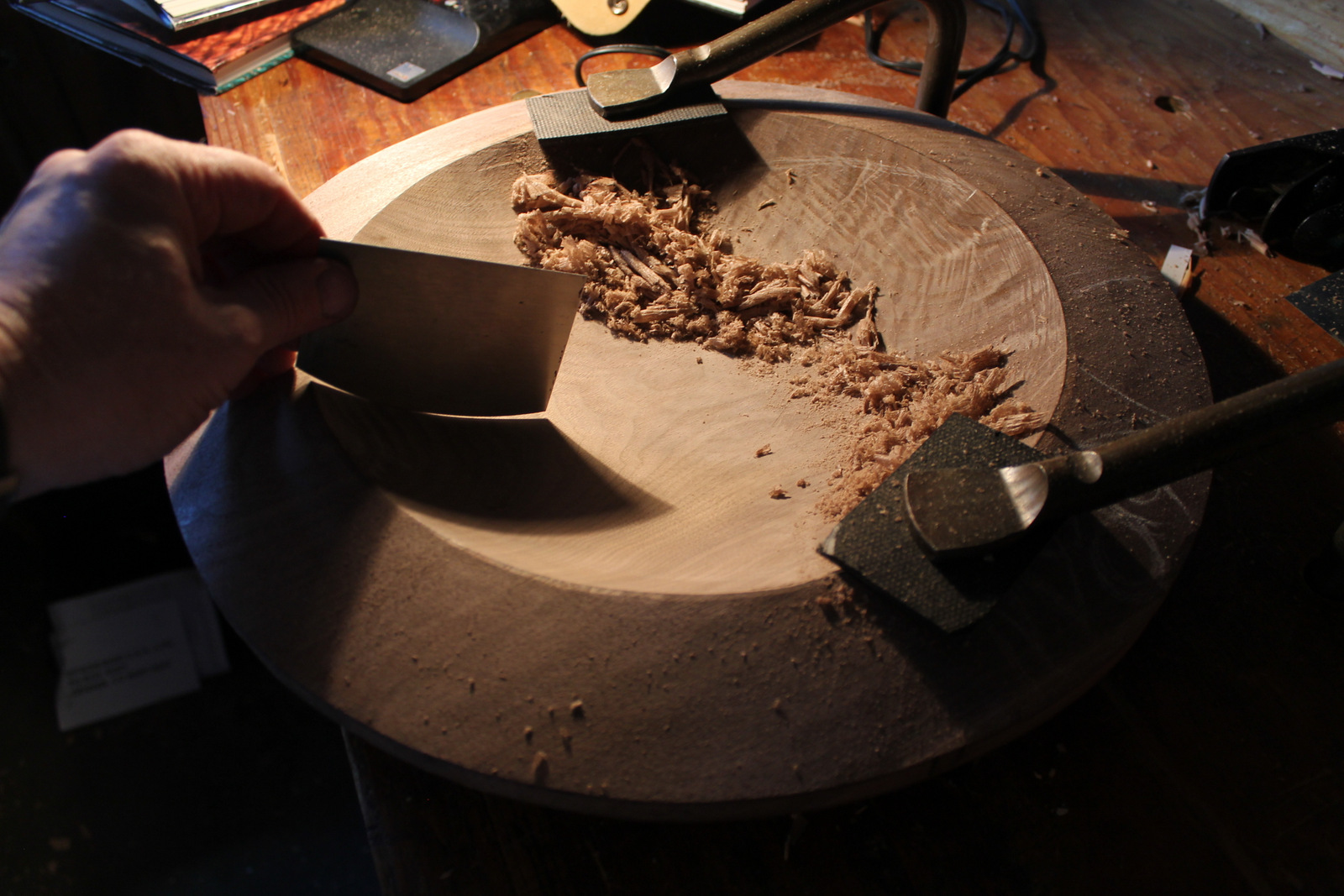
A custom card scraper refines the interior of the bowl.


After honing the edge and turning a burr, I was ready to refine the surface inside the bowl.  A sharp scraper will cut delicate shavings, and I was surprised at how well the surface took shape.  It was necessary to smooth the scraped surface with some light sanding with very high grit paper, so I submitted to that task. Thankfully, it was relatively quick, thanks to the effectiveness of the scraper.

In the photo, it is clear that the scraper is ground slightly tighter than the bowl surface.  In use, it is tilted forward a bit and flexed, resulting in a good match.

I’ve now done more work on this bowl, including the lettering.  I’ll be able to share some photos of the finished bowl soon.

Posted in adze, axe, bowls, holding, layout, Lettering, tools, Uncategorized, walnut | Tagged , , | 7 Comments

The Organic Artist

IMG_5822

Not long ago, in this post, I discussed my experiment of painting a spoon handle with home-made pigments from rocks.  A few of us were discussing that idea at Lie-Nielsen, when this book was recommended to me: The Organic Artist by Nick Neddo.  I’m glad I picked up a copy, and I now realize I was just scratching the surface with my little experiment.

Nick’s book not only covers in detail methods for getting pigments from rocks, he goes into brushes, inks, crayons, charcoal, paper,…. Well, check out Nick’s website, where you can explore his beautiful work done with materials from nature.  There’s a link there to check out his book, including the table of contents, and purchase it if you’d like.  The book is beautifully done, and everything is explained with remarkable clarity.


Posted in books, paint, tools, trees, Uncategorized | Tagged , | 1 Comment

More on the Maine Woods… from Eric

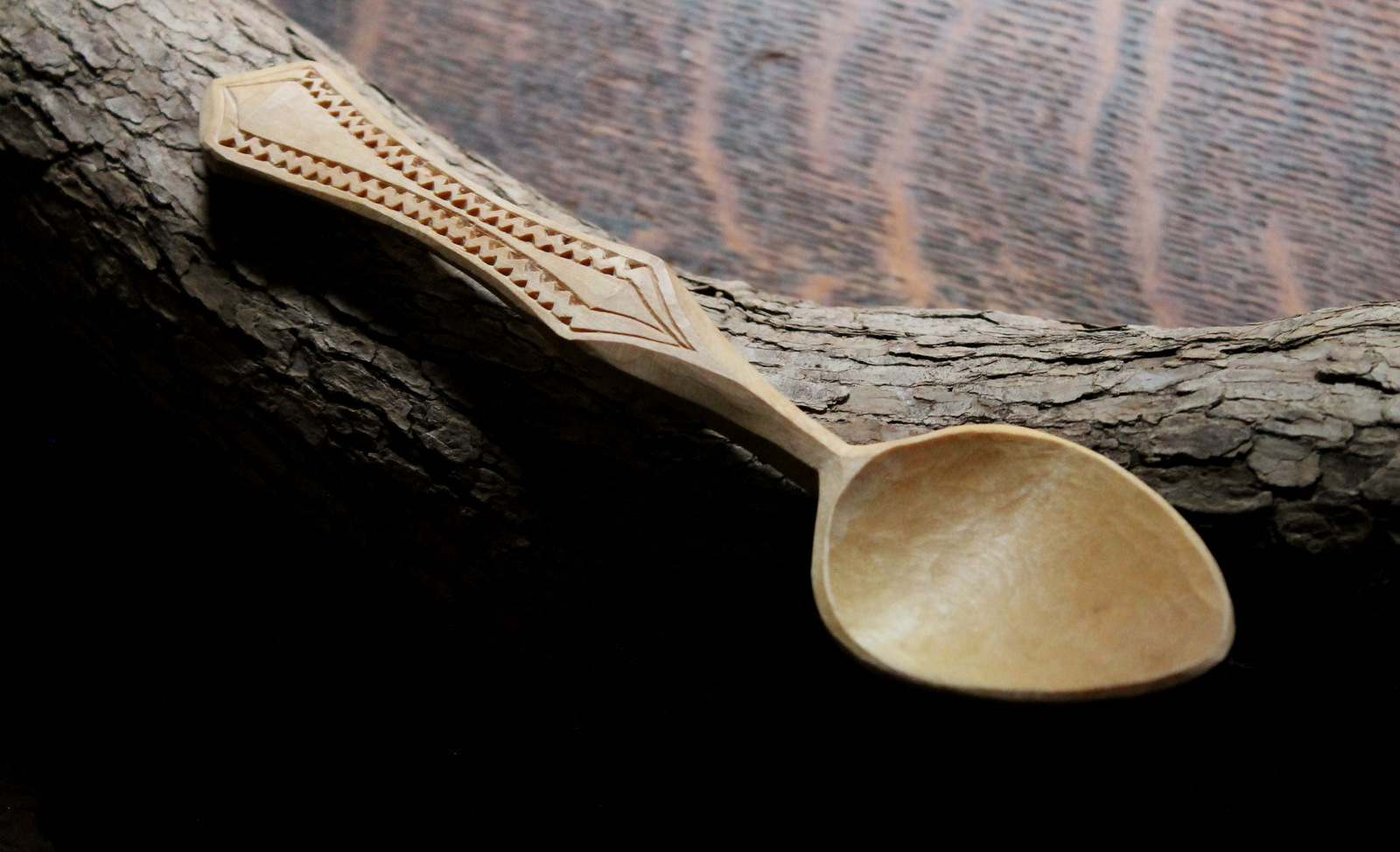
Rhododendron Eating Spoon by Eric Goodson

Rhododendron Eating Spoon by Eric Goodson (on a Rhododendron branch)

In addition to meeting new friends in Maine, I was able to catch up with some old ones, including Eric Goodson.  He even gifted me this lovely eating spoon with a delicately chip-carved handle.  Eating spoons are tricky to get right, but this one works great.  I’ve been testing it out!

Eric writes a thoughtful blog about his carving journey.  His two most recent posts relate some of his experiences in Maine with much more detail and more links than mine.  He also mentions many of the other folks that were there, including Drew and Louise Langsner.  It was the information in Drew’s books and on his website that got me started with bowls years ago.  It was a real pleasure to meet and talk with Drew and Louise in person.

Lot’s of interesting and helpful stuff in Eric’s prior posts as well.  And if you want to know what potential spoon carving gatherings are coming up, Eric is the guy to ask.  Here is the link to Eric’s blog if you missed it above.

Posted in bowls, patterns, spoons, Uncategorized | Tagged | 1 Comment

The Maine Woods

Jogge Sundquist carving at Lie-Nielsen Toolworks

Jogge Sundquist carving at Lie-Nielsen Toolworks

A little over 150 years ago, Henry David Thoreau visited the Maine woods to learn from nature and the Penobscot tribe, including his Penobscot guide, Joe Polis.  A week and a half ago, I also journeyed to the Maine woods and joined a tribe of carving enthusiasts who had traveled from Texas, Japan, and many places in between.  The guide was the Swede Jogge Sundquist, assisted by a man from Thoreau’s neck of the woods, Peter Follansbee.  Our piece of the Maine woods was situated behind Lie-Nielsen Toolworks.

I’ve been relatively physically isolated in my woodcarving pursuits, but this trip showed me the benefits of getting out there.  Jogge has many years of experience studying traditional Swedish handcrafts and incredible skill with a knife.  A visit to his website is a colorful feast for the eyes and truly inspiring (there’s an “English” button at the top).  The opportunity to listen to him, talk with him, and watch him work was a special one indeed.  Plus he’s a nice guy with a great sense of humor.

Peter Follansbee and Jogge Sundquist at Lie-Nielsen Toolworks.

Peter Follansbee and Jogge Sundquist at Lie-Nielsen Toolworks.

Peter and Jogge made a fantastic team throughout the weekend.  There were so many others I enjoyed talking with as well.  And Deneb, Chris, and the whole Lie-Nielsen crew are first-class.

Carving, learning, laughing, and sharing — and some birds!  What a pleasure to get together with folks from diverse backgrounds with a common passion.  Twenty guys having a blast making chips under the trees.  With so much going on, I did snap a couple photos that inspired these two sketches.

Thoreau was captivated by Maine, making three great journeys through it’s woods.  I’m looking forward to a return one day as well.

Posted in carving, nature, sketch, Uncategorized | Tagged , , | 10 Comments

Curly Bird

IMG_5532

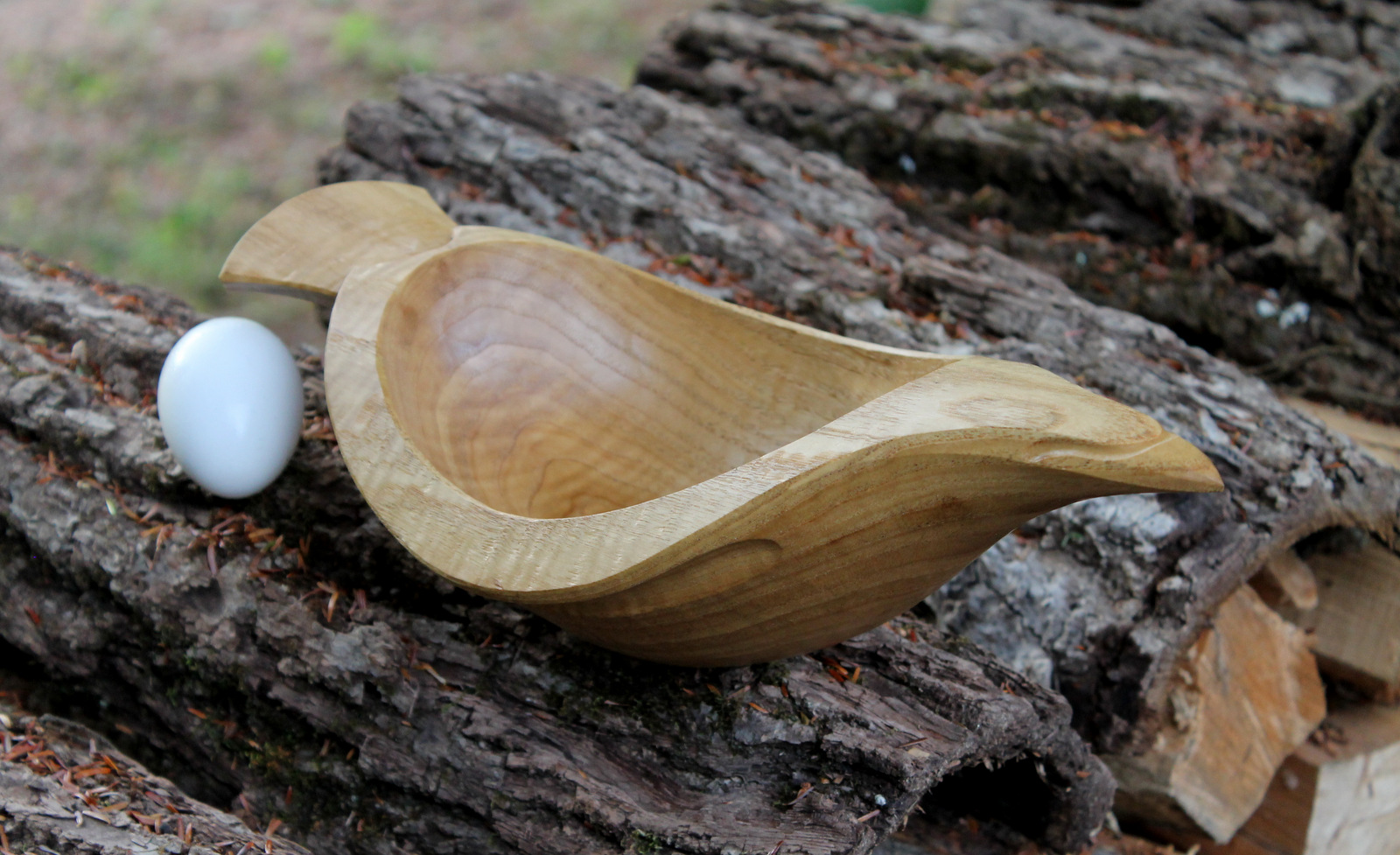
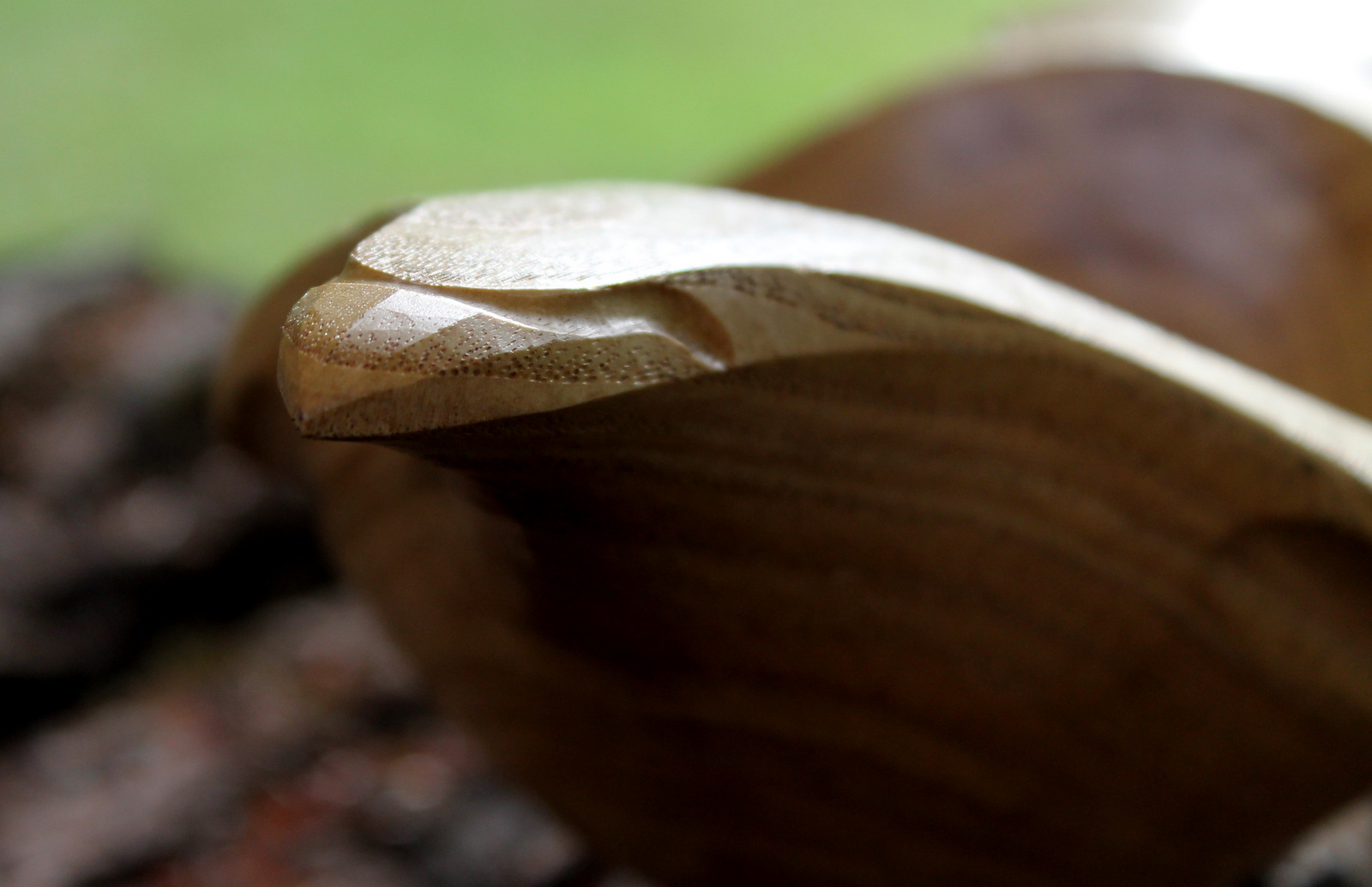
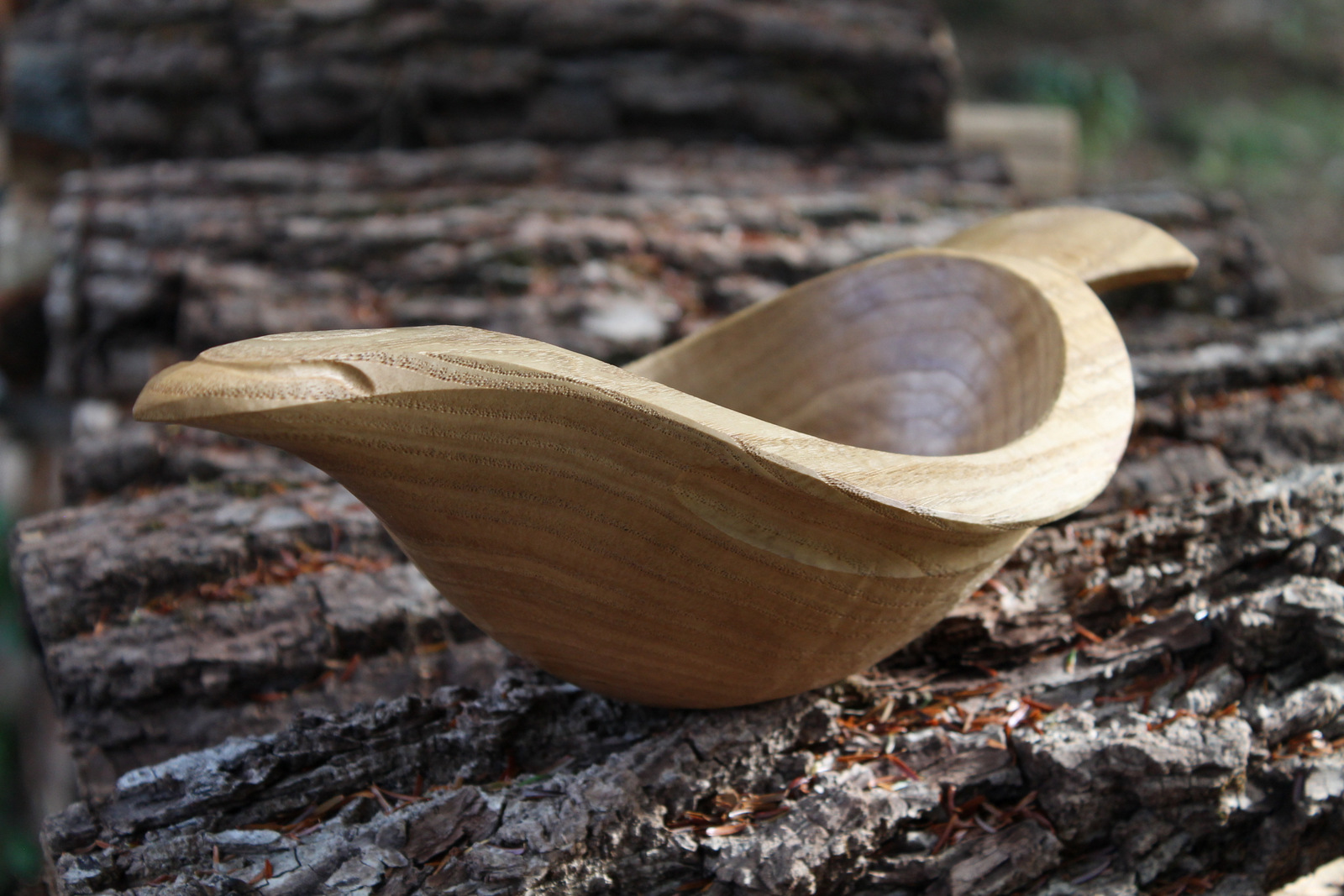
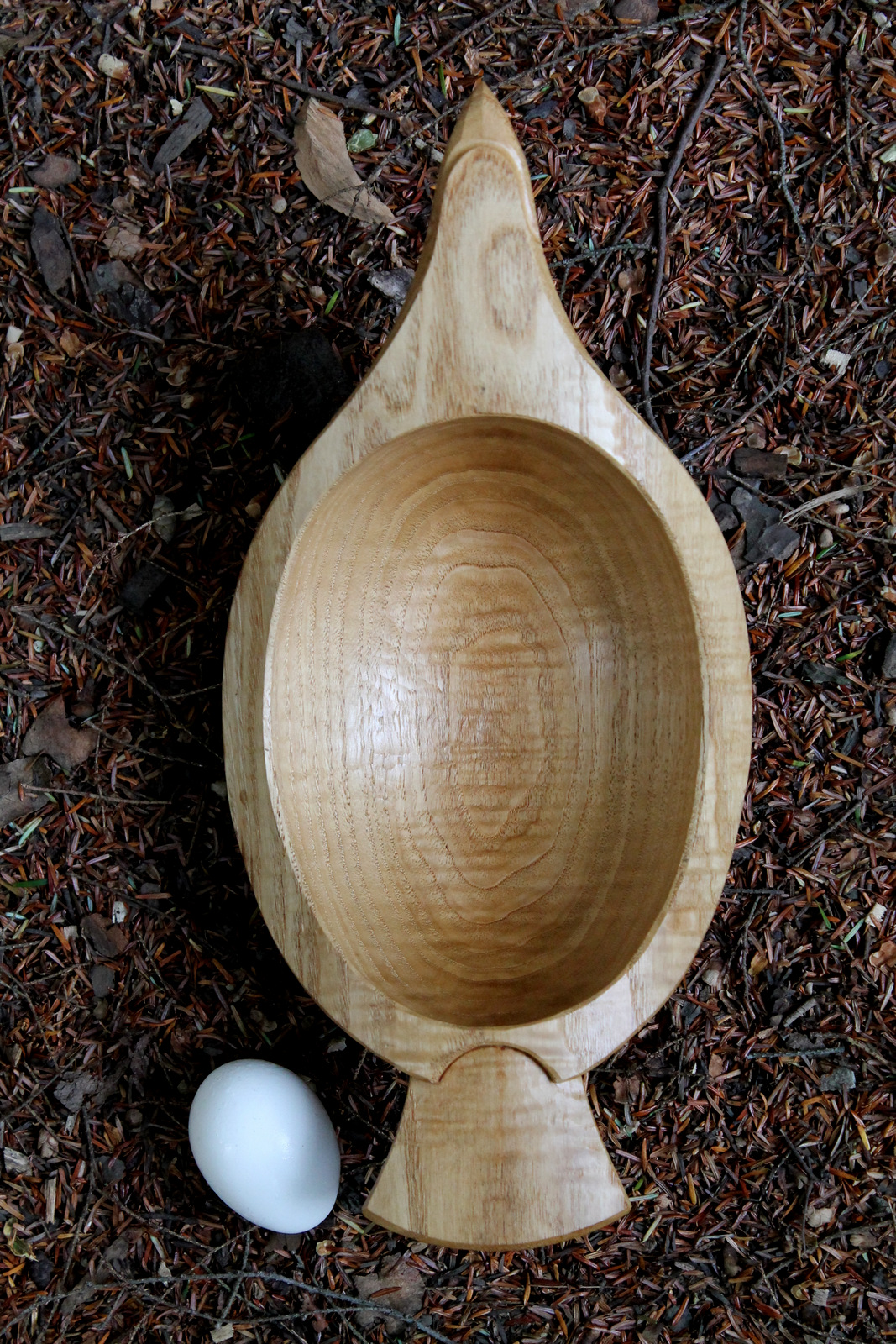
I’m looking forward to writing about this past whirlwind weekend full of knives, wood chips, and beards.  But, meanwhile, I’ll post some photos of this bird-inspired bowl carved from Chinese chestnut.  I hope the egg might provide some sense of scale.  The overall dimensions are 13 1/4″ long, 6 3/8″ wide, and 4 1/4″ high.

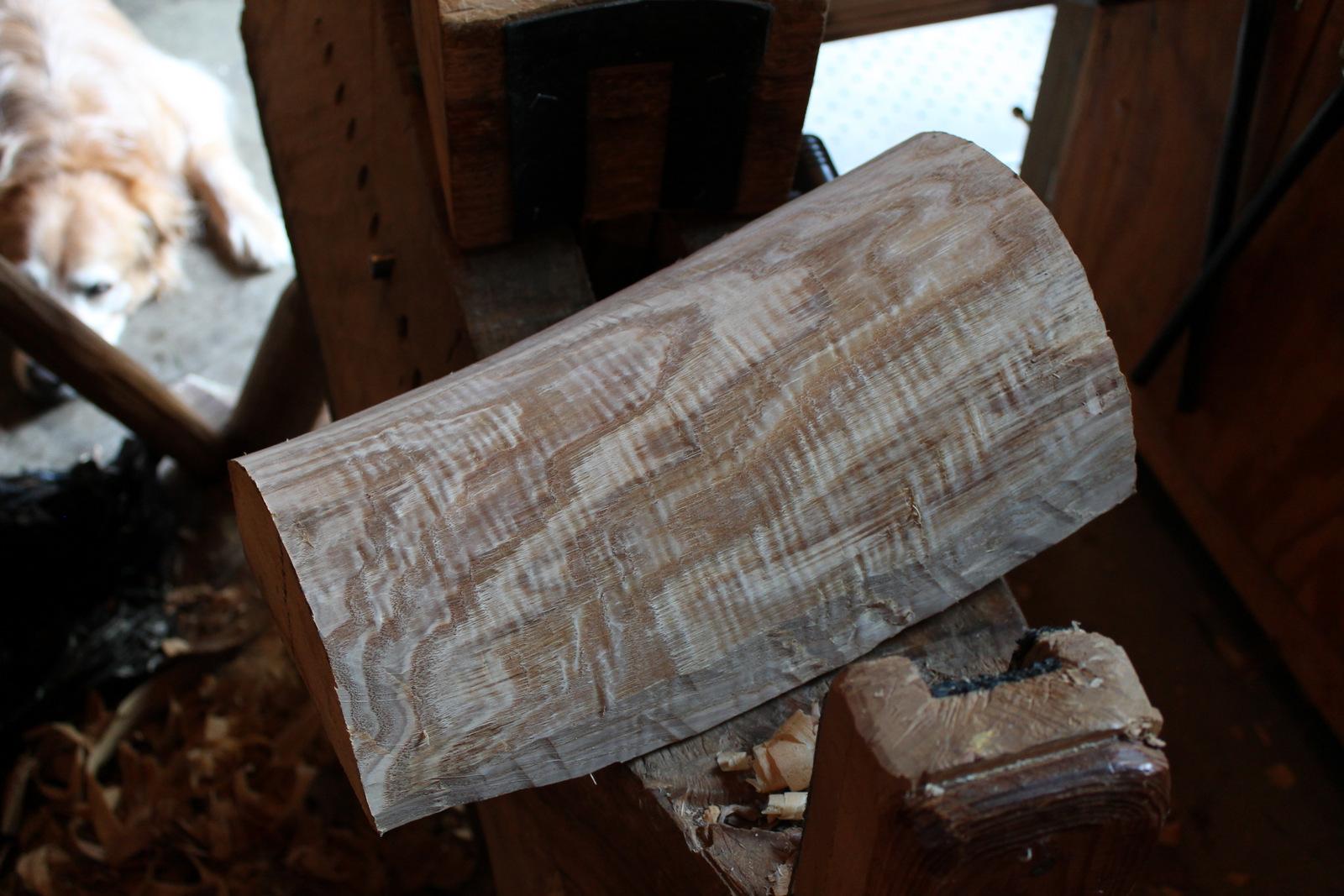
IMG_4595I was both excited and concerned to see the obvious figure in the wood when I shaved off the bark.  Curl is prized for it’s beauty, but it can be a bear to cut cleanly without tear-out.

The most challenging areas for avoiding this were along the upper edges of the wings and other places where the surface followed the annual ring layers closely.  Areas in which I was cutting clearly “downhill” were no problem, as long as the tool was sharp.

IMG_5521

Light and shadow. All carving depends upon it.

I have carved several bird shaped bowls over the years, and it’s fun to play with design ideas.  The concept of bowls in the form of birds is an old one.  I’ve seen many photos of Scandinavian examples, including the well-known ale geese.   There are endless variations, each representing the playfulness and creative freedom within the tradition.  So, while this bird is far removed in many ways from the old ale geese, it is in the same spirit.

Here are some more photos showing some ideas I played with on this one:

From another angle.

From another angle.  Although, the “wings” don’t project out much, a sweeping gouge cut beneath helps to define them.

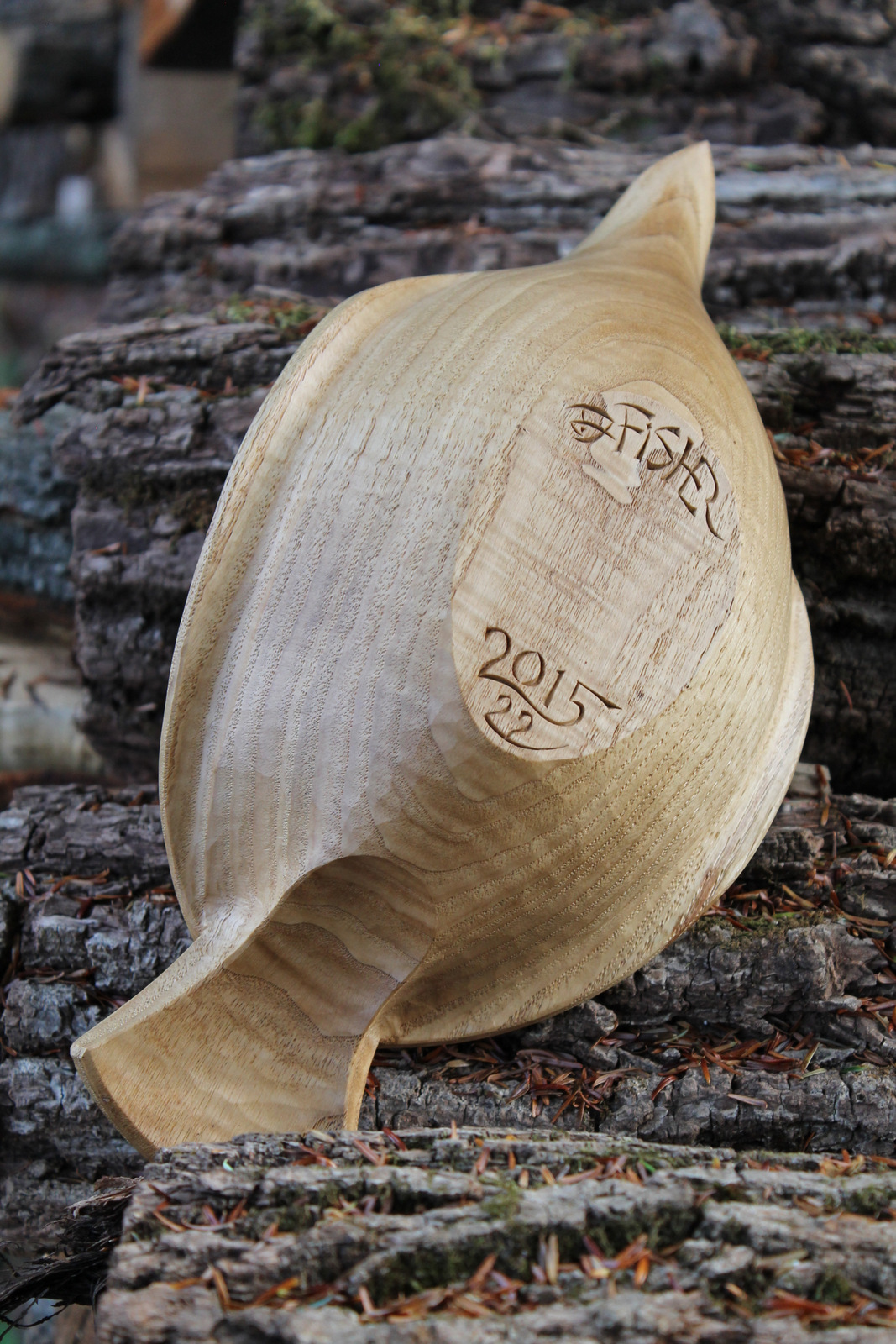
This view of the underside shows the carving beneath the tail and the egg-shaped bottom surface of the bowl.

This view of the underside shows the carving beneath the tail and the egg-shaped bottom surface of the bowl.

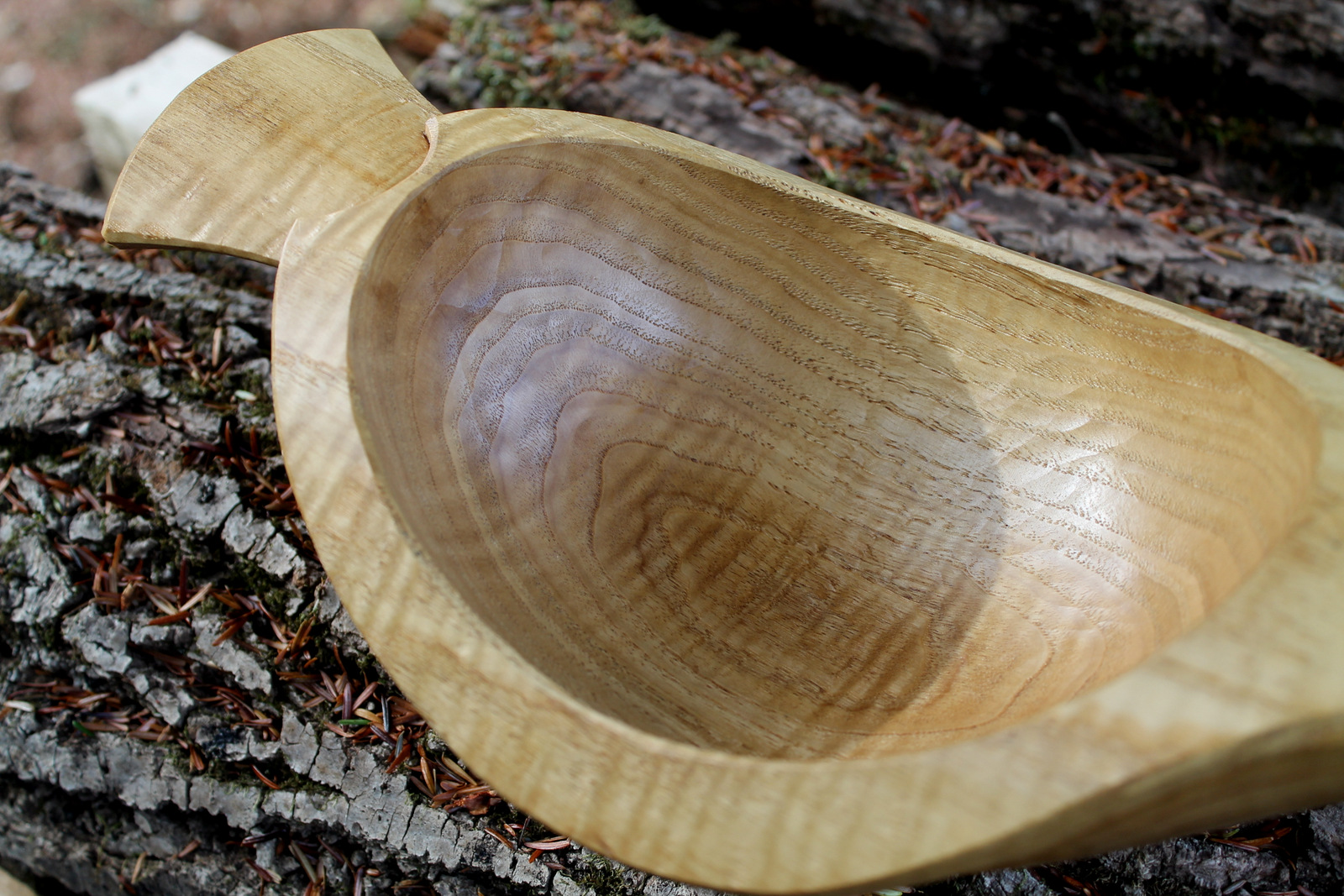
The curl.

The curl.

This view from above shows the grain orientation.

This view from above shows the grain orientation.


Posted in bird bowls, bowls, Uncategorized | Tagged , | 3 Comments

A Little Color

IMG_5472

After carving these spoons, I decided to add some color to the handles.  The top three are artist oil paints.  I like how easy it is to just squeeze a little out of the tube for small jobs like this.  I thin the paint with a little citrus thinner if I want the wood grain to show through more.  There’s no grain raising, but they certainly take longer to dry than other paints such as acrylics.  As with plain oil, I find some sunshine or other heat source speeds that considerably.

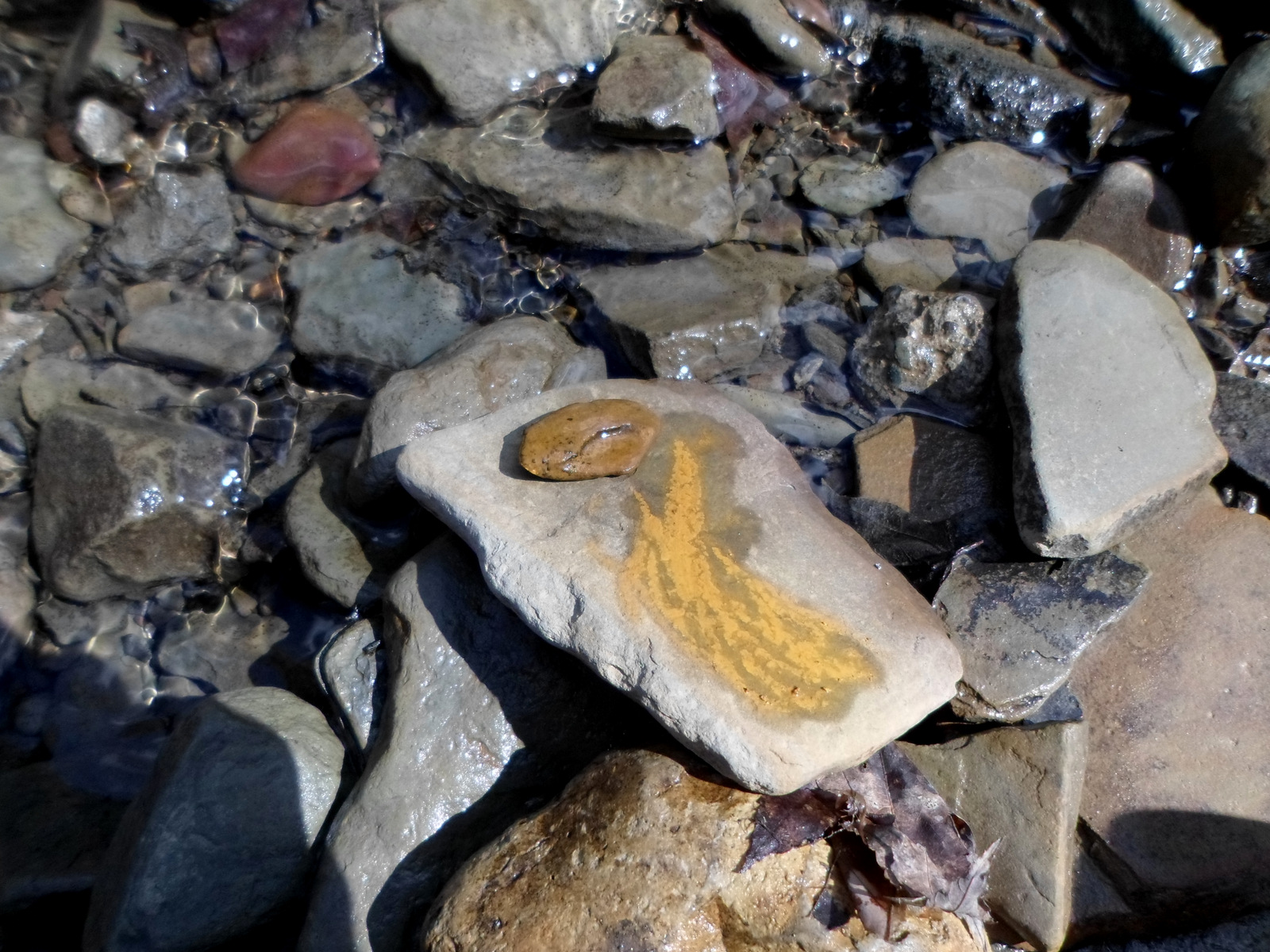
SAM_2125The bottom brownish-red one is also oil paint, but not from a tube.  I picked up a few ochre stones in a stream.  All sorts of yellows, reds, and browns are available.  It’s easy to test out the color by rubbing on a nearby rock.  Really, you’ve got a simple paint right there, and what a great reason to play in a stream.


SAM_2121

another option for your pallet

IMG_5471I’ve read about some more involved procedures for grinding the pigment, but I just kept it simple by pulverizing the relatively soft rock with a mortar and pestle.  Rubbing the rock on fine sandpaper also works.  Then I mixed in a little flax seed oil into the powder well and painted it onto the spoon.  Even with the relatively course pigment it works out pretty well.

Now that the paint is dry I can pop the spoons into some flax seed oil.  Next week, I should have some photos ready of a bowl I carved from this log:

IMG_4595


Posted in paint, spoons, Uncategorized | Tagged , , | 20 Comments

By Hound and Eye

IMG_5493

Arcs flow seamlessly across a transition point if their radii align there in a straight line.

— George Walker and Jim Tolpin, By Hound and Eye

If you read the quote above and said, “Huh?,” it’s because you haven’t seen it in the context of a page from By Hound and Eye by George Walker and Jim Tolpin.  Geometry and design are difficult topics to explain through words alone.  Walker and Tolpin have created a 177 page workbook that not only leads the reader sequentially through an astounding array of concepts, but also invites the reader to try out the concepts through many exercises.  The statement above, for example, becomes crystal clear once you have actually laid out two arcs that flow sweetly across a given point — right in the book.

Andrea Love’s illustrations add charm and clarity to the rich journey, a journey that empowers your designer eye.  I know my copy will end up with lots of holes and marks in it.

Posted in books, layout, patterns, Uncategorized | Tagged , , | 4 Comments

White Oak Bowl — Finished


IMG_5397In creating, the only hard thing’s to begin;

A grass-blade’s no easier to make than an oak

— James Russell Lowell, A Fable for Critics (1848)

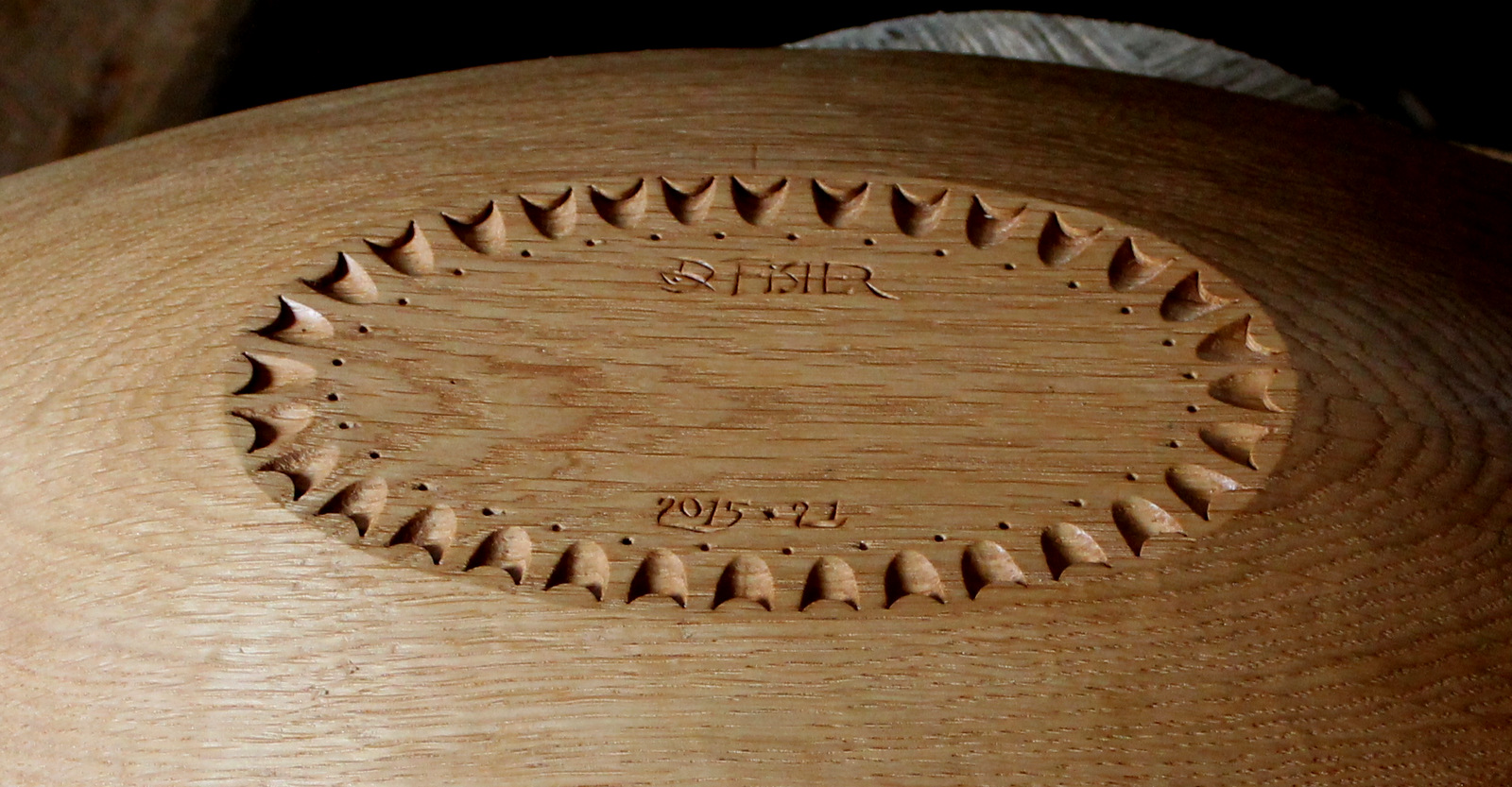
IMG_5384I wonder if James Russell Lowell ever carved an oak bowl?  In these two previous posts (here and here), I discussed the beginning stages of this bowl of white oak.  I like the result, but I might wait forty years or so before trying another!

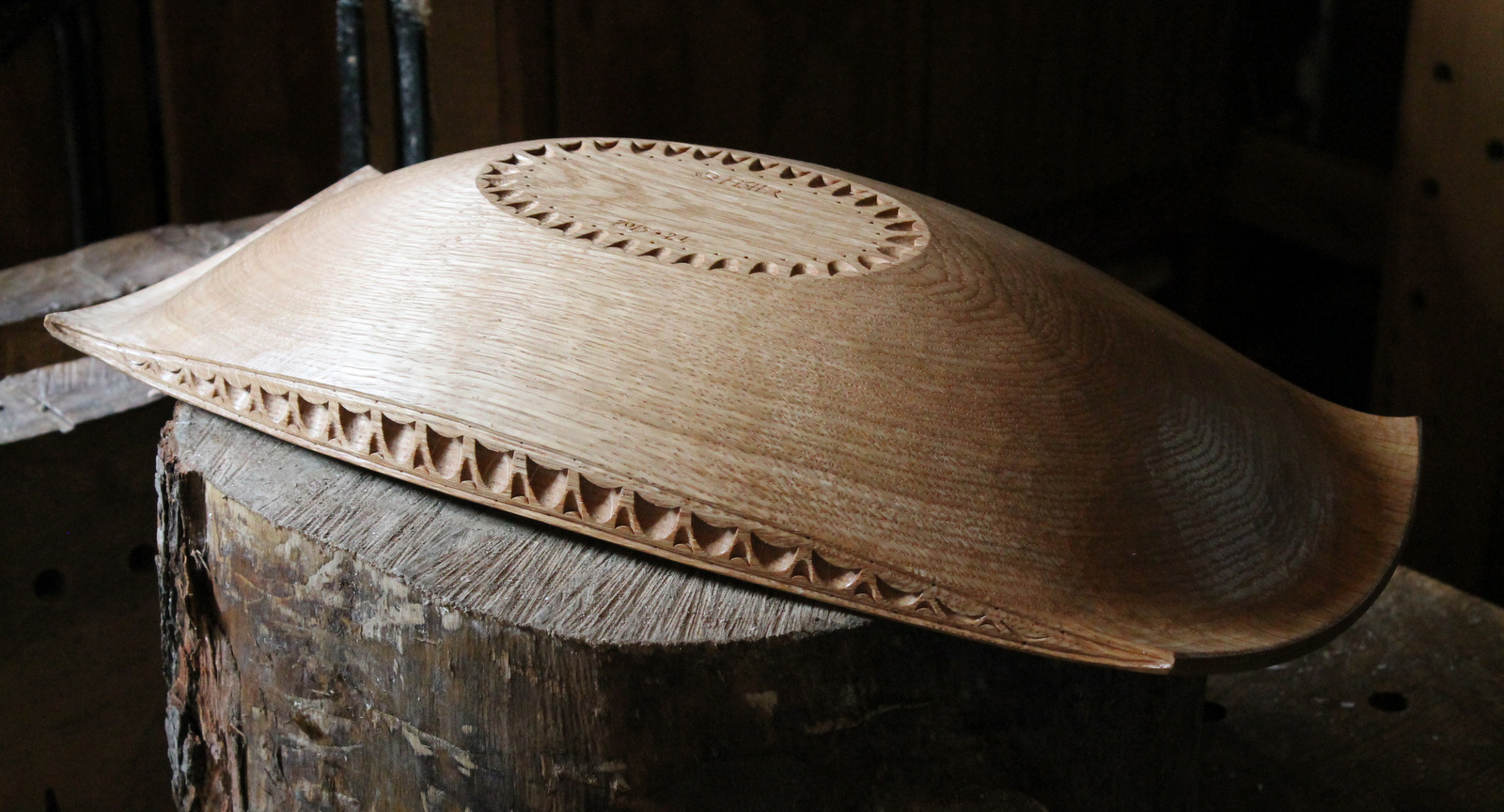
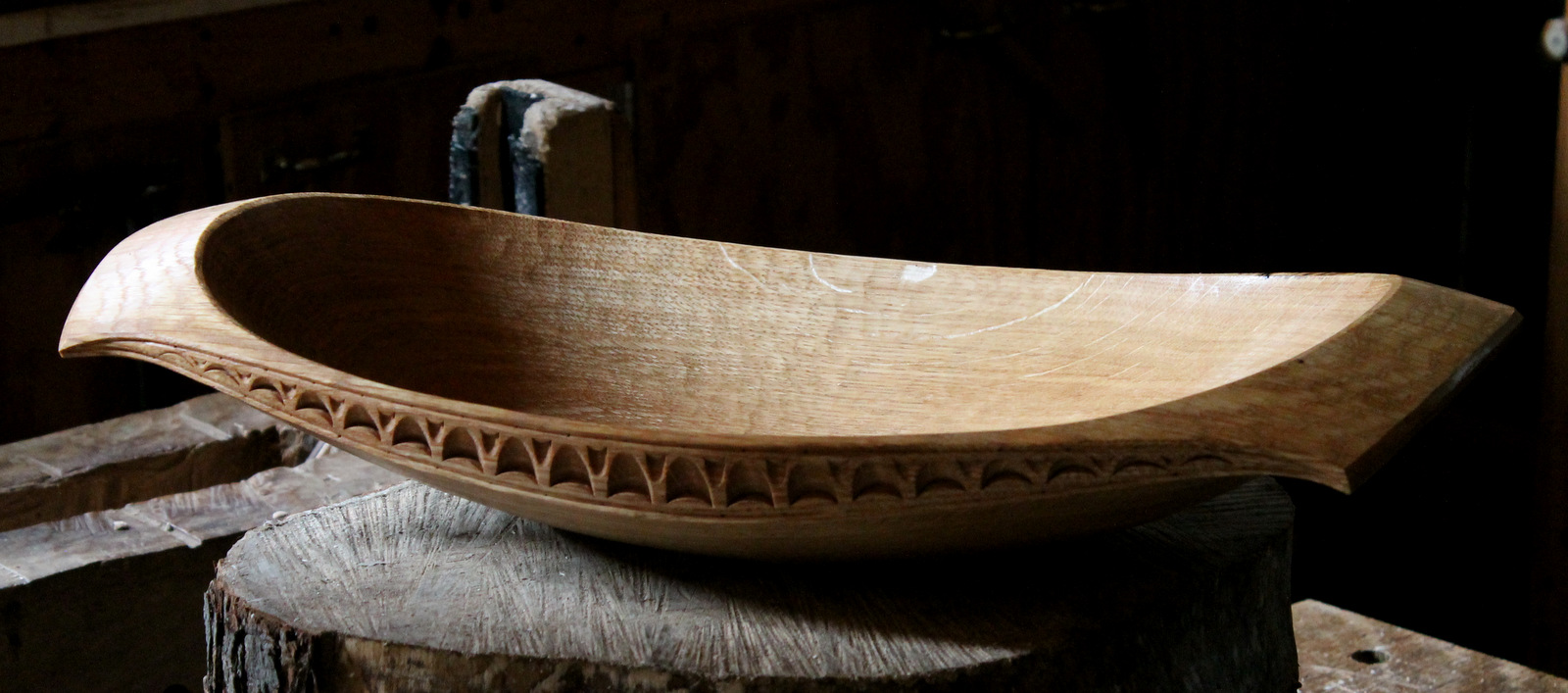
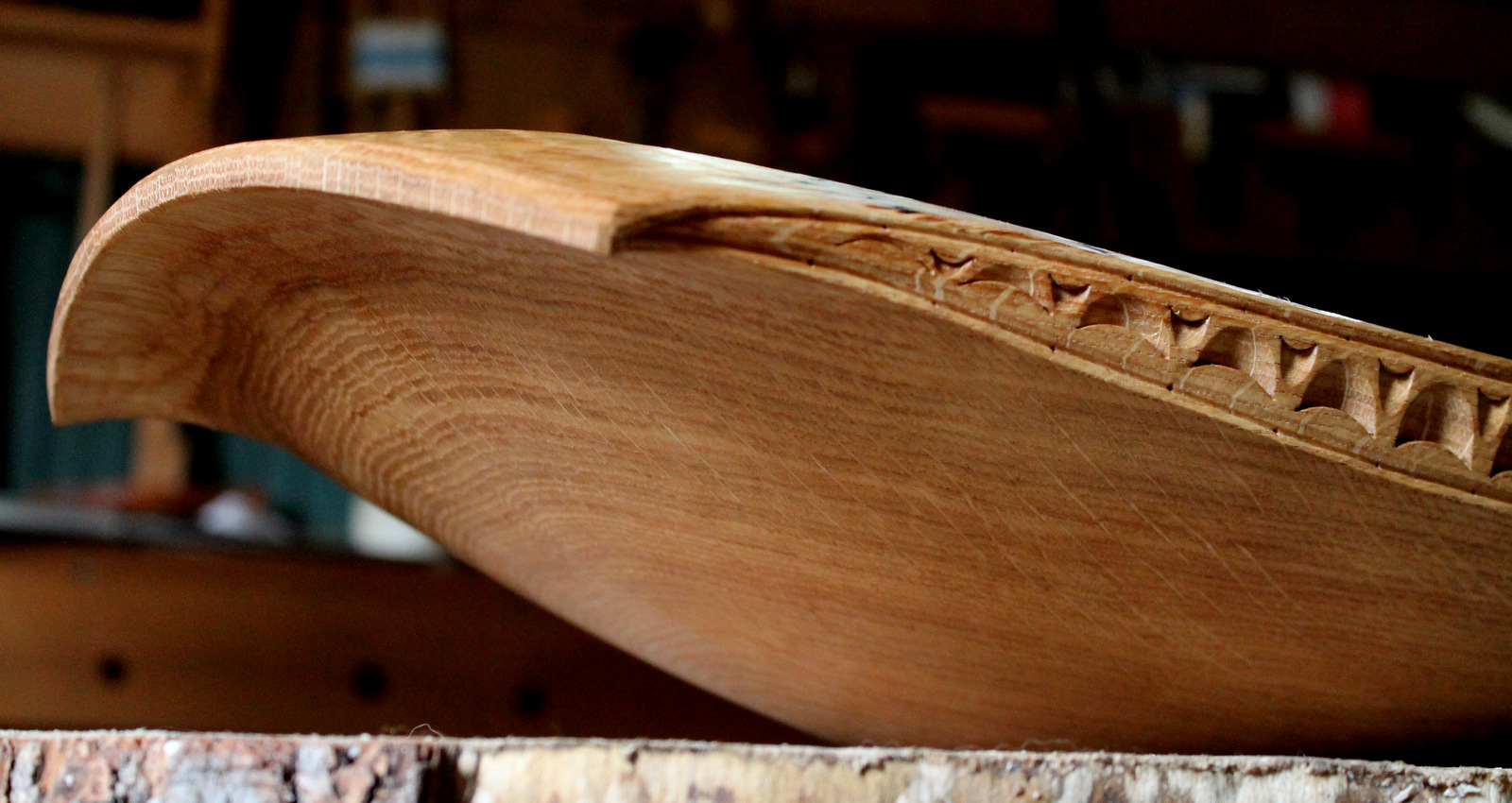
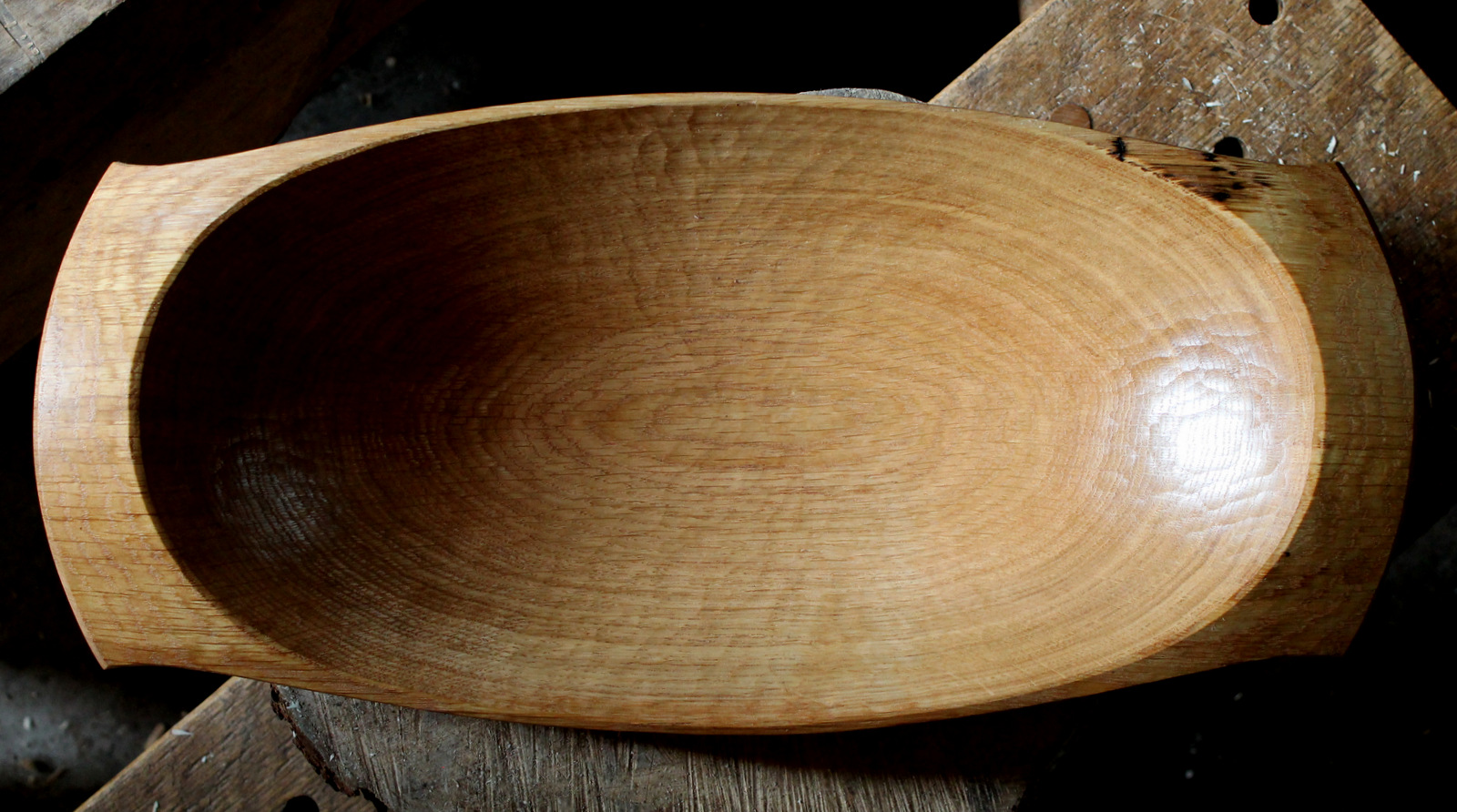
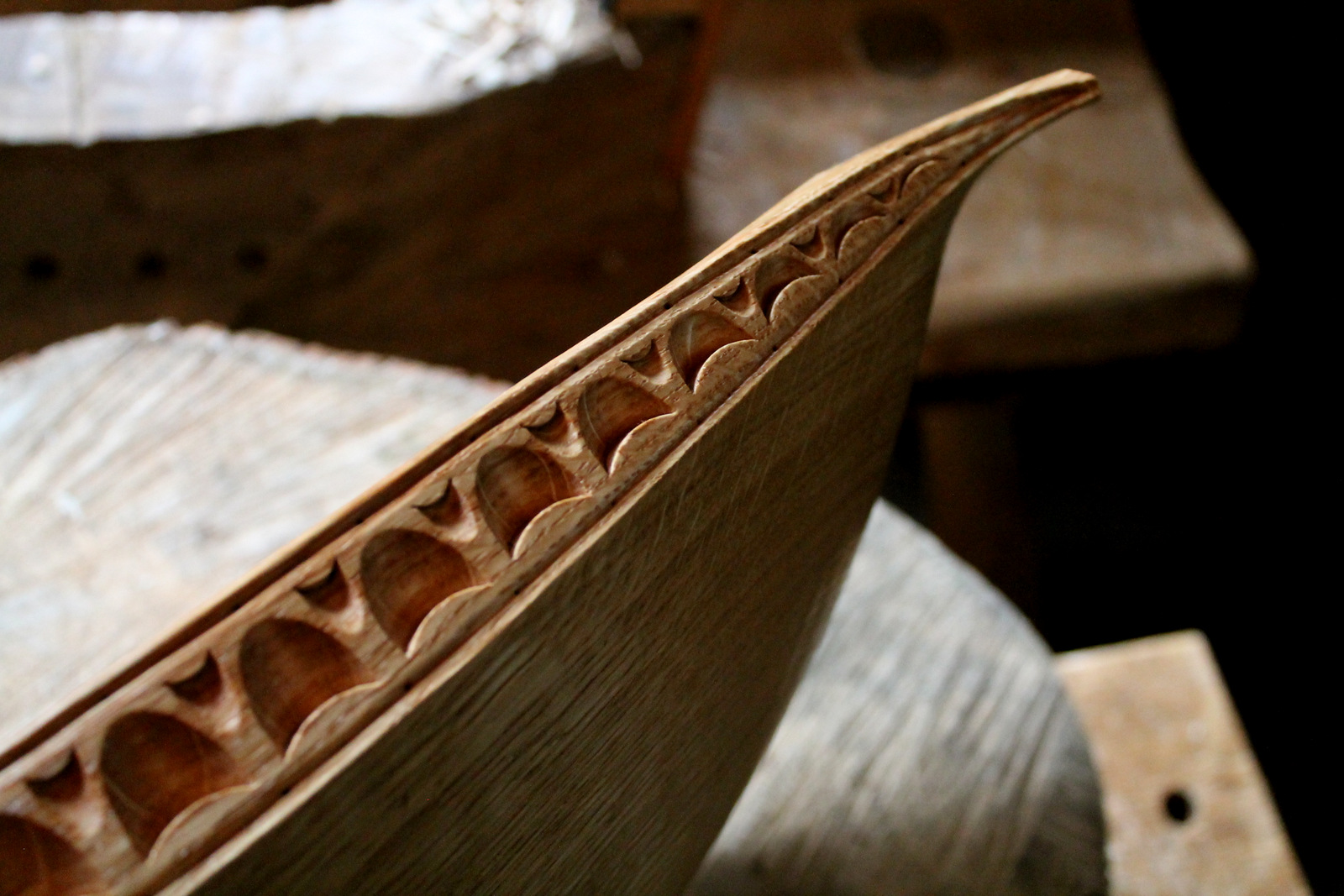
IMG_5401I thought the character of the oak called for some bold gouge cuts, albeit on a sleek form; a relationship similar to that of the hardy Northmen on their graceful oaken longboats.  This oaken vessel is 23 3/4 inches long, 11 1/4 inches wide, and 4 1/2 inches high.

IMG_5386In this overhead shot, the grain orientation is visible, as well as the “character stains” resulting from bugs digging around in the log at the fringe of the sapwood.

I’ve posted it to my website.  Time to go sharpen my tools…

IMG_5394    IMG_5390-001


Posted in bowls, patterns, quotes and excerpts, Uncategorized | Tagged , | 9 Comments