Singing in the Shop

IMG_8993

The crickets felt it was their duty to warn everybody that summertime cannot last forever.

— E.B. White, Charlotte’s Web

IMG_8980

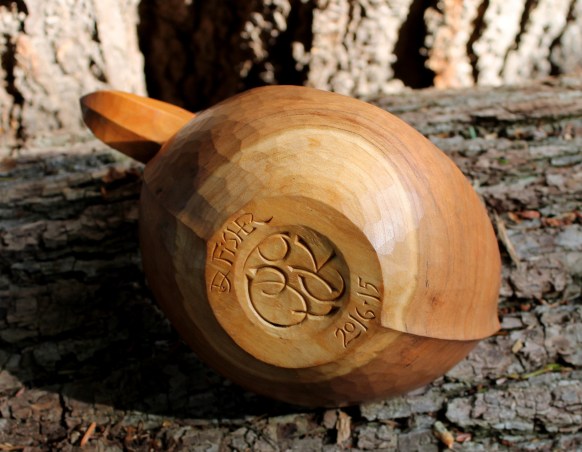
I know nothing about crickets, other than there is one hanging out in my workshop and I like the way he sings.  I find his song soothing and the perfect carving accompaniment.

He’s been here the past few evenings.  On the second night, I spotted him on a board leaning against the wall — along with what I’ll assume was his intended audience.  I haven’t seen her since, and to be honest, I am assuming it was a her.  The night after that he sang again, using my pack as a stage.  He didn’t seem to mind me looking closely.  And as I write this, he is perched on a shelf full of odd chunks of wood, chirping away.  He’s helping me finish a bowl from a large maple crook, and I should be able to share the results soon.  I keep the door open, so he must want to see the project through to the end.

So, cheers to crickets.


Posted in carving, quotes and excerpts, Uncategorized | Tagged | Leave a comment

In a Bowl Care May Not Be

IMG_8888The inspiration for this bowl goes back to the Middle Ages.  It seems that the unpopular English King John (the same that inspired the legend of Robin Hood) planned to build a hunting lodge (another version suggests a royal road) near Gotham, a little village not far from Nottingham.  That was a little too close for comfort as far as the residents of Gotham were concerned, but how to dissuade the King?

The villagers agreed to a plan by which they would, in various ways, act like mad fools engaged in crazy pursuits.  When the royal scouts reported the scene in Gotham to King John, he decided to build elsewhere, frightened and duped by the “Wise Men of Gotham.”

_71499746_ff4309ad-370b-4c67-aa0a-96a01c2dabb2

A later version of the Gotham Tales

Although these stories are believed to have existed in the oral tradition as early as the 12th century, they were first published in the 16th century as “The Merry Tales of the Mad Men of Gotham.”  Among the tales is that of a man carrying sacks of grain over his shoulders as he rides his horse so as not to overburden the horse.  We also learn of the villagers’ attempts at drowning an eel as punishment for eating so many fish, and the man who lights his smithy on fire to remove a wasp nest from the thatch. Maybe the best known story is that of the failed attempt to fence in the cuckoo bird; it seems they built the fence too low.  The “Cuckoo Bush Mound” can still be visited in modern-day Gotham — population 1800.


These stories have inspired many creative efforts over the centuries since.  In fact they inspired Washington Irving to satirically nickname New York City “Gotham” back in 1807 in the magazine Salmagundi.  And if you want to look more deeply into the Batman connection, you can start here.

Well, I’m no Washington Irving (like Yossarian in Catch 22), but this bowl too was inspired by one of the Men of Gotham tales.

The particular tale is of three wise men of Gotham setting off in a bowl to rake or net the moon from the sea.  But of course, each time they engage their tools the moon scatters into pieces and eludes their grasp, only to reappear whole as before.  This episode led to a simple nursery rhyme in the 1765 edition of Mother Goose, printed below from the 1901 edition:

IMG_8869

My daughter’s decade-old Three Men of Gotham toy/bowl.  Complete with dings and stray nail polish, as it should be.  We’ll find the net one day…

The same story seems to have captured the attention of English writer Thomas Love Peacock (1785-1866).  He wrote a couple poems based upon it, one beginning with the line, “In a bowl to sea went wise men three, on a brilliant night in June: They carried a net, and their hearts were set on fishing up the moon.”  Years ago, when my daughter was a little girl, I carved and painted a bowl, three figures, and a net for her based on that one. The lines I carved on this walnut bowl, however, came from another, more thoughtful, of his poems titled Three Men of Gotham:
 

IMG_8892-001
Gotham’s three wise men we be.
Whither in your bowl so free?
To rake the moon from out the sea.
The bowl goes trim. The moon doth shine.
And our ballast is old wine.–
And your ballast is old wine.

Who art thou, so fast adrift?
I am he they call Old Care.
Here on board we will thee lift.
No: I may not enter there.
Wherefore so? ‘Tis Jove’s decree,
In a bowl Care may not be.–
In a bowl Care may not be.

Fear ye not the waves that roll?
No: in charmed bowl we swim.
What the charm that floats the bowl?
Water may not pass the brim.
The bowl goes trim. The moon doth shine.
And our ballast is old wine.–
And your ballast is old wine.

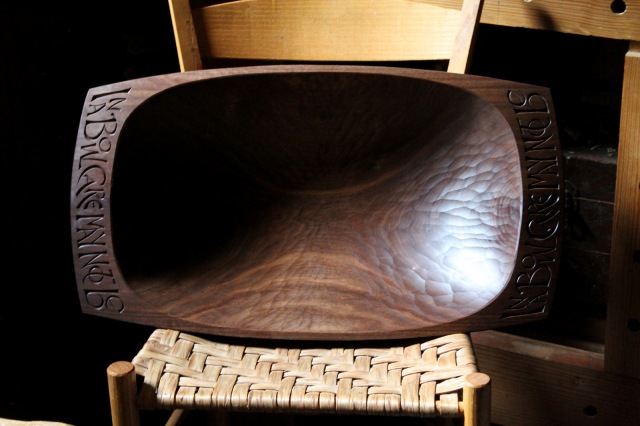
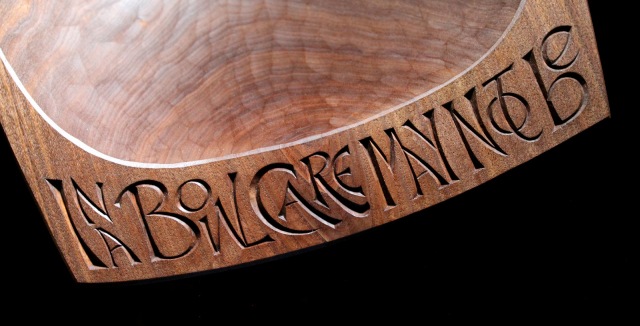
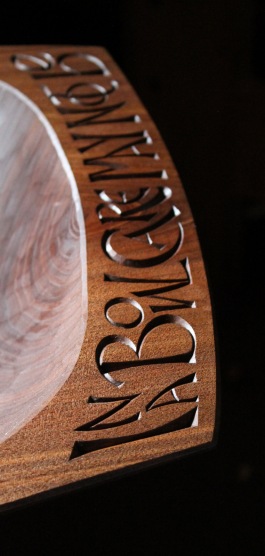
I find it interesting how he has taken this centuries old fun tale of feigned madness, and infused it with deeper meaning.  Captivated with the idea of the bowl as a sort of sanctuary from care and worry, I decided to carve the repeated line, “In a bowl Care may not be.” on the handles of this bowl.
IMG_8934

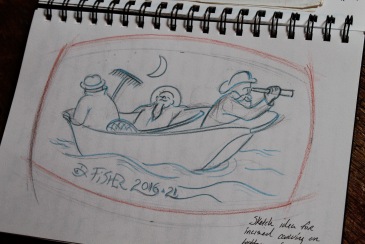
I wanted the bottom of the bowl to provide a hint of context for the excerpt, so I sketched an illustration that captures the scene as I imagine it.  It features a representation of this particular bowl carrying the three wise men of Gotham.  This was then transferred to the bottom of the bowl and v-incised with a knife.

Below are some more photos of the bowl, including the incised carving on the bottom.

IMG_8875

IMG_8907

The chair provides a sense of scale; this bowl is big and deep: 24 inches long, 13 1/2 inches wide, and 4 3/4 inches high, all heartwood black walnut.
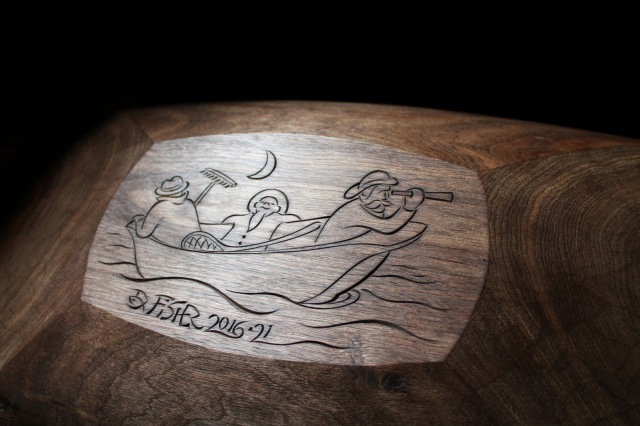
IMG_8895

This work was done with the pen knife blade.

IMG_8841

A pre-oil shot.  I think I’ve seen a beard like that before.
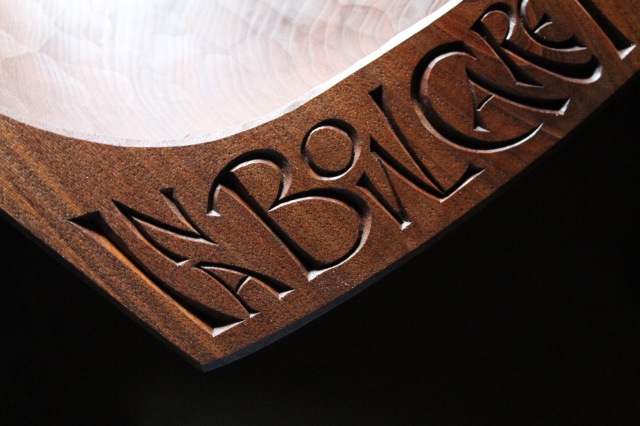
IMG_8922

Letters this size in walnut require some chisel and gouge work, but the knife blade still bears much of the duty.
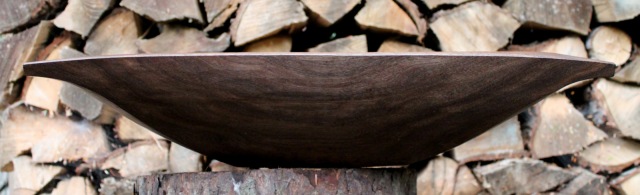
IMG_8953

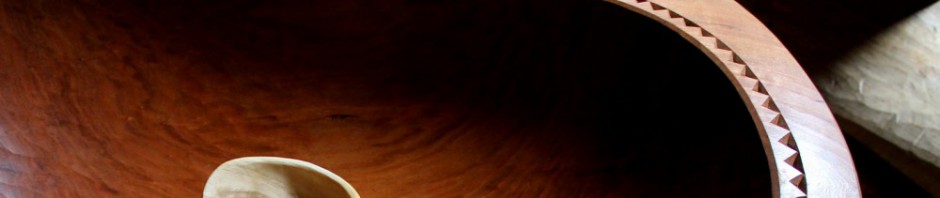
And a few outside shots after the rain ended to better indicate some of the exterior form, consisting mainly of four sculpted facets.  These outer surfaces were left from the drawknife with a little gouge work just under the handles.
 

Posted in Uncategorized | 12 Comments

Reflections on the Marsh

OLYMPUS DIGITAL CAMERA

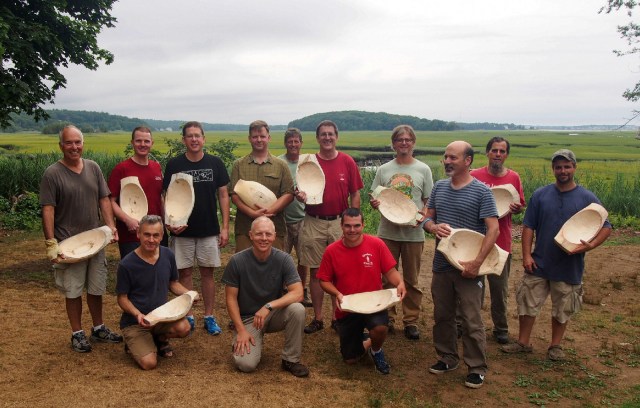
The Marshfield Baker’s Dozen:  (Front row L-R): Tom, me, Lucas, Nat (Back row L-R): Gene, David, Jonathan, Matt, Joel, Gordon, Sean, Pret, and Chris – a.k.a. Plymouth’s Paul Bunyan.  Their bowls were already looking great, with a couple more hours left to refine things.  Photo by Marie Pelletier

If you ever are part of a class with Plymouth CRAFT, be prepared to employ all of your senses beyond the work itself.  Between the beautiful venues, the mouthwatering flavors of Paula Marcoux’s hand crafted lunches, and the sense of comradery, the whole experience is one to be savored.

A couple weekends ago, I taught a class in bowlcarving in Marshfield, Massachusetts.  As we were busily setting up for the class Friday evening, I was shaken from my mental to-do list by the unique beauty of my surroundings.   As I walked around the corner from the barn, the fog was rolling in over the river that meanders among the marsh grasslands.  The effect was otherworldly — especially to a guy from Western Pennsylvania.  Heck, I still can’t get over the idea that those rivers keep filling and draining every day; back and forth, up and down, flowing this way then that…!  Where I’m from, the rivers have pretty much made up their minds.

OLYMPUS DIGITAL CAMERA

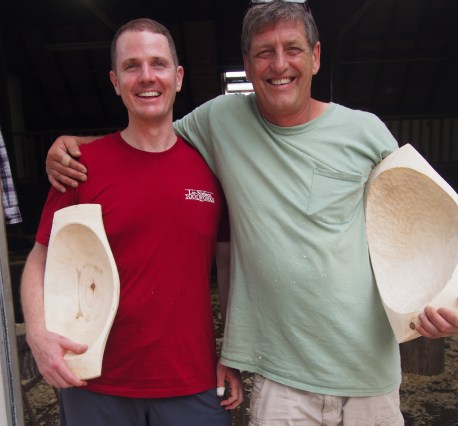
David and Joel with their bowls…and band-aids!

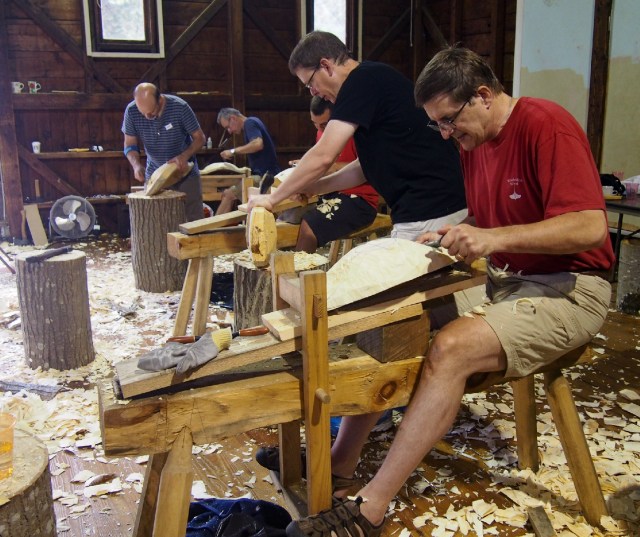
I had a great time reconnecting with a few folks met at Greenwood Fest and spending two days with a great group of guys armed with axes.  If you’ve never experienced the sight and sound of twelve adzes making chips fly through a barn, put it on your list.  By the end of the second day, everyone had transformed a log into a bowl, all in the same general design, but each unique due to choices made by the individual students and the nature of the logs.

I’d like to thank Marie Pelletier (a P.C. board member and all-around big help) for all of the photos in this post.  I am a terrible multi-tasker, so I failed to take a single photo during the class.  But Marie came to the rescue and shared some of her photos with me.  Thanks Marie.  Here’s a few more:

OLYMPUS DIGITAL CAMERA

Gordon, Jonathan, Lucas, Nat, and Tom working among the chips.

OLYMPUS DIGITAL CAMERA

Me (the guy who learned the most) admiring the lines of Joel’s bowl.

OLYMPUS DIGITAL CAMERA

We also had a chance to discuss things like lettering.

OLYMPUS DIGITAL CAMERA

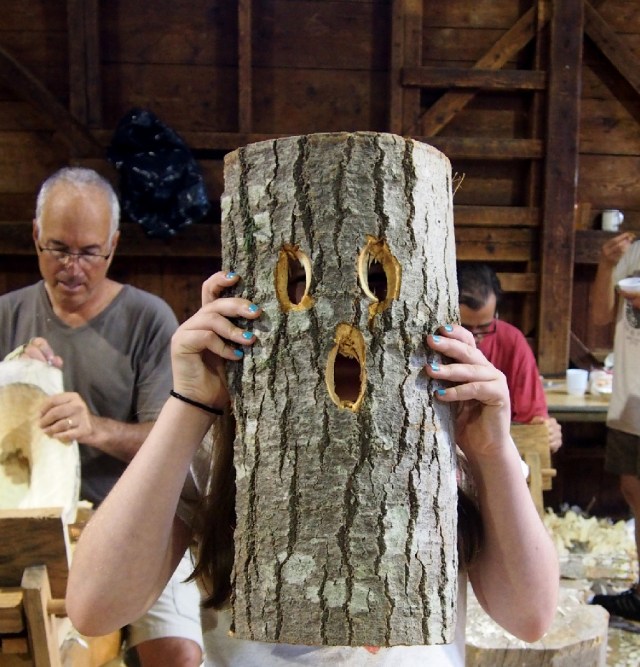
Peter Follansbee and his family took time out to visit the class both days, even though Peter was preparing to leave Sunday night for his trip to England and Sweden.  He showed us a quick trick learned from Roy Underhill in making a mask from a fresh piece of bark.  That’s Peter’s daughter, Rose, behind the mask.  Of course, you know it’s not Peter because he doesn’t wear blue nail polish.


Posted in bowls, classes, events, nature, teaching, Uncategorized | Tagged , , | 1 Comment

Aspen/Poplar/Popple Ale Bowl

IMG_8685

I’m settling back in after teaching a bowl carving class (not ale bowls) in the Plymouth, Mass. area with Plymouth CRAFT.  More about that great experience in another post before long. Meanwhile, one of the tasks on my list today is to package up this horse head ale bowl and get it on its way to a customer.  This one is another personal size ale bowl, about 11 inches long and holds about 18 ounces.

I carved it before the class, but from the same species of wood that we worked in the class this weekend.  Around here we call it bigtooth aspen, which is one of the poplars — in fact it’s scientific name is Populus grandidentata.  By the way, what we do call poplar here is not a poplar.  Anyway, it seems that this aspen is usually called popple or poplar in Massachusetts. Regardless if I have that all right or not, it is a white-yellow wood with undramatic grain that is nice to carve. Some of the students asked about painting possibilities and one of the options we discussed was artist’s oils.

For this bowl I thinned artist’s oils with flax oil to create a consistency somewhere between a stain and a paint.  The blue-grey color is a mix of a few shades, while the top is titanium white (which is non-toxic if you were wondering.)  After it had dried I did the chip carving.  Then I treated the whole bowl, inside and out, with flax oil, followed by a mix of flax oil and beeswax.  The rubbing and buffing afterwards results, in sharply raised areas, in the subtlest rub-through of the paint, which I liked in this case.

Just one of many options for the twelve new bowls that were carved this past weekend.

Posted in ale bowls, bowls, paint, patterns, trees, Uncategorized | Tagged , , | 3 Comments

What’s Wrong with this Edge?

IMG_8714

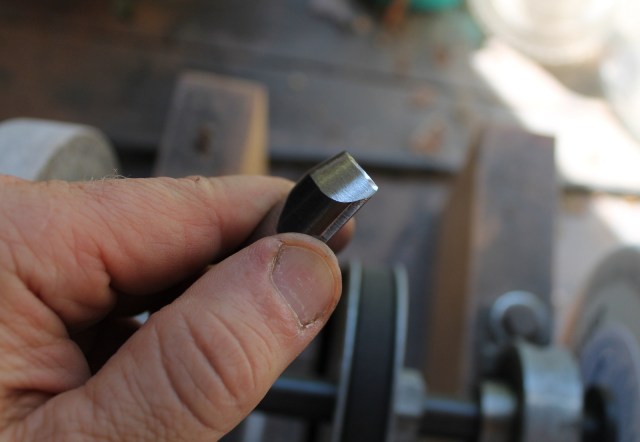
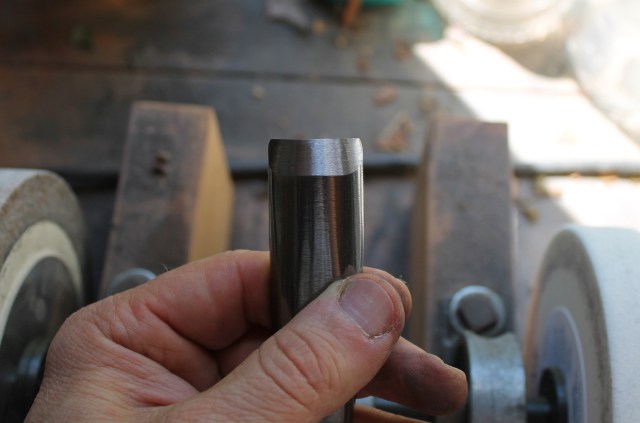
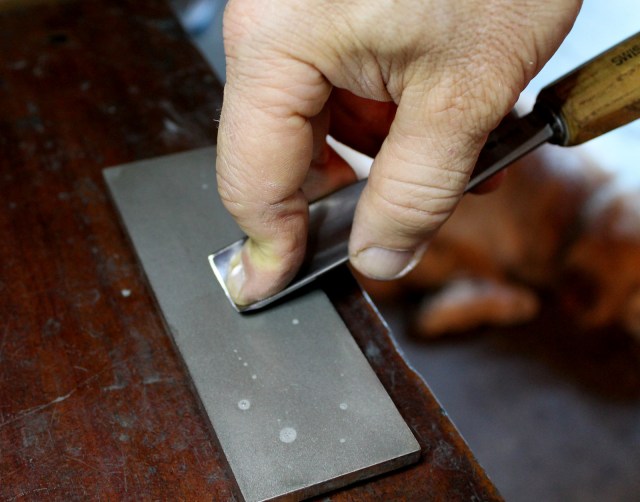
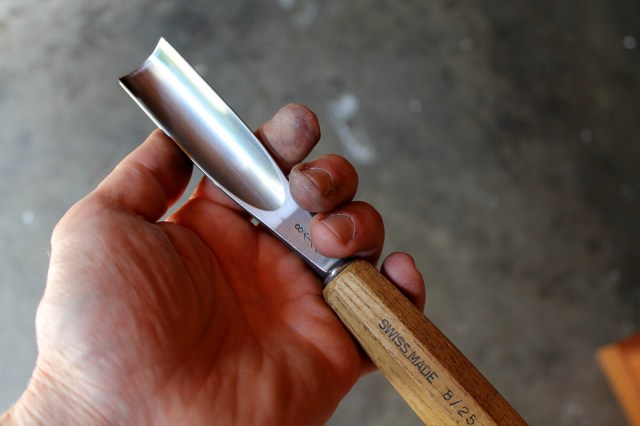
Look at the lines of reflection on the beautiful polished surface.  The polish is good.  The fact that the lines of reflection take a bit of a nosedive as they reach the cutting edge is a problem, and a very common one.  In this case, it is the result of aggressive work on the buffing wheel by the folks at Pfeil Swiss Made (they come pre-sharpened), but all edges eventually develop some rounding.  The wood does fight back somewhat, after all.

It’s no fun to obsess about sharpening.  The idea is to get it right and get to work.  That abrupt rounded bubble of steel behind the edge is like a water heater attached to the underside of your car; it hurts your performance.  Well, I’ve talked about the idea before in some of my other sharpening related posts.  In this one, I want to show how I go about getting an edge like this into shape.

IMG_8720

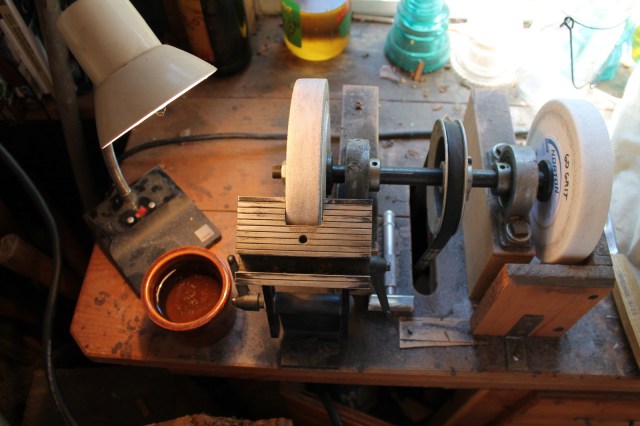
You can take care of it without a grinding wheel, it will just take a much longer time.  There can be a significant amount of metal to remove.  You could use a wet grinder.  I use a dry grinder.  Mine is a simple rig with an arbor and a belt that goes down to an old washing machine motor.  A friend and a hand-cranked grinder would be great.  I can never find any friends when I need to sharpen.  However you do it, just get an abrasive wheel to spin.  Disclaimer: This set up does not follow safety guidelines.  You should have a bunch of guards on yours (I live on the edge), and safety glasses, dust mask…

IMG_8718

I drop my Veritas grinding support out of the way for this.  It will be a freehand operation.  Notice that the left side of the wheel has a slight convex area as the edge drops off.  This can be used to create a slight hollow grind on some tools.

IMG_8723

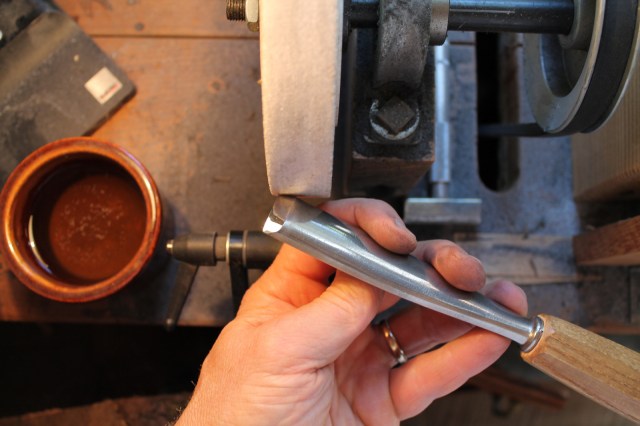
Sight from above so that you can see when the bevel is flat against the wheel.  My right hand steadies the back of the handle and provides rotation.  I start in this position, then…

IMG_8722

rotate the gouge while maintaining contact along the bevel…

IMG_8724

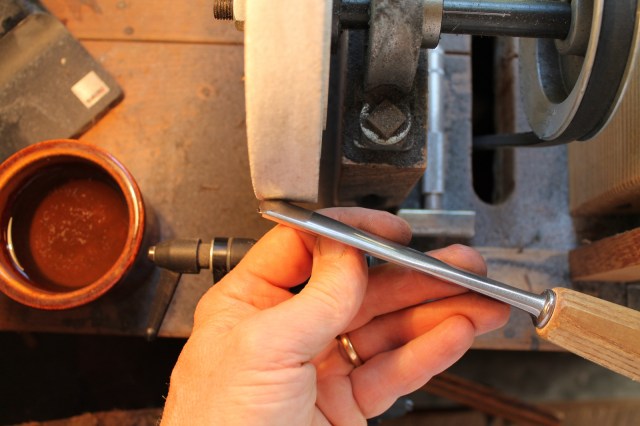
and finish in this position.  It becomes pretty natural and you can see exactly what’s happening all along the way.  With a light touch, you shouldn’t generate much heat in the tool at all.  If you do feel it starting to heat up, cool it in water before it is hot.

IMG_8727

I wanted to lengthen this bevel to give the tool a lower angle of attack.  Therefore, material is being removed from the heel of the bevel first.

IMG_8730

Continue grinding at the same angle, keeping the bevel flat.  Of course, the last shiny area is where the tool was abruptly rounded.  Don’t be tempted to tilt the tool to grind that.  Keep grinding the whole bevel until…

IMG_8733

the grinding marks are even and right to the edge.

IMG_8734

Since I lowered the angle of the outer bevel, I add a slight inner bevel that makes sure the edge is durable enough.  I move a slip stone (here a diamond cone) across and back and forth.

IMG_8735

another angle

IMG_8738

Then sharpen on your stones like always.

IMG_8751

When I get to my finest stone, I work both sides of the edge lightly with a very fine ceramic slip.  This takes the most patience — I keep going back and forth from outside bevel to inside bevel until the wire edge is removed.  Sometimes you don’t see it, sometimes you do. Then I strop and get to work.

IMG_8752

With practice, it becomes natural.  The gouge will now sing and be much easier to touch up next time.

Posted in sharpening, tools, Uncategorized | Tagged | 12 Comments

Ale Hen

IMG_8666

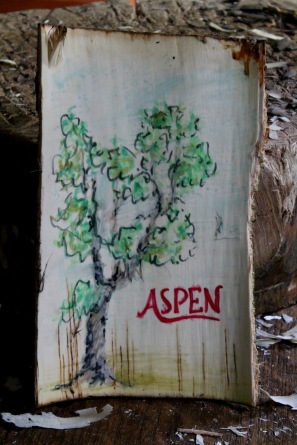
In one of my conversations with Beth Moen at Greenwood Fest, we talked about the use of aspen as a traditional wood for bowl carving.  Beth said that she liked Aspen because, although it is a relatively soft hardwood, the surface hardens nicely as it dries and holds up well.  I was able to salvage some aspen from a hillside that had been cleared nearby, and this is my first finished piece from it.

Ale hens are a traditional way of serving beer at special occasions.  You can see some of the incredible variety at the digital museum here.

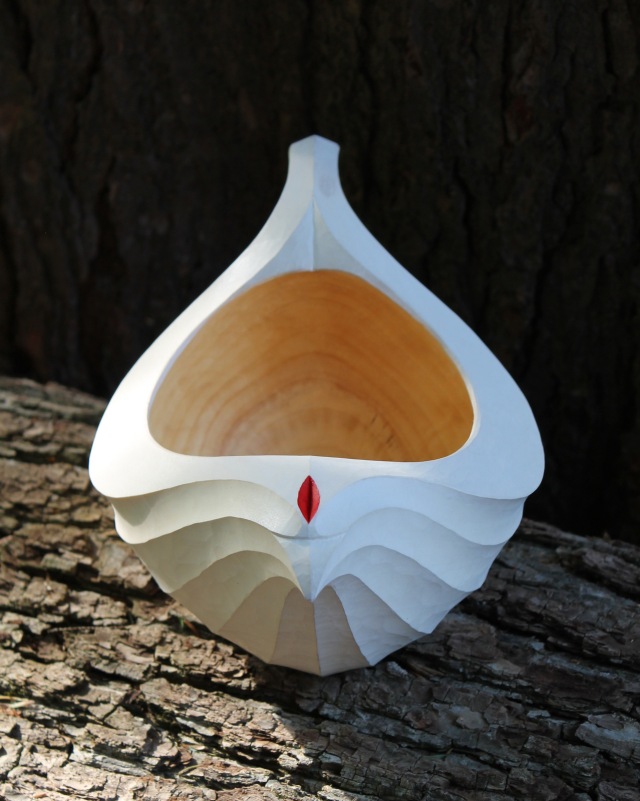
As you can see, my design features fluted facets that flow from the tail, along the full body, and up to the tip of the beak.  The outside has been painted with not-toxic titanium white artist oil paint thinned with flax oil — followed by a coat of wax.  The inside is treated with  flax oil and beeswax.

IMG_8648

It is hard to tell in the photos, but the hollow is deeply undercut beneath the wings, making the sidewalls nice and thin all the way down to the bottom.  It makes the hollowing process more difficult, but it is what works best for the design.  Subtle things like that can make a big difference.  It gives the bowl a nice feel, and makes room for more ale of course (about 24 ounces).  The bowl rests on a bottom that’s in the shape of an egg.  It is 11 inches long, 7 inches wide, and 4 3/4 inches high.

IMG_8652

And one last idea: when you pop that fresh aspen bark off the log, take your watercolor pencils or greenwood pencil and draw a picture.  It’s almost like painting and works with other kinds of bark as well.  Great fun for kids — and for me.  When the bark dries, it’s all permanent.

IMG_7602


Posted in bird bowls, bowls, historical reference, trees, Uncategorized | Tagged | 9 Comments

Swallows in Wood and in Motion

IMG_8608

Last week, I finished these two swallow inspired bowls, one in maple and the other in cherry.  Then I found myself in Lou’s barn, a swallow haven.

My friend Lou is a part-time sawyer who knows more about trees than just about anyone I know.  Lou’s property is graced with an enormous grey time-worn barn that shelters lumber, equipment, and dozens of happy swallows.  Truthfully, it bothers Lou that the swallows don’t clean up after themselves, but that didn’t seem to matter as Lou and I watched the swallows dart after bugs over his garden in the evening.  And it’s not just that they catch bugs, it’s the way they catch bugs; truly poetry in motion.

Here is a short film that slows the magic down for us:

Here is the maple branch crook from which the larger of the swallows was carved.  How can you go wrong with a branch like that?  The swallow is practically flying out of it!

IMG_8172

And, speaking of birds, I also finished another cherry duck bowl (ale duck?).

And if you’re still not sure that it’s a duck….

IMG_8638

Posted in bird bowls, bowls, finding wood, nature, Uncategorized, video | Tagged , , , | 2 Comments

For Peace Comes Dropping Slow

IMG_8484

And I shall have some peace there, for peace comes dropping slow

–William Butler Yeats, from The Lake Isle of Inisfree


Posted in bowls, carving, green woodworking, photography, quotes and excerpts, Uncategorized | Tagged , | 6 Comments

Time for a Shave?


Hans Karlsson Scorp (or inshave) — photo from the Dictum website.

A few days ago Chris Schwarz shared a post on the Lost Art Press blog about an old Estonian scorp used for general hollowing tasks.  Check out the post here.  Coincidentally, I had just stumbled upon the existence of this scorp (left) made by Hans Karlsson.

I may have to explore the use of scorps, shaves, inshaves — whatever term one prefers — in bowl work.  I have messed around just a little with a chairmakers inshave on large bowls; same with a travisher. Beth Moen had a very cool little bowl shave with her, but I didn’t get the chance to try it out or see her use it.

For certain designs of bowls, these shaves could be a good transtitional tool following the adze work, and in some circumstances, possibly the finishing tool.  For now, I just thought I’d direct attention to the similarity between the Hans Karlsson tool and the Estonian shave.  I’m looking forward to reading Woodworking in Estonia when it ships next month.

And in case one is interested, the HK scorp may be available elsewhere too, but here is the link to Woodsmith and Dictum.


Posted in bowls, carving, tools, Uncategorized | Tagged , , , , | 6 Comments

Behind the Mask

IMG_8416Last week, I found myself in a house with this intriguing wooden mask on display.  It was about 17 inches high, 9 inches wide, and 7 1/2 inches deep.  I know very little about African masks, but to my untrained eye it looked to be old and authentic.  It had been carved quite thinly and still retained remnants of a woven web in the back that would secure it to the wearer’s head.  I had enough time to sit and make a sketch of it.

The experience reminded me of a documentary I had seen awhile back, part of which explores the way that the Dogon people of Mali carve masks.  There are many interesting scenes and thoughts in the ten-minute clip below, ranging from the respect shown for the tree to the importance of context in understanding such objects.

Check out the precision work performed with the adze as well as the other techniques demonstrated in the making of these beautiful and meaningful examples of greenwood carving.


Posted in adze, finding wood, green woodworking, historical reference, holding, sketch, Uncategorized, video | Tagged , | 3 Comments