For those of you interested in an axe and/or a couple exhibitions of wood art in Philly, read on.
First, a few months ago, Robin Wood sent an axe to me to try out and provide him with some feedback. I’ve known Robin and his daughter, JoJo, now for several years. They’re friends of mine and I admire them as craftspersons and persons. This new axe of theirs, the Wood Tools Sheffield Axe, is forged in the historic steel city of Sheffield, England. It’s the one I’m using in the photo above. You can read more about it here.
Robin didn’t ask or expect me to post any review or recommendation, but I recorded my observations in my notebook so I’ll share those pages below. Beats typing at a computer.
Two Mark Sfirri Exhibitions:
Last year I had some work included in an exhibition curated by Mark Sfirri, a highly-skilled and imaginative wood turner and carver, known especially for his multi-axis turning techniques. Mark has been making beautiful things from wood for over 50 years and he has two solo exhibitions coming up. One actually opened last night and the other opens December 14. If you can make it in person, there will be a lot to be inspired by and to learn from. Here are some links:
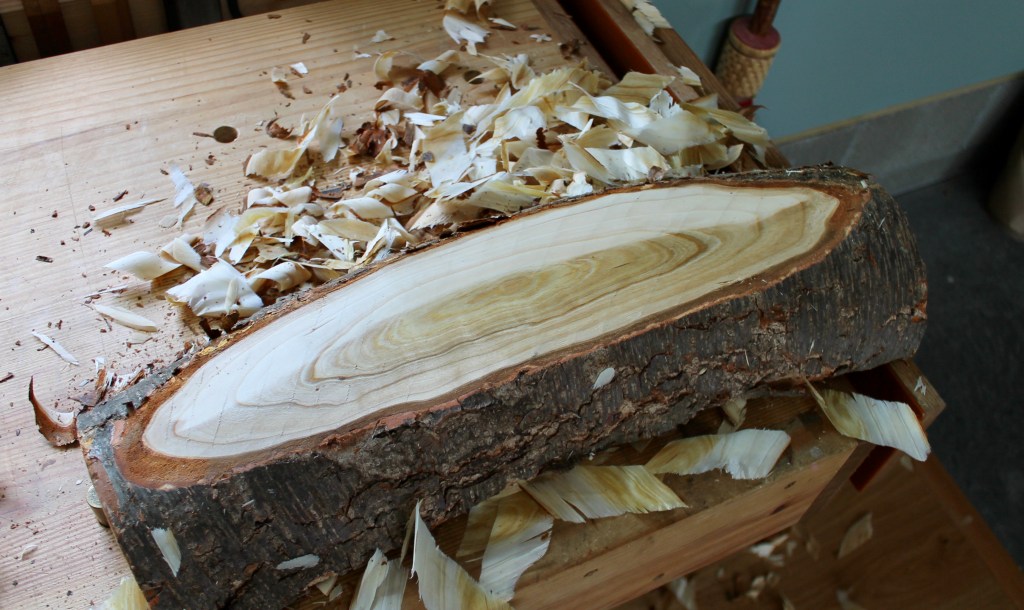
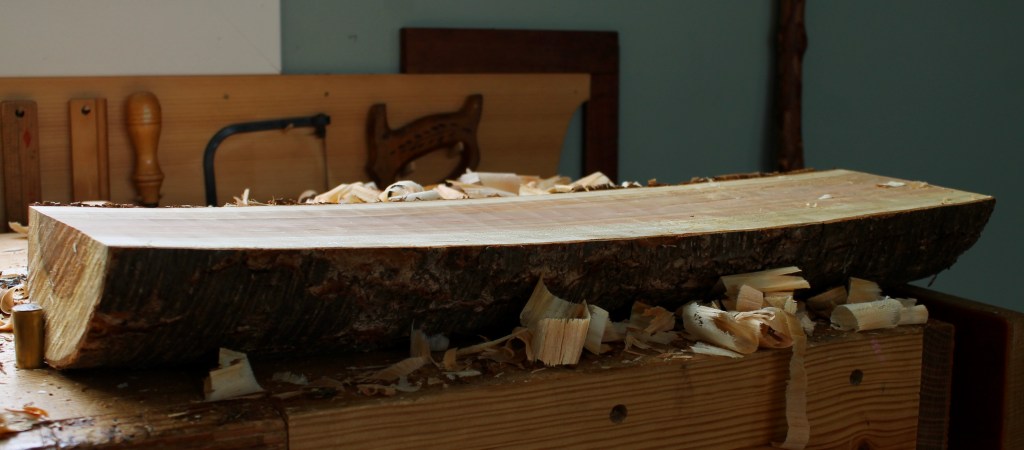
A wide walnut logs came my way a couple weeks ago, and I’ve been busy roughing out a few things from it. One of them will be a big open round bowl, 18 or 19 inches (46-48cm) in diameter. In the photo above, The pith of the tree is up, bark side down. I split the lower portion of this half log for another bowl blank. I chainsawed the corners off to form a rough circle, then hewed and planed the upper and lower surfaces flat and parallel, working across the grain with the plane.
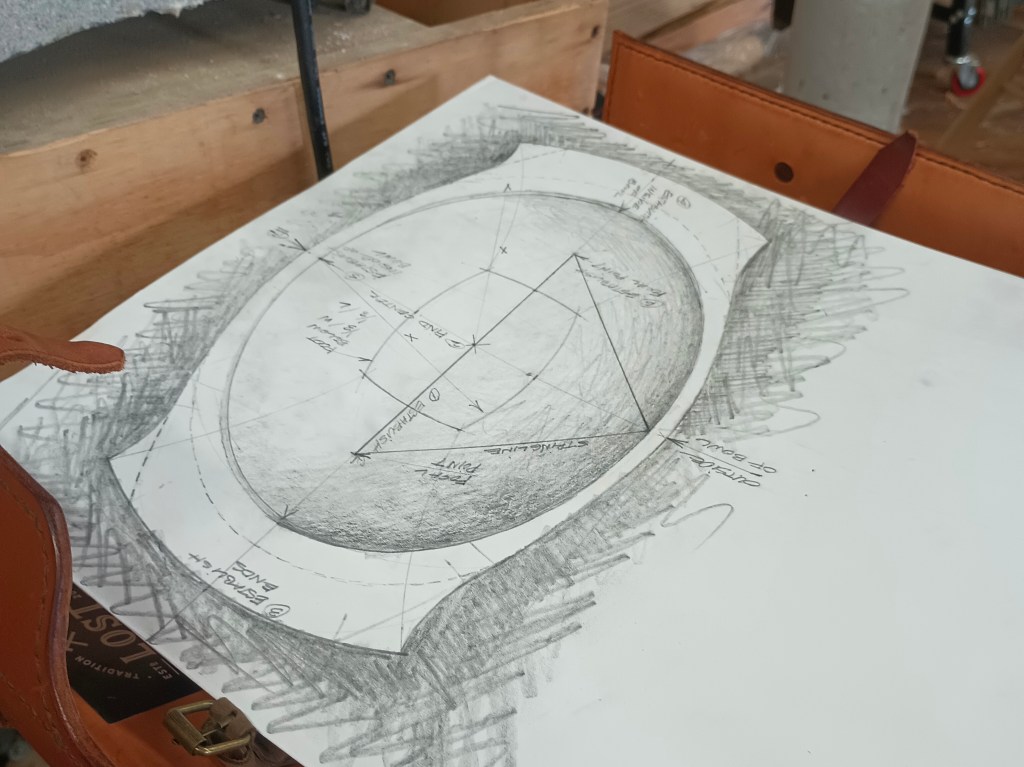
This walnut is green, full of moisture. As it dries it will shrink across the grain but not with it. If I carve a circle, I’ll end up with an oval. So I laid out an oval in order to end up with a circle. I’ve mentioned this sort of layout before, but I think these marked-up photos may make it more clear.
Large round bowl layout — allowing for shrinkage across the grain.
Instead of using one central focal point for the compass, I established two focal points 3/4″ apart from each other along the cross-grain center line. The yellow and blue lines represent the radii forming the right and left boundaries, respectively. The two sides are sketched together in the area of the green boxes. The 3/4″ difference is a hopeful estimate. There are tables with simple shrinkage percentages for various wood species, but there are all sort of confounding variables at play (what time of year was the tree harvested, how long has the log been sitting around, variations in individual trees, etc.).
I’m confident it will shrink at least that much, maybe a little more. At any rate it will end up closer to a circle than it would have otherwise.
Long-handled adze with big round walnut bowl.
For a bowl this big, I began hollowing with this long-handled adze. I hadn’t used it in a while, but I wrote about it a couple years ago in this post.
Surveying the axe work on the outside of the round walnut bowl.
After much more adzing on the inside and axing on the outside, it’s much further along now. It’s wrapped in a couple old towels to control the rate of drying and I’ll keep my fingers crossed.
Drawknife work on walnut bowl blank at the bowl horse.
Meanwhile, I’ve been roughing out more pieces from this same walnut log. One of my strategies for storing green wood is to avoid storing it. Within reason and when possible, I rough out a bunch of pieces in succession, then return to them whenever it’s convenient, after they’ve dried. Above, I’m shaping up a quarter-log blank that should become a hen bowl. And there are a couple more in-process almost ready to begin drying. We’ll see all these bowls someday.
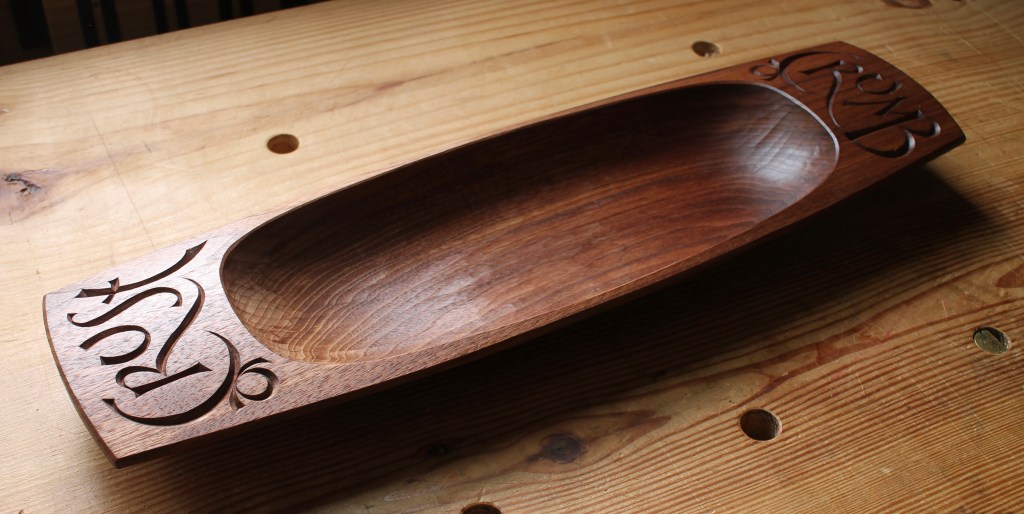
Walnut “A Crust — a Crumb” bowl 2024, 21″ x 6″ x 2″
It’s been a week since I’ve returned from teaching an October class at Peter Galbert Workshops. I carved this walnut bowl in July and took it along as an example for the students. I’ve decided to offer it for sale now, since I’ll have one or two new ones before the class in March. That class is full, but it’s a good idea to get on the waiting list if you’re interested. Even if nothing opens up for March, you’ll get first dibs on the next one.
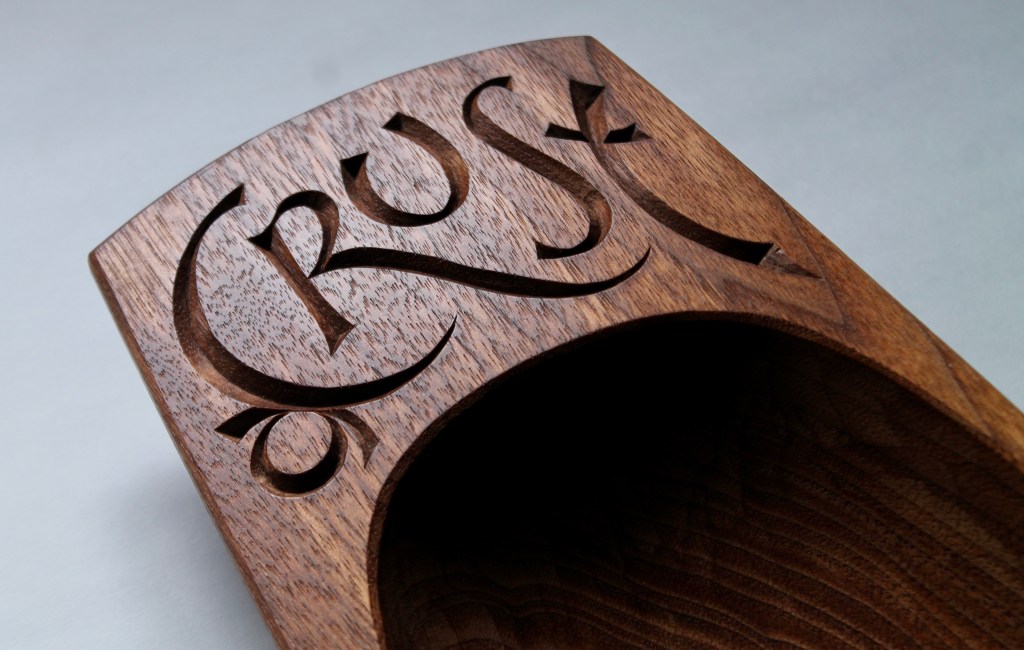
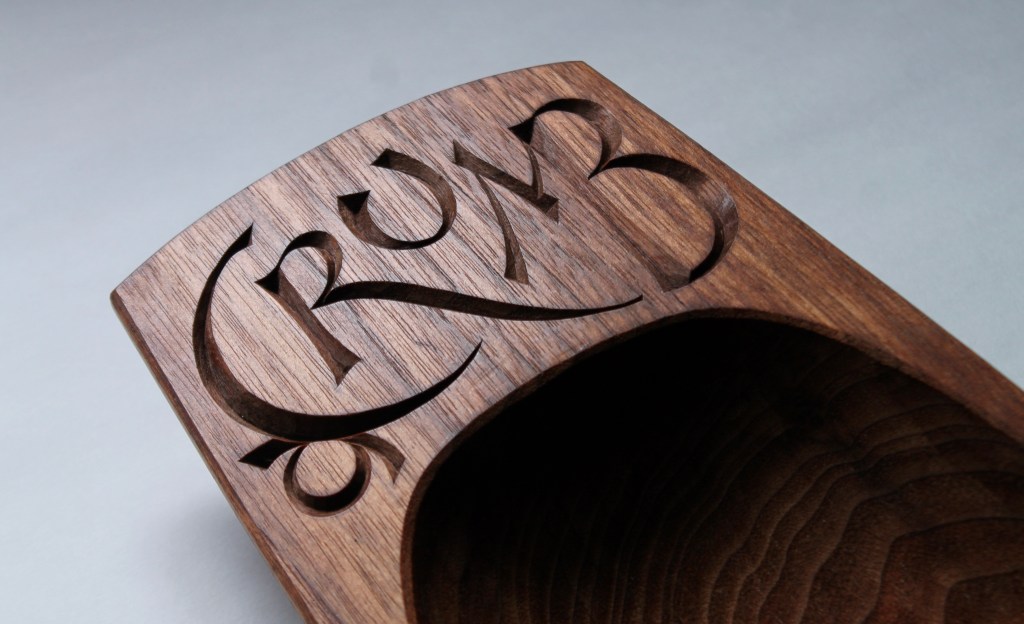
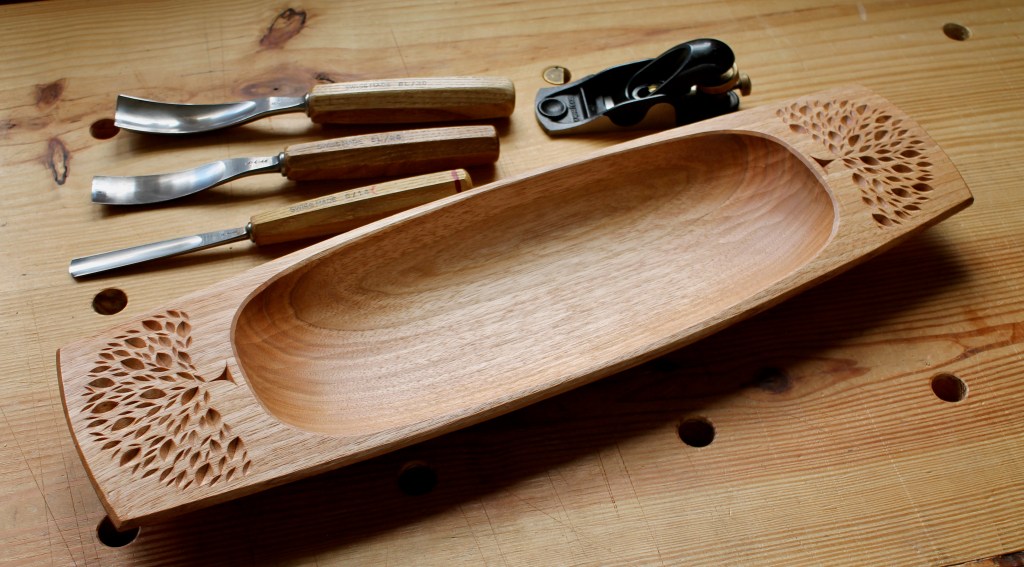
Departing from the tree design I’ve carved on the other Bowls-from-Planks, I carved an excerpt from an Emily Dickinson poem on the handles.
A little bread—a crust—a crumb— A little trust—a demijohn— Can keep the soul alive—
— Emily Dickinson, from Poem 159 (1896)
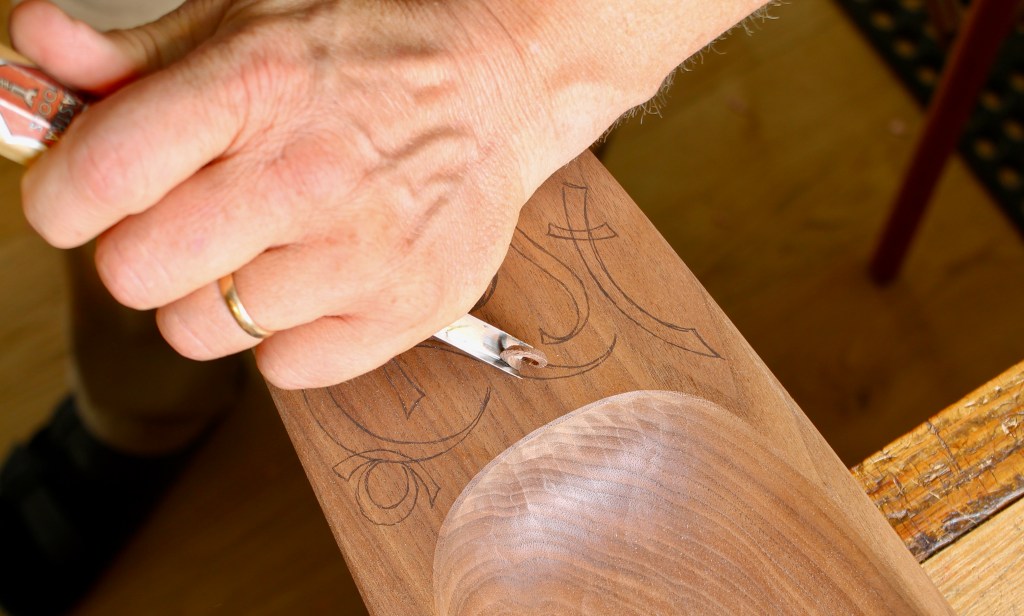
I adjust my letter carving technique depending on the size and style of the letters as well as according to the hardness of the wood. In the case of this walnut, I began with a v-tool after transferring my drawing to the wood with graphite paper.
I use a mallet for this v-tool work. The little taps provide controlled bursts that provide a lot of control.
I leave the lines and then some. Every wall and junction will be carved over. This just gets rid of the majority of the waste and goes relatively quickly.
There’s what it looks like after the v-tool work. Ready for the more painstaking knife and gouge stage.
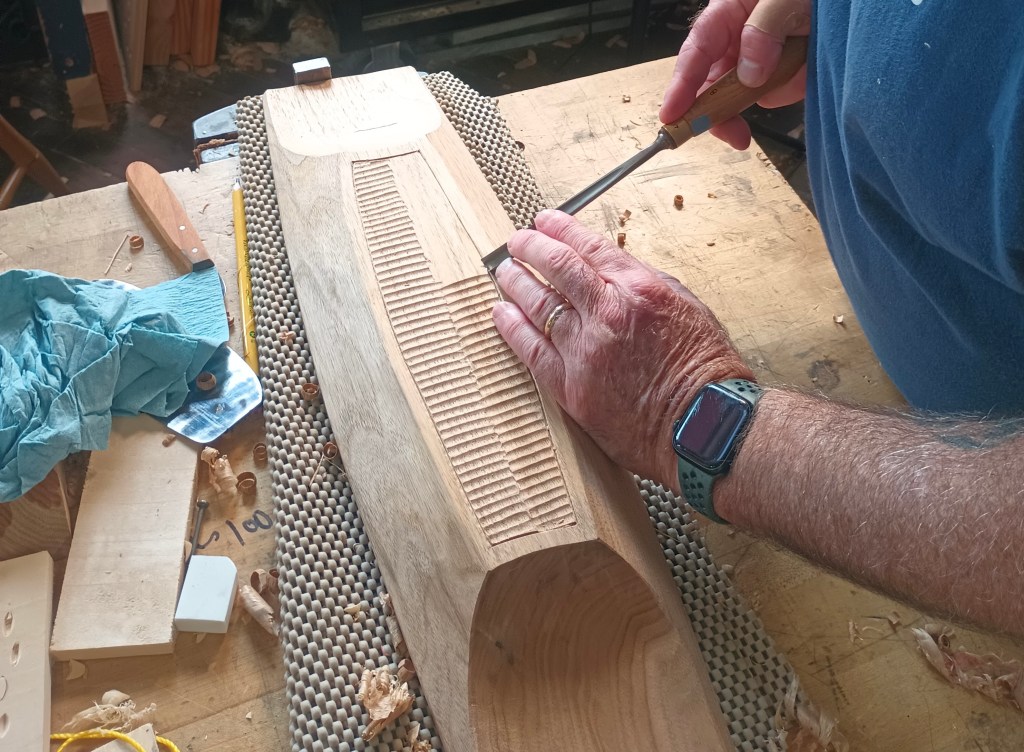
There’s a shot of the foot and underside of the bowl. I carved flutes under the handles of this one, a technique I demonstrate in class that can be used in many other circumstances.
If you’re interested in purchasing this walnut bowl, please email me at dandkfish@gmail.com. It is 21″ long, 6″ wide, and 2″ high. The price of $950 includes shipping.SOLD
Tulip Poplar Bowl-from-a-Plank 2024, 21″ x 6″ x 2″
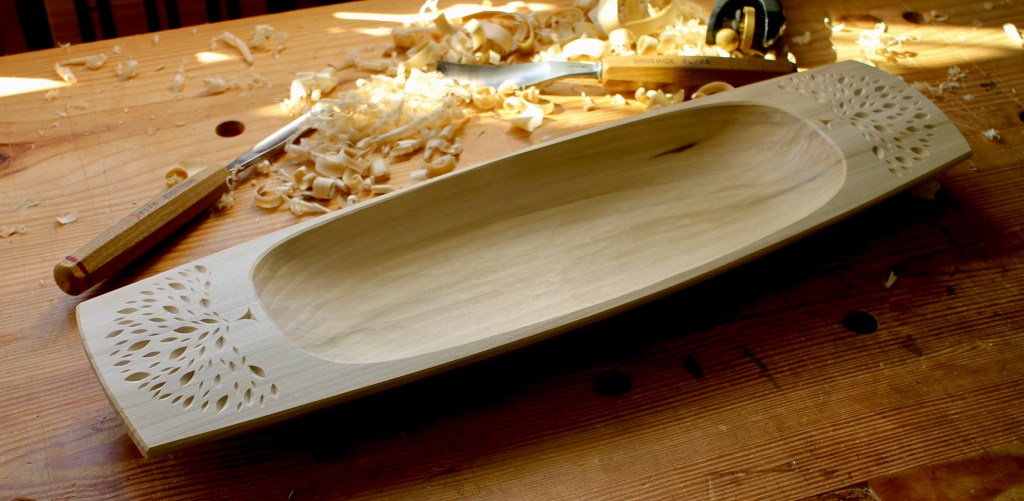
During class, I demonstrated each step on my own blank, but often only on half or a quarter of it. I brought it home with me and finished it up to take with me in March for an example. There it is, above. We used tulip poplar for this class, which is ideal in many ways. Softer than cherry and walnut, but harder than basswood (linden) and butternut, it works easily enough (even as a dry plank) while still holding crisp detail. It makes sense that it was such a traditional choice for bowls.
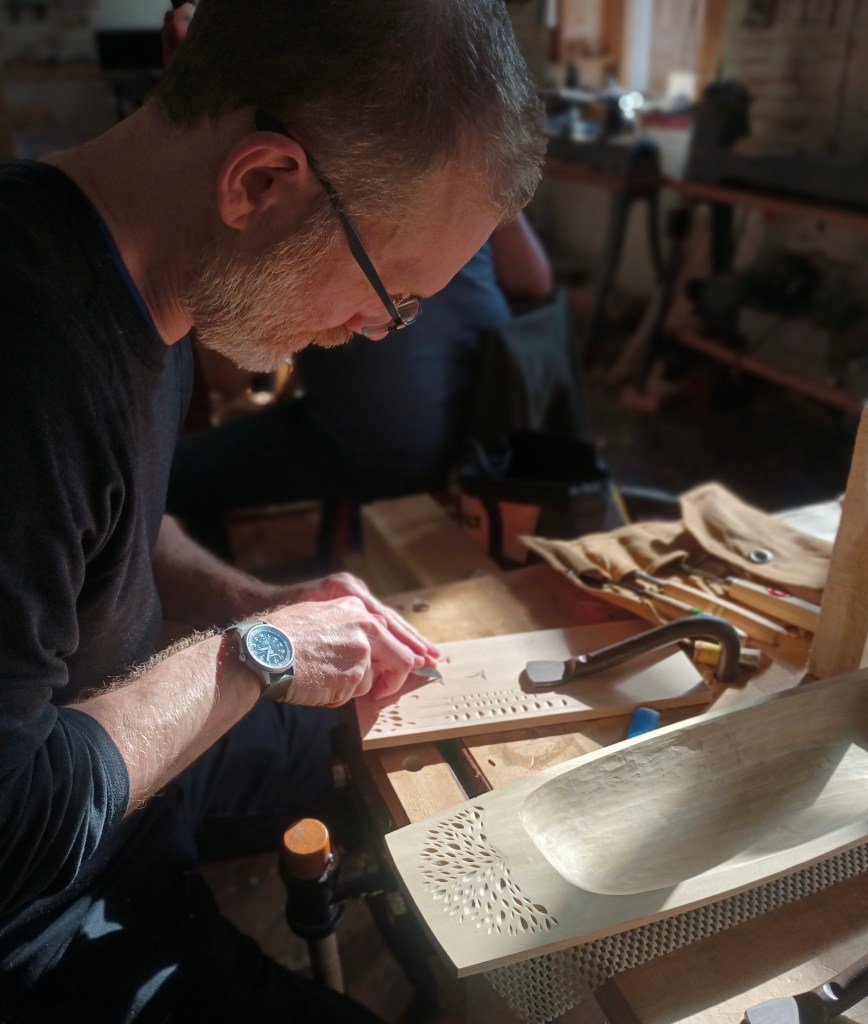
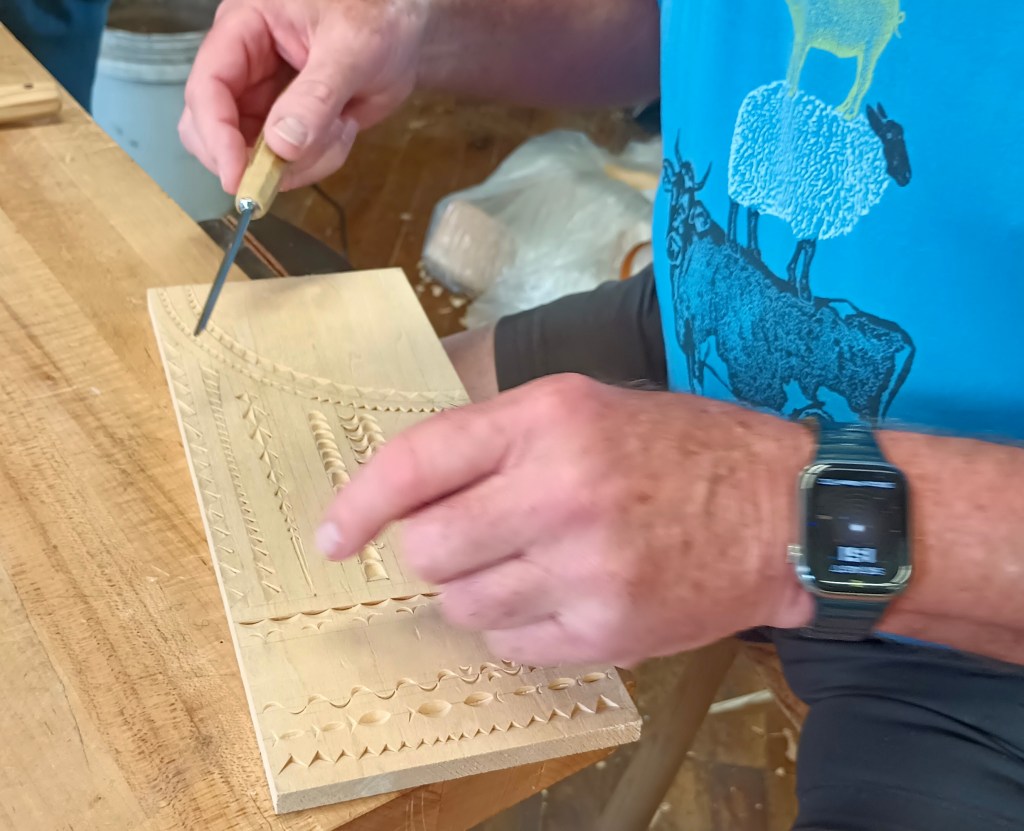
There’s one of the students, Jon, practicing his decorative carving on a sample board with his tulip poplar bowl, almost finished, beside him. Pete’s shop gets wonderful afternoon light coming through the windows. Ideal for carving. It was another wonderful group and we had a great week together.
The pale greenish hue of tulip poplar wood will mellow to a pleasing soft brown with subtle variations in the grain.
The tulip poplar leaves around here are mellowing pretty nicely as well.
Fall is here and I’m excited for my October class at Pete Galbert’s. I’ll burrow into the shop for the winter, then we’re going to do it again in spring. Registration for a class at Pete’s March 10-15 opens up on Monday, October 7 at 8:00 a.m. Through the week, we’ll carve the bowl above, right down to the final cuts and finish. But more importantly, we’ll learn how to adapt to make other bowl designs, sharpen gouges for optimal performance, lay out other bowl forms, carve decorative motifs, and more. In the August class, we even were able to touch upon the basics of letter carving. It’s really about the understanding and skills you take home with you, more so than the bowl. We call it Bowl Carving Exploration.
The trees are still mainly green around here, but some leaves have begun to fall.
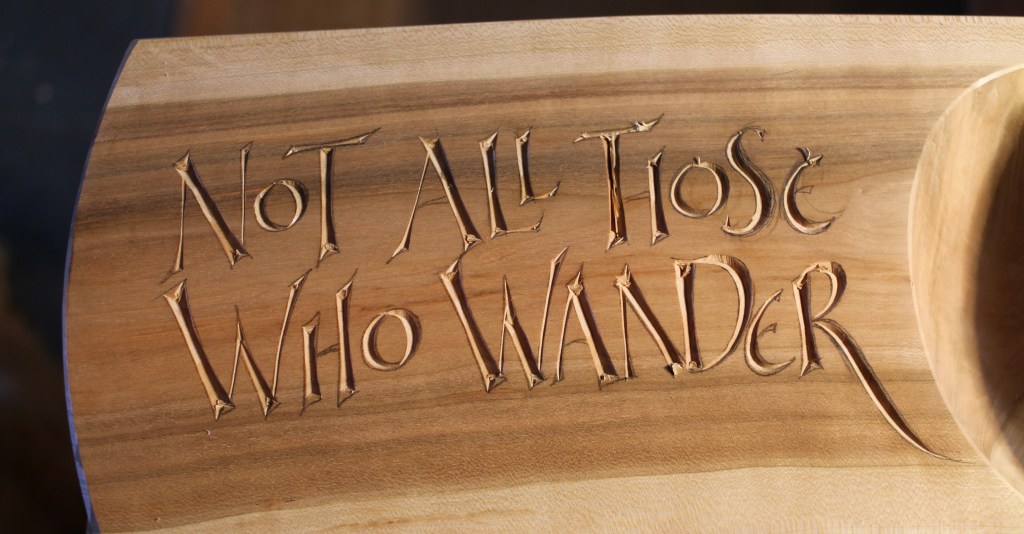
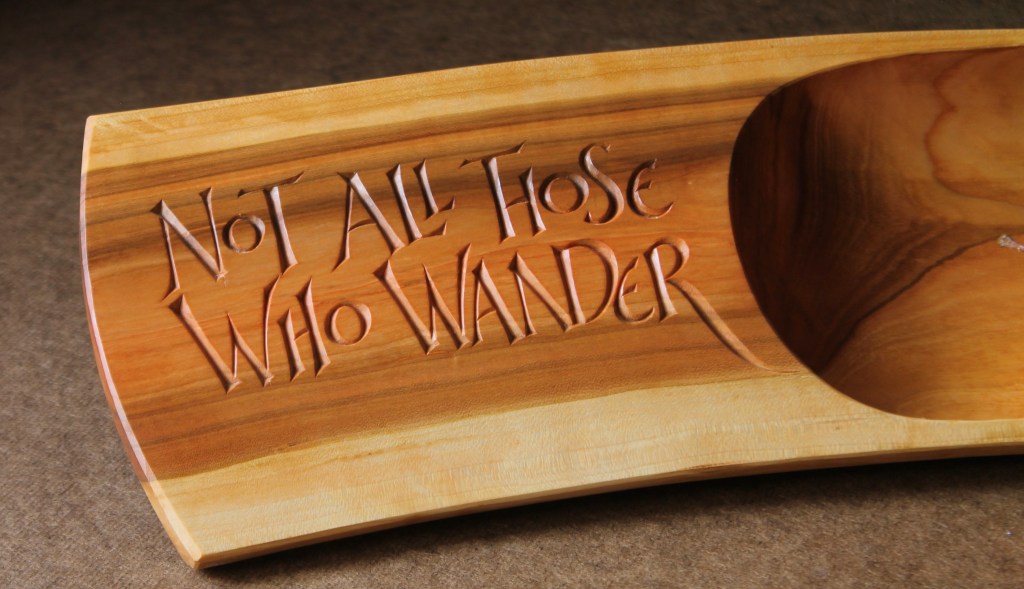
This is the third time I’ve carved these words from J.R.R. Tolkien on a bowl, but it has been several years. Each bowl has been different, and so has the lettering. I think working with green wood straight from the tree, especially, can be a form of wandering. We don’t know where the journey into a piece of tree will take us. We respond to discoveries made along the way. That’s the way it was with the bowl above that came from the lower half of the cherry log below.
I brought this chunk home because I was intrigued by the top half with the “handle” of a branch that had merged back into the trunk of the tree. I sawed the piece in half and set the top aside. I hadn’t planned anything for the bottom half, but staring at it there, I decided to explore it a bit. It was nearly two feet long and only six or seven inches wide, bending a little in both directions.
I shaved a flat on the bottom. You can tell by the growth ring pattern that the fibers curve up (or down, in this shot) from the bottom toward both ends.
I flipped it over and shaved the top surface, following the general flow of the fibers. I finished by working across the grain with a plane.
I shaved the top flat across from side to side. As the bowl dried after the green carving stage, the top moved into a gentle arch.
The layout of everything was just freehand sketching. Here you can just see a general safe zone mapped out for the foot. The final shape would be refined later. I’m working across the grain with an adze to remove the wood under the long handles.
It wasn’t until I wandered into the hollow that the whole idea for this bowl came together.
This is a shot of the hollow just after I’ve carved it in the green stage. There was a dark growth ring band at the sapwood/heartwood border on one side of the log. It brought to mind a hill and sky. And I thought about a journey across that landscape.
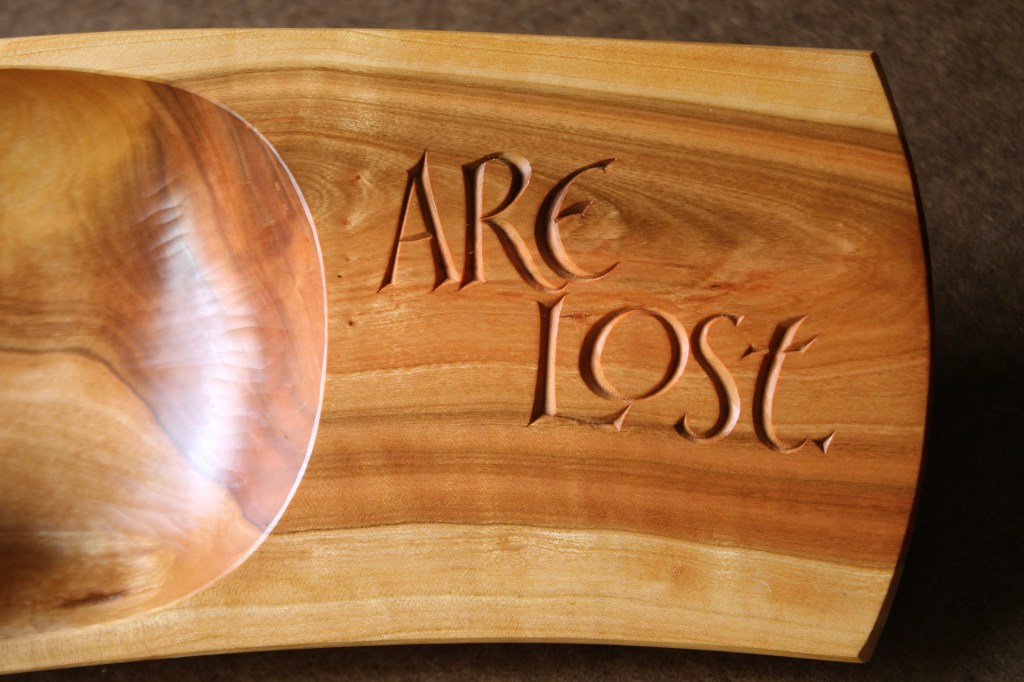
After a few weeks of drying followed by the final carving stages, I started sketching Tolkien’s well-known words. Here they are in the context of the whole stanza:
All that is gold does not glitter, Not all those who wander are lost; The old that is strong does not wither, Deep roots are not reached by the frost.
— J. R. R. Tolkien, from “The Riddle of Strider”, The Lord of the Rings: The Fellowship of the Ring
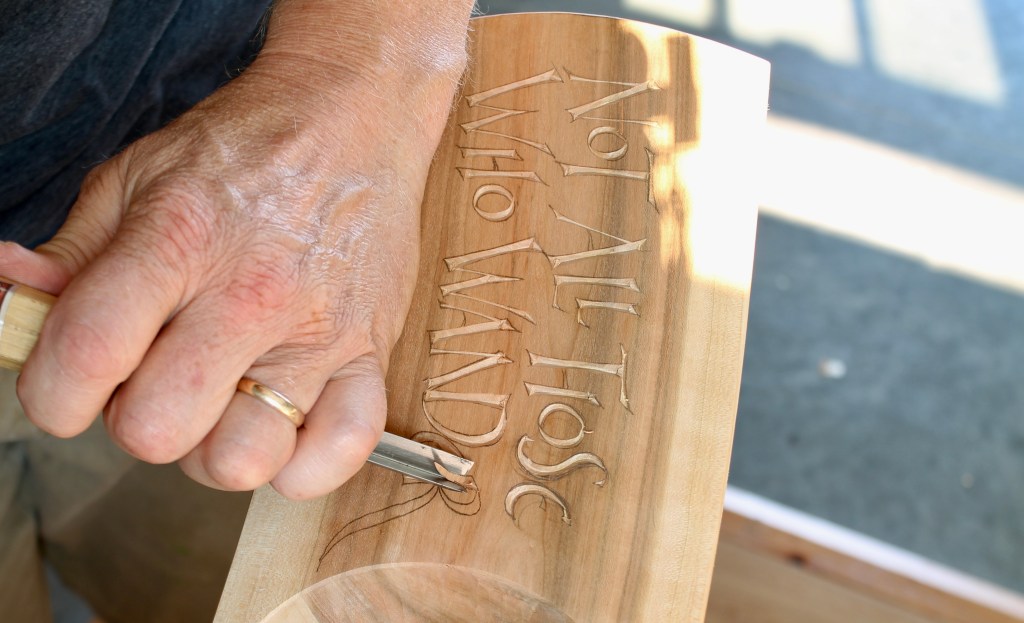
In this (particularly) hard cherry, I removed much of the wood with a v-tool before going in with knife and some gouges.
Above is where I stopped with the v-tool. I have left the lines, and then some, for the next stage with the other tools. In terms of time in the letter carving (not including the designing/drawing time), it’s probably not even 20% along at this point. As with bowl carving, removing the bulk goes relatively quickly.
I’ll end with a few shots of the finished bowl below. Dimensions are 22 1/2″ long, 6″ across, and 3″ high. It is available for purchase. $1200 includes insured shipping to you. If you’re interested, please email me at dandkfish@gmail.com. SOLD
I like this silver maple bowl that I just finished, and I liked making it even more. Part of the reason is that it gave me an opportunity to use a curved (cooper’s hollowing) drawknife that I had picked it up on eBay a couple years ago.
Whenever you’re working with a good drawknife, it seems like the birds sing more sweetly. That held true once again after I honed it up and used this cooper’s hollowing drawknife to shave a series of concave facets on the sides and ends of the bowl. Above, I’m shaving the uppermost facet. I started next to the foot, concentrating on leaving a good line on the left edge of the facet. Then same with the adjacent one after that, and so on.
Here’s a photo of the drawknife. The edge is about 6″ long. The outer edges of the handles are about 15″ apart. I can’t see any stamp on it, but I’m nearly certain it was made by D. R. Barton. They made great tools in Rochester, NY beginning in 1832. I have a couple other drawknives by them and this one shares the characteristics.
Here’s an edge-on shot. A relatively gentle curve compared to some others. Probably made for hollowing the staves of larger barrels, with less curvature than those of smaller containers.
And there’s the back side.
After working on the sides, I adjusted the bowl horse to hold the bowl sideways as I worked across the end grain, skewing the knife to get a cleaner cut. The last row, right under the handles, was a little tighter, so I used a gouge there.
I rotated the bowl up almost vertical and shaved the ends of the handles with a regular drawknife.
Again, skewing the blade eases the end grain cuts.
Then, more fun easing the sharp edges by shaving chamfers with the drawknife.
For the edge of the hollow, I switched to a sloyd knife. I’m guiding it with both hands here.
Above is the outside of the finished bowl. The dimensions are 16 3/4″ x 9″ x 2″. This silver maple had some ambrosia streaks in it, a reaction of the tree to fungus carried by boring beetles. The dark spots on the bottom there are beetle holes. The lighter wood is sapwood (near the bark) and the darker wood is heartwood. This blank is a radially-split blank, so, like quarter sawn. That meant the broad foot stayed flat even as it dried.
And there’s the view from the top. A broad shallow bowl useful for all sorts of things.
From this low angle, the hollow facets from the drawknife can be seen. And an apple for scale.
The line of gouge chips on the end emphasizes the curve of the handle, but is subtle enough to not compete with the strong character of the color and figure in the wood. Those of you from the class at Pete’s might recognize this pattern from our sample boards.
This bowl is available for purchase. If you’re interested please email me at dandkfish@gmail.com. The price of $600 includes shipping. SOLD
A couple months ago, I wrote a post that included an explanation of a honing method using a board secured vertically in a vise as an aid to honing gouges and chisels. I don’t know what to call it. Honing ledger? Sharpening shelf? I’ll go with alliteration.
Anyway, it allows the gouge to be slid side-to-side across the stone while maintaining a consistent sharpening angle. There’s a photo from the original post above. Call it what you want, but it’s just a scrap board.
A couple weeks ago, this showed up in my mailbox, a gift from Bill Skinner. Bill took the idea and made a deluxe version with a 1/2″ diameter steel rod at the top.
Here’s a shot of the other side. The uprights are joined to the body with a half-lap joint. Overall dimensions are 13″ x 6″ x 7/8″. Bar length between uprights is 11″. There’s a 1/2″ gap between the bottom of the rod and the top of the body.
I tried it out just like it is and it works great, especially with a drop of oil or a little wax rubbed onto the bar.
So, it works just like a board, but the special benefit of Bill’s configuration is that it can be used with the Tormek SVS 38 clamp. I don’t have one, but Bill says it keeps the tool square but still allows the rotation to sharpen the gouge. Above are photos that Bill sent. On the right is a depth setting block to allow for a consistent angle when setting the clamp on a gouge. Again, I don’t have a Tormek or one of these clamps, but Bill says you can get one (the clamp, not the Tormek) used on Ebay for around $20.
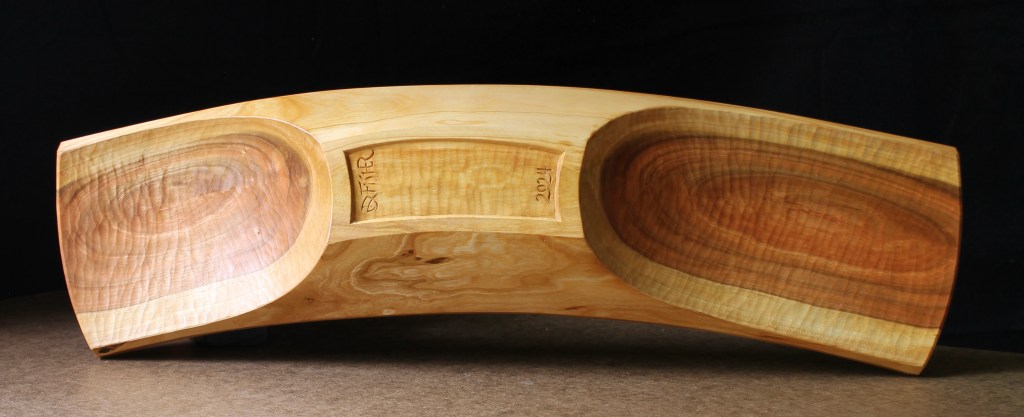
What I make is usually dependent on what bits of tree become available. Responding to each piece is a fun challenge. When I checked out a small cherry tree that had fallen over in a yard, it had already been cut into various lengths. I split open this short chunk, only about a foot long, with a little upward curve and a striking band of heartwood.
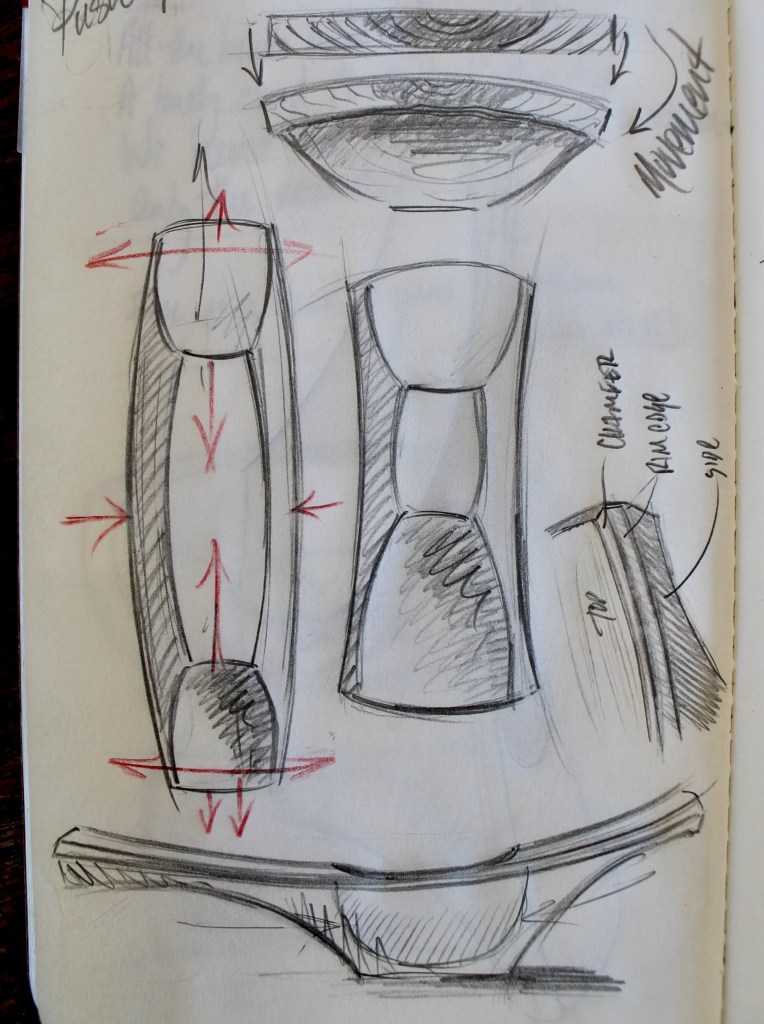
I wanted to keep a lot of that heartwood streak. Long “handles”, like in the Bowl-from-a-Plank design, would allow for that. But this piece of wood wouldn’t fit that exact design. So, I thought about distorting the Bowl-from-a-Plank design, much like you could distort an image of Snoopy from the Sunday comics with Silly Putty. The sketchbook page above reflects some of this mental Silly Putty stretching. The bowl with the red arrows is the Bowl-from-a-Plank (underside), and the rest represent the design for this bowl.
There’s the underside of a Bowl-from-a-Plank, above…
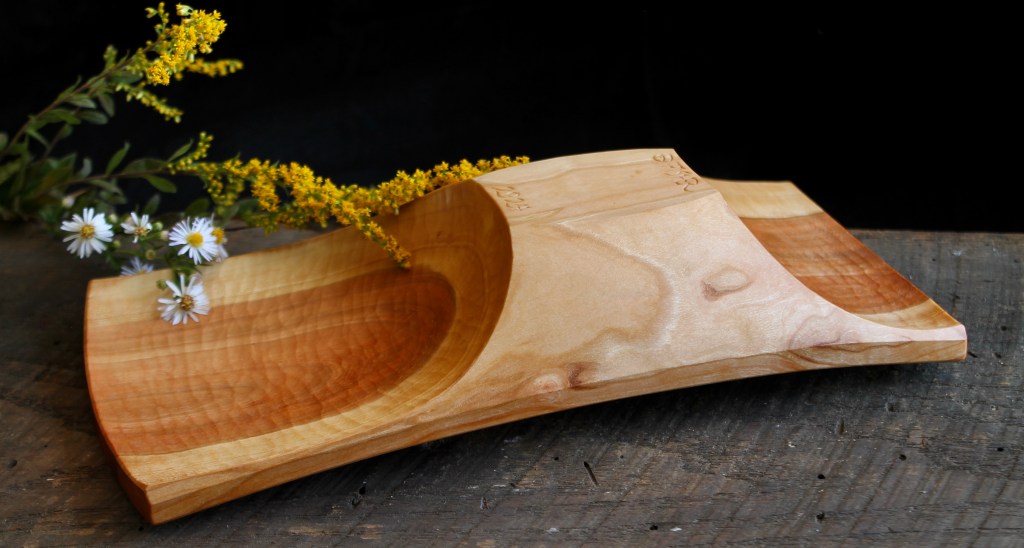
…and a similar view of this latest bowl. The areas beneath the handles are slightly hollow along their lengths and widths.
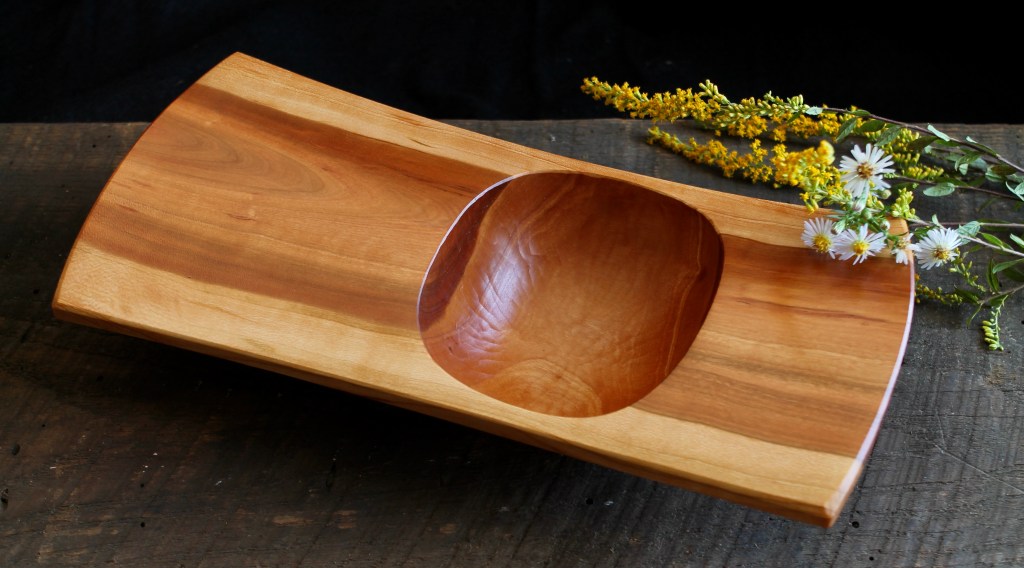
The layout for this one is just freehand sketching. A spoon-bent gouge was needed to shape the steep tight hollow. The hollow itself is 4 1/2″ x 3 3/4″, a nice size for candy or olives.
This bowl is available for purchase. Overall dimensions are 11 1/4″ long, 5 1/2″ wide, 2 3/8″ high. If you’re interested, please email me at dandkfish@gmail.com. $600 includes shipping. SOLD
And now for the spoons…
Normally, I wait until I have more spoons before posting a group, but I know it will be a while before I can get to more (other projects underway). So here are three spoons, all from crooks, finished with pure refined cold-pressed linseed oil and cured in my kiln. Ready to serve. Again, if you’re interested, email me at dandkfish@gmail.com and let me know if you’d prefer to receive a PayPal invoice or send a check. Thanks for looking.
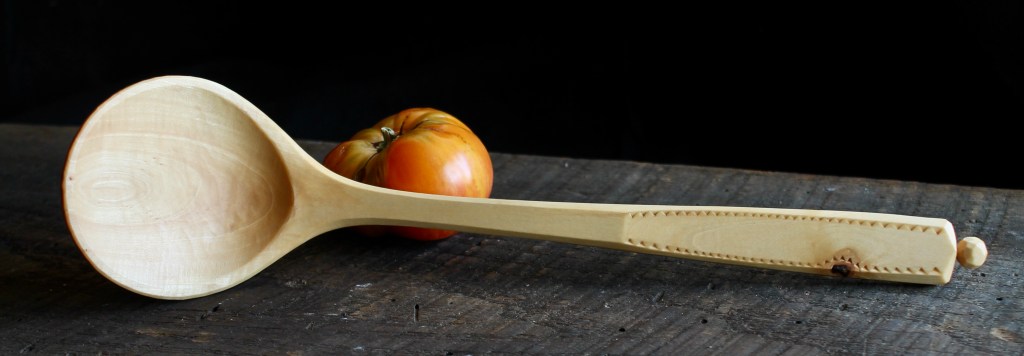
#1: Maple, 12 1/2″ x 3″. The shape of this maple crook called for a ladle with a wide shallow bowl. The second photo gives a better indication of the relatively tight bend from handle to bowl. You can reach deep into the pot. Chip carved handle. $150 includes shipping. SOLD
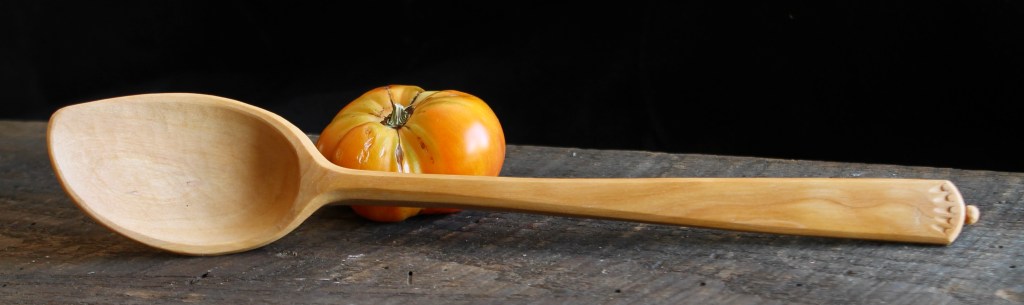
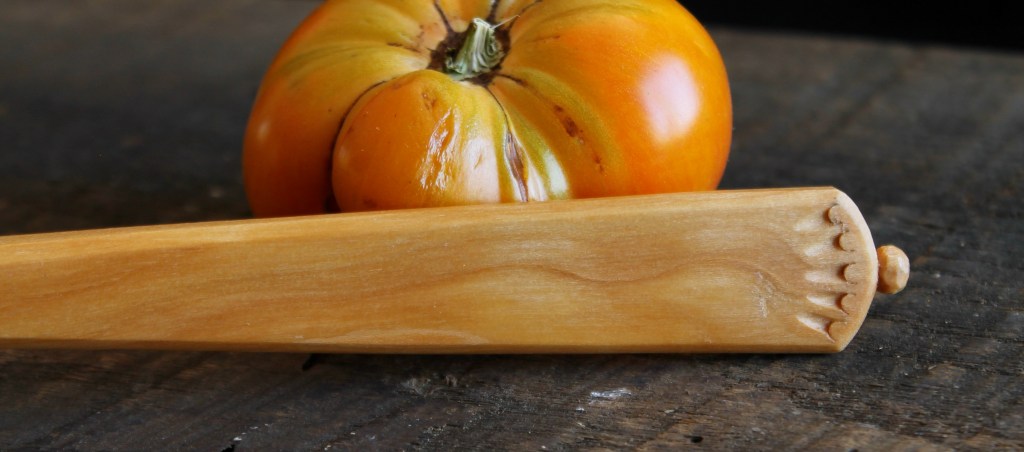
#2: Cherry, 12 1/2″ x 2 1/4″. This is a good general use kitchen spoon for stirring, cooking, serving or whatever. Carved from the sapwood of a black cherry crook. Handle detail below. $150 includes shipping. SOLD
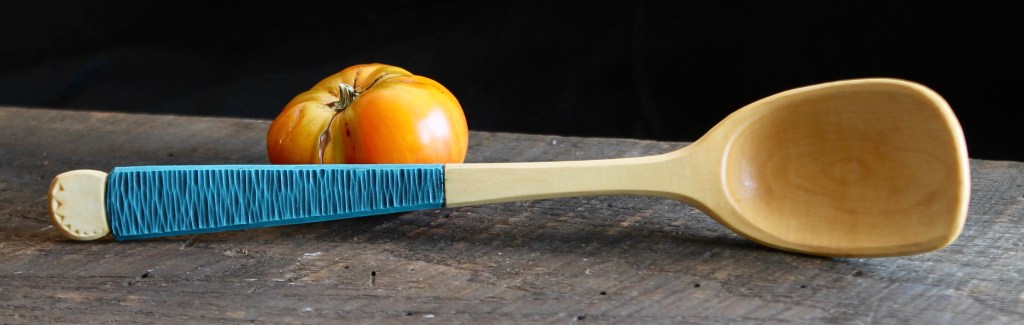
#3: Maple, 11 1/4″ x 2 1/8″. Another good general use spoon. A little more crank than the cherry one above. The handle was textured with a narrow gouge then painted with artist-oils (linseed oil and pigment), black over blue. $140 includes shipping. SOLD
I couldn’t resist adding some goldenrod and aster blossoms to the bowl photos. The goldenrod is in full bloom all along the trail. The colors of fall are coming.
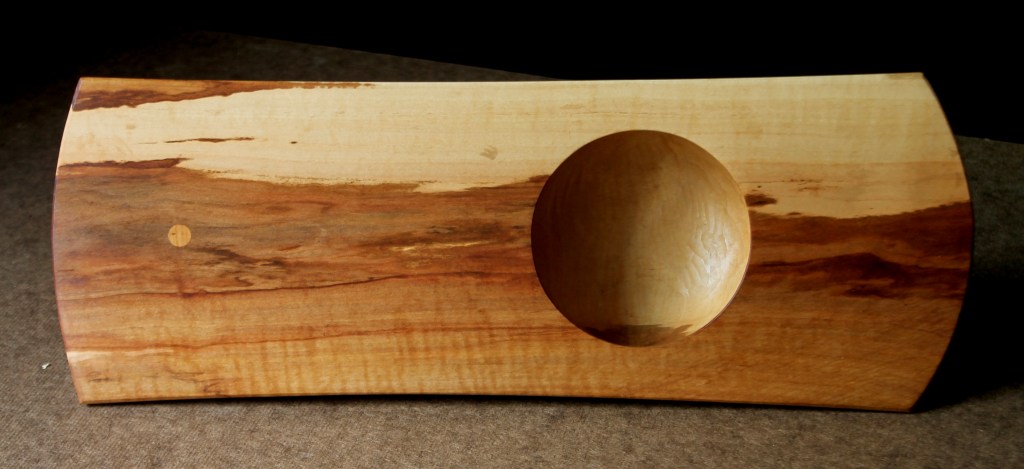
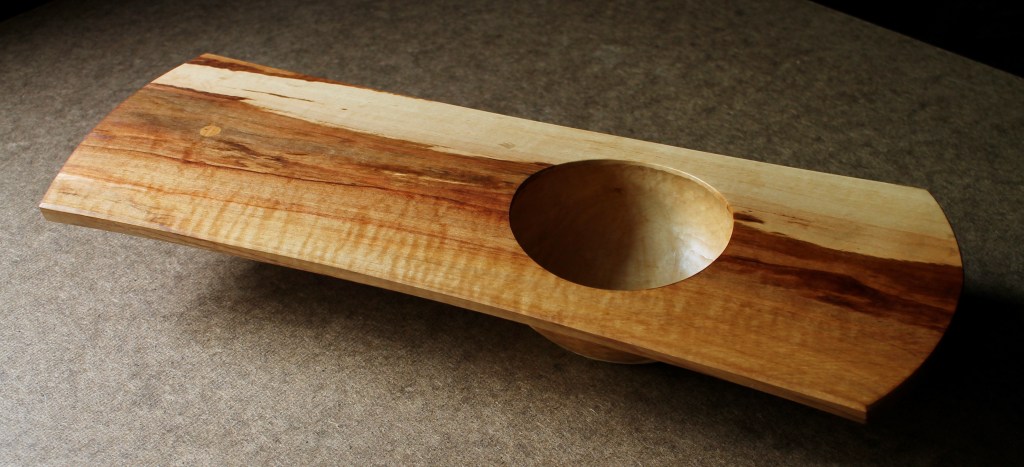
Venus-and-the-Moon Bowl 2024. Pearwood. 16″ x 6″ x 2.5″.
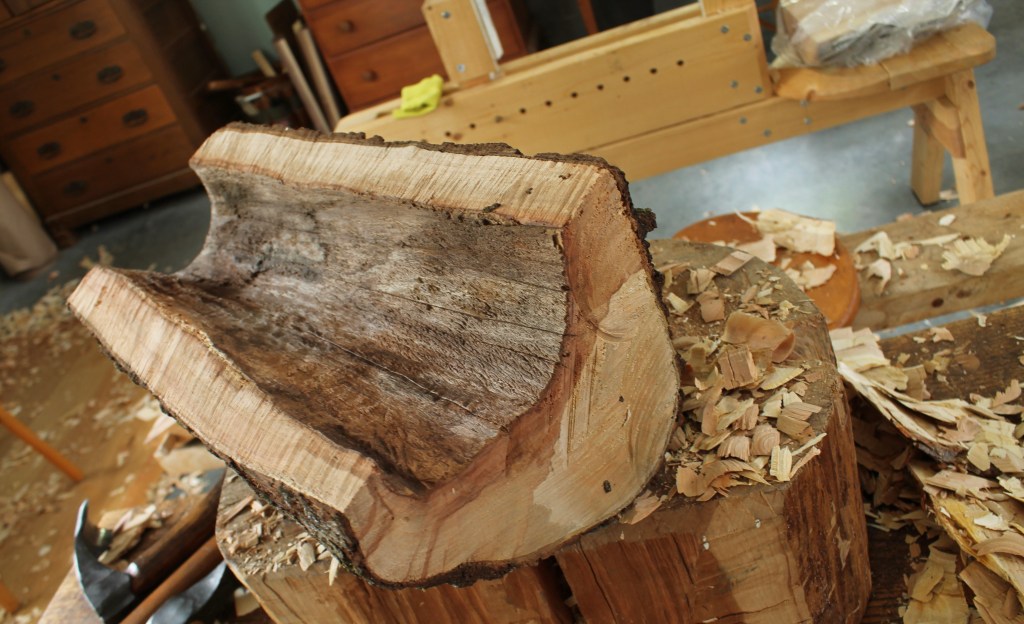
A friend alerted me to an old fruit-bearing pear tree that had fallen in a windstorm, just a couple minutes down the road. When I went to check it out, I wasn’t optimistic about its prospects. Most of the tree had rotted beyond use. The tree had been hollow for decades and mountains of old nutshells had spilled onto the ground. But, near the base the tree had been holding on with a ring of healthy wood to one side of the hollow.
I carved a spoon from a smaller piece and found the wood to be wonderful. But I stared at that bigger piece on and off for a couple weeks, coming up empty. But I kept thinking. It seemed to me that what made this log special was the character of that boundary area between the darker wood and the deeper, lighter sapwood beyond it.
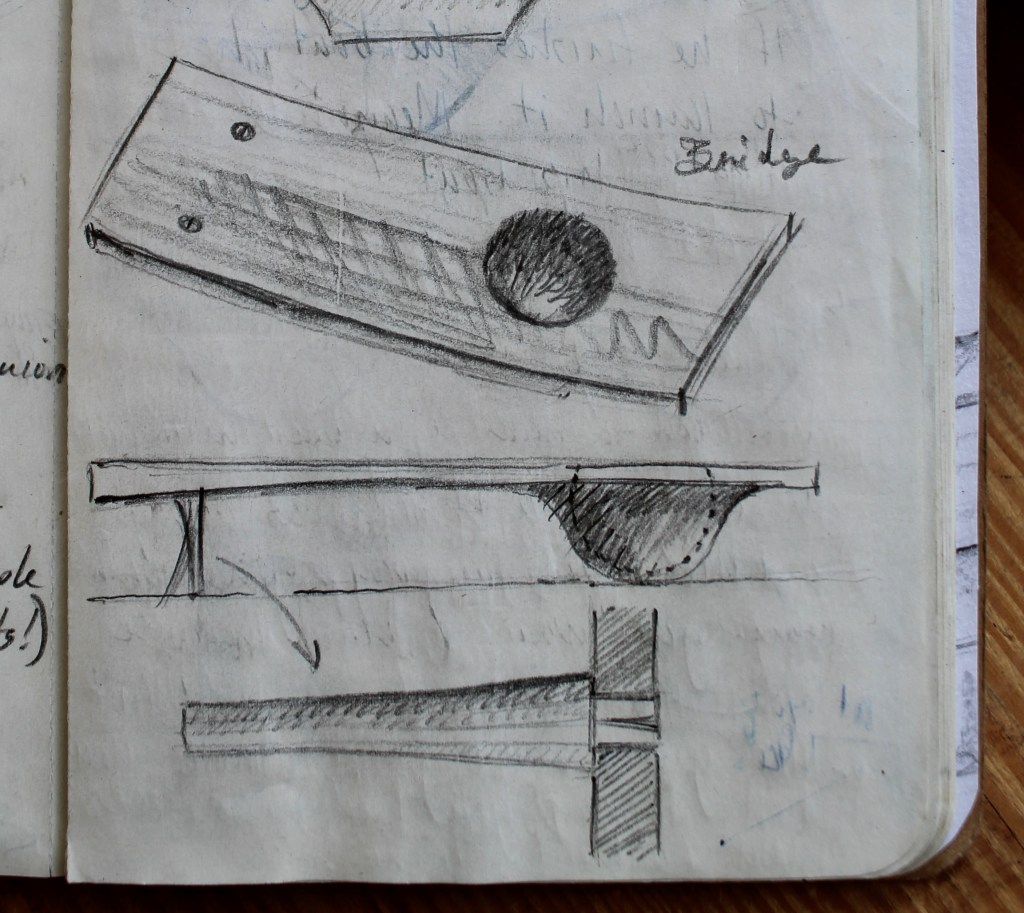
As I thought about that and another long narrow log (more on that later), I sketched a little idea in my notebook. Knowing that the details would evolve a bit as I worked, I had enough in mind to start shaping the log.
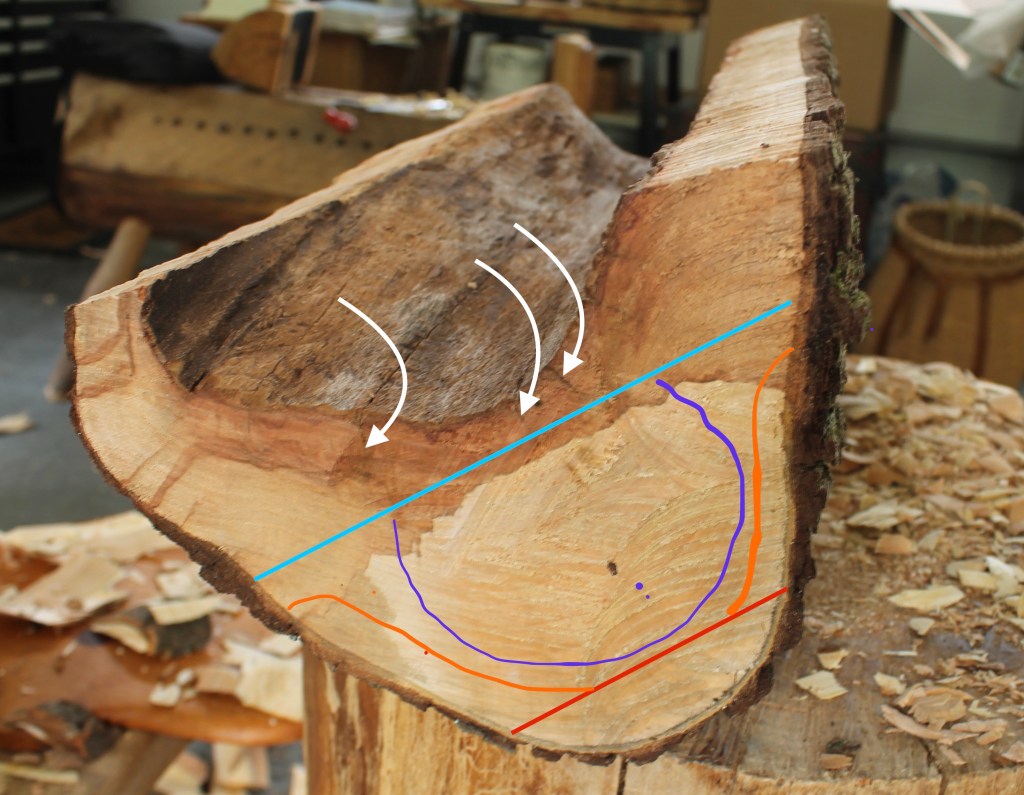
This is a rough idea of how the piece was oriented from the end. The light blue line is the top. I had to get it below the compromised wood and cracks (indicated by white arrows) next to the tree hollow. The red line is the foot. The purple and orange lines are the general idea of the deep round bowl interior and exterior.
Just like any bowl, I established the upper and lower surfaces. In this case, both flat. I split, hewed and planed. The curly figure in the pear wood was a nice surprise, and the subtle color variation was even better than expected. So, now it was a matter of not messing up such a unique piece of tree. I sketched my layout and then began to excavate the hollow with a gouge, followed by hook knives to achieve the undercut shape. I’ve put some process images into a slideshow, below.
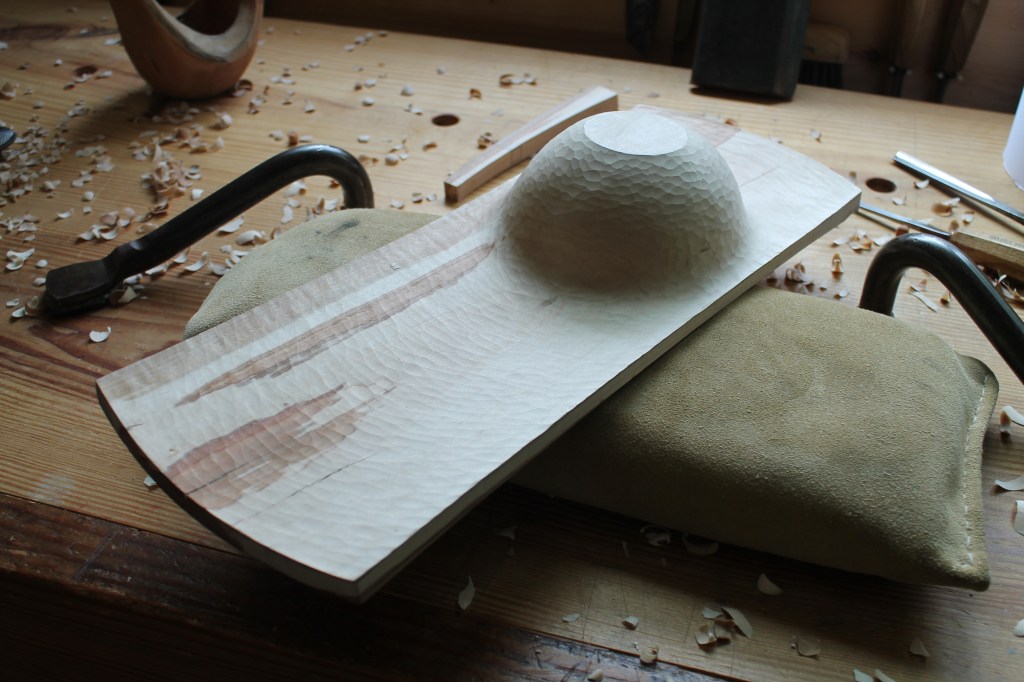
After a few weeks of drying, I returned to do the final shaping and refining of all the surfaces. During drying, the top took on a gentle arch from side to side. In the photo above, I had been using a sand bag and holdfasts to hold the bowl while working on the underside.
I’ll put a few photos of the finished bowl below.
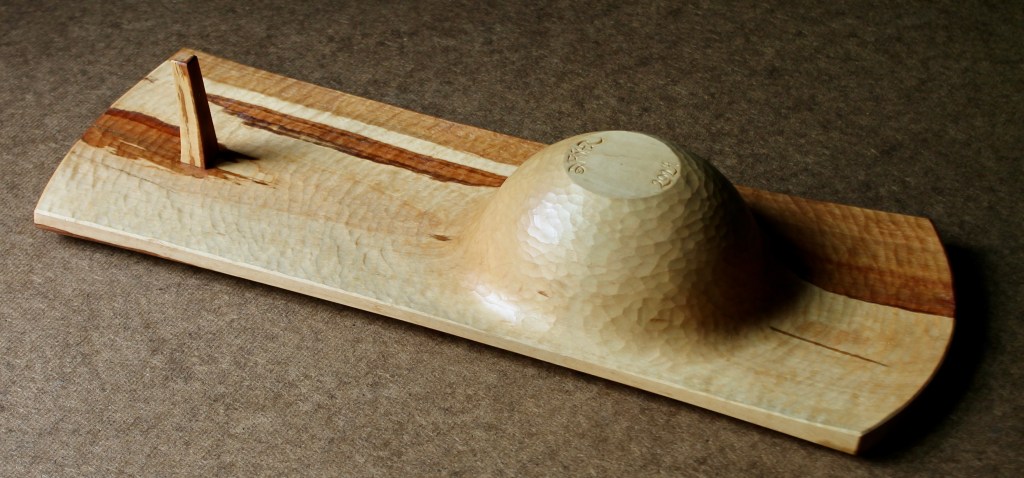
In the photo above, for me, the illusion of a sphere hovering in front of a board appears. Now I have trouble unseeing it! “Venus” is represented by the round end of the leg tenon.
After some experimenting I determined that only one leg was needed. I dried a small piece of the same pear and carved it with a curving taper. Then carved a shouldered tenon to fit tightly into the mortise in the top.
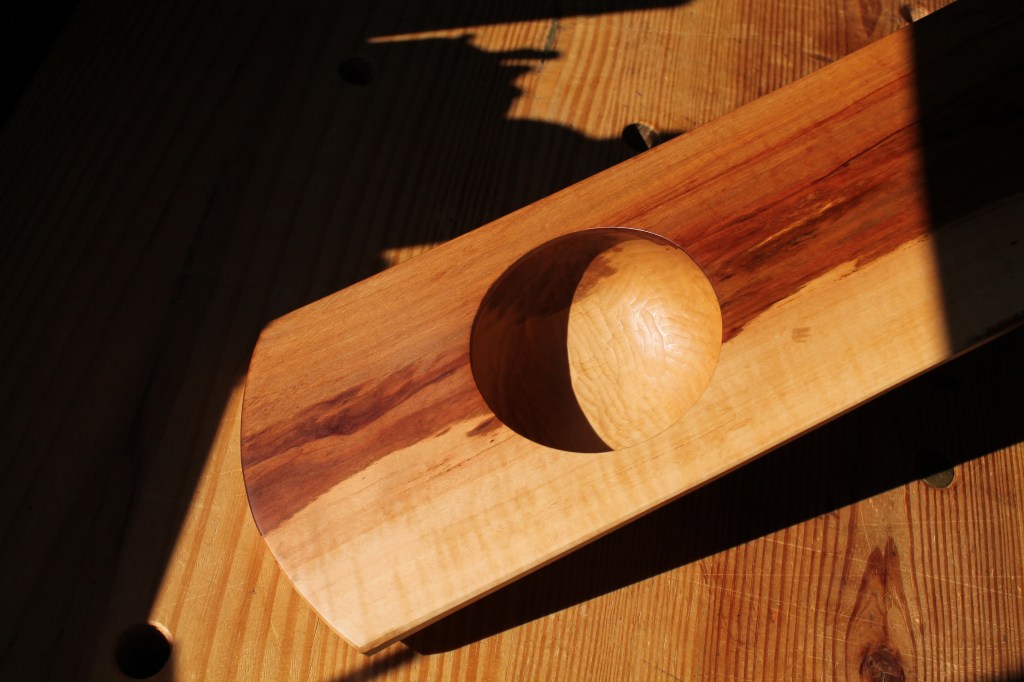
In very direct light (like this late afternoon light coming through my shop window) the shadow cast by the rim of the bowl creates a crisp crescent.
Georgia, one of the sweetest attractions to Pete’s shop.
It’s been a week since my bowl class at Peter Galbert Workshops ended. While I’ve settled back in and have returned to some projects that were underway, my time at Pete’s is still fresh on my mind.
Eating lunch outside of Pete’s shop building. Not a bad spot for a bite together!
What a pleasure it was to get to know these eight “students” over our six days together. I put that in quotes because I think I learned as much from them as they did from me. Architect, arborist, goat farmer… I was taking notes on all sorts of things from design terminology to regional colloquialisms. Then there’s also what I learned from being around Pete for a week.
Of course, in class we focused on all things related to bowl carving and even made bowls. We practiced various layout techniques on poster board for reference at home later. That’s Joe’s version above. Joe knows his way around a pencil.
In spite of this being my first go-around with this particular class, all went smoothly because Pete and his shop manager, Karen, provide a wonderful space in which to work.
As we were all introducing ourselves on the first morning, I was struck by the fact that three of the students had taken classes at Pete’s before. Some of them three or four times.
Decorative carving sample board underway.
Student bowl in butternut woodJoel Paul joined us to share some of his bowl carving knowledge, too. There he is, front and center.
They come, and come back, for many reasons…Georgia, all of the handmade (Pete-made) chairs and stools around, the coffee, Karen, the transfer of knowledge and skills, and the encouraging, positive atmosphere that Pete has established. I just stepped right into it. Pete has a passion and an incredible talent for making wonderful things. It is matched by his drive to connect people to the experience and to each other.
Peter Galbert Workshops sign carved in white oak
A couple months ago, Pete wrote in his blog, “If I could only work with one species for the rest of my days, it would be white oak.” So that’s what I used to carve the sign above for him. (That’s a representation of a travisher in the middle).
While “Peter Galbert Workshops” is the official name, there’s more of a personal connection for those that have been there. They think of it as “going back to Pete’s.”


























 David Fisher, Carving Explorations