The Grass so little has to do –
A Sphere of simple Green –
With only Butterflies to brood
And Bees to entertain –
And stir all day to pretty Tunes
The Breezes fetch along –
And hold the Sunshine in its lap
And bow to everything –
–Emily Dickinson, The Grass so Little has to do (1862)
Spring has inspired me to be a little colorful, like with this birch spoon I’ve just finished. After carving the words, I diluted some mixed artist’s oil paints with a little citrus thinner and applied it to the handle like a stain. The letters naturally appear darker. After that dried, I painted the sun and “stir” with a golden color. Once dry, the entire spoon was soaked in flax oil for a couple days.
I’ve experimented with different types of paint. There is something unique and versatile about oil colors, and they hold up well in use. I’m not concerned with any potential toxicity in some pigments, as I only use them on surfaces not really in contact with food. A beginners set of small tubes is reasonably priced and will go a long way. Any color can be created through mixing. Thinning allows the wood grain to show through and increases penetration into the wood.
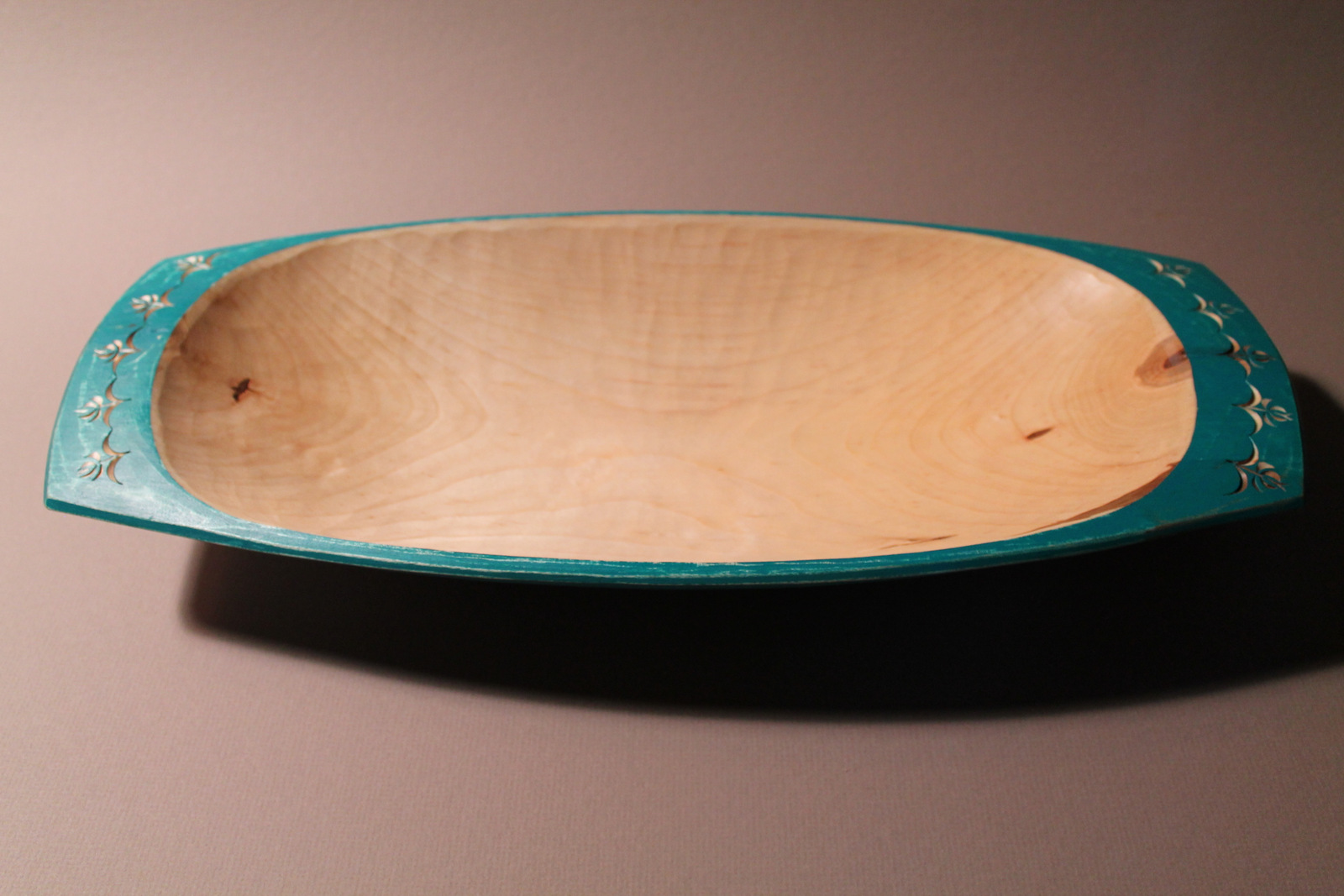
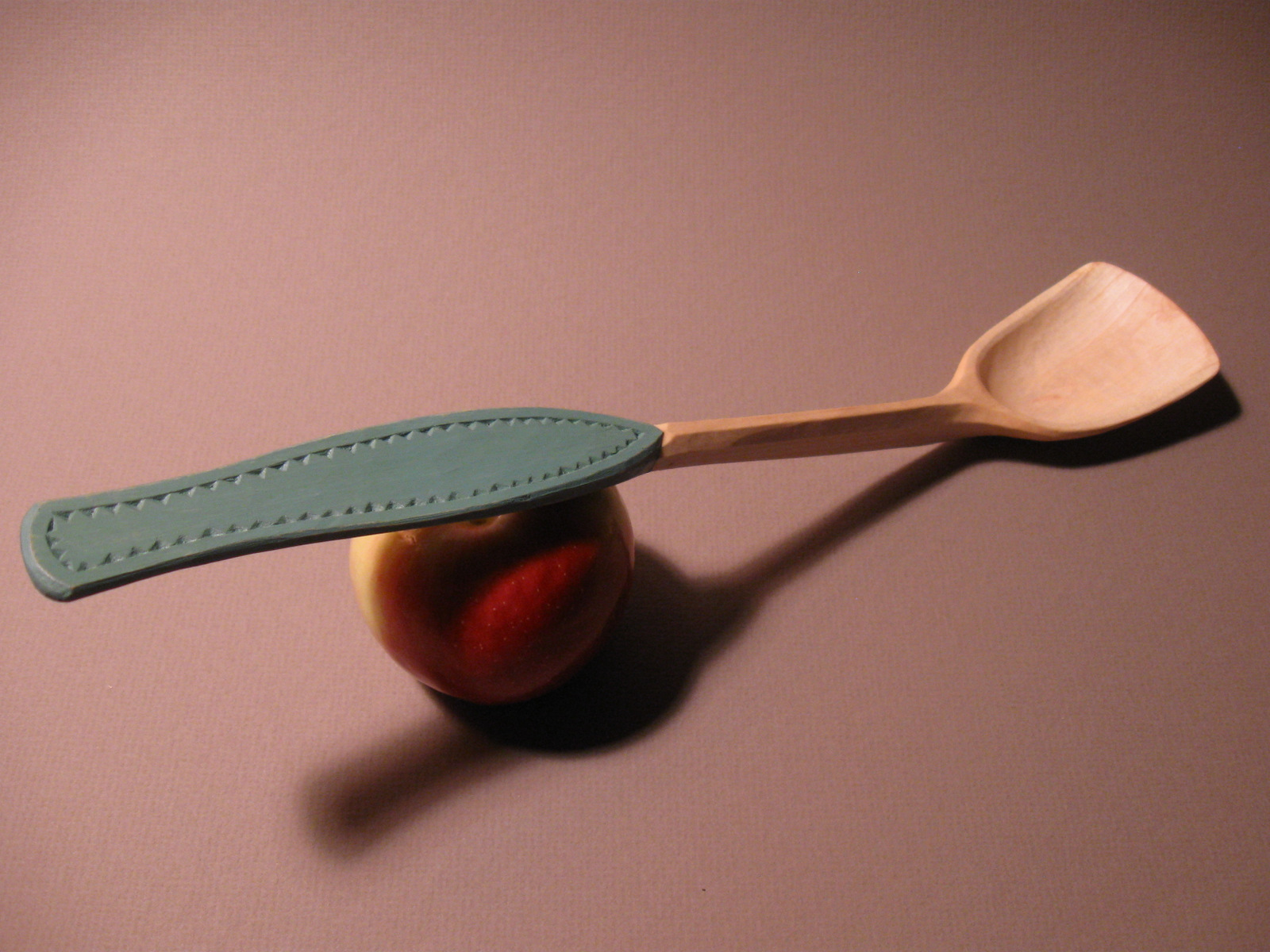
Lighter, neutral-color woods like birch and maple, offer interesting possibilities for paint. Below you can see some more examples, including some in which I carved through the painted surface to reveal the natural wood color beneath. Mix it up and have some fun this spring.
Back in the bone chilling days of January, my son and I warmed up a bit by collecting some walnut logs from a fallen tree at a friend’s house (and I posted about it here). Now, the snow is gone, the birds are singing, and I’m nearly finished with a bowl from that walnut tree.
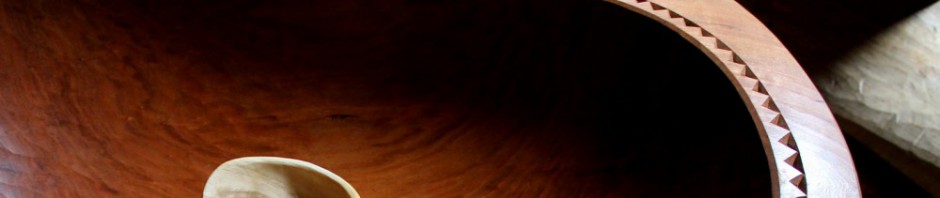
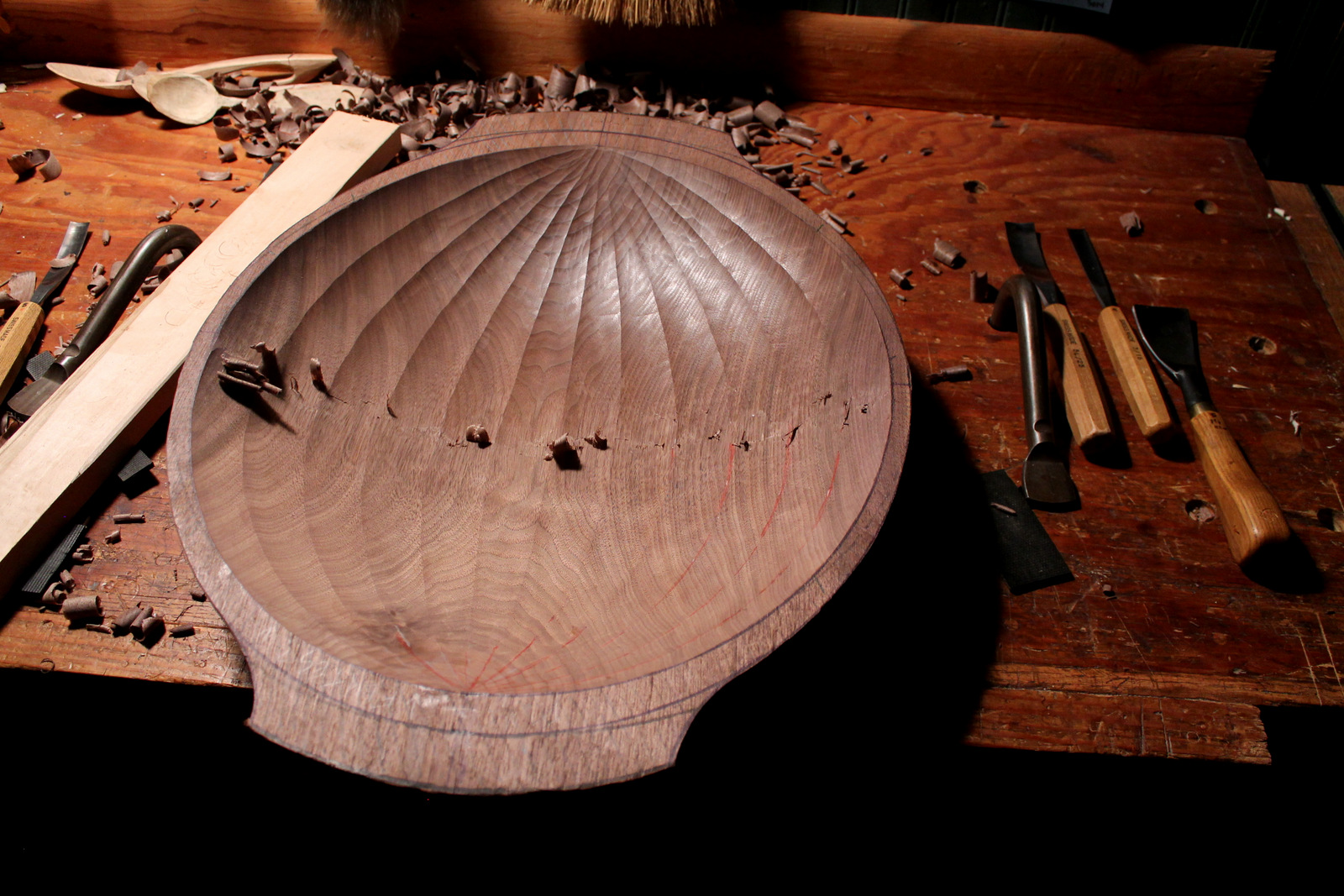
The shot at the top of this post was taken midway through the process of carving the flutes on the interior. I’ve carved similar flutes on a few bowls now. It is a bit painstaking, and, on dry hard walnut like this, painful at times! You can see this same bowl following the green carving stage to the left. It was close to 17″ wide at that point, and now it is around 16 3/8″ (x 22″ long).
The general procedure for the fluting starts with dividers. I use them to pace off equal divisions along the lateral center line inside the bowl. Then I sketch a series of longitudinal lines until they look right. I use a shallow gouge to create a flute between the lines, leaving a raised ridge line between them. In the top photo, remnants of the drawn guidelines still remain; I continue to pare away within the flutes until the pencil lines just disappear. The nature of the hand work provides texture and slight variations along the line and within the flutes.
If it gets warm enough over the next week or two, I might be able to set the finished bowl outside and let the sunshine help the oil cure. I’ll post some pics when it’s finished.
When the flush of a newborn sun fell first on Eden’s green and gold, Our father Adam sat under the Tree and scratched with a stick in the mold; And the first rude sketch that the world had seen was joy to his mighty heart, Till the Devil whispered behind the leaves: “It’s pretty, but is it Art?”
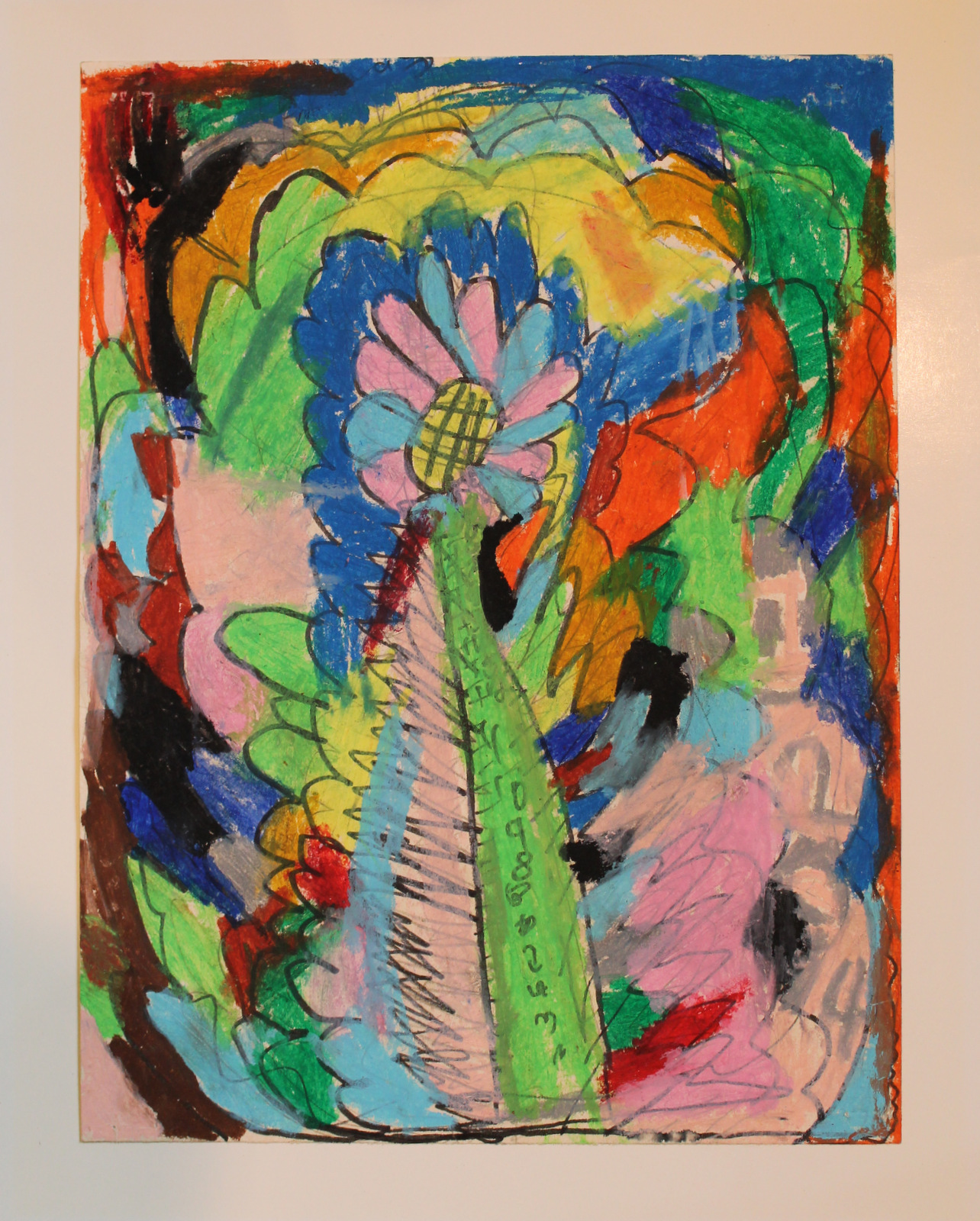
When my children were small, I loved to watch them draw; minds and bodies completely focused on the magic unfolding before them. My daughter, especially, would often pause after adding a new line to a drawing, her face beaming with overwhelming joy. She heard no whispering behind the leaves.
I keep a picture (above) that she did many years ago on the wall in my shop. It is a reminder to revel in the creative experience. Savor the moment and the joy. Listen to the music of the gouge slicing through the wood, deaf to devilish questions.
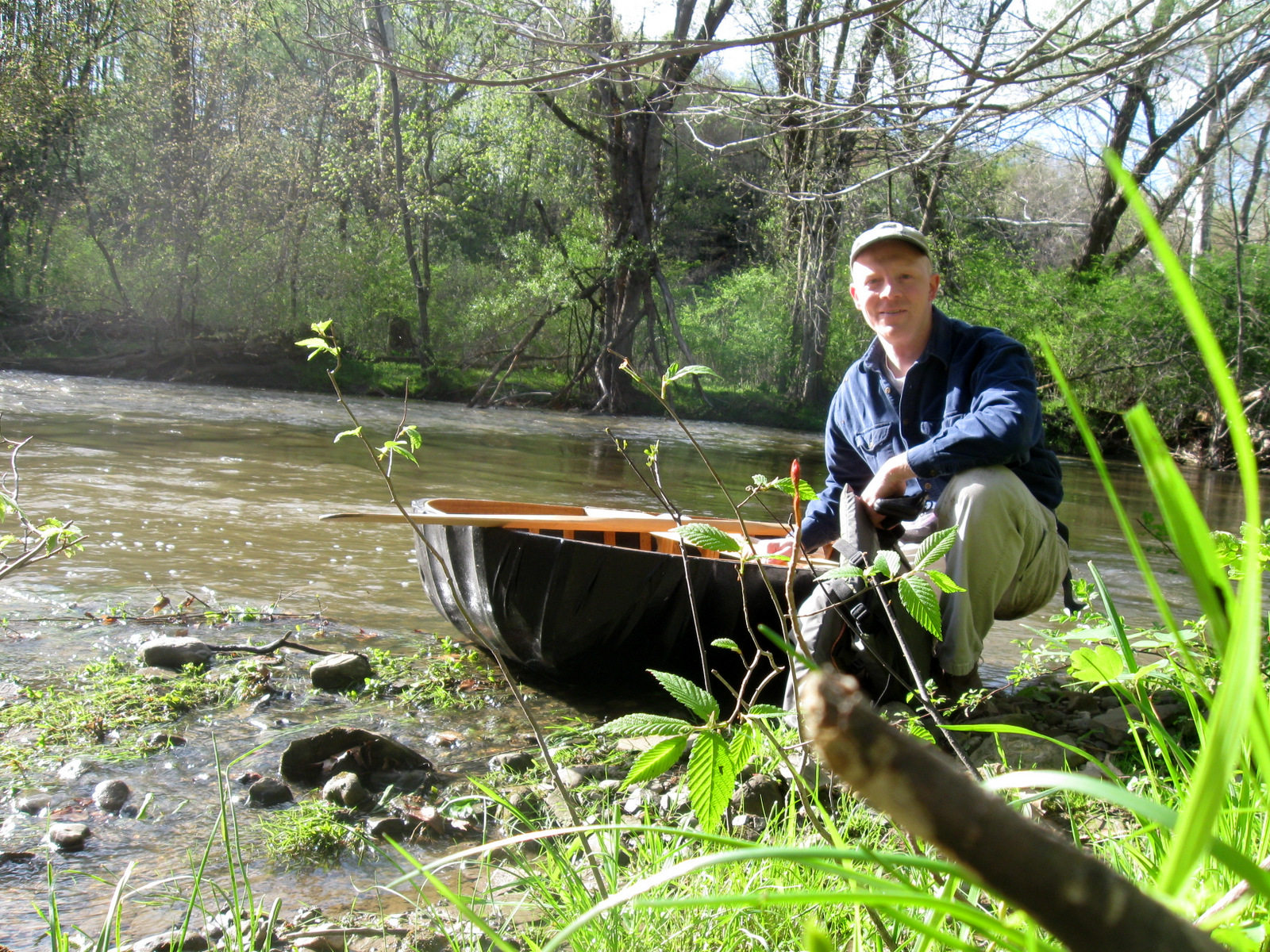
I’ve never been cool. My natural tendencies, interests, even hair, just wouldn’t allow for it. I’ve never been into fast cars or fast boats. For a couple years, I even drove a bright blue-green Ford Aspire — and I still found a girlfriend (now my wife)! So, if you see me walking to the river with a coracle on my back, there’s no need to say it; I know. I’m not cool — but I’ll be smiling.
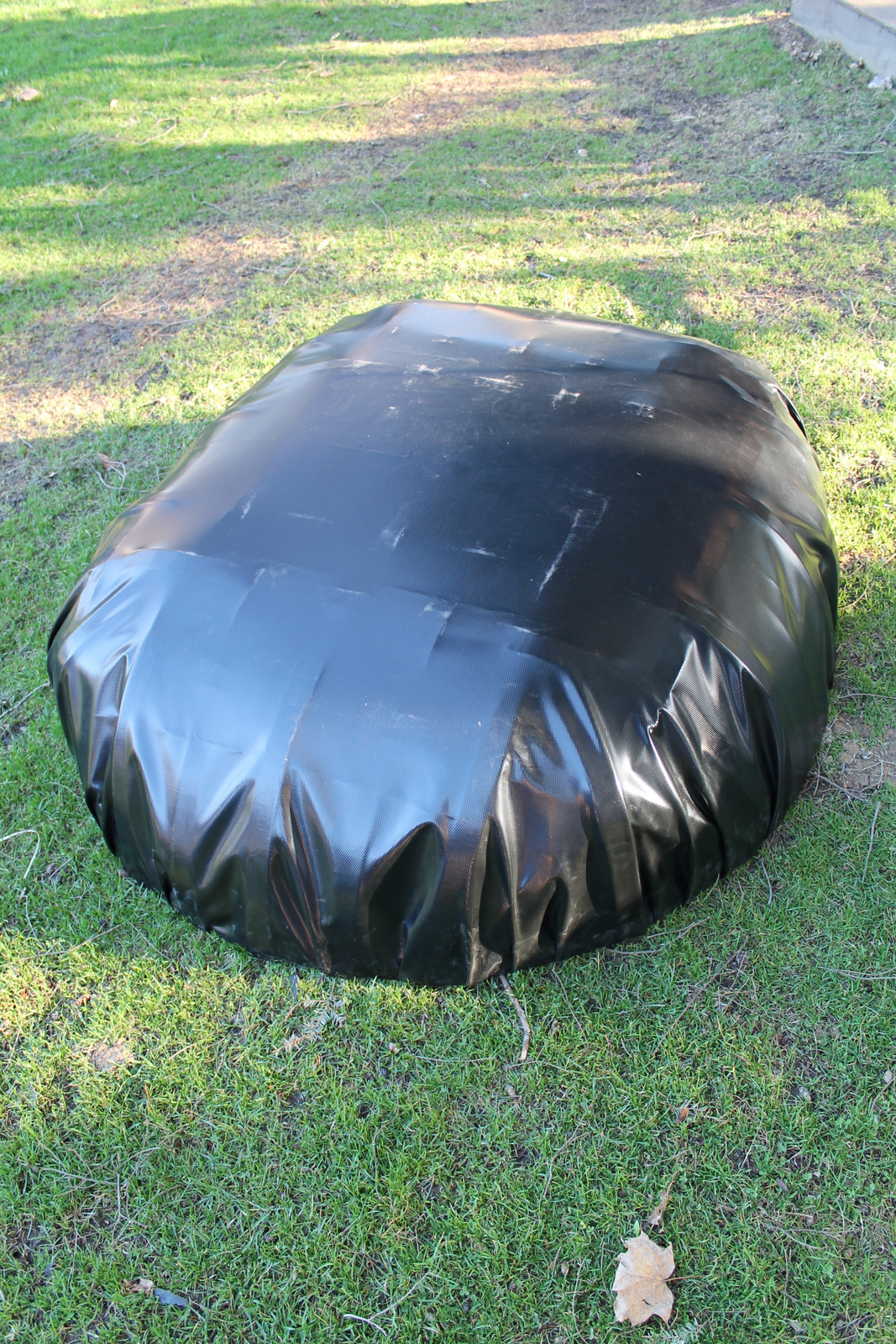
That’s because coracles are such fun — to build and to use. I built a couple nearly ten years ago, one for me, and one for my kids to have some fun with. After many duct tape repairs, it was finally time to “re-skin” it. This time, rather than tar coated canvas, I used pvc coated polyester fabric. It’s obviously not a natural fabric, but I gave in this time. It is incredibly strong and should hold up very well against sharp rocks.
The sequence above shows the two coracles when I first made them, then the larger one right before I decided to re-skin it. The third photo shows the sawn hickory laths re-exposed (hickory was probably overkill), and finally the new skin.
I am 185 pounds, and my coracle is plenty stable at 5 feet long and 4 feet wide. I forget where I saw the general plan years ago, but here is a site with plans plus some great information in general about coracles.
There are many styles. In this video clip from the BBC Edwardian Farm series, you can watch Sean Hellman build one with willow wands. As you’ll see, they also try it out, but don’t let that deter you. By the way, the entire BBC Farm Series shows are wonderful. Most episodes are on YouTube in their entirety. A quick search on You Tube will get you started. Robin Wood is turning bowls in one of the Medieval episodes.
And this short video from 1934 should give you an idea of how stable they really can be:
A coracle is a little sluggish on open water, but a joy on a river. It goes with the flow and spins around on command (or on a whim, sometimes) for a change of view. And you don’t have to chance looking cool.
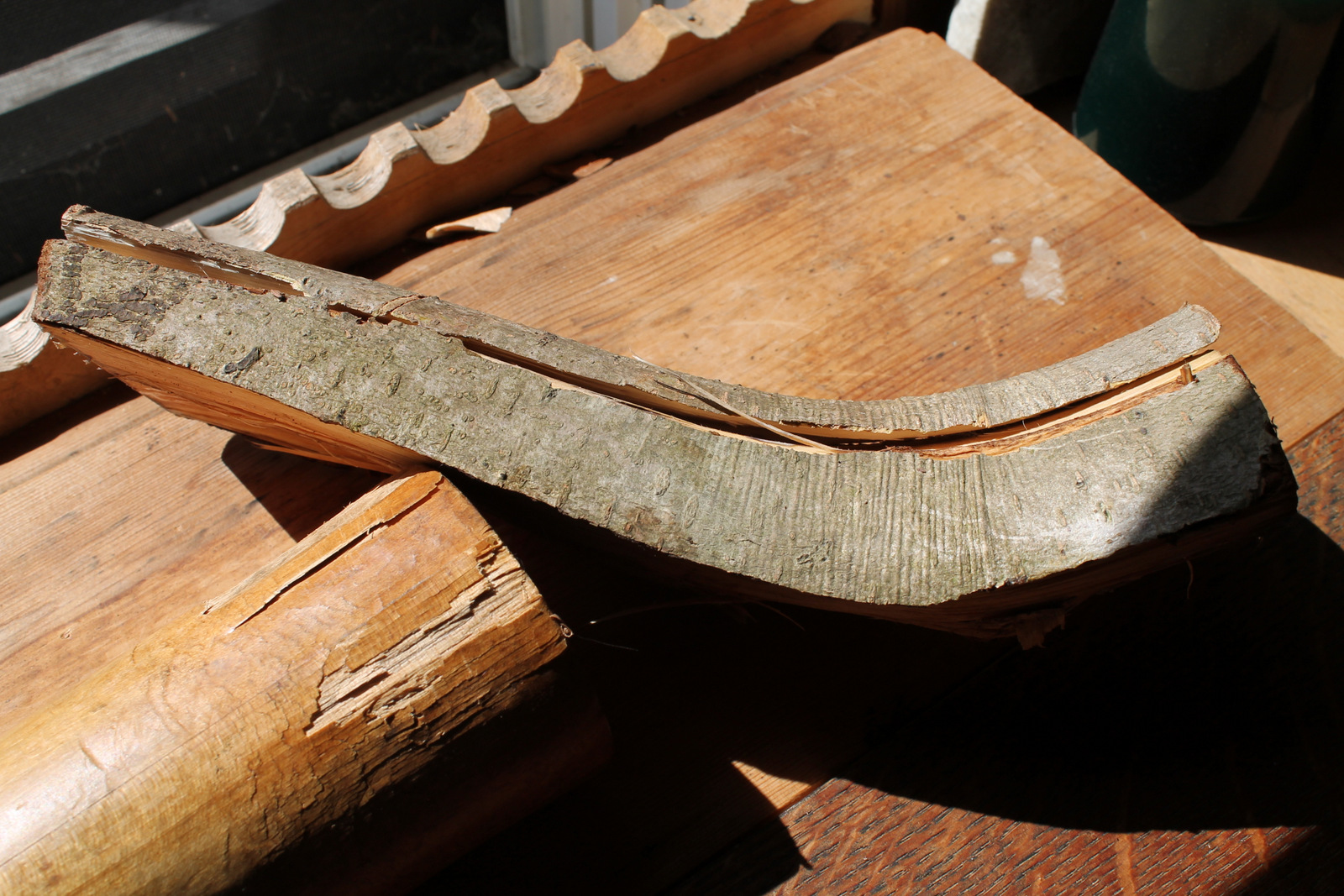
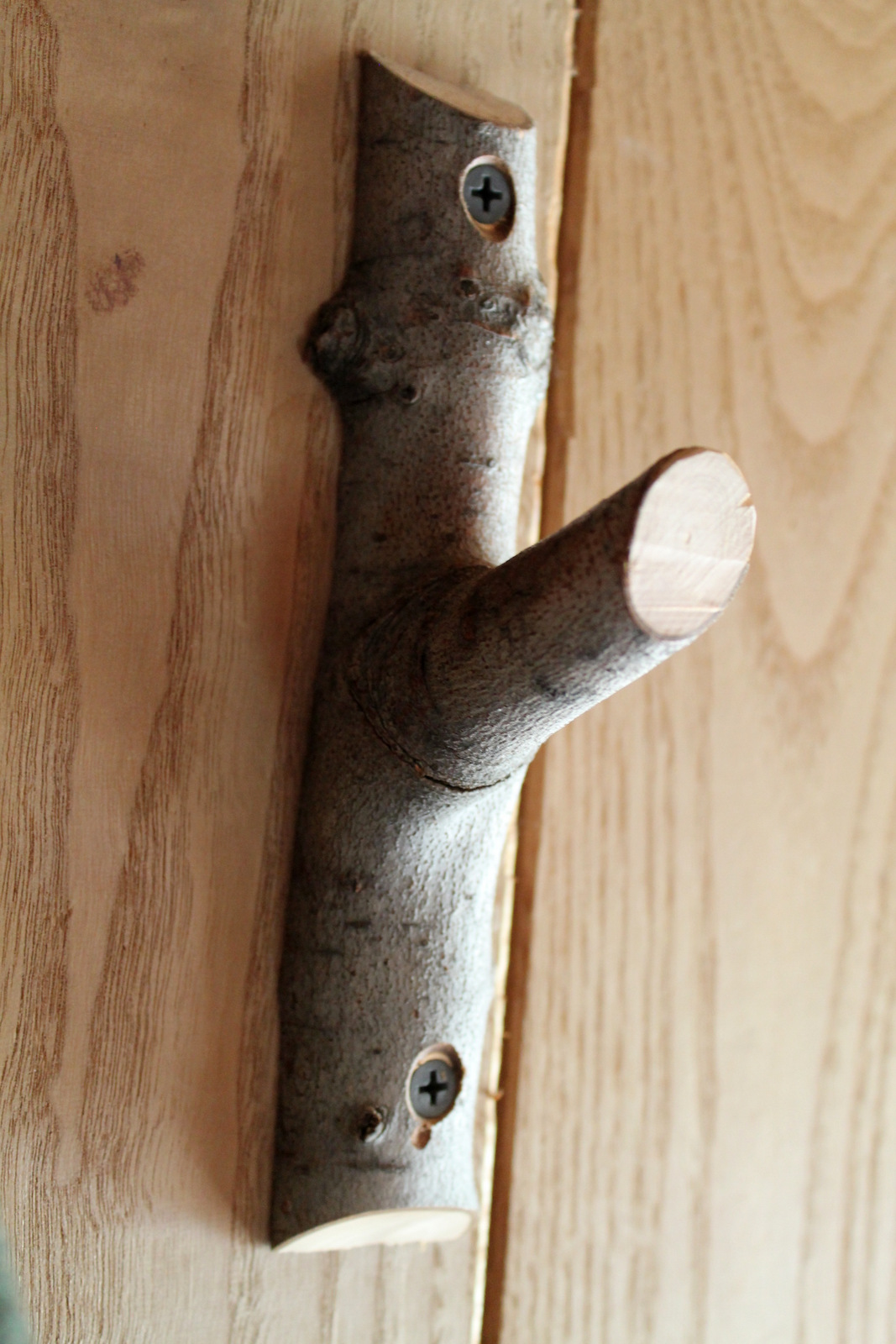
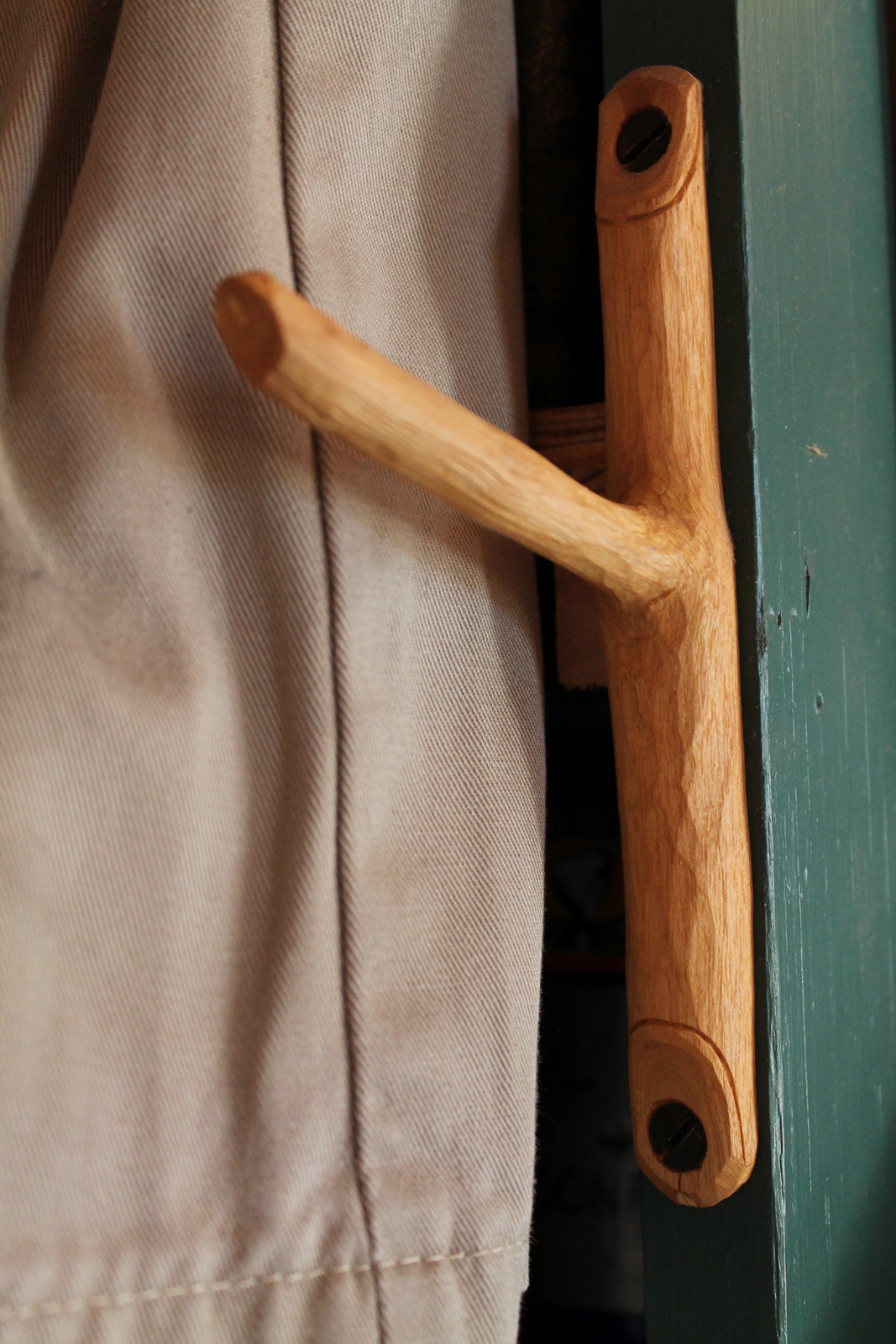
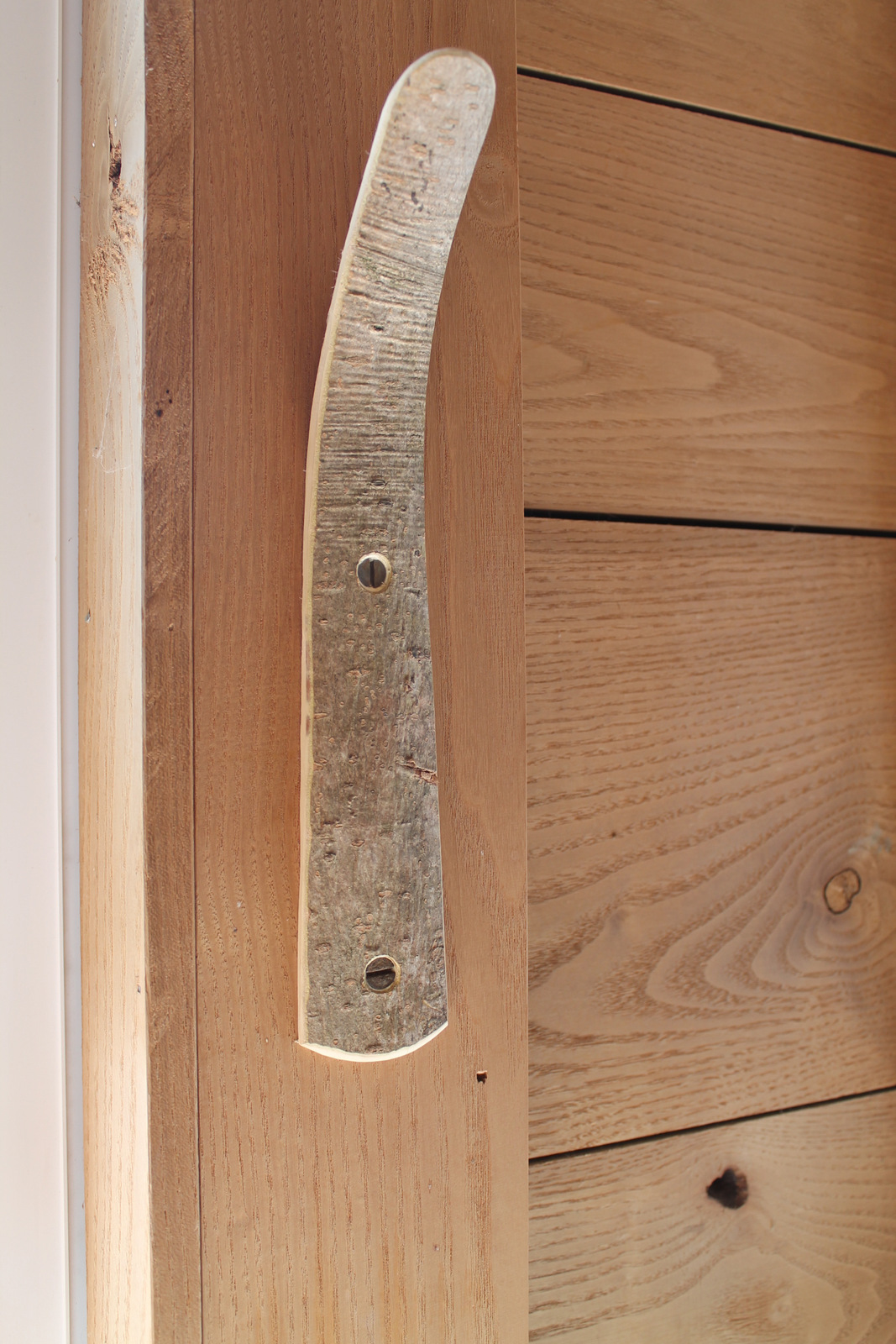
When splitting branch crooks for spoons, I often end up with a thin split from the upper portion of the crook. Sometimes such a piece may have potential for a smaller eating spoon, but I also like to use them for wall hooks. It is a quick and simple project; a fun diversion and also a great idea for working with kids.
Of course, a natural branch junction makes a good hook also. Below are a couple examples from my shop walls. The one holding my braces is an extreme natural curve. You can’t pass that up in a brush pile. I’ve seen photos of branch hooks folks have made with lots of funky shapes and painted colors. Lots of creative possibilities.
Making a hook from a spoon crook goes something like this:
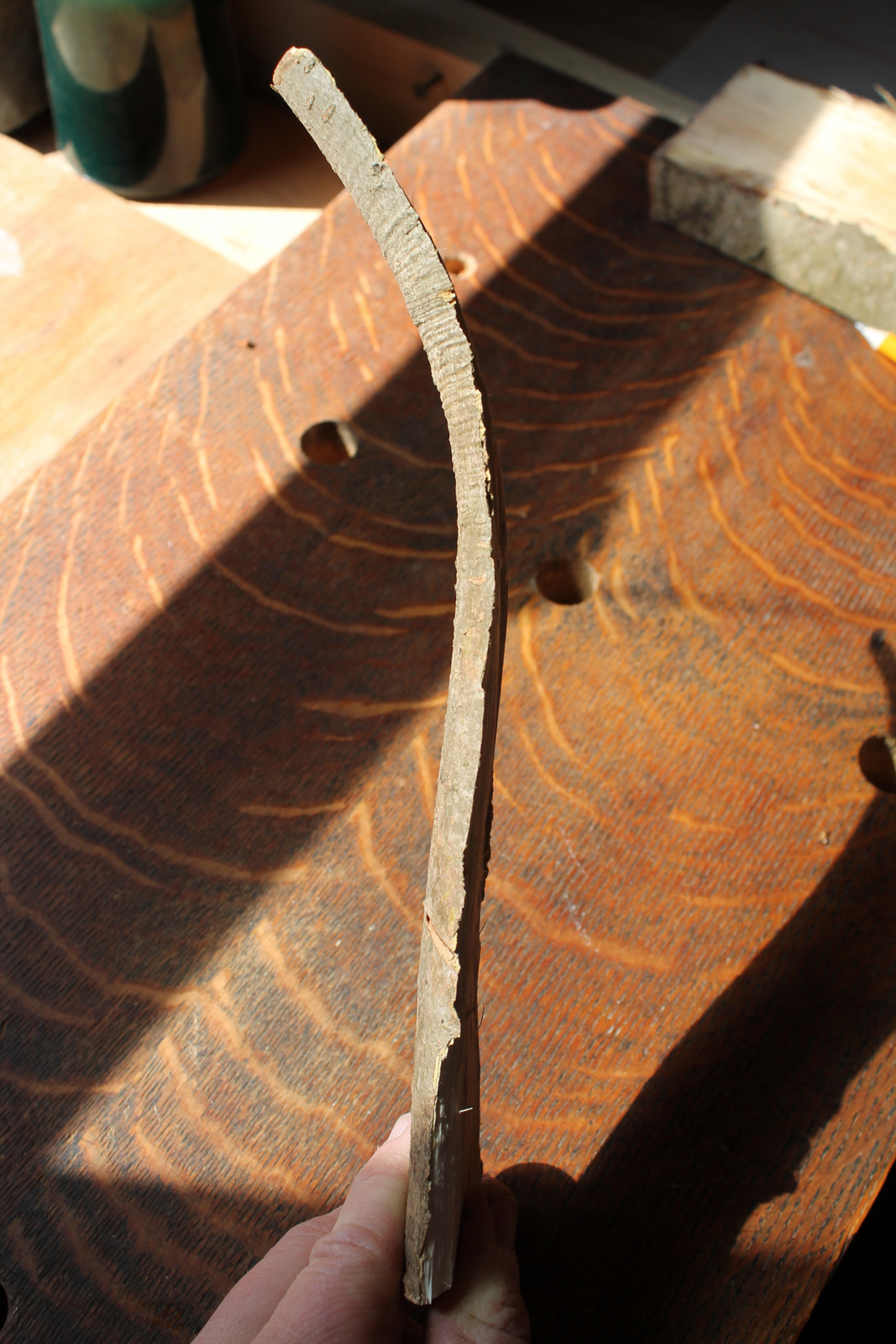
The crook has already been split along the pith (the bottom of the piece in this photo). Before further carving of the piece into a spoon, I split a thin crook from the upper portion.
The flat lower portion will go against the wall. I flatten the back further with a knife. A block plane could be used as well.
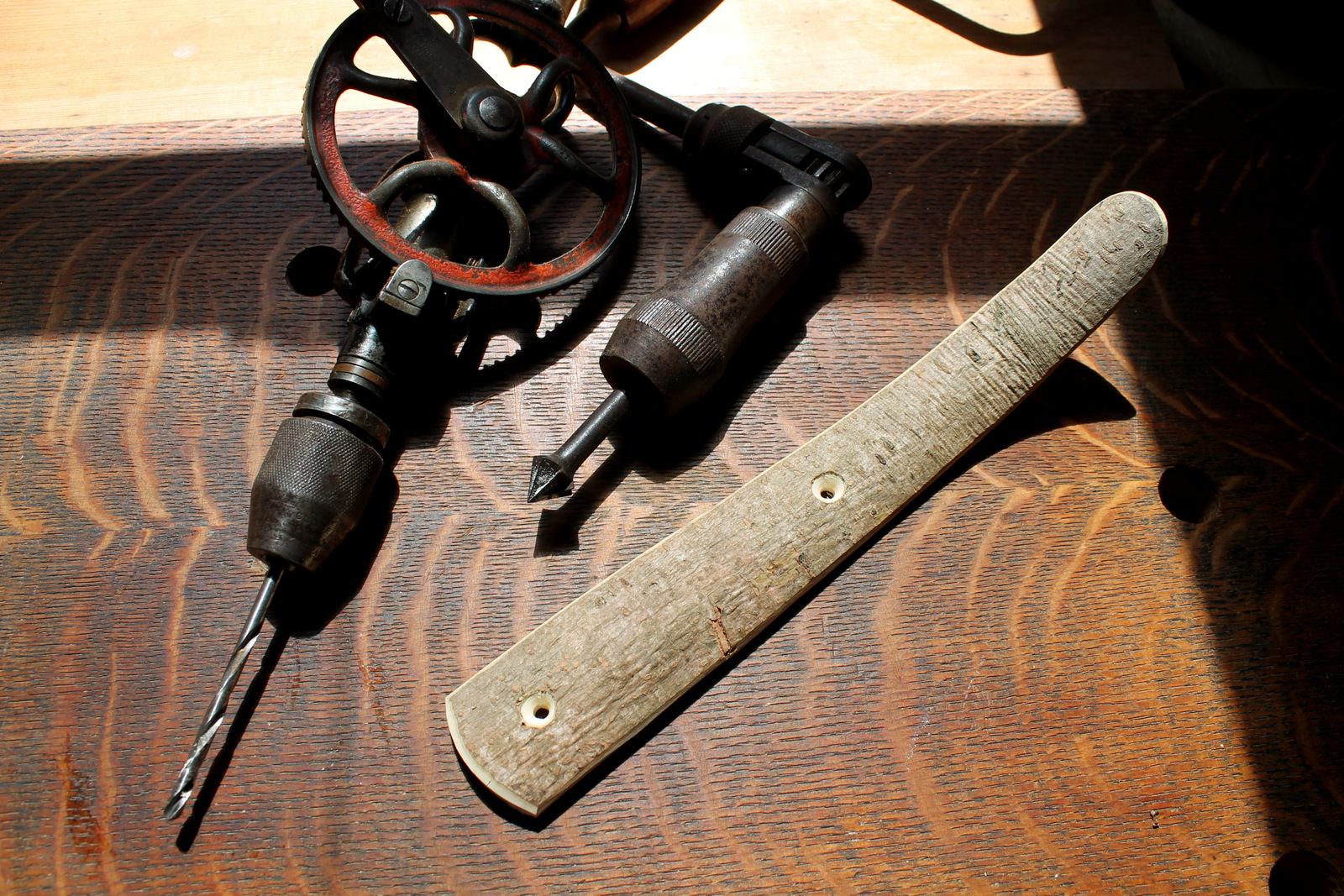
After a little shaping with a knife, I drill a couple holes as wide as the screw shank, then countersink for the screw heads.
With my “Bottoms Up” post a couple weeks ago, there was a comment/question about what I use to do the lettering and date. I thought I’d elaborate more on the answer in this post.
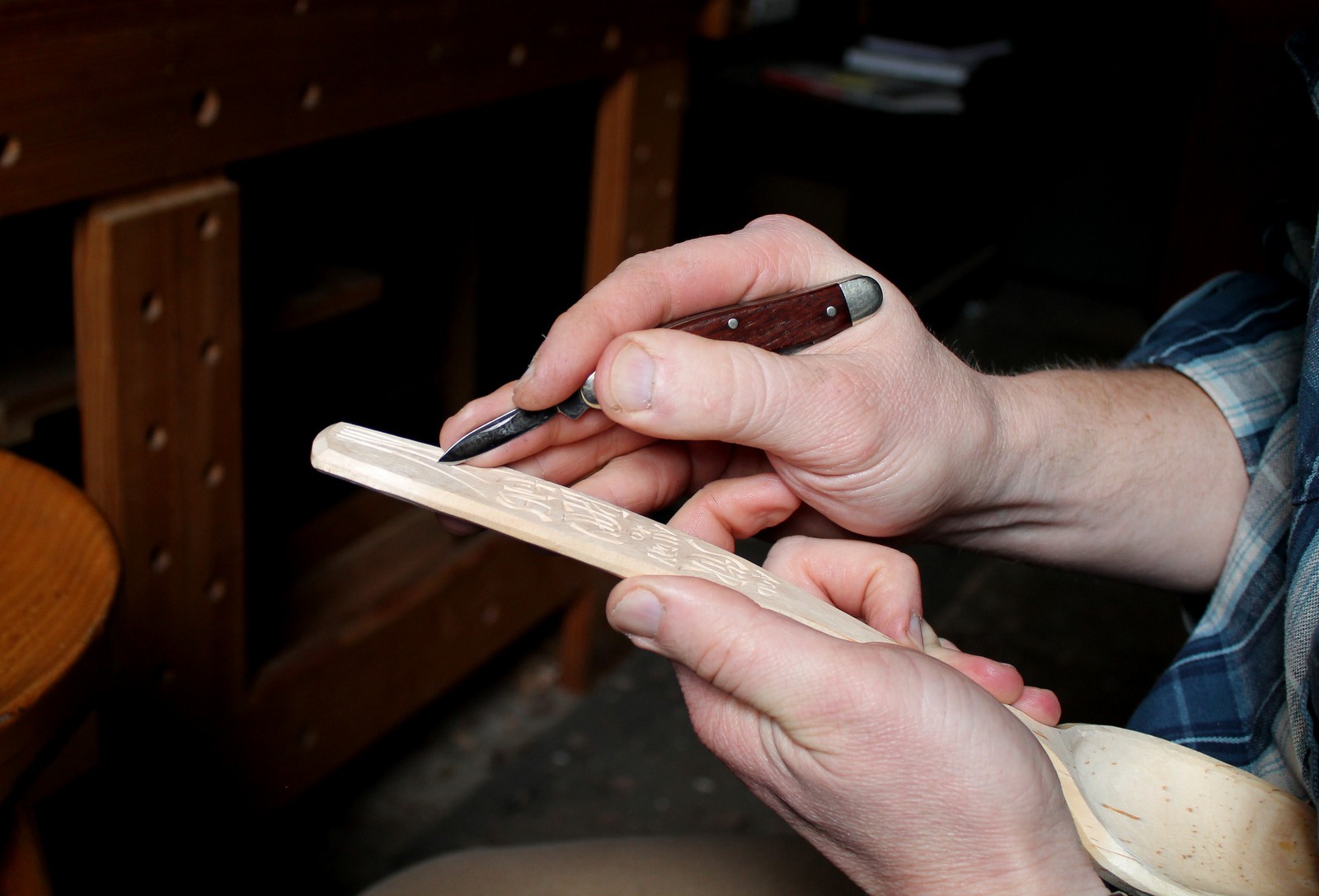
In the photo above, I’m using the grip and knife with which I do just about all small lettering and incised decoration, especially on spoon handles and bowl bottoms. Whether for the lines of a letter or a tree branch, the method consists of making two slanted cuts that meet at the bottom to form a v-cut. Sometimes I will vary the grip a little, raising the blade more for tighter curves. Regardless, I always pull the blade rather than push it. I use the movement of my shoulders rather than fingers to do the work, and the spoon moves as much as the knife. They are like dance partners.
Other knives will work as well, pocket or otherwise. I think the key is the slight curve at the tip of the cutting edge. This allows the blade to track more smoothly and ease out of cuts. I like the pocketknife because it fits right in to the outer web of my thumb and forefinger. My knife is 3 1/2″ long closed and 5 1/4″ long with the pen blade open. Plus, it is always right there in my pocket. The blade will not be sharp enough new. I reduce the bevel angle to a very fine edge, and strop it.
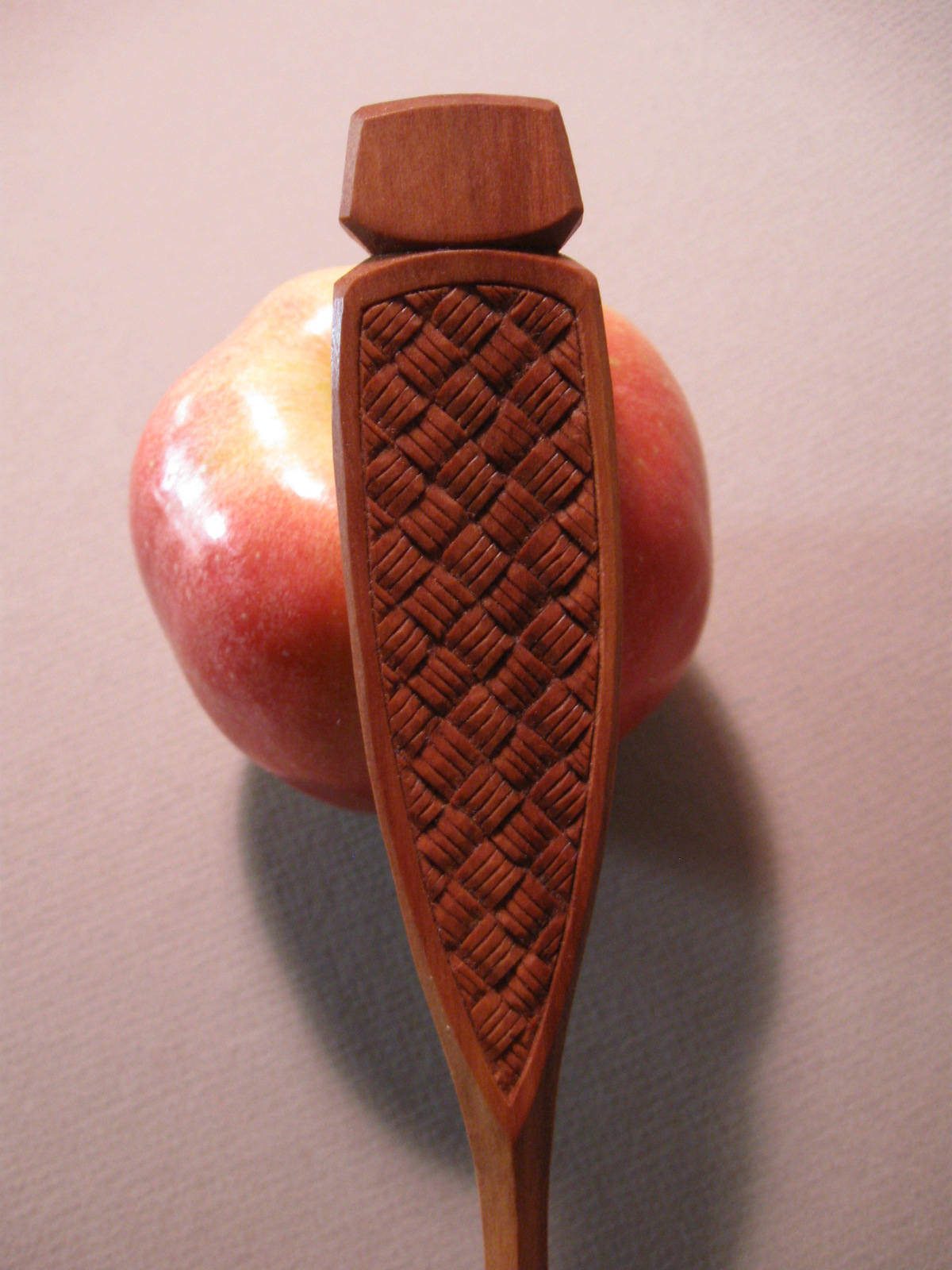
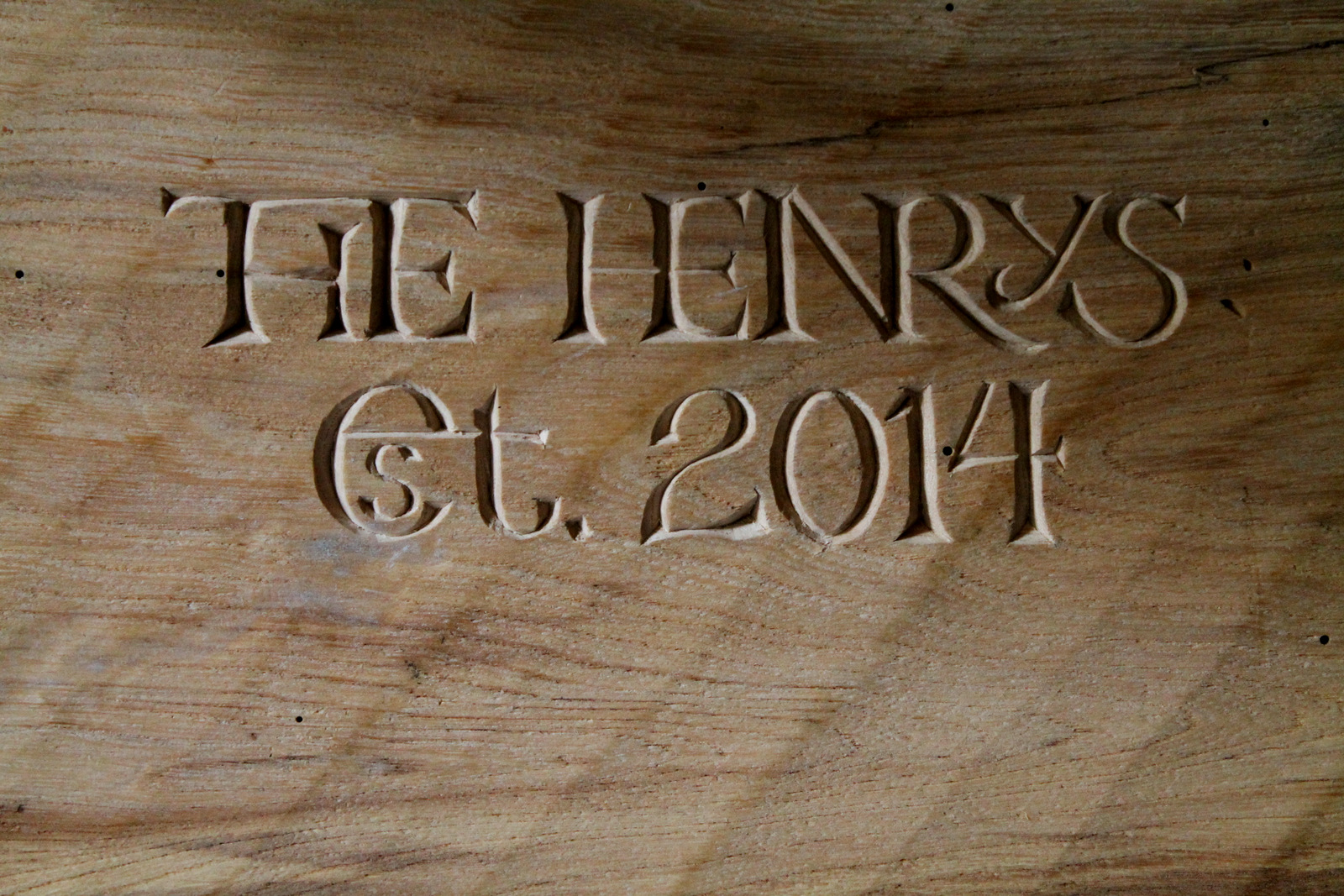
Here are a few examples of incised decoration and lettering I’ve done with that same knife. Click on the photos for an enlarged view.
For lettering that is a bit larger, I’ve been messing around with an adjusted blade in a utility knife. I ground a shallow curve into the thin blade then sharpened it (see the photo to the left). I can put more “oomph” behind this blade. I’ve included photos of a bench (elm seat, oak legs) that I made last year with the incised carving on the bottom done with the adapted utility knife.
For larger and/or more formal lettering, I usual use traditional carving chisels. Chris Pye wrote an excellent book on such lettercarving in wood.
The more I learn the more I realize how little I know. In our age of computer generated, machine cut inscriptions, artful lettering is often overlooked. This short video of a true letter artist, Martin Wenham, asks us to pause and reconsider.
Hewing a bowl with an axe and an adze certainly qualifies for what David Pye called “the workmanship of risk.” The risk doesn’t end when the axe is laid down. Anyone who is going to carve many bowls is sure to have some crack, but with a little foresight it shouldn’t occur often at all. I’ve got another one ready to dry…
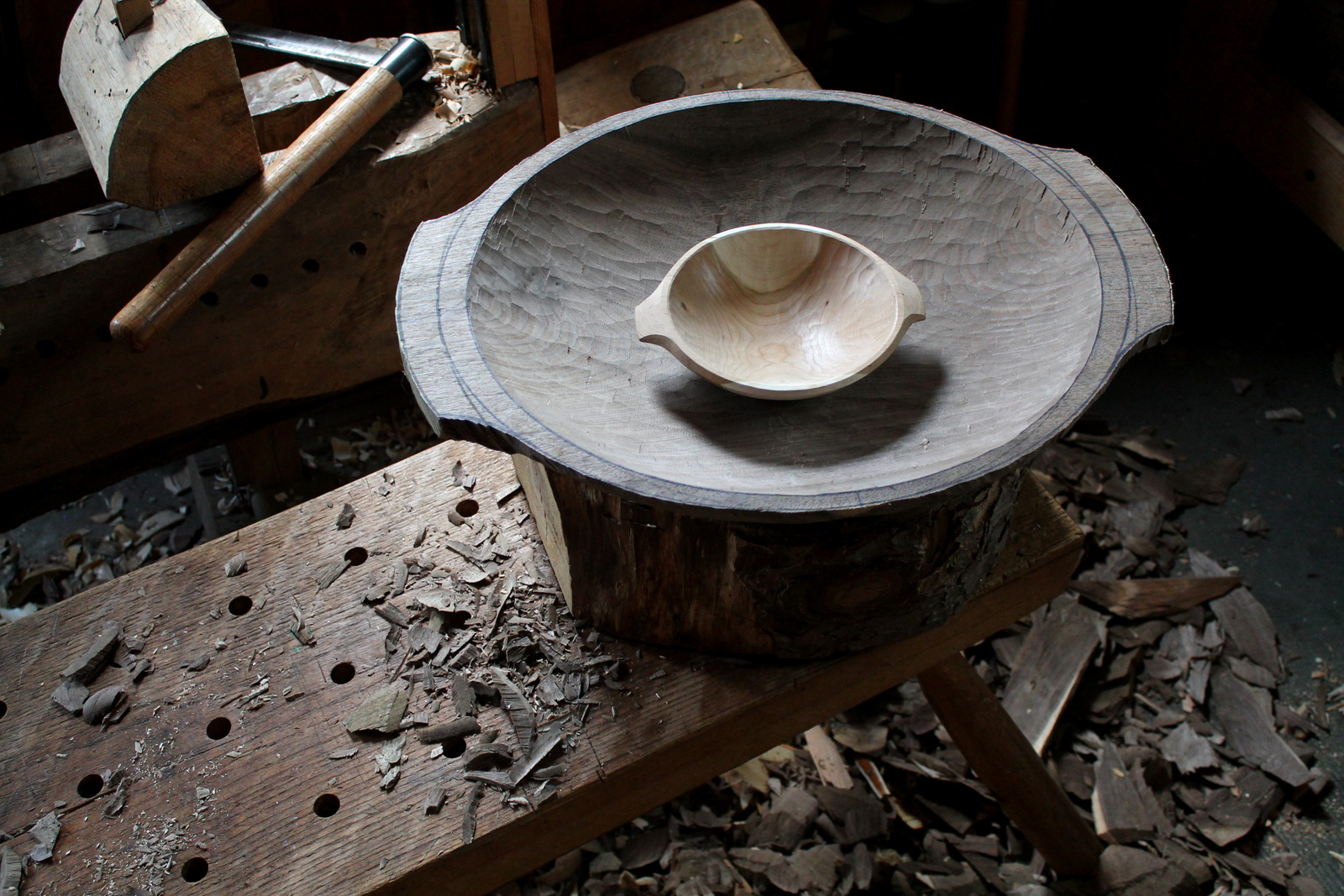
A couple days ago, I got around to hewing the 22″ x 17″ walnut bowl that I had laid out a while back. In the photo above, it sits drying after the adze and axe work. Inside it is a 7″ wide cherry bowl I just finished carving that gives a sense of scale. I have found that the most important steps to prevent cracking take place long before the carving begins. Here’s my crack (and crying) prevention procedure.
Before carving:
If I can’t use a log right away, I try to store it whole with the bark intact. Then you’ll want to seal the end grain to prevent moisture loss. You can do this with a product designed for that purpose, like Anchor Seal. Alternatively, you can use yellow woodworker’s glue or paint all of the end grain with two heavy (slopped on) coats of leftover latex paint. I keep the logs in the shade. I’ve used them over a year later in some cases.
When I’m ready to use a log, I start by cutting off a couple inches or so (depending on how bad the end checks might be) of the length from each end. I study the end grain intently. Any major checks may determine along what line I split the log in half. Even the tightest, smallest checks have to be identified because the bowl will crack along these lines of weakness as it dries. Sometimes small checks can be avoided without cutting away more log length by orienting the bowl in such a way that that area of the log will be carved away later.
Once I am happy with the check situation, I split the log to make sure the pith, or center, of the tree will not be in the bowl. Due to the differential between the amount wood shrinks along the growth rings compared to perpendicular to them (it shrinks much more along the growth rings, cracks usually project out from the pith.
Due to this differential shrinkage, a bowl that is oriented in the traditional fashion (bark down) will develop some degree of crown across it’s top as it dries and the top width will increase slightly. A bowl that is oriented bark-up will get slightly less arched and the sides will get a little closer to each other. For us carvers, this is no problem at all — let it move, and our tools freely follow the new shape (still symmetrical usually) as we make our final cuts after drying.
Some woods and conditions are more prone to cracking. There are lots of charts available that show the percent of shrinkage of various wood species, but there are many other factors such as the moisture content when harvested or a tree growing under tension on a hillside. I’ve learned a lot just by trying lots of woods and scenarios, but I still get surprised, and not always pleasantly.
During Carving:
If I have to pause midway during the green carving stage (whether for 10 minutes or a couple days), I always keep the piece in a plastic bag. I don’t want any drying to occur until enough mass has been removed from the log so that it can move as it dries without cracking.
Bulky areas are prone to problems. I think of it this way: even with the pith gone, a half-log will still crack on the ends because the ends are losing moisture much faster than the interior. When we carve a bowl, we reduce this differential greatly. If we get rid of enough bulk, then the moisture can escape more evenly and the bowl can move freely as it dries.
I try to make sure the thickness of various parts of the bowl are symmetrical, so that both sides move in the same way and dry at the same rate. Hands and eyes do the job.
After Carving:
I am in no hurry to dry a bowl, but I have found that drying too slowly (buried in wet chips, plastic bag rotation, etc.) can often result in mold or stains that go too deep to be removed in the final carving stage.
I will sometimes rub a bar of paraffin wax across the handle ends before setting the bowl aside for drying. This prevents moisture from escaping from the end grain of the handles as quickly.
I consider weather, humidity, and other conditions that might impact drying. If I lived in Arizona, I might have to adjust my procedures! Absolutely, I keep a drying bowl away from wind.
Typically, as soon as I’m done with the green-stage of carving, I wrap the bowl in some textiles, like an old towel or bedsheets. This acts as a partial moisture barrier, slowing the evaporation of water. The thicker the textile, or the more wrap, the slower it will be.
You can check if a bowl has dried completely by weighing it on a kitchen scale over successive days. When it stops losing weight, that’s as far as it will go under those conditions. I usually just go by feel to know when I will do the final carving. Sometimes this is after two weeks of drying, often longer. I’ll definitely wait longer before hand planing the bottom flat.
A couple weeks in with no cracks and you’re home free. No worries after that.
Although I rarely have a bowl crack during drying now, it is the nature of this workmanship of risk. And besides, it may be an opportunity to try something creative:
(Apologies to Buck Owens and Ray Charles for the title of this post!)
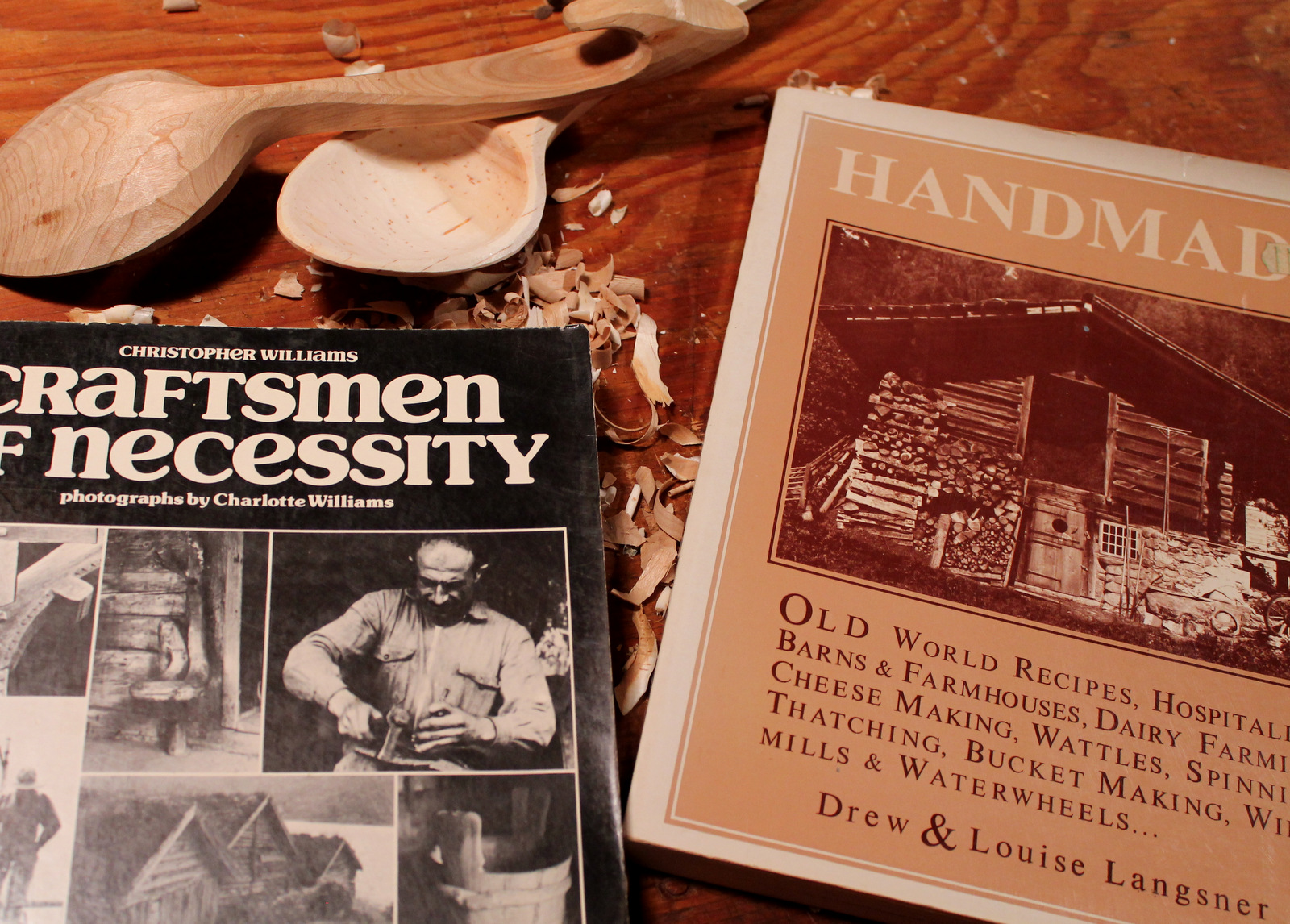
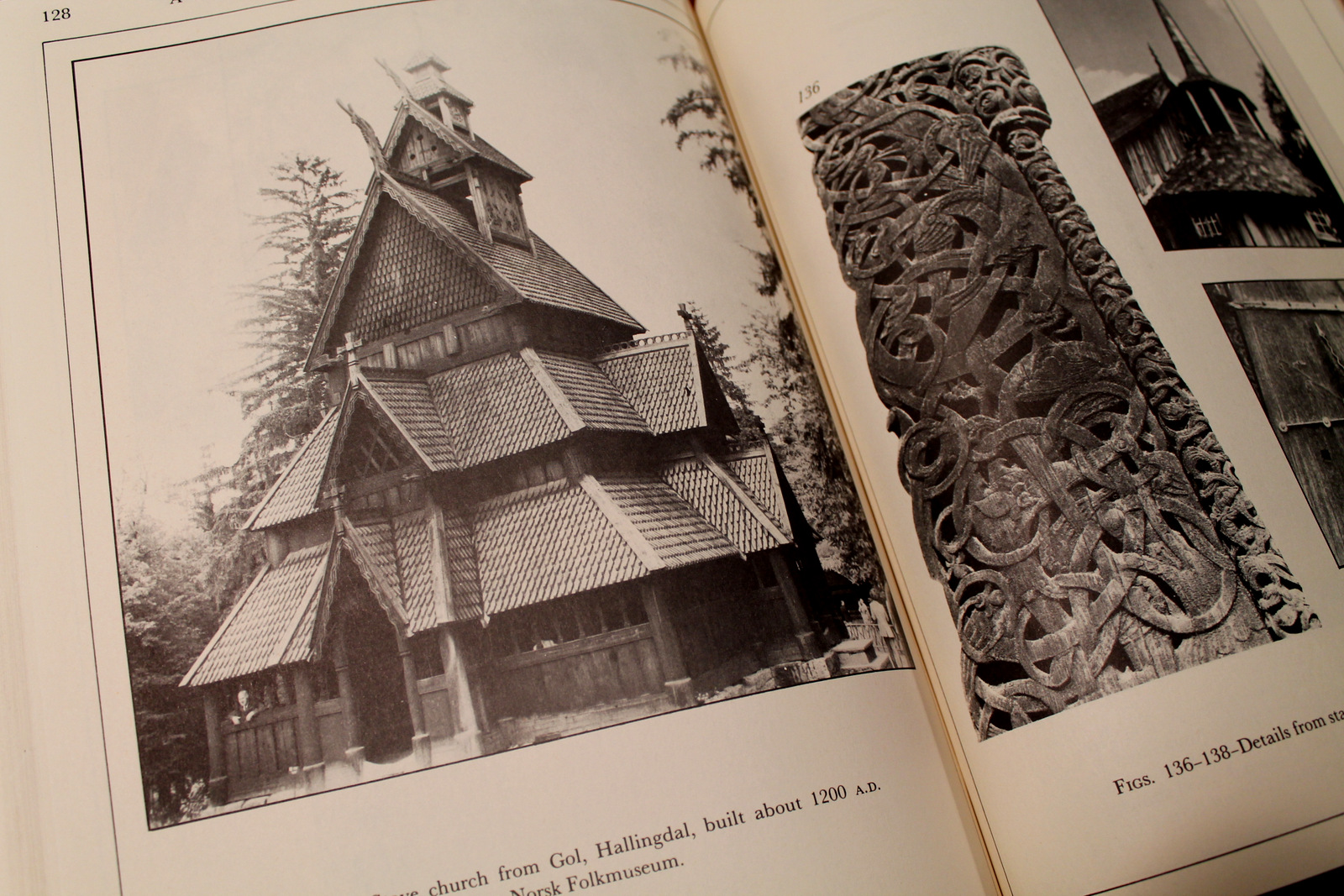
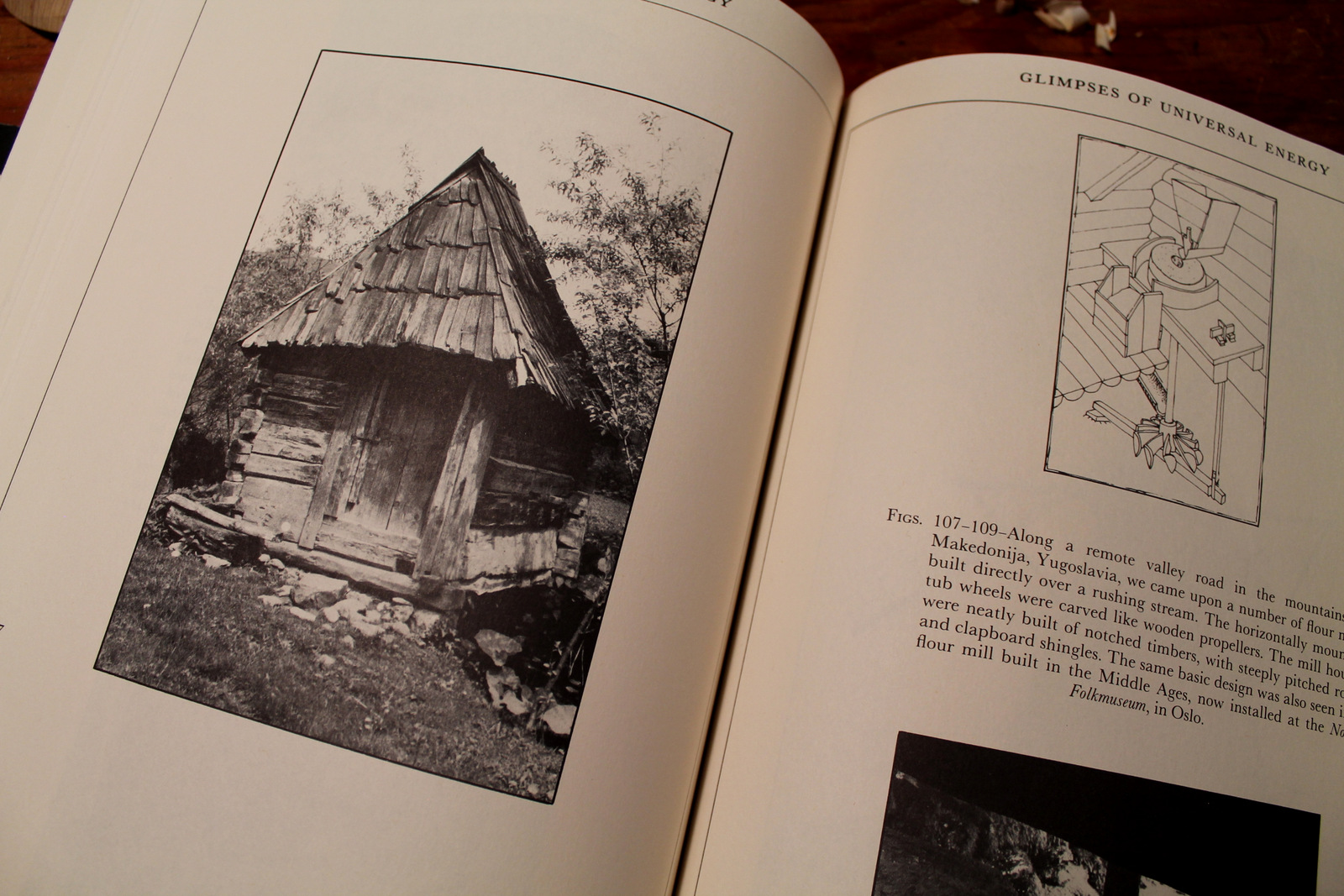
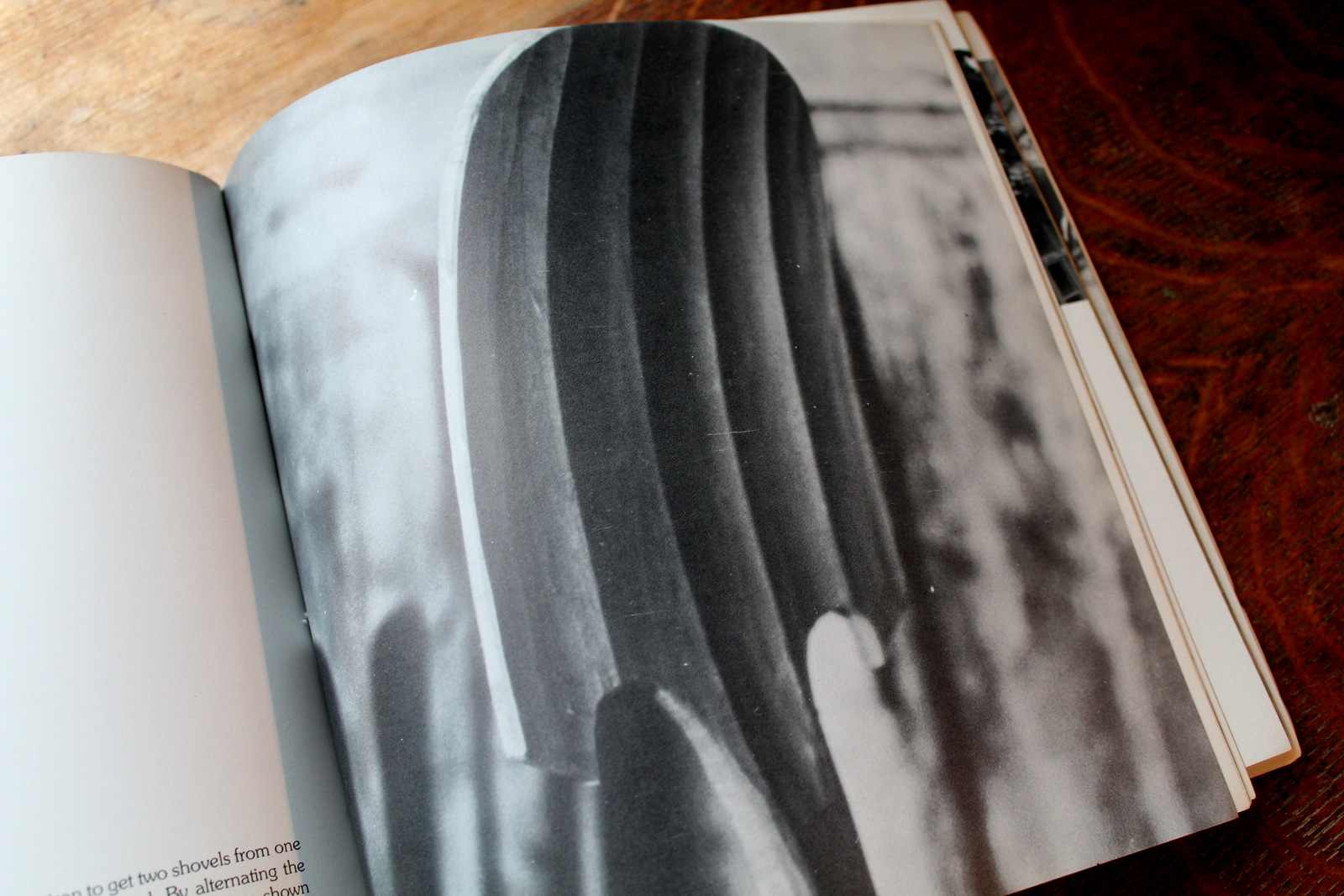
In 1974, I hadn’t yet learned to read. I didn’t know what I was missing. Two books with a similar theme were published in that year, and they are both gems. Both involve married couples traveling thousands of miles to explore the crafts and daily lives of vanishing cultures. They documented, through words and beautiful photographs, the way in which natural materials were used to sustain and enrich the lives of the people they met. These are books that inspire not only with their display of craft, but also with their deep respect for cultures around the world.
If I haven’t convinced you to consider finding an old copy, here are a few samples from each to entice you:
This is a journey to rural villages and farmlands, down dirt roads and up mountainsides, into houses of stone, adobe or wood that are the homes of the people of the land. Most important, it is a journey into their lives — we want to know how they live, what grows in their fields and gardens, about their barns and kitchens.
— Drew and Louise Langsner, Handmade (1974 – Harmony Books)
The work of most artisans is a total involvement of mind and body. Many have found that two hands alone are not enough. They use as much of their bodies as possible.
— Christopher Williams, The Craftsmen of Necessity (1974 – Vintage Books)
So….time for me to put on some Jim Croce and revisit these books.
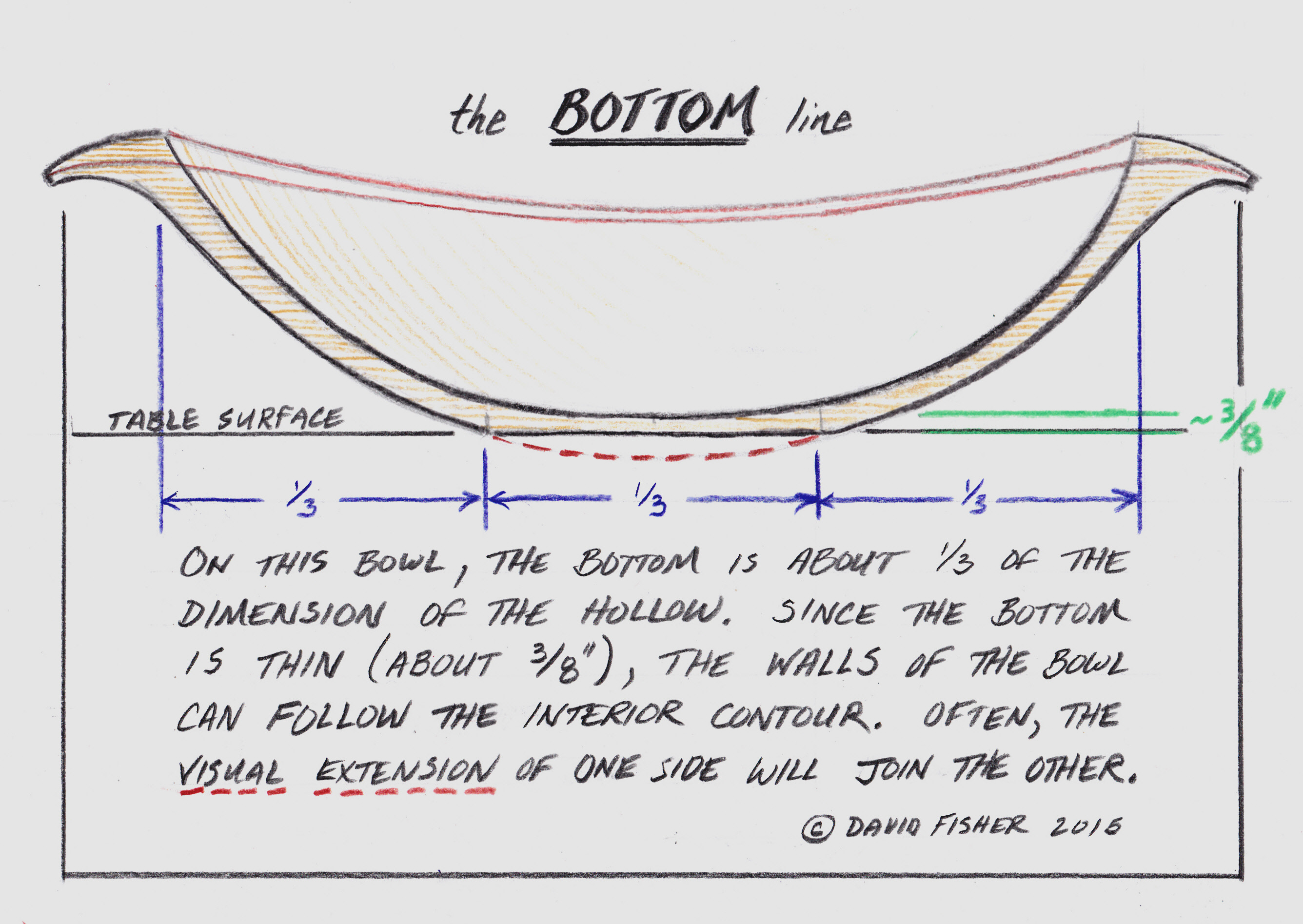
It’s time to think about bottoms. After all, your bowl is going to spend most of it’s life resting on it, and it is an important design consideration. You can even add some fun designs. Folks might even smile when they look at your bottom.
I’ve done a little drawing to express some thoughts on “the bottom line.”
I adjust these guidelines depending on the situation, but one constant is a relatively thin bottom. The long grain on the bottom allows for this, and it can be thinner yet on small bowls. Of course, too thin and you have a strainer, so there is no need to push it. If I plan on carving a design of some sort on the bottom, then I leave a little extra.
The flipped-over cherry bowl in the top photo is my most recently completed bowl. Here it is in profile. I just posted it and another bowl to my website. I made a short YouTube video of carving the leaf design on the bottom. Just enough to get the idea, but really a pretty simple carving.
I didn’t film the rounding over of the outer lobes of the leaves. It is done with just a straight carving chisel to form a convex shape. The inner lobes are concave.
The question of measuring beauty — that is objective assessment beyond “Very nice,” “Exquisite,” “This appeals to me” — has troubled scholars and other laymen at least from the time of the Greeks. And, beginning with the Greek philosophers, there has been widespread disagreement.
— The Golden Mean: Mathematics and the Fine Arts by Charles F. Linn (1974)
The golden mean, the divine proportion, the golden rectangle; whatever one calls it, the argument goes that the ancients discovered a ratio that was a key to beauty. Simply put, it describes the ratio between two components (e.g. width and length) so that the shorter is to the longer as the longer is to the sum of the two (S:L=L:S+L). This works out to a ratio of 1:1.618. Of course, they had to get over the fact that it is not a whole number. Neither is pi, but irrational as it is, it comes in pretty handy.
Today it is still used to varying degrees by architects, designers, even plastic surgeons. Heck, even Donald Duck knows about it:
If you’d like to dig way deeper into the golden mean, the Fibonacci sequence, mathematics in music, patterns, and more, pick up a copy of Mr. Linn’s little book (quoted to open this post). He shows a great sense of humor and makes a potentially dry subject pretty interesting. To the left is a page that he uses in an experiment, asking people which building proportion they prefer.
Linn says the majority pick the bottom one, 5:3 (or 1.6:1), the closest of the four to the golden proportion. Still, he is skeptical of folks that want to, in hindsight, find the divine proportion lurking in everything the ancients built. In fact, he presents a rebuttal of such an argument regarding the pyramids.
So how does all of this apply to bowls, and what is that thing with the bowl in the opening photo? The walnut bowl in that photo is one I just made, an ellipse with a length and width purposely laid out according to the golden proportion — the first time I’ve consciously done so with a bowl. I got so caught up in the idea that I even made a simple proportional divider — two sticks of equal length with a pivot point connecting them. In this case, the pivot point is positioned at a point that divides the length into a 1:1.618 ratio. Whatever width they are opened to, the golden proportion exists between the wider end and the narrower end. The same can be done for any ratio by placing the pivot point at the appropriate spot.
So…the bowl is nice. However, to be honest, it doesn’t seem to me to have a magical attraction. It is not glowing with a golden radiance. Besides, the only way to view it from a perspective that reveals this special proportion is to position one’s head directly over the center of the bowl. How often are we viewing any building or cabinet from the perspective that indicates it’s perfect proportions? Or maybe things with good proportions look good from any vantage point. And, with a bowl, do the handles count?
In this photo, the walnut bowl is on the right (not yet complete) and a nearly finished cherry bowl is on the left. The outside of the walnut bowl is done to the golden proportion, while the outer dimensions of the cherry bowl are in a 2:1 ratio (which occurred by accident). However, that includes the handles while the hollow form seems to grab the eye’s attention more. And the hollows are different shapes, colors, etc.
Proportion is just one element in the design of any piece — bowl, furniture, figure, or other. With bowls, the lines of a piece are as important, probably more. I have made bowls of all sorts of proportions from round (1:1) to another 40 inches long and 10 inches wide (4:1) and all sorts of proportions in between. I just laid out a bowl on a walnut log over the weekend. It will be 22 inches long and 17 inches wide. Why? Width: because it grew that wide and I won’t waste any of that wide dark heartwood. Length: because there were branches above and below, plus any longer and I might not have been able to carry it! It is up to me to come up with a good design within those dimensions. In that way, designing greenwood bowls is different from designing furniture.
I think the golden proportion, or any proportion, can be a useful guide. I realized after making many bowls, that the size of the bottoms I laid out by eye tended to be at a 1:3 ratio to the size of the top hollow. So now I know I like bottoms with a certain ratio (I think there is a song about that). In some cases proportions might even be essential or at least very important — as in painting a realistic human being.
Rather than suggest that there is one ideal proportion, George Walker and Jim Tolpin focus on methods of finding pleasing proportions using simple, whole number ratios. Their book By Hand and Eye is a fascinating and enlightening look into all of this stuff and more. They explain how to put proportions to work!
So, how important is the golden proportion? How heavily was it relied on in the past? Do all pretty faces display it? I don’t know, but I find it interesting. More important, I think, is to trust intuition. Trust your eye. A knowledge of proportions can help one to recognize why he finds something beautiful, but I think, I hope, that it is unrealistic to discover a conclusive formula for beauty. And a little mystery is nice too. I’m not about to approach a wooden canoe, a songbird, or my wife with calipers. Besides, only the canoe would cooperate.
The Grass so little has to do –
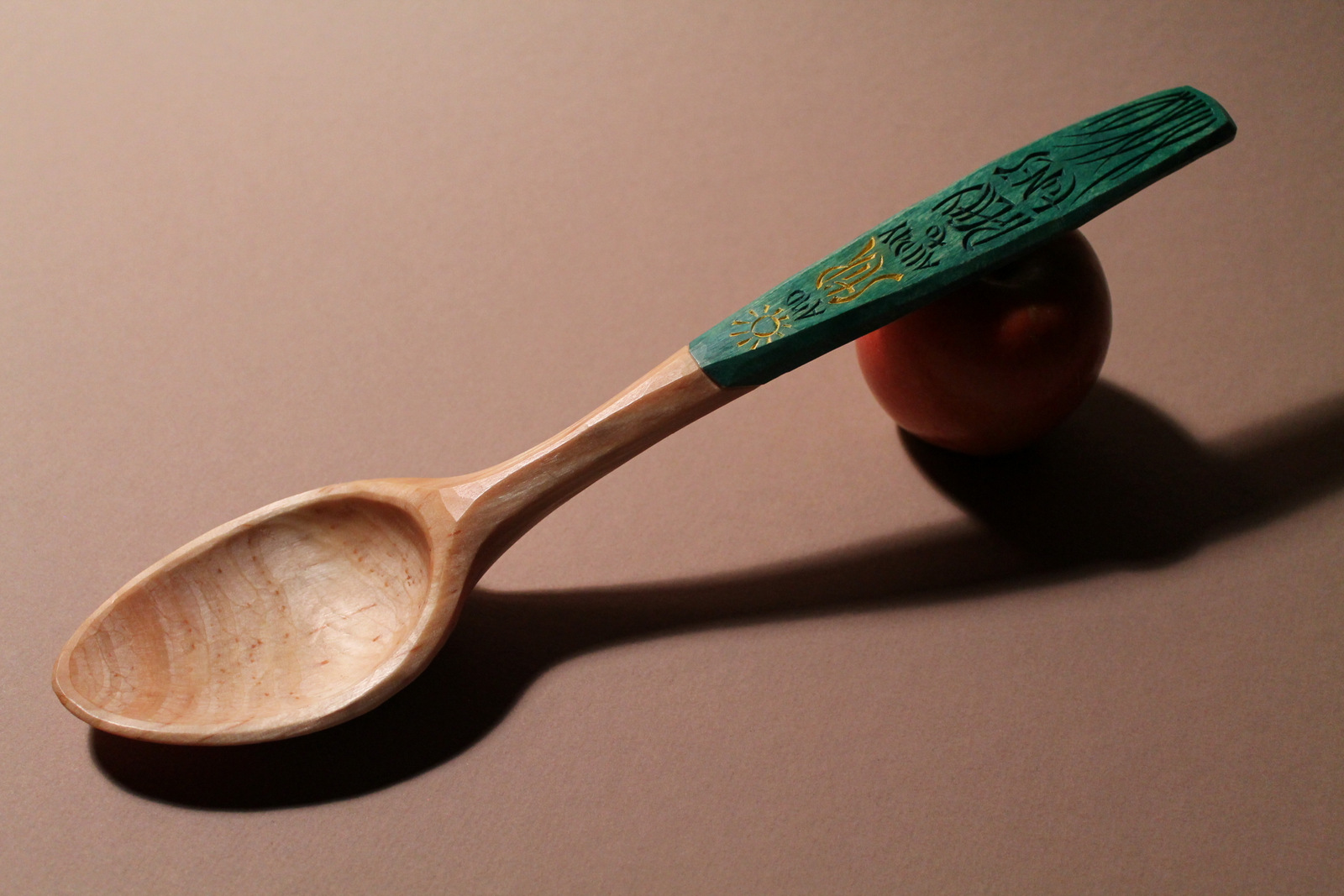
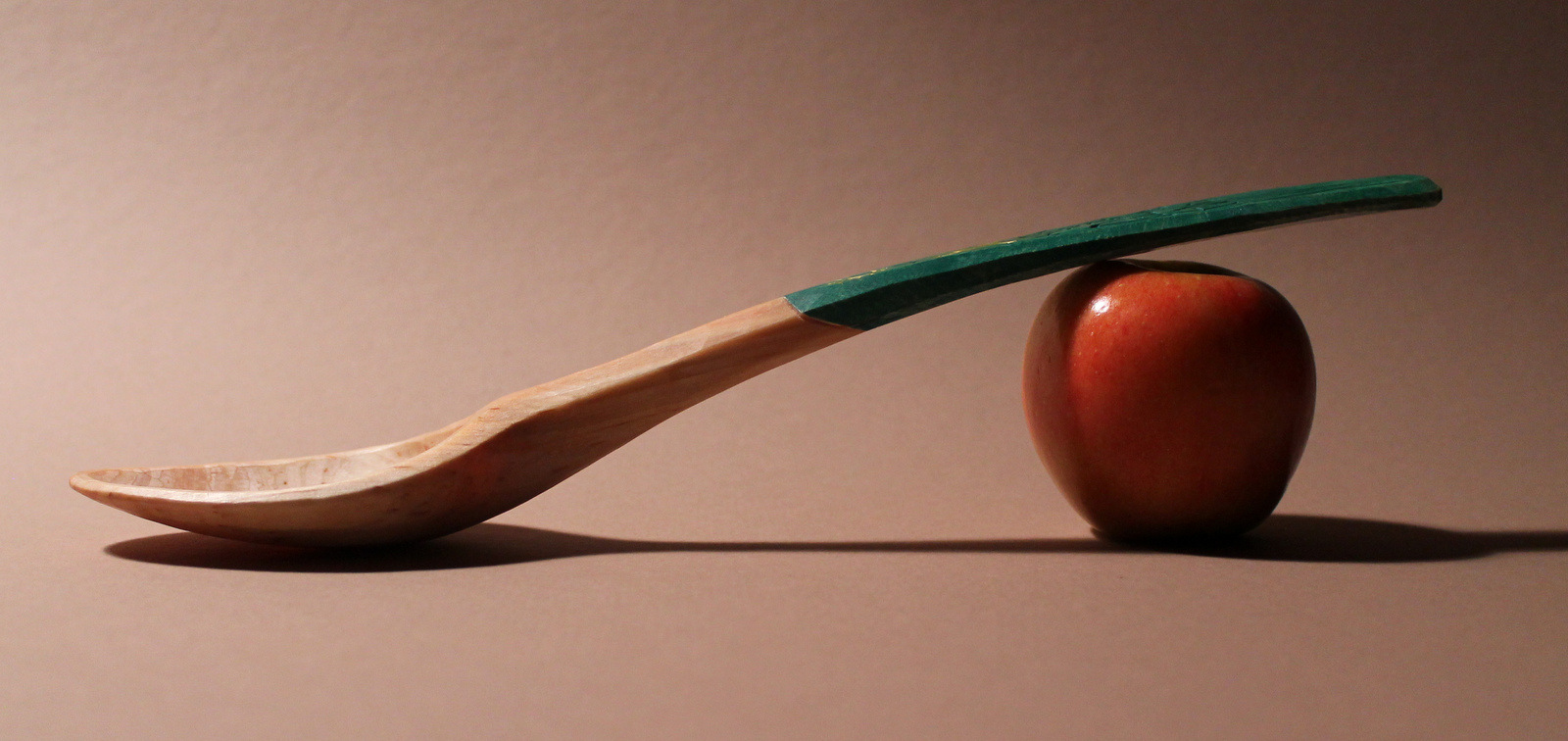 Spring has inspired me to be a little colorful, like with this birch spoon I’ve just finished. After carving the words, I diluted some mixed artist’s oil paints with a little citrus thinner and applied it to the handle like a stain. The letters naturally appear darker. After that dried, I painted the sun and “stir” with a golden color. Once dry, the entire spoon was soaked in flax oil for a couple days.
 I’ve experimented with different types of paint. There is something unique and versatile about oil colors, and they hold up well in use. I’m not concerned with any potential toxicity in some pigments, as I only use them on surfaces not really in contact with food. A beginners set of small tubes is reasonably priced and will go a long way. Any color can be created through mixing. Thinning allows the wood grain to show through and increases penetration into the wood.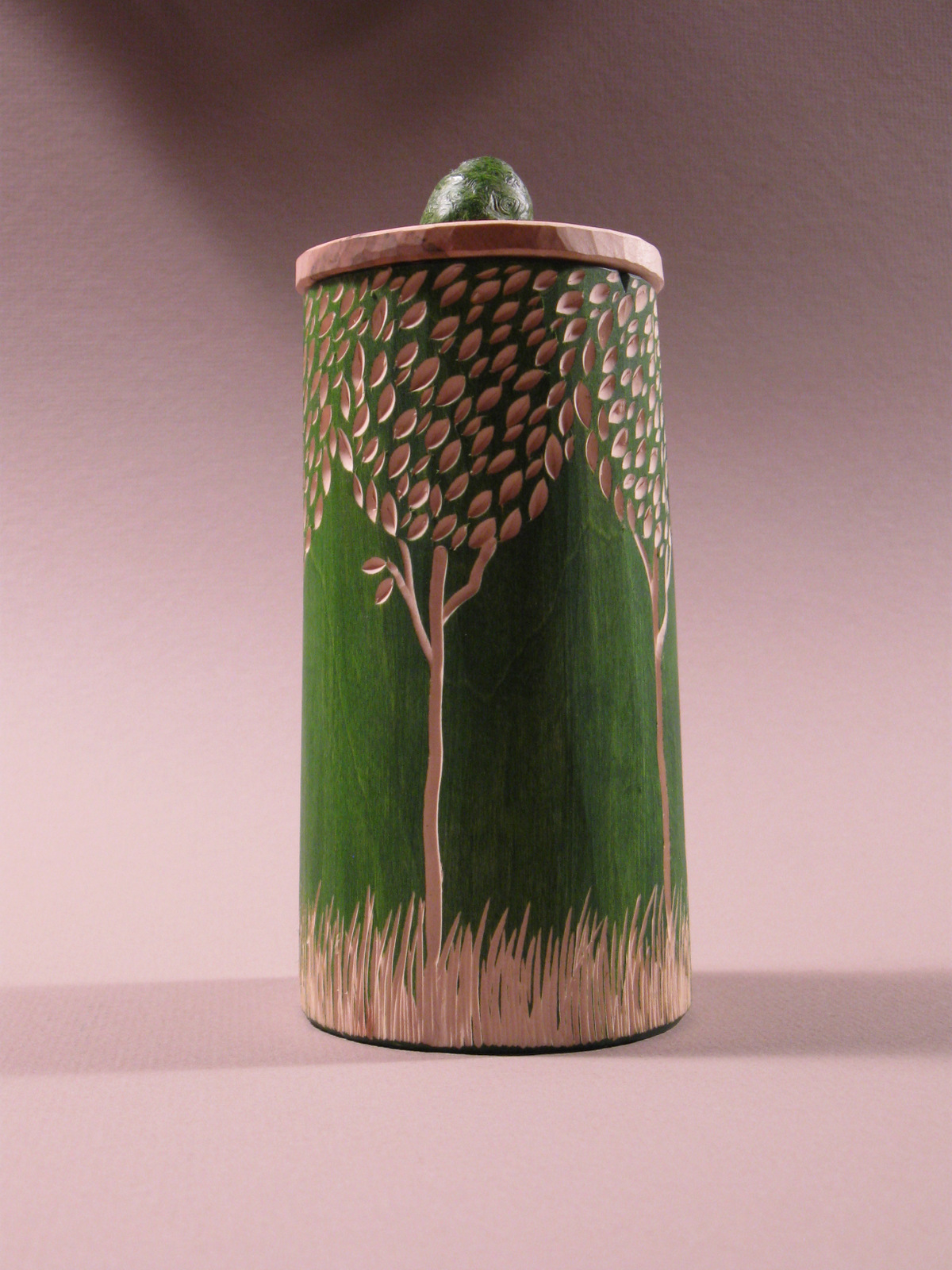



















 David Fisher, Carving Explorations