Travisher

img_0732-001

I’ve briefly mentioned the idea of using a travisher on bowls, in this post for example.  The travisher in that post was one I had made years before using a blade that I purchased from Country workshops. I used it for the occasional chair seat and for other tasks.  It’s the one at the top of the photo below:

img_7748-001.jpg

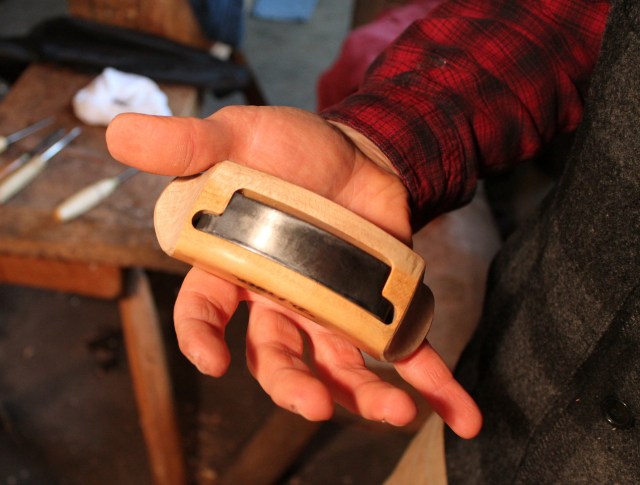
The travisher below it in the photo is one that I purchased from James Mursell’s website.  I found that it had some great features.  Two deeply recessed set-screws hold the blade firmly in position.  The shavings exit the top rather than the back, allowing for thumbs to be placed on the solid wood behind the blade, great for control and comfort.   The tighter radius (about a 4 1/2″ radius) made it more versatile than my other travisher.

Still, there were some aspects of the design that made it difficult to use for bowls — which is no surprise, since it wasn’t designed for that use.  I experimented and made some important modifications to the body that made it more ideal for bowl shaving.  I’ll show you what I did below.  Pretty simple, really.  By the way, I have absolutely no connection with James Mursell.

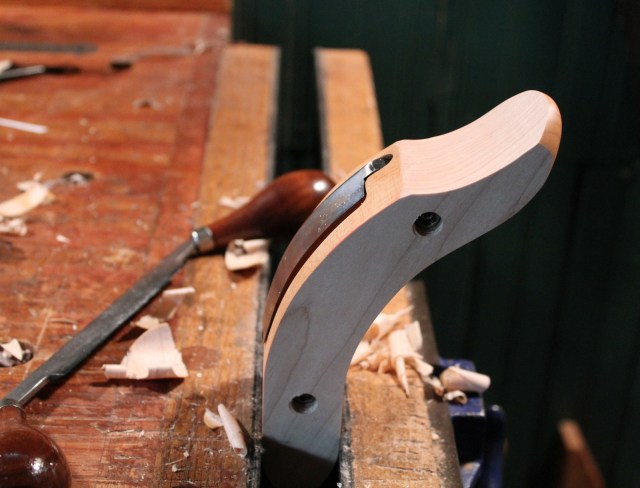
Notice the red line I drew on the travisher in the photo above.  Trim the sole back to the red line, leaving about 1/2″ of sole in front of the blade.  The set screws are recessed deeply enough that they’re not affected at all.  In the photo below, that has been done.
img_7751-001

Above and below are two different views of the handles after I shaved recesses to either side of the blade.  This allowed my ring and pinky fingertips to fit under the handles which also helps with control.

img_7753-001

The last step is to round the sole in front of the blade down to a line about 1/8″ or so above the existing toe (see the pencil line in the photo below).

img_7754-001.jpg

You want a gentle arc from the existing wood right in front of the blade down to the pencil line.

img_7755.jpg

I used a finely set spokeshave, but a rasp or block plane would work as well.

img_7756-001

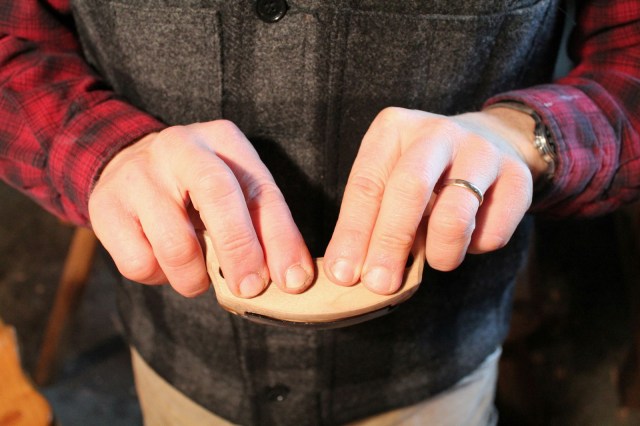
Here’s how I hold it in general.  My thumbs are pressing on the wood behind the blade.
img_0731-001

You certainly don’t need a travisher for carving bowls, and it’s really off limits for some bowl designs and sizes, but for general medium to large bowls it can be useful for fairing the hollow.  The compact size makes it pretty nimble and versatile.  I’ve used it occasionally as an intermediate step, but I suppose one could choose to leave the surface directly from the travisher.

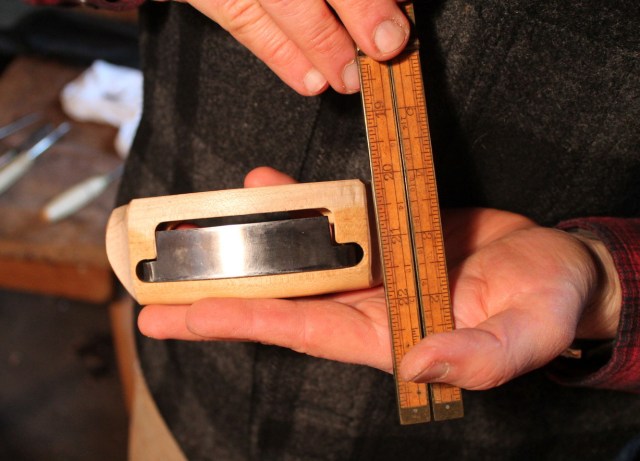
Here’s one final shot with a ruler for reference.
img_0735-001


Posted in green woodworking, tools, Uncategorized | Tagged , | 3 Comments

Noah’s Bowl

IMG_8537

After his first few days home from college for Christmas break, my son told me he wanted to carve a bowl.  Being in the workshop with him was nice and reminded me of many moments in the workshop when the kids were growing up.  Usually, the projects were spur-of-the-moment ideas that struck them; bows and arrows, boats, wooden swords, miniature stages for little ponies and the like.

And every so often, they’d pop in and help me with a project I was working on.  Attention spans tend to be short at that age — there are so many things to explore — so I never made the shop into a detention center.  Over the years, they’ve continued to investigate and discover their own interests and talents, from drawing to guitar playing.  Once in awhile they pop back in to the workshop as Noah did to really carve his first bowl, a gift for his mother.

IMG_8533

We worked with green tulip poplar, one good option for a first bowl.  We stuck to a form that allowed him to get used to the feel of the tools and the response of the material rather than become overwhelmed with a really complex design.  Still, the bowl has a nicely arched top and some undercutting beneath the handles.  He enjoyed it and made a lovely bowl that will see lots of use in our house over the years.  This tulip poplar log had a cool purple streak running through it that was a nice bonus.  The bowl is 16 inches long, 7 inches wide, and 3 inches high.

IMG_8725IMG_8726

IMG_8732The photos were taken after the bowl had dried in the open for over a week and had lost nearly half of its weight through water loss.  Now Noah will have to decide if he wants to go over all of the surfaces again with fresh cuts to refine the form and leave a more burnished surface, as I do. But he really took the time to leave nice cuts during the green stage and there was really no discoloration or anything during drying, so maybe he’ll just flatten the bottom with a hand plane and oil it.  IMG_8736

IMG_8542Wishing you all a 2019 filled with memorable moments in and out of the workshop.

Posted in bowls, drying, patterns, teaching, Uncategorized | Tagged , | 21 Comments

Feline Inspiration

IMG_8636

You can learn a lot by watching cats.  They are studies in elegant movement and sinuous lines.

Our cat, Mavis (named after a Thomas-the-Train engine), is sixteen years old.  Quick sketches of him appear here and there through my sketchbooks.  He always seems to be in a good pose that creates a miniature landscape of curves.  I suppose their natural fascination as subjects is one of the reasons cats appear in the art of many cultures going back to the earliest civilizations and that they continue to be popular models.

IMG_2735

Mavis doing his best “Sphinx” pose.


IMG_8626

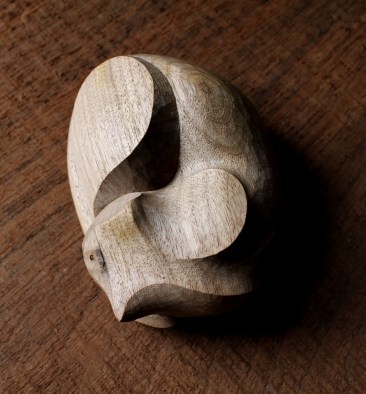
Buttternut cat viewed from above.

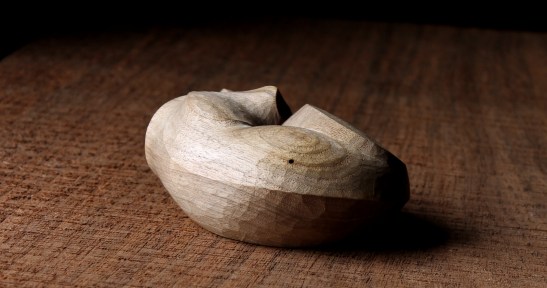
As a gift for my daughter, I carved a small representation of Mavis (or any cat) curled up sleeping.  I tried to simplify the form and translate it into a combination of curving lines and surfaces — a sculptural form much like a carved bowl or spoon.

At four inches long, this piece was sized well for holding in a hand while carving.  I used many of the same knife grasps that I use for spoon carving.  Most of the carving of this piece of butternut was done with a sloyd knife and pocket knife, and the surface is left directly from the knife cuts.  No oil had been applied yet when the photos were taken.

Just as with a spoon or a bowl, distinct facets catch the light or hold shadows.  And the effect changes when the piece is seen from different viewpoints.

IMG_8664

It seems to me that automobile designers consider these same things, putting a lot of thought into the lines formed where two surfaces meet and the effect of light.  Engines and horsepower aren’t really my thing, but I’ve always loved the image of the designer scraping away the clay from the car model, checking the surface with hand and eye.  A process that continues today as you can see in this short video.

I find it interesting how the tapeline is established on one surface as the important junction, then the adjoining surface is faired by judgement to the line.  I suspect that Charles Douglas carves spoons and bowls.

Anyway, this little diversion got me thinking, and, like every project, taught me a thing or two.  Mavis, by the way, couldn’t care less.

IMG_8558

Posted in carving, figure, patterns, proportions, Uncategorized | Tagged , , | 14 Comments

Norman Stevens

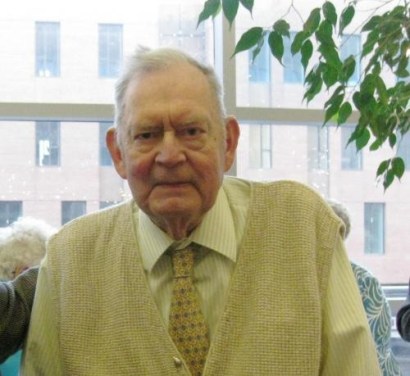
Norman Stevens

I received word last night that Norman Stevens died yesterday after a short bout with pneumonia.  Norman’s love and support for carved spoons began decades ago and continued right on through the current surge of interest in spoon carving.

Norman's Big Spoon

Norman Stevens.  Thanks to Norm Sartorius for both photos.

Norman joined us at Greenwood Fest 2017 to share some of the spoons from his collection, a collection that he continued to build upon, reaching his goal of 400 spoons not even a month ago.  Norman meticulously catalogued each spoon in his collection and valued the craftsmanship of each of the carvers to whom he reached out over many years.

In this post from 2016, I wrote about how Norman’s affection for wooden spoons began and how he had made arrangements to bequeath his collection to the Peabody Essex Museum in Salem, Massachusetts.

Norman continued to quietly support and encourage handcrafts in many ways, including his recent donation of many personal treasures to the September 2018 fundraising auction organized by North House Folk School to benefit the Wille Sundqvist and Bill Coperthwaite Slöjd Fellowship Fund.  Norm went on to work with North House this fall in order to make copies of Dan Dustin’s book Spoon Tales available.

So, here’s to a man whose passion and kindness touched so many others.  I and many others are grateful.

Posted in Persons, spoons, Uncategorized | Tagged , | 5 Comments

Back to Basics Bowls

IMG_8421

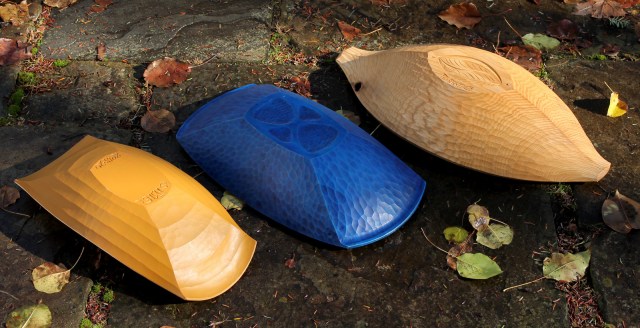
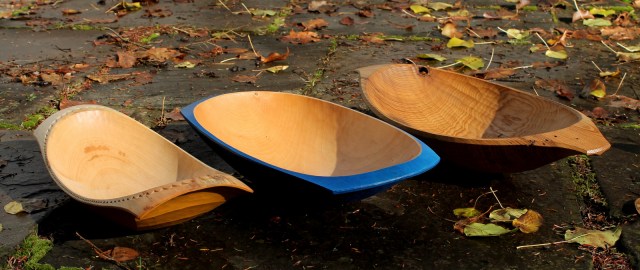
I’ve been wanting to have some bowls to keep around as examples of forms that are aesthetically pleasing, yet more straightforward in execution than other bowls I make.  One consideration is size.  These bowls range from 14-18 inches long, 7-9 inches wide, and 3-4 inches high.  That size and proportion is ideal for starting out with an axe and an adze.

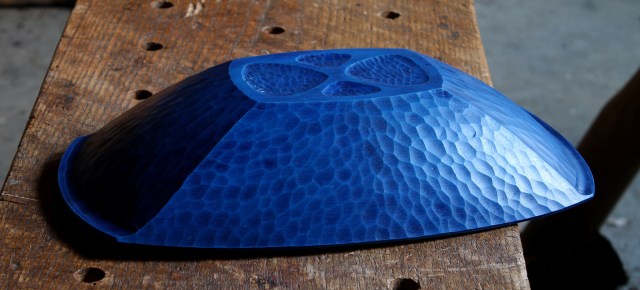
From left to right, these bowls were carved from tulip poplar, red maple, and sassafras.  Through a few other photos, I’ll share some thoughts on some of the design elements.  And the paint is just an option you could easily forego, but I had fun with it.  That’s just one example of the endless variations possible.

IMG_8435

IMG_8368

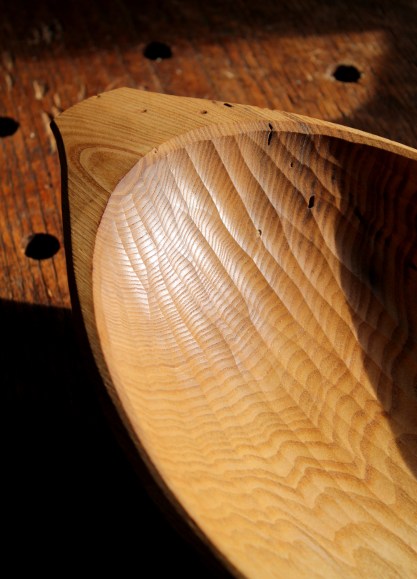
Using a relatively soft hardwood encourages bold, yet crisply cut surfaces.  The hollow was finished with paring cuts with a sharp bent gouge.

The open pores of sassafras aren’t ideal for a bowl used with liquids, but it would serve well as a fruit or bread bowl.

IMG_8366

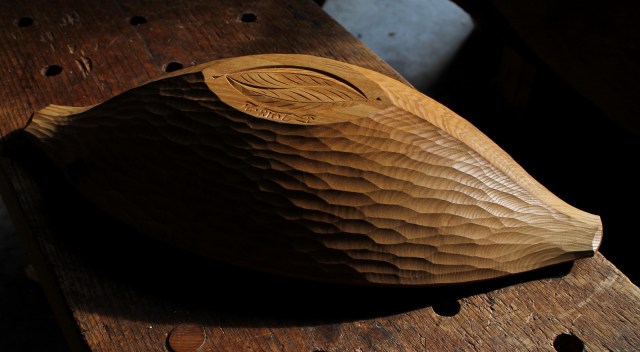
The shape of the exterior tapering down to the narrow handles makes for relatively simple axe work.  Decisive cuts with a gouge refine the surface and leave a distinct ridge flowing from the points at the end of the foot through the ends of the handles.  Very few tools are needed; Even the leaf design on the foot was carved with just a knife.

IMG_8306

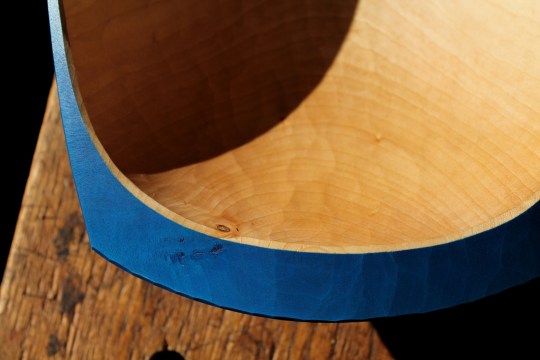
The sides of this blue bowl flow to the corners of the handles without flaring back out in an s-curve, and the end walls slope simply in a slightly convex curve mirroring the interior hollow.  A lip under the handles adds a little more challenge.  If the handles were extended the form of the end walls could be adjusted, resulting in a shallower slope, easier to cut.

The surface was painted with artists oils, a base coat of brighter blue, followed by a much thinner coat of very dark blue which was rubbed back.

IMG_8417

IMG_8307

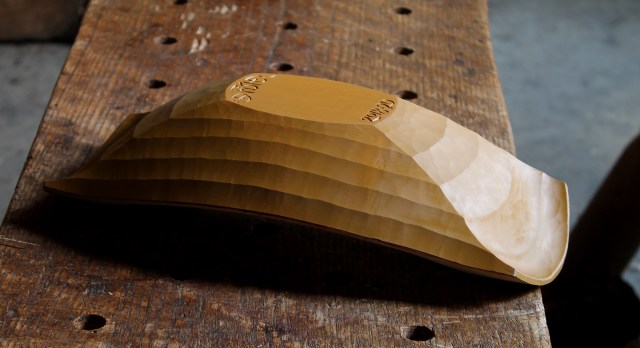
The form of the yellow bowl is a bit more complex.  The end walls are s curves from foot to handle and scooped out beneath the curved handles, but still not as dramatically as they are in other designs.  The exterior surface is fluted, but in this case they are carved relatively loosely and freely with the gouge.  Again, painted with artists oils.

IMG_8372

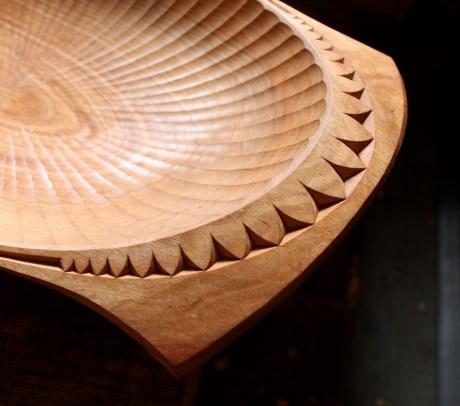
The necklace around the rim really catches light and shadow.  It’s made up of smaller chip cuts from a knife, rather than the more demanding design I’ve done many times, most recently on this just-finished walnut bowl:

IMG_8458

It makes a lot of sense to start with a relatively simple design and strive to execute it well.  Even if you’re beyond starting out, there’s plenty of challenge, beauty, and joy to be found in these forms.

Posted in bowls, layout, paint, Uncategorized | Tagged | 19 Comments

The Nimble Fishtail

IMG_8328

Having just finished carving “necklaces” on a couple bowls, I thought I’d explain a bit more about the tool I use for the carving of the large triangular recesses that make up the design.  In the FWW  article and video, I refer to the tool as a skew chisel, but, the more I think of it, it’s the fishtail aspect of the tool that’s at least as important as the skew.

IMG_8299Here’s a shot of the necklace I just finished on a cherry bowl.  I briefly outlined the procedure in a blog post a couple years ago.  And in another post, I showed the fishtail skew in action on a straight-walled version of the necklace.
The fishtail shape excels in these tight quarters, as the shank of the tool doesn’t interfere or mar the surrounding wood.  By grinding away the sharp corners on the sides of the tool behind the cutting edge, the tool can be made even more stealthy and nimble.

Technically speaking, the tool is a double-bevel fishtail carving chisel.  As it is straight, it is a #1 sweep (sweepless).  I’ve not been able to find one that also comes with a skewed edge, but no matter.  The fishtail aspect is the most important, and if you wish to make a skew of it, it’s a simple procedure (see the top sketch) and you can create as much or little skew as you wish.

The particular brand doesn’t matter, so long as it is by a good reliable maker.  How wide the edge should be depends on the size of work you’ll be doing, but mine is 20mm (3/4″) wide and serves me well.  Here are some links to a few options and no doubt more can be found:

Fishtail Gouge

https://twocherriesusa.com/product/spade-chisel/ (looks like single bevel, but could easily be reground to a double-bevel)

https://www.lie-nielsen.com/product/auriou-lettering-chisels/auriou-lettering-chisels-fishtail-chisel-14mm-9-16-double-bevel-?node=4163

http://www.stubai.com/index.php/en/woodworkingtools/serie-52-k/n-53-stubai-fishtail-chisels-detail

You’ll find such a chisel useful for all sorts of situations, including lettering.


Posted in Lettering, patterns, sketch, tools, Uncategorized | Tagged | 9 Comments

Perpetual Thanksgiving

IMG_7640

I am grateful for what I am and have.  My thanksgiving is perpetual.  It is surprising how contented one can be with nothing definite,–only a sense of existence.

Henry David Thoreau, letter to H.G.O. Blake, 6 December 1856

Posted in quotes and excerpts, Uncategorized | Tagged , | 11 Comments

Sign Auction

IMG_8254

The sign now, with light coming from the upper right.

It’s been four months since I wrote a blog post about carving this sign for Jennie Alexander.  Since then, the leaves have fallen and the oiled oak has begun to take on a patina.  Although Jennie was able to see photos of the finished sign, she passed away before she was able to receive it.  After a lot of thought and talking with Jennie’s daughter and others close to her, I’ve decided to auction the sign and donate the money to the recently established Plymouth CRAFT Green Woodworking Scholarship.

This scholarship has already received some generous contributions, and they will allow many people over the coming years to participate in Plymouth CRAFT classes and events who would have otherwise been unable to.  I think that Jennie would have supported such an idea, especially considering the special relationship between her and Peter Follansbee, one of Plymouth CRAFT’s founders and most active instructors.

IMG_6808

The sign in July, with light coming from the upper left.

After researching all sorts of options, including raffles, many options involve tangled legal webs and reporting issues.  So I’m going to keep it simple:  I’ve just posted the sign for sale on ebay.  The link is here.  I’ll ship the sign to the winner of the auction, then I’ll donate all of the proceeds to The Plymouth CRAFT Scholarship Fund.

IMG_6802

There’s more information about the sign and the carving process on the original blog post.  It is 29 1/2″ x 7 3/4″.  The thickness tapers from roughly 1/2″ to 3/4″ from bottom to top as it was radially split from the tree.  White oak — Jennie’s favorite.


Posted in Uncategorized | 5 Comments

On Eating Spoons and Such

IMG_8237

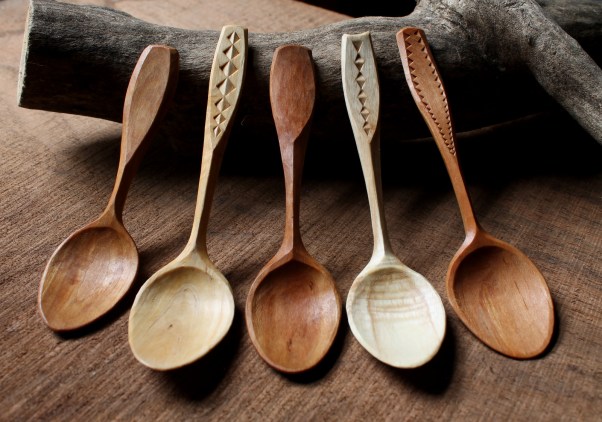
I finished carving a few eating spoons and bowls recently.  There are many factors to consider when making objects such as these that will be held and used daily.  First among these is wood choice.  Relatively dense hardwoods with tight grain are generally stronger and less absorbent than softer or open-pored species.  The spoons above are all black cherry except for the fourth from the left, which is American sycamore.  The fact that they’re all from branch crooks also allows for more delicacy and thinness while maintaining strength.

IMG_8230

Carved accents can be a nice touch.  The three patterns on these spoons were all achieved by combining the same sort of triangular chip cuts in different ways.  One benefit of sliced, rather than sanded, surfaces is the lack of grain raising in use and after washing.

IMG_8274

The interior surface of this cherry eating bowl allows the eating spoon to glide along getting the last bit of ice cream.

IMG_8096

The outside can be textured and or painted in a variety of ways as with the maple bowl above.  For more on this, keep your eyes on Fine Woodworking Magazine.  I’ve written an article that goes step-by-step on the carving of eating bowls like these, including subtle design options, that will be in a future issue.

I wrote in this post about my typical oil treatment for bowls.  Cleanup is just a matter of a quick wash at the sink, then dry with a towel.  After a while you can re-treat to freshen the surface if you’d like.   I also have some information on treatment and care on this page of my website.


Posted in bowls, cherry, patterns, spoons, Uncategorized | Tagged , | 2 Comments

Maple Hen

IMG_8166

I just finished a hen bowl in maple and left it natural except for the bit of red paint on the comb.  Besides the lack of paint on the body, I made a couple other changes compared to those I’ve carved before.

IMG_8157

The most obvious difference is the longer tail feathers.  This log was long enough to allow for them, so I used it up.  The finished bowl is 15 inches long, 7 inches wide, and 4 3/4 inches high.  The coloration of the wood near the beak and tail occurred while the log was in storage.  Begins pretty quickly in maple, and I like the effect in this case.

IMG_7143

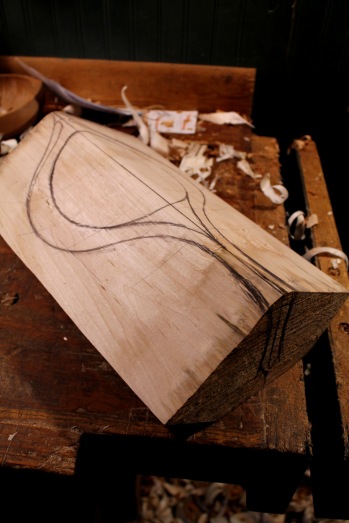
Here’s the blank prepared and laid out.

IMG_8113

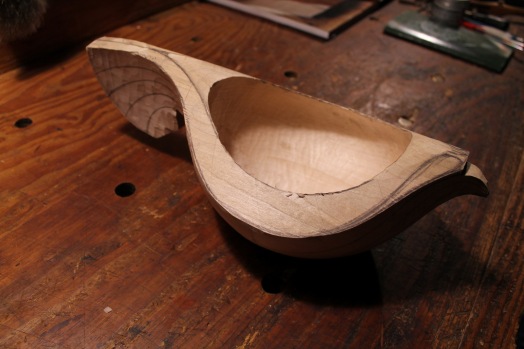
I hollow it out first.  The adze does a bit of the work, but with such a deep and undercut hollow it gets put aside pretty quickly in favor of a bent gouge.  After that, the remainder of the hollowing work is done with a spoon bent gouge and hook tools.  Then I hew the outside with an axe and follow up with a spokeshave.  Then it’s ready to dry before moving on.

IMG_8112

After drying, I sketch on the ridge lines between the flutes to be carved and dig in with a gouge.  Just keep it between the lines.  I wrote a post about that general process here.

One last shot with the oiled hen tilted for a better view of the hollow and crest.


IMG_8174-001


Posted in ale bowls, bird bowls, bowls, layout, Uncategorized | Tagged , | 9 Comments