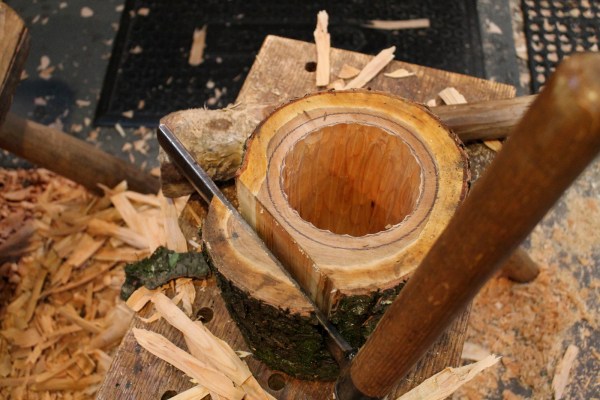
Wishes for a Peaceful New Year

IMG_1696

When it is peaceful and quiet, using the knife will not break the tranquility.  Sometimes there will be other things to listen to, such as conversation, music, the singing of the birds or wind rushing through the leaves.  Indeed, sometimes you will listen to the actual quietness around you when you carve.

— Wille Sundqvist, Swedish Carving Techniques (1990)

IMG_1690

Carving spoons with my son, Noah, a couple days ago.  Sometimes it’s nice to listen to quietness together.  And any conversation is eased by the carving.  It rises up naturally like a shaving from a knife.

Wishing you all a peaceful new year full of chips and shavings.

P.S. — I’ll wrap up 2019 with my humble attempt at a couplet inspired by the photo of Noah and me and the passage of the years.  (“Ba Ba Ba, Ba Ba Ba, Ba – Ba – Ba”):

Once I had curly hair just like that.

Years went by leaving me just this hat.

Posted in carving, green woodworking, quotes and excerpts, spoons, Uncategorized, writing | Tagged , , | 16 Comments

Cigar Box Reminder

IMG_1620

Lately, my evenings and weekends have been filled with non-carving matters, including tending to the needs of our house that was built in 1905.  When Kristin and I bought it in 1996, the same year we were married, we became the third owners of this humble place in our hometown then in need of a good dose of TLC.  We entered in with little money, but plenty of DIY enthusiasm and enough ignorance to maintain our confidence.  Little by little, we’ve gotten to know this house by working on it and living in it, and it continues to surprise us with hidden quirks.

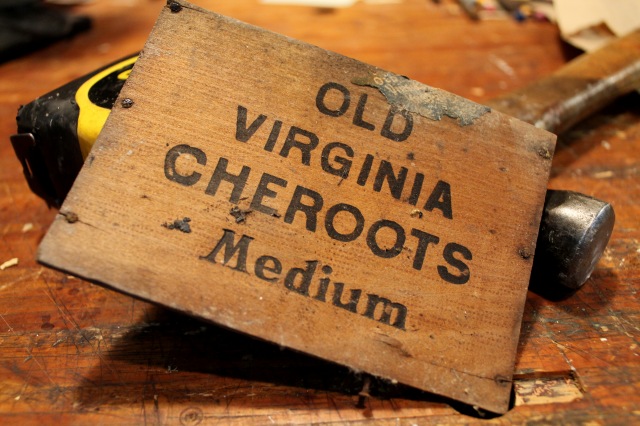
Two became four and we’ve shared a lot of memories in this house.  Once in a while the house reminds me it needs some more attention.  I kick and scream a bit, then get to work.  This week, as I was working in the cellar, by the stone foundation in need of re-pointing, I found a piece from a cigar box stamped with the words “Old Virginia Cheroots — Medium” (top photo).

Now, as much as I had been trying to maintain a positive attitude, I was not in a good frame of mind.  In fact, I probably looked a bit crazed, covered with grime, dust, cobwebs and a scowl.  Thoughts of condominiums kept passing through my mind.  Oddly enough, that little scrap of cigar box encouraged me.  I guess it was a small reminder that the house has a long memory and I’m just part of the story.

The first owners of this house were William and Minnie Fisher (no relation).  William owned a cigar store downtown and did some horse dealing on the side.  Our little town was growing then, and business was booming.  William often donated free cigars to various celebrations.

IMG_1627

Greenville Evening Record, April 14, 1916.  There you have it, a good five cent cigar.

After William’s death in 1932, Minnie lived here quietly, one might assume, except for one morning in 1939 when she was rudely awakened.  I can see her now jumping up, looking out my bedroom window, only to see a dump truck just below, where the front porch had been:

IMG_1633

Greenville Record Argus, June 28, 1939
IMG_1640

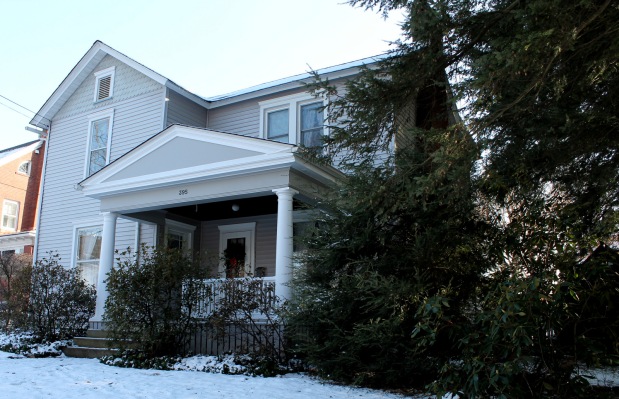
The front porch was rebuilt.  There it is yesterday afternoon.

After Minnie died in 1949, the house was purchased by V. Spencer and Pansy Goodreds.  Spencer was a professor of Literature and Theater at Thiel College here in Greenville.  Pansy was involved in Thiel affairs and hosted sorority gatherings at the house:

IMG_1628

Greenville Record Argus, Dec. 14, 1949

We never had the pleasure of meeting Pansy.  She lived here alone for nearly twenty years after Spencer died and then moved, in her nineties, to live near her son in another state.  I’m writing this now, almost exactly seventy years after that Christmas party, in front of a fire in that same fireplace.  But not a sorority girl in sight.

So I’ll make the best of re-pointing the cellar walls, but I think that job and some others can be spread out.  The little garage where Pansy parked her old Ford is now my workshop, and I’ll make some time for the bowls and spoons in there calling me.

Note:  These clips came from our local Greenville newspaper, which, thankfully, is still being published daily.  The archives of ours and many other newspapers are fully searchable at NEWSPAPERARCHIVE.  It’s a great resource.
 

Posted in historical reference, Persons, Uncategorized | Tagged , | 22 Comments

Thankful for Birds and Trees


IMG_1475

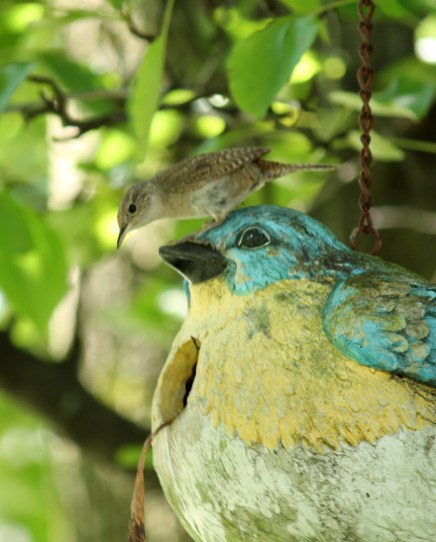
This past summer, we were fortunate to have a pair of wrens make a home in our yard.  We enjoyed watching them flit around and hearing them sing.  It also reminded me of my grandmother who loved her “Jenny wrens.”

IMG_0300-001

Check on the brood in the nest box, then fly to the nearby hemlocks for a song.

IMG_0231-001

IMG_0236-001

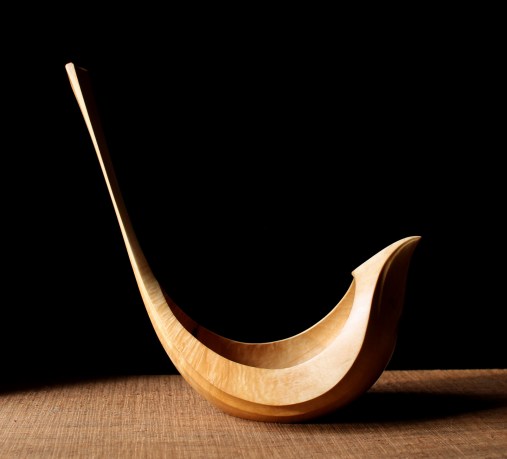
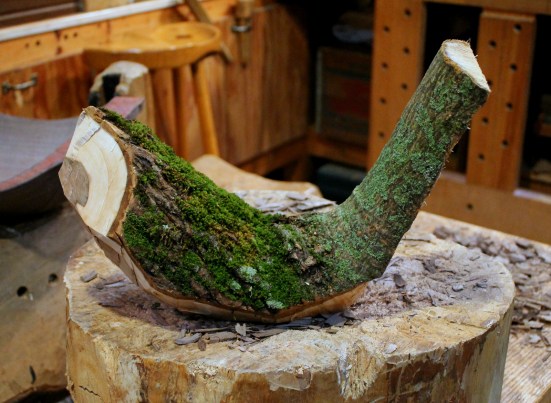
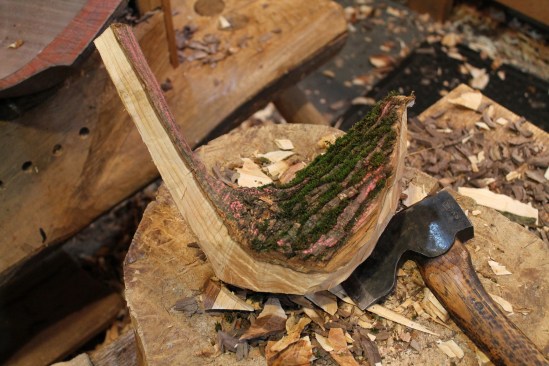
I wasn’t able to catch it with the camera, but that tail is always flicking upward to a jaunty angle.  I was thinking about that when I saw this tight bend in a piece of Norway maple this fall.  In the photo below, I’ve hacked away everything on the outside of the pith.

IMG_1225

I didn’t set out to make a wren, but rather a general bird form that was inspired by that lifted tail and the piece of tree itself.  After some rough chalk marks, I’ve hewn away much more of the excess below.  This is such a free and fun process.  I’ve hewn a flat for the foot of the bowl already at this stage.  I want to be able to set it upright and see the overall attitude of the lines.

IMG_1228

Then I chop and shave away the bark and shape the upper surface.  Considering the wild grain in this figured crook, I used a very coarse rasp in certain areas to roughly shape the contours.  You can see the marks from the rasp on parts of the surface at this stage.  I also draw a centerline and the other guidelines.  This is simply freehand sketching, like drawing the form of a really big spoon.

IMG_1237

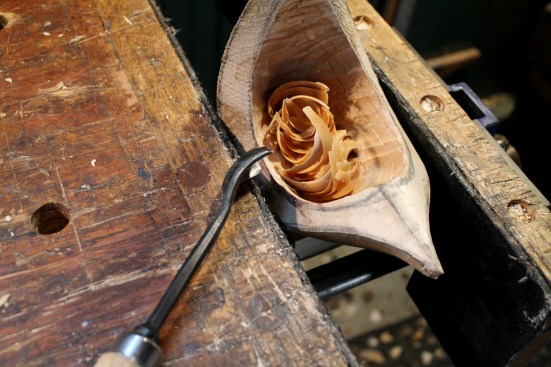
After more axework on the exterior, I do a little work with an adze on the hollow from the sides, but otherwise the quarters are just too tight.  Here I’m continuing to work the hollow with a spoon-bent gouge.  The hollow is too steep and deep for a standard bent gouge.

IMG_1240

It’s not long before that tool has reached its limits and I switch to a hook knife to continue the hollowing.  The hook knife can reach back into the undercut portions of the hollow and refine the shape nicely.  Lots of light cuts in this maple.

img_1243-1.jpg

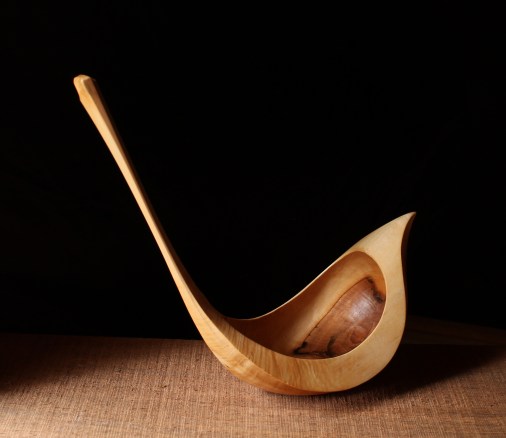
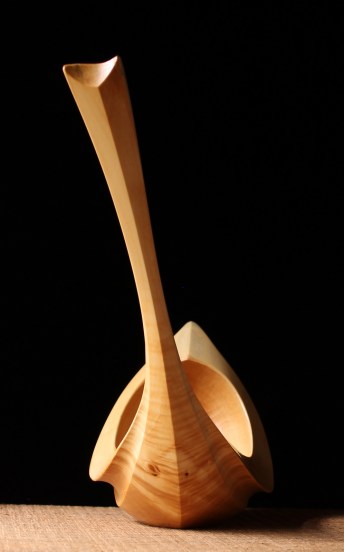
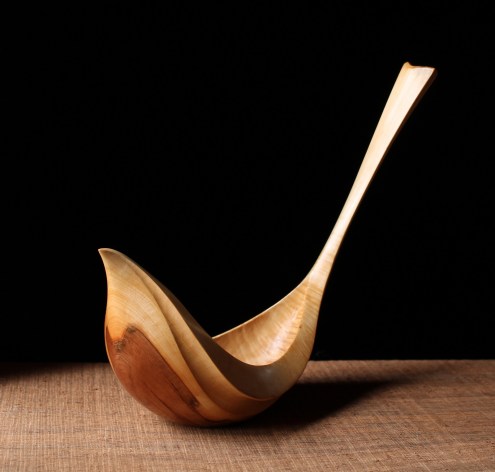
After a little more shaping to thin down the sections a little more, I set it aside to dry.  Then I refine the shape and all of the surfaces.  Here are some more shots of the recently finished piece.

IMG_1536

There is a subtle contrast in textures.  The main hollow and the flute under the wings are left straight from the tool, while the other surfaces have been smoothed with a card scraper and a little very fine sandpaper.  Finish is flaxseed (linseed) oil.  9 1/2 inches long, 4 1/2 inches wide, and 9 1/4 inches tall.  This one has found a good nest box.

IMG_1510

IMG_1467IMG_1471IMG_1498IMG_1495

IMG_1453

I’ve got plenty to be thankful for.  Thanks for taking the time to check out my posts, and I wish you a very happy day of thanksgiving.

Posted in bird bowls, tools, trees, Uncategorized | Tagged , , | 17 Comments

Three Spoons in November

IMG_0710

Seeing this photo with the summer sun warming the flowers beside the fence makes me, on this frosty November morning, think about the changing of the seasons. The sun this morning casts longer shadows onto the lawn strewn with golden Norway maple leaves.  They’ll crunch and dance before the tines of my rake this afternoon.

IMG_1589

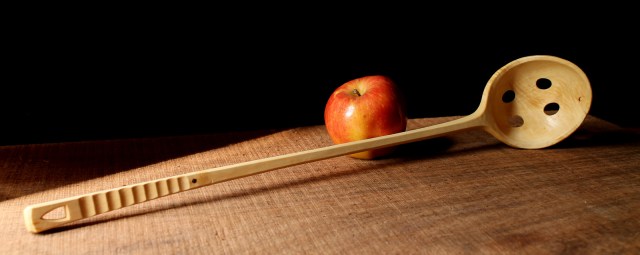
In that summer photo, I was carving a long ladle from a neighborhood Norway maple tree.  I sent that ladle, along with a few other spoons, to an exhibition in North Carolina which has now ended, so I have some spoons for sale.  If you’d like to purchase one, you can email me at dandkfish@gmail.com or leave a comment.  You can pay by sending a check or with paypal.

First is that one I was carving in the photos, a long slender slotted ladle carved from a Norway maple crook.  This stuff is lovely for spoons; harder than silver maple with a very tight grain.  The characteristics of the wood and the flow of the fibers allowed for a thin and graceful design while remaining strong and flexible.  The color will deepen over time.  It is 17 1/2 inches long and 3 1/8 inches wide.

IMG_0780

IMG_0793

IMG_0778

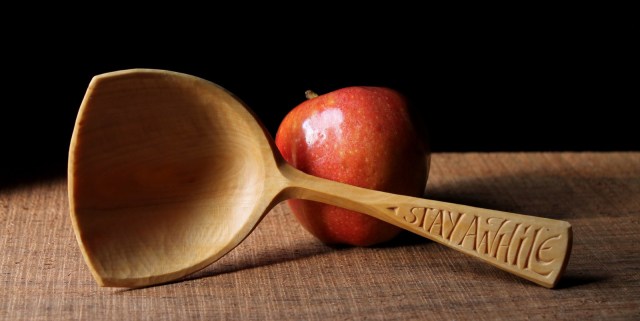
The second one is from a rhododendron crook.  A nice wide serving spoon, 7 5/8″ x 3 1/4″.  “Stay Awhile” carved into the handle.  $200 includes shipping.  SOLD

IMG_0739IMG_0728

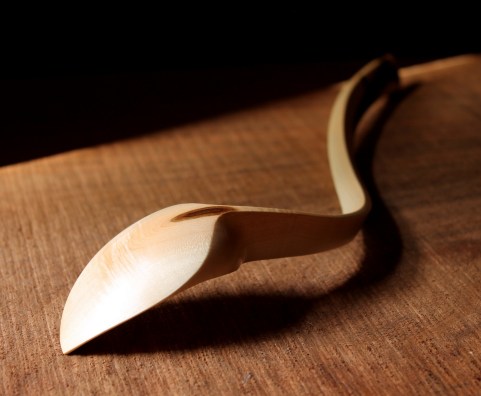
The third one goes back to the Norway maple.  The branch above a sharp crook was bent and twisted in a sinuous curve.  I went with it and kept the fibers true through the handle.   The handle takes a winding road, but still has a good relationship to the bowl when held.  Unlike the others that have a surface straight from the knife, I finished this spoon by sanding to a fine polish.  14 3/8″ x 2″.  $230 includes shipping.  SOLD

IMG_0807IMG_0812

IMG_0803


Posted in nature, spoons, Uncategorized | Tagged , | 14 Comments

Treasures from Millersburg

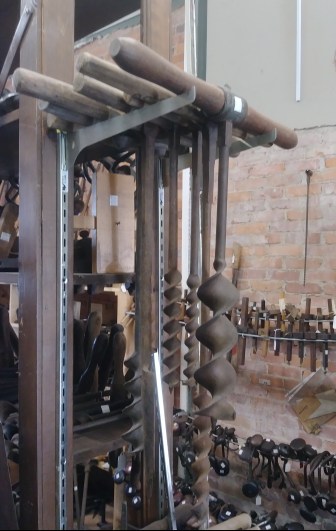
1101191346These T-handle augers weren’t the only treasures I found in Millersburg, Ohio last weekend at the Early American Artisans Fair.  I included some links in a previous post.  The Artisans’ Guild has some exciting plans, so its well worth a look.

The Augers were at Dan Raber’s Colonial Homestead store, beside more old planes, gouges, anvils, and antique tools of all sorts than I’ve ever seen in one place.  Some new ones too.

But — and I’m not being sentimental when I say this — the real treasures were the folks I met and the stories they shared.  Collectively, they were reminders of how the creative process and working with our hands has profound meaning.  It was evident in the eyes of folks talking with me about their experiences and plans.  I could see it in the fascinated faces of kids picking up freshly cut wood chips from the floor to rub between their fingers.

Some people shared inspiring things they had made or had found.  For example, David and Michele brought along this sweet little dipper/spoon.  David provided some more detailed shots here.

At the risk of leaving out a bunch of other fascinating people, I have to mention Bryan Koppert.  Talking with Bryan brought back many great memories of my days in high school wood shop with Mr. Bill McInturf, a caring man and an inspiring craftsman.  Bryan has his students at Triway High School in Wooster, OH working with their hands, solving problems, and building beautiful pieces.  You can see the pride in their faces in this article.  Guys like Bryan should be treasured even more than a good T-handle auger.  Long live shop class!

One of Bryan Koppert’s students, Bevin, with his quarter sawn oak hutch.  Photo by Bryan Koppert.

Posted in events, historical reference, teaching, tools, Uncategorized | Tagged , | 8 Comments

Fluted Walnut Bowl

IMG_1443

IMG_1435

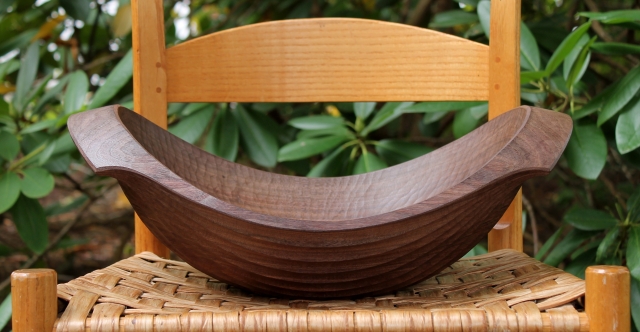
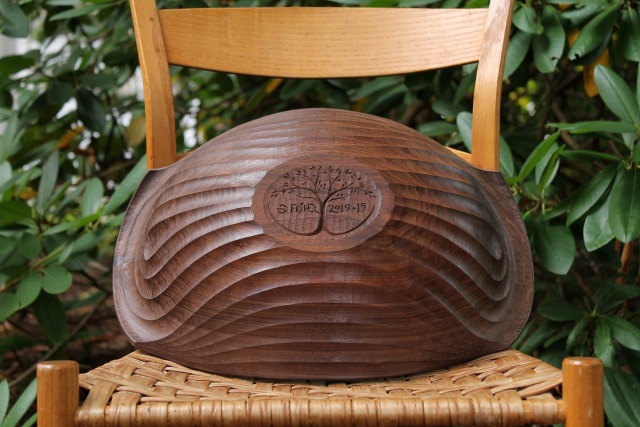
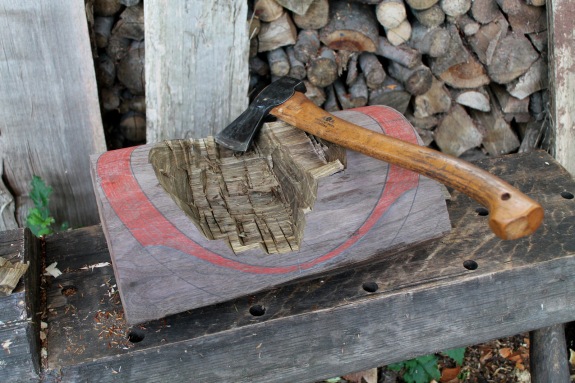
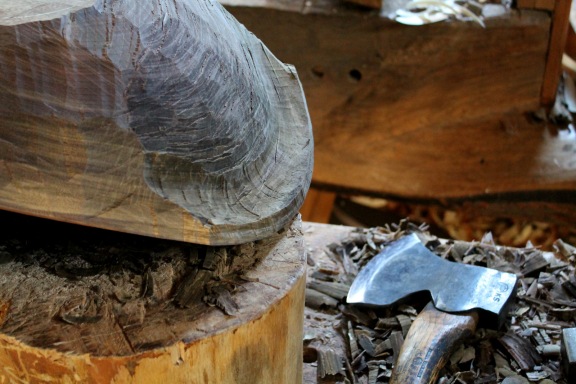
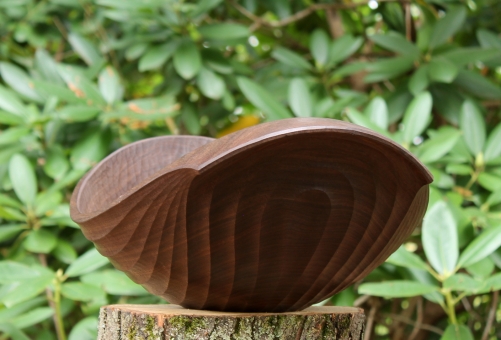
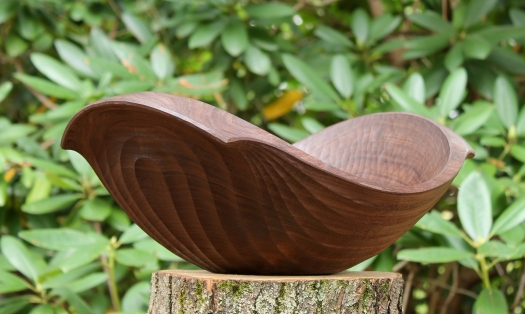
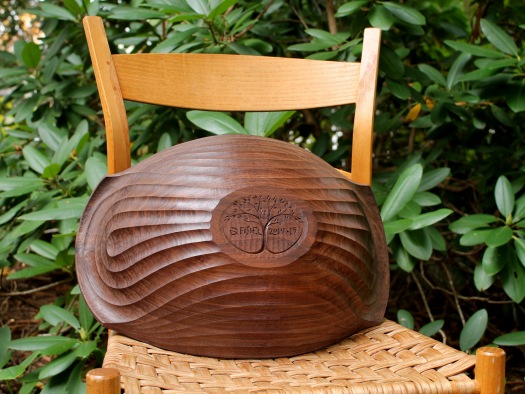
After making many bowls, I’m still thrilled by the prospect of shaping a rough chunk of log into a finished bowl.  The just-finished walnut bowl in the two photos above began with flattening the bottom and fairing the upper surface of a split log.  Then I started in with an axe.

IMG_1061

For large bowls with deeply swept rims, I sometimes begin the hollow with this 19″ axe.  I make a deep v notch across the middle, then expand it toward the handles.  I swing freely with a one-hand grip at the end of the handle, flinging the axe head into the wood. I’ve tried sawing a series of crosscuts to chunk out some of this material.  Works ok, but the axe is faster and more fun.  I switch to an adze for the rest of the hollowing.

IMG_1189

After the hollowing, I roughly hew the exterior with an axe.  An adze worked across the ends under the handles creates relief that allows for continued work with the axe.

IMG_1191

Here’s another shot (above) of the material to be removed with adze work.

IMG_1197

Here is the surface after going back to the axe to further shape the outside down to the roughly adzed area under the handles.  Then the back and forth continues with more careful work with the adze:

IMG_1201

Here, the adze has cut reasonably close to what will be the final shape under the handles.

IMG_1202

And back to the axe again.  It’s a wonderful, satisfying process, and, writing this, I can smell the fresh walnut chips again.

IMG_1209

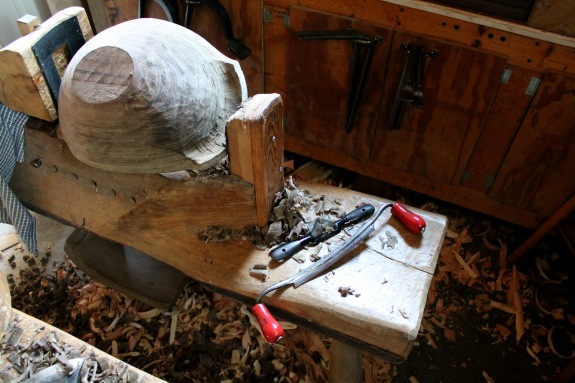
Some work with a drawknife and spokeshave refine the shape.

IMG_1370

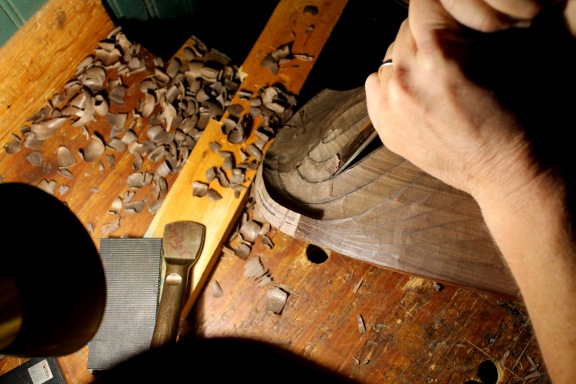
Of course, there’s lots of work after the bowl dries.  Here’s a shot of carving the flutes.  I was watching an old interview with Bruce Lee recently and he said, “And when you do punch, I mean you’ve got to put the whole hip into it and snap it and get all your energy in there.”  That same advice is pretty good for carving these end grain areas and as close as I’m likely to come to a fight.

IMG_1397

Eventually, all of those flutes come together.

IMG_1398

IMG_1427

Posted in adze, axe, quotes and excerpts, tools, Uncategorized, walnut | Tagged , , | 22 Comments

Contemporary Greenwood Exhibition


This “Folded Lowback” chair by Peter Galbert is among the items on display at the Contemporary Greenwood exhibition in Rockport, Maine.

Back at the beginning of September, I mentioned a couple upcoming exhibitions in this post.  Now, one has wrapped up (I think) and the other is still in full swing.

Many of the items on display at the Contemporary Greenwood Exhibition can now also be viewed on the CFFC website, so if you can’t make it up to Maine, you can check out the pieces at this link.

Lot’s of inspirational work like Pete’s chair to kick your imagination and hands into gear.

Posted in events, green woodworking, Uncategorized | Tagged , | 3 Comments

2019 Sundqvist/Coperthwaite Sloyd Fellowship

Masashi K

2019 Wille Sundqvist and Bill Coperthwaite Slöjd Fellowship recipient Masashi Kutsuwa

Anyone who has met Masashi Kutsuwa would understand the big smile that appeared on my face when, at Täljfest, Peter Lamb announced that he had been awarded the 2019 Wille Sundqvist and Bill Coperthwaite Slöjd Fellowship.

Jogge's Crew

Lie-Nielsen 2015.  Photo by Colin Hayward

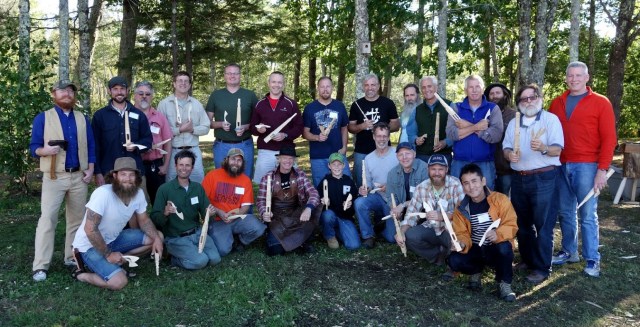
I had the pleasure of meeting Masashi in 2015 in Maine at a Lie-Nielsen class taught by Jögge Sundqvist.  It was an incredible group gathered there, and Masashi was fascinating to talk with.  He also brought some wonderful spoons and other pieces from Japan.

Masashi, Kenneth, and Eric

Masashi Kutsuwa, Kenneth Kortemeier , and Eric Goodson at Lie-Nielsen in 2015.  Photo by Peter Follansbee

Masashi is a widely accomplished craftsman and ambassador for handcrafts.  He is richly deserving of this award.

Click on the link below for more information about the award and Masashi:

2019 Slöjd Fellowship Press Release

Masashi certificate

Which brings me back around to Peter Lamb, the maker of the birch bark certificate, close friend of Bill Coperthwaite, and tireless explorer and supporter of handcrafts.  There’s much more to know about Peter and his insights into the importance of working with our hands.  I highly recommend getting a copy of the latest issue (Issue 7) of Mortise and Tenon Magazine.  It features an interview with Peter Lamb in which he shares his rich experiences and thoughts.

IMG_1231

This is another great issue from Joshua Klein and his crew at Mortise and Tenon.

Posted in events, green woodworking, Uncategorized, writing | Tagged , | 5 Comments

In the Beginning

IMG_1185

Wanting to make another big cherry shrink pot like the one in this post, I put my big folding saw in my pack and walked to a nearby woodlot where a cherry tree had fallen a few months ago.  The saw revealed heartwood just wide enough for the size of pot I wanted (about 6″ diameter at the base).  I toted a chunk back to the workshop and dug in.  Here a few photos showing the beginning of a shrink pot.

IMG_1154

I secured the log on my low bench with some giant holdfasts and, standing on the bench myself, started in with the 2″ T-handle auger.  Something so simple can be such a sensory delight; the body twisting and exerting itself, the crunching sound of the edge slicing through end grain, the sight of fresh chips flowing from the top, the perfume filling the shop.  Even Tom Sawyer wouldn’t trade away this bit of work.

IMG_1156

For a shrink pot this big, there’s still a lot of material to be removed.  I expand the original hole by working around and around with a mallet and gouge.  I flip the log back and forth a few times to work from both ends.

IMG_1162

I want this pot to be all darker heartwood, so I split off the bulk of the sapwood with a froe.

IMG_1164

The froe leaves some wood still to be shaved away with the drawknife.  I do that at the bowl horse, but forgot to take a photo.  Pretty easy to imagine though.

IMG_1167

Then I clean up the inside a bit by paring with a gouge.  Although the perspective in the photo distorts it a bit, the pot is tapered, an inch narrower at the top than at the bottom, so working the gouge from top to bottom on the inside works with the grain to achieve the cleanest cuts.

IMG_1168

A view from above.

IMG_1220

Now the bottom is in place and the walls can quietly close in on this first stage.

Posted in cherry, holding, shrink box, tools, Uncategorized | Tagged , , , | 14 Comments

Early American Artisans Fair

Go West

Woodcut by Gustave Baumann, 1901, courtesy Art Institute of Chicago

Ten minutes west of my house is a line separating Pennsylvania from Ohio and the official Midwest.  I’m looking forward to crossing for a very short jaunt westward at the beginning of November when I’ll be at the Early American Artisans Fair in Millersburg, Ohio.  There, I’ll be demonstrating and talking greenwood carving with whoever feels like joining in, so if you’re in the area, stop by.  I can talk and make chips at the same time.

As you can see at the link above, there will be plenty to see and do.  I’m looking forward to seeing some incredible artisans with diverse skills and backgrounds.  Many who are coming have been featured on the Colonial Homestead Artisans Guild blog recently.  While you’re in Millersburg, you can stop in at Colonial Homestead and drool over the tools.  Dan Raber has created a special place there and now he’s put together what promises to be a fantastic event.


Posted in events, tools, Uncategorized | Tagged , | 3 Comments