Bowl Horse at Fifteen

IMG_1048

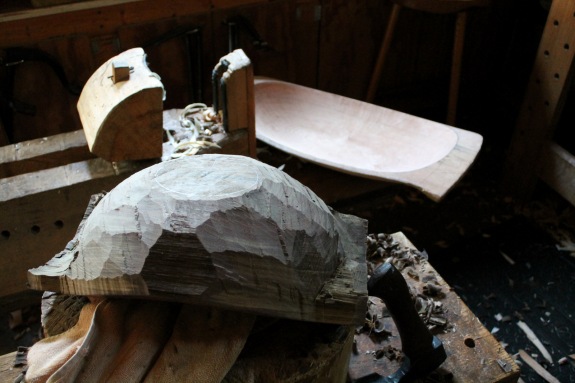
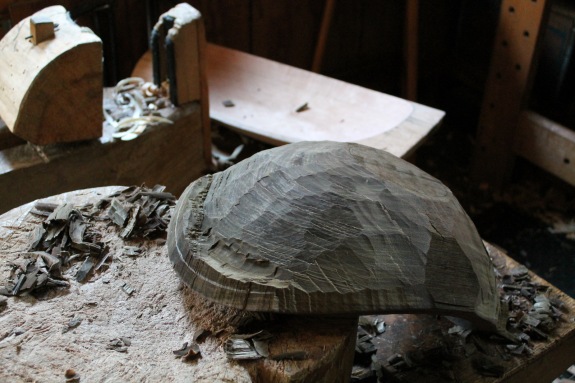
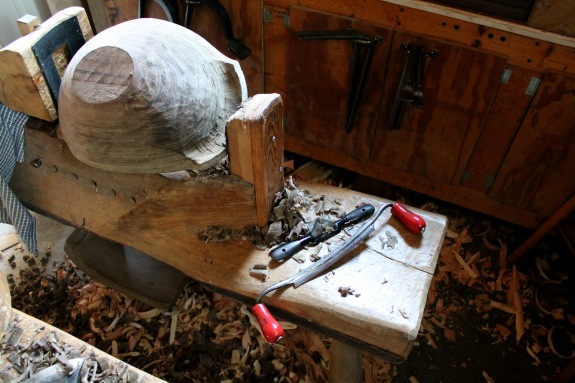
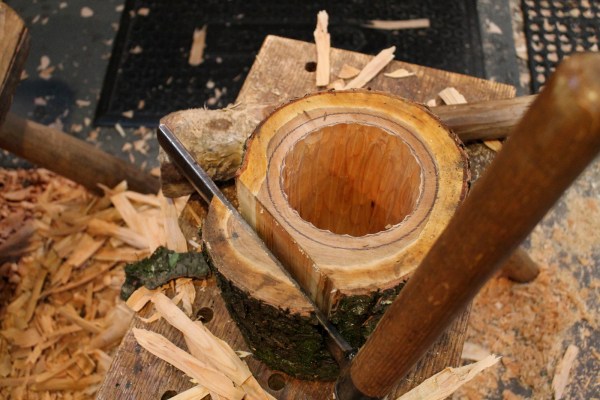
It’s been fifteen years since I built my log bowl horse, and it’s still serving well and regularly in my workshop.  I mentioned it in this article, but the focus there is more on building the more portable version from lumber.  The log version is so organic that I’ve not said much about specific dimensions, but after hearing from a couple folks that plan on making log versions of their own, I made the sketch above with some general reference dimensions of mine.  Of course, not much is specifically important and there would be many ways of achieving results that work as well or better, so use what you have available.

IMG_1050

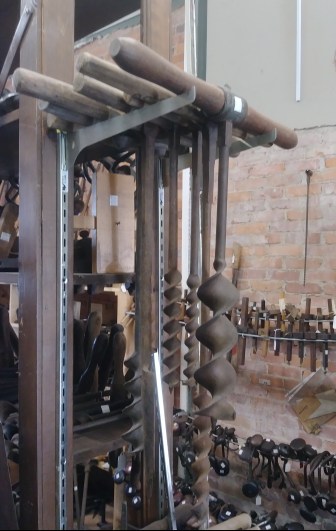
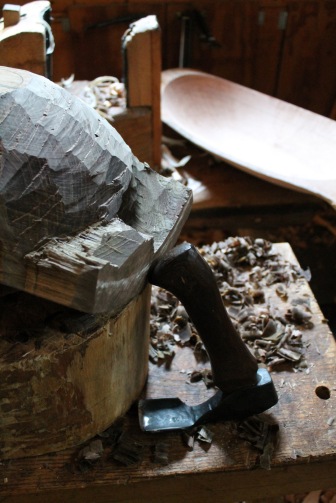
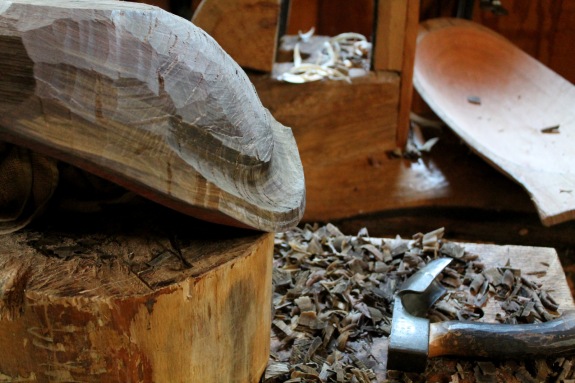
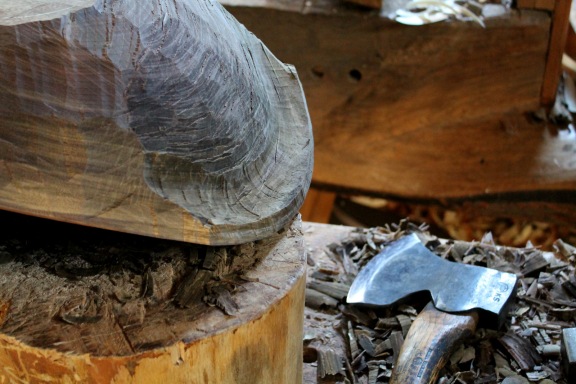
The first thing I did when I built mine was bore the 2 1/2″ holes for the legs with a T-handle auger.  Once the legs were driven in, I flipped it over and had nothing more than a log on legs.  Then I moved on to shaping the log.

IMG_1060

IMG_1056

IMG_1059

Many things could work as a pivot pin.  Mine is a shaft from an old broken tubing cutter.

IMG_1051

Certainly don’t let not having one keep you from carving bowls.  This is not a necessity, but I’m not giving mine up.  It’s the closest thing I’ll ever have to a Harley.

Posted in holding, tools, Uncategorized | Tagged , , | 14 Comments

Mulberry Rooster Bowl

IMG_0915

In summer, the birds and I eat the mulberries from my neighbor’s tree.  We have a deal; the birds get the high ones and I get the low ones.  The other way around proved to be far too dangerous.

A couple years ago, one of their two mulberry trees, about thirty feet tall, came down.  Much of it became firewood, but a few pieces went under the knife.

When working this wood fresh, the bold yellow color really grabs your attention.  It’s related to Osage orange, but not as heavy and hard.  Still, it’s moderately hard and a bit tricky to carve.  I roughed this bowl out not long after the tree came down and returned to it just in recent weeks.

IMG_0852

In the months since I had roughed it out, the surface had mellowed to a golden brown.  Fresh cuts revealed the brighter color beneath, and now the new surface of the finished bowl has already begun to develop a nice patina.

IMG_0862

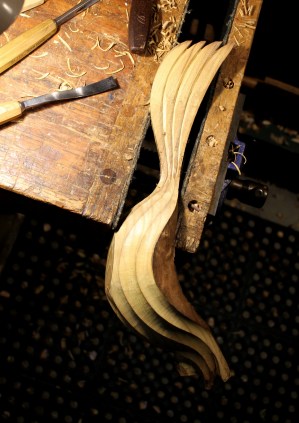
The vise comes in handy for carving the flutes, but much of the work is done away from the bench.

IMG_0925

I’m often unsure how all of the elements and surfaces are going to come together, so I just take the next step that I determine has to be done for sure.  Then the next decision becomes more clear, and so on.  Eventually, I stumble upon a resolution and discover I’ve created what may be an Elvis-inspired rooster.

IMG_0913

The dimensions are 17″ long, 5″ wide, and 6″ high.  There’s room enough for some preliminary adze work, but, especially considering the depth and undercutting,  most of the hollowing was done with gouges and a hook knife.

IMG_0907

The fibers flow through this big mulberry crook down from the head and on up through the tips of the tail feathers.

This one is for sale.  $800 includes fully-insured shipping.  A little more for overseas, depending on your location.  Email at dandkfish@gmail.com if you are interested.  Thanks.  Update: SOLD

Posted in bird bowls, finding wood, tools, trees, Uncategorized | Tagged , , , , | 15 Comments

Short Lettercarving Video

At Spoonfest, Tom Hepworth filmed Barn and I talking briefly about carving letters with a knife.  I also demonstrated how I go about cutting a letter.  Tom posted the video to Youtube not long ago, and here it is.  Just ignore my awkwardness and you may find something useful!  There are also some nice views of Spoonfest to open the video.

Posted in carving, Lettering, tools, Uncategorized, video | Tagged , | 7 Comments

Two Upcoming Exhibitions

IMG_0807

If you’re in the neighborhoods of Asheville, NC or Rockport, ME, there are two exhibitions coming up that may interest you.

Opening first is Spoonin’: A Showcase of Handcrafted Spoons that will run from 14 September through 13 October at Grovewood Gallery in Asheville, NC.   Greenwood carving will be well represented, including spoons from Curtis Buchanan, Tim Manney, and Dawson Moore.  The show should offer plenty of inspiration, with a diverse range of styles, methods, and materials — including hand-hammered metal.  Check out the full list of participants at the link above.

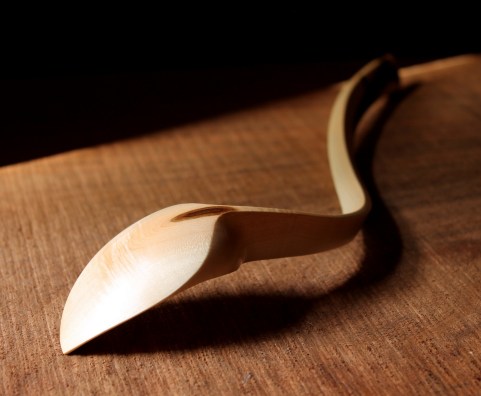
I’ve sent a few recently completed spoons, including the one in the top photo that came from a neighborhood Norway maple branch that was bent and twisted just so.  14 3/8″ long, 2″ wide.  Here’s the backside:

IMG_0812

Here are the other spoons I’ve sent:

IMG_0778

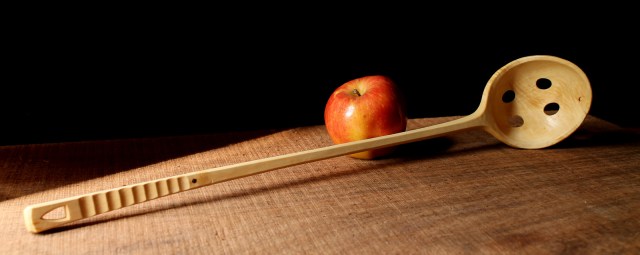
This long slender ladle (17 1/2″ long, 3 1/8″ wide) is from the same Norway maple tree.  All of these spoons are from crooks with the fibers flowing through the handle and bowl, and Norway maple, though not as tough as sugar maple, proved to be plenty strong, harder than cherry.  The combination of the flow of the fibers and the hardness of the wood allowed for a thin strong bowl.

IMG_0780IMG_0793

The one below (13 5/8″ long, 3 5/8″ wide) came from a big cherry crook.  I walked out onto a fallen cherry tree over an icy creek last winter to collect it, so I’m glad it worked out!  The Latin Fabas indulcet famas means “Hunger sweetens the beans.”

IMG_0763-001

Here it is the lettering turned right-side-up:

IMG_0719

I was able to finish a couple spoons from that neighborhood rhododendron I mentioned a few posts ago.  Here is an eating spoon, 7 1/8″ long and 1 5/8″ wide.

IMG_0755IMG_0752

And the final spoon for the Spoonin’ Exhibition is this lettered server, also from a rhododendron crook.  7 5/8″ x 3 1/4″.

img_0739.jpgIMG_0728

IMG_0715

The second exhibition is Contemporary Greenwood and will run from 20 September 2019 through the end of the year in Rockport, ME at the Center for Furniture Craftsmanship’s Messler Gallery.  At the link above, you’ll see it listed as an upcoming exhibition for now.  Additional information and a full list will be posted eventually there, but I know there will be work from some familiar Greenwood Fest folks such as Pete Galbert, Amy Umbel, Jarrod Dahl, and Curtis Buchanan.

I’ll be sending a couple pieces that I’ve posted about earlier this year here on the blog:

IMG_9878

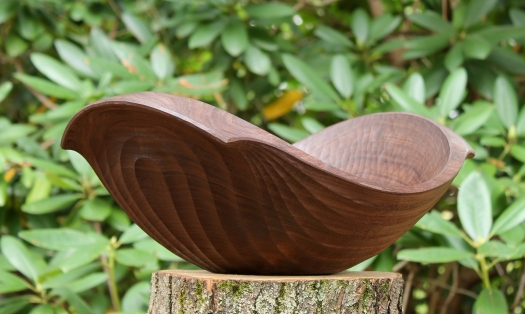
The walnut bowl above started as a quarter-log split.  I wrote about it in this post.

IMG_9809

The cherry bowl above came from a crook with lots of character.  I wrote about it in this post.

So, those two will be on their way to Maine this week.  If you’re able to make it to either of these exhibitions, there will be work there from many folks.  Pieces you can see directly with your own eyes — and I’m hoping — feel with your hands.  Of course, the gallery rules trump my thoughts, but, for what it’s worth, you have my permission to touch the bits of tree I’ve sent.

Posted in bowls, events, spoons, trees, Uncategorized | Tagged , , , , | 9 Comments

Täljfest 2019

IMG_0635

Gerald Getkate making clogs at Täljfest 2019

In my lectures at both Spoonfest and Täljfest, I referred to an excerpt from Mary Oliver’s poem Sometimes:

Instructions for living a life:
Pay attention.
Be astonished.
Tell about it.

Astonishment comes easy at Sätergläntan, the traditional crafts school in Insjön, Sweden and home to Täljfest 2019.  The school offers open week-long classes in the summer while being dedicated to full time students the rest of the year.  The students have quite a setting!

0809190320

After the train ride through the Swedish countryside, I had come to expect the red and white paint on the buildings.  Some of them are new, but many are old cabins that have been moved to the location over the years.

0809190321

This log building sits on a hillside overlooking the forested valley.

0808190953b_HDR

The view from the other side of the window shows the sheep whose fleece is used by the textile craft students at Sätergläntan.

0809190932a

Frederik kicked things off.  I was able to snap a photo, but I missed more photos than I got.  Not a single photo of Jögge Sundqvist or many other people that were a central part of the event.  No photos of the incredible food served up for every meal by the talented staff.  No photos of my first Scandinavian sauna.  Here are some more of what I did get, and there are plenty more floating around out there on the net, I suppose.

The carvers in my classes were ready to roll.  Thanks to the volunteers, current and former Sätergläntan students, all of the preliminary work to prepare the blanks was done ahead of time so that the students could jump right in and make the most of the three hours.

0811190549b-001

Although we spent a little time at the chopping blocks, most of the work was done in the Sätergläntan woodshop at workbenches.  The focus was on understanding basic design principles and techniques.

0810190615b

It was an international bunch of carvers with a lot of experience, skill, and humor.  Craft is a universal language.  In the middle in the photo below is Julia Kalthoff who makes a great carving axe.  She had them on hand at the festival to try.

0811190559c

Every time you turn your head at Sätergläntan, you find inspirational pieces that are used there like this lidded bowl,

0809190508d

and these two beauties by Bengt Lidstrom that have been in use for a couple decades:

0809190503

0809190501a

The visiting instructors brought some of their work.  Just one example is this small sampling of pieces by Anja Sundberg.

0809191142a.jpg

And the work brought by the festival attendees was incredibly inspiring as well.  How about this shrink pot by Per Norén!

0810190841

Amazing baskets and tool holders of all sorts were everywhere.  I loved this one of split pine.  I think it was Ulrika Eckardt’s.

0811190357

0809191301_HDR

Hiking trails surround the school, flanked by wild blueberries and spectacular views.

0810191408a

Evenings were time for free carving and fun and games.  We had a spirited game of Kubb going.  Some of you might recognize world traveler Brad van Luyt from Australia up there on the left in the green jacket.  He was an ace.

0810191353

The Kubb King of the Täljfest!  Long live the king!

0810191433

The King is dead.

0809191553

Swedish pancakes.  They have carrots in them, but they’re still good.  Who knew?

IMG_0647

Before taking the train to Sätergläntan, Noah and I were able to spend a couple days in Stockholm.  I think that’s the City Hall building above.

0806191446

The city, made up of a number of islands, was beautiful and vibrant.  This is a shot of the Old Town area, right beside the Nobel Prize Museum.

0807190517

We visited the Nordic Museum.

0807190330a

In one room, this rocking bird made by Bengt Lidstrom was there offering children a ride.

0807190720

This windmill was at Skansen, an open air museum full of authentic old buildings and artifacts.

0807190445

And of course, we couldn’t miss the Vasa Museum.  The ship is amazing, but the story is even better.

IMG_0642

The walk along the waterfront to the museums is pretty nice as well.

In the closing ceremony of Täljfest , Jögge summed up the excitement and good feelings that were shared by all, then we sang a delightful song about little frogs and danced.  Täljfest only happens every three years, so you’ve got time to make your plans for 2022!

Posted in classes, events, green woodworking, historical reference, paint, shrink box, sketch, Uncategorized | Tagged , | 15 Comments

Spoonfest 2019

0804190229

There it is, down there in the middle by the big white tent.

I’m back from my first ever overseas adventure, and it was a thrilling and enriching one.  The English countryside, London, Stockholm, and the Swedish countryside.  Almost a week after my return, my head is still spinning with all I saw and all of the people I met.  I want to share a bit of my experience in England in this post, then I’ll move on to Sweden in the next.

IMG_0554-001

I’ll begin with a heartfelt thank you to Jögge Sundqvist and Peter Lamb for the 2018 Wille Sundqvist and Bill Coperthwaite Slöjd Fellowship.  That went a long way toward making this trip possible for me, a trip that allowed me to meet and share ideas with an international group of craftspersons.  I carved and took along this sign for Jögge and Peter as a small token of my appreciation.

0804190707

So, again, we’ll focus on England in this post.  These photos may give you some sense of what you’ll experience if you get a chance to go next year or one of these years.

First, you’ll be greeted in Edale at Spoonfest by fascinating, friendly people like Barn the Spoon and Robin Wood, who, along with a host of busy and helpful volunteers, make the magic happen.  That’s Barn in the photo above, just back from the mall it seems and excited about the bargains he found.  Actually, he was punching his truck — really.

0803191324

I think that’s Harry and his son clearing odd bits of wood from the site.  There are piles of branches of various species for folks to choose from, including lots of crooks!

0802190927b_HDR

There was plenty of time to share ideas about carving, sharpening, the meaning of life, and, looks like, dance moves.

Some carvers from Cornwall even explained to me the proper way to apply jam and clotted cream to a scone.  There was much unexpected passion raised over this subject, especially when a Devon man spoke up.  I learned many things in England, about spoon carving and beyond.

0802190924b

Lots of contented carving under the trees and tents.

0802190204

I noticed that folks like to queue in England, even when they’re just carving.  Actually this is the beginning of the early morning line to sign up for that day’s workshops.  Steve has the pole position for a line that would stretch far back through the field.  You’ve never seen happier people in a queue.  People in the workshops were enthusiastic and wonderful.  Thanks to all of you who attended my workshops, demos, and talk.

0802190923

In addition to workshops, demonstrations, lectures, and exhibits, there are programs for the kids at Spoonfest that teach them safe tool skills and fun projects.

0803190812a

In the barn there are things for sale.  Tools, books, and spoons — hundreds of spoons.  I can’t believe this was the only shot I took of a spoon table.  I was often so taken in by things that I neglected to take photos.  Therefore, I have no shots of the musicians, the barn dance, the food, nor many other things.  But I did get a photo of a cool rock:

0803190936

There’s a whole portion of a barn dedicated to sharpening.  Sean Hellman was kind enough to educate me about many natural sharpening stones, including this lovely Moughton Hole whetstone.  He even gave me a small one to take home.

0804190627a

There was a beautiful and moving exhibit set up inside those doors, a blend of photography and words sharing the inspiring stories of many individuals and how spoon carving has impacted their lives deeply.  If you’ve experienced the meditative and therapeutic effects of  carving, this exhibit made it clear that you are not alone.

I picked up this lovely spoon for my daughter, made by Lars Laursen, a Danish craftsman who began his woodworking with an apprenticeship with Wille Sundqvist.  Lars shared many stories about his special time with Wille.

0802191247

When you look up from your spoon or take a walk with a friend, you can’t miss what a beautiful place you’re in.  Edale, in the Peak District, is unlike anything I had ever seen.

1564899364751

A hike into the hills surrounding Edale takes you along dry laid stone walls, through pastures dotted with sheep.

0804190309_HDR

Within an hour, you’re far above the village, treated to breathtaking views.

0804190246_HDR

That’s my son, Noah, up there.

0804190351

You can sense the thick layer of peat under your feet.  The water has percolated through it before tumbling over the rocks, making a cold-brewed peat tea.

0804190349

I had always heard about the heather on the hills in songs and poetry, and there it was all around me.

IMG_0697

And there was a proud ram up on the ridge beside the trail.  And would you believe he was holding a spoon?

0804190408.jpg

There were smaller creatures too, like this violet ground beetle.

0802191244_HDR

And when you come back down from the hills into the village a pint is waiting for you at The Old Nags Head.

After Spoonfest, we had some time to visit London briefly before heading to Sweden.  Here are a few photos:

0805190636

A limewood (basswood) sculpture at the Victoria and Albert Museum.  Notice the hollowed out back, probably to encourage drying with minimal cracking.0805190636a

A close-up of some of the gouge work on the armor.

0805190643

A spiral staircase of wood from a medieval villa.

0805190835

Enormous London Plane (A hybrid of American Sycamore) trees in a park.

0805190857

Police dogs are relaxed in London.

0805190920

Of course, there was one amazing building after another.

0805191014

I had heard about Ben Wilson, and there he was.  The Millenium Bridge, a footbridge across the Thames, has a pattern of small raised metal bars to encourage traction and drainage.  Chewing gum gets pushed down into the recesses between these bars, and this creative fellow has taken to use the gum as canvases for his miniature works of art.  Now there’s lemons into lemonade.  You can learn more about Ben and his painting here.

0805191450a_HDR

Hyde Park was a wonderful place to walk, and we walked upon a sculpture by Henry Moore titled The Arch.

0805191451_HDR

The piece is dynamic, changing appearances with your viewpoint as you walk.

0806190418_HDR

As we left for the airport via a train at Paddington Station, there was still some inspiration:0806190419c


Posted in classes, events, green woodworking, historical reference, teaching, Uncategorized | Tagged , , , | 19 Comments

Branches, Barn’s Book, and Bowls

IMG_0309

The gnarled rhododendron branches you see above are what I call neighborwood.  On my walks around my neighborhood I often find piles of pruned branches or, in this case, the remnants of a large rhododendron that had been cut down.  The neighbors are happy to have it taken away, and I’m happy to have it.

IMG_0312

The qualities of rhododendron wood and it’s tendency to grow with many crooks, earned it and its relatives, such as mountain laurel, the nickname “spoonwood.”  The biggest branches of this neighborhood rhododendron were five or six inches across.

IMG_0316

As I split out some spoon blanks, the curl in many of the pieces showed up.

IMG_0407

I roughed out several blanks, then bagged them and put them in the freezer.

IMG_0473

Another person in the neighborhood was very upset that she had to have her Norway maple (Acer platanoides) removed, but I’ll at least try to give some of it a new life.

IMG_0568

In fact, I split a couple pieces.  What a beauty.

IMG_0464

It’ll have to wait a couple weeks.  I’m going to be seeing Barn soon, which reminds me about his new book.  I’ve read every word of it, and I highly recommend it.  It’s a wonderful introduction to green woodcraft and would be encouraging and inviting to anyone thinking about getting started.  It’s full of confidence building projects like this useful wooden clip (below), all described clearly and with plentiful photos and illustrations.

IMG_0463

All of the projects are organized around central skills such as knifework and axework.  As skills develop, the book features more challenging projects like this chair:

IMG_0462

And here are a few new bowls that, along with a few spoons, will be traveling with me to Spoonfest and Taljfest.

IMG_0513

This little hen is a small (a little under 8″ long) version of this one with a few twists.

IMG_0521

A maple bowl, about 15 inches long.

IMG_0533

IMG_0539

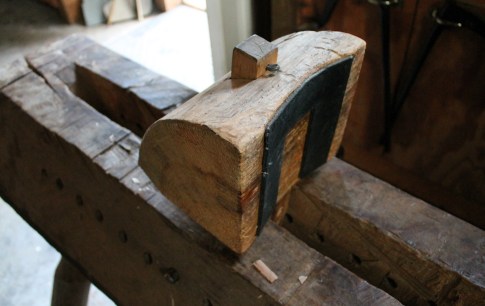
And a new cherry eating bowl design.  Nice to cradle in one hand.  With flutes that wrap in a wavy pattern around the exterior, and a squarish hollow that is steep and deep.
IMG_0498

I should have some incredible things to share with my next post.  I’m going to be like a kid in a candy store.

Posted in books, bowls, finding wood, Uncategorized | Tagged | 5 Comments

Axe Sheath of Wood

IMG_0373

At last month’s Plymouth CRAFT Spoon Day, I saw Oliver Pratt’s cool wooden axe sheath.  It worked by pinning a wedge in place that secured the sheath.  Oliver had seen the concept somewhere and had created his sheath by chopping a long and deep mortise into the edge of a board.  After praising Oliver, I made a quick sketch of the general idea.

Back in my shop, I went about making one by laminating together three thin boards to achieve a snug fit.  I didn’t take any photos while making it, but the woodworking part is pretty straightforward.  The key is the layout.  Here’s how I went about it.

IMG_0350

Trace the outline of the axe head portion to be sheathed onto a piece of paper.

IMG_0351

By the way, these “My First Ticonderoga” pencils are my new favorites for green woodworking.  Although they’re marked as #2, the graphite mix is dark and marks easily.  It also seems to be a bit water soluble.  Best of all, the barrel is a fat 3/8″ diameter with a thick lead.  The lead is far less likely to break internally after falling or getting knocked around.  And the bright yellow color jumps out on a cluttered workbench.

IMG_0355

Now treat the pencil outline as the interior of the eventual sheath and go through the motions of rotating the beard of the axe into the sheath.  At points along the way, stop and mark the furthest extent of the upper corner, or toe, of the axe head (the red marks in my photo).  This line of these marks indicates the clearance required to get the axe head into the sheath.  All of these shapes and lines will be specific to your axe head, but the same general procedure should work.

IMG_0357

Connect the red dots and the shaded red area at the top will be the exact shape of the eventual wedge that secures the sheath.  You can see how the axe would be locked in place with a wedge in the red area.  The little area of red at the bottom will simply be relieved to make it easier to sneak the axe in at the bottom without requiring as large of a swing at the top.
IMG_0361

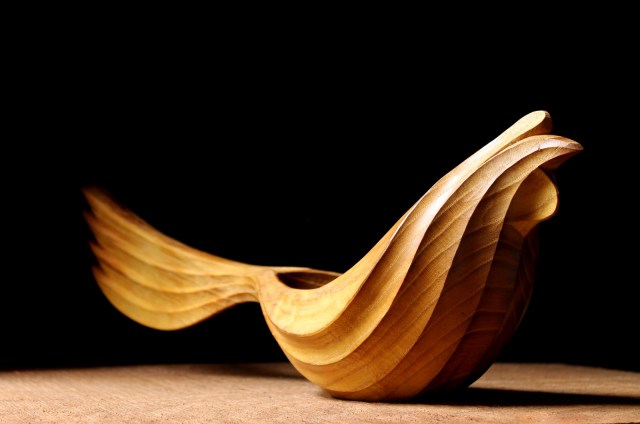
Sketch on the shape for the outer perimeter of the sheath.  I’ve left a bit extra at the bottom for attachment of the wedge and pin tethers.

IMG_0365

I resawed and planed a butternut board down to a heavy 5/16″ (8 or 9 mm) thick.  It can be crosscut into three lengths long enough for the sheath.  My finished sheath is about 3″ wide and 6″ long, but ideally the rough lengths of the three pieces, especially the middle one, will be a bit long at this stage for strength before the glue up.

Transfer the outline of the interior hollow onto the middle board (the line just inside the blue areas, including the white and red).  With a coping saw or other means, cut the shape of the interior.  Do not cut the exterior shape of the sheath (outside the blue area) at this point.

Using glue, sandwich the middle board between the solid outer boards.  The overall thickness will now be about an inch.  Once the glue has cured, transfer the outer perimeter line to the sheath sandwich and shape it accordingly.

IMG_0384

Using a piece of the same board material, cut a wedge corresponding to the upper red area in your paper template, leaving a bit sticking out as a little handle.  With the axe and wedge in place, bore a hole through the sheath and wedge for a wooden pin.  I reamed the hole to a slight taper and trimmed the pin to match.  That allows for a secure pressure fit, but a tight-fitting straight pin would work too.

With a few gouge cuts, I carved away some of the interior walls of the sheath near the back to allow for the thickening portions of the cheeks of the axe head.

There are many possibilities for wooden sheaths.  Just use your — imagination.

Posted in axe, green woodworking, layout, Lettering, patterns, Uncategorized | Tagged , , | 11 Comments

Bright Shrink Pot

IMG_0078

Around me the trees stir in their leaves

and call out, “Stay awhile.”

The light flows from their branches.

Mary Oliver, from the poem “When I am Among the Trees”

That poetry excerpt may look familiar.  I shared it last year in this post, and the poem has now inspired this shrink pot carved in quaking aspen (Populus tremuloides).  Here it is spinning around in the slideshow below.  If you’re viewing this in your email program, click on the title of the post to open it and see all of the photos.


This slideshow requires JavaScript.

The shrink pot is 7 1/2 inches (19cm) tall, 4 3/8 inches (11cm) diameter at the base.  I painted it a sky blue with artist oil paint, then carved through that surface with my penknife into the creamy white wood.

The lid was also carved from one piece of aspen.  It fits snugly to give a pretty good seal to whatever you want to keep inside.  It’s interesting that the fit changes slightly depending on the humidity.  On very humid days, the shrink pot expands slightly, and the lid pushes on relatively easily.  On drier days, the top gives a pleasing “pop” when it’s removed.

And here’s another surprise:  My daughter has a string of battery powered LED twinkle lights.  I popped them inside and…

I’ll offer this shrink pot for sale.  Price is $650 which includes shipping in the US.  I’ll also ship outside the US for a bit more.  If you’re interested, leave a comment below or email me at dandkfish@gmail.com.

Hoping you have a chance to take a walk and read some of Mary Oliver’s poetry this week.  She died earlier this year, but she continues to be an inspiration.  I put her on the cover of my latest sketchbook last week:

SAM_4740


Posted in paint, patterns, quotes and excerpts, sharpening, shrink box, Uncategorized | Tagged , , | 16 Comments

Playing With Cool Sticks

IMG_9809Green woodworking can imply more than just the general notion of working wood that is still relatively fresh with a high moisture content.  Among other things, the term connotes the idea of working with nature, sensitively considering the unique attributes of each bit of tree, rather than thinking of a chunk of wood as just so much plastic.  The carver has to be flexible and adapt to what nature has provided in terms of the flow of fibers and other characteristics.  This can be a serendipitous journey between hands and material as the destination is slowly revealed.  To me, this is one of the most fun aspects of greenwood carving; I just like to play with cool sticks.

I gathered the stick that became this goose-inspired bowl from a small cherry tree that, after years of fighting for light beneath the canopy, had fallen in the woods.  Much of it was in the early stages of decay.  Among other pieces I put in my pack on successive walks, there was a sharp crook with patches of bark already missing and fungus at work on the sapwood.

IMG_9849

As I worked with it back in the shop, the solid heartwood revealed dark streaks and dramatic color variations.  The bend in the fibers guided the design and allowed for a thin elongated tail and a neck stretching upward.

IMG_9817

The twist in those fibers directed the serpentine line that flows from the beak to the tip of the tail.

IMG_9853

I don’t usually sand pieces, but in this case I didn’t want texture competing with the dramatic figure and color of the tree.  Scraping and sanding achieved the effect I wanted with this one.  Actually, there is some subtle contrast in the texture through the piece, with the inside surface left from the hook knife and the underside of the wings left from the gouge.  Fingertips will notice.

IMG_9833

It’s 14 inches measured in a straight line from the beak to the tip of the tail, 8 1/2 inches high, and 3 1/2 inches wide.  I need to hold on to this one for now, but I should have some other things to offer up soon.

Hoping you find some cool sticks this week.

Posted in bird bowls, bowls, cherry, figure, finding wood, green woodworking, Uncategorized | Tagged , | 14 Comments