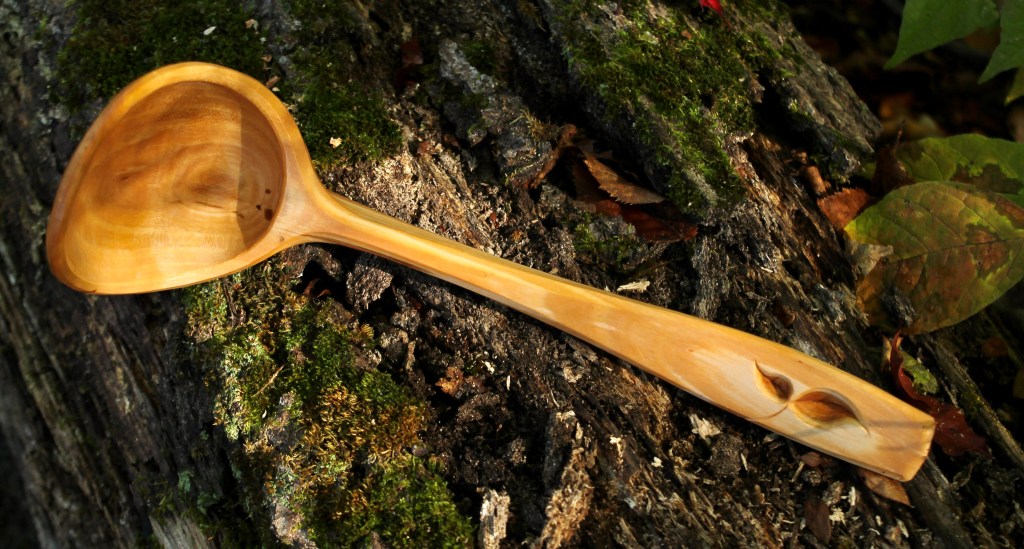
In April, I wrote a post about riving three spoon blanks from branch crooks. I finally got around to carving the finished spoons. All were carved from black cherry.
In the shot above, you can see the difference in the amount of crank in each spoon, each following the flow of fibers in the crook.
Each of these is available for purchase. I’ll post the information for each spoon below. If you’re interested, please email me at dandkfish@gmail.com. Prices include shipping. Thank you.
#1 (above): Cherry Serving Spoon. The heartwood/sapwood pattern worked out very well on this one. 10″ x 3″. $155 SOLD
#2: Cherry Ladle. A crook for a ladle like this doesn’t often come my way. 9″ x 2 7/8″. $185. SOLD
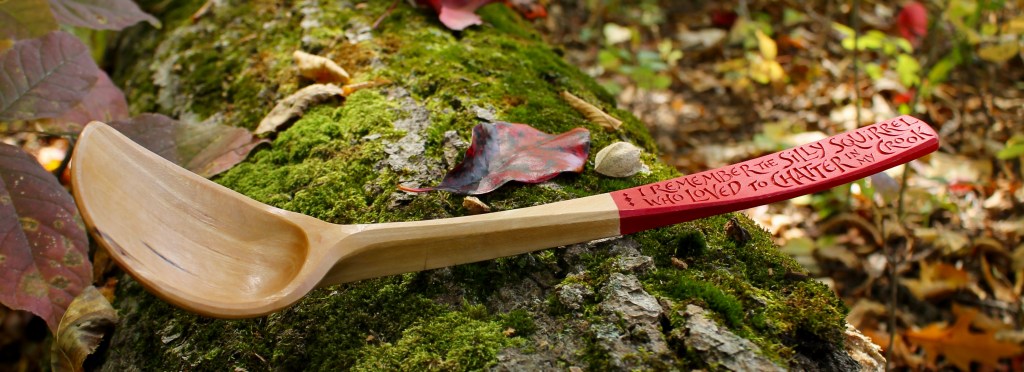
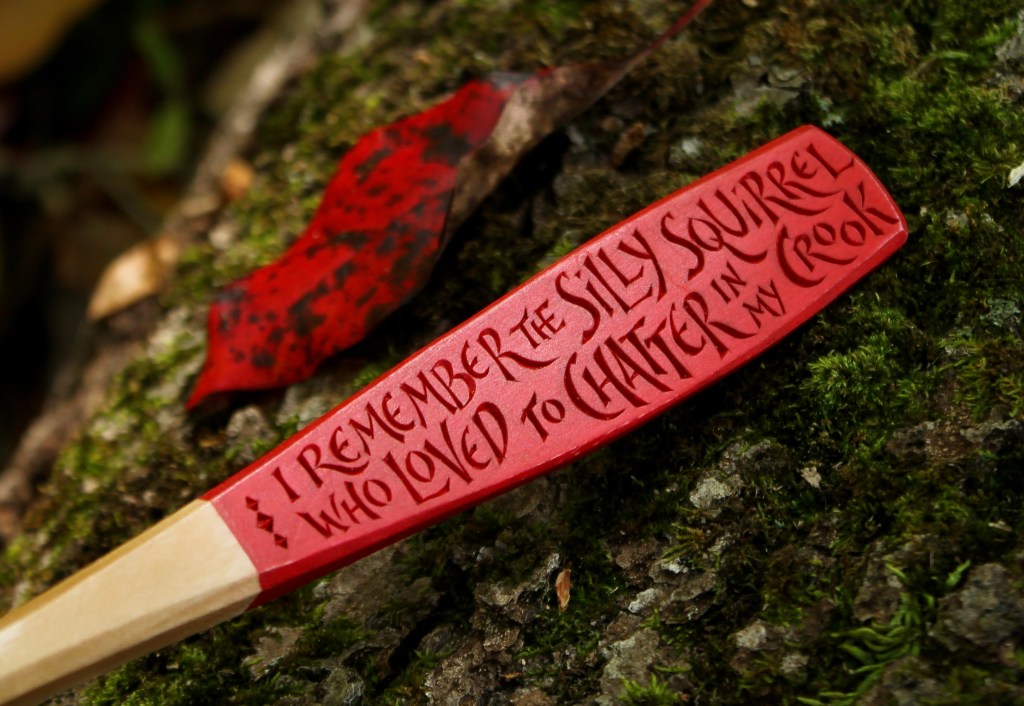
#3: Cherry All-Purpose Spoon. 11 1/2″ x 2 5/8″. I often think about the former lives of the bits of tree I carve, anthropomorphically imagining the things they must have experienced. If they could talk…
I had to wear my cheater glasses to carve that lettering. Painted with artist oil color. $230 includes shipping. SOLD
Everybody should own a tree at this time of year. Or a valley full of trees, or a whole hillside. Not legally, in the formal way of “Know all men . . .” and “heirs and assigns” written on a paper; but in the way that one comes to own a tree by seeing it at the turn of the road, or down the street, or in a park, and watching it day after day, and seeing color come to its leaves. That way it is your tree whenever you choose to pass that way, and neither fence nor tile can take it away from you. And it will be yours as long as you remember.
Hal Borland, “A Tree of Your Own”, New York Times, October 8, 1950
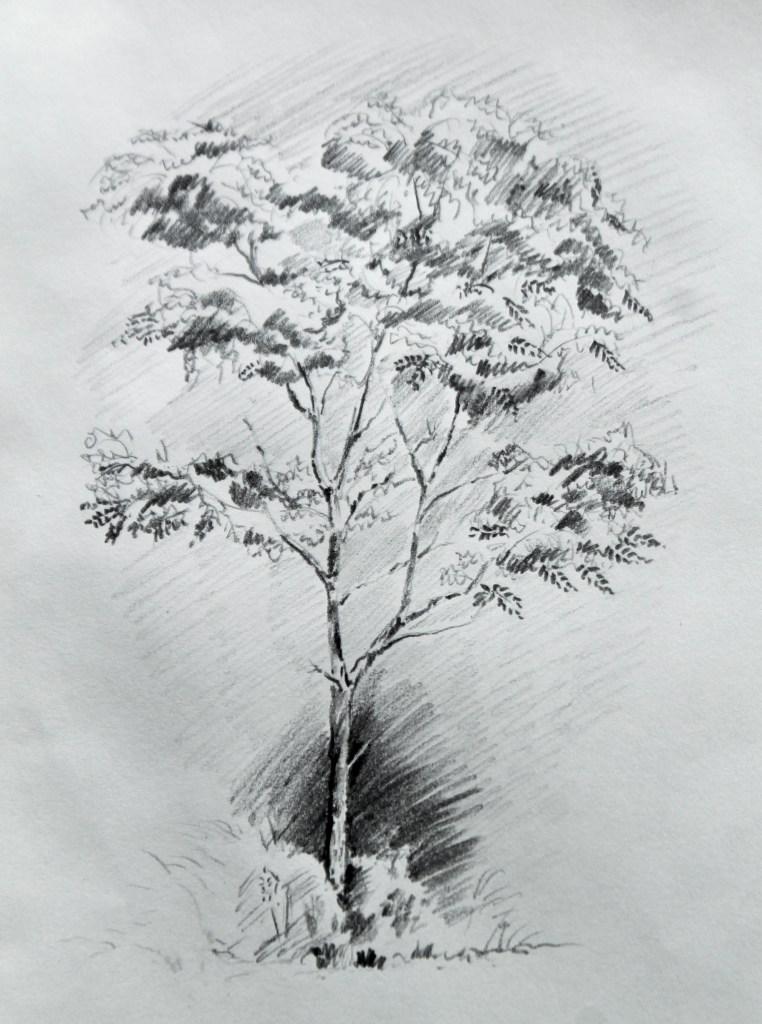
I’ve been getting acquainted with some new individual trees and plants on my walks around our new neck of the woods. The walnut tree in the sketch above lives at the edge of the woods just beyond our yard, and I can see it out the workshop window. In the spring, it was the favorite perch for a talkative catbird. I’m looking forward to getting to know this walnut tree better over the years. Its green summer leaves are just a touch more yellowish now.
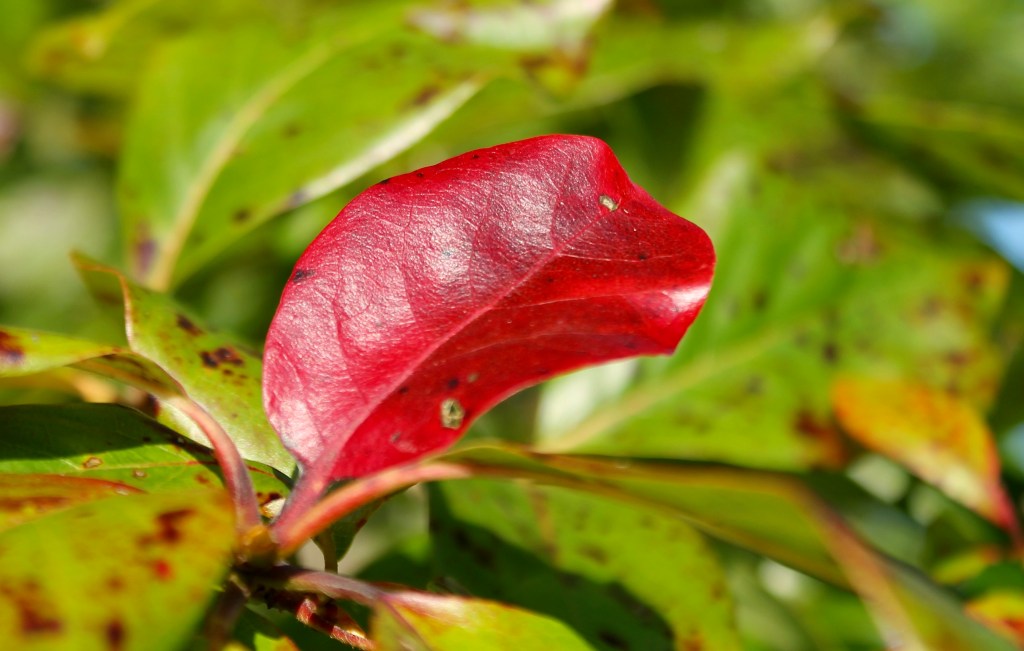
Green is still holding on strong, but the signs of Autumn are showing up every day on my walks, along with the welcome cooler temperatures. Later in the same essay I quoted above, Hal Borland wrote, “And a sour gum is a thrilling tree to own, for its reds and oranges are like no other tree that grows.” There are several nice sour gums (Nyssa sylvatica) I’m getting to know here. They’re just beginning to light up. I snapped the photo above yesterday.
Here’s a nice red sour gum leaf standing out among its fellows.
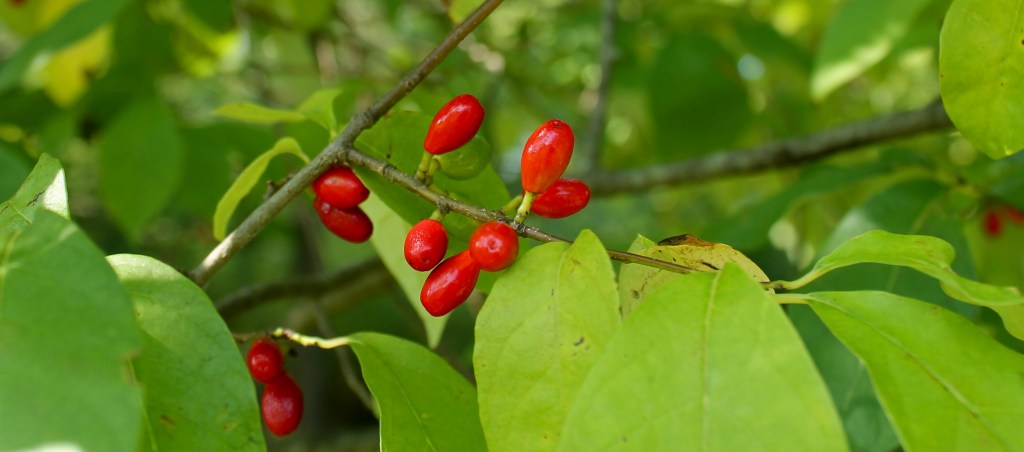
I don’t know if it gets any redder than the spicebush berries. Give a leaf or a berry a squeeze and be treated to a refreshing spicy scent.
Of course, there are other colors ahead of the trees at this time of the year. The fields and woodlot edges have been shining with goldenrod blooms for weeks. All sorts of pollinators have been gorging on them lately.
Pokeweed stems shout out in impossible pink.
The asters are more subtle with their soft violet petals. Kristin told me today as we walked past that they’re September’s birth flower. Makes sense.
And I like these ones with their 1/8″ petals. They abound at the edge of the soybean field. It’s either Smartweed or Lady’s Thumb. I don’t know. I usually call them “the little pink ones at the edge of the bean field.”
The trees will really steal the show next month. I’ll keep an eye on my walnut tree.
I love to watch tree branches dance in a breeze. If the wind really gets up, even the heavier limbs rock and sway. What a ride it must be; one that can shape the limbs themselves over time.
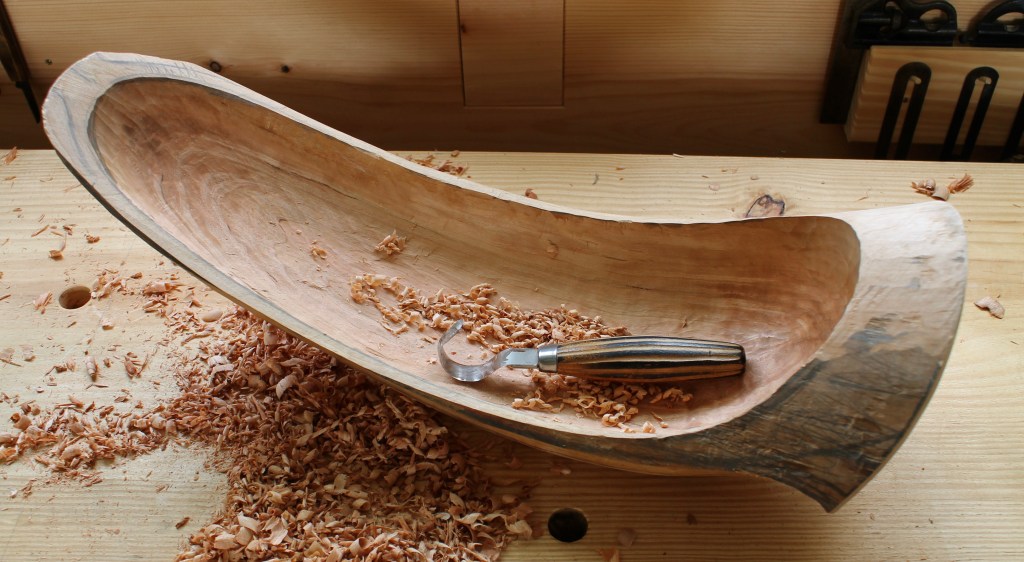
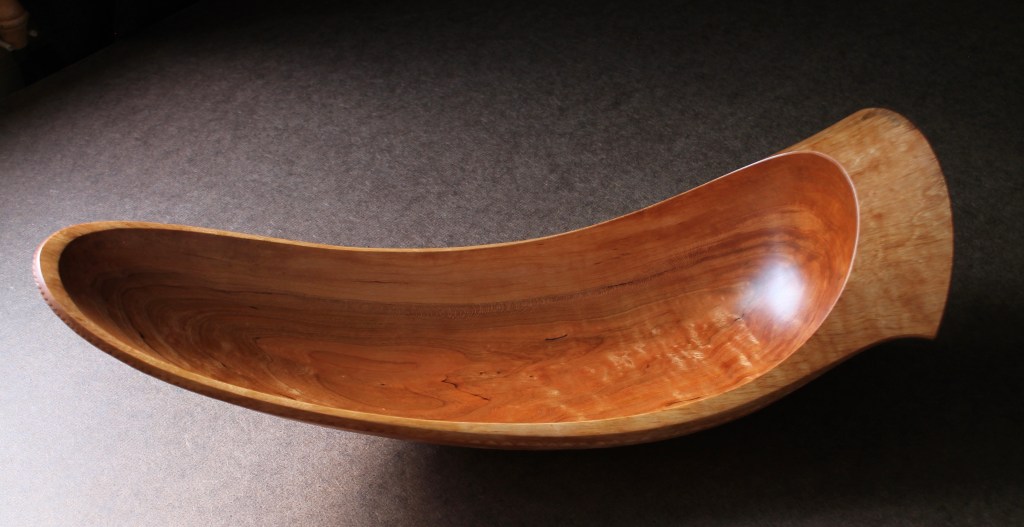
This bowl was carved from a black cherry limb with a curve that spoke of it’s time riding the wind. Eventually that same force brought it to the ground. I wanted to carve a bowl from it that evoked a sense of that movement.
The finished bowl is just shy of 18″ long, 7″ wide, and 5 3/4″ high. I’ll be sending this bowl, along with a few other pieces (more on those later) to an upcoming exhibition at the Wayne Art Center just outside of Philadelphia — way over on the other side of “Penn’s Woods.” The exhibition is called InGrained: Furniture, Sculpture, and Woodturning by Pennsylvania Artists, and it will run from December 2, 2023 through January 20, 2024. It’s an honor to have been invited by curator Mark Sfirri.
More will follow as the specifics of the exhibition take shape, but here’s a link to the general information, including the lineup. In addition to the pieces by current makers, there will be pieces in the exhibition by Wharton Esherick and George Nakashima.
When it came to carving this piece, the figured grain and rapidly-changing fiber direction of this limb was a challenge. I found that the best method for refining the shape of the hollow was using a hook knife, heavily skewed, with many light cuts in quick succession. The wood was thoroughly dry by this stage.
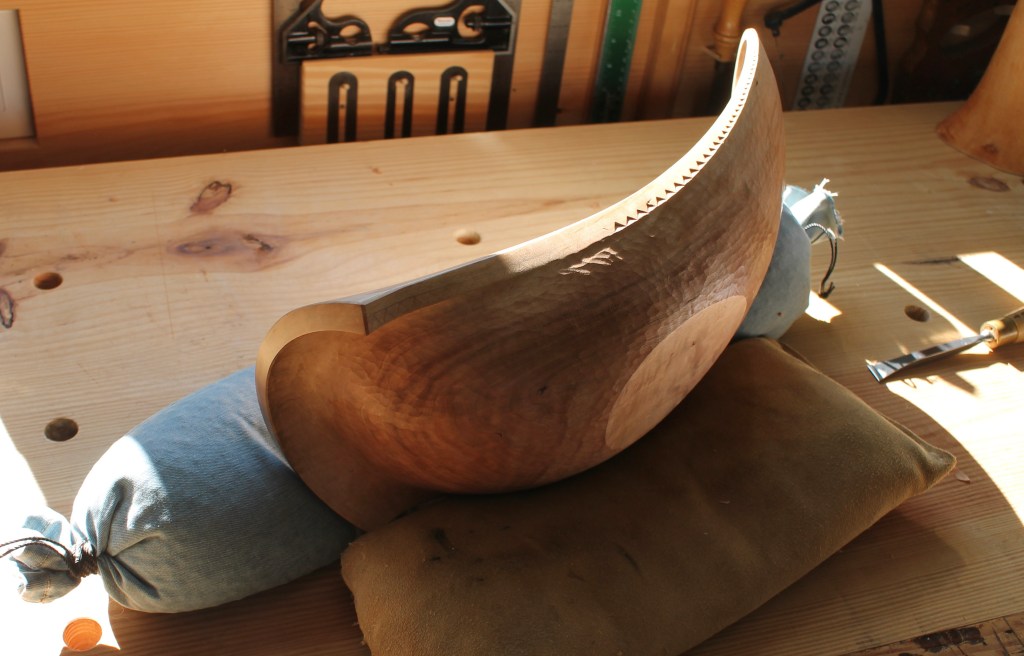
To do justice to the figure in the wood, I decided to smooth the hollow of this one with a card scraper, followed by hand sanding with very fine sandpaper. This contrasts with the dappled texture of the gouge-cut exterior surface. A shape like this can be a challenge to support while working, which brings me to a bag of beans.
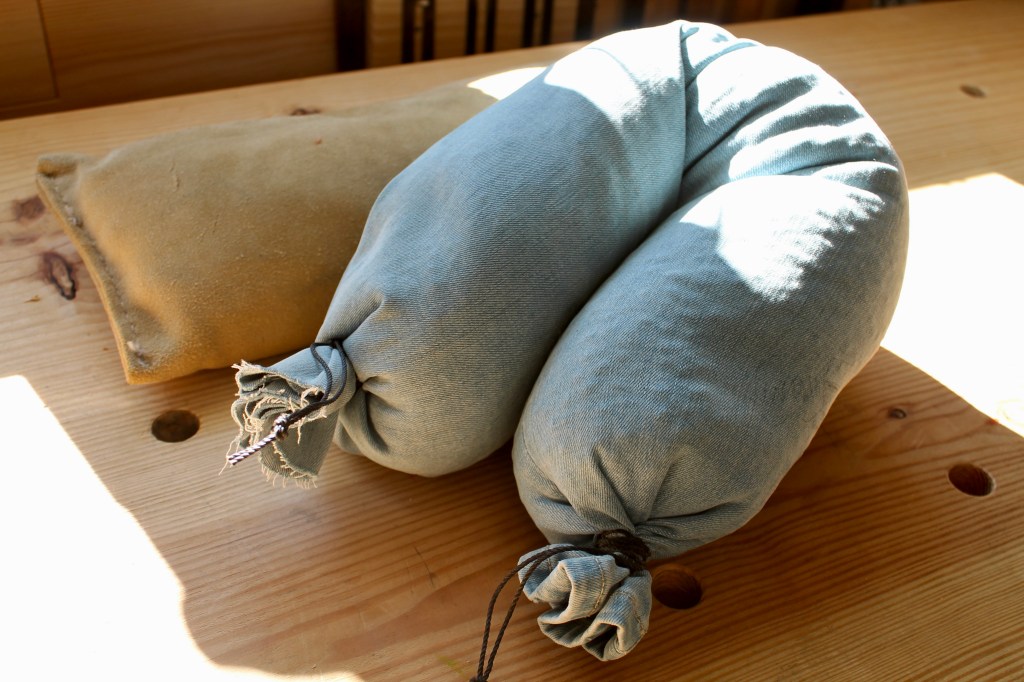
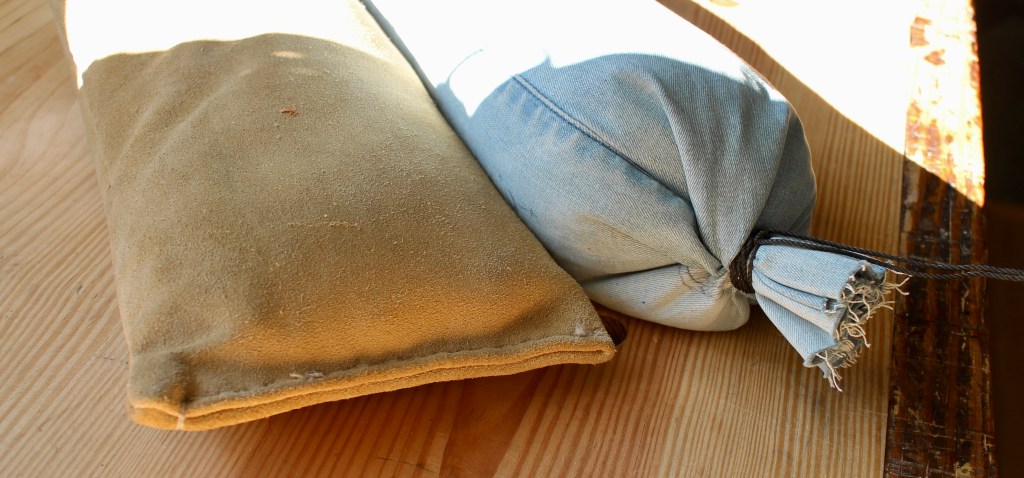
Several years ago, I made a sandbag from heavy suede leather. That’s it in the back in the photo above. It’s very useful for supporting odd shapes, especially. I use it in all sorts of ways. It is a bit of trouble to make, requiring the leather and a good bit of heavy stitching time.
Maybe a year ago, I wanted another one. This time I took a leg off of a pair of jeans and filled it with dried beans. Dried beans are pretty cheap and they won’t make much of a mess if they should break free. I used my son’s old jeans, which turned out to be a good choice. His jeans are skinny and stretchy. Mine are neither. The flexibility of the material allows it to take various configurations, while still holding the beans firmly.
The bean bag took a fraction of the time to make compared to the sandbag. Mainly because there was no stitching involved. I just wrapped and tied one end tightly with strong cord, poured in the beans, then secured the other end with cord the same way. I’ve heard that some folks have also used rice with good results.
I used the bags to support this bowl for the chip carving, but there are all sorts of other uses combined with holdfasts, etc. I missed some photo opportunities with this one.
I don’t always carve a design on the foot, but this one seemed to call for it.
I’ll share the other pieces that will be heading to the exhibition over the next couple months. I have to finish some of them first! All of the pieces I submit will be for sale during the exhibition.
As soon as I opened the pack of shims, I recognized the particular scent. I took a closer look at the package and noted that the manufacturer celebrated this wood as superior to the spruce, pine, cedar, or plastic used by other producers. So what wood is it? They call it “Beddar Wood” and have that trademarked.
These shims are made in Minnesota by Nelson Wood Shims. For some reason, Nelson states what species their shims aren’t but doesn’t reveal what they are. A marketing choice I guess. A few cuts with my knife confirmed what my nose told me. It seems to me that Beddar Wood is basswood (Tilia americana), and that’s good. A pack of 42 12″ shims is only 7 bucks (about 16 cents per shim) and available at just about every home center and hardware store. They make them in several other lengths and configurations.
With their acute taper, shims like these, whatever the wood species, can serve in many ways in the workshop:
Steady a wobbly bench or work table
Level a chair or bench in preparation for trimming the legs
Keep a workpiece from rocking on the benchtop
Clamp workpieces using a peg-and-wedge system
Sacrificial pieces between a workpiece and clamps
Glue spreaders
Stir paint or finish
Sample boards for paint color
And, especially because these are basswood, carvers may find them useful for practice or testing out new patterns. You could trace your latest spoon handle onto the shim and experiment with some carved decoration. I could even see these being used for carving butter spreaders, an exercise often used to teach about grain direction and carving techniques. I think they could be great for kids, or adults, to carve little figures. Just stick to the thicker end of the shim or you’ll quickly have a pierced carving.
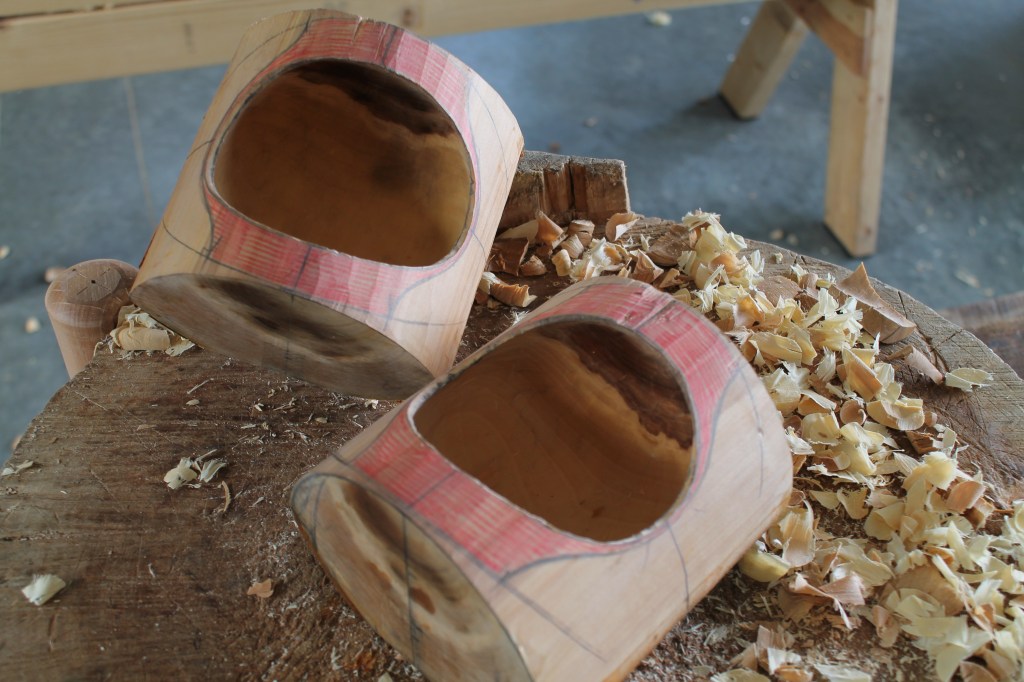
A couple weeks ago, a friend brought me a length of clear apple tree trunk, about 6 or 7 inches in diameter. Apple is relatively hard and dense, even when it’s green. Then it tends to move a lot as it dries. It’s hard to beat for spoons, but in this case I decided to rough out a couple compact bowls that will have some carved side panels. The apple wood will hold small details at this scale well.
No need for an adze to hollow these. I bored a hole in the center, then worked with gouge and mallet followed by a hook knife.
I roughed the outside with an axe, then went to the bowl horse.
The drawknife took care of the general rounding.
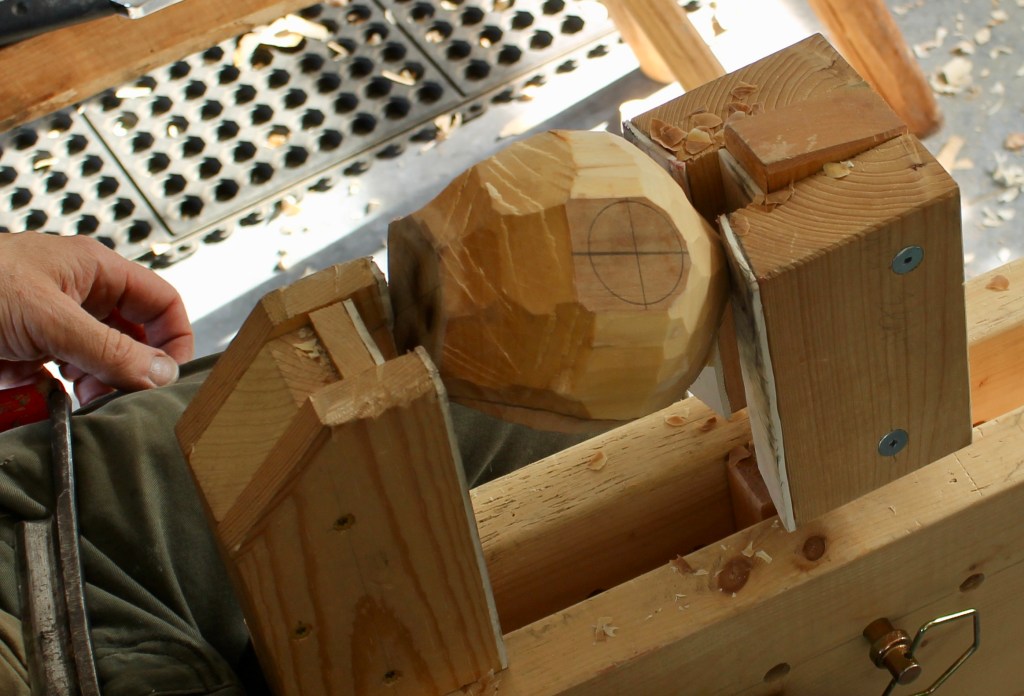
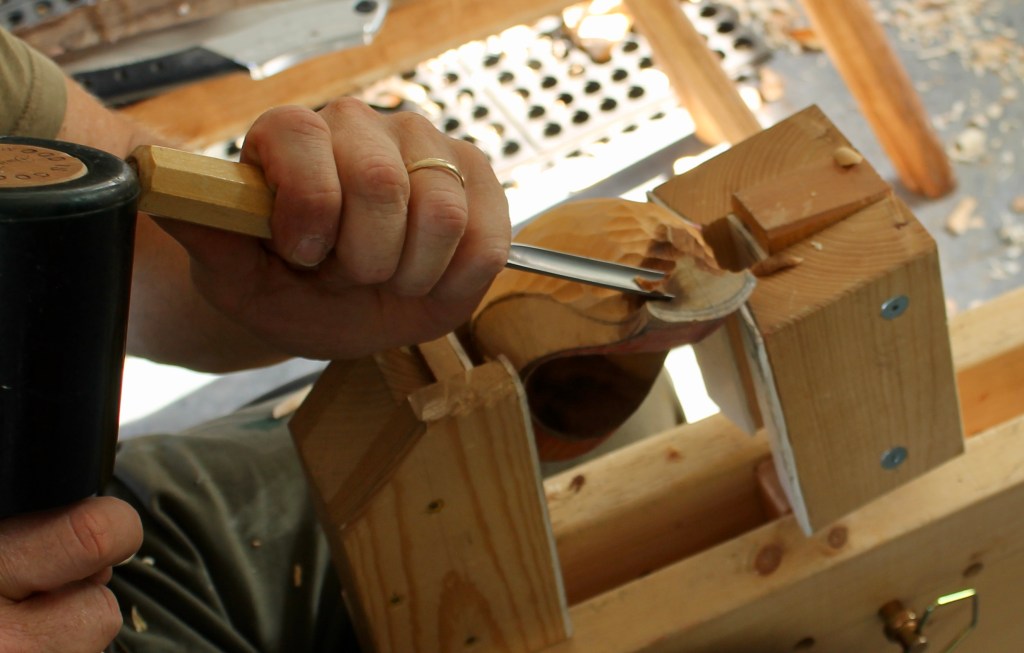
With this design, there’s a lot of end-grain carving, including the tricky area under the arched handles. To rough that out, I used a steep (#9) gouge and a mallet. Sharp strikes.
A spokeshave fairs the curves.
Some paring cuts with the gouge finished up the area under the handles. Then it was time to set it aside to dry before round two.
I had this little end grain disc from the end of one of the apple blanks. When it was green, that upper surface was flat. After drying for a couple weeks, it’s pretty clear how much it moved. Had this been a disc of the whole log, including the pith, it would have cracked, of course. Something’s gotta give.
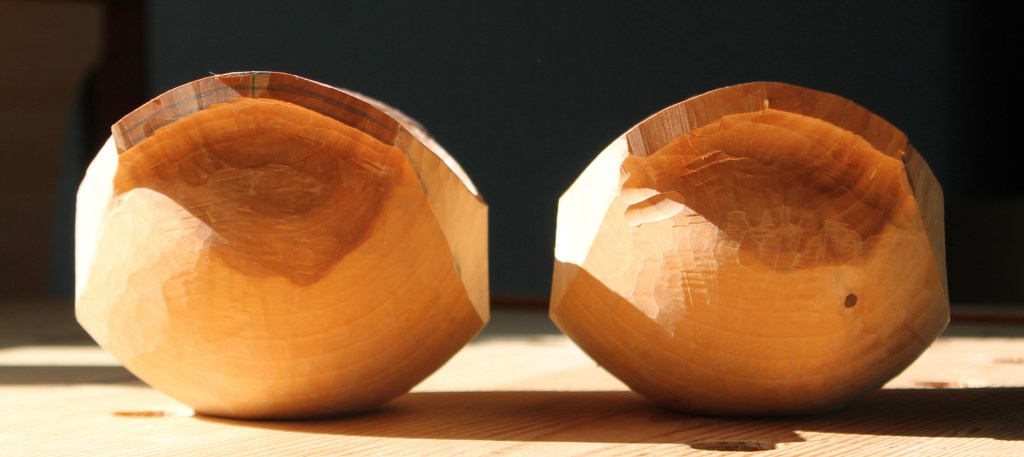
The same sort of movement has now taken place in the bowls, but it’s not as noticeable since they had arched tops already. They’ve just arched more. Any unwanted wonkiness can be reshaped now.
A look at the feet of the bowls shows the movement too. Those ovals were circles before drying.
Lots more to do with them, so I’ll get back to them soon enough. Meanwhile, several other projects are underway at different stages that I’ll share in upcoming posts. Here are progress shots of three of them. Cherry, cherry, and…cherry.
Ever since encountering Amy Lowell‘s Imagist poem The Green Bowl, published in her first poetry collection in 1912, I had wondered about it. Was it inspired by an actual bowl? If so, does it still exist? Who was Roger, the carver of this little bowl? Here’s the poem:
The Green Bowl by Amy Lowell

          This little bowl is like a mossy pool
          In a Spring wood, where dogtooth violets grow
          Nodding in chequered sunshine of the trees;
          A quiet place, still, with the sound of birds,
          Where, though unseen, is heard the endless song
          And murmur of the never resting sea.
          'T was winter, Roger, when you made this cup,
          But coming Spring guided your eager hand
          And round the edge you fashioned young green leaves,
          A proper chalice made to hold the shy
          And little flowers of the woods.  And here
          They will forget their sad uprooting, lost
          In pleasure that this circle of bright leaves
          Should be their setting; once more they will dream
          They hear winds wandering through lofty trees
          And see the sun smiling between the leaves.

From A Dome of Many-Coloured Glass (Houghton Mifflin Company, 1912).
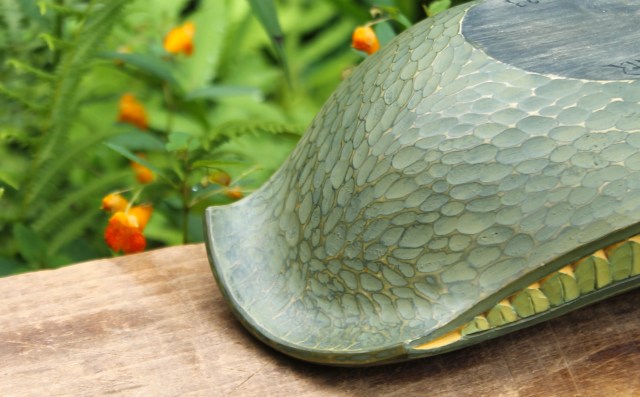
I decided to carve my version of Amy Lowell’s green bowl. I suppose, if I had adhered to the clues offered, that the bowl should have been round. Maybe in the next version. This time I went with a side-panel form à la Bengt Lidstrom. It’s a tight little bowl, just 10 1/4″ long, 5 1/2″ wide, and 3 3/8″ high. Carved from quaking aspen.
It gave me a chance to play with milk paint and explore a bit. I used many thin layers and rubbing back to create a sense of age and texture.
The bowl may have only existed in Lowell’s imagination. I still wonder though. Those of you in the Boston area, keep your eyes peeled at estate sales for an old green bowl with “Roger” on the bottom.
If you’d like to hear a reading of Amy Lowell’s poetry and learn more about her, here’s a link to a presentation given at the Boston Athenaeum several years ago.
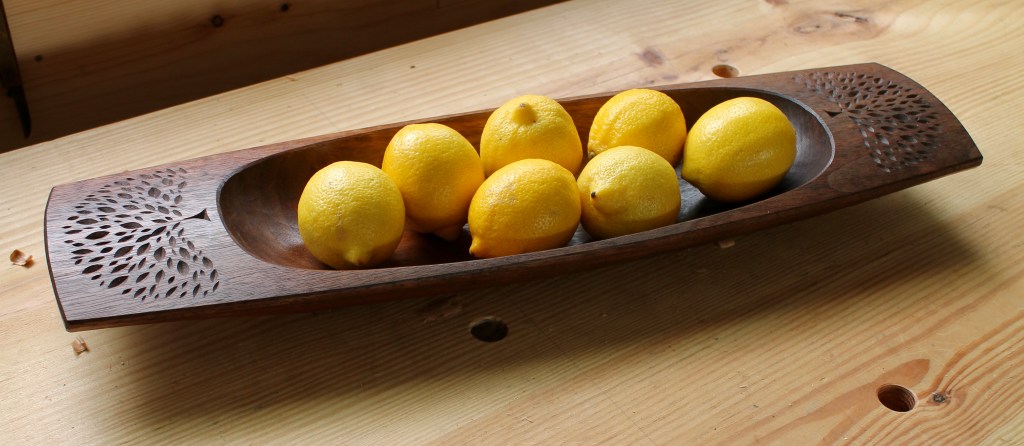
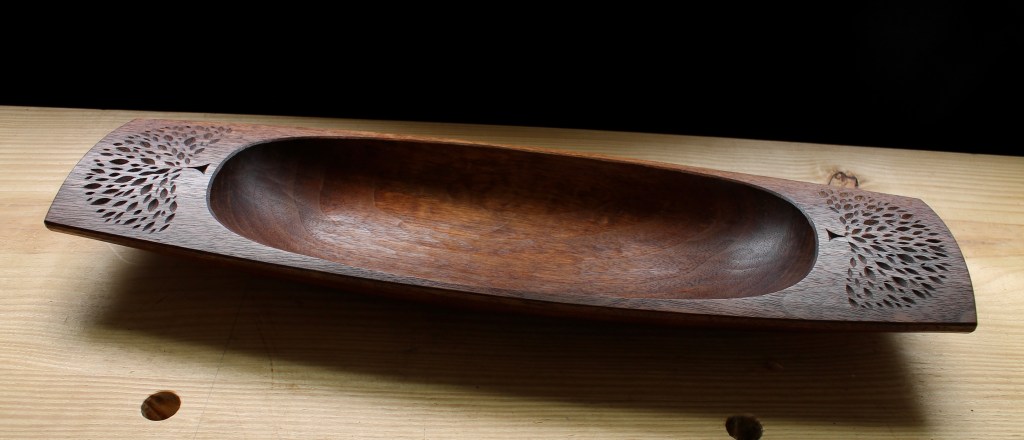
I had to put this bowl aside eight months ago, unfinished. I finally returned to it last week when I brushed off the dust and focused on the handles. This bowl was carved from a dry walnut plank. I documented the process in two previous posts, here and here.
Walnut Bowl-from-a-Plank
Originally, I was thinking about some carved lettering on the handles, and that will probably happen on a future version. But the idea of a figurative tree kept rolling around in my head, so I started scribbling some ideas, settling on an outline for the tree form.
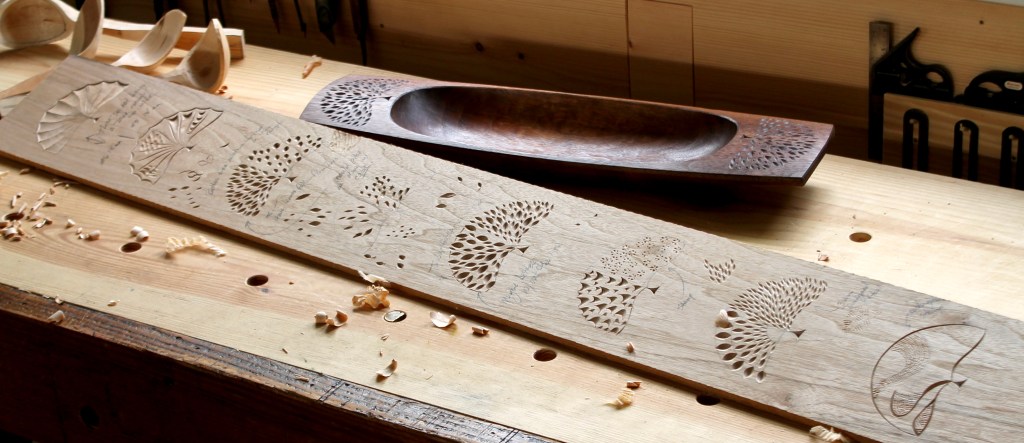
To continue developing the pattern, I grabbed a board and laid out a whole series of the tree outline in pencil. Then I started playing with some carving tools. I think the important thing with this process is to not edit your ideas too soon. Move forward with them, because there is no risk. If you think “That will probably look stupid,” go ahead and confirm it! That board above is full of silly ideas, but some of them may trigger something down the road. The sample board also reveals when a design conflicts with the realities of wood and grain direction.
A few of the sample trees represented variations of what I ultimately went with, using straightforward cuts with a bullnose gouge. I wrote about that tool and technique in this post.
I’ll probably offer this bowl for sale eventually, but there are plans in the works to write and shoot an article about this bowl design. So I’ll be holding on to it at least until that process is complete.
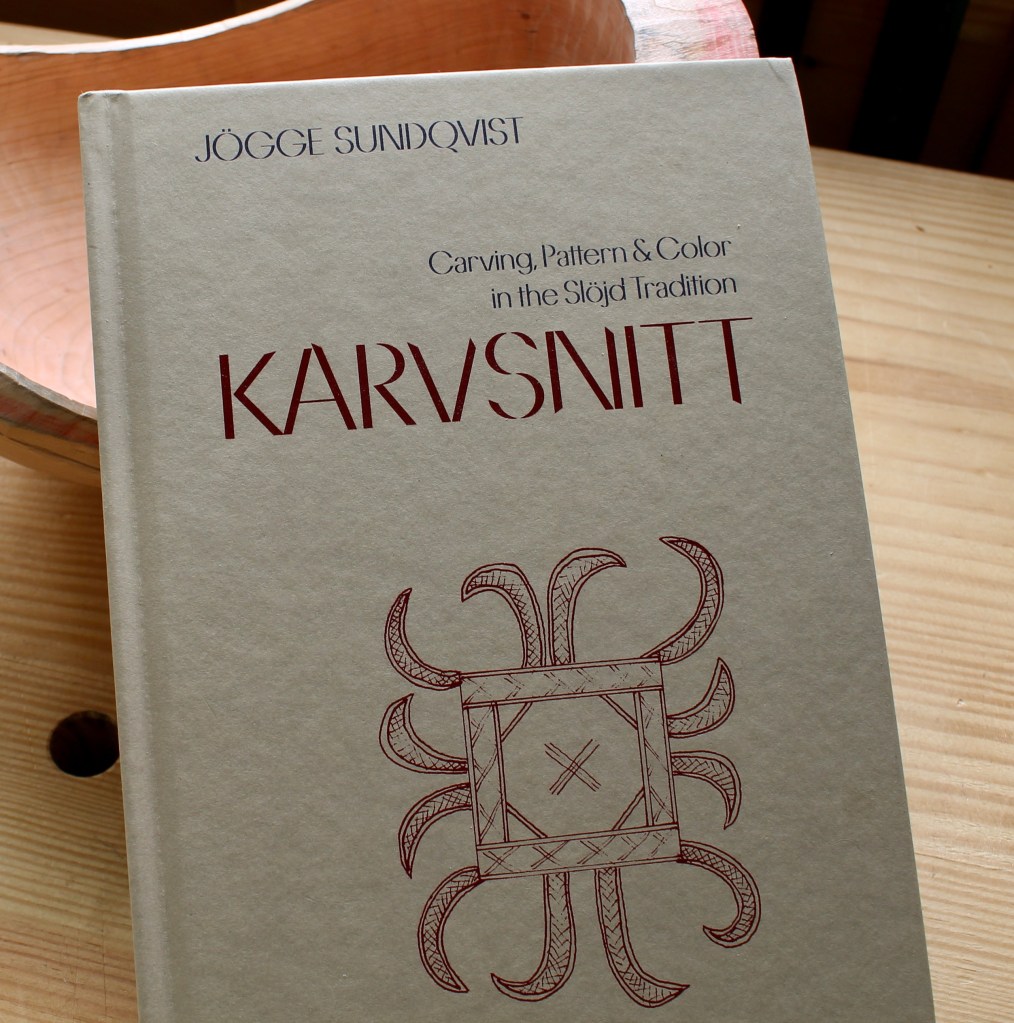
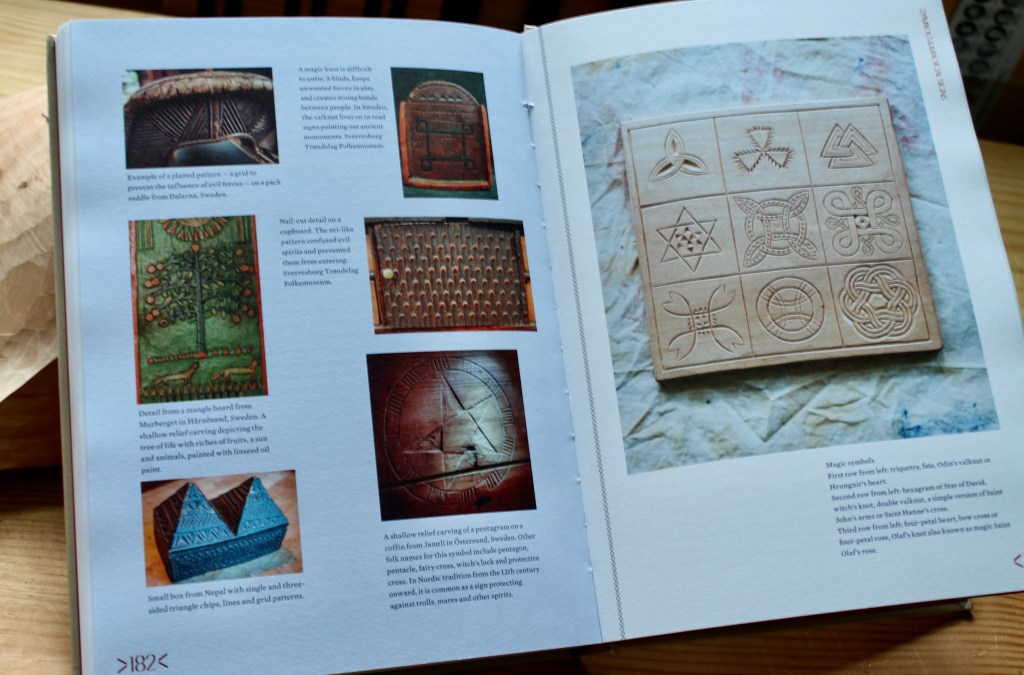
For some real pattern inspiration, I’ll recommend the work of three pattern masters, starting with Jögge Sundqvist. Jögge’s new book is now out in English and it is fantastic. I can’t recommend it highly enough. You can check out the full table of contents and learn more about it at Lost Art Press.
Jögge shows and discusses many historical pattern examples and explains how they inspire new designs.
Another pattern expert is Peter Follansbee, of course. Peter’s “Joiner’s Notes” blog is what led me to begin my blog several years ago. And it’s full of carving pattern resources. Peter has a new blog rolling on Substack now. Many posts feature historical pattern photos and information. Yesterday, his post was about arched designs with some great examples.
Another person who really understands patterns is David Berman. David is an expert on the work of English Arts and Crafts designer CFA Voysey. He recreates Voysey’s designs into wallpaper and posters which he offers through his business Trustworth Studios. A look there at the wallpaper designs can inspire many patterns.
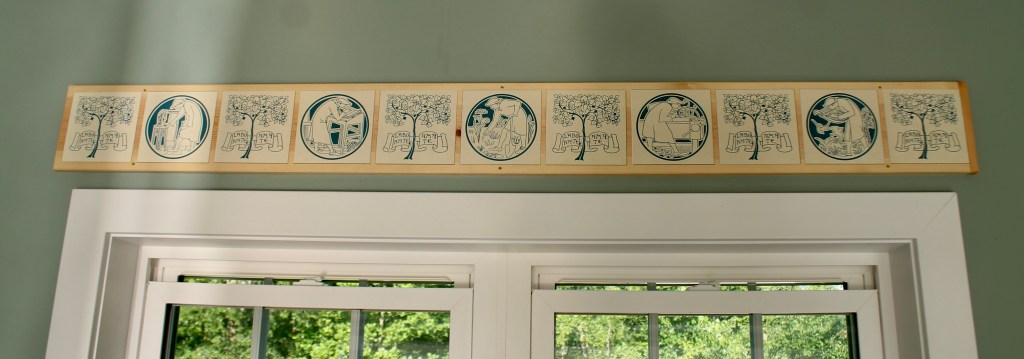
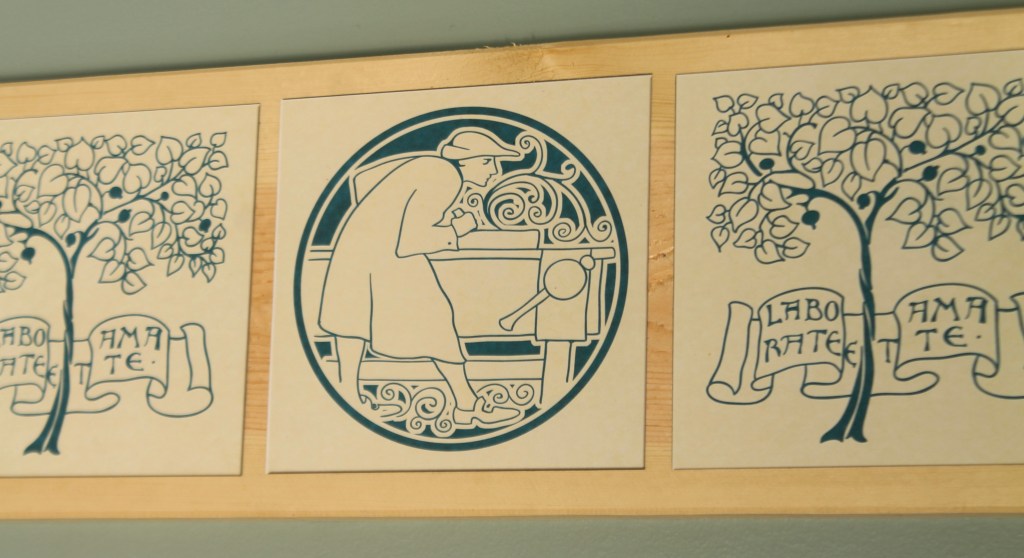
One Voysey design, originally for tile, that David transformed is “Laborate et Amate” (Labor and Love). I took a section of the wallpaper and cut it into individual 6″x6″ squares, then mounted them to a pine board above my workbench windows. The contrast will increase over time as the pine darkens.
There’s a sculptor, a scribe, a gardener, a musician, and (of course) a woodworker at the bench. I love the pattern of shavings coming out of the plane.
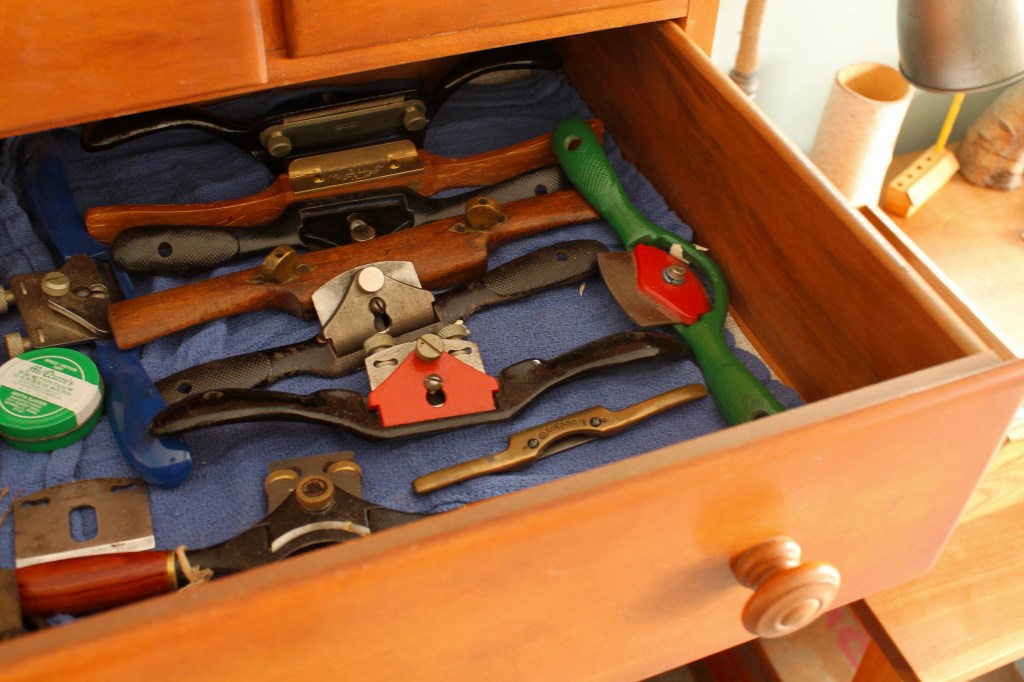
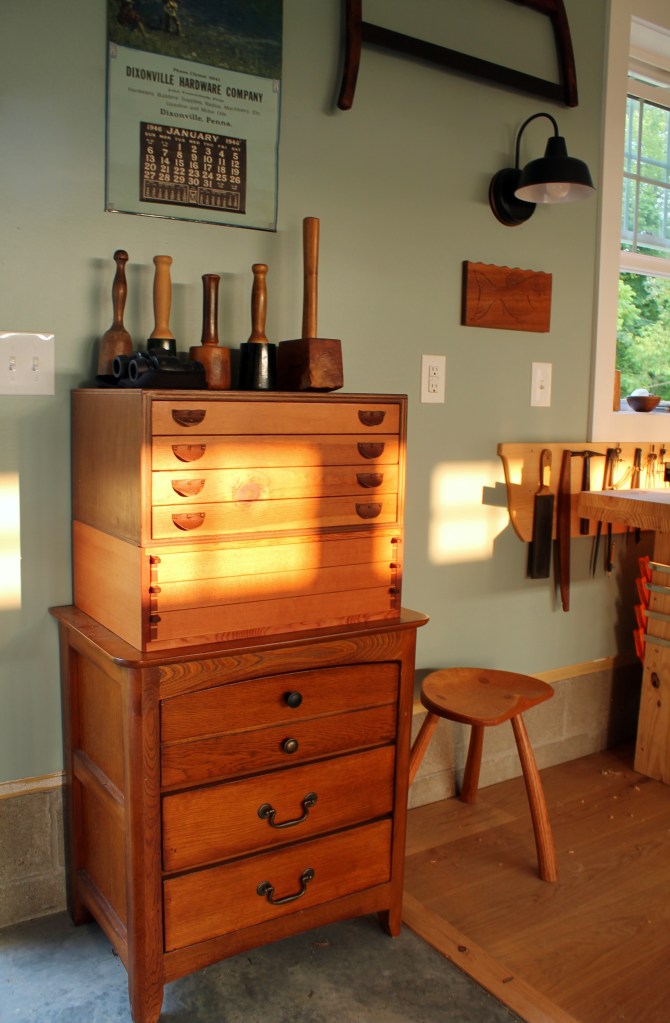
A couple posts ago, the one about the wall shelves, I showed the photo below and someone asked about the chests of drawers. They are part of my approach to organizing the new shop which emphasizes things like repurposing, avoiding clutter, and flexibility. The chest of drawers on the left (below) had been in our room in the old house. We found we were able to get by with one less dresser in the house, so it came to the shop. It and the chest of drawers beside it now hold tools and other shop supplies. Instead of a sock drawer, I have a spokeshave drawer. And a backsaw drawer, and a molding plane drawer…
Old “out of fashion” furniture like this can often be had for very little money at yard sales and flee markets. I found the chest of drawers beside the desk at a local flea market a few weeks ago. It is absolutely solid. It was made from maple at a furniture manufacturing facility — probably in Pennsylvania. The paper label from the manufacturer was mostly gone, but there is a blue crayon scribble on the back indicating that it was sold from Donaldson’s Store in Arbuckle, Pennsylvania on September 10, 1943. Sold to Donald Yost for $39.75 (That’s equivalent to about $700 today). That scribble wasn’t meant for my benefit, but I appreciate it. Scribble on your furniture.
I made the writing desk under the window years ago. With no room at the inn, it also came to the shop. And that repurposing theme goes on. Old dented filing cabinets, wood crates, etc. They’re practical and pleasing to the eye.
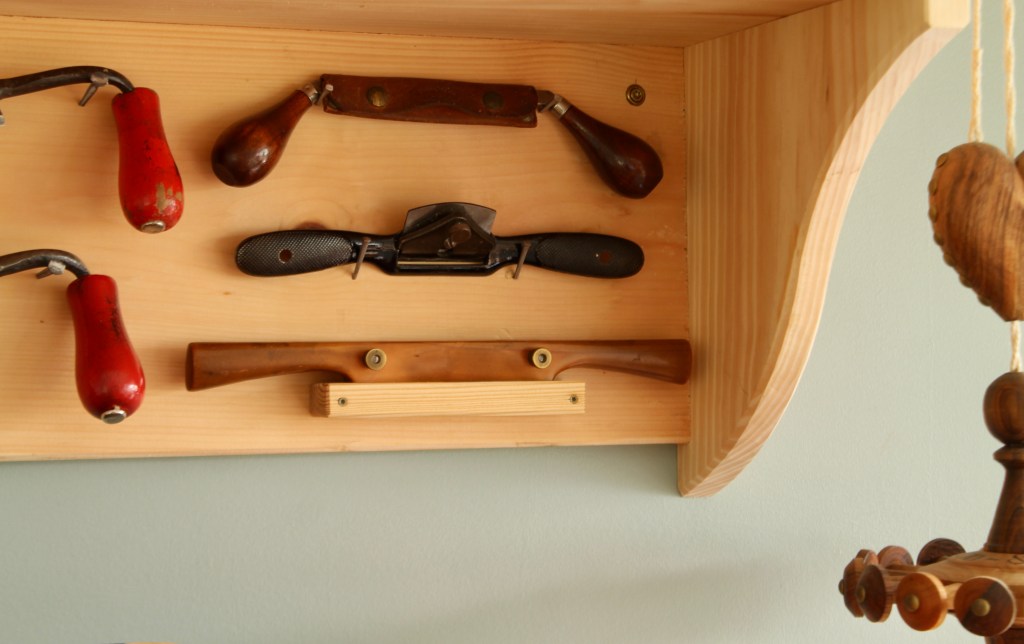
I find that I use a handful of tools far more often than the rest. I keep those close at hand for quick access, like the spokeshaves and drawknives above. The rest are in drawers away from dust, but still ready to serve with no digging around in a deep cabinet.
Many of the tools I use frequently at the bench are within easy reach either on the windowsill, the board on the wall right behind the bench, or on the bench itself. The stack of chests of drawers to the left holds carving tools, mainly.
I made the two cases with the shallow drawers years ago, but I picked up the little stand with drawers below them at the flea market recently. It was $38.
These shallow drawers are like trays and can be pulled completely out and taken to the bench if desired.
I did spring for a mobile tool cabinet (by the garage door in the photo above) with heavy duty drawers. It holds heavier tools and sharpening equipment. My grinder is on top along with a small metalworking vise and space to use my sharpening stones.
The central area of the garage is the spot for several things: two bowl horses (the new version and the original log model), Low bench, chopping block, old carpenter’s tool chest, English shave horse, and some other odds and ends, including a sleeping dog. I don’t turn much, but my spring-pole lathe is disassembled in the shed and I can set that up in the shop if I need to do some spindle turning.
So, the shop is ready to roll. It may look nice, but, more importantly, it’s working well. The chips have been flying and a few projects are underway.
It had been several months since I had roughed out a bowl from a log, the longest period of time in the last 25 years or so. There’s still plenty of settling-in to do here, but I was able to take advantage of a wind-fallen cherry tree to get back to swinging an adze. It felt good.
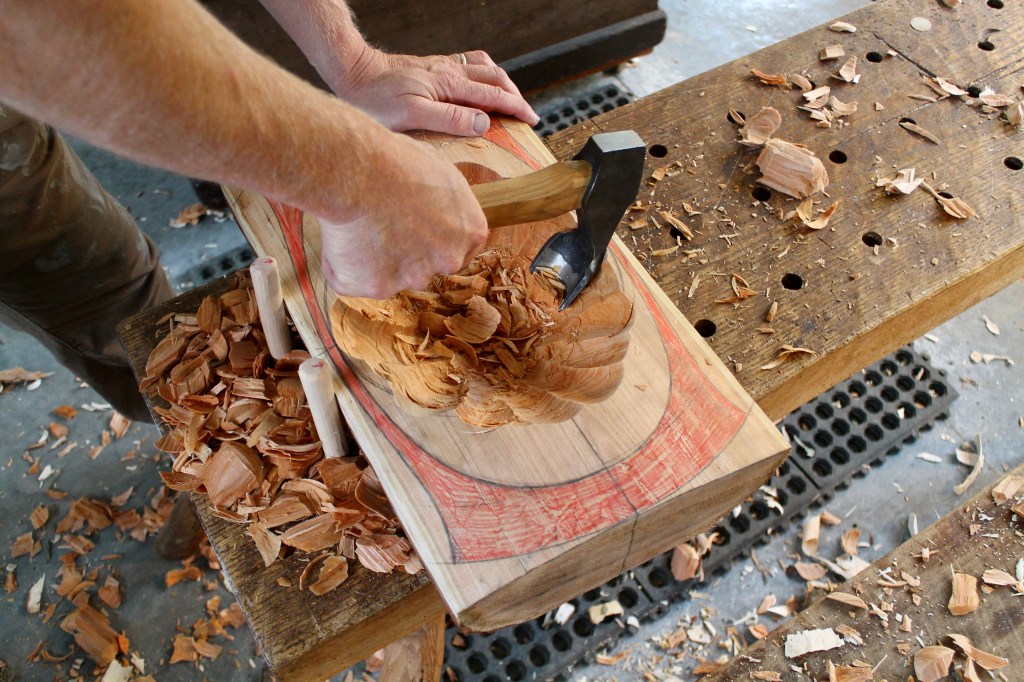
For a blank this large, my preferred way to hold the blank is to set it flat on my low bench with the end up against a peg or two. If the blank is smaller/lighter, then I may put pegs on the opposite end as well and drive slim tapered wedges between the blank and the pegs. With the method above, I can stay on one side of the bench and spin the blank around to work the opposite end.
With or without wedges, I’ve found that pegs that wedge tightly into the hole work best. So I taper them ever-so-slightly. They’re long enough that they can be knocked back up from beneath. They should also be from a tough wood. I split and shaved these last week from a small hophornbeam tree that had fallen nearby.
Above, I’m cutting the lateral trench across the grain with the bowl blank up against the two pegs.
50mm bowl adze by Oscar Rush
This also gave me a chance to work more with a bowl adze made by Oscar Rush. There are many more people making adzes these days than when I got started, and I haven’t had a chance to try even a small fraction of their tools. There may be dozens of sweetly performing adzes being made by different folks that I haven’t tried. Of the ones I have tried, it’s unusual to find a really good one. I’ve mentioned a few good ones before. An adze is a tough thing to get right. Oscar has got it right as far as I’m concerned. And I like that he has left enough meat on his handle to allow for some minor adjustments to suit personal preferences. You can see in the photo above where the wood is a little lighter near the kick at the bottom of the handle. I like it to narrow like that at the front. Took about five minutes.
It’s nice to be surrounded by fragrant cherry chips and shavings again.
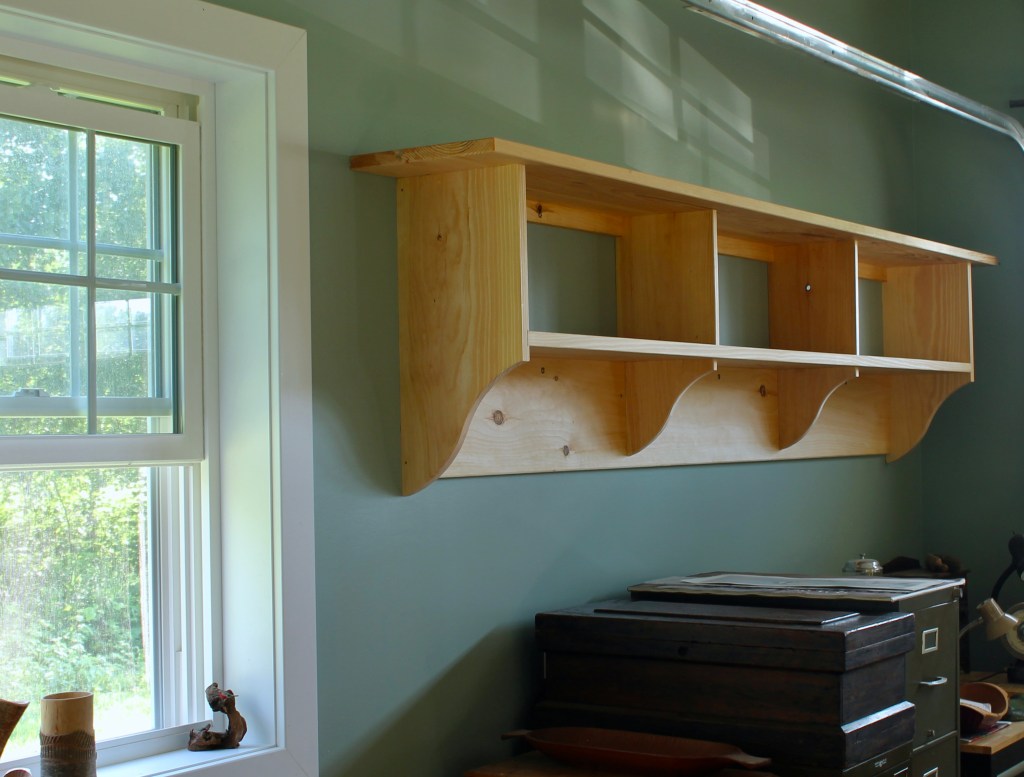
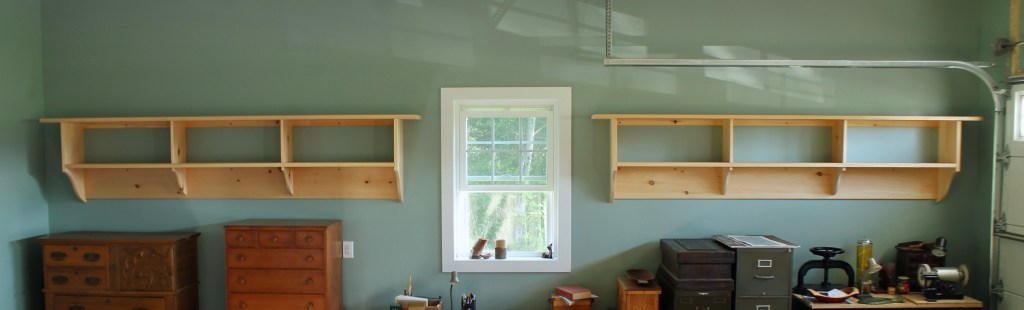
Hanging wall shelf, one of two, 9′ long x 25″ high x 12 3/4″ deep
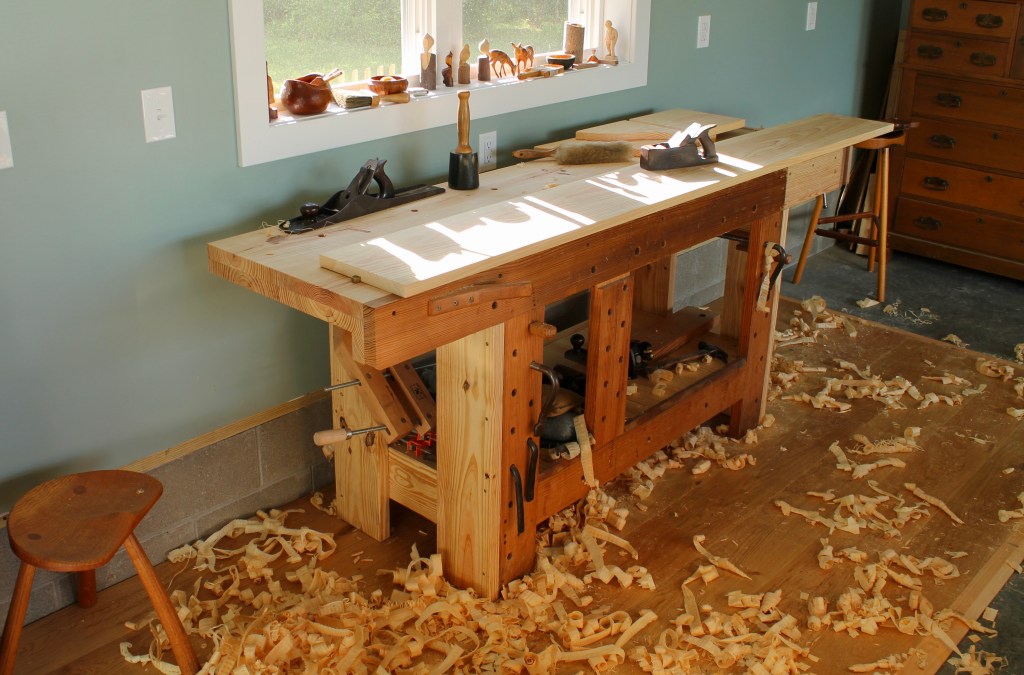
Building two matching shelf units to hang on either side of a central window in the garage/workshop was the first real testing ground for the new workbench. It works, and so do the shelves. I wanted them to hold a full load of books with no sagging. The lower ledger board flat against the wall supports the length of the shelf above and also provides a surface for hanging tools (more on that eventually). It, and the narrower ledger above, also provide anchor points for plenty of strong screws to connect the shelves to the wall framing behind the drywall. The top shelf can hold all sorts of things, including books.
The lower ledger boards were 3/4″ (19mm) thick 1 x 12 pine boards from the home center. But the rest of the material was white pine from a local sawyer. They were much beefier, finishing out after planing to 1 1/16″ (27mm) thick. This made for much stiffer shelves. Above you can see the simple setup for edge-planing an 8-foot board. (That is just a single board; the color difference is just from light exposure in storage.) A couple holdfasts and the crochet at the end held the board right where I needed it, even with pressure on the free end.
For the surface, I just put a bench dog in the far dog hole as a stop and set the board on the bench top.
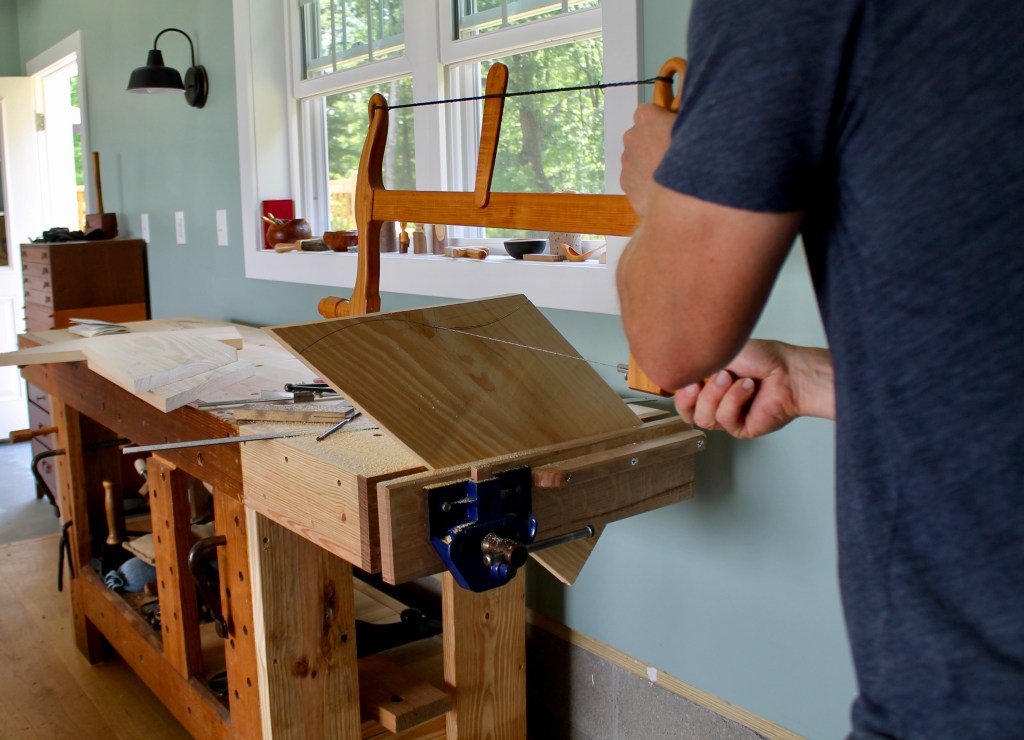
To saw the curved profile of the vertical shelf supports, I put the boards in the end vise. The stability of the length of the bench resists any movement from the motion of the bowsaw. You could, alternatively, extend the board over the edge of the bench top, secure it with holdfasts, and saw vertically.
To clean up the curves, I positioned the boards like you see above. With the direction of force toward the end of the bench, the leg of the near holdfast prevents any rotation of the board.
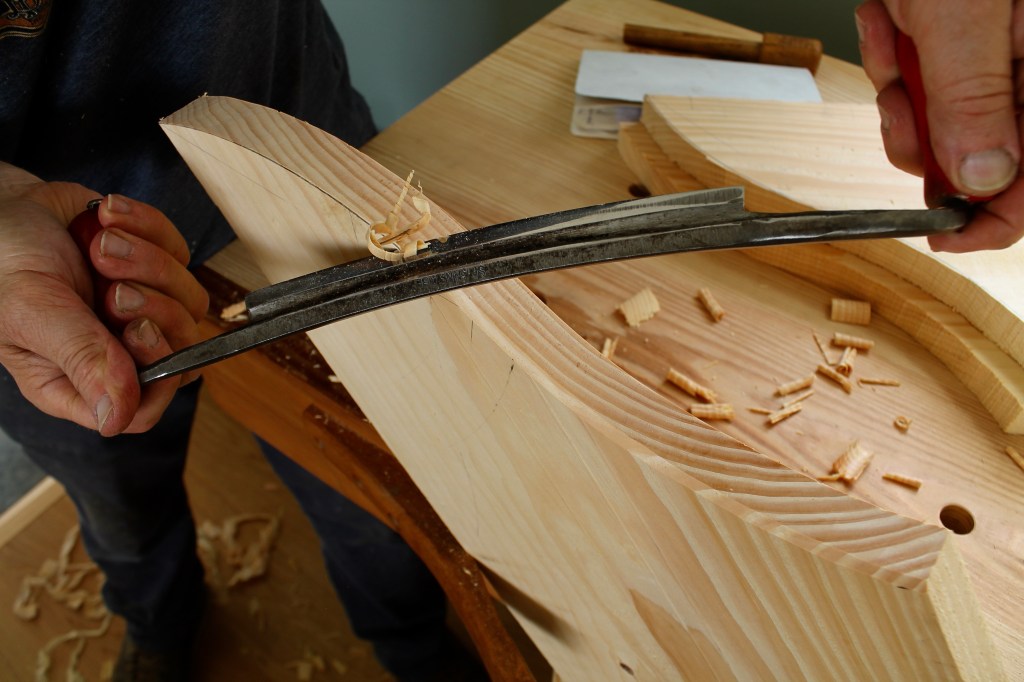
I looked all over for which box contained my spokeshaves, but I couldn’t find them. Turned out to be a blessing, because the drawknife worked well and was great fun.
I also used the drawknife to cut a chamfer along both edges of the curve.
Two dogs held the boards for face planing in one direction…
and in the other direction.
Edges required just a couple pegs and the crochet.
The dadoes in the vertical boards were the standard practice of work with knife…
saw…
and chisel. Then a little cleanup with a router plane.
Assembly occurred on the floor with some glue and some screws.
There’s the shelf to the right of the window.
So, both shelf units were up and ready for loading.
Loaded they are. I’ll go more into tool storage and general shop organization later, but for now you can get an idea of how I’m employing the shelving units and where they are in some context.
Here’s the other side. Some adjustments will likely be made as I see what works well in practice in the new space and what doesn’t. That’s as clean as it will ever be.
Of course, I found my spokeshaves right after I finished the shelves. There are the two I tend to use most.























 David Fisher, Carving Explorations