Four Shrinkpots and Some Tool Thoughts

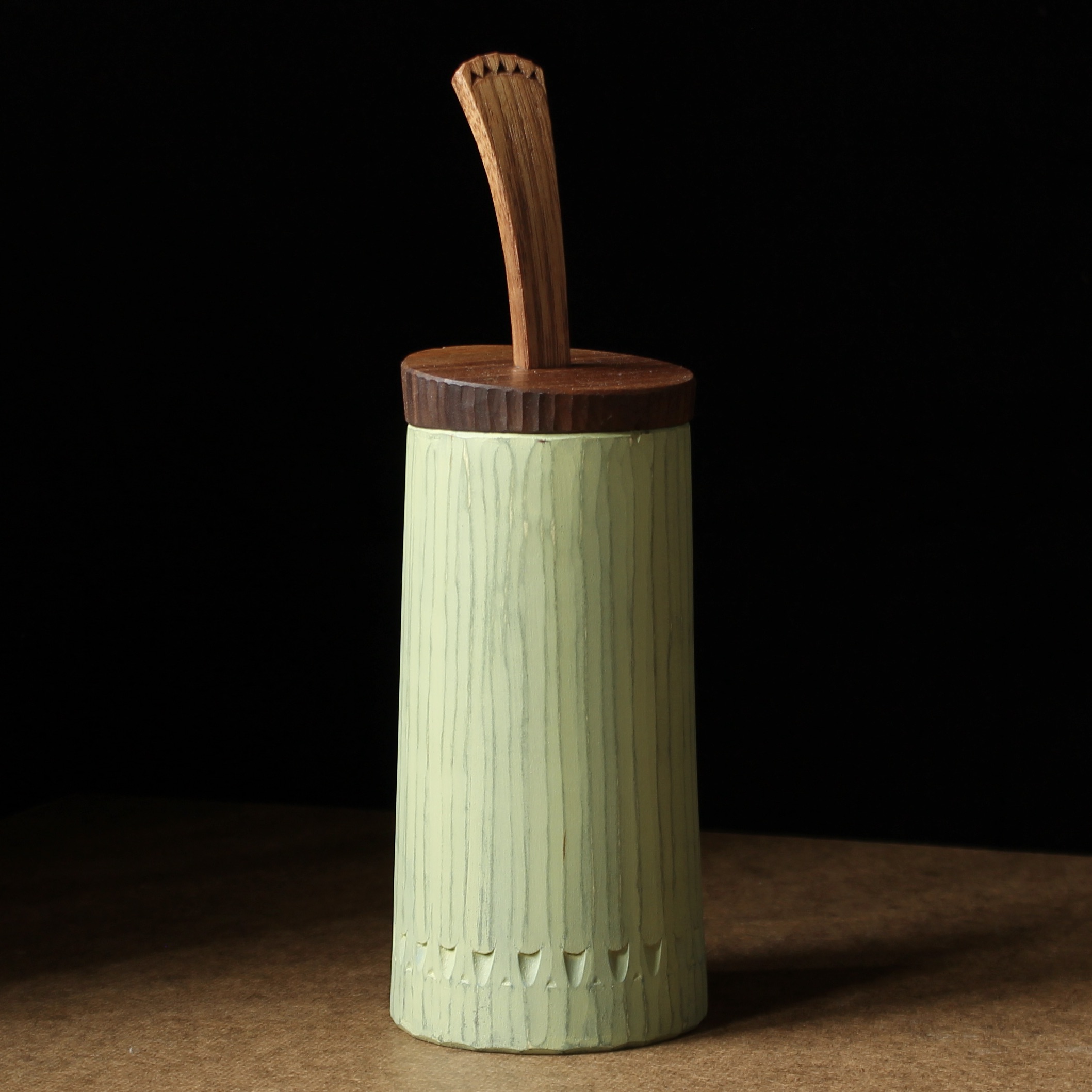
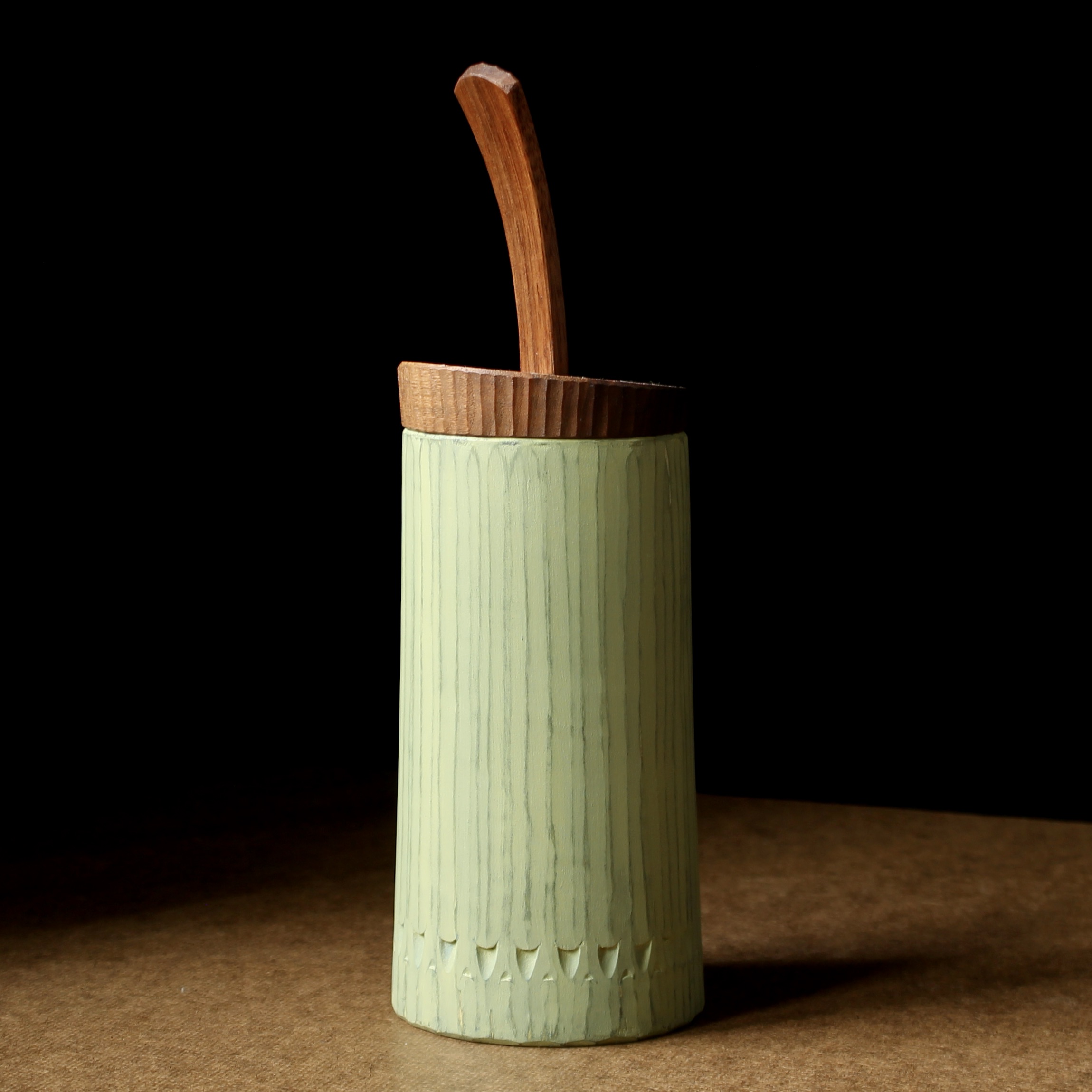
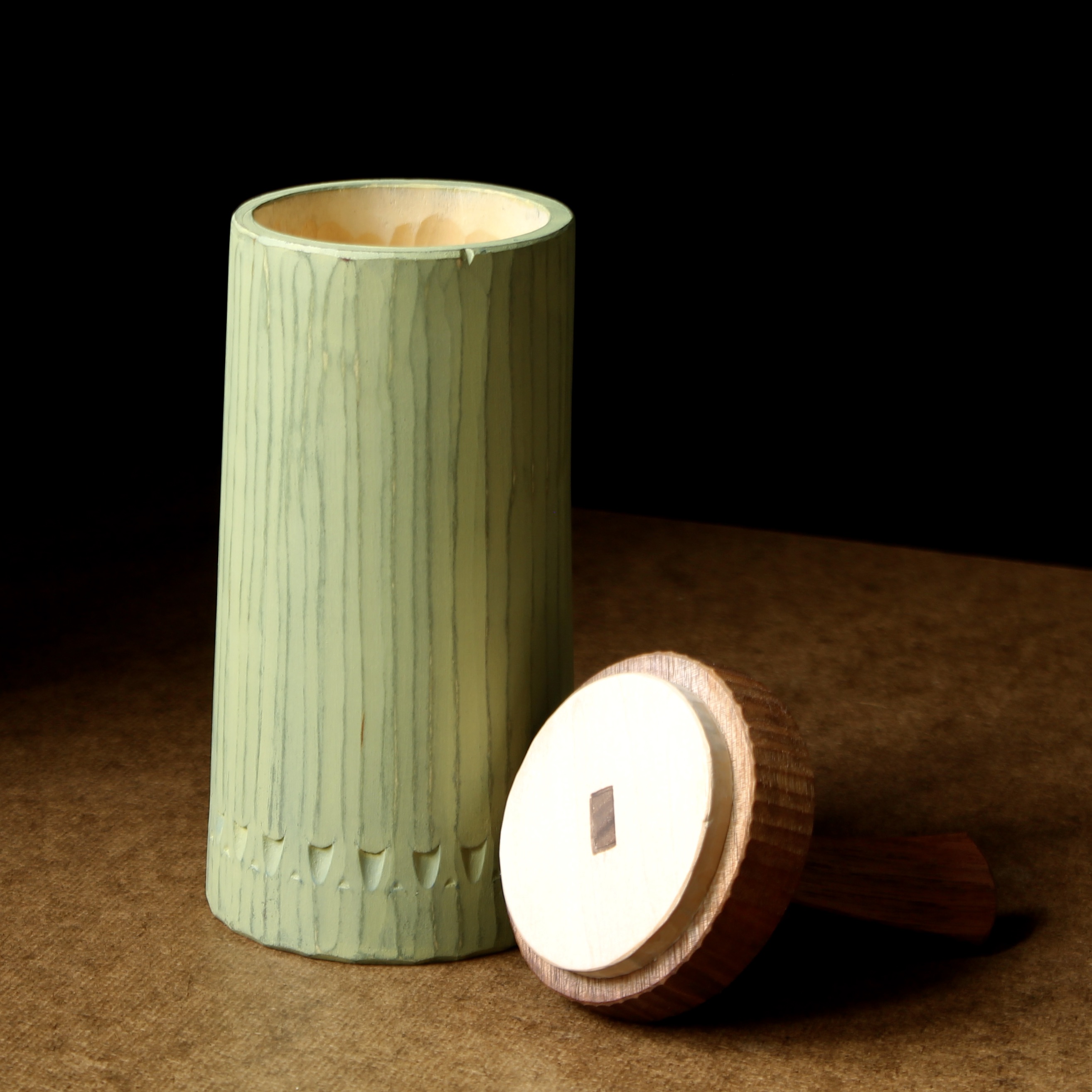
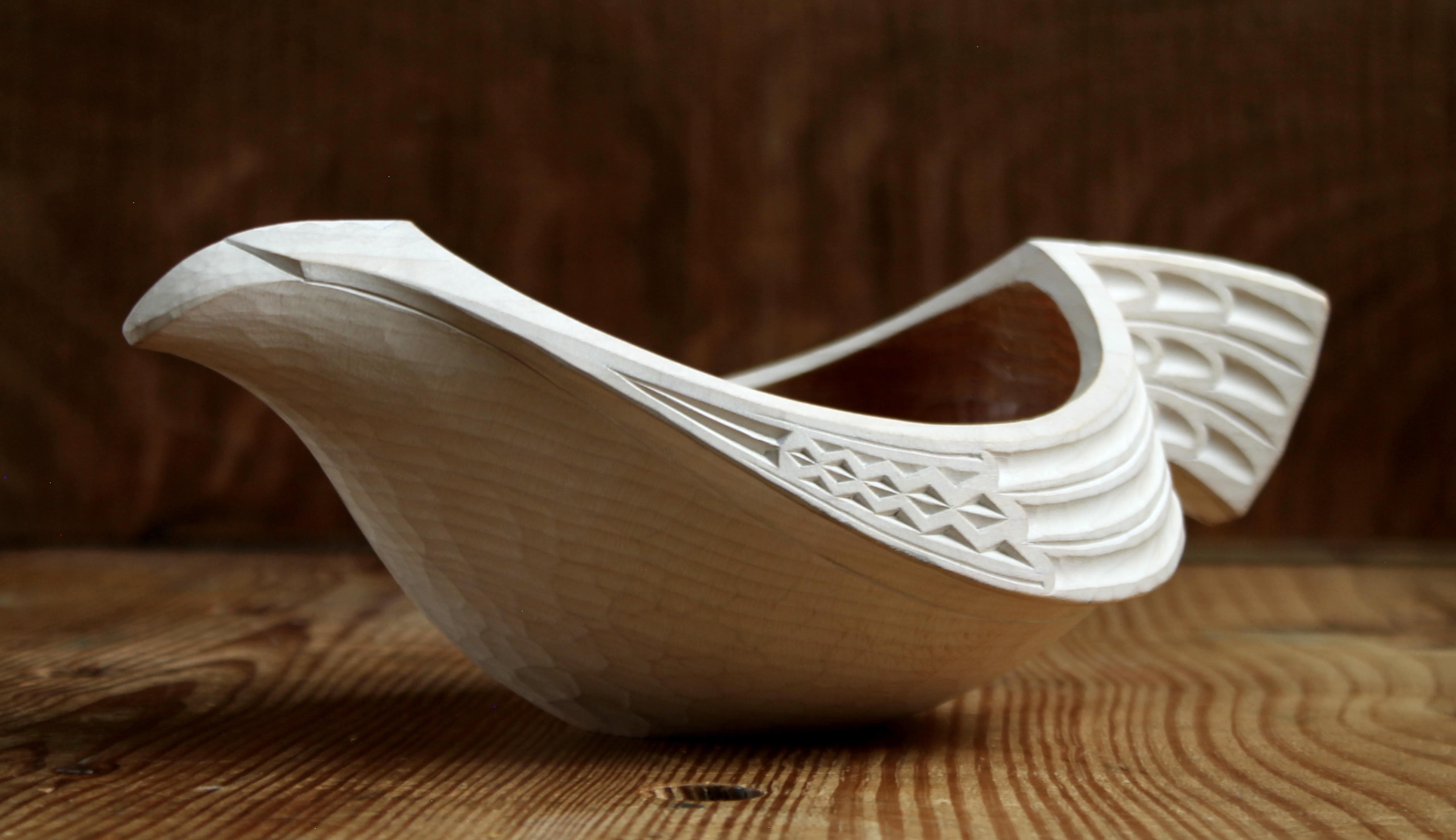
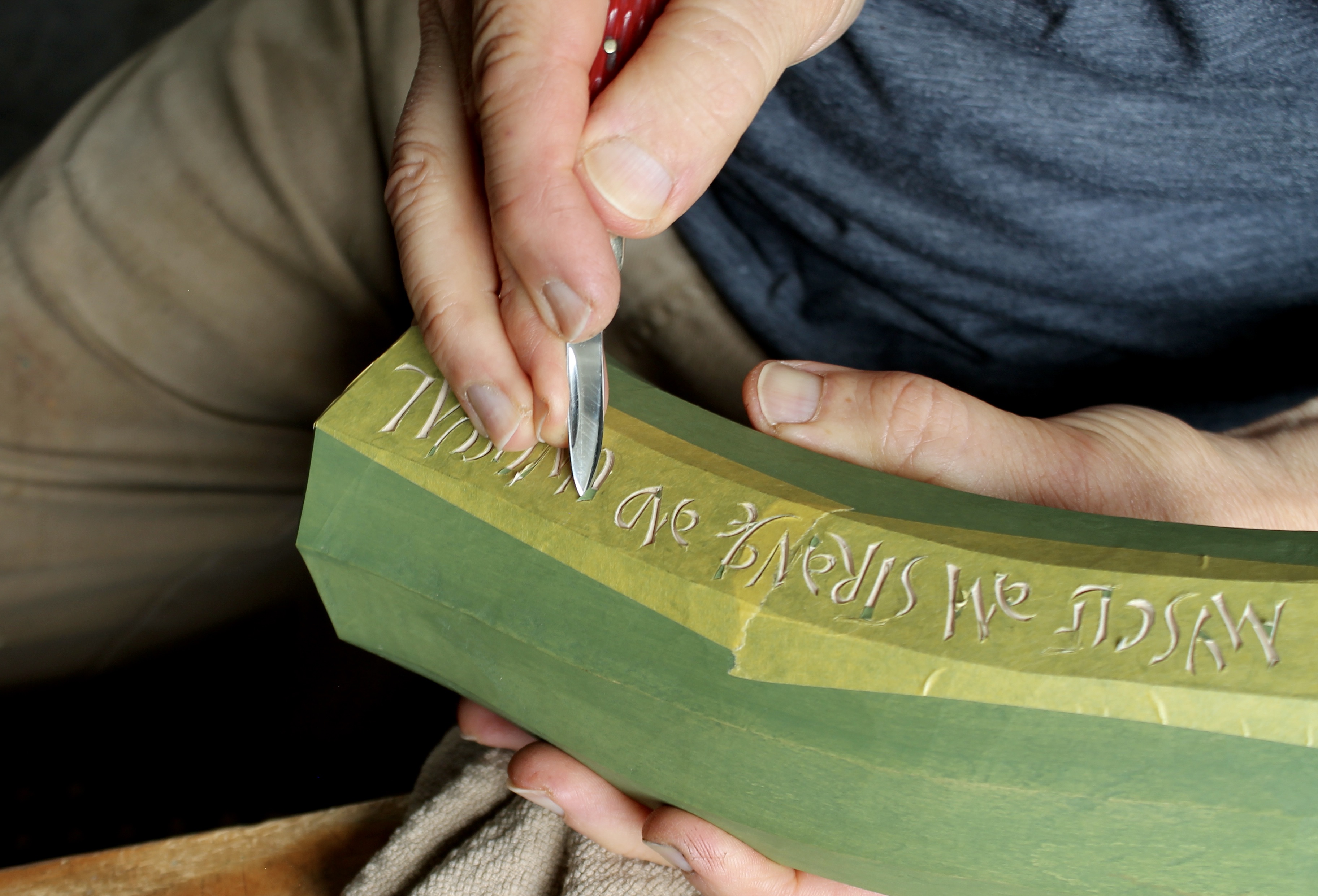
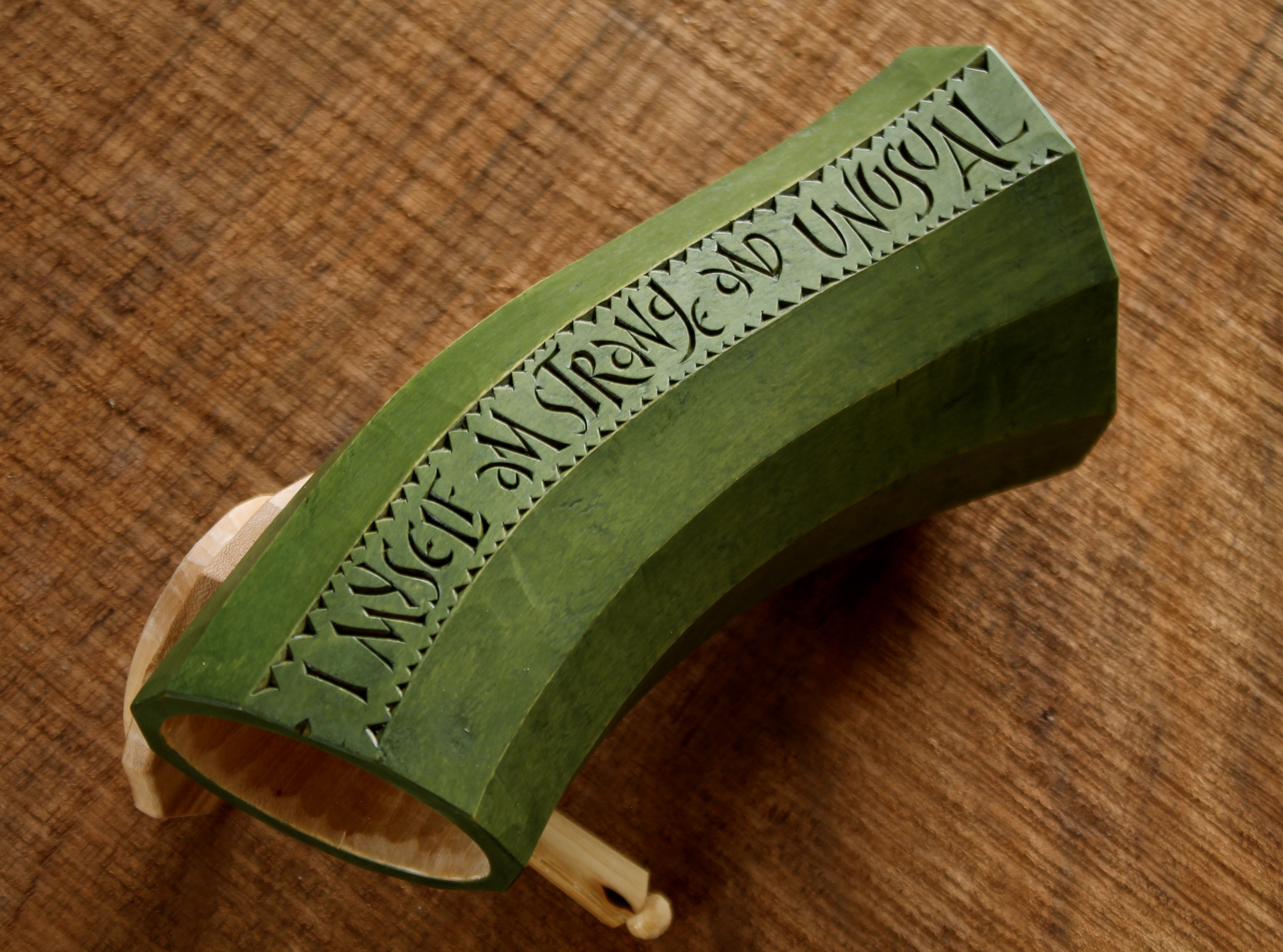
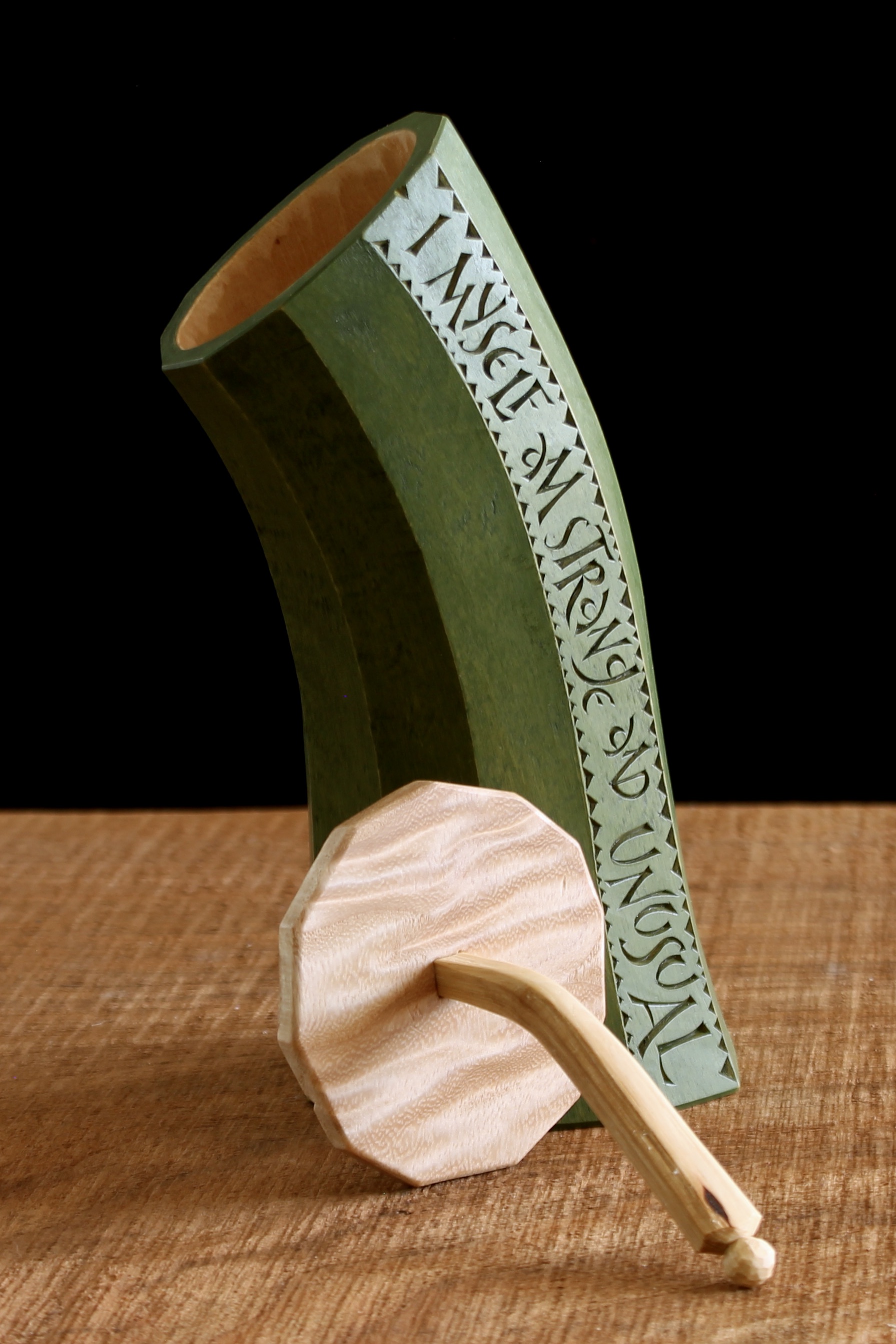
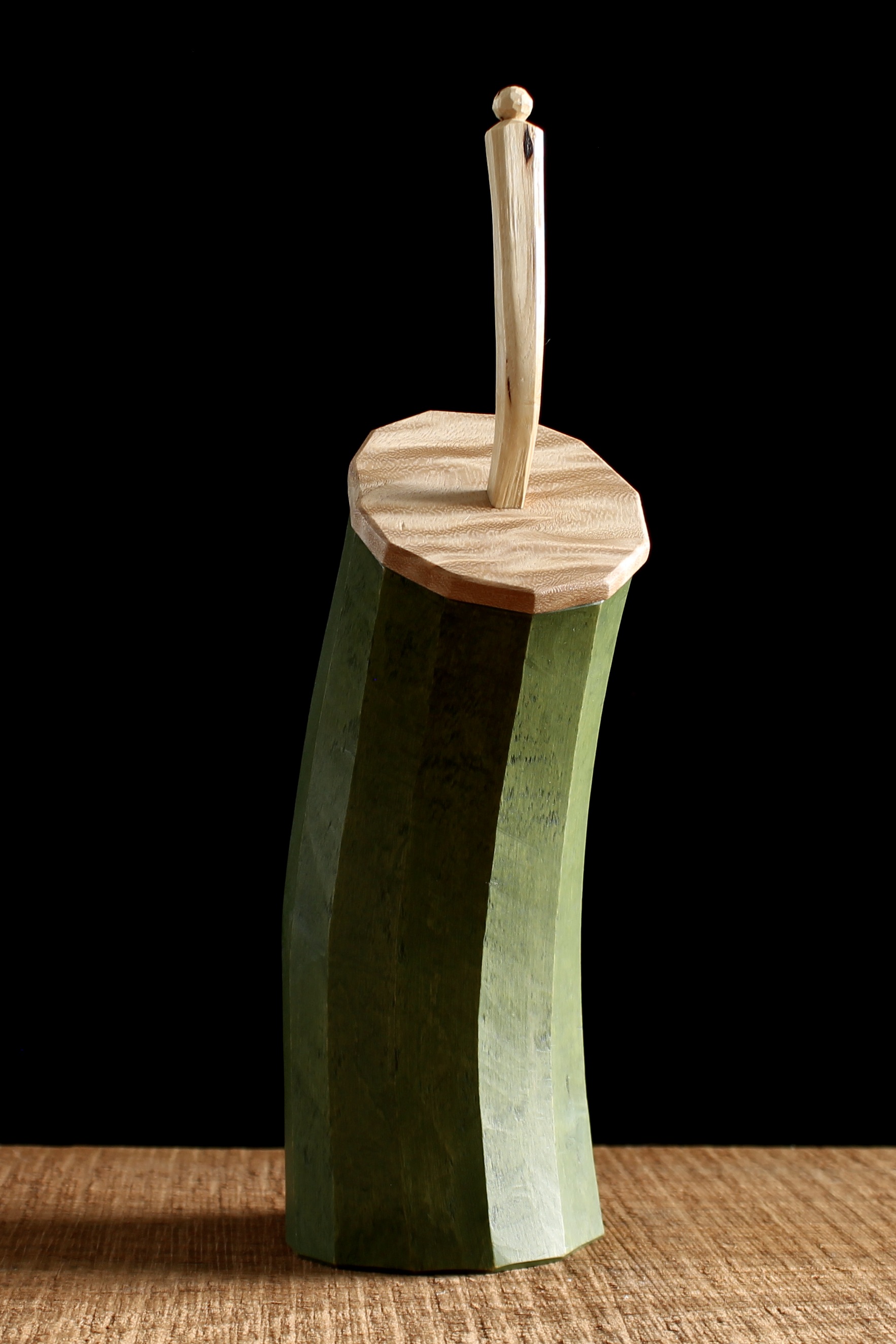
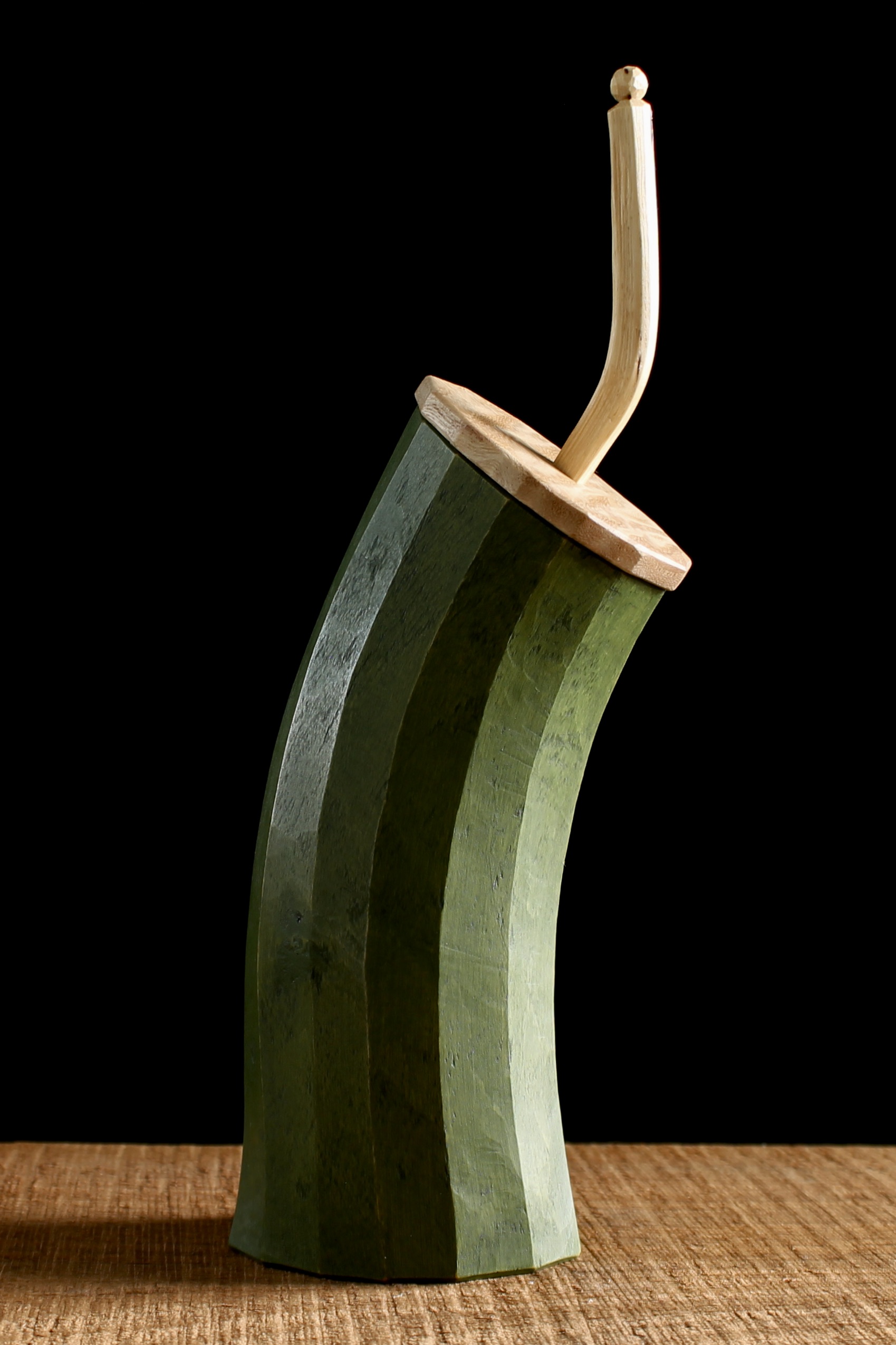
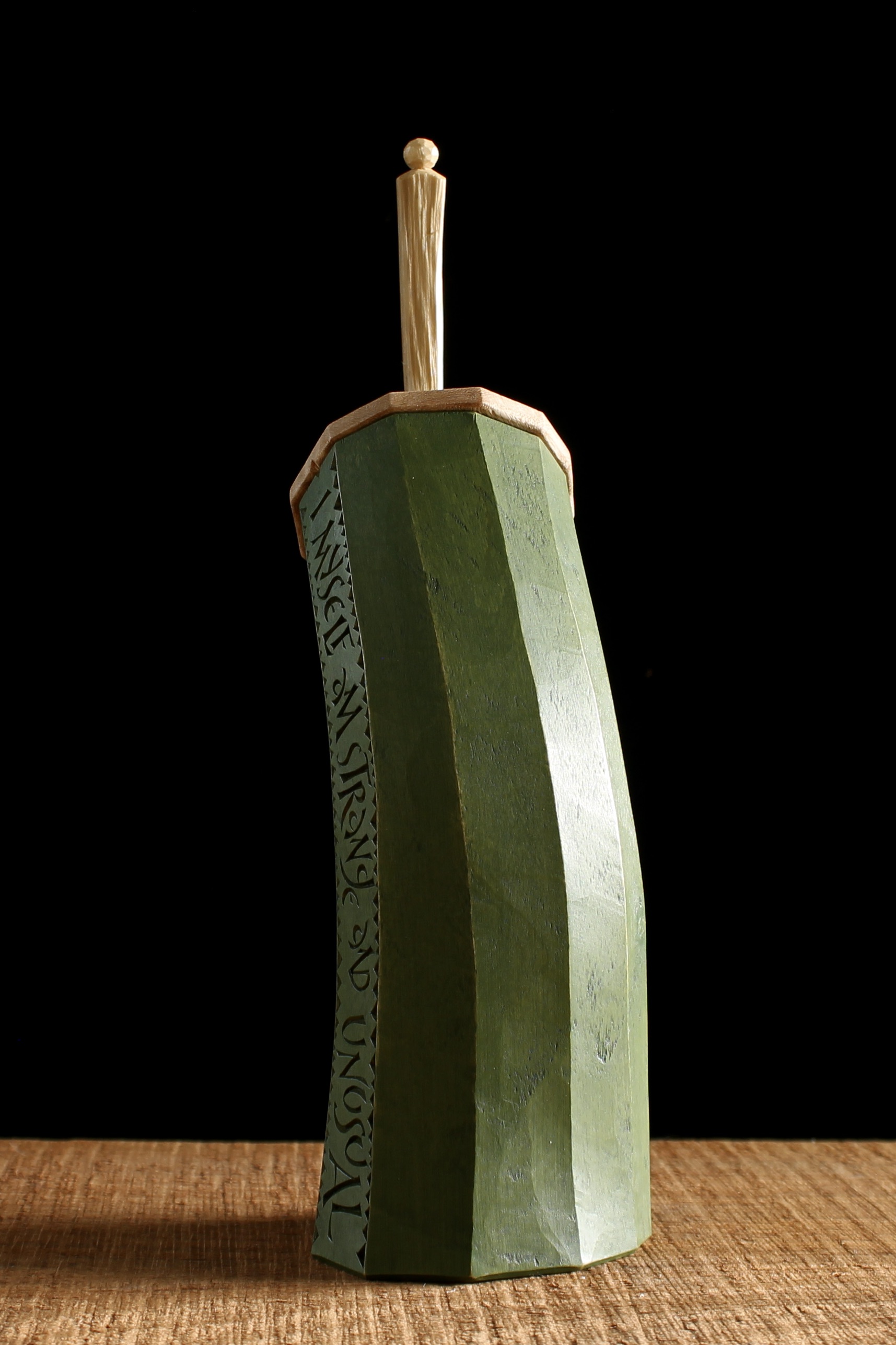
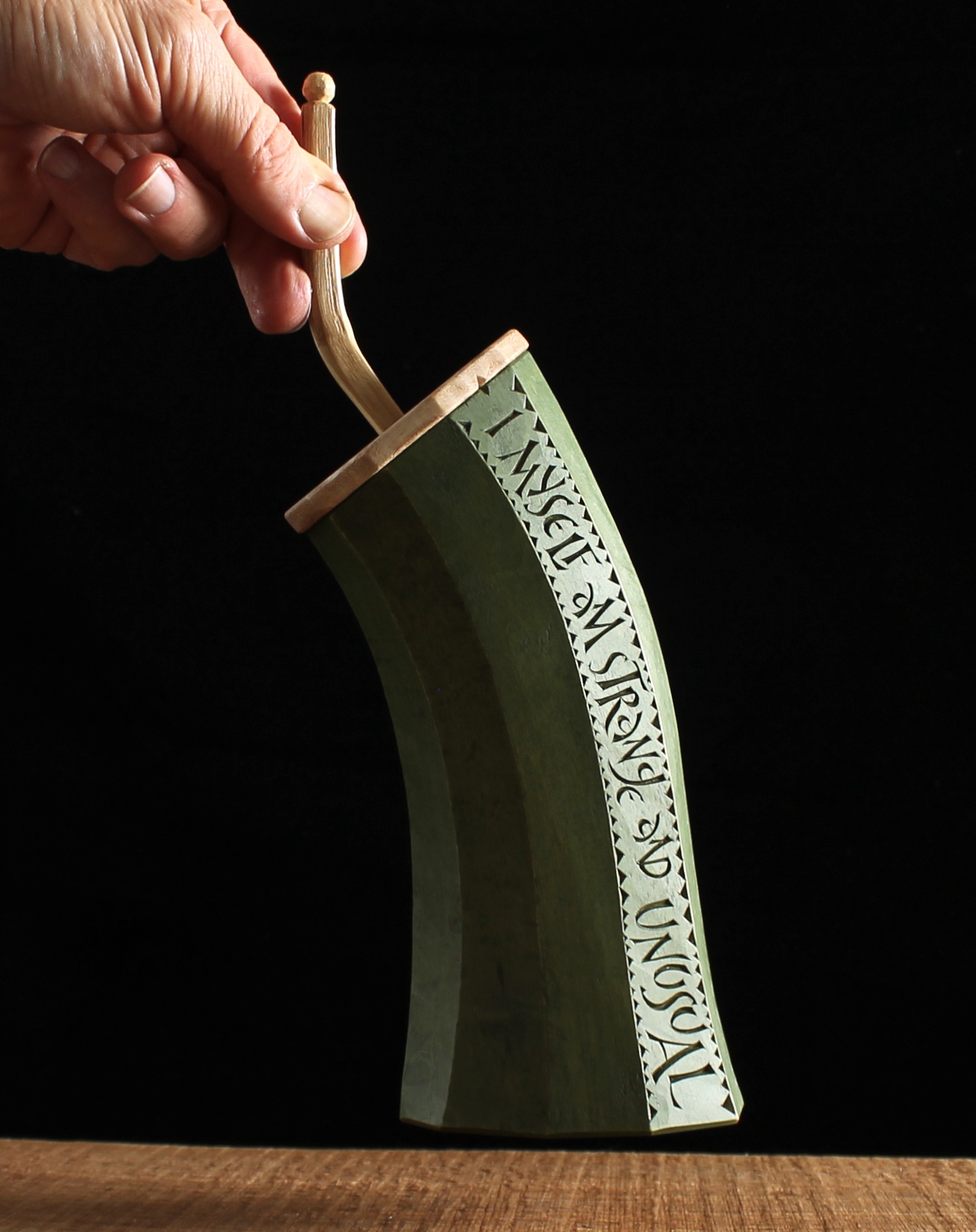
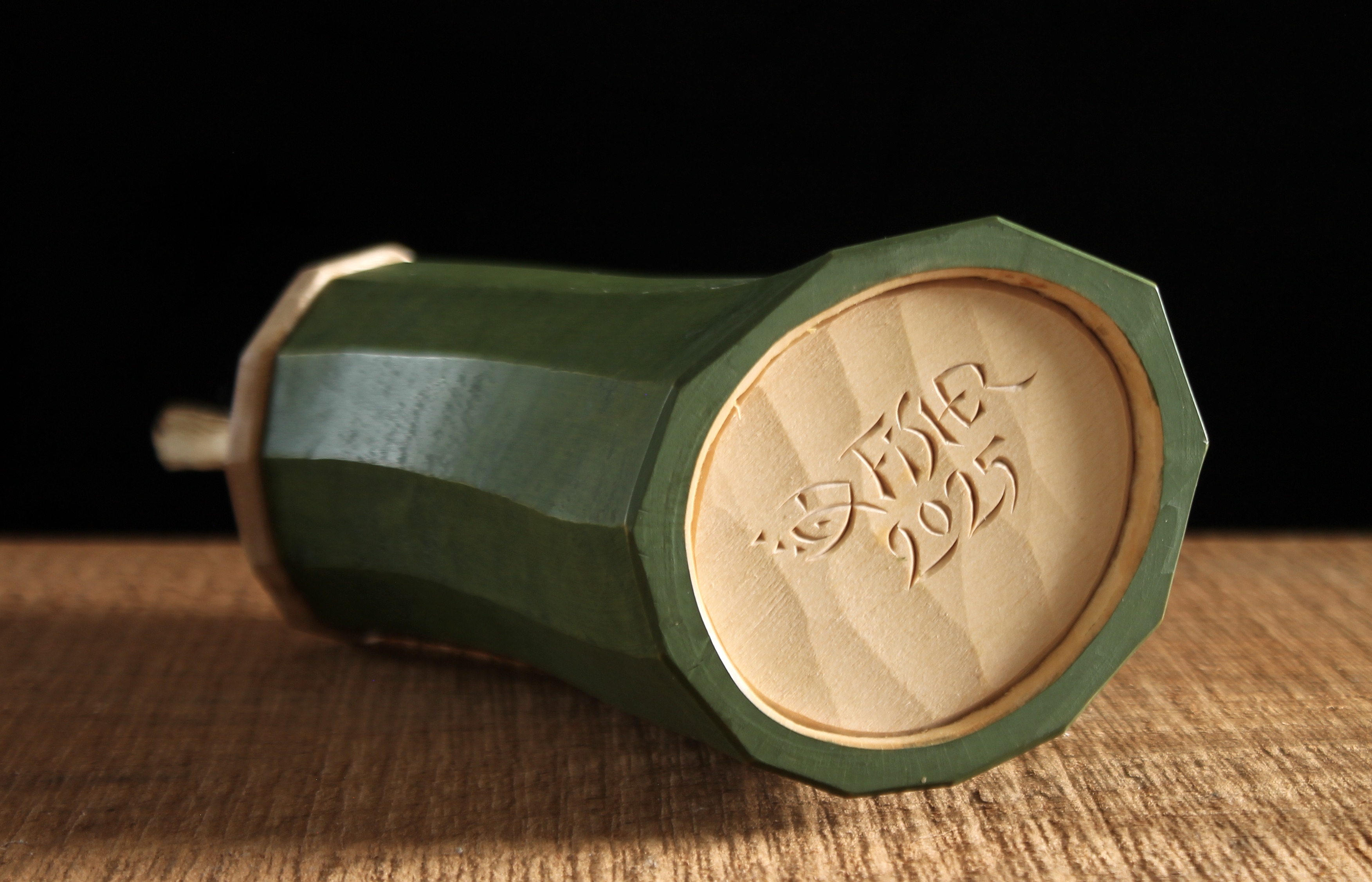
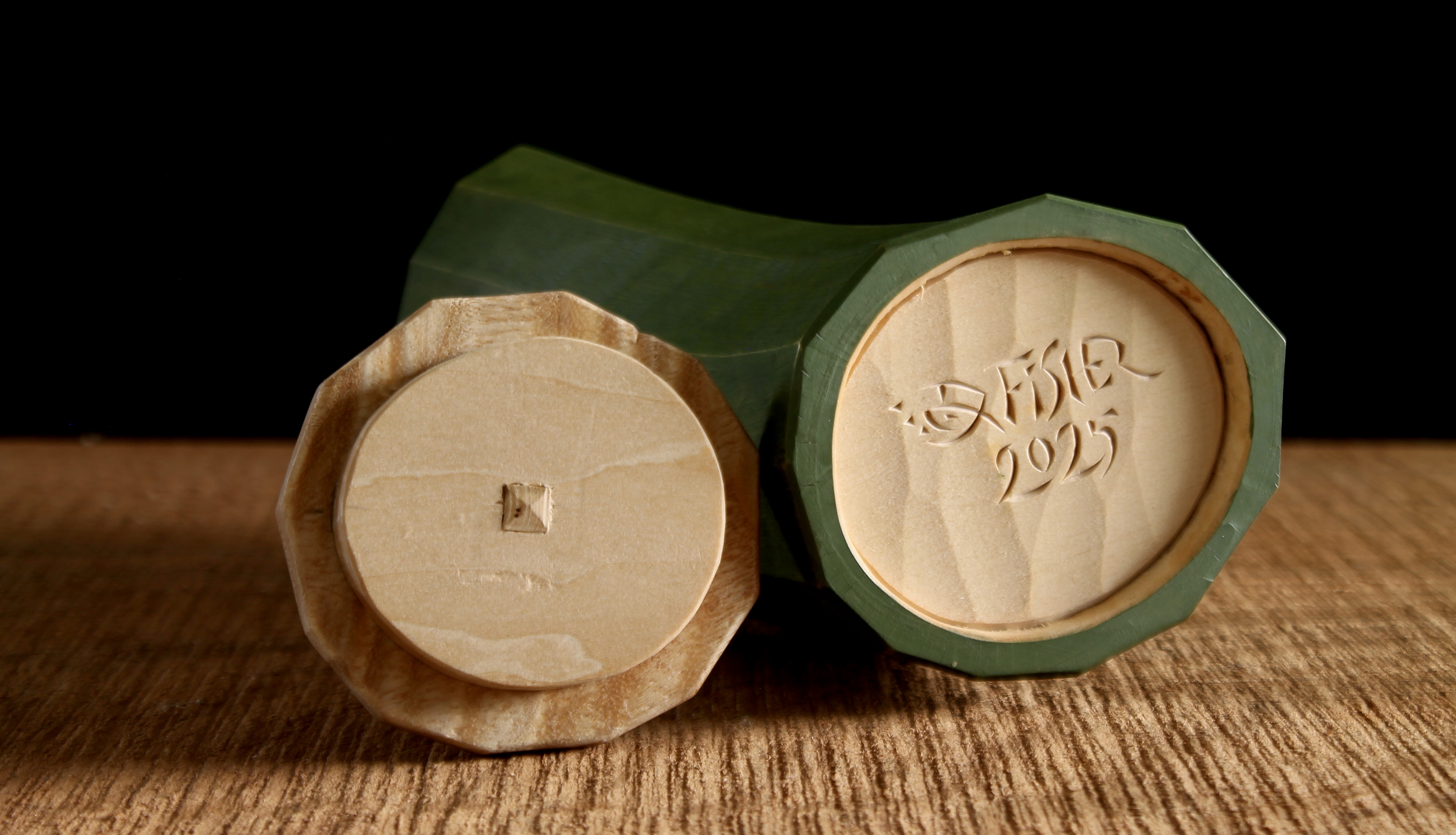
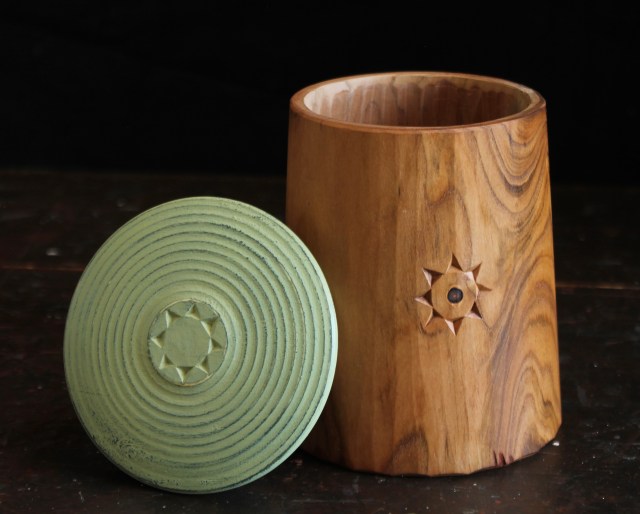
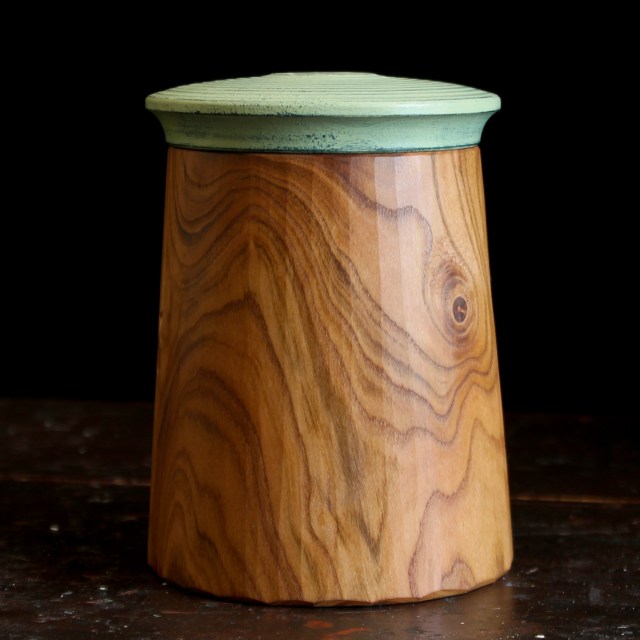
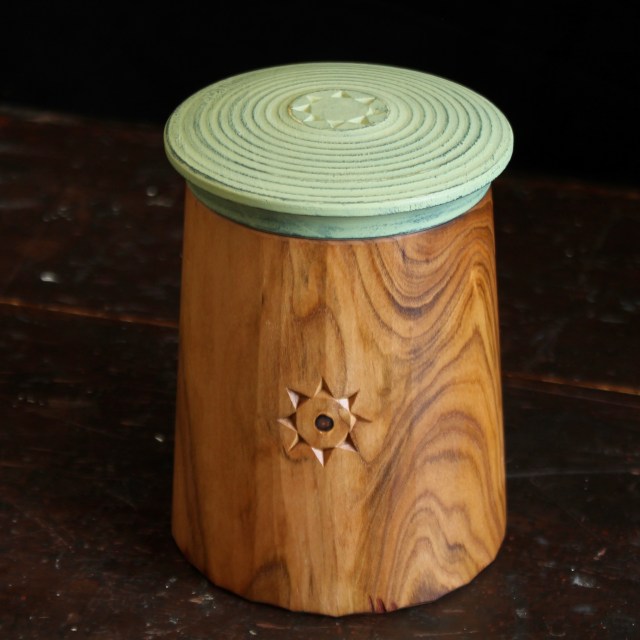
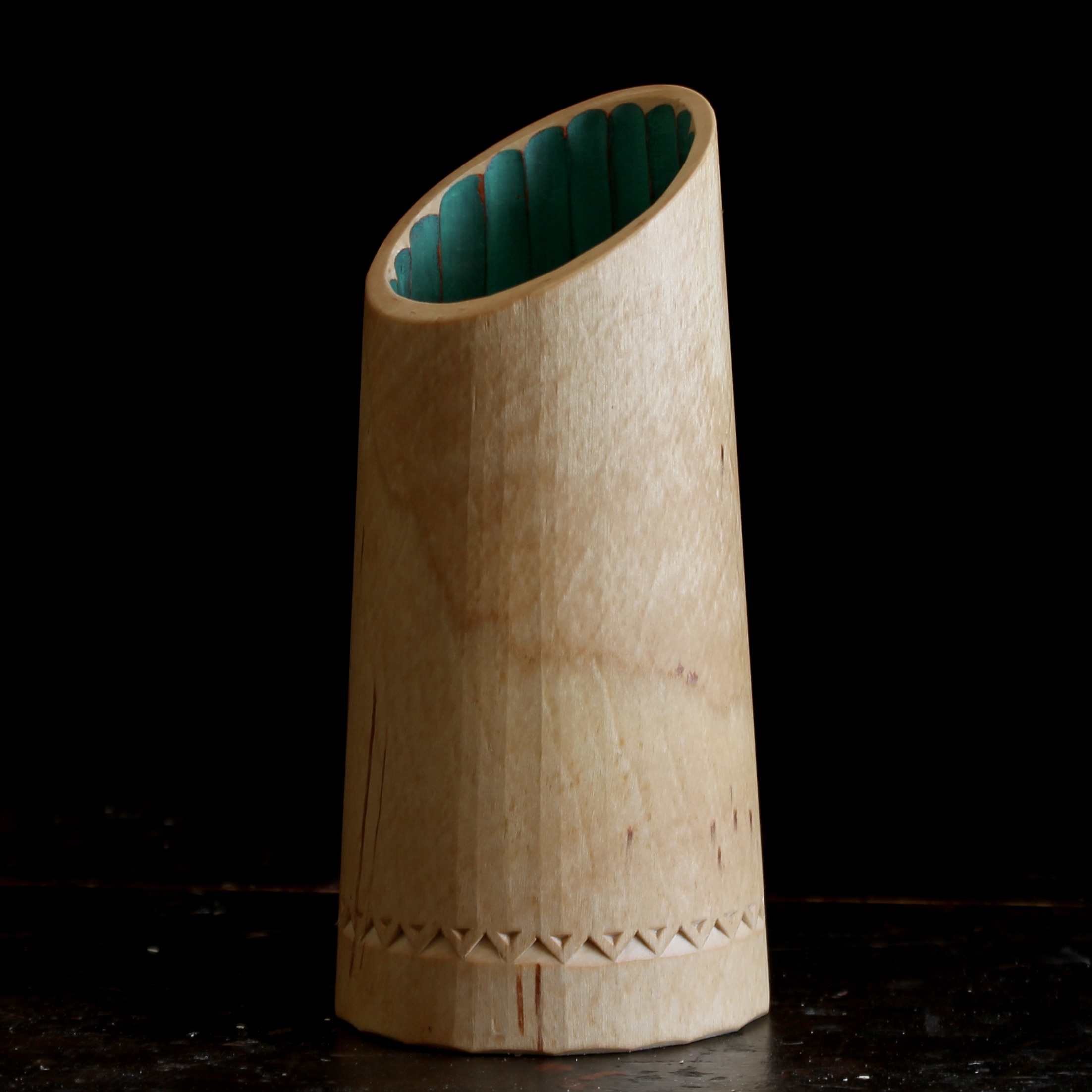
I’ve just finished four shrink pots that are available for purchase. They are made from various wood species, which I’ll detail below. All are finished with a mixture of linseed oil and beeswax. The lidded ones all have tight-fitting lids (to seal in any dry goods you choose to store in them) and unfinished interiors. If you’re interested, please email me at dandkfish@gmail.com. Prices include shipping. More information, measurements, and slideshows for each one below, followed by a few thoughts on in-cannel vs out-cannel gouges for hollowing shrink pots and groove cutters.

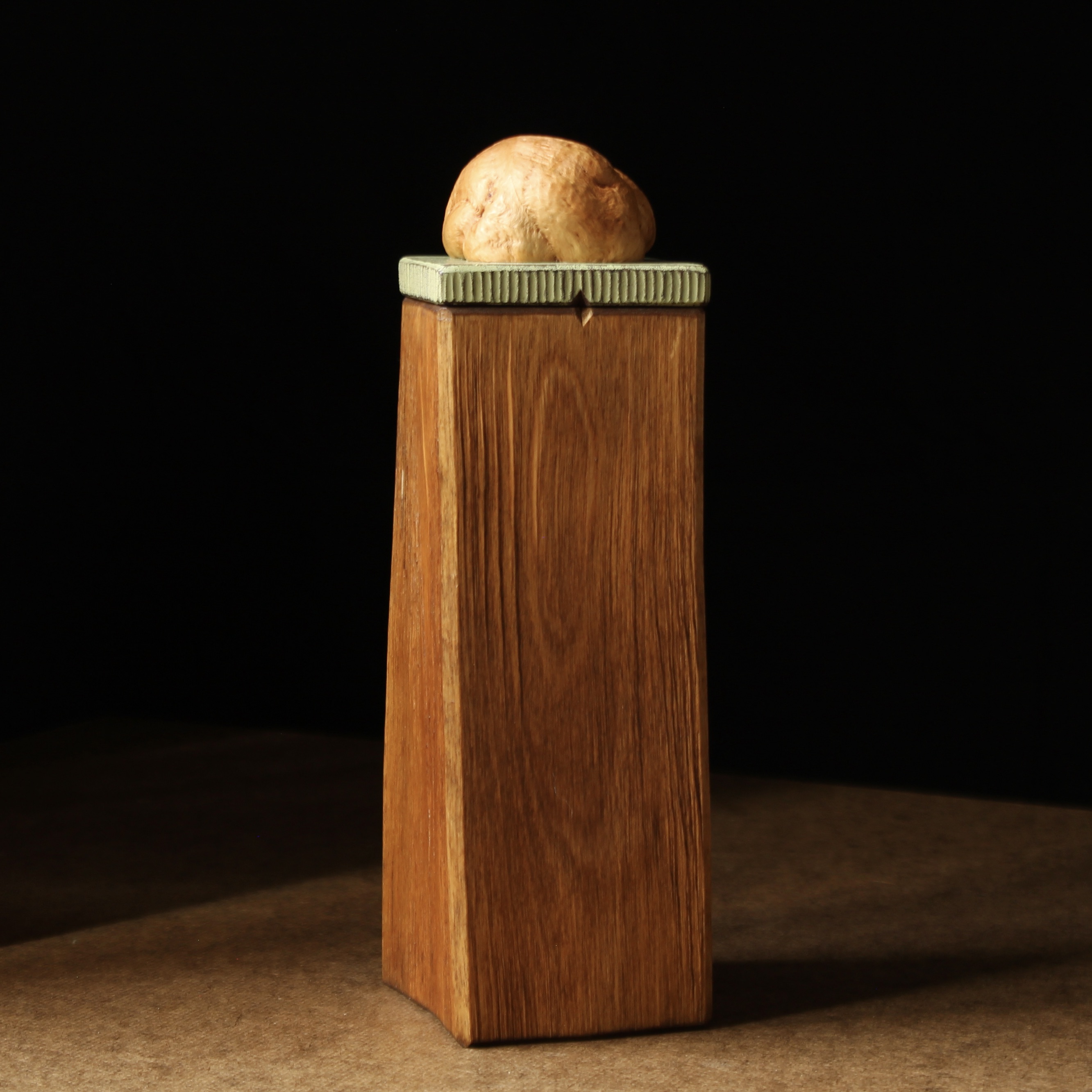
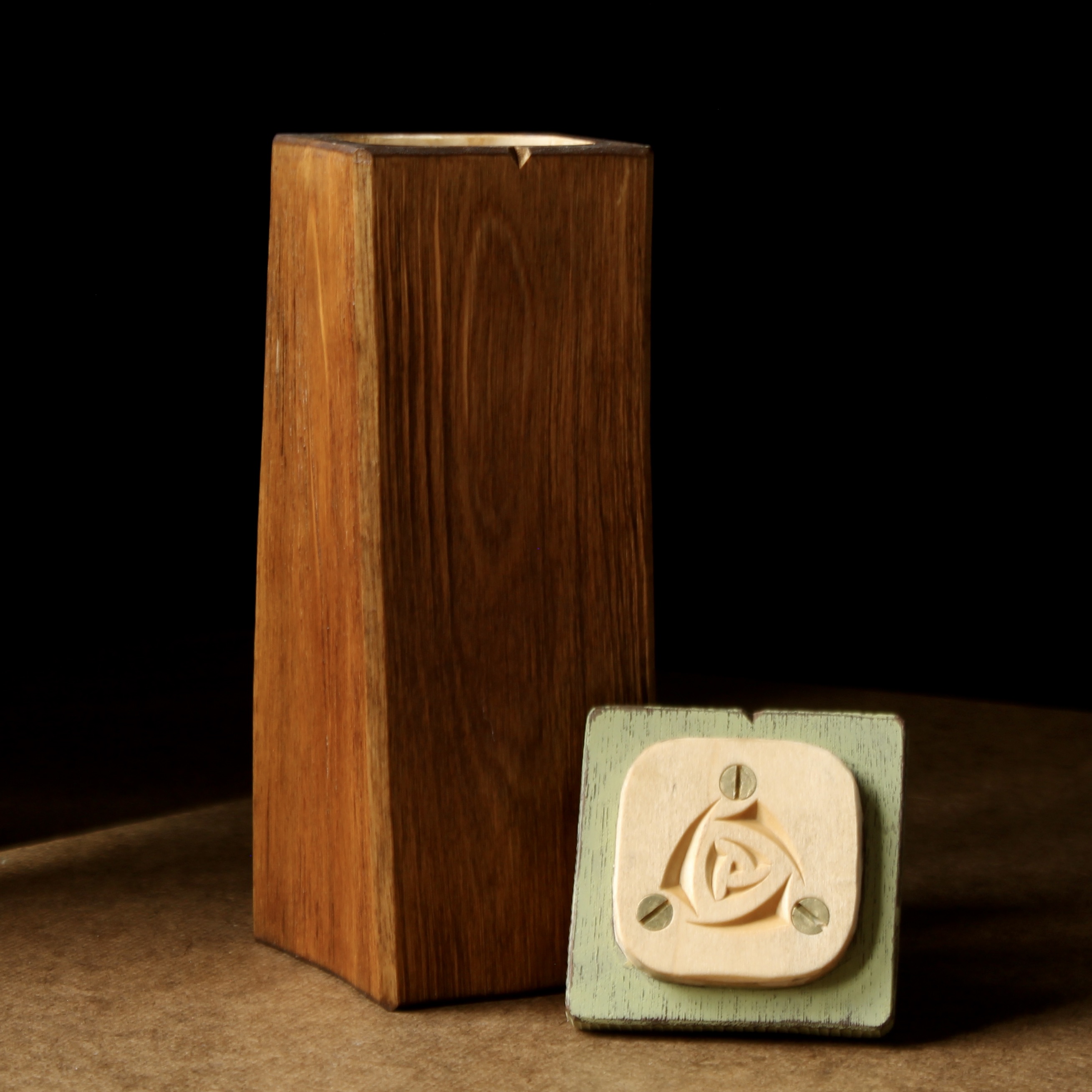
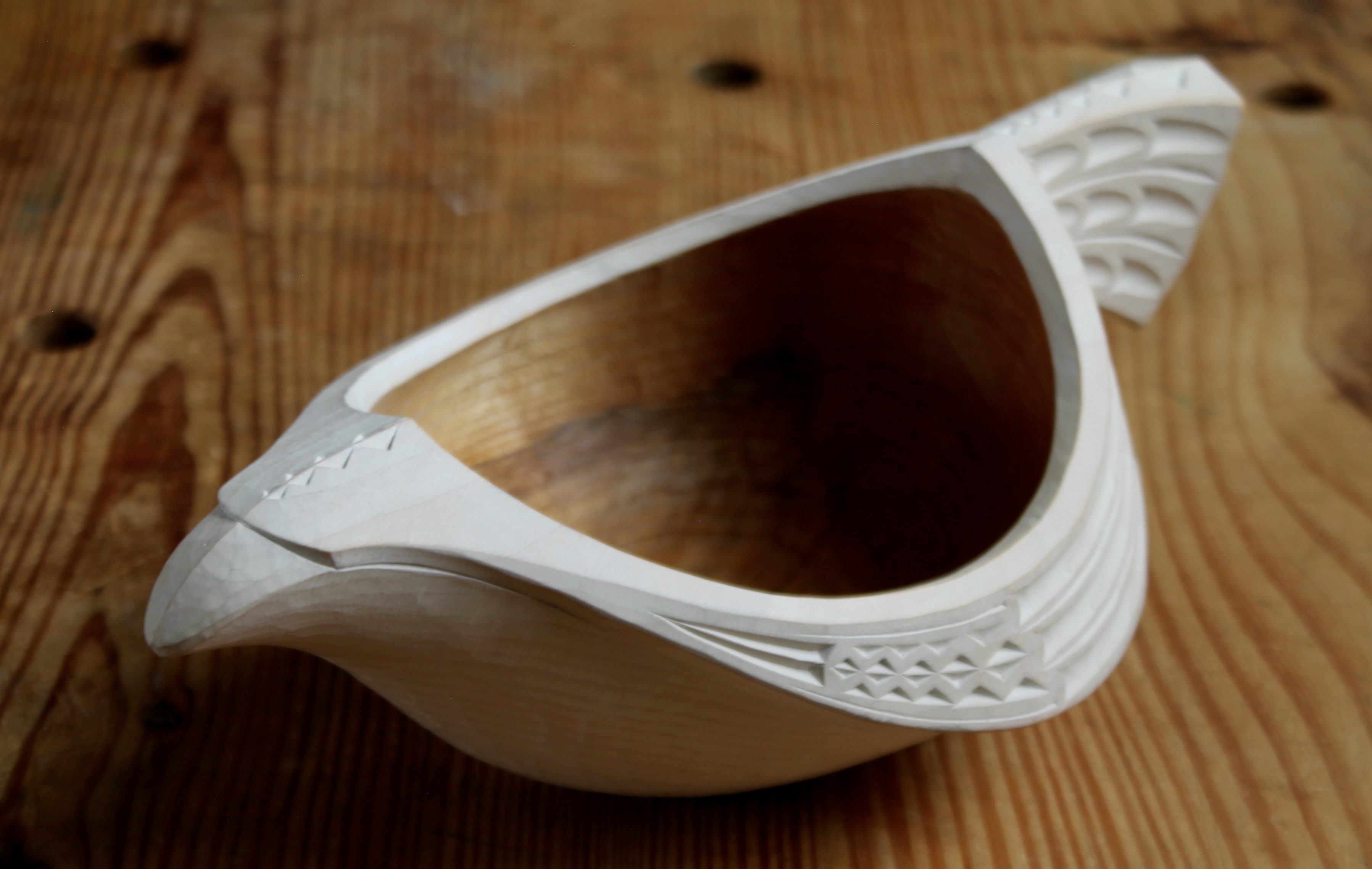
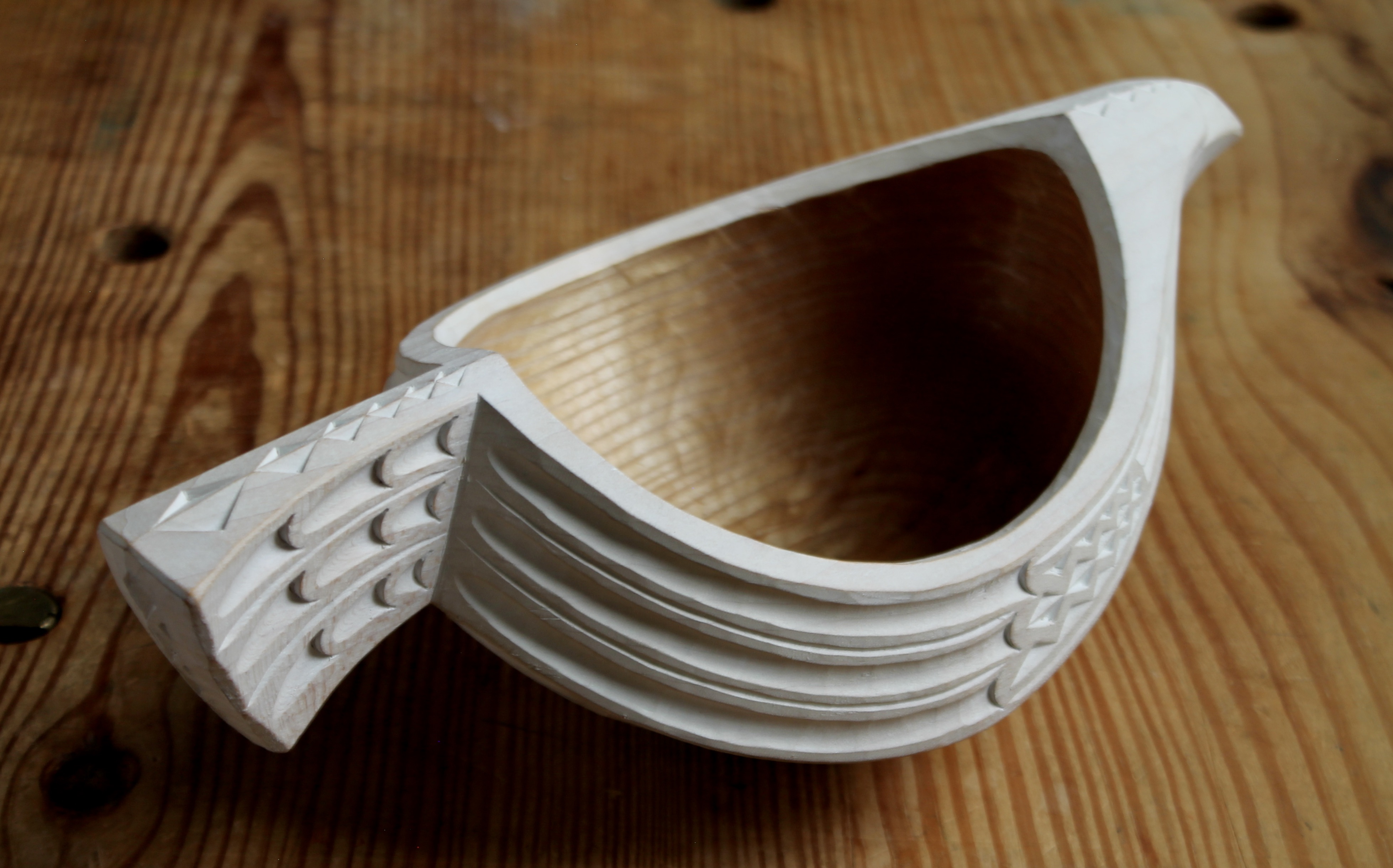
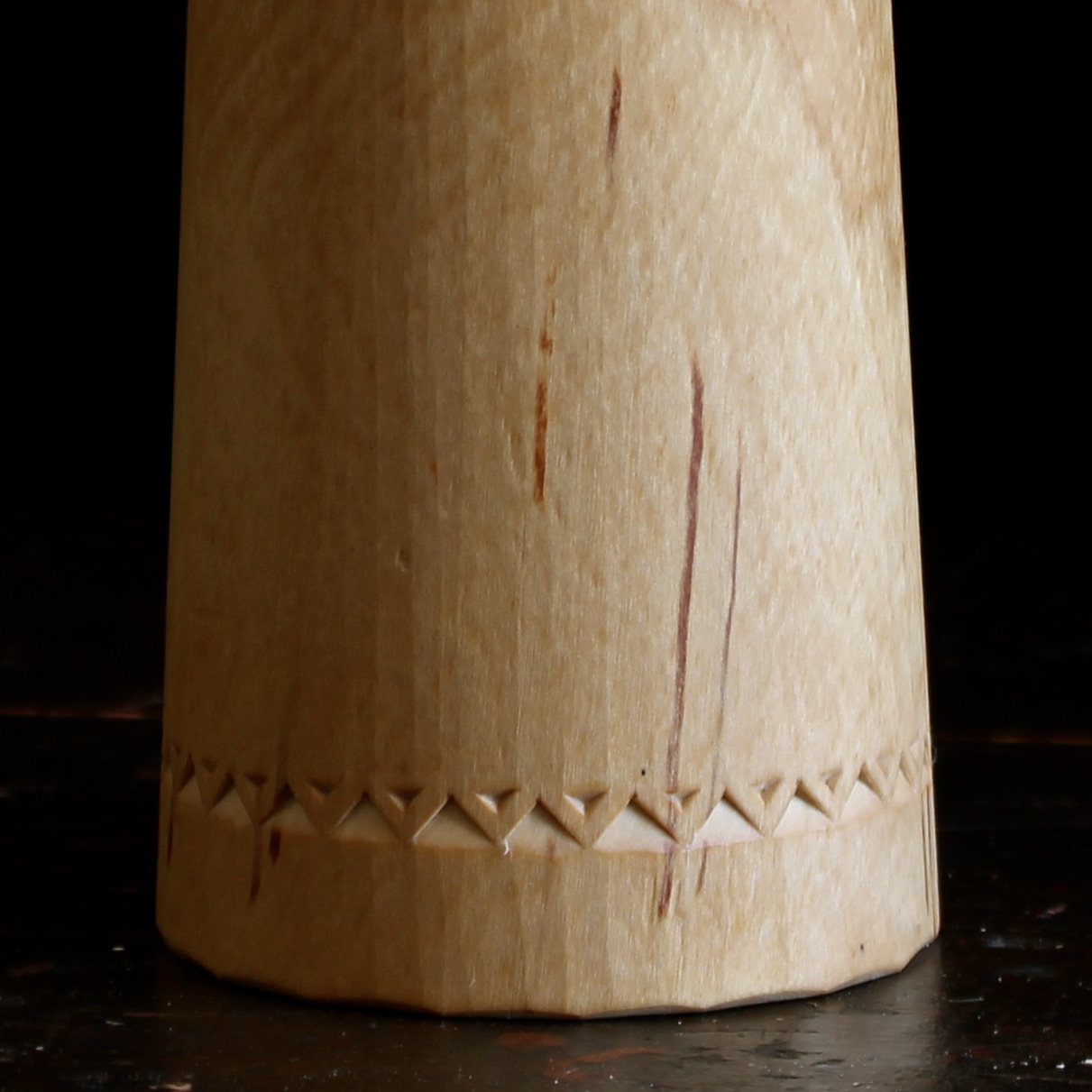
1: 5 1/2″ high, 4″ wide. Apricot body, aspen lid. A while ago, some fresh apricot wood became available. Never having tried it, I roughed out a few spoons and this shrink pot. Looks great, but a bear to work with. It’s safe to say that this will be my last tribute to apricot. I made sure to carve the top of the pot truly round, then I turned a lid from a chunk of aspen, so this lid fits snuggly no matter how you put it on. I played off of that tight pin knot on the side of the pot with some chip carving, then complemented that with some more on the inside and outside of the lid. Milk paint on the lid, Granny Smith over peacock. Detail photos above. $450 includes shipping. SOLD

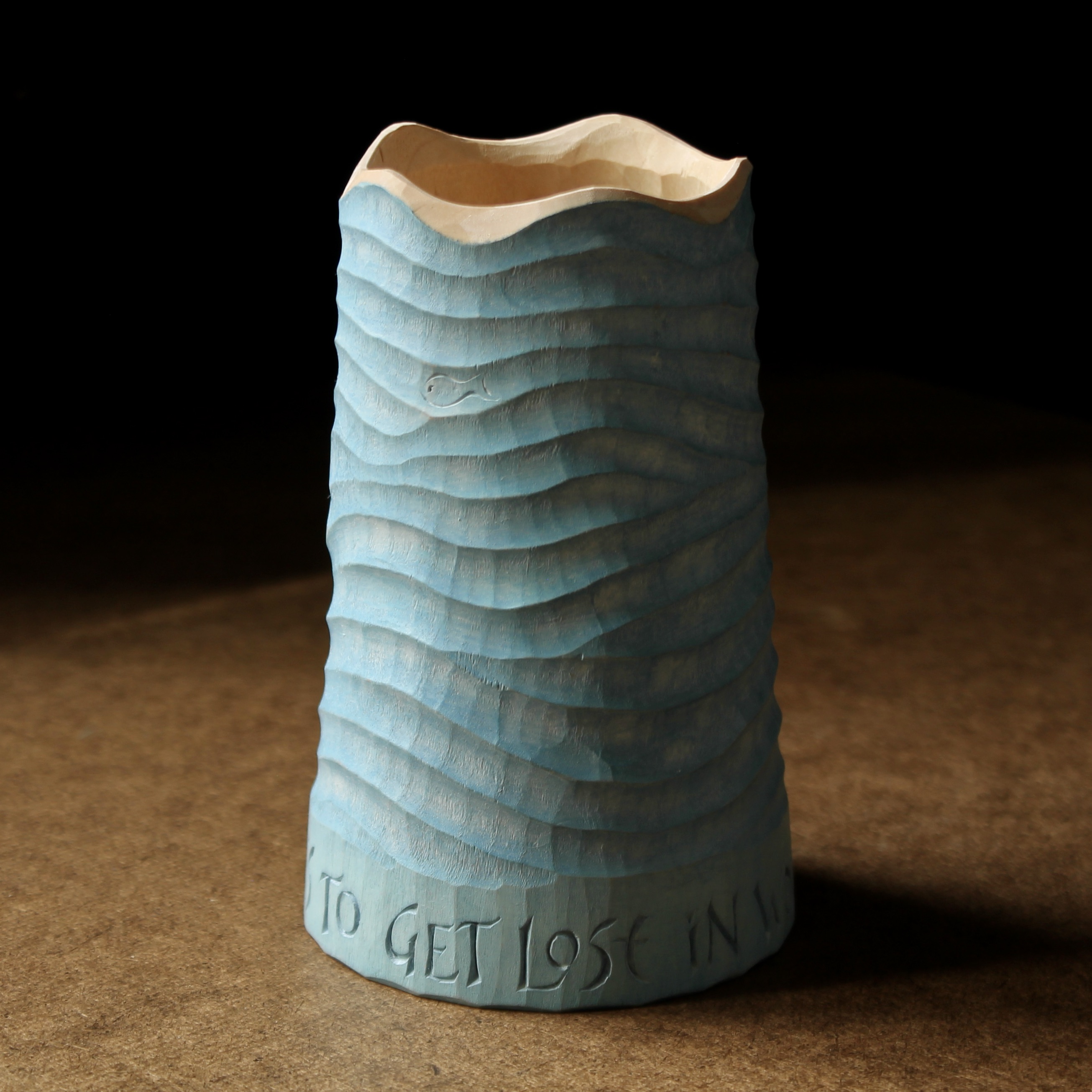
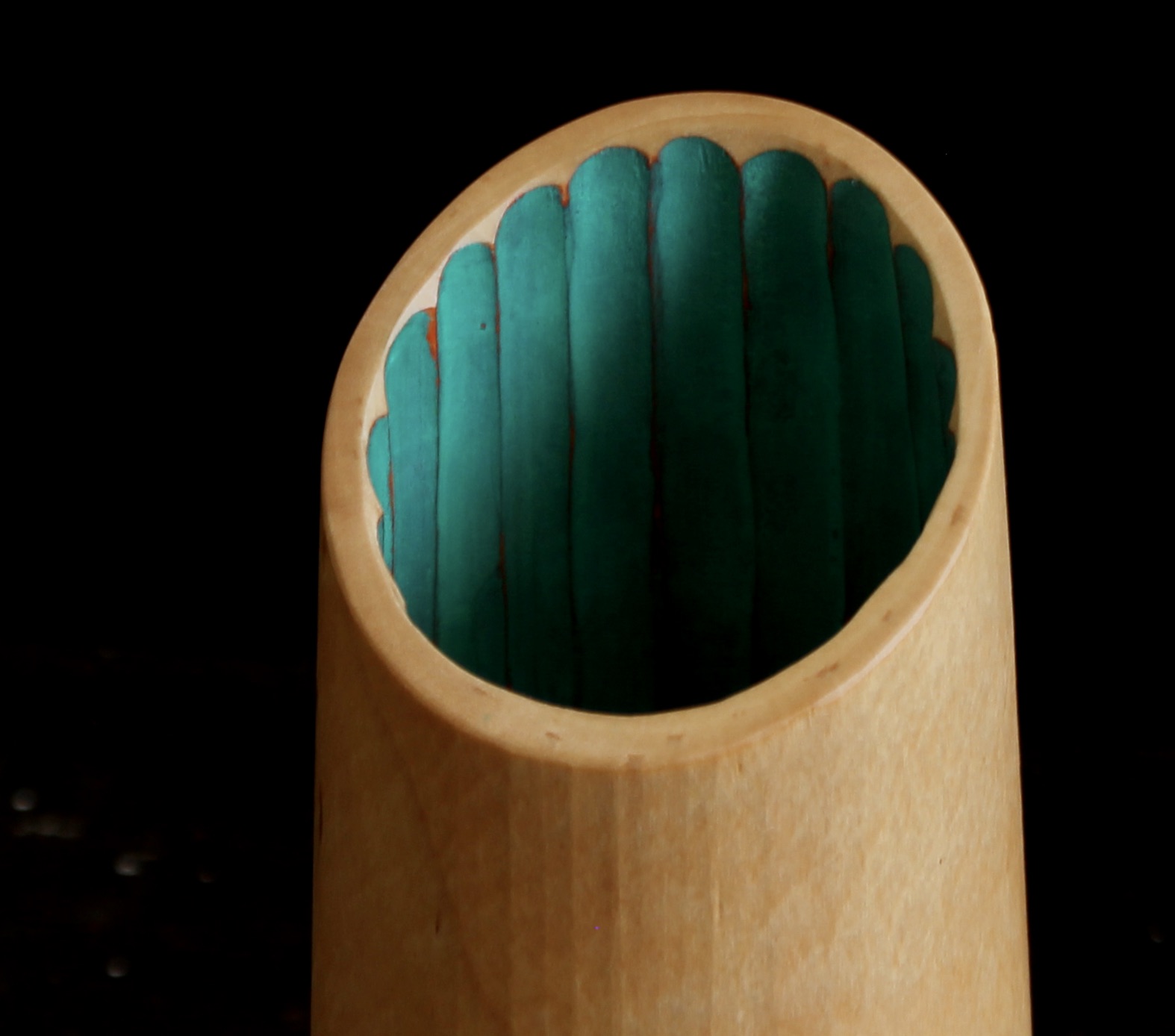
3: 7 1/4″ high x 3 3/8″ wide. Birch. Milk-painted interior, spearmint over persimmon. No lid on this one, which allows it to hold longer things you want to access like pencils, paint brushes, kitchen spoons…wrenches? The combination of the two milk paint colors reminds me of patinated copper. Detail photos above. $350 includes shipping. SOLD

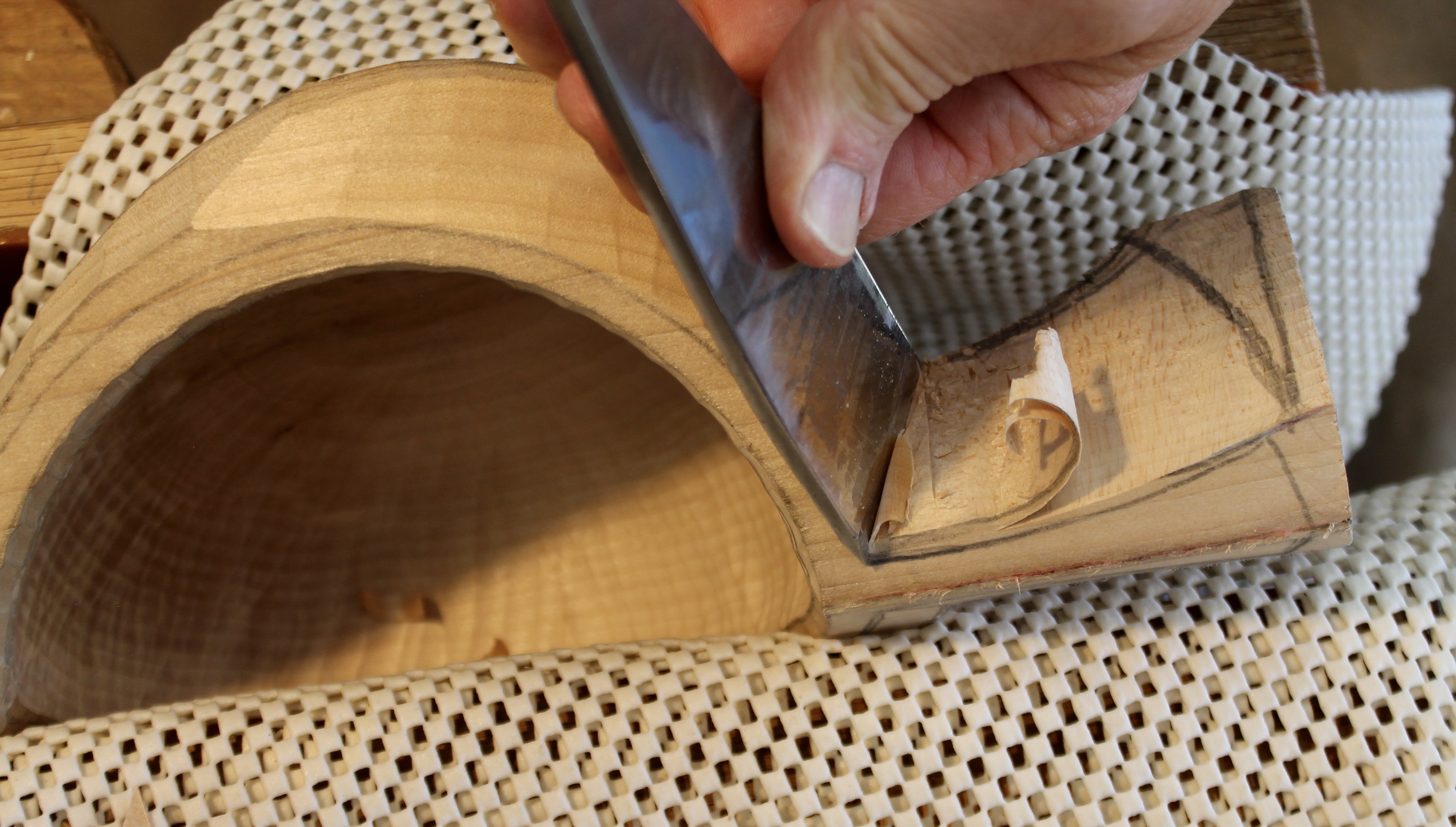
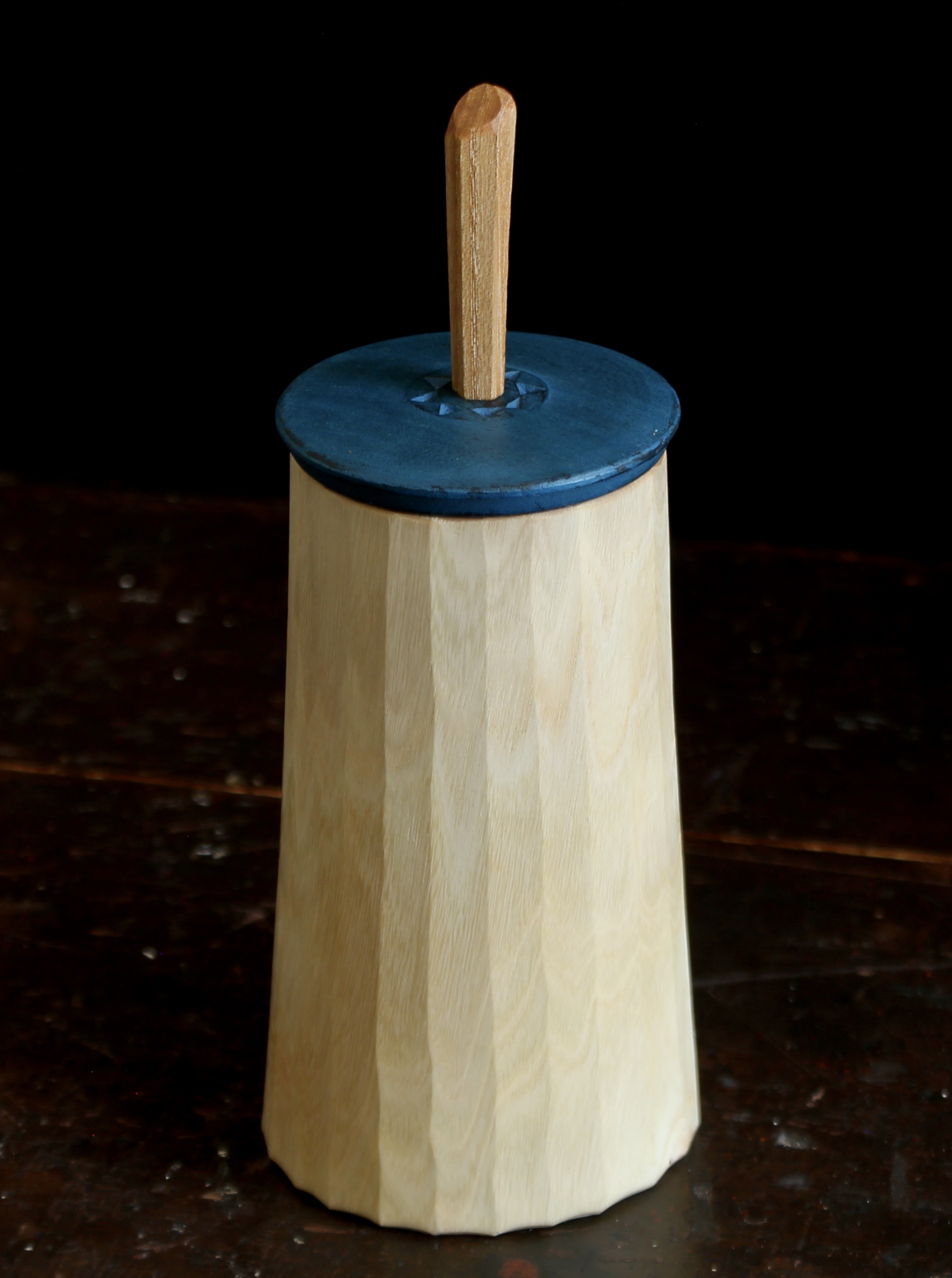
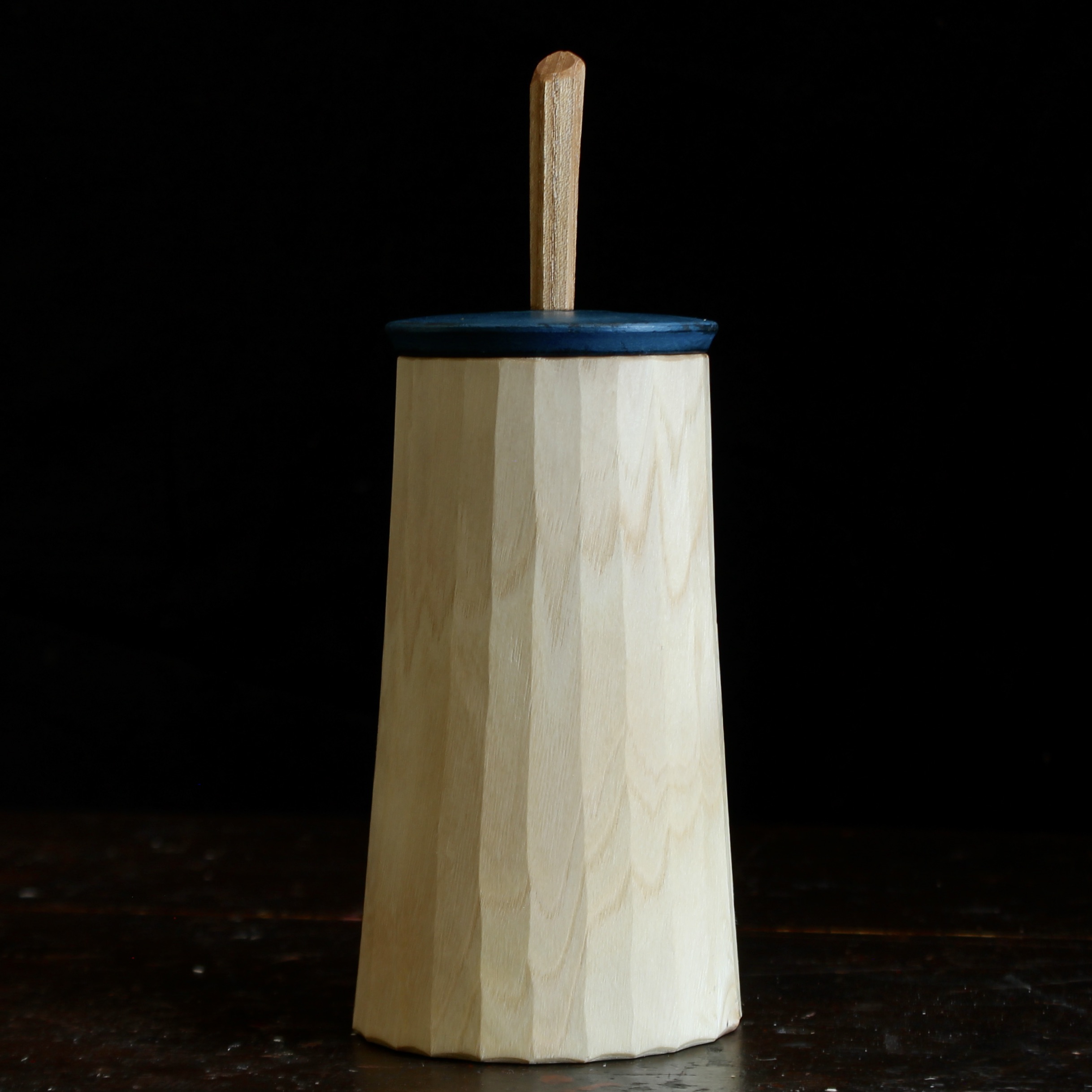
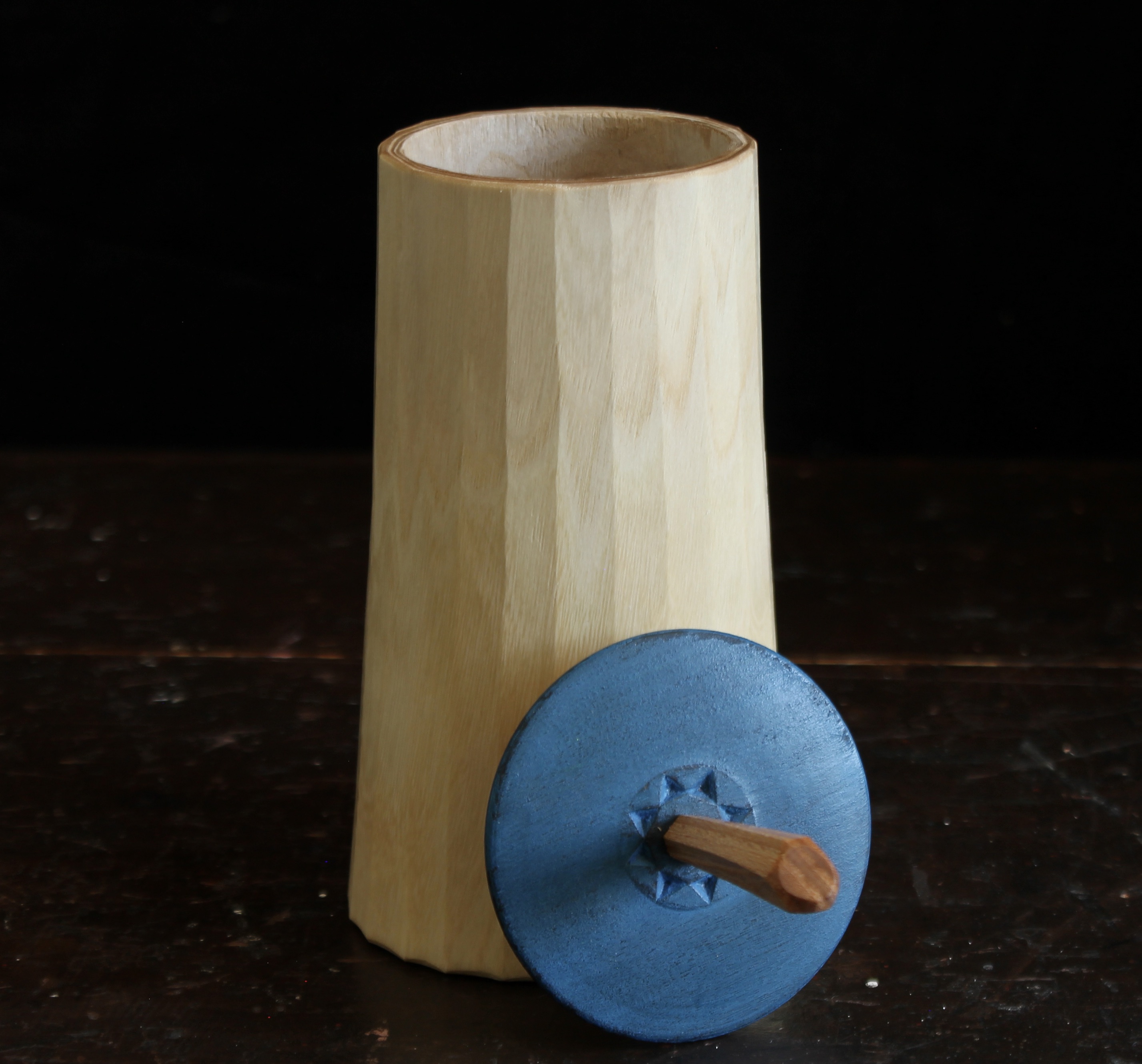
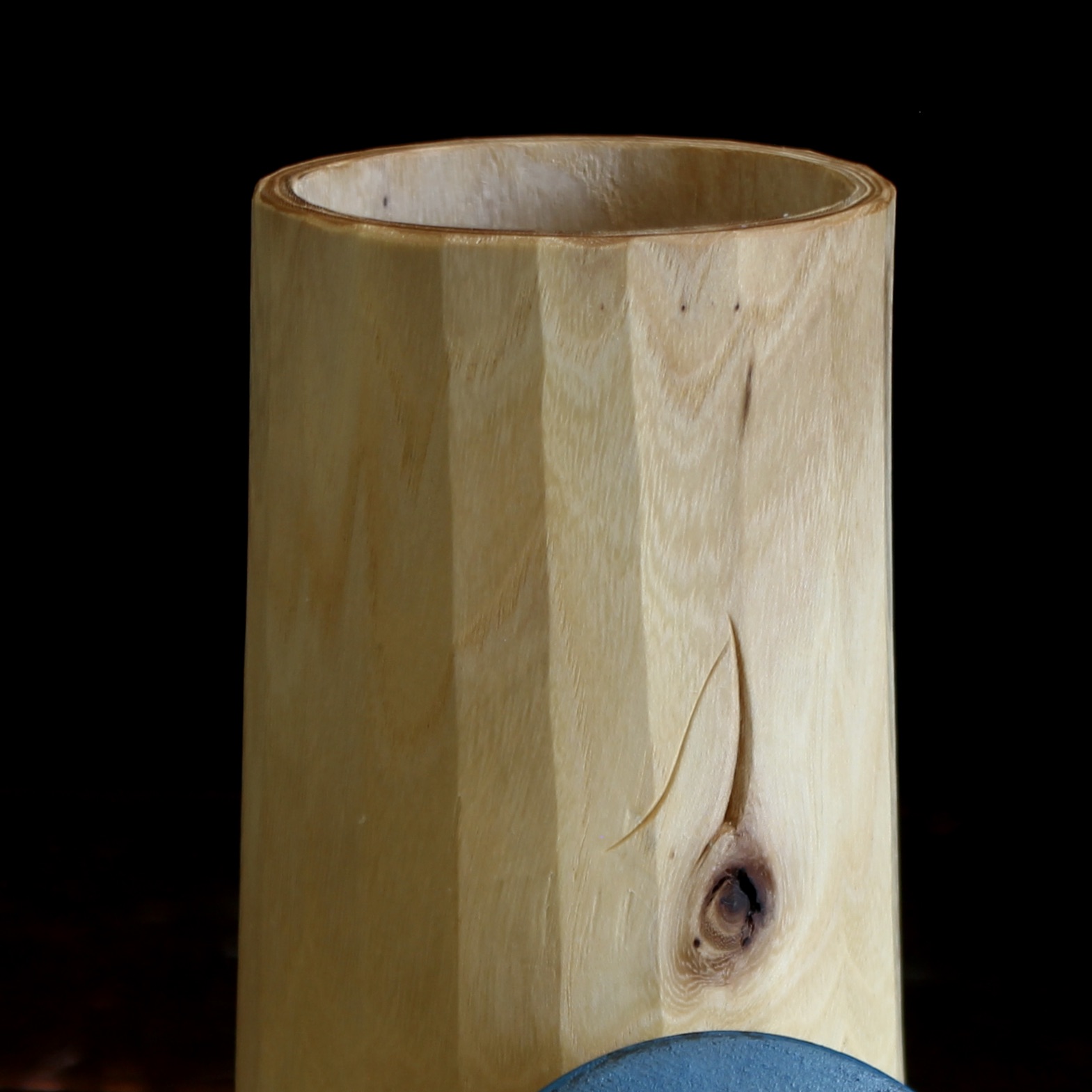
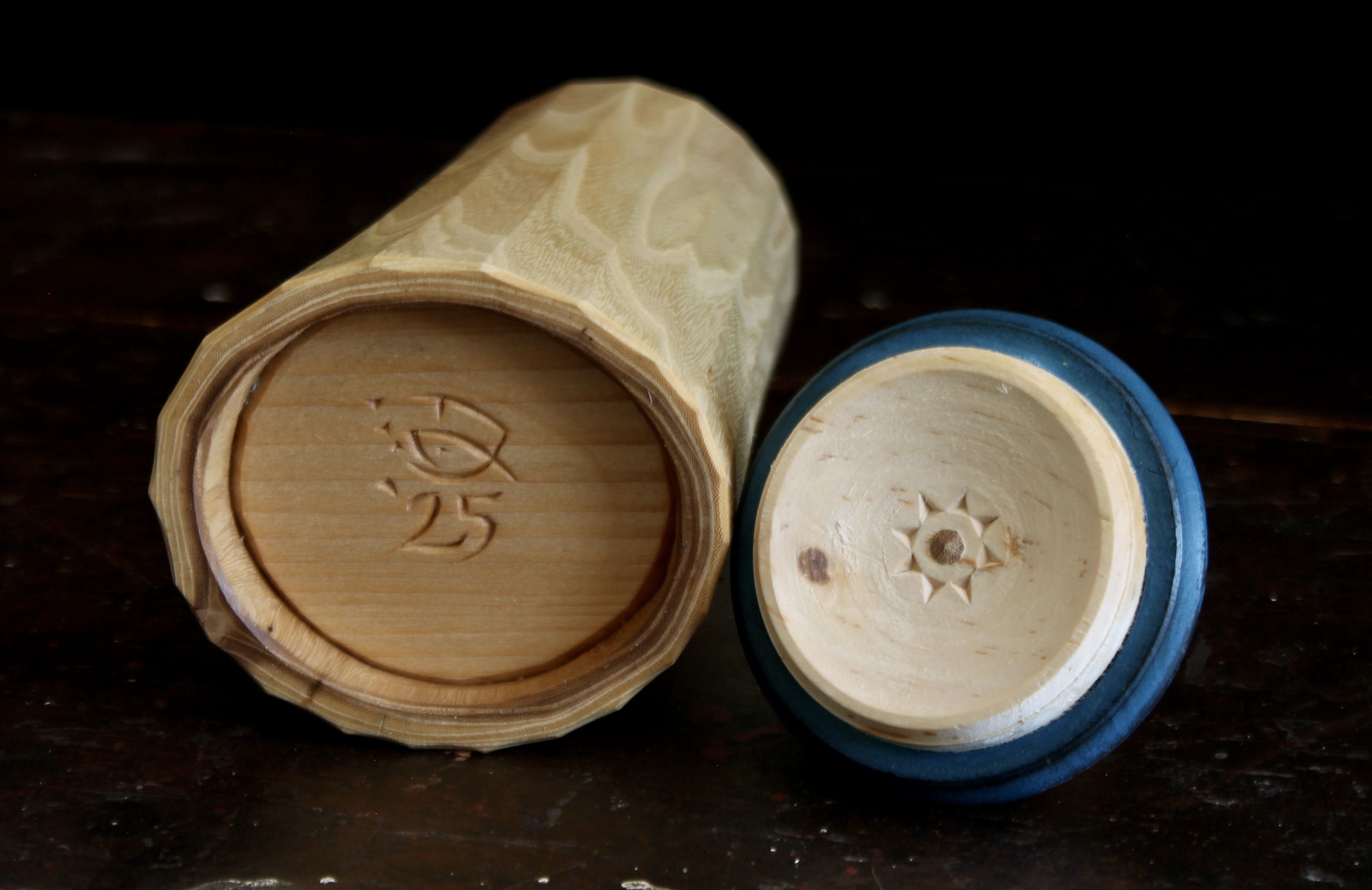
4: 8 5/8″ overall, 6 1/4″ without the finial/handle. Base is 3 1/2″ x 3″ oval. Elm body and finial. Birch lid with blue milk paint (mix) over black India ink. I carve the outside of shrink pots at the bowl horse. In this case, with a drawknife. Some fibers lifted just above a knot and it struck me how much it looked like an eye and an indication of a beak. I just enhanced the tear-out with a bit of carving, leaving a subtle image that may or may not be noticed. Detail photos above. $400 includes shipping. SOLD

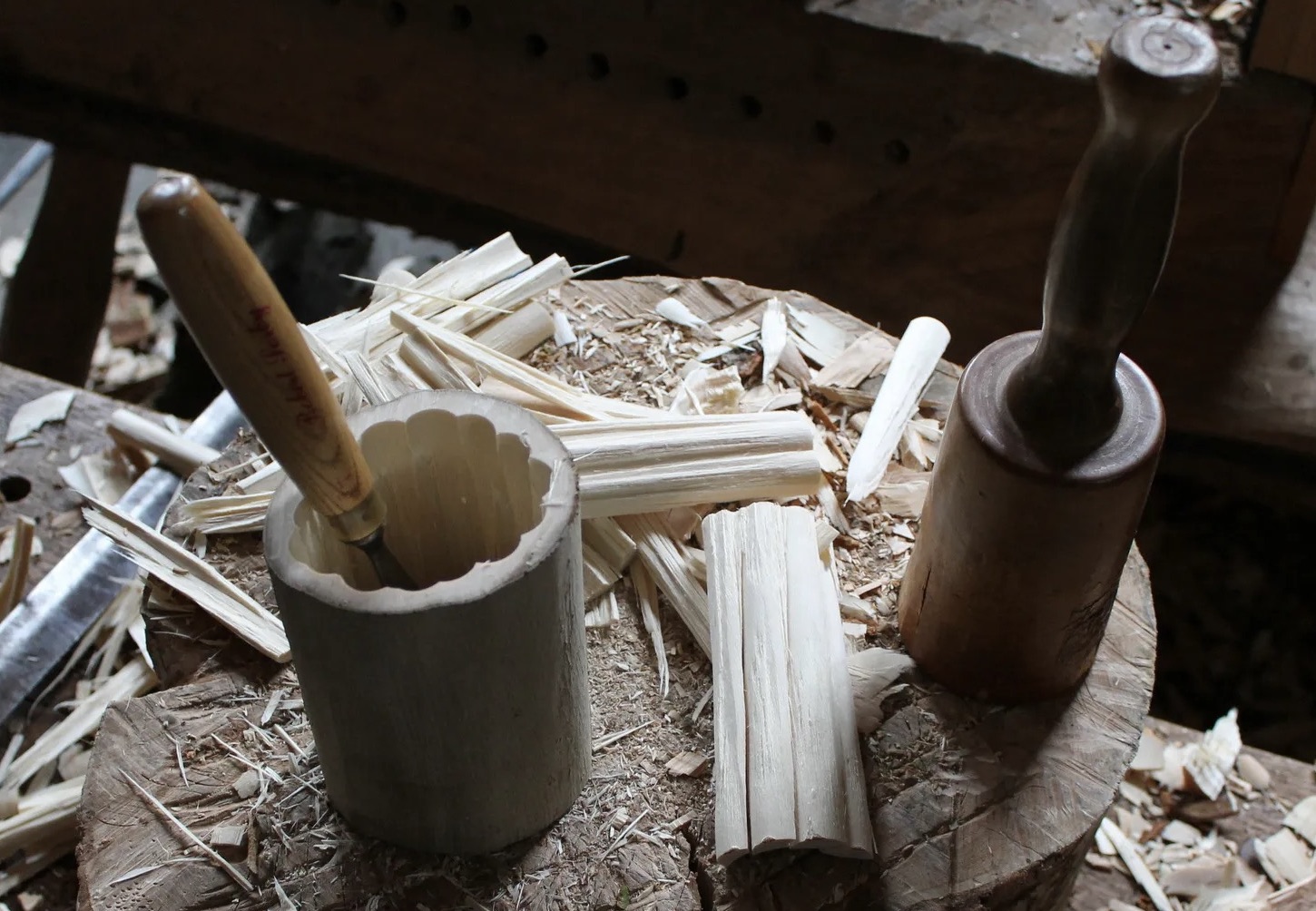
I’ve got lots of posts about making shrink pots, but I’ve been asked a couple times recently about whether I use an out-cannel or in-cannel gouge for hogging away the material after boring a central hole. I guess I’ve never addressed it specifically.

An “out-cannel” gouge has the bevel on the outside, so a typical gouge used for carving. An “in-cannel” gouge has the bevel on the inside with the outside of the tool straight all the way to the cutting edge. In-cannel gouges were/are used for special purposes, by pattern makers for example.

I understand the logic of using an in-cannel gouge for this, and I suppose it would work fine. But I’ve always used a “normal” out-cannel gouge for two reasons. One, I don’t have an in-cannel gouge, and, two, an out-cannel gouge works fine. In the photo above, from a post almost ten years ago, that is an out-cannel gouge. I just tip the handle toward the center so the bevel lies in the direction of travel. If I need to direct the cut back to the center, I can lean the handle back away from center to lever gently off the back of the bevel. The final surface can be pared with gouges, or with a hook knife, or whatever.

One last thing…In that post link, I show a groove cutter (a croze) made from a thread-cutter insert. I still use that one sometimes, but I more often use one made from a v-tool blade. you can see how I made that in this post.

Posted in carving, paint, shrink box, tools, trees, Uncategorized | Tagged , , , , , , | 2 Comments

Moby Dick Book Box

Moby Dick Book Box 2025, 9 3/8″ x 6 1/4″ x 2 1/4″ DF

There’s a long tradition of making boxes and other items in the form of books. I’ve made a few now, each in a different way. In an old post I showed one joined from several pieces and another example made with shrink pot construction. For this latest one, made for a birthday gift, I started with a dry block of butternut and a separate piece for the sliding dovetail lid/cover.

This is stock that I split from a large butternut log several years ago, quite dry now. In the photo above, I’ve sawed and planed the the block for the book itself into general shape then laid out the essentials for the rest of the work with pencil. Under the main block is another piece of the butternut in the process of being sawn to size for the sliding lid.

After sawing the sides, I marked the rough thickness and resawed. The lid, and the block, have a quarter sawn orientation to minimize wood movement.

Before I shaped the outside of the block at all, I carved the sliding dovetails in the box, then gradually planed the edges and end of the lid to match, sneaking up on the final fit. In the photo above, that’s as far as the lid would go at that point. There’s a very slight taper from the open end to the closed end. One or two more shavings off the side of the lid, then it was on to shaping the top of the lid and carving the background for the cover image.

I carved the wavy flutes with a small #7 gouge. With that texture carved and the lid fitting well, I went on one step at a time. I didn’t take any more process photos, but here are some more shots of the finished book box:

The book box standing upright with the cover closed. The paint is artist acrylics. Artist oils would have achieved what I wanted as well, but I didn’t have time to wait for them to dry. The paint comes out of the tube thick like toothpaste. I thinned it a lot with water so that it wouldn’t obscure the carved texture and would allow the grain of the wood to read through a bit.

With the light hitting at this angle you can get a better sense of how much the color is in the wood.

The interior of the box has a texture left from the carving tools and is painted to match. Might make a good lunch box.

The lid fits just right now, but if it should loosen with moisture changes, there are magnets in the box and lid that will keep the lid from sliding out too easily.

There’s the back cover. The silhouette is based on an illustration by Rockwell Kent for the 1930 Lakeside Press edition of Moby Dick. The whole exterior was finished with a linseed/beeswax blend.

If you want to explore many more book-inspired objects, I just discovered that there was an exhibition at the Metropolitan Museum of Art last year. The MET website has background information on the collection and a page with detailed photographs. Many of the bookish things are made from wood, but also metal, stone, fiber and other materials. Books translated into spruce gum boxes, jewelry, pin cushions…

Posted in books, historical reference, Lettering, paint, patterns, shrink box, Uncategorized | Tagged , | 13 Comments

August 2025 Spoons (and Such)

DF Spoons August 2025, Front View

I always keep my eyes open for interesting branch crooks that can make good spoons or other things. Here I’ve got a group of 11 available for purchase now. All of these were carved from branch crooks with the design strongly influenced by what nature provided. All surfaces are straight from the cutting edge and all have been treated with pure linseed/flaxseed oil and kiln-cured. Ready to serve.

You can get a general sense of scale from the photo above. I’ve got another photo further below of the back sides. In the list just below, I’ve provided wood species and dimensions for each spoon. And in the slideshow at the bottom of the post, I’ve got individual photos with the corresponding item number in the captions. All so you can see clearly what you’re getting. Some have deep or shallow bowls, more or less crank, and so on. The photos should make all of that pretty clear.

If you’re interested, email me at dandkfish@gmail.com. Let me know which one(s) you’d like and if you’d prefer to send a check or receive a Paypal invoice via email. Prices include domestic shipping. A little more if outside the US. I’ll try to keep the status updated on the list below. Thank you.

  • 1: American Sycamore, 10 1/2″ x 3 1/8″, A small goose-inspired bowl carved from a crook. Good for holding candy, nuts, or even olives or other small things at the table. $325 SOLD
  • 2: Maple, 14″ x 2 1/8″, milk paint on handle, artist linseed oil paint on finial. $170 SOLD
  • 3: Apple, 8 1/4″ x 1 1/2″ $115 SOLD
  • 4: Cherry, 10 1/4″ x 2 3/8″ $135. SOLD
  • 5: American Sycamore, 9 1/4″ x 2 1/2″ $145 SOLD
  • 6: Maple, 15″ x 2 3/4″, artist linseed oil paint. $170 SOLD
  • 7: Maple, 13″ x 2 1/2″, cake server/spatula, artist linseed oil paint, carved lettering “Let them eat cake.” $240. SOLD
  • 8: Cherry, 10″ x 2 1/2″, very shallow bowl $125 SOLD
  • 9: Cherry, 8 1/4″ x 2″ $120 SOLD
  • 10: Maple, 15 1/2″ x 3″, milk paint $185 SOLD
  • 11: Cherry, 10 1/4″ x 2 1/4″. Darker than the others because I carved it months ago. $115 SOLD
DF Spoons August 2025, Back View

The slideshow above has individual photos. The caption provides the item number for each piece.

Posted in spoons, Uncategorized | Tagged , , | 12 Comments

Bowl Carving Instructional Video Sale

Four years ago, while we were all still under pandemic restrictions, Elia Bizzari turned lemons into lemonade by asking some of his fellow craftspersons to make a series of live interactive instructional videos with him. I jumped in for bowl carving while Peter Follansbee, Jane Mickelborough, and Curtis Buchanan each did their own take on spoon carving. Jane also did one on carving fan birds. Elia just announced a sale on these videos, half price through September 1.

I was in my shop, Elia was in his, and all of the class attendees from all over the place were in their homes, but we were all together on the screen. There were some interesting advantages to the format. For one, folks were able to join in from far away. Also, the participants were able to ask questions mid-process, so clarifications could be made for the benefit of all. And there were tons of excellent questions! I demonstrated a step, then Elia carried out that step while adapting to the equipment and tools available in his shop. I offered suggestions along the way and answered questions, then we moved on to the next step. In the days between sessions, students worked on their own bowls, following the steps we had covered.

The sessions follow the process from a half log. My resulting sample bowl (seen above and below) began with a cherry log about 8″ in diameter and 15 1/2″ long. Alternatively, you could follow along and do just fine with a dry length of 4×6 timber, say 14-16″ long — ideally something like basswood or poplar if you’re working dry wood. This class focuses on the concepts and skills that can be used and adapted for a variety of styles and designs, even your first time through. No carved flutes required!

Every minute was recorded. Three sessions for a total of over 9 hours of instruction. You have unlimited access to the recordings and you can pause, rewind, fast forward and so on. Here’s the link to Elia’s website for the bowl carving series. And here’s the link to all of the videos by Peter, Jane, and Curtis.

There’s a unique benefit to in-person instruction. But that doesn’t work for everyone for a variety of reasons. This video series is an excellent alternative or supplement.

DF Maple Cake Server 2025

I’ve been working on a couple of bowls myself lately, but I always make time to carve a spoon when a good crook comes along. I’ve got a batch of 11 spoons (and spoon-related pieces) ready to post for sale tomorrow afternoon.

Posted in classes, teaching, Uncategorized | Tagged , , , | 6 Comments

Birch Ummik and Woodworking in Estonia

DF Black Birch and Sycamore shrink pot 2025, 9″ x 5″

Making and using shrink pots for grain and food storage is an ancient practice. In one of the greatest woodworking books, Woodworking in Estonia, Ants Viires, dedicates several pages (89-95) to it. In various regions of Estonia, these containers were known as “ummik” or “umku, umpu.” He asserts that these containers made by hollowing out a log or branch predate coopered containers. He goes into welcome detail on methods. For example, Viires explains that often the hollowed log would be put into boiling water or soaked to expand further before the bottom was inserted. But he states, “We also have evidence of the insertion of the dry base into the green wood container without ‘boiling’ or soaking; this may be considered an older method.” I guess I’ve only made “old school” ummiks. More on Woodworking in Estonia later.

I made this grey birch pot (above) fifteen years ago and it has stored ground flax seed ever since. I pop off the top every morning and sprinkle some flax seed on my oatmeal, because I live on the edge like that. A plastic container would be just as practical, but it wouldn’t give me as much joy or be so pleasing to the hand and eye.

There’s the grey birch pot in the lower left beside the larger black birch container I just finished.

This black birch bark wasn’t smooth like paper birch or grey birch. So, while I left the bark on, I shaved the outer surface away with a drawknife, leaving a series of subtle vertical facets. On one side the bark was dappled, on the other side not so much.

Shrink pot lids, should the pot need one, can be projects all their own and can certainly take longer than the pot itself. I made the lid from some quarter-sawn sycamore I’ve been hanging onto.

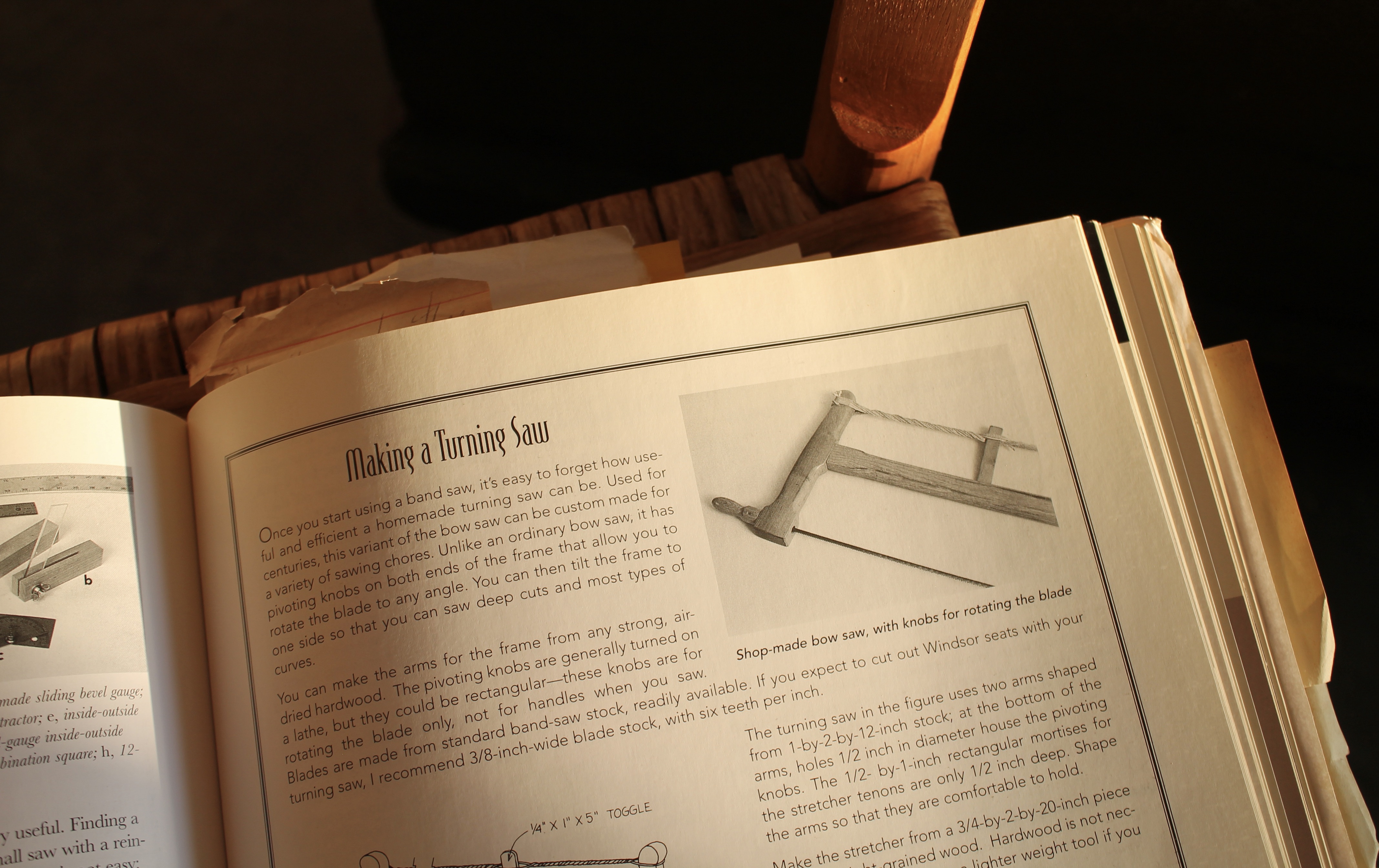
One of the tools I use pretty regularly, but hardly seem to mention, is a coping saw. I don’t have a band saw, but even if you do, I think a coping saw should be hanging near your bench. It’s such a simple thing, and so effective. You can get fancy ones, but I’ve gotten good service from this Eclipse model that’s available for around twenty bucks. There are similar ones made by many different brands. A pack of 6 1/2″ blades will last a long time. I prefer the finer blades, like an 18 or 24 TPI.

A shot of the finished lid. I decided to make the handle/finial out of the same sycamore and suggest a rising sun. Especially appropriate if the pot stores your morning oatmeal or coffee.

The handle is joined to the lid with a long tenon. I’m shaving the tenon cheek with a chisel in the photo above.

There’s another angle of the finished lid. The rabbet on the underside of the lid can be carved from the lid piece itself, or a separate piece of wood can be glued to the underside of the lid. In this case, I shaped a thin basswood board to a snug fit then glued it on. When the glue dried, an idea came to mind and I hurried and went ahead before I talked myself out of it.

Linseed oil and beeswax on the outside of the pot and lid, no finish at all on the inside. It’s 9″ high and 5″ wide. By volume, it will hold nearly 1 1/2 quarts, about 45 fluid ounces (1.3 liters).

I want to finish this post with a return to Woodworking in Estonia, because I can’t emphasize enough what a treasure it is.

There are hundreds of illustrations and photographs in the book. Above and below are just a couple of the ones from the “shrink pot” section.

There are so many interesting and practical methods for work-holding discussed and pictured in the book. Check out these two below. Both of them feature horses that hold the work with pressure from end to end, like a “bowl horse“. I was delighted to see this when Lost Art Press published and made it widely accessible in 2016. This allows the craftsperson access to the entire upper surface of the workpiece. Works great for shaving shrink pots too.

Posted in books, historical reference, quotes and excerpts, shrink box, Uncategorized | Tagged , , | 13 Comments

Cracked Pot

DF Cherry Shrink Pot 2025, 10 1/2″ high x 5 1/2″ wide.

I roughed out this cherry shrink pot with split sides a few years ago. It cracked a couple days into drying, leaving a 1/2″ wide gap. It’s a rare occurrence, but sometimes you get lucky.

My first inclination was to burn it. After all, I’ve got lots of uncracked shrink pots waiting to be finished. But I kept it around, hoping for the right time and inspiration. I started thinking about a line attributed to Groucho Marx, a play on the Beatitudes:

Blessed are the cracked, for they shall let in the light.

So, recently I returned to the long-neglected shrink pot. Although the bottom was still in its groove, I pinned the sides to the bottom board with some bamboo pins (skewers) to make sure it stayed that way. After checking that the bottom surface sat flat, I marked the top surface parallel by spinning it around against a stationary pencil point as in the photo above. Then I sawed and planed it to the line.

I wanted a cherry lid, but I didn’t have any dry cherry boards around. I grabbed a chunk of dry cherry from the firewood stack and sawed off both checked ends.

I flattened the short piece that remained with a drawknife, then a plane. With a coping saw and knife, I shaped the lid to match the irregular exterior of the pot, then carved a rabbet to match the interior. After working out the lettering through some sketching on paper, I drew it again on the lid and carved the words.

I returned to the firewood pile again and found a curving piece of dry hickory. I split out a thin piece and carved a tenon onto one end. The mortise is outlined in pencil on the lid in the photo above.

There it is in place on the finished lid. It’s a comfortable handle and finial.

These are the three tools I used to carve the lettering. The gouges just for the tighter curves of these small letters. The letters range from 1/4″ to 3/4″ in height.

To keep the lid from rotating at all, I inserted two registration pins into the lid. The bottom of the finial tenon can be seen on the underside of the lid, too.

The bottom of the pot and the bottom of the lid.

This one is available for purchase. The exterior is finished with linseed oil. The color of the cherry has already deepened a little beyond that in the photos after a couple days in the intense sunlight to cure the oil. 10 1/2″ high overall (6 1/4″ to the top of the lid) and 5 1/2″ wide at the base. $725 includes shipping. If you’re interested, please email me at dandkfish@gmail.com. Thank you. Update: SOLD

I’m planning to teach classes on (uncracked) shrink pots next year at Pete Galbert’s. I’ll get a course description together soon and get it posted to Pete’s site. Shrink pots offer many possibilities and I’m excited about it. I’m looking forward to making more designs in the coming months, so you’ll be hearing more about them.

Posted in cherry, Lettering, shrink box, Uncategorized | Tagged , , | 6 Comments

Blue Maple Bowl

Maple Bowl 2025, 12 5/8″ x 7 7/8″ x 3″ ( 32 cm x 19.8 cm x 7.5 cm)

It started out as a red maple (Acer rubrum). The top half of the tree snapped off a month ago across the road. I hurried and started carving away on some of it. Maple doesn’t store well for long in hot weather.

Roughing out with the adze goes quickly.

Adze work finished.

For shaping the sides, I just went straight to the drawknife.

The bottom side of the bowl, with the outline of the foot.

Shaping the ends with an axe.

Then fairing the surface with a spokeshave before wrapping in an old towel to dry for a week or two.

After drying, the surface is oxidized and a bit mottled. The upper portion shows the new surface cut with a gouge after drying. Red maple has a consistency similar to fruitwood or even boxwood when dry. Clean cuts leave a burnished surface and it holds carved detail well.

There’s the whole hollow in the finished bowl.

I carved a series of parallel rows across the end panels, following the curve of the handle end. That’s a #3 12mm gouge.

Above is a video clip. I stop the carving about half way across. Later, I work back to that spot in the other direction from the other side.

There’s the finished exterior, painted with sky blue milk paint. The natural wood will turn more golden over time, complementing the blue.

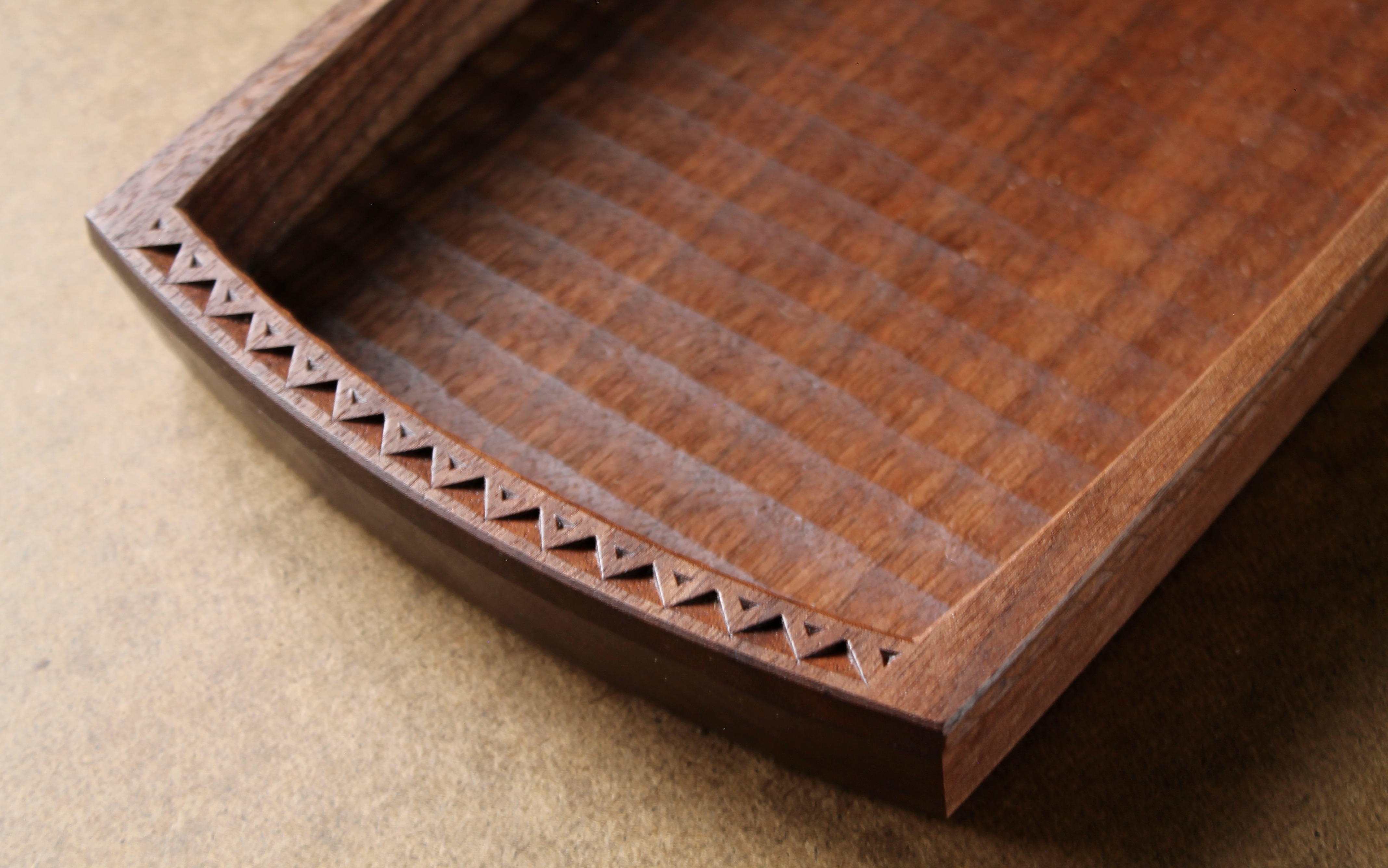
I left a narrow panel to the outside of the rim and chip carved a pattern of graduated alternating triangles. I was so focused I forgot to take photos of that stage.

This bowl is available for purchase. Finished with milk paint and kiln-cured pure linseed oil, ready to serve. It is 12 5/8″ long, a little under 8″ wide, and 3″ high. (32cm x 19.8cm x 7.5cm). The price of $700 includes shipping. Update: SOLD. If you’re interested, please email me at dandkfish@gmail.com. Thank you.

One last photo for this post. A shot of a monarch butterfly caterpillar feeding on milkweed in the back yard today.

Posted in bowls, paint, Uncategorized | 4 Comments

Before I Forget… A Few Things

This post was going to be about using my favorite T-handle auger, the one I use to bore the hole to begin making a shrink pot. With a couple green lengths of tree available, I took a few photos as I honed and used the auger. As I was thinking of organizing the post, a thought struck me: “This seems familiar.” A quick search under “auger” in my own blog brought up essentially the same post, from nine years ago, that I was planning to write. There’s a message to me there. Anyway, here’s the link to that post. I read through it and agreed wholeheartedly!

Besides the shrink pots and things around the house, I’ve been busy with several projects in various stages including drawing a design for a lettered exterior sign, a door repair, a couple bowls, some spoons, and plans for classes. More on all of those in time.

Meanwhile, there’s an event coming up this Saturday that I want to mention. Living under my rock, I hadn’t heard about this until a student mentioned it to me during a recent class. Many of you probably already know much more about it than me. The event is known as Hand Tool Haven, a one-day gathering just outside of Pittsburgh, PA. It’s a fundraising event for Plane Wellness, a non-profit organization devoted to improving mental wellness through woodworking, founded just two years ago. They’ve got some big sponsors and it should be a special event. I’d like to make it there on Saturday myself; we’ll see if it works out.

While I’m on a roll, a couple quick book recommendations. First, a little book full of big ideas. Apprenticing: A Manifesto by Lance R. Lee. The compact size (5″x7.5″, 48 pages) encourages you to tuck it in your back pocket to read as opportunity allows, like the next time you find yourself waiting at the DMV or an outlet mall. A friend recently gave it to me as a gift, and I’ve been returning to it often, gleaning more and more.

Another that I’ve been meaning to mention is Good Eye by George Walker and Jim Tolpin. It goes beyond, and complements, Walker and Tolpin’s previous books, exploring all sorts of ideas such as asymmetry, patterns, ornamentation, and my favorite chapter: Playing with Curves. Packed with illustrations and exercises to get you thinking and saying “aha!”

Now, back to that T-handle auger for a minute. I love using the tools in my shop. It would be a pleasure even to just sit and drawknife a green branch away into a pile of shavings with no particular purpose. I love hewing, planing, slicing, gouging, and so on. They are not just means to an end. Using this auger is one of those wonderful sensory experiences.

I recorded a few clips as I bored the initial hole for a shrink pot from a black birch log this week. It’s harder and more dense than black cherry (which I featured in that post nine years ago). You can see and hear how the auger lips cut the end grain fibers as the auger is pulled into the log by the lead screw. I wish you could smell the wintergreen.

T-handle auger into end-grain black birch

Below, I’m much further into the log. I backed the camera up to show the handle in motion. You get into a rhythm.

T-handle auger handle motion

And one final clip in which I cut the bored section away and we peek through.

Cutting the black birch section for the shrink pot.
Posted in books, events, tools, Uncategorized | Tagged , | 12 Comments

The New Peter Galbert Workshop

View from inside Pete’s workshop. Photo by John Britton

Two weeks ago, a bunch of us were savoring our last day of class together in Pete Galbert’s new workshop facility in Berwick, Maine. Pete’s old workshop was in a 19th century former mill building and it was a great place to work. The new workshop is better.

Peter Galbert’s Workshop. Photo Jay Jarman

The inside is spacious with a comfortable wood floor. Large windows fill the room with light and invite views of the countryside outside the shop. They also allow refreshing breezes to flow through, although the first three days of our class we opted to use the mini-splits to cut the humidity. We were able to concentrate on our carving during three brutally hot days.

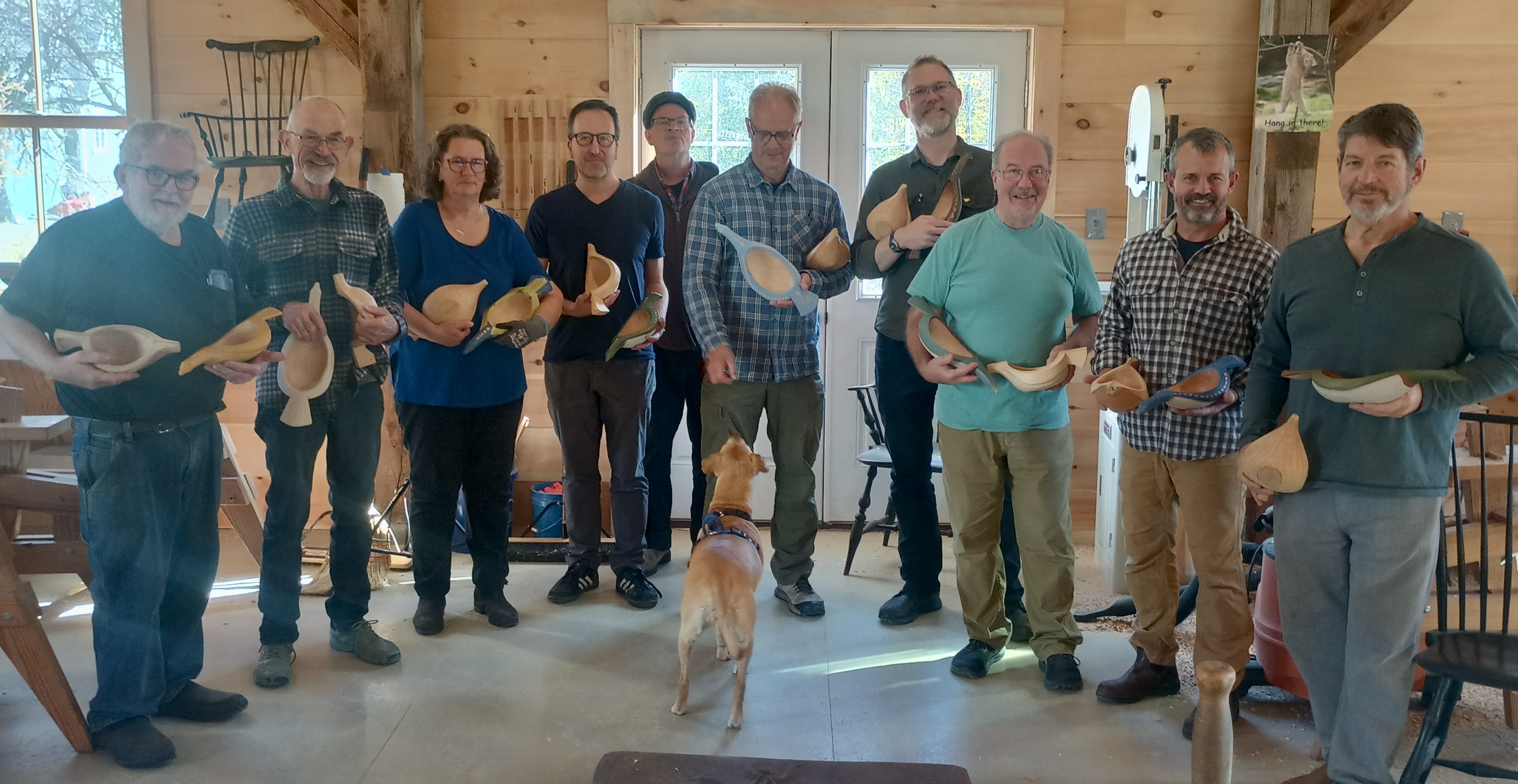
This was my first bird bowl class, and it was also sort of a class reunion, as six of the students had been in my Bowl Explorations class together last August. They were eager to get back together and they welcomed three newcomers. The encouragement that students give one another, and the sense of togetherness that develops as we work side by side is a wonderful thing to be a part of. Joel Paul, on the far right, joined me as an instuctor with this class and his knowledge, understanding, and sense of humor were a critical part of the success of the class.

Above, Joel is guiding Gary through the sharpening of his drawknife.

Oh — and we carved bird bowls. Here is a ladder shot of nine goose-inspired bowls. I was thrilled with how the students tackled this challenging form and with the creativity and imagination they demonstrated. I emphasize not to be concerned with mistakes on the class projects, that we’re here to learn skills and concepts. But it is nice when it turns out well.

Another shot from a lower angle.

We also got our hen bowls carved with a few details and painting to finish up at home. There’s Joe carving the flute under the wing.

And Mac shaving the side of the tail.

There was also plenty of bird inspiration all around us.

Photo by Macauley Stubbs

The swallows love Pete’s barn.

One little bird even joined us in the workshop. This chipping sparrow couldn’t seem to find his way out and he was very cooperative when I was able to assist him in returning to the field and trees.

Pete Galbert, Dave Fisher, Frank Strazza. Photo Joe Bass.

You never know who’s going to drop in to Pete’s. I had been eager to meet Frank Strazza for a long time. One afternoon he just walked in to see Pete and we (me and whatever students hung around) got the chance to talk about all sorts of things, especially his incredible marquetry work.

A couple days later, Tim Manney dropped by and we we dove into tools and talked about all sorts of stuff. I’ve known Tim for almost ten years and every time I talk with him I learn something new about sharpening or woodworking in general. He’s got a weekend class coming up at Pete’s if you can join in.

Pete has a sitting area just outside the shop, and good coffee (so they tell me). Not a bad spot to begin the day.

When I returned home, I found the neighbor’s red maple tree had fallen in a storm. So I started on a few things while it was fresh, including this shrink pot in progress. More on that later.

I’ll be back at Pete’s in October with a few tweaks to the class procedure after the first run. Meanwhile, lots of projects in mind.

Posted in Uncategorized | 9 Comments

Finishing Bird Bowls Just in Time

Painted Hen Bowls, 2025

Thirty years of classroom teaching has taught me the importance of preparation. As I’ve readied for next week’s inaugural bird bowl class at Peter Galbert’s, one of my fun tasks has been getting bird bowl examples finished. There’s a few chickens above. If you see them crossing the road, you’ll know where they’re heading.

In a post last month, I showed these in the raw basswood stage. Plain basswood can be a little lackluster, so I played around with some different milk paint techniques and combinations. We’ll be exploring those in class. I’ve also used artist oils (linseed oil paint) before, but the dry time would make it inconvenient for a class setting as students pack their still-wet painted bowls into luggage.

Likewise, starting with green wood wouldn’t allow us to finish pieces during our week together. Starting with dry 4″ x 6″ basswood (a.k.a. linden or limewood) blocks, allows us to remove bulk relatively quickly and move forward to the finished piece. And the ease of obtaining material will make these designs more accessible beyond class as well. All of these chickens are 11-12″ long. A brief digression: There’s something about that photo above that reminds me of an 80’s movie:

Twins, 1988

The twins looking away.

A reminder to be careful in the heat this week.

There will be several other non-chicken birds going as well.

And even though we won’t be carving from green branch crooks, our methods will translate to that sort of work as well. So I’ll have some examples and we’ll be discussing the considerations for working with green wood and the possibilities presented by crooks. As an example, I carved this little goose-inspired bowl from a crooked bit of American sycamore. Like a spoon with a tail.

That crooked bit of American sycamore.

There’s a shot of the upper surface shaved and ready for some layout lines.

And, while on the subject of crooks, I finally finished a bowl I roughed out from a cherry tree crotch (above) a year-and-a-half ago. I wrote about that process in a post back then.

Cherry Bird Bowl 2025. 7 3/4″ high, 6 1/4″ long, 3 3/8″ wide.

There’s the finished bowl, above, along with a few more shots in the slideshow below.

This one will be flying close by my side on the way to Pete’s and back. We’ll be revisiting many of these birds on the blog, in time.

Posted in bird bowls, classes, finding wood, paint, patterns, Uncategorized | Tagged , , | 14 Comments