A couple months ago, I wrote a post that included an explanation of a honing method using a board secured vertically in a vise as an aid to honing gouges and chisels. I don’t know what to call it. Honing ledger? Sharpening shelf? I’ll go with alliteration.
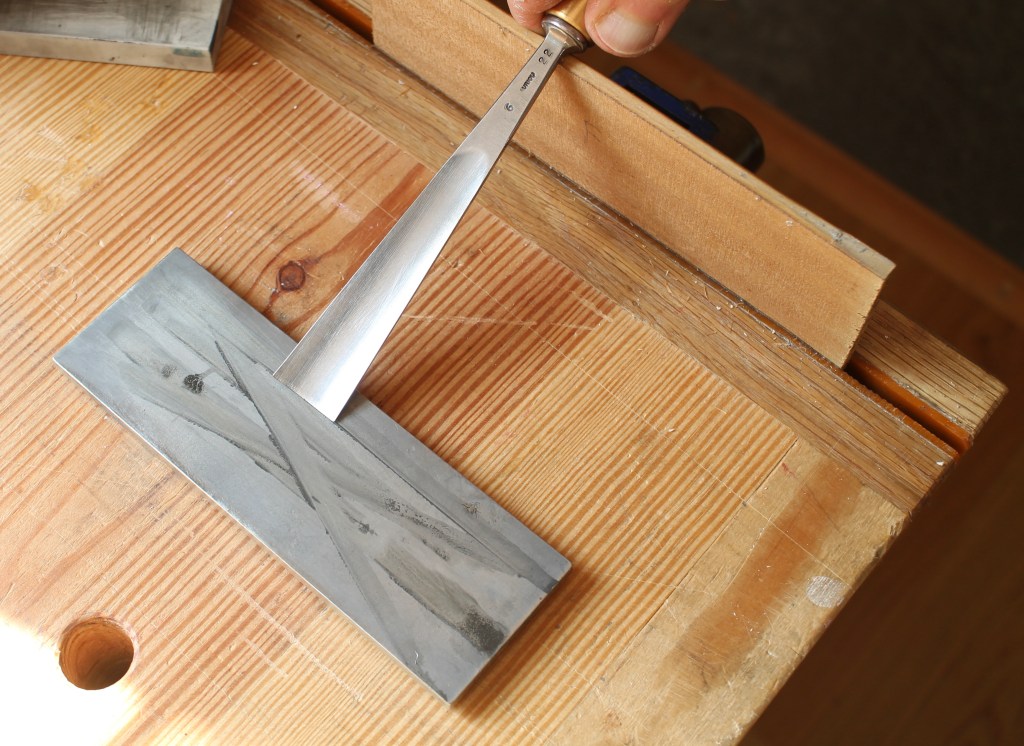
Anyway, it allows the gouge to be slid side-to-side across the stone while maintaining a consistent sharpening angle. There’s a photo from the original post above. Call it what you want, but it’s just a scrap board.
A couple weeks ago, this showed up in my mailbox, a gift from Bill Skinner. Bill took the idea and made a deluxe version with a 1/2″ diameter steel rod at the top.
Here’s a shot of the other side. The uprights are joined to the body with a half-lap joint. Overall dimensions are 13″ x 6″ x 7/8″. Bar length between uprights is 11″. There’s a 1/2″ gap between the bottom of the rod and the top of the body.
I tried it out just like it is and it works great, especially with a drop of oil or a little wax rubbed onto the bar.
So, it works just like a board, but the special benefit of Bill’s configuration is that it can be used with the Tormek SVS 38 clamp. I don’t have one, but Bill says it keeps the tool square but still allows the rotation to sharpen the gouge. Above are photos that Bill sent. On the right is a depth setting block to allow for a consistent angle when setting the clamp on a gouge. Again, I don’t have a Tormek or one of these clamps, but Bill says you can get one (the clamp, not the Tormek) used on Ebay for around $20.
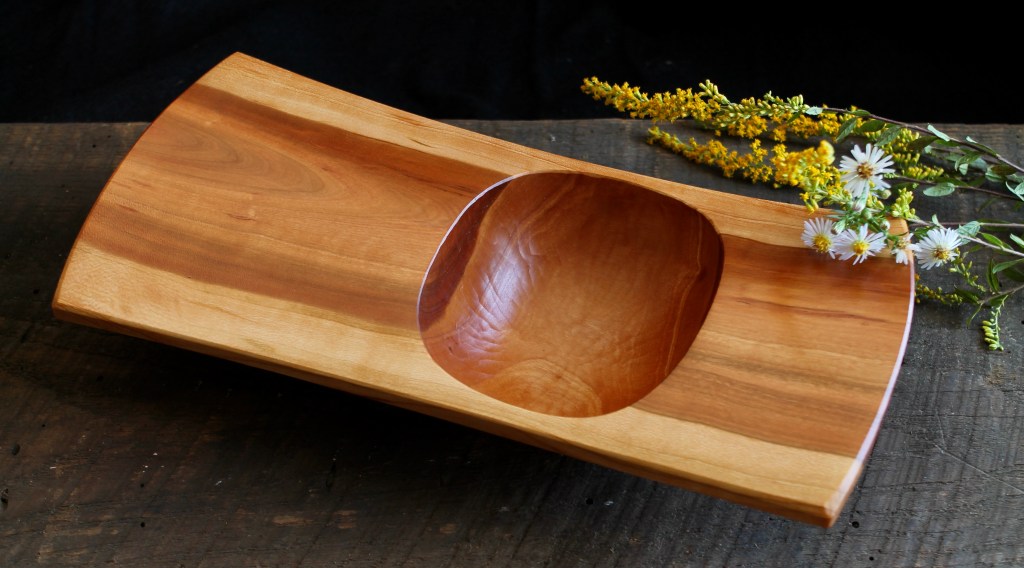
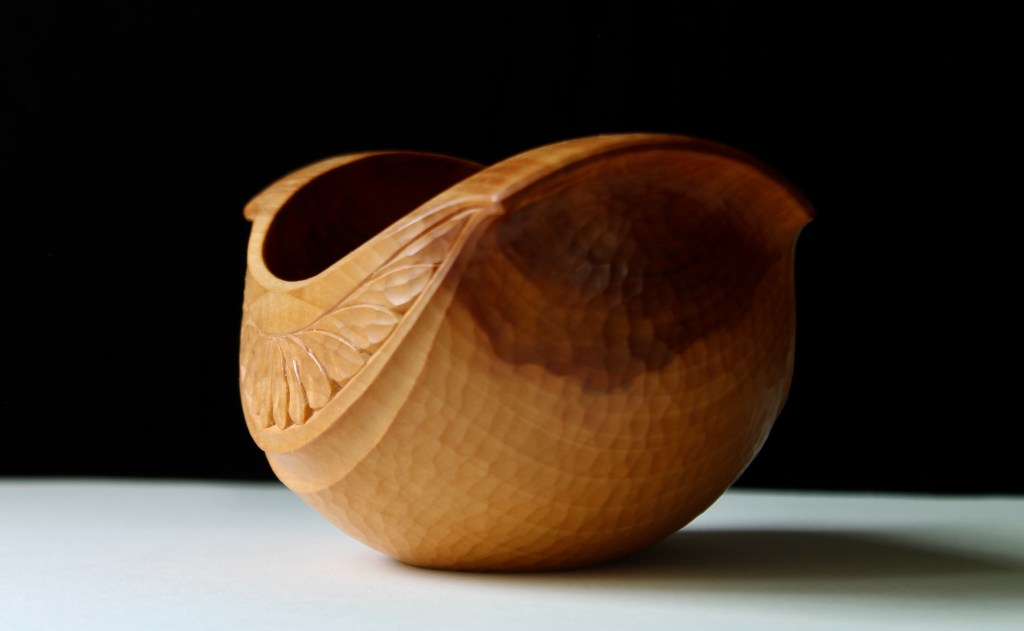
What I make is usually dependent on what bits of tree become available. Responding to each piece is a fun challenge. When I checked out a small cherry tree that had fallen over in a yard, it had already been cut into various lengths. I split open this short chunk, only about a foot long, with a little upward curve and a striking band of heartwood.
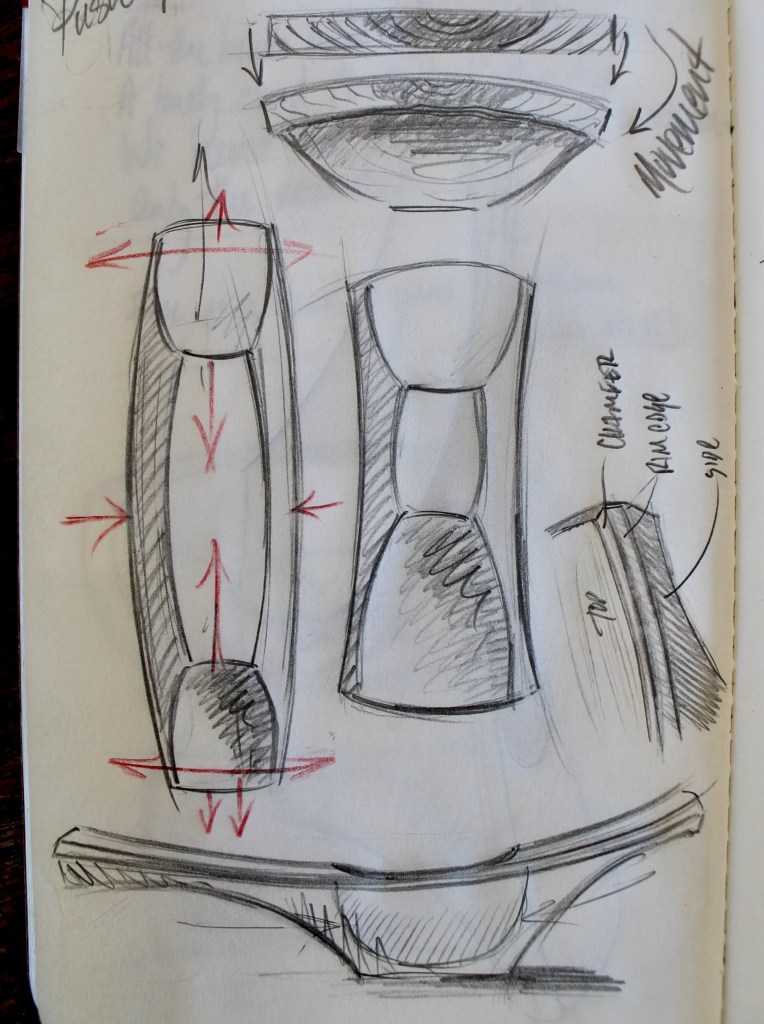
I wanted to keep a lot of that heartwood streak. Long “handles”, like in the Bowl-from-a-Plank design, would allow for that. But this piece of wood wouldn’t fit that exact design. So, I thought about distorting the Bowl-from-a-Plank design, much like you could distort an image of Snoopy from the Sunday comics with Silly Putty. The sketchbook page above reflects some of this mental Silly Putty stretching. The bowl with the red arrows is the Bowl-from-a-Plank (underside), and the rest represent the design for this bowl.
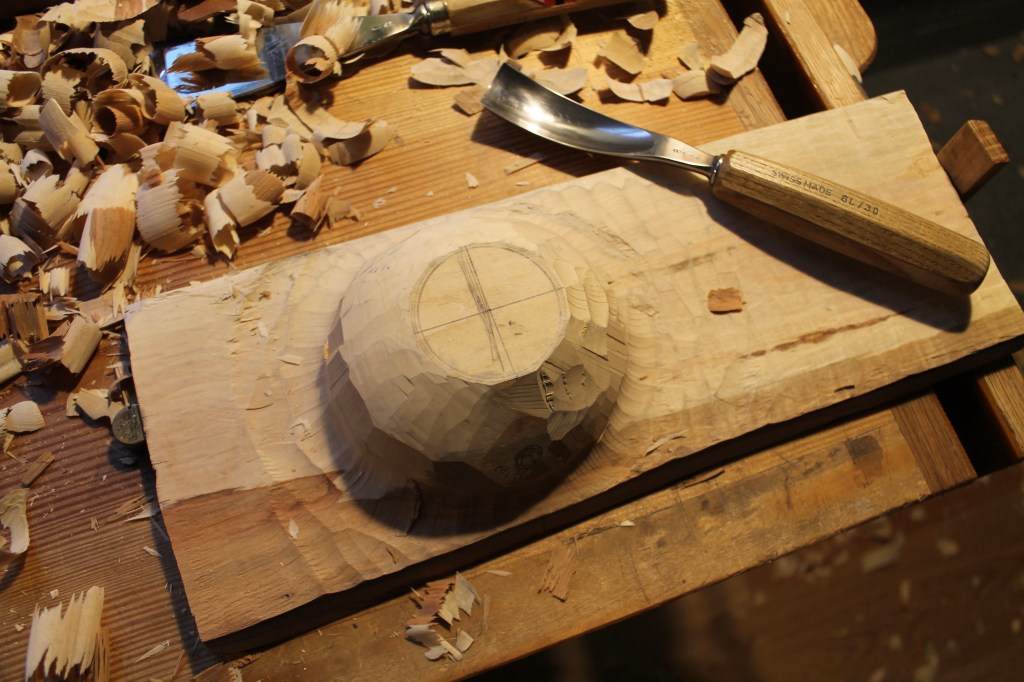
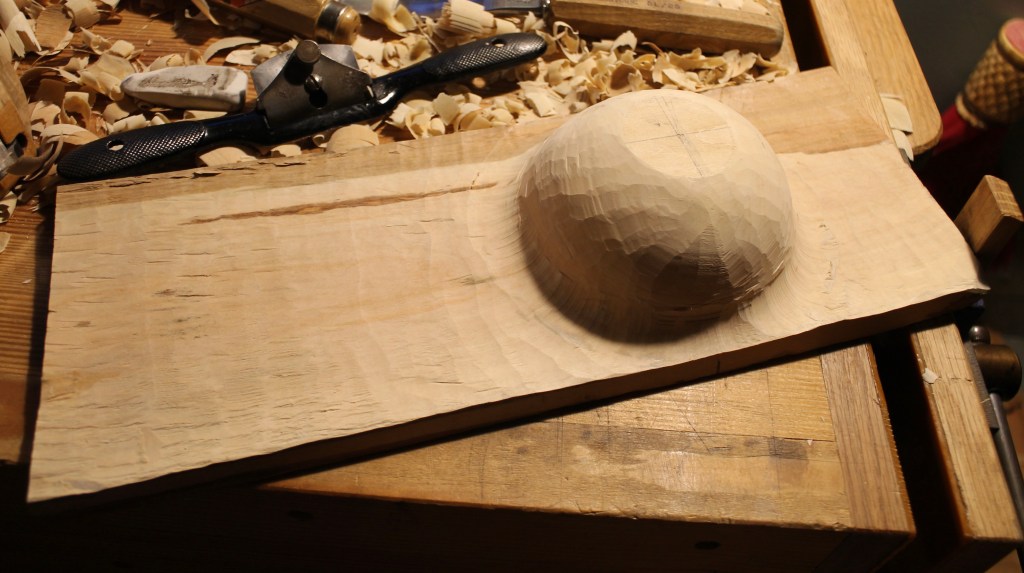
There’s the underside of a Bowl-from-a-Plank, above…
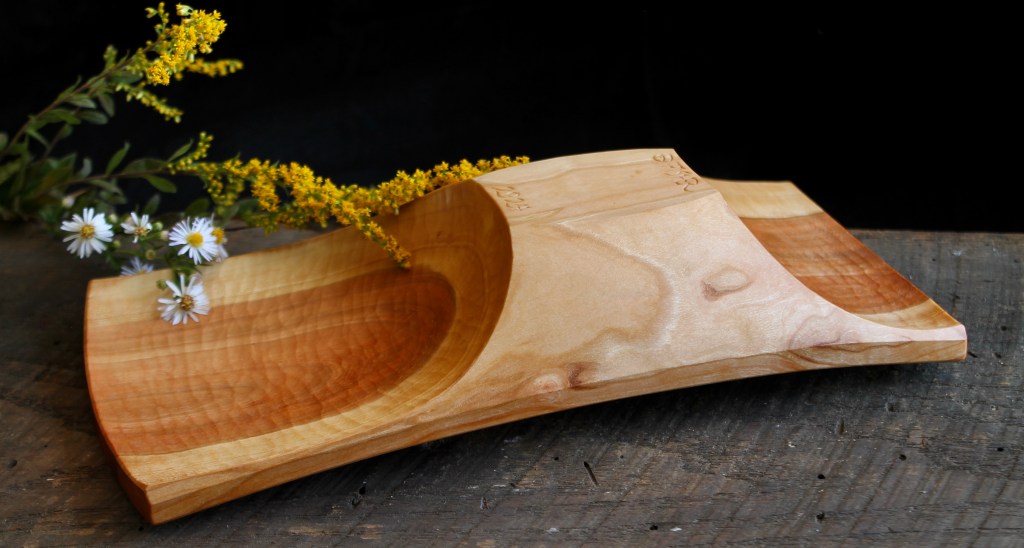
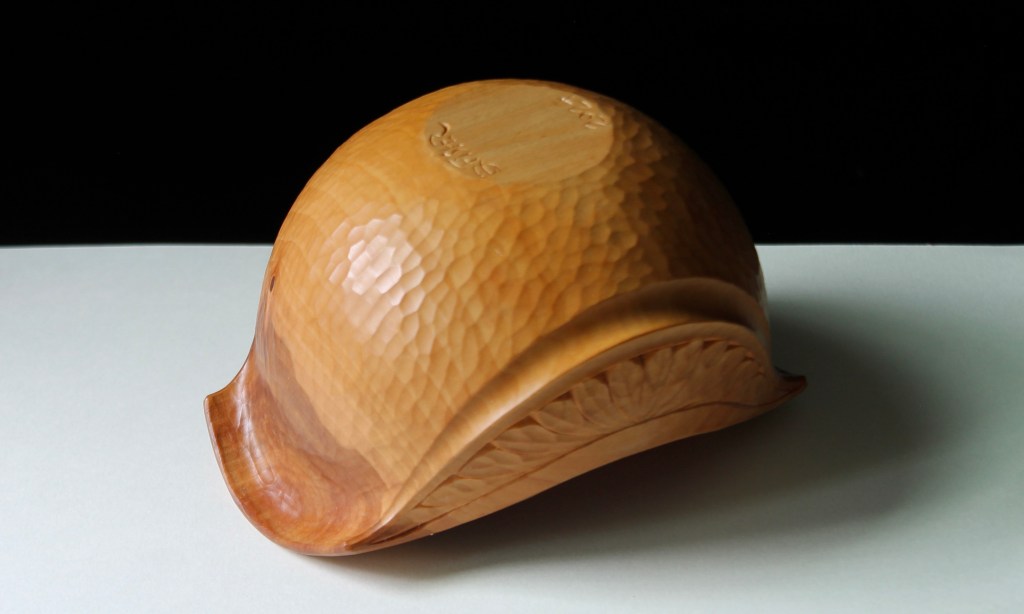
…and a similar view of this latest bowl. The areas beneath the handles are slightly hollow along their lengths and widths.
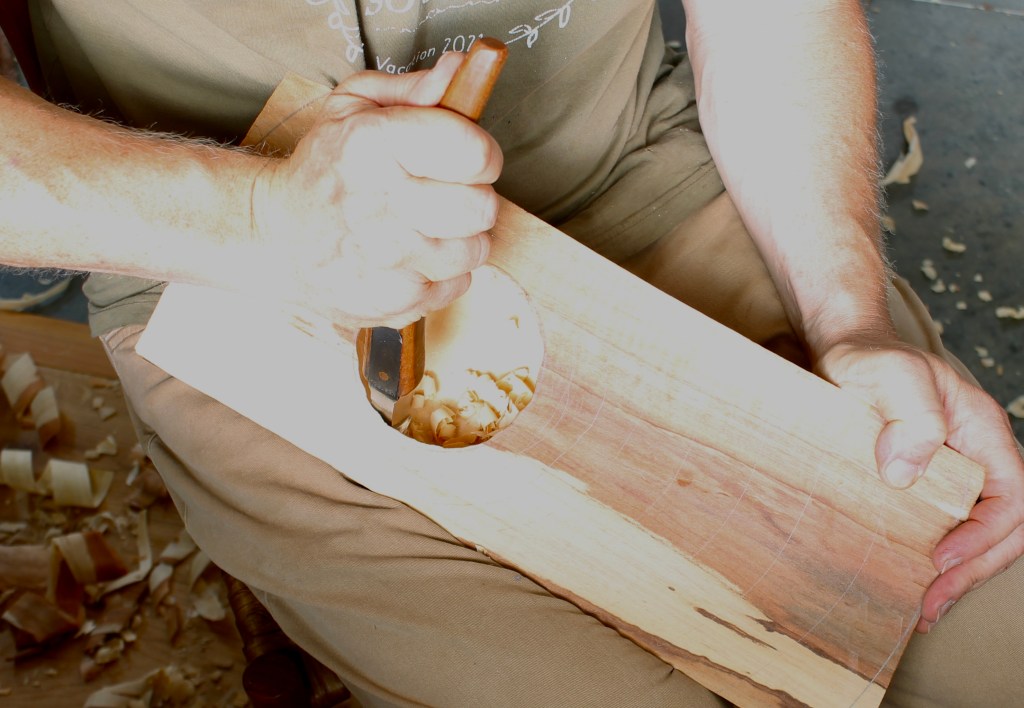
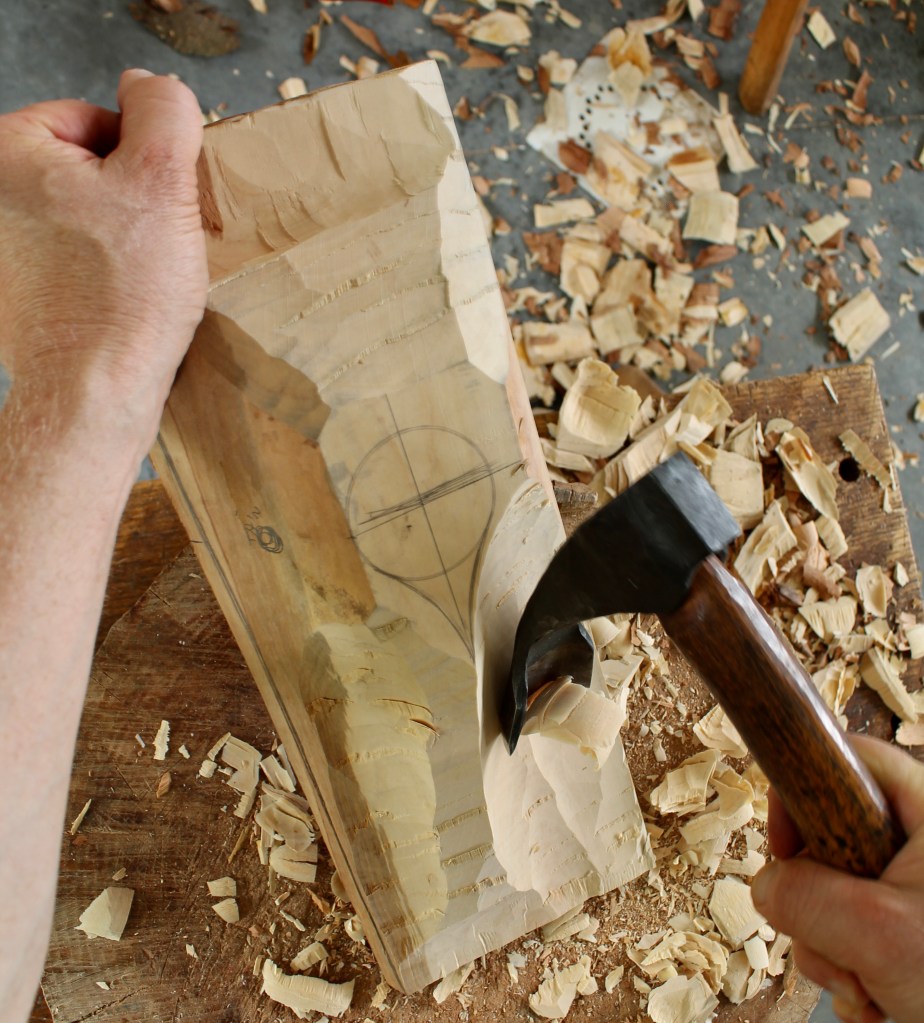
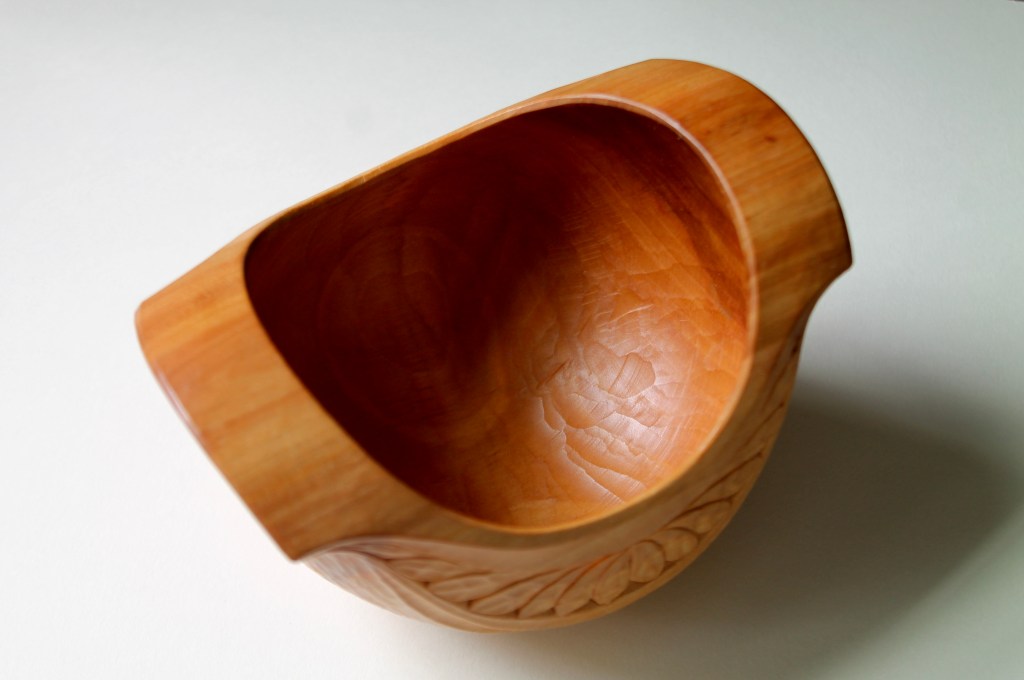
The layout for this one is just freehand sketching. A spoon-bent gouge was needed to shape the steep tight hollow. The hollow itself is 4 1/2″ x 3 3/4″, a nice size for candy or olives.
This bowl is available for purchase. Overall dimensions are 11 1/4″ long, 5 1/2″ wide, 2 3/8″ high. If you’re interested, please email me at dandkfish@gmail.com. $600 includes shipping. SOLD
And now for the spoons…
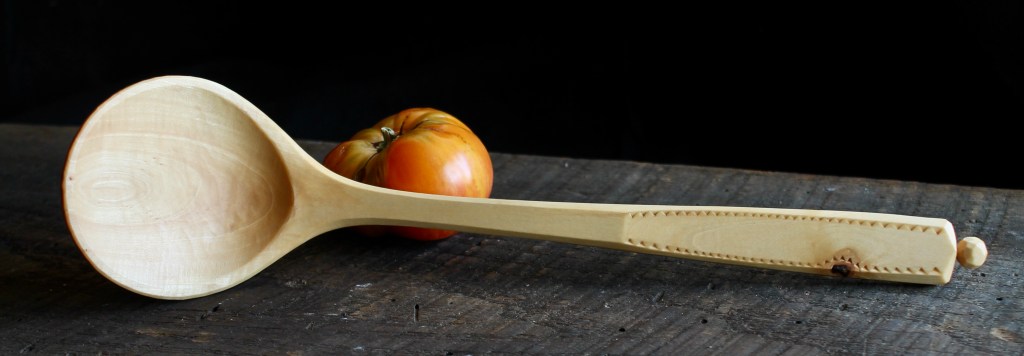
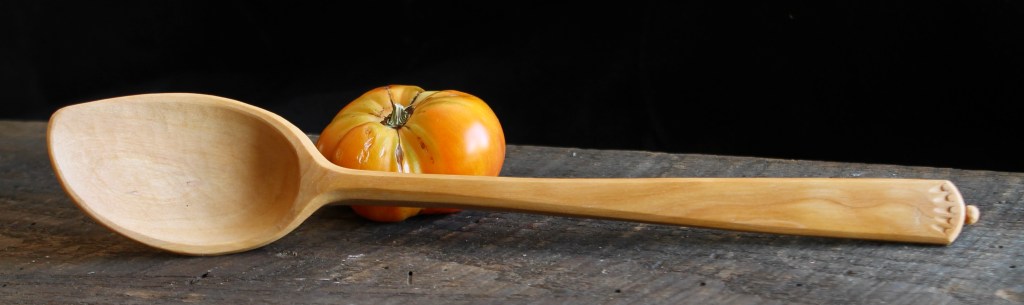
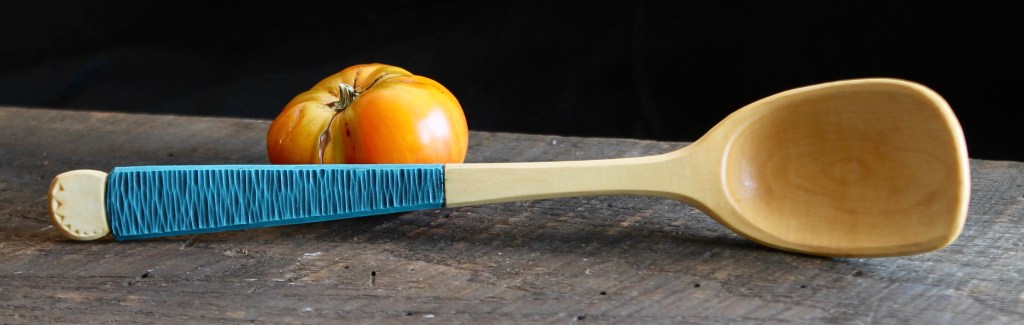
Normally, I wait until I have more spoons before posting a group, but I know it will be a while before I can get to more (other projects underway). So here are three spoons, all from crooks, finished with pure refined cold-pressed linseed oil and cured in my kiln. Ready to serve. Again, if you’re interested, email me at dandkfish@gmail.com and let me know if you’d prefer to receive a PayPal invoice or send a check. Thanks for looking.
#1: Maple, 12 1/2″ x 3″. The shape of this maple crook called for a ladle with a wide shallow bowl. The second photo gives a better indication of the relatively tight bend from handle to bowl. You can reach deep into the pot. Chip carved handle. $150 includes shipping. SOLD
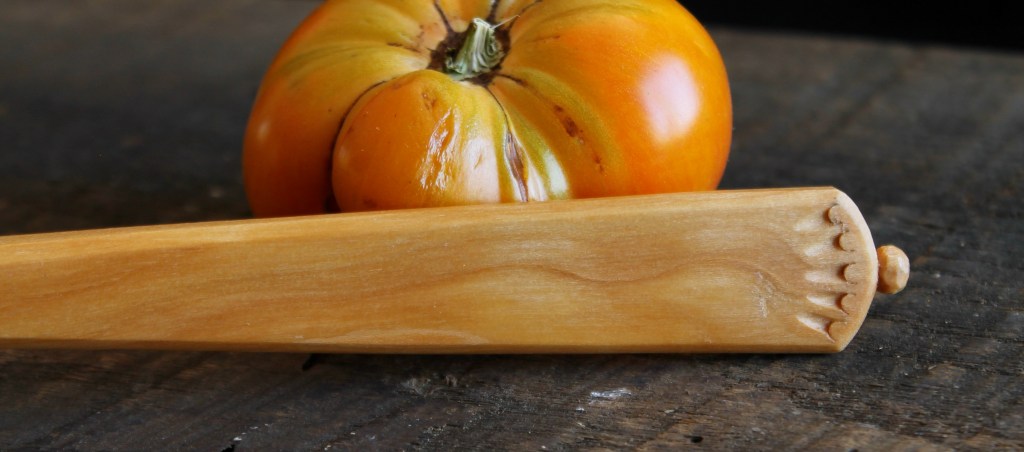
#2: Cherry, 12 1/2″ x 2 1/4″. This is a good general use kitchen spoon for stirring, cooking, serving or whatever. Carved from the sapwood of a black cherry crook. Handle detail below. $150 includes shipping. SOLD
#3: Maple, 11 1/4″ x 2 1/8″. Another good general use spoon. A little more crank than the cherry one above. The handle was textured with a narrow gouge then painted with artist-oils (linseed oil and pigment), black over blue. $140 includes shipping. SOLD
I couldn’t resist adding some goldenrod and aster blossoms to the bowl photos. The goldenrod is in full bloom all along the trail. The colors of fall are coming.
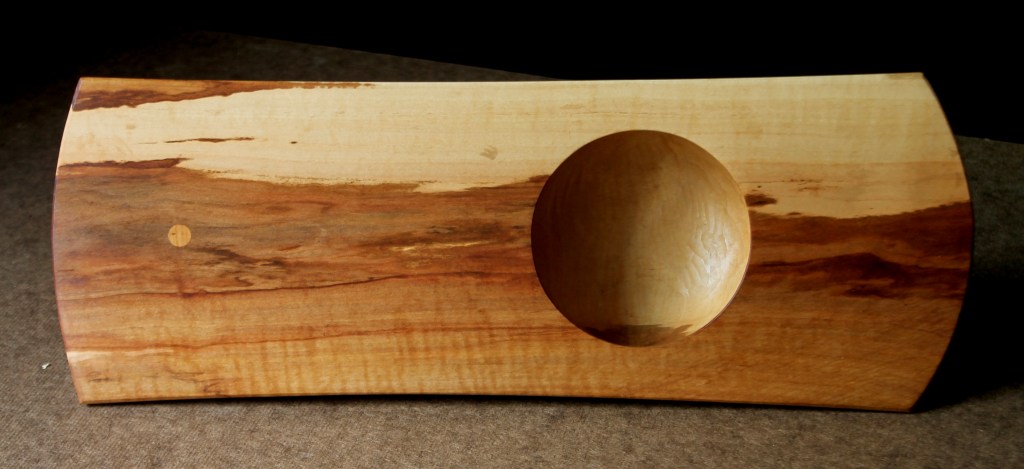
Venus-and-the-Moon Bowl 2024. Pearwood. 16″ x 6″ x 2.5″.
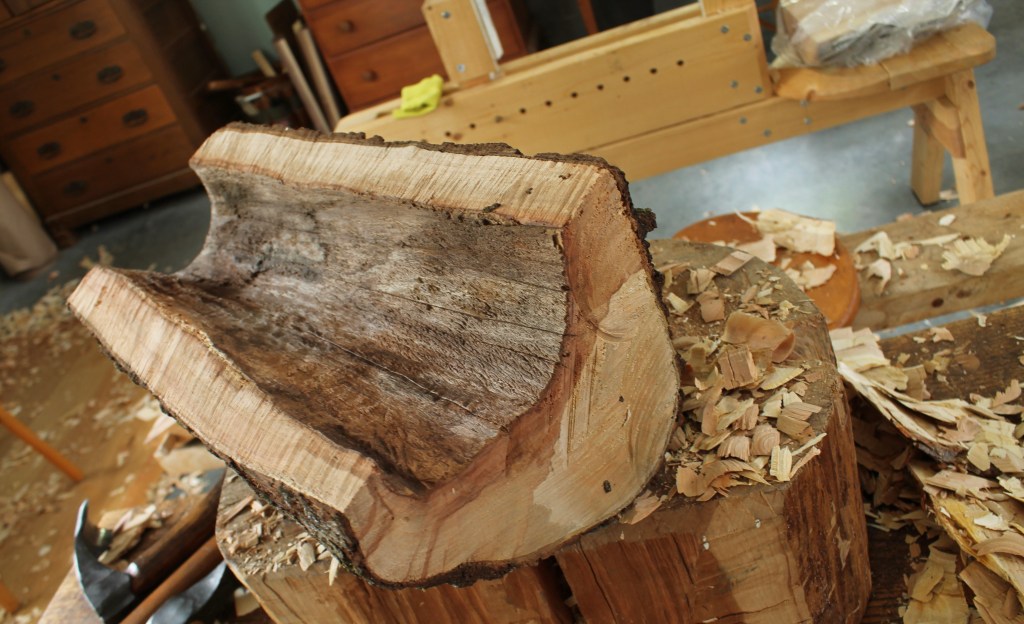
A friend alerted me to an old fruit-bearing pear tree that had fallen in a windstorm, just a couple minutes down the road. When I went to check it out, I wasn’t optimistic about its prospects. Most of the tree had rotted beyond use. The tree had been hollow for decades and mountains of old nutshells had spilled onto the ground. But, near the base the tree had been holding on with a ring of healthy wood to one side of the hollow.
I carved a spoon from a smaller piece and found the wood to be wonderful. But I stared at that bigger piece on and off for a couple weeks, coming up empty. But I kept thinking. It seemed to me that what made this log special was the character of that boundary area between the darker wood and the deeper, lighter sapwood beyond it.
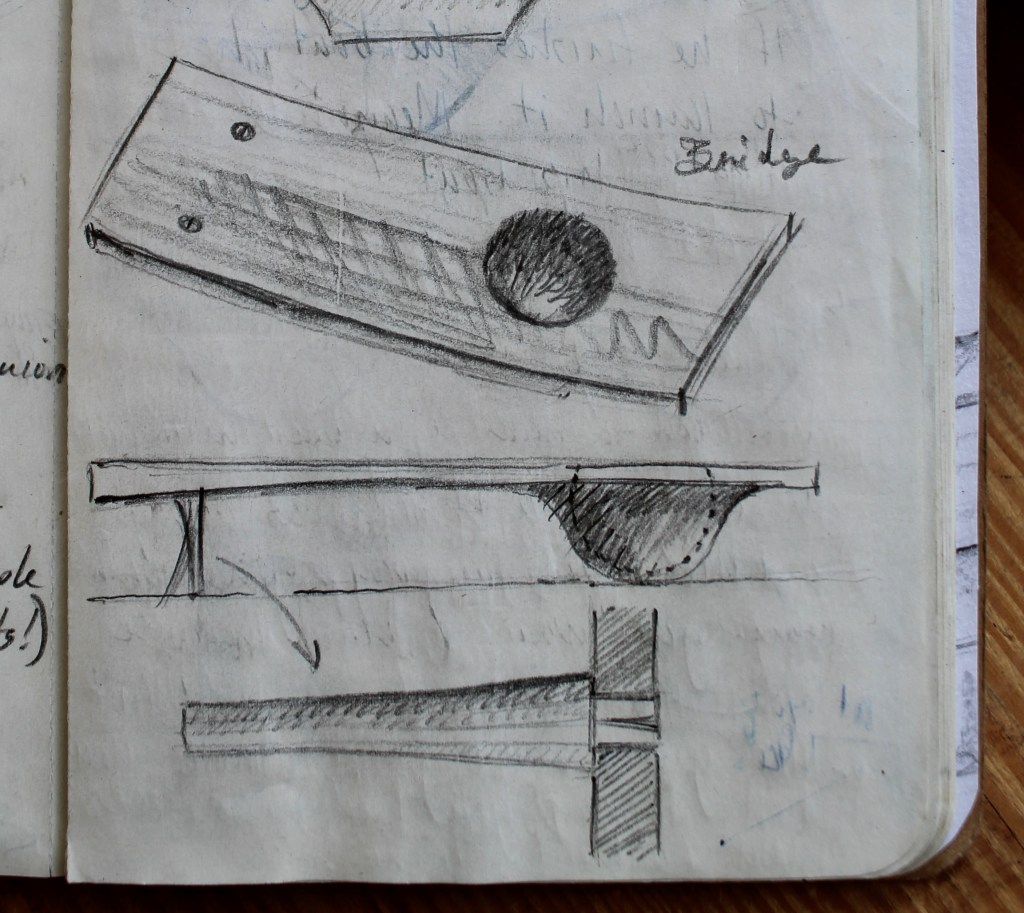
As I thought about that and another long narrow log (more on that later), I sketched a little idea in my notebook. Knowing that the details would evolve a bit as I worked, I had enough in mind to start shaping the log.
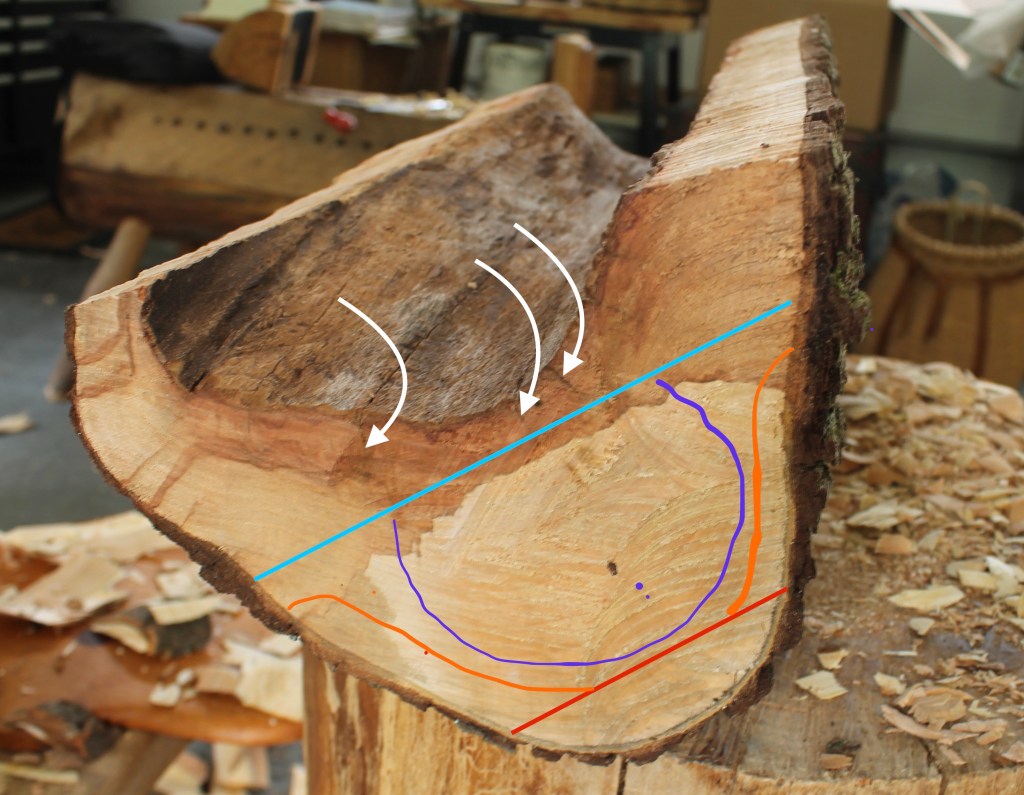
This is a rough idea of how the piece was oriented from the end. The light blue line is the top. I had to get it below the compromised wood and cracks (indicated by white arrows) next to the tree hollow. The red line is the foot. The purple and orange lines are the general idea of the deep round bowl interior and exterior.
Just like any bowl, I established the upper and lower surfaces. In this case, both flat. I split, hewed and planed. The curly figure in the pear wood was a nice surprise, and the subtle color variation was even better than expected. So, now it was a matter of not messing up such a unique piece of tree. I sketched my layout and then began to excavate the hollow with a gouge, followed by hook knives to achieve the undercut shape. I’ve put some process images into a slideshow, below.
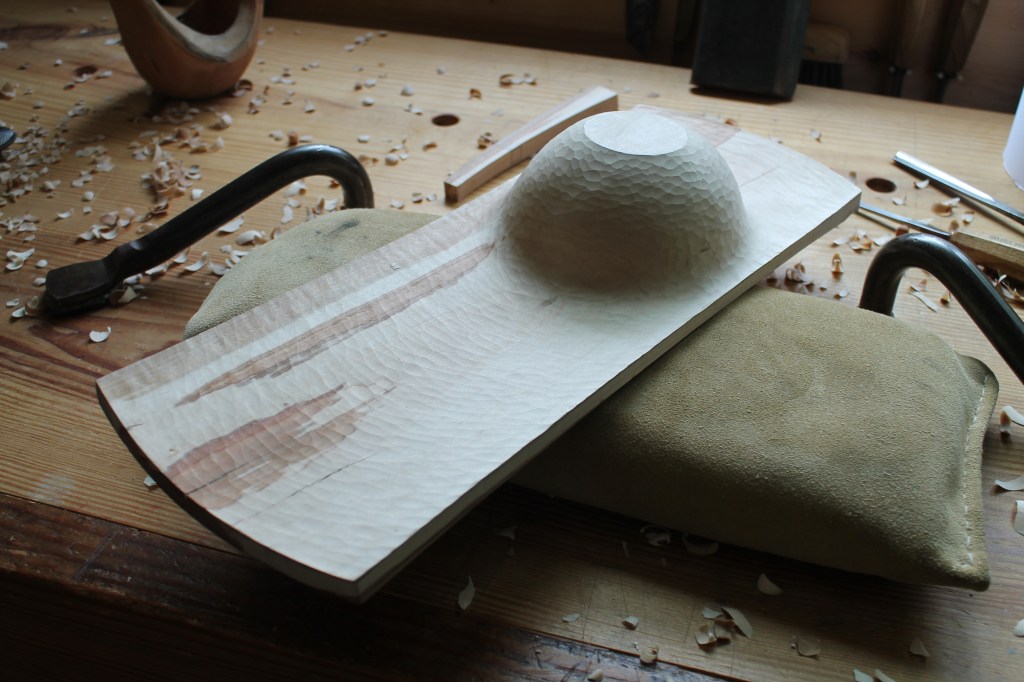
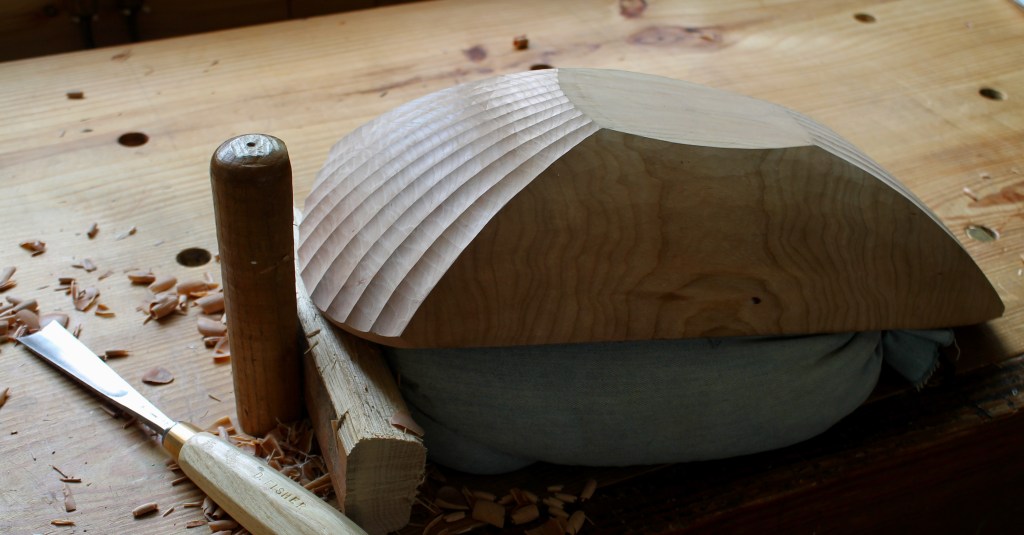
After a few weeks of drying, I returned to do the final shaping and refining of all the surfaces. During drying, the top took on a gentle arch from side to side. In the photo above, I had been using a sand bag and holdfasts to hold the bowl while working on the underside.
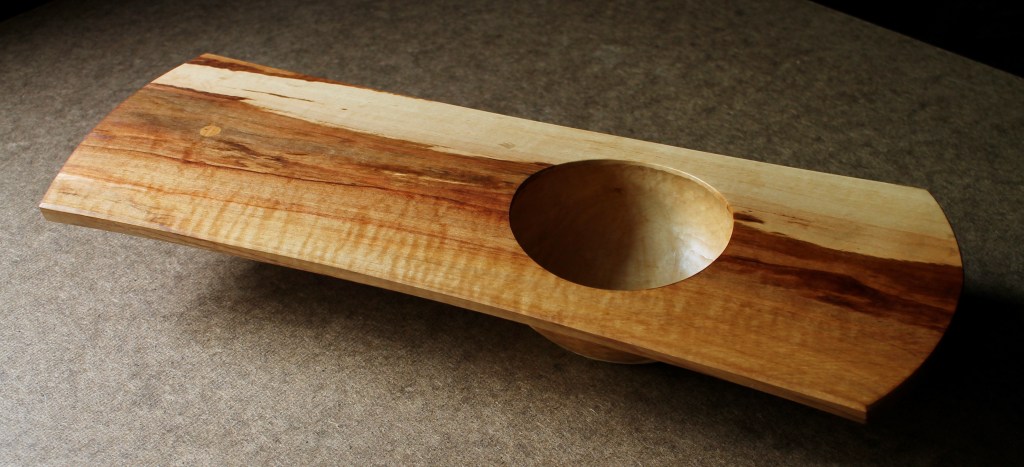
I’ll put a few photos of the finished bowl below.
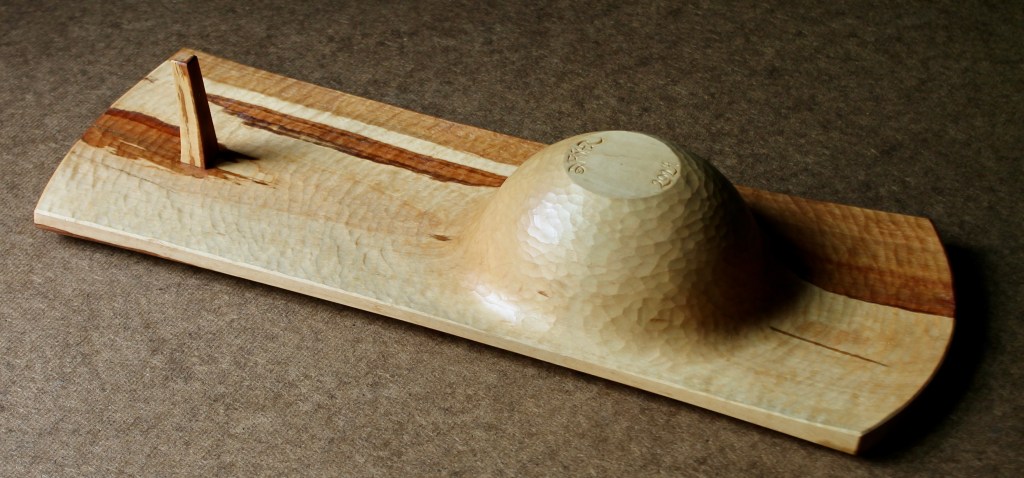
In the photo above, for me, the illusion of a sphere hovering in front of a board appears. Now I have trouble unseeing it! “Venus” is represented by the round end of the leg tenon.
After some experimenting I determined that only one leg was needed. I dried a small piece of the same pear and carved it with a curving taper. Then carved a shouldered tenon to fit tightly into the mortise in the top.
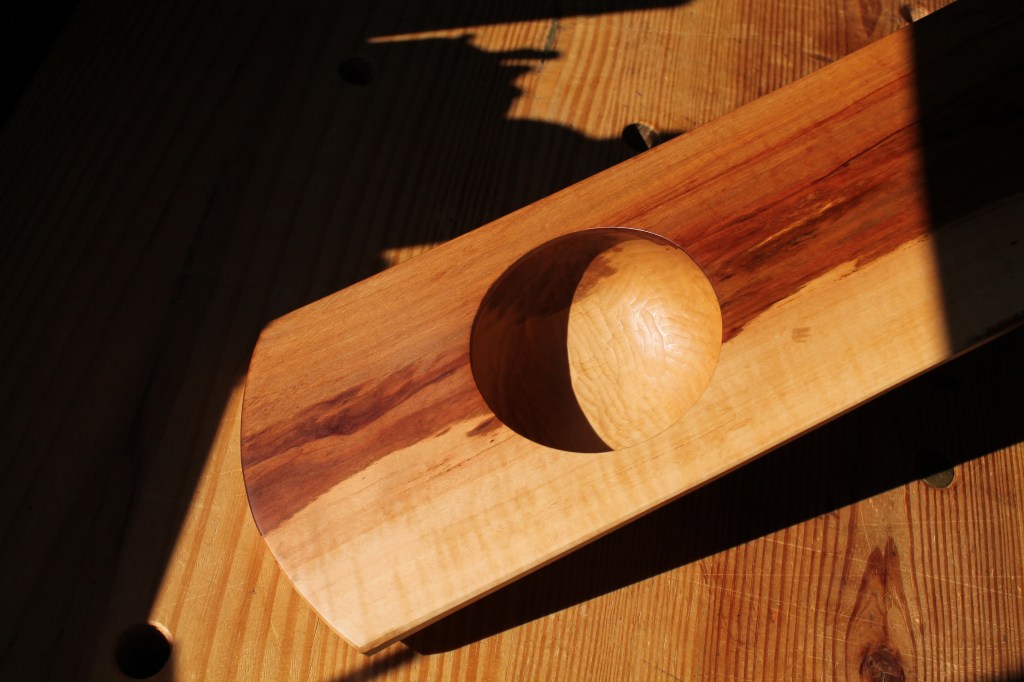
In very direct light (like this late afternoon light coming through my shop window) the shadow cast by the rim of the bowl creates a crisp crescent.
Georgia, one of the sweetest attractions to Pete’s shop.
It’s been a week since my bowl class at Peter Galbert Workshops ended. While I’ve settled back in and have returned to some projects that were underway, my time at Pete’s is still fresh on my mind.
Eating lunch outside of Pete’s shop building. Not a bad spot for a bite together!
What a pleasure it was to get to know these eight “students” over our six days together. I put that in quotes because I think I learned as much from them as they did from me. Architect, arborist, goat farmer… I was taking notes on all sorts of things from design terminology to regional colloquialisms. Then there’s also what I learned from being around Pete for a week.
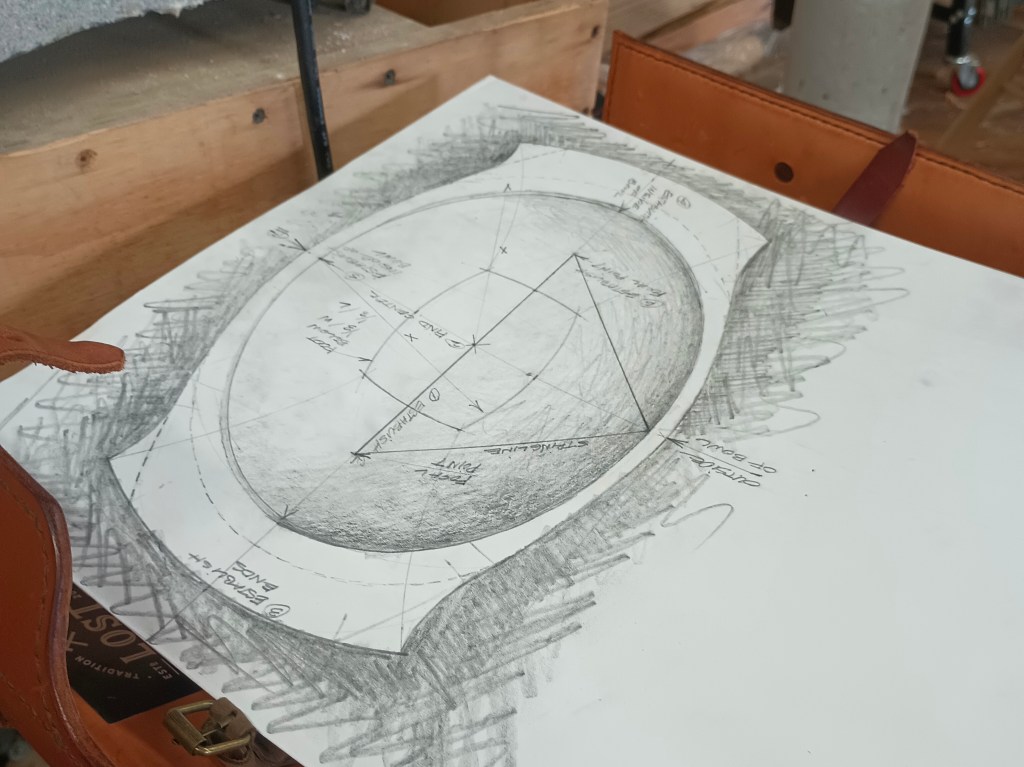
Of course, in class we focused on all things related to bowl carving and even made bowls. We practiced various layout techniques on poster board for reference at home later. That’s Joe’s version above. Joe knows his way around a pencil.
In spite of this being my first go-around with this particular class, all went smoothly because Pete and his shop manager, Karen, provide a wonderful space in which to work.
As we were all introducing ourselves on the first morning, I was struck by the fact that three of the students had taken classes at Pete’s before. Some of them three or four times.
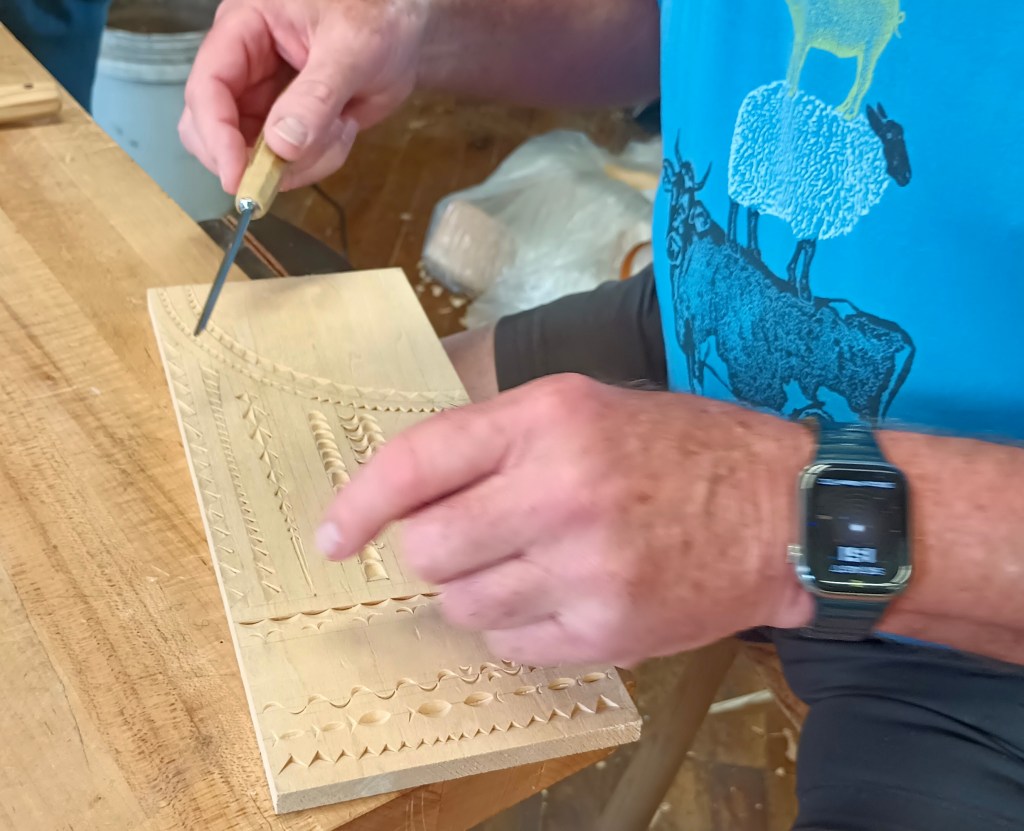
Decorative carving sample board underway.
Student bowl in butternut woodJoel Paul joined us to share some of his bowl carving knowledge, too. There he is, front and center.
They come, and come back, for many reasons…Georgia, all of the handmade (Pete-made) chairs and stools around, the coffee, Karen, the transfer of knowledge and skills, and the encouraging, positive atmosphere that Pete has established. I just stepped right into it. Pete has a passion and an incredible talent for making wonderful things. It is matched by his drive to connect people to the experience and to each other.
Peter Galbert Workshops sign carved in white oak
A couple months ago, Pete wrote in his blog, “If I could only work with one species for the rest of my days, it would be white oak.” So that’s what I used to carve the sign above for him. (That’s a representation of a travisher in the middle).
While “Peter Galbert Workshops” is the official name, there’s more of a personal connection for those that have been there. They think of it as “going back to Pete’s.”
Anybody that wants to get somewhere quickly doesn’t want to ride with me. One of the annoying things I do is pull the car over every half-hour or so to take a 10 minute stroll. This is difficult to do on interstate highways, so I stay off of them when I can. There are all sorts of interesting places on smaller roads. Little cemeteries, shaded and quiet, are good spots.
While I’m meandering around a cemetery, I’m on the lookout for hand-cut stones among the ubiquitous sandblasted granite ones. In other areas, slate is a common material for hand-cut stones. It holds up very well, with crisp edges and fine lines after centuries. It’s the best, but I hardly ever see it in cemeteries around here, even among old stones. Around here, most of the hand-cut stones are marble from the 19th century. Sadly, just about all of them look like they have melted due to the effects of acid rain. Many are completely illegible now. So, the hand-cut stones still in good shape were typically cut from some variety of local sandstone. Apparently silicates typically aren’t effected drastically by acid rain.
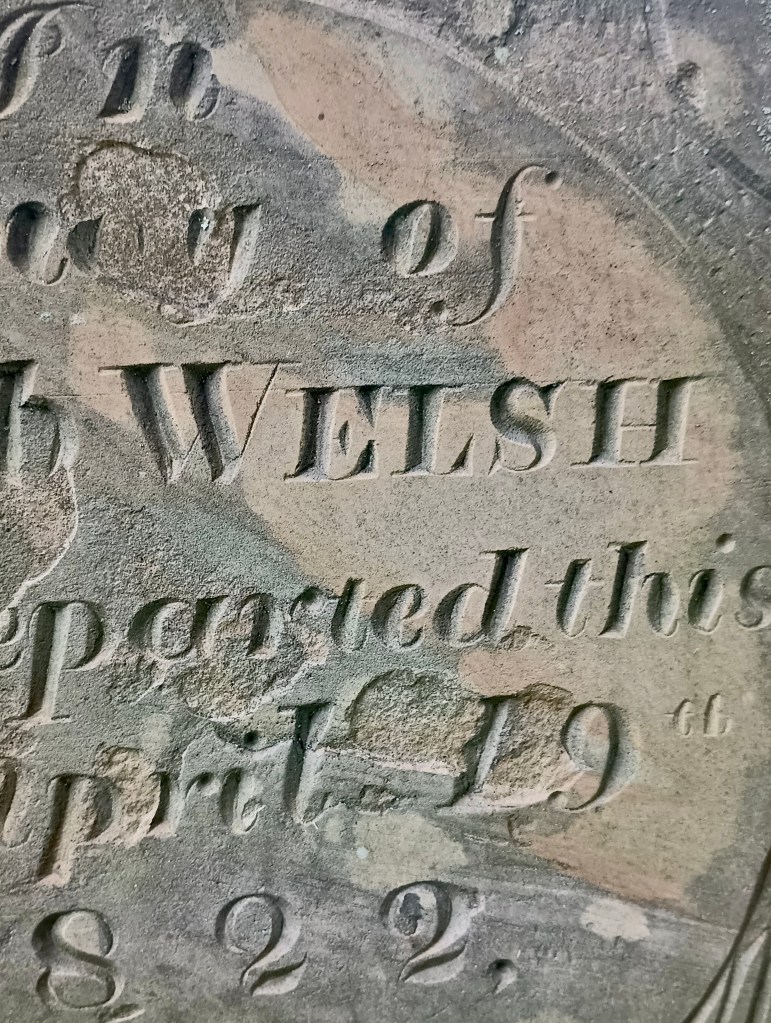
I found a gem recently while stretching my legs in a cemetery beside a rural road about an hour west of me, in eastern Ohio. The whole lovely cemetery is no larger than a football field. The stone is in memory of Jacob Welsh who, it records, died on April 19th, 1822, age 67.
The lettering, clearly influenced by the popular typefaces of the time, was skillfully cut. But in this case it was something other than the lettering that most captivated me.
It was that angel’s head at the top of the stone. “Angel’s Head” stones have a long history. The image is thought to represent the soul of the departed ascending to a heavenly reward. This site features many of them found around Hartford, Connecticut. And this site documents hundreds, going further back, located in the Bale of Belvoir in England.
To my eye, there’s something special about this one. It is so animated and delightful, even with the little frown on the face. I love how the carver has merged the frame surrounding the inscription up and into the angel’s face. It seems that he wanted to say that this angel is indeed intended to represent Jacob Welsh. The carver has used texturing effectively on the background and also added interest to the wings. The curves are lovely, and how about that bouffant?
Whoever the carver was, he created a memorial with personality, meaning, and charm with his or her thoughtfulness and craftsmanship. I don’t know much about the funeral industry, but it seems to me that folks are usually directed toward the standard packages while there are lesser-known alternatives that might be a better fit and may even cost less. The cost of machine cut stones is so high that it may well be possible to get a special hand-cut stone in slate or a local sandstone for less. The Lettering Arts Trust in the UK is one organization that is dedicated to helping people navigate that possibility. And their site features gobs of incredible lettering art inspiration.
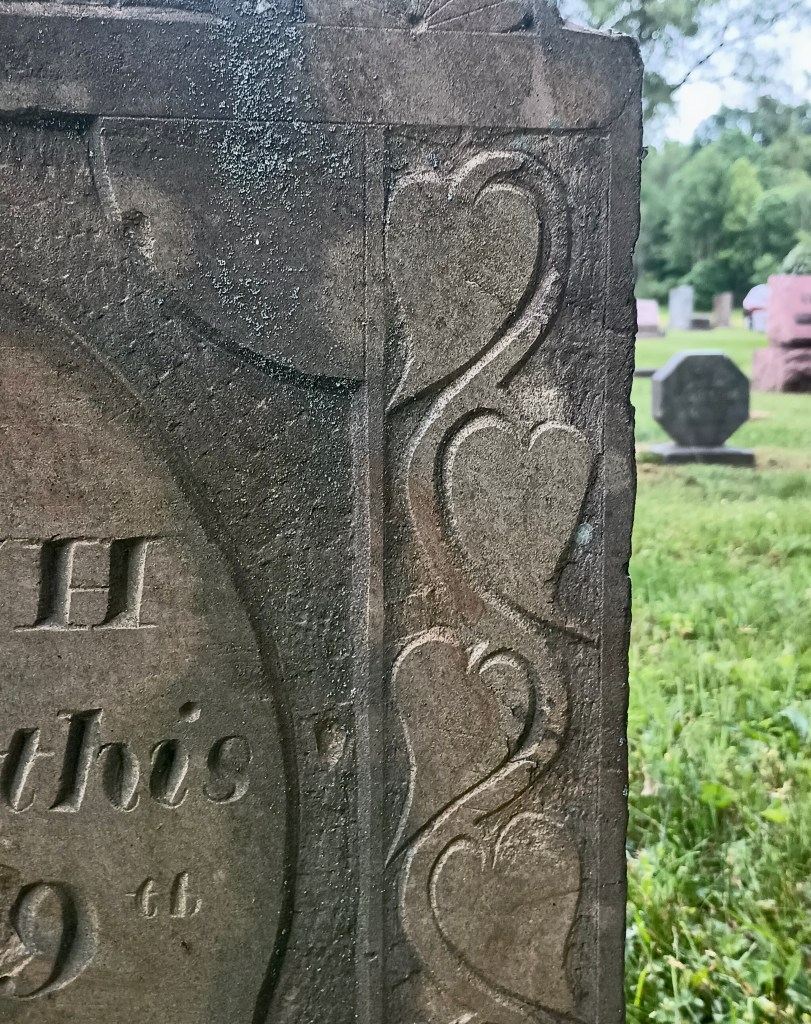
Returning to Jacob’s stone, the vine pattern with heart-shaped leaves is eye-catching. Looks like something that should be on the stiles of one of Peter Follansbee’s chests.
The shoulders of the stone are decorated with these little compass-derived epaulettes.
Here’s a shot of the back of the stone.
As I was writing this post, I decided to see if I could find anything out about Jacob Welsh. Surprisingly, some information popped up after just a few clicks. It turns out Jacob Welsh had a pretty interesting life.
Born in Boston in 1755, he graduated from Harvard at age 19 and fought as an officer in the American Revolutionary War in his early twenties, during which he corresponded with George Washington. He followed this service with some industrial espionage, traveling to Europe and somehow smuggling out a carding and spinning machine and bringing it back to Massachusetts. In 1809, at the age of 54, Jacob left the comforts of Lunenburg, Massachusetts and ventured to what could be considered the Wild West of the time — the eastern Ohio/western Pennsylvania frontier. He donated 50 acres of his newly acquired land (which the government had recently taken from Native Americans through forced treaties and such) to establish “Welshfield”, Ohio. He died there of tuberculosis ten years later, just shy of his 67th birthday.
Yet, none of that is mentioned on his modest hand-cut stone in the little cemetery. It was the hand-carving that drew me in.
In thirty years of teaching, I’ve learned (and sometimes failed to remember) the value of preparation beforehand and flexibility once things get started. I’ve been doing a lot of preparation for my upcoming class. Materials, logistics, and many other things. Much of it involves thinking through processes in detail with the student point-of-view in mind. Here are three brief thoughts about gouges that have run through my head lately.
Honing methods.
Back in May, Pete Galbert posted a video to his blog showing a method for honing gouges that he first learned from Steve Brown. It involves running a screw through a board, clamping the board upright in a vice, and registering the dimple at the back of the gouge handle on the point of the screw. You then swing the gouge from that pivot point while rocking the bevel on the stone.
I’m used to honing my gouges freehand, like I show in this post. I tried out the screw method and it works pretty slick. I like its simplicity. But I’m a little clumsy and the gouge kept slipping off of the screw point when I’d get the gouge moving quickly. So, a little spin-off idea struck me (and it has probably struck many others before) and I gave it a try.
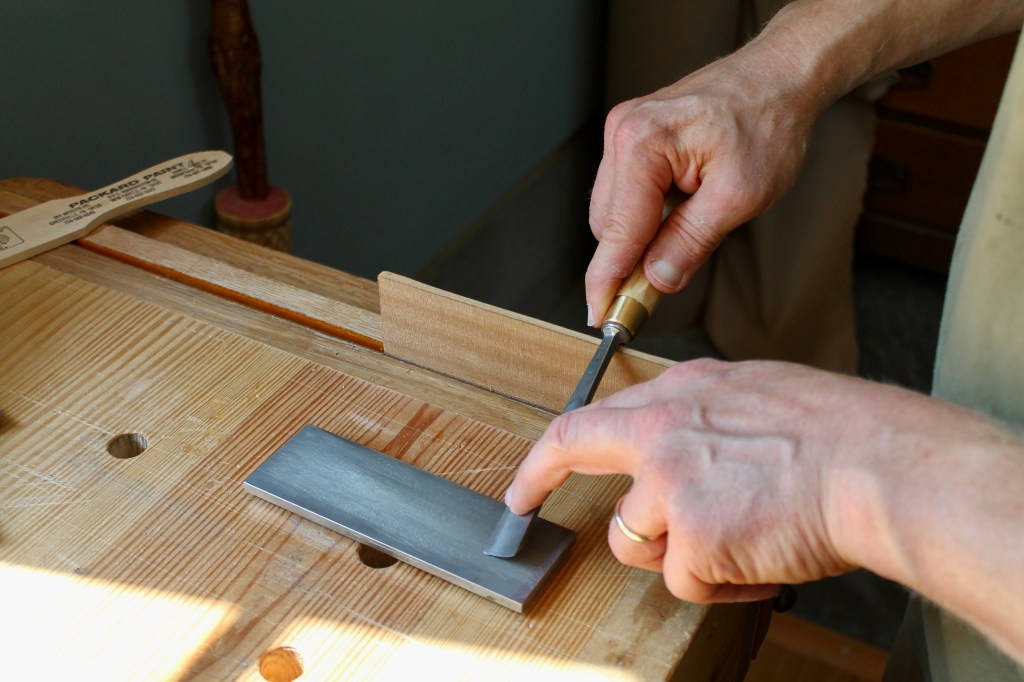
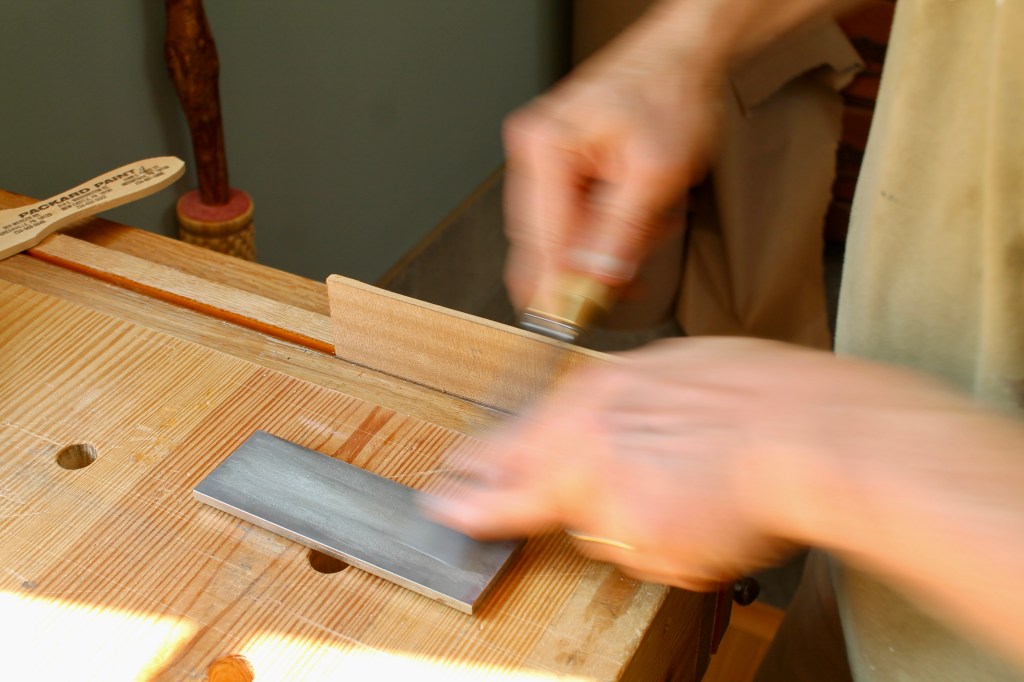
I took a thin scrap of wood and clamped it in my vise so that the upper edge was parallel to the benchtop at the appropriate height to put the bevel flat on the stone. I could have used a thicker board and tapered the edge. With the bolster registered against the edge of the board, I slide the gouge back and forth along the board and stone while rocking the gouge from corner to corner to cover the entire bevel. This mimics the same motion I use when freehand sharpening but assures a consistent honing angle.
In the top photo, I’m at the end of the stroke with the left corner of the gouge in contact.
Then I slide back along the stone as I gradually rotate the tool.
Above, I’m at the opposite end of the stroke with the right corner of the gouge on the stone.
The motion becomes automatic and you can get moving.
It works. Now on to a finer stone. If it’s the same height, just interchange the stones. If not, shim the thinner stone up on a magazine or whatever.
You can reposition the stone however you’d like to use different parts of the surface.
Here I’m honing a vintage spoon-bent carving chisel with the same method. No sweep at all to the edge, so I just held it flat while sliding it, like a chisel. Due to the configuration of the tool, I’ve raised the board up. Notice the series of parallel lines I marked on the board to aid registration in the vise.
Walnut Bowls 2024
2. Gouge Versatility.
I’ve made a couple more Bowls-from-Planks and took more careful notes on the details of each procedure. One variation I experimented with is to carve flutes under the handles. The two gouges you see on top of the bowls are the gouges I recommend as a starter pair if someone wants to get into bowl carving. They are both long-bent gouges, #5/25mm on the left, and #8/30mm on the right. Brand differences and slight variations in width and curvature are absolutely fine, of course.
Normally, I’d carve flutes in a situation like this with maybe a #5/16-18mm. Using the full width of a #8 would make the ridges between the flutes too sharp and fragile. But, in the traditional system of sweep numbering, the sweep number is relative to the width of the gouge. So by using a small portion of a wider gouge, you effectively get a narrower gouge of a lower sweep. I wrote about this in a different circumstance here, along with photos to better explain. With that in mind, the #8/30 performed well on the flutes.
3. Intermediate size tools.
I’ve been making samples of carving patterns that can easily be cut with knife or gouge on bowl rims, sides, or handles. For gouge fingernail chip cuts, I like #8 sweeps. The two smaller tools above are #8/4mm and #8/7mm, respectively. Notice they have a “D” (diminutive? dinky?) on the handle as well. This indicates they are a little shorter than full-size carving tools, although they have the exact same edge profile and steel. Pfeil calls them “intermediate size,” but some other brands have a similar offering. The gouge at the top is a full length tool, for comparison. Anyway, the point is that the intermediate tools have lower prices than their longer kin and perform just as well, certainly for work like this. In fact, they can be much more nimble. Here are links to some at Woodcraft and Chipping Away and Woodworker Specialties.
Only three weeks until I head to Pete Galbert’s for our six-day bowl carving course. Among the various tools we’ll be using, the compass is an important one. I use mine on every bowl I make. It does a lot more than make circles.
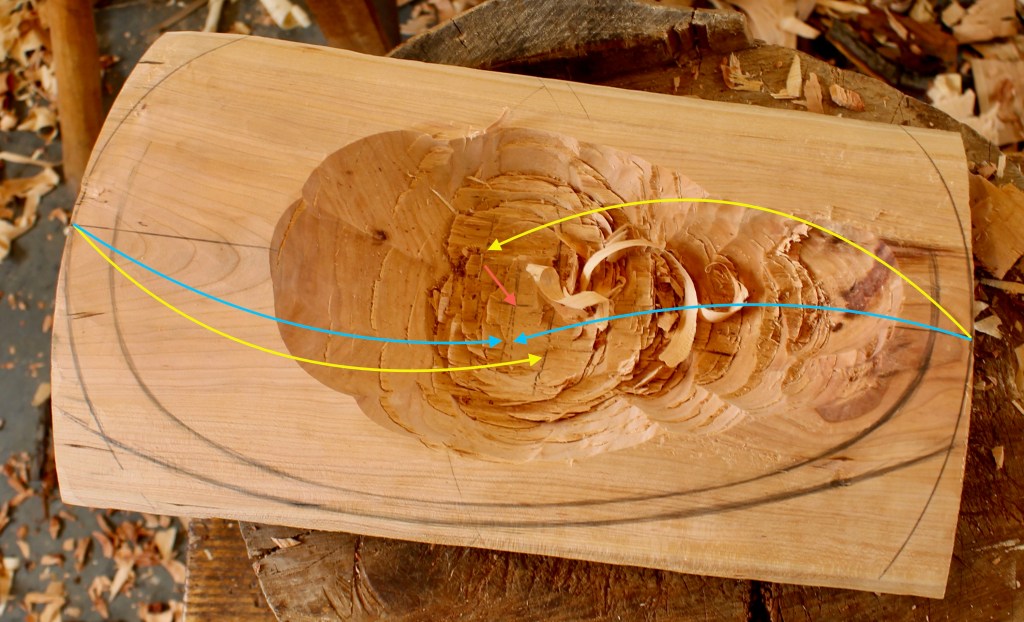
In my last post, I wrote about redesigning a bowl after I had already begun to excavate the hollow. The first thing I did was to relocate the center down in that recess somewhere. If you zoom in, you can see some pencil lines struck from the compass. I started by guessing a little over half of the distance and striking the arcs at the yellow arrows. Then I could easily estimate the distance between them and reset the compass to strike the lines indicated by the blue arrows. I did the same from the sides to determine center at the red arrow. Unlike straightedges, compasses reach over obstructions.
In the above photo, I’ve established the ends of the bowl with the compass from the center point. Then I sketched the edge of the hollow and the outer wall on one side of the bowl. I wanted the other side to be symmetrical.
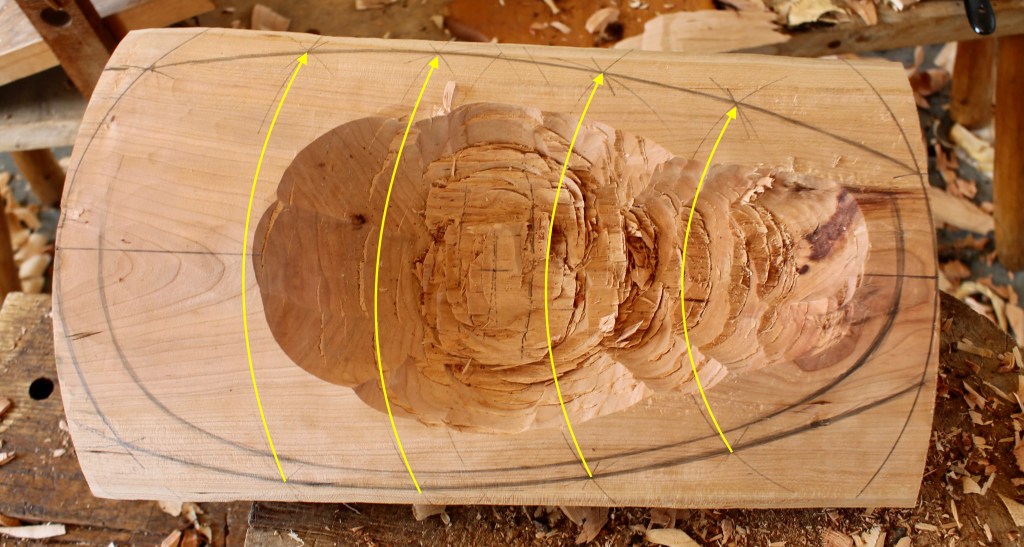
The compass can be used to transfer points from one side to another. Notice that at the ends of each yellow arrow there are some arc sections crossing each other. Those were struck with a compass. Connect the dots and you’ve got it.
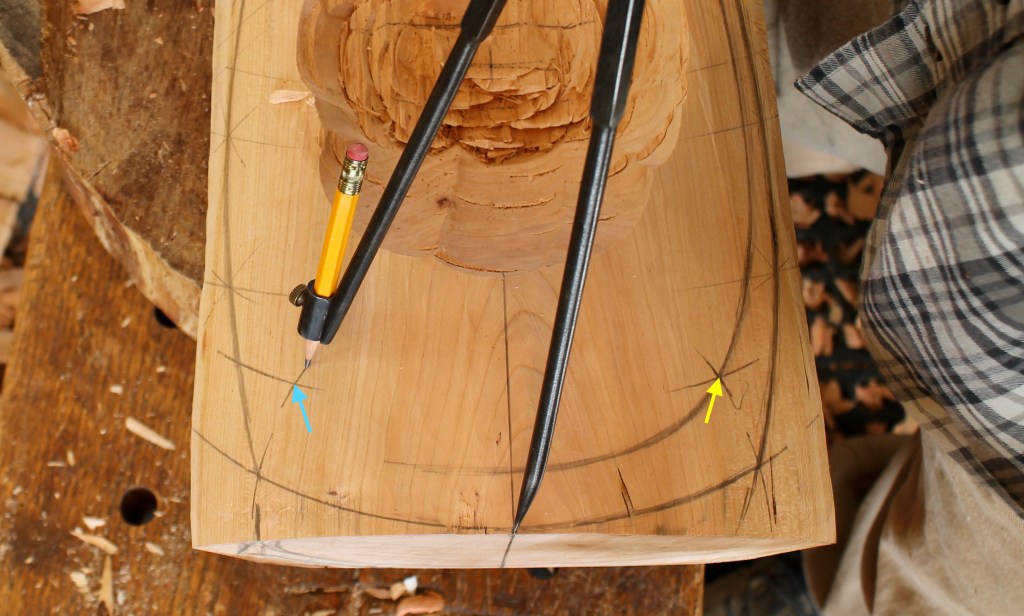
This concept can be used in a variety of circumstances. I’ll break it down with this example to transfer a point that will guide me in drawing the edge of the hollow on the other side. With the compass focal point in the center, I strike an arc through the drawn line representing the edge of the hollow (Let’s call it the “hollow line”). The arc crosses it at the yellow arrow. Then I extend that arc over to the other side (blue arrow). Now I just need to pinpoint the place that the arc crosses the hollow line.
I pick another point common to both sides (in this case, the center of the end of the bowl) and set the compass to the place where the arc and hollow line cross.
Then I swing that arc over to the other side. I now know that the edge of my hollow should pass through that point where the two arcs cross (at the blue arrow). That gives me enough to go by to get close enough to draw the rest by eye. But you could transfer as many points as you’d like if you want more dots to connect.
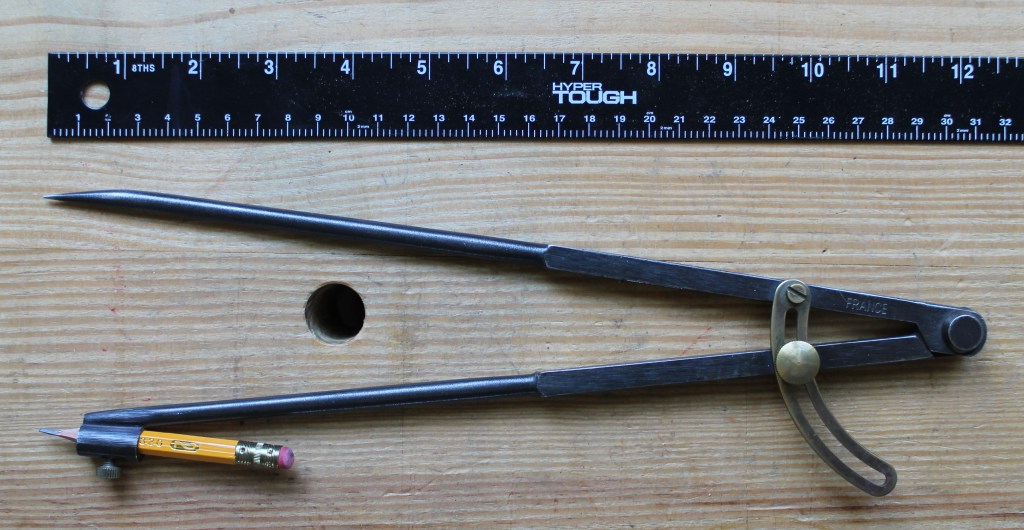
I find that a 12″ pencil compass works very well for just about every situation. This is the one I’ve been using for many years. I bought it from Lee Valley Tools. I see they still have it, but I think the price has about doubled since then, and they no longer stain it black.
I love mine, but there are other versions available for much less that will perform well, too. Here’s one available from Grizzly. If you do a search under 12″ pencil compass, you’ll see others.
Do they make good compasses in France? Oui oui.
A compass is pretty straightforward to operate, but before you go off striking arcs, make sure to put the legs of the compass together and set the pencil point and the compass point at the same depth. This will keep the hinge balanced over both points as you use it, making it feel much more natural to use. Also, a compass is a great use for pencil stubs.
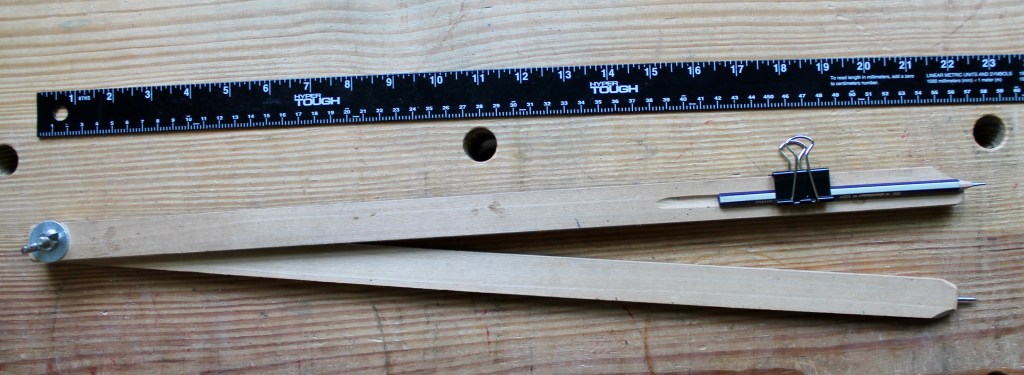
You can also make your own compass of any length with simple materials. Here’s an extra large one I made years ago from two scrap lengths of poplar, a little under an inch wide and 5/16″ thick. I drilled a hole near the ends and sandwiched them between two broad “fender” washers, all connected by a bolt and a wing nut. The friction between the boards holds the compass setting quite well.
I drilled a hole in the end of one leg, drove in a nail, then filed it to a point.
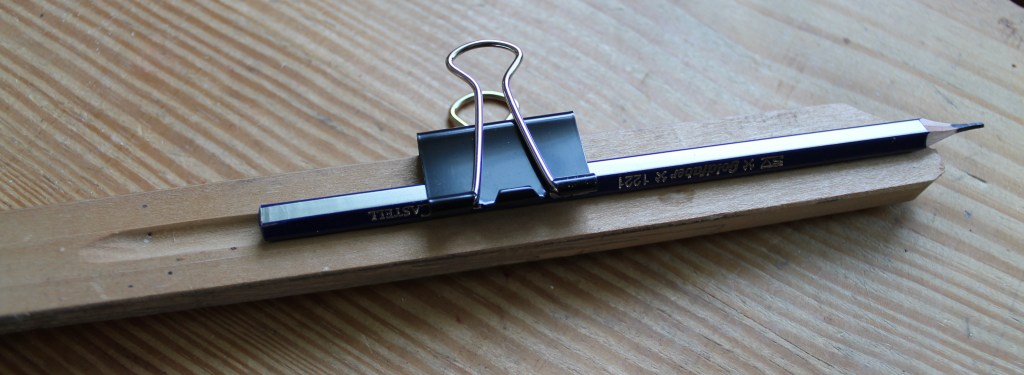
I carved a groove along the outer face of the other leg. A common paper clamp holds the pencil firmly in the groove.
I’ll be packing my compass soon, then again in October. I’m really looking forward to carving with everyone both weeks.
Greenwood carving calls for flexibility. I do my best to decipher clues about what will be found inside the log. Still, I’m often surprised. Sometimes, a total redesign is required. The cherry bowl in the photo above ended up very different from what I envisioned when I started digging in.
I laid out a symmetrical bowl with handles, but as I started hollowing with the adze, I noticed hints of past trauma to the tree on that left side. So I started digging over that way to explore the extent of it.
Two main areas with bark inclusions and cavities. There was a legitimate argument for just tossing this one onto the firewood pile before investing any more time in it. But I thought I’d explore a little further and see if I could redesign and make something out of it.
I chopped and shaved the troubled end lower until I was past the major problem areas. The bowl would now have one end higher than the other. And eliminating the handles would allow me to dig further toward the end, past more of the trouble.
I decided to make the shorter end narrower, too. I sketched one side of the bowl freehand until I liked the lines. I’ll write another post soon about how I transferred that to the other side.
Then I adzed, gouged, hewed, and shaved the bowl to shape as usual. There it is at the end of the green carving stage, ready for drying.
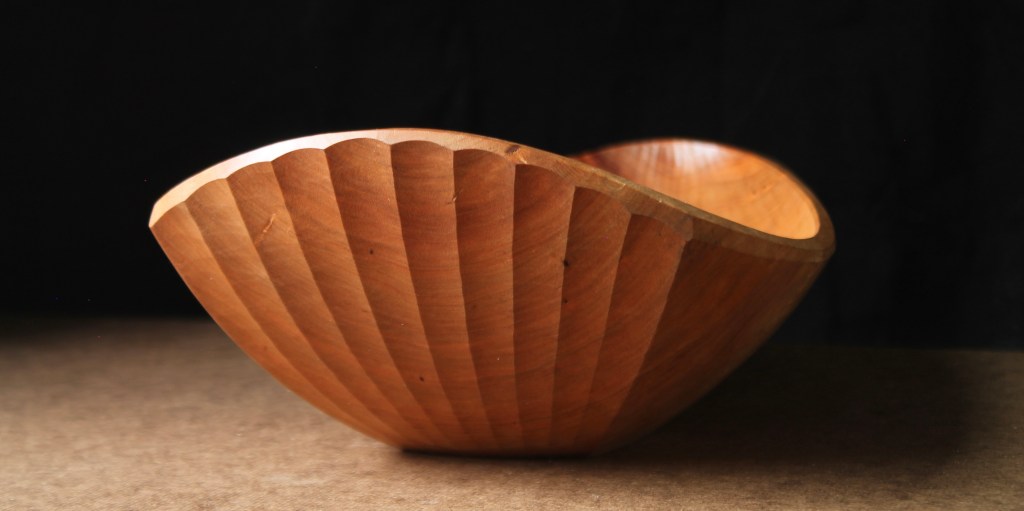
After a few weeks of drying, I did the final shaping and surface carving, including the flutes on the tall and short ends.
To hold the bowl steady while carving the flutes, I turned to my pant-leg-full-of-beans that I wrote about in this post. The bean bag conforms to the bowl hollow and keeps it steady and supported.
There they are right-side-up.
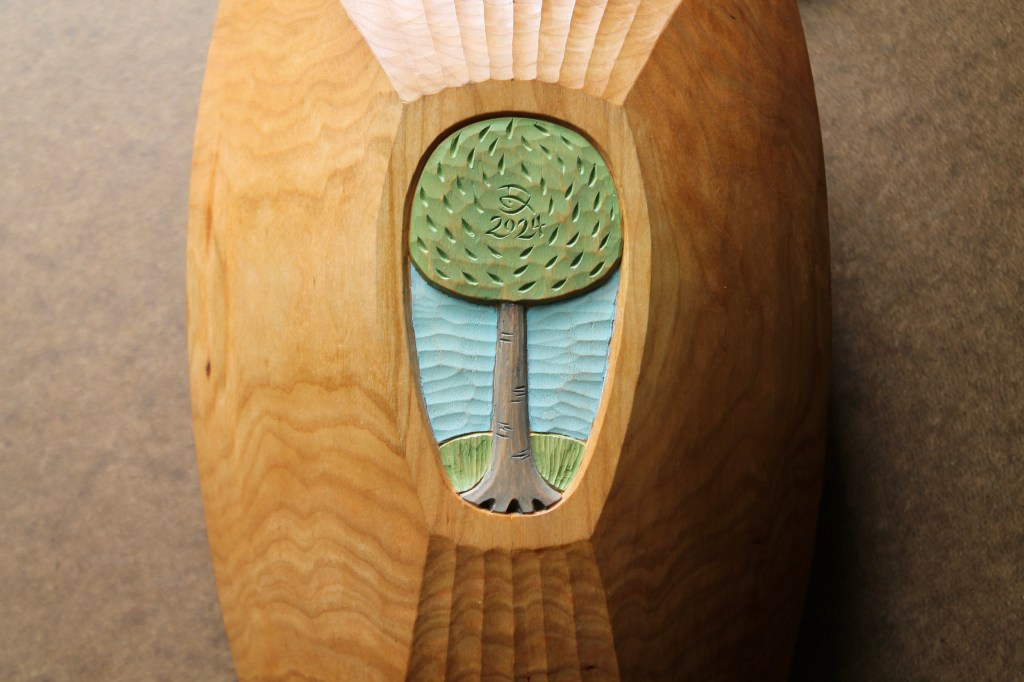
On the foot, I carved a relief of a simple tree, making sure that all parts of the image were carved below the level of the outer rim of the foot. To do the carving, I kept the beanbag under the bowl and wedged it against a sandbag to take it easy on the edges of the completely-carved bowl. I was able to just flip the bowl/beanbag stack around as needed.
Then, I decided to paint the image with artist’s oils. A little surprise when someone flips over the bowl. I even thought about putting a little notch just below the rim at the end of the hollow so that it can be hung from the wall and taken down for use as a bowl. I haven’t.
This bowl is available for purchase. It is 15 1/4″ long, 7 3/4″ wide, and 4 3/8″ high. That dark area in the upper corner has a sliver of an opening between two growth rings. I’m not worried about it, but it’s worth mentioning. Of course, since it’s cherry, the color will deepen quickly. If you’re interested, please email me at dandkfish@gmail.com. The price of $825 includes insured shipping. Update: SOLD. Thanks for looking.
I roughed this bowl out of a green apple log almost a year ago. It’s just under 5″ end-to-end; you can cradle it in one hand. Next time, I’ll make a bigger one. It will be a lot easier!
This one is available for purchase. If you’re interested, please email me at dandkfish@gmail.com. The price of $750 includes insured shipping. Update: SOLD. I’ll show a few other angles below then get to the leaves.
The dark heartwood of the apple tree is up around the handles.
The hollow is undercut all around. That kept the sidewall thin. I’ll leave it a little thicker next time so I’m not flirting with danger so much when carving the leaves. I hate flirting with danger.
There’s a good view of the dappled gouge-cut texture on the exterior.
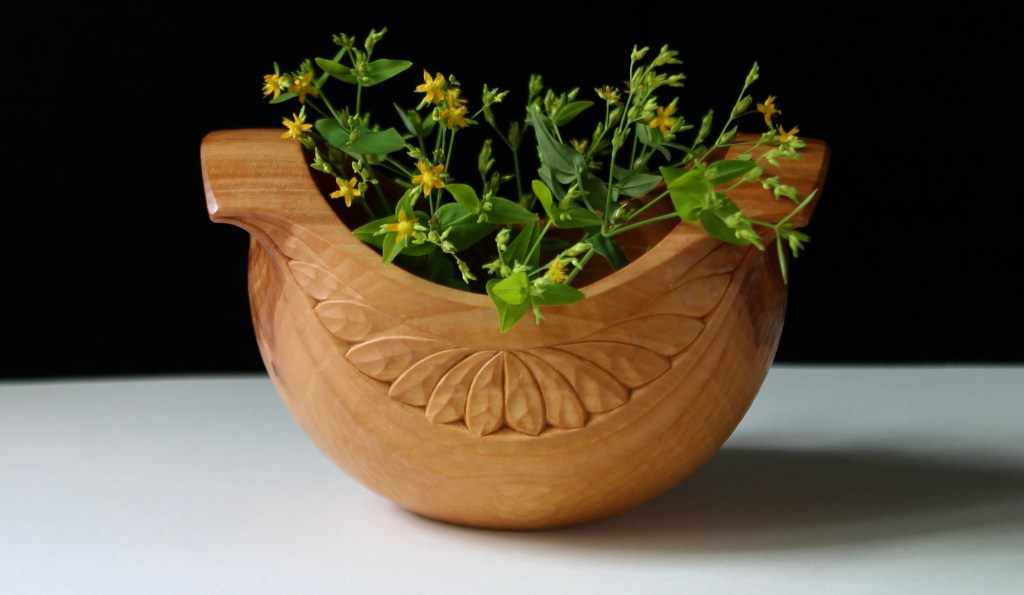
Back to the leaves. I first drew up and carved this general pattern for the side panel of the bowl above in 2015. The concept of a carved “side panel” came to me from seeing Bengt Lidstrom‘s bowls. I have no idea what Bengt called that area of his bowls. If he did have a name for it, I’ll bet it was in Swedish.
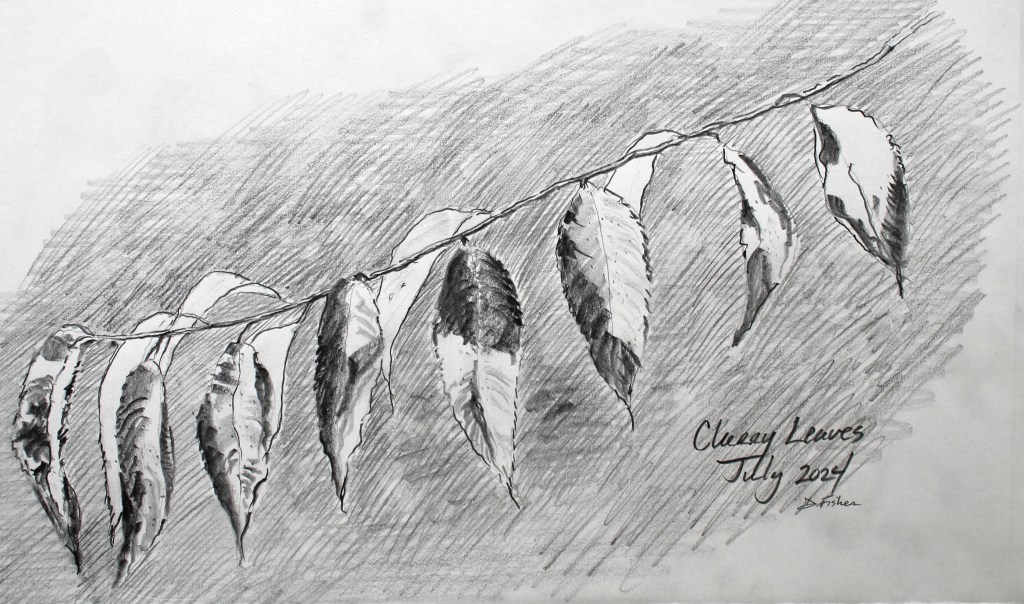
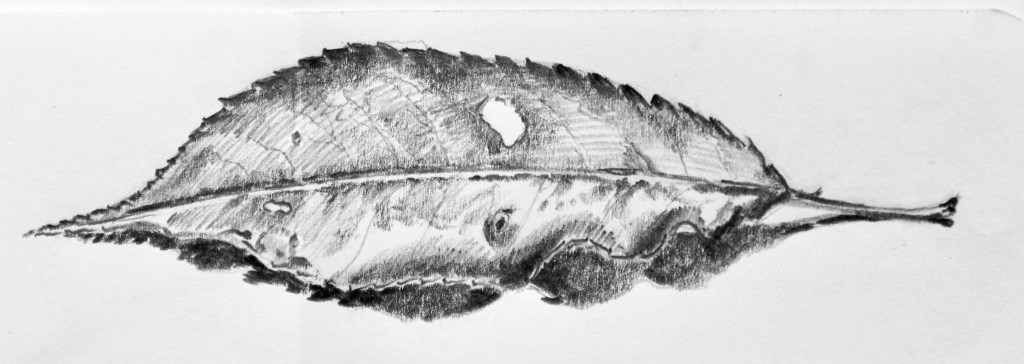
I didn’t design the pattern with any particular leaves in mind, but it is reminiscent of how black cherry tree leaves line up along their long slender twigs.
I’ve tweaked and adapted the pattern several times to panels of various proportions.
Here’s a different variation, and with a little color.
And now, to use an expression I once thought my dad invented, it’s time for me to make like a tree and leave.
I’m not as obsessed as Captain Ahab, but this whale has been surfacing in my mind for a couple years.
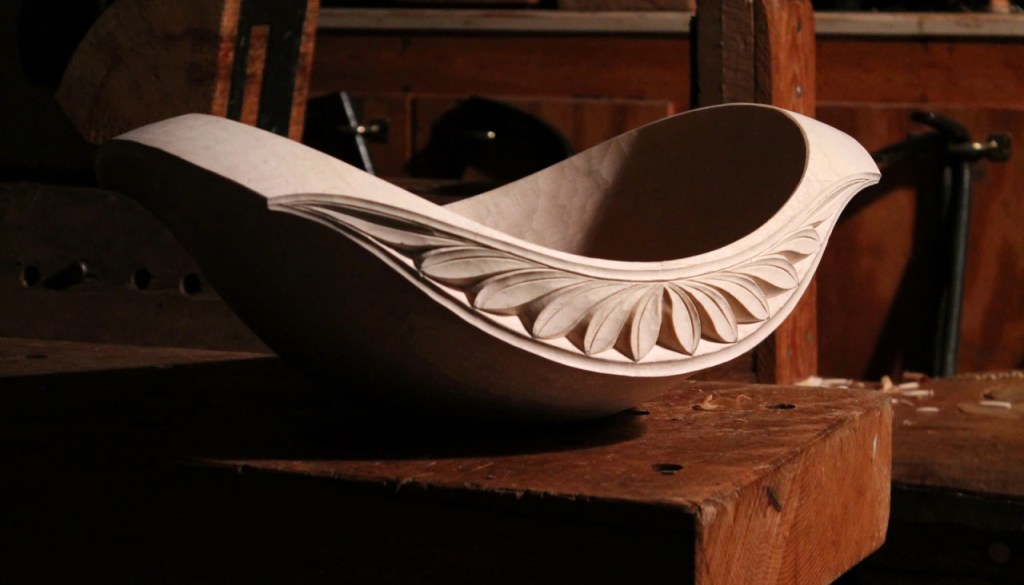
I think the idea for it came from carving bowls like this with the flutes on the end panels. They brought to mind the “ventral grooves” along the underside of a whale’s throat that allow the skin to expand like an accordion. I wanted to play around with the idea of using an upside-down (bark up) blank to make a whale bowl.
I started sketching lines on a half log of aspen, then started carving. Above, I’m working on the hollow with a bent gouge, more than a year ago.
Carving the flutes is just like on a non-whale bowl.
I was pretty happy with the form and lines of my first attempt. There it is above, last year.
Other projects occupied my time for a few months before I painted it with acrylics (unusual for me). I wasn’t happy with the paint job, so I carved all of the paint off. Then it sat there for several more months.
Recently, I went for it again with paint — this time with milk paint. I wanted some of the carving texture to read through. I rubbed it down with steel wool, then sealed it with a thin coat of shellac, then rubbed the shellac with steel wool and wax before a final buffing. There it is, above. I’m not completely pleased.
One of the issues is a little (too much) blotchiness here and there, especially that area on top of the tail. My fault for not keeping the thin layers of paint consistent enough. It didn’t really show up until the shellac hit it, but the same would have happened with oil.
There’s a shot of the underside before paint last year…
…and with paint now. I’m ok with that area.
So, a design in progress. I think I’ll let this one rest and do another one when I get a chance. It’s a fun bowl to carve and have on the table. And, lacking a green log, it can be carved from a 3″ thick plank. I’d like to put a tutorial together along with some plans if there might be interest.
Meanwhile, I’ve been happily working away on several other projects including a couple bowls-from-planks, in walnut. At least one of them will head up with me to Pete Galbert’s in August. As I’ve been carving, I’ve been taking extensive notes to further refine procedures and thoughts for the class. I’ll be teaching it again in October. Last I knew there was still one, or maybe two, openings left for the October class.





































 David Fisher, Carving Explorations