Burl

IMG_3932Once in a long while, I will encounter an interesting and usable burl on a fallen tree or branch.  They say that burls result from stress usually in the form of some infestation or injury.  The result is a wart of convoluted grain that can be quite unusual, beautiful, and tough.

I have encountered enough of them to know that it is a bad idea to remove one from a tree or fell a tree just to get one.  Not just because of concern for the tree, but also because burls often hold disappointing surprises.  There are often voids, bark inclusions, and other issues that can render it unusable for what one had in mind.  But once in awhile, I’ll find one that is ready to be rescued, and I can see what it offers.

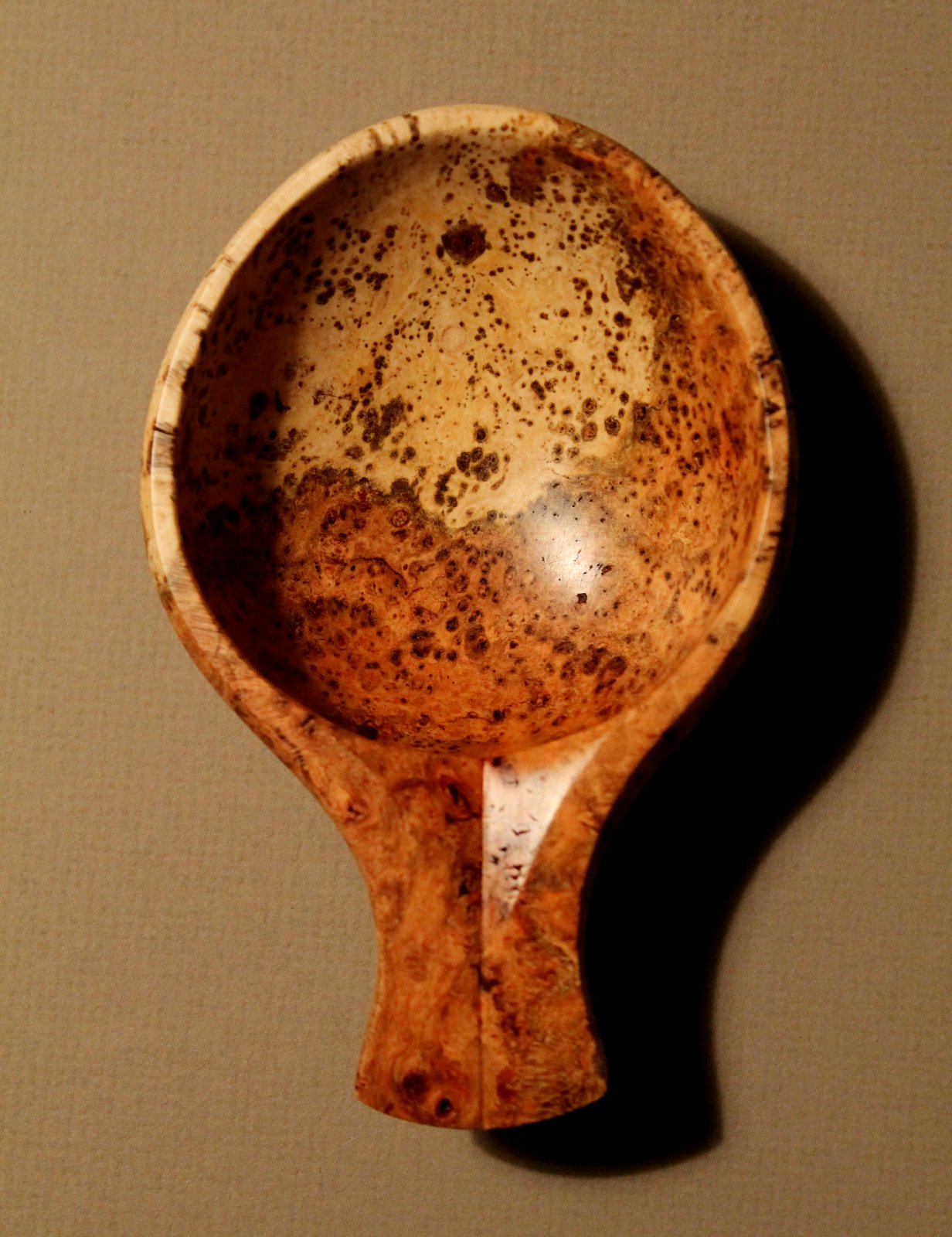
I carved the kuksa in the photo from such a piece.  I usually change my tactics when it comes to burl.  While the burl is still green, I carve as usual with axe, adze, knife, and gouges.  I leave a lot of extra material before the drying stage, because I find that burl likes to twist and turn in unpredictable ways as it dries.  After it is completely dry, I turn largely to a rasp to refine the shape.  The dry burl has a hard and brittle texture that cuts well under the rasp but not under the knife.
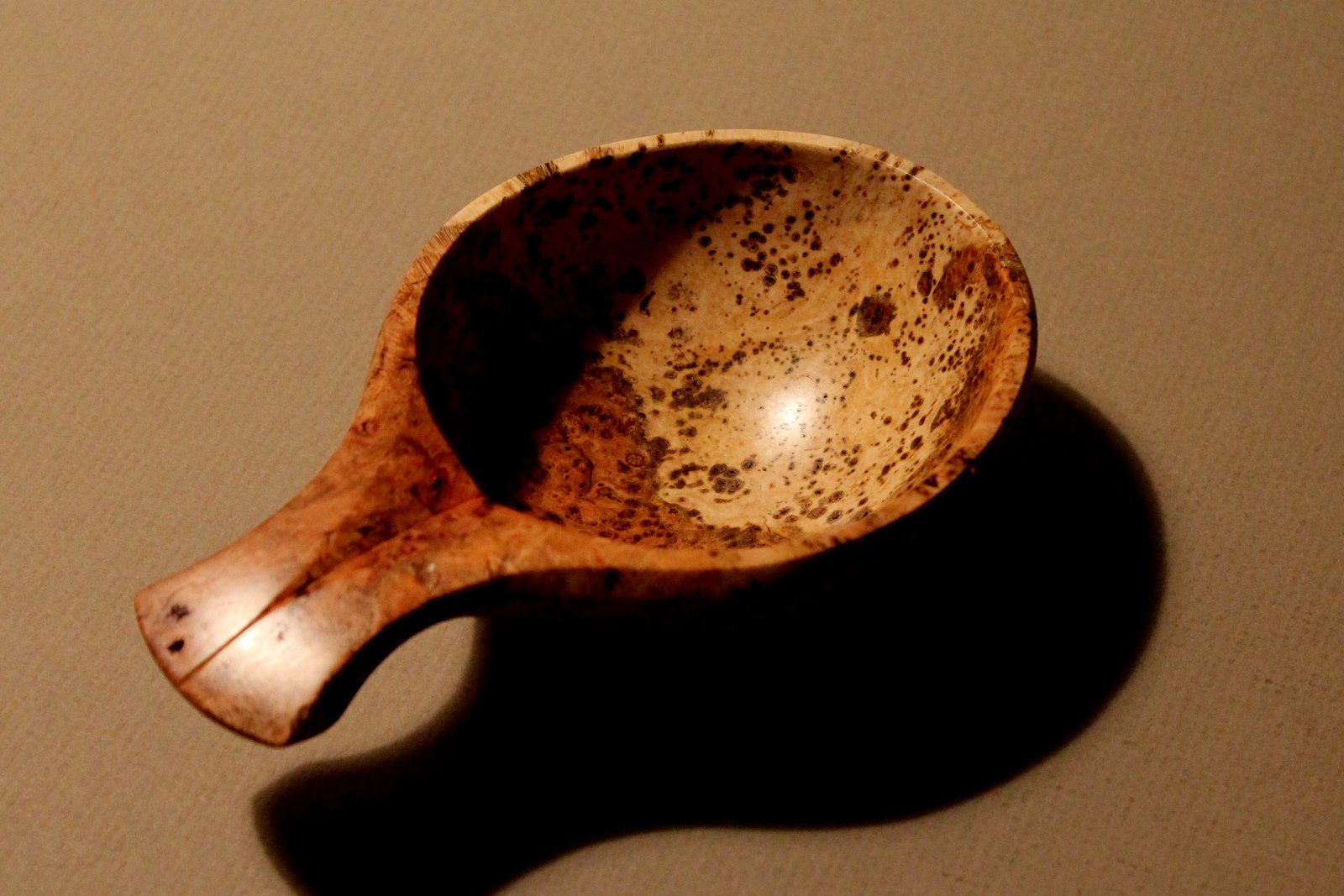
IMG_3925I use card scrapers, some curved, to refine further, then finish up with fine sandpaper. That is very unusual for me, as I prefer to leave my pieces straight from the cutting edge.   But for this burl, finishing with abrasives made sense.  The kuksa is 5.5 inches long, 3.5 inches wide, and 1.5 inches high.

Who knows how long it will be until I work with another burl.  If you want to see the work of a burl virtuoso, check out the work of Norm Sartorius.  You might also enjoy this video on the efforts of Norm and others to honor the work of Emil Milan.

Although the burl kuksa is already spoken for, I actually have been catching up and working on some things, some of which I hope to post for sale within a couple weeks.  I’ll post some info here when I do.
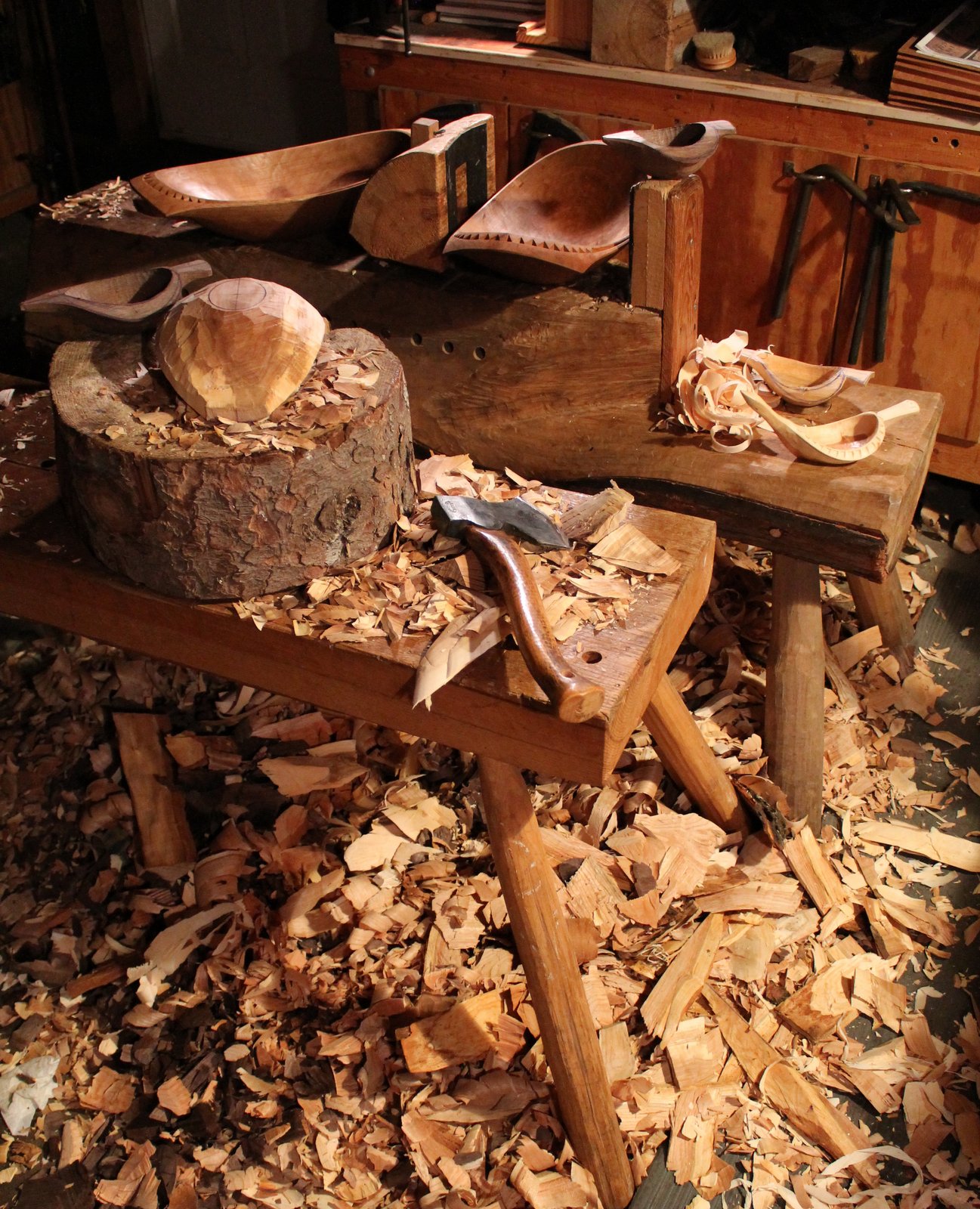
IMG_3896

One last thing: my last post focused on holding with holdfasts when working with gouges, but for many tasks I prefer hands and a knife.  I use a knife at some point on everything I make.

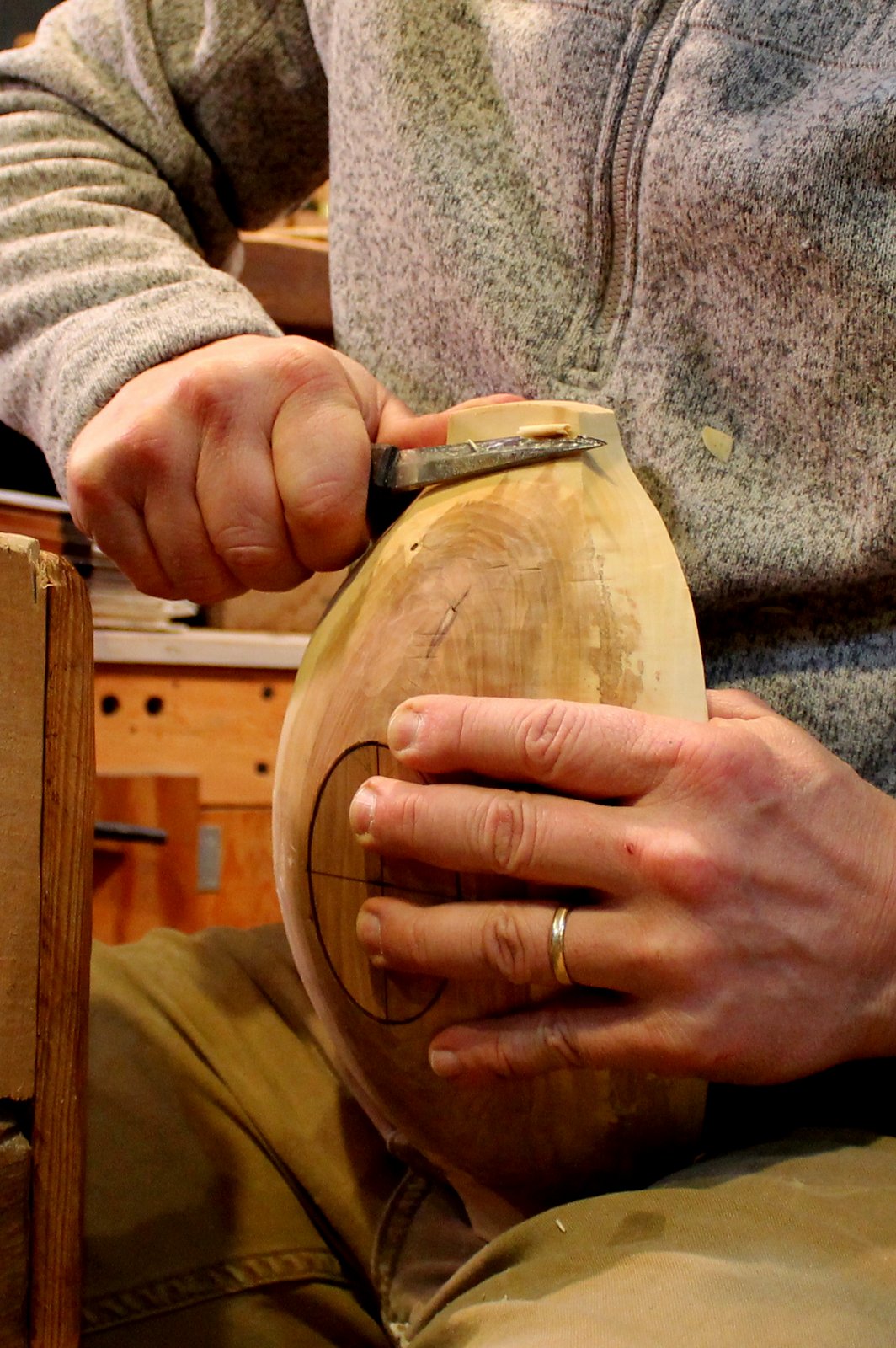
Below, I am making a slicing cut by pulling the knife along the underside of the handle of a crab apple bowl.  Great for controlled concave cuts.
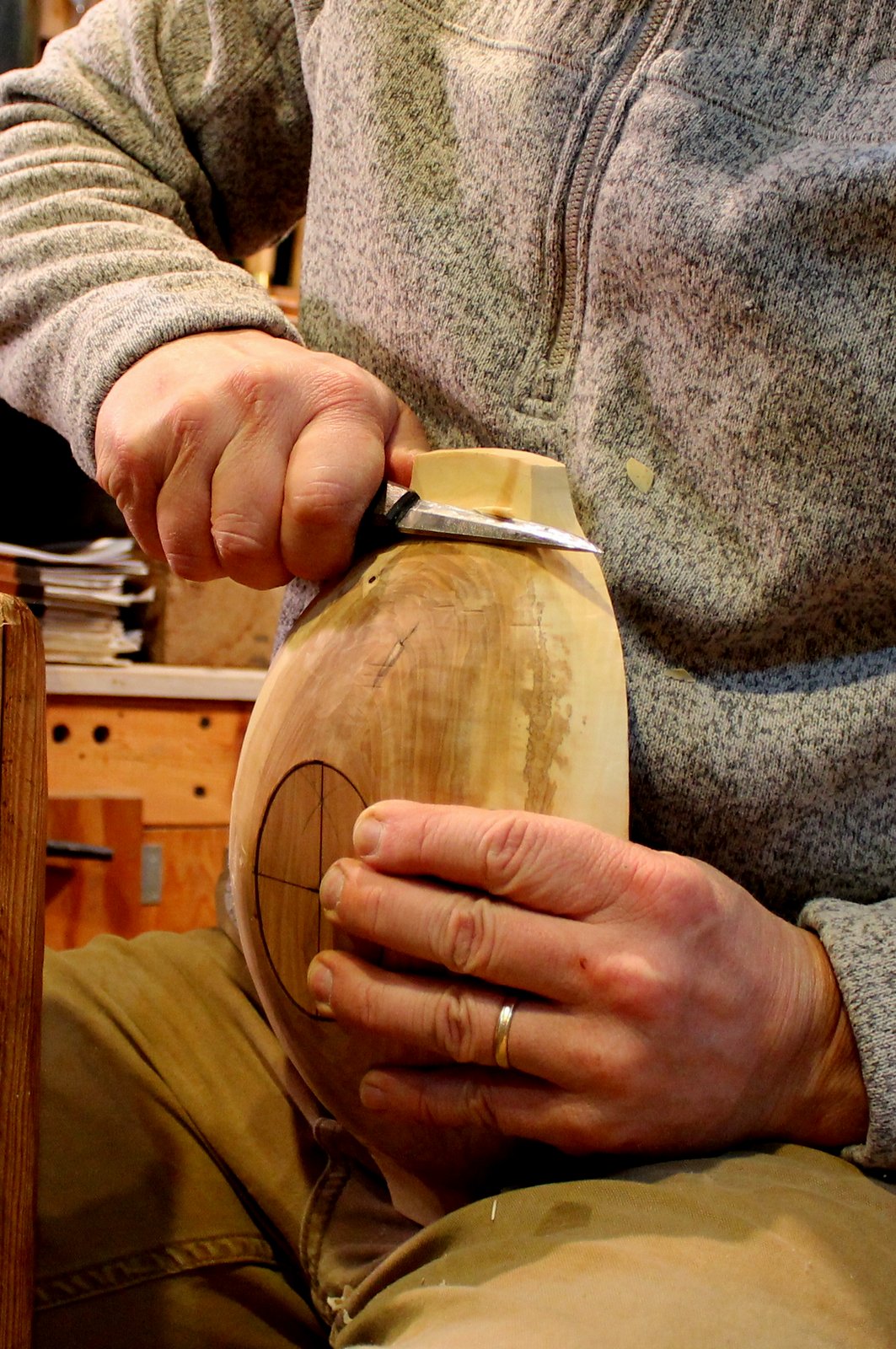
IMG_3898IMG_3899

Posted in burl, cherry | Tagged , , | 6 Comments

Hold Fast!

cartoon 2014 I hate it when that happens_NEW

So you’ve sandwiched the bowl between extended bench dogs and you’re making the final paring cuts when an unfortunate series of events occurs, all within a split second.  The end on which you are working goes down suddenly, the gouge makes a nasty divot, and the other end of the bowl shoots up at an arc into your face.  Yeah, I hate it when that happens.

You need holdfasts.  Not in the early stages, but rather near the end when doing any final gouge work.  In the beginning, I don’t use any holding devices at all, other than the hand that is not holding the axe or adze.  I usually use the bowl horse for refining the shape of the outside.  But for final gouge work on the interior, under handles, and more, holdfasts live up to their name.

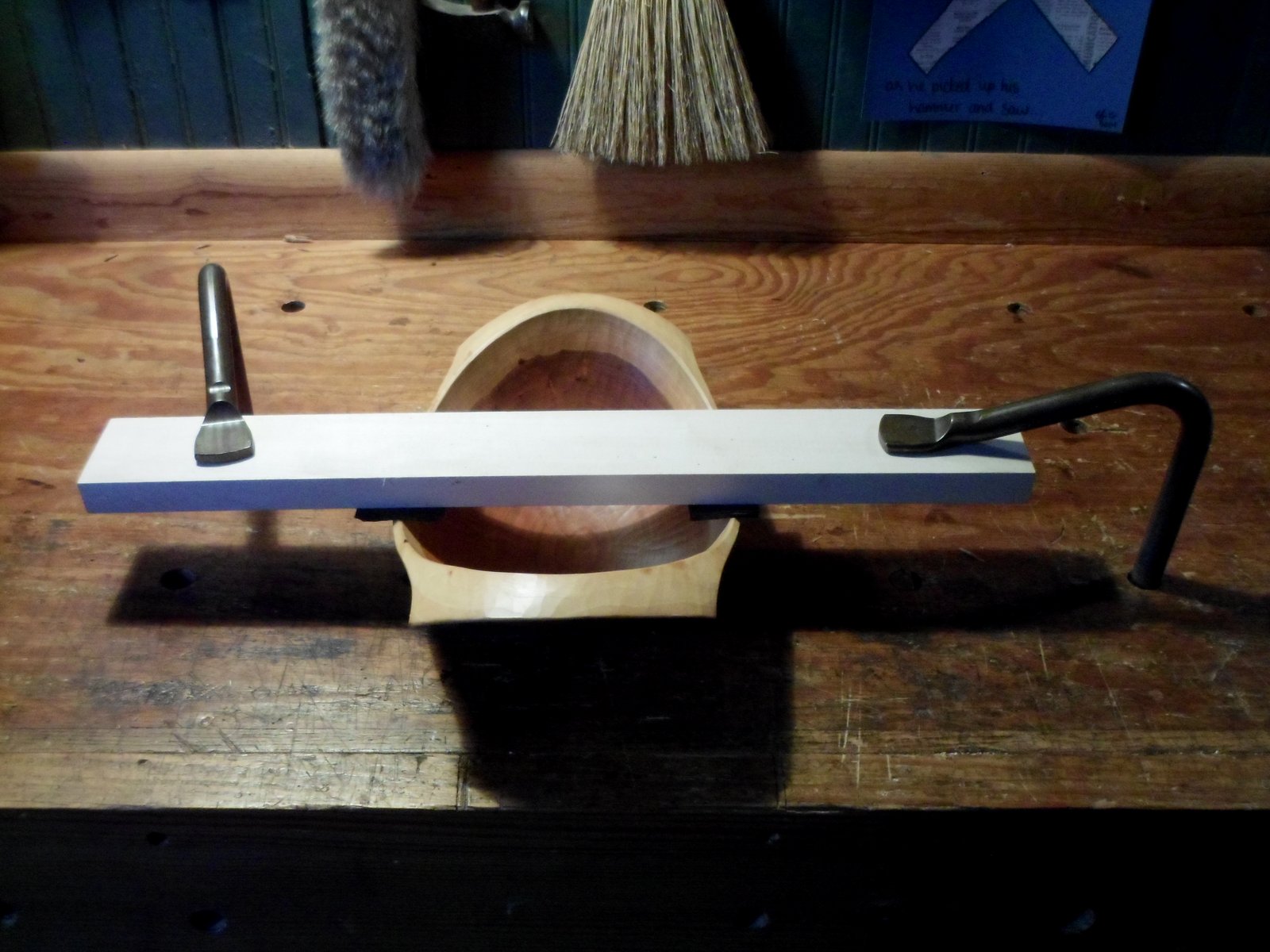
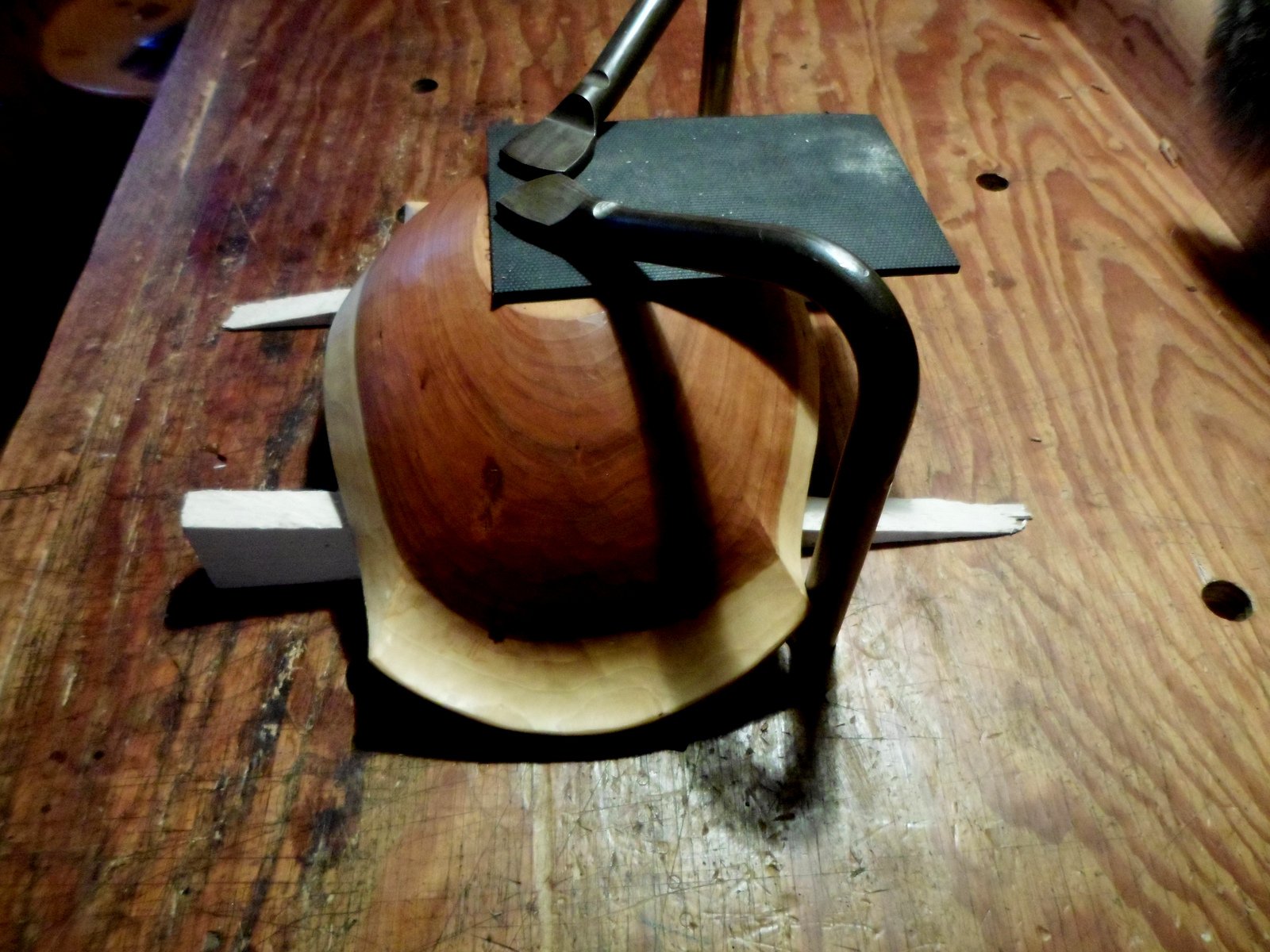
I’ve shown some typical arrangements in the photos below, but a little creativity can lead to many other solutions as well.  The bowl in the photos is a relatively small one we’ve been using in the house, but the same principles will work with bowls of different sizes and shapes.

SAM_2032

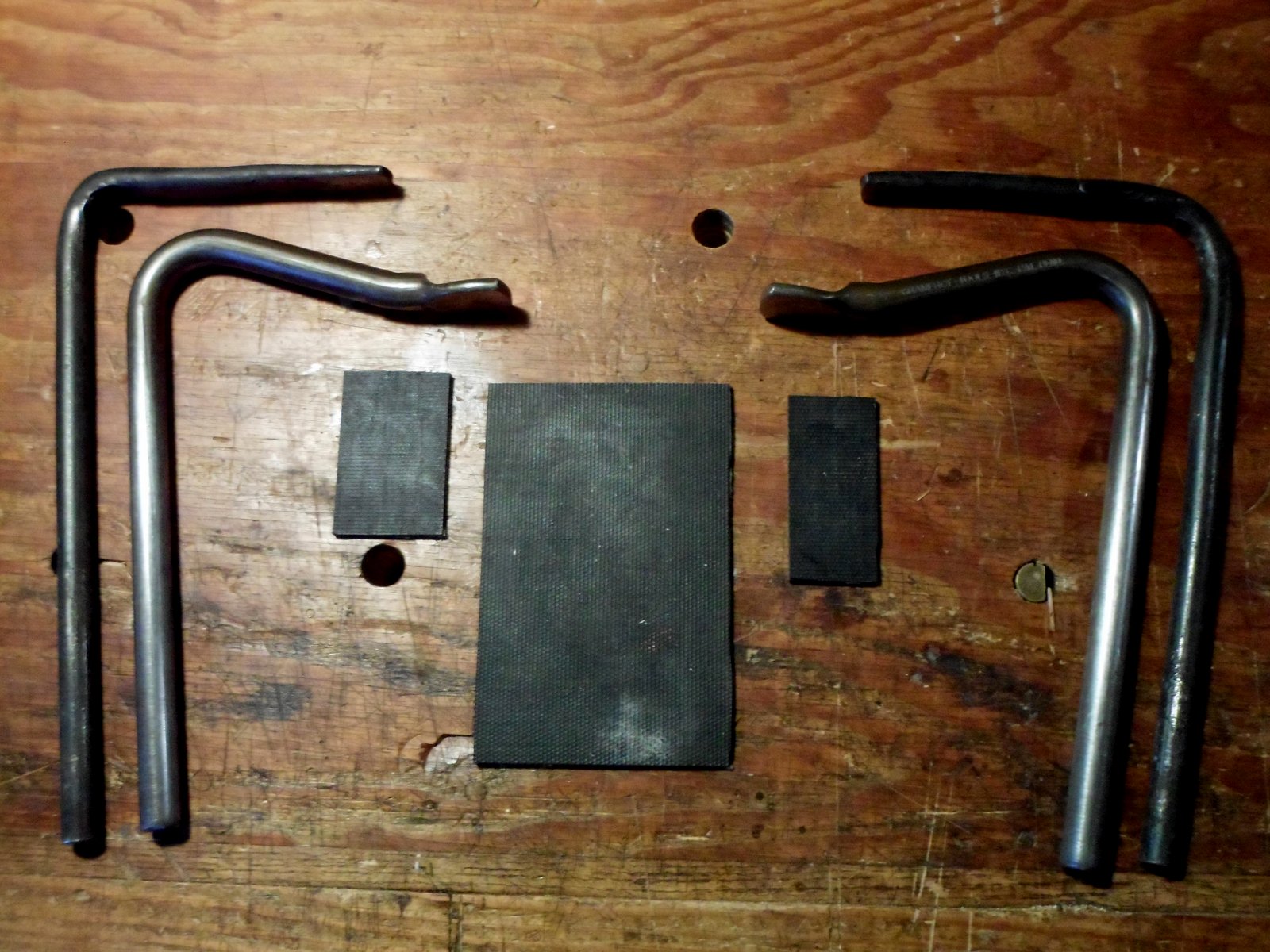
Here are the holdfasts I use.  Others work well too.  The inner ones are by Gramercy at Tools for Working Wood.  The outer ones, I made using a campfire, a double-action hand pump as a bellows, and some 5/8″ steel bar.  They look like crap, but they work well.  The angle is about 85 degrees.  The holes in my bench are 3/4″ diameter, and the bench top is three inches thick.  They work well for me in benches of 2 and 4 inch thickness too, so use whatever slab of wood you’ve got and bore some holes in it.

The other key component is some material to add friction between the bench and bowl  and the holdfasts and bowl.  You could try leather, old rubber floor mats, inner tube, etc.  I like this rubber belting material I found at Tractor Supply.  It is sold in various lengths and widths, can be cut, is very tough, and has great grip.  Great for lining vice jaws too, but it can sometimes leave some black smudges on lighter woods.

Old sailors referred to a well secured line as being “held fast”.  So now you too have a reason to get “HOLD FAST” tattooed to your fingers, just like a sailor.  You can show folks the bowl scar on your forehead as you tell them of your woodworking adventures.

Unseen is the rubber mat under the bowl.

Unseen is the rubber mat under the bowl.

SAM_2035

Softwood wedges keep the bowl from tipping.

Softwood wedges keep the bowl from tipping.

The upright of the holdfast itself can keep the bowl from sliding.

The upright of the holdfast itself can keep the bowl from sliding.

Posted in cartoons, holding | Tagged , | 15 Comments

Mellowing

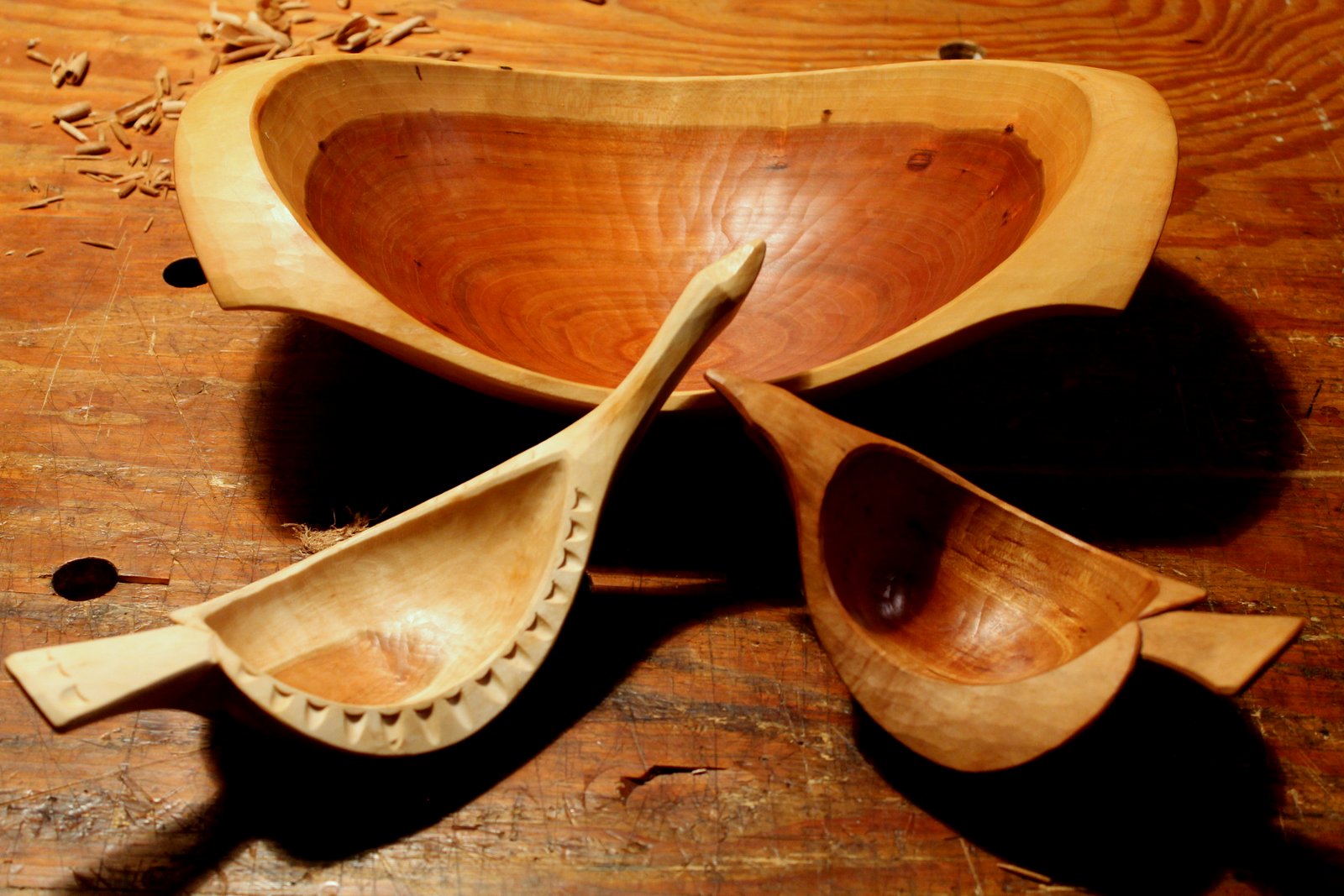
Cherry sapwood on bowls of varying age

Cherry sapwood on bowls of varying age 

As we make our official transition into another calendar year, maybe it is an appropriate time to think about mellowing.  It is reassuring to know that many things in life sweeten and become more beautiful with time.  Wood can be one of them.

I primarily work with green wood, so I can’t discount the advantages of freshness and newness.  The crisp smell and coolness of a just-split green log are wonderful sensations, and the wood is a joy to work. But the journey of a newly finished piece has only just begun.

I saw this clearly as I finished a small goose-inspired bowl this week.  Some woods, such as cherry and walnut, feature a distinct color difference between the sapwood and the heartwood.  I sometimes use sapwood as a design element or, in the case of the goose bowl, because the branch is nearly all sapwood.  At first, the color difference is quite sharp, but over time, things mellow.

The other two bowls in the photo have been part of our household; both cherry also.  The one in the background was made about a year ago.  The heartwood has deepened in color and the sapwood has begun to become more subtle.  The smaller bird bowl in the lower right was made in 2009.  The sapwood has taken on a rich brown tone, more in harmony with the heartwood.

Storing (aging) logs for some months before use, can help to mellow the wood, making it less brash and more relaxed.  At least it seems that way.  I like to think of it sort of like a ripening process.  It is not necessary, and for decay-prone species it may mean rotten wood.  But if you haven’t gotten to that log yet, it might be good news.  I have also noticed that the sapwood takes on a hint of color similar to the heartwood if in storage long enough.  Keep the moisture in the log, though.

Happy mellow new year!


Posted in bowls, carving, cherry | Tagged , | 9 Comments