Walnut Spoons

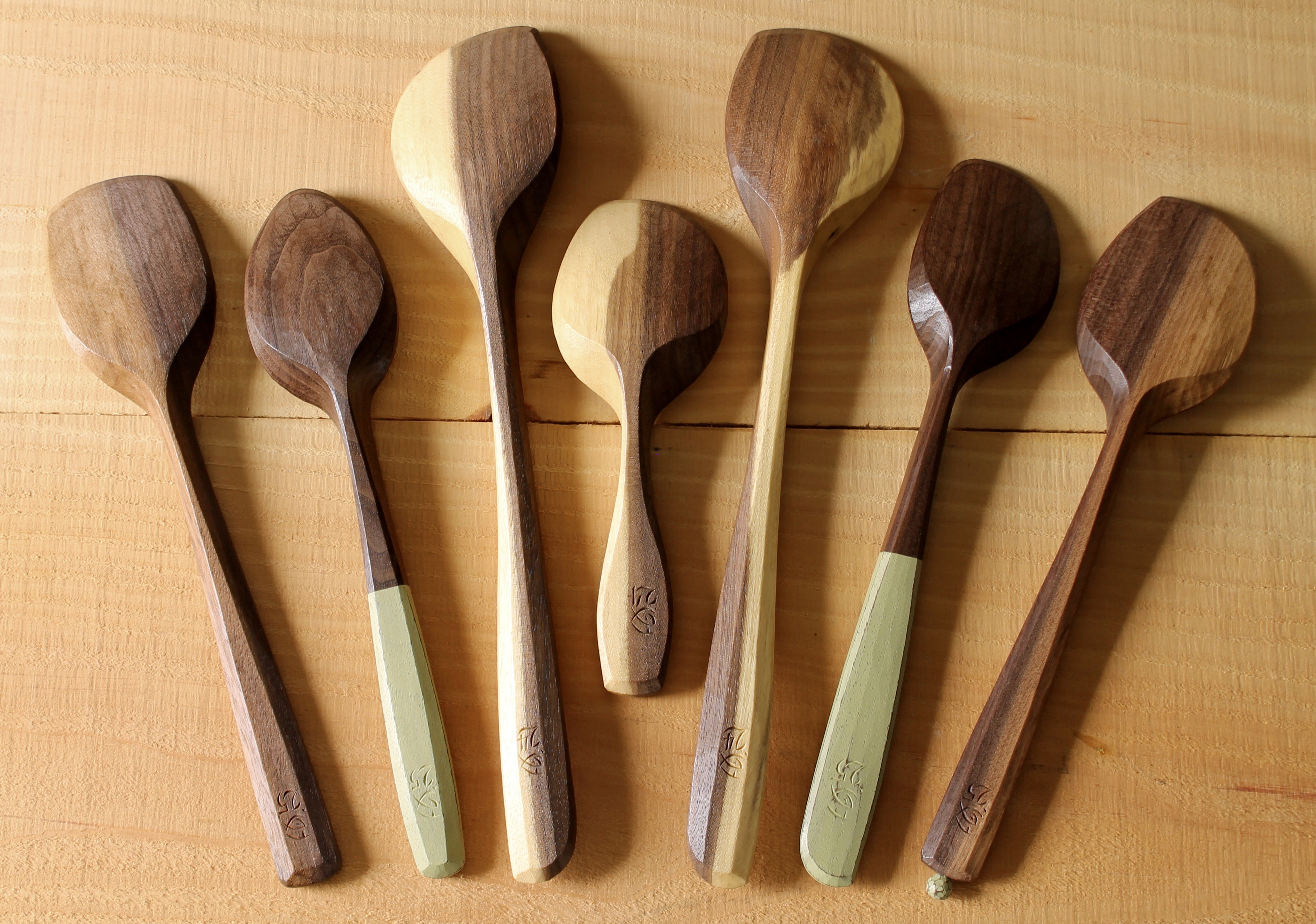
Having some nice walnut around, I decided to make some spoons from it. I’ve got seven here for sale. The two longest ones, #3 and #5 were made with a pair of salad servers in mind, a pair of matching opposites, but each could be a good general use spoon as well. They are 14″ (35cm) long. The compact and curvy serving spoon in the middle, #4, is 8″ (20cm) long. The other four are 11″-12″ long, good for general kitchen duties, cooking, stirring, serving. All surfaces are straight from the cutting edge.

There’s a shot of the back side of them. The ones in the middle were carved when the log was absolutely fresh and the white sapwood holds its color for some interesting contrast. The two on the outer edges were also carved right on the heartwood-sapwood border, but after a couple weeks in the log. The sapwood had begun to mellow in color. #2 and #6 have a light green milk paint on the handles and #7 has the same on the ball finial.

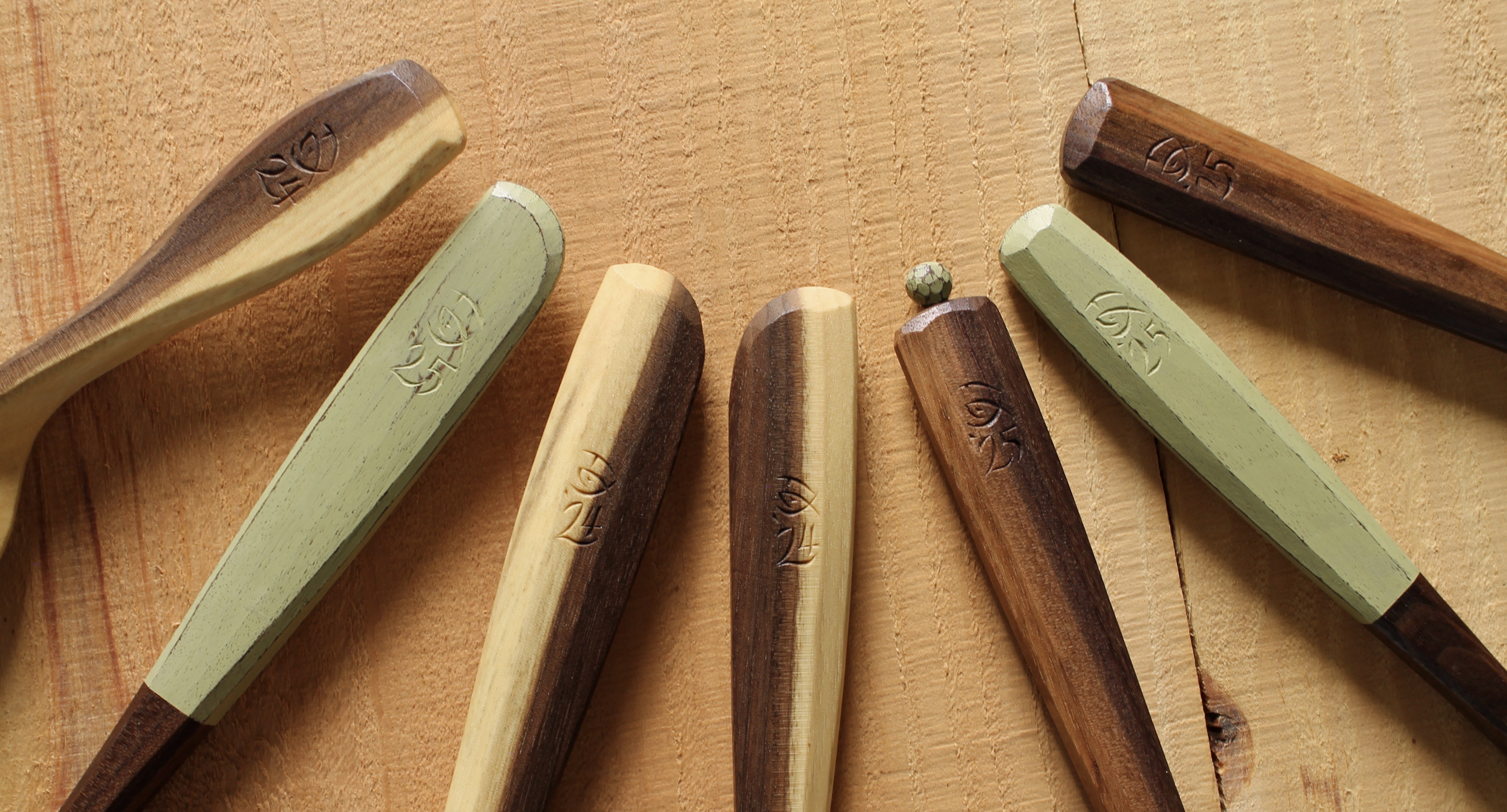
Here are the handles closer up (not in the same order as the other photos). You can zoom in to see more detail.

And a close-up of the backs of the handles.

There they are again, with a metric and imperial measuring stick for scale. The prices listed below include shipping. If you’re interested, email me at dandkfish@gmail.com. Let me know if you’d like to send a check or receive a PayPal invoice. Thanks!

  • #1, #2, #4, #6, #7 are $160 each.
  • #3 and #5 are $350 for the pair.

UPDATE: All of the spoons have sold. Thank you.

Posted in patterns, spoons, Uncategorized, walnut | 2 Comments

Two Duck Signs

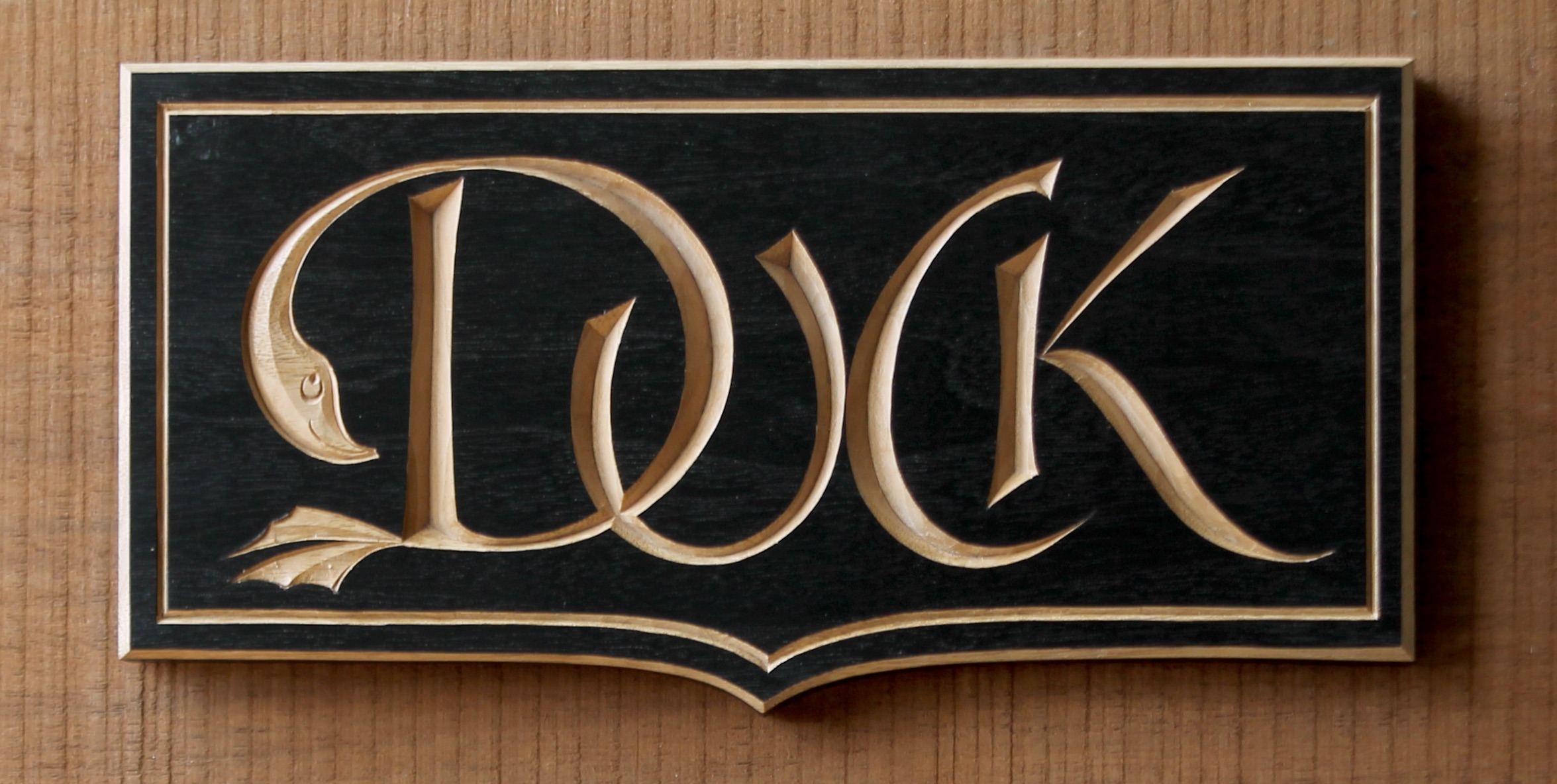
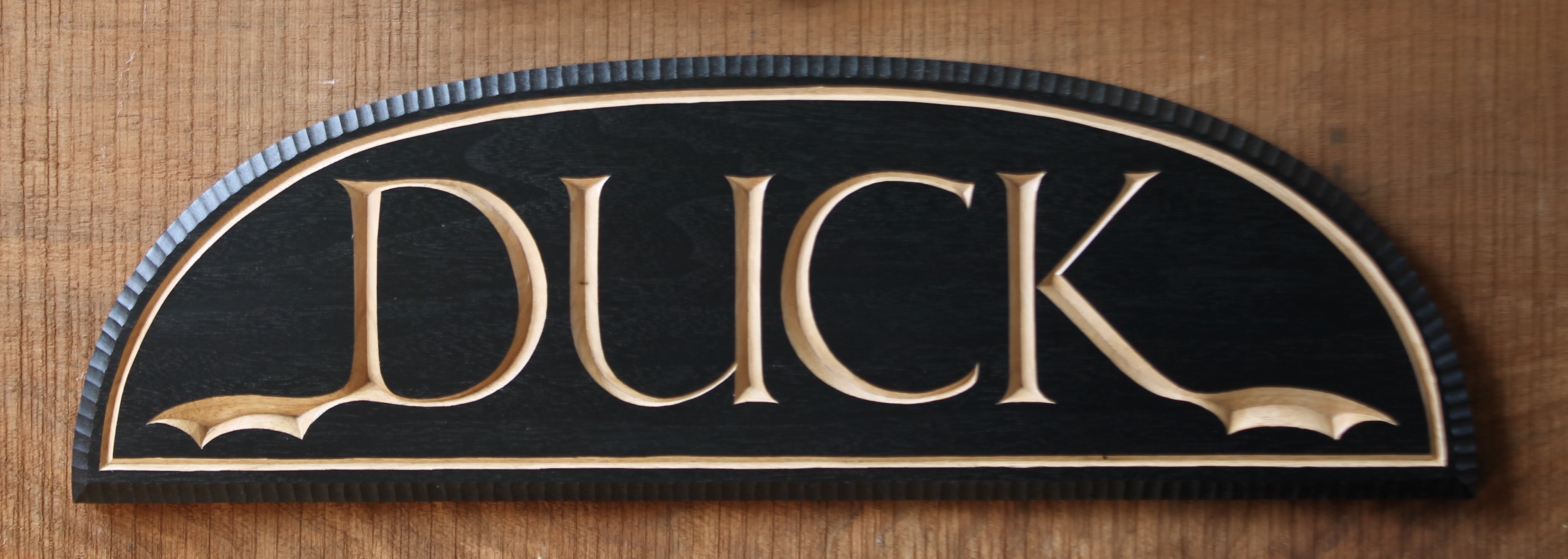
“Duck” Signs 2025. 10 3/4″ and 20″ long

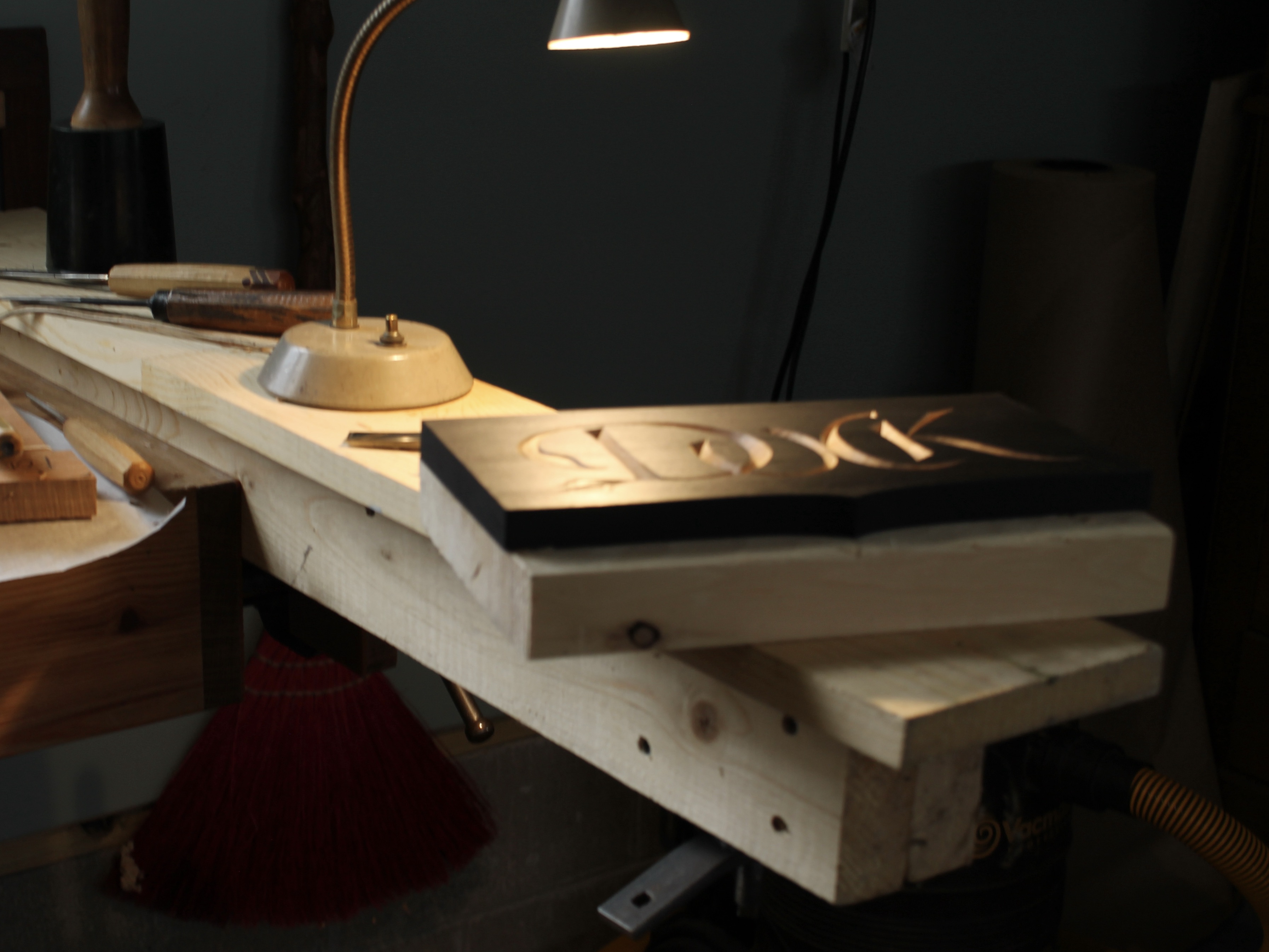
I had an unusual request recently to make a pair of signs, one for each side of a doorway between rooms in an old house. Apparently, the low height of the doorway has claimed the forehead of many a guest. The signs, hanging just above the doorway will serve as a playful warning/reminder.

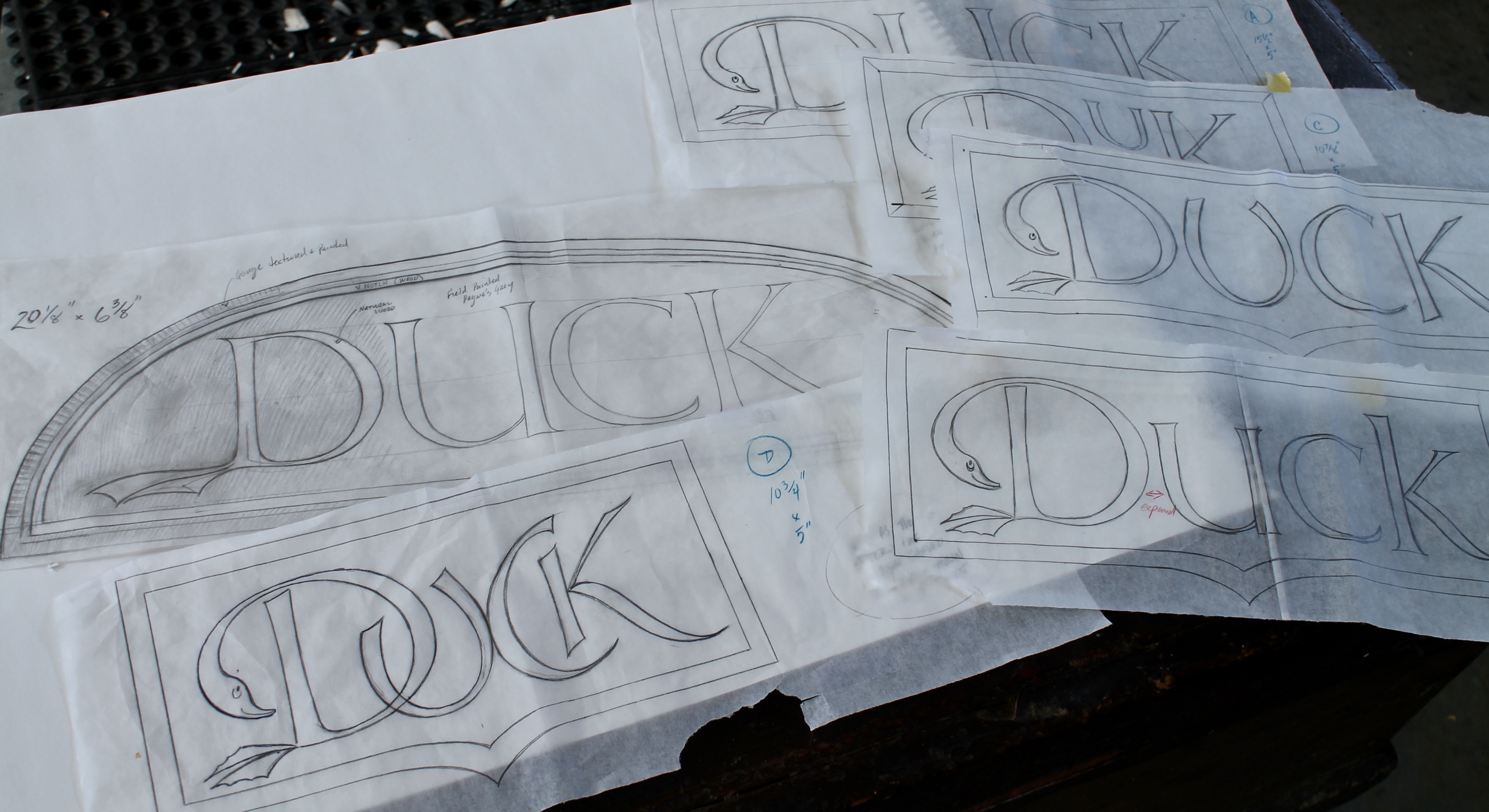
The longest part of the process occurs before I pick up a chisel. I played around by drawing several design possibilities. Ultimately, I carved the two on the left.

The one above, at just under 11″, will hang on the side of the door with a little less open room. These letters (and duck elements) were just freely drawn.

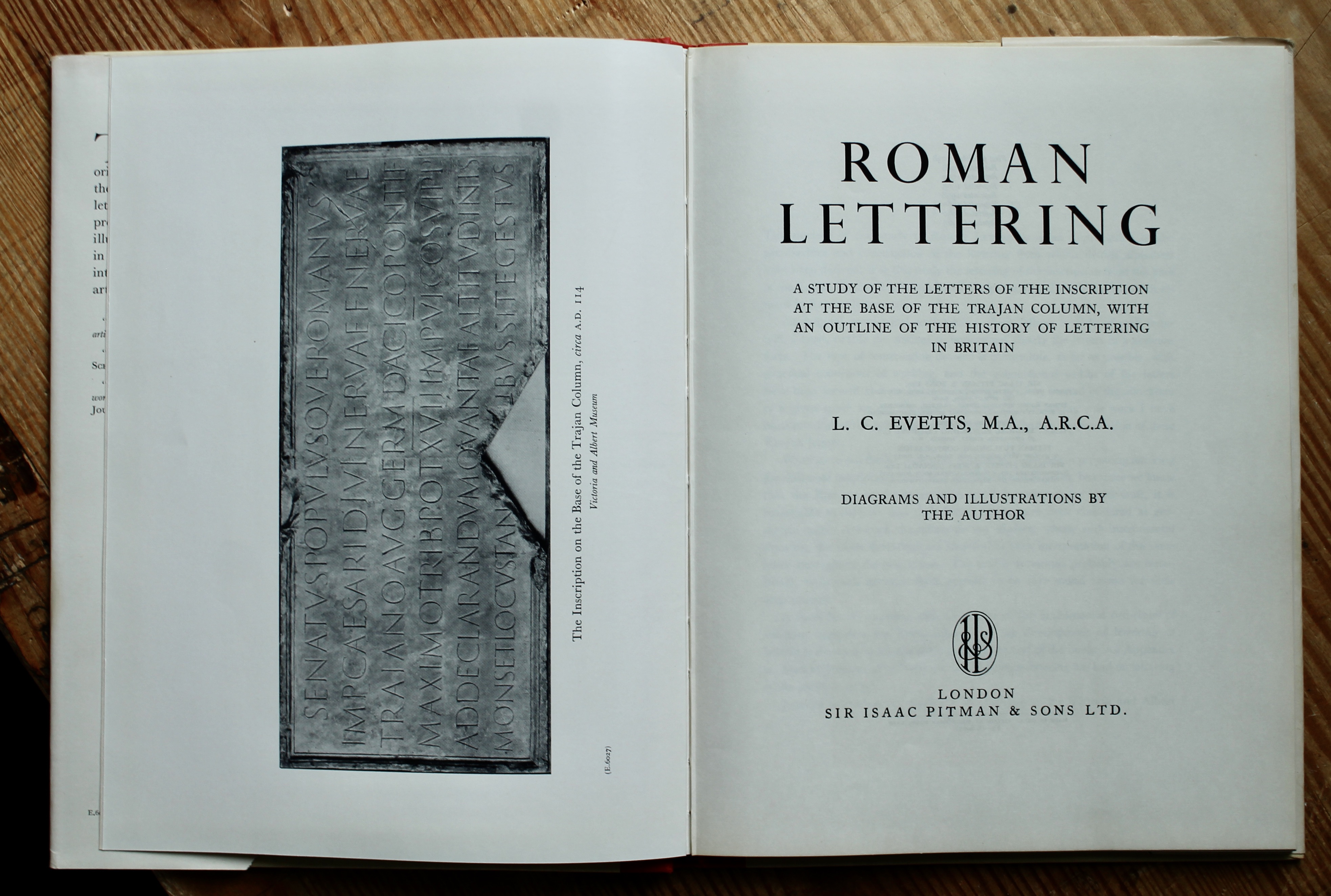
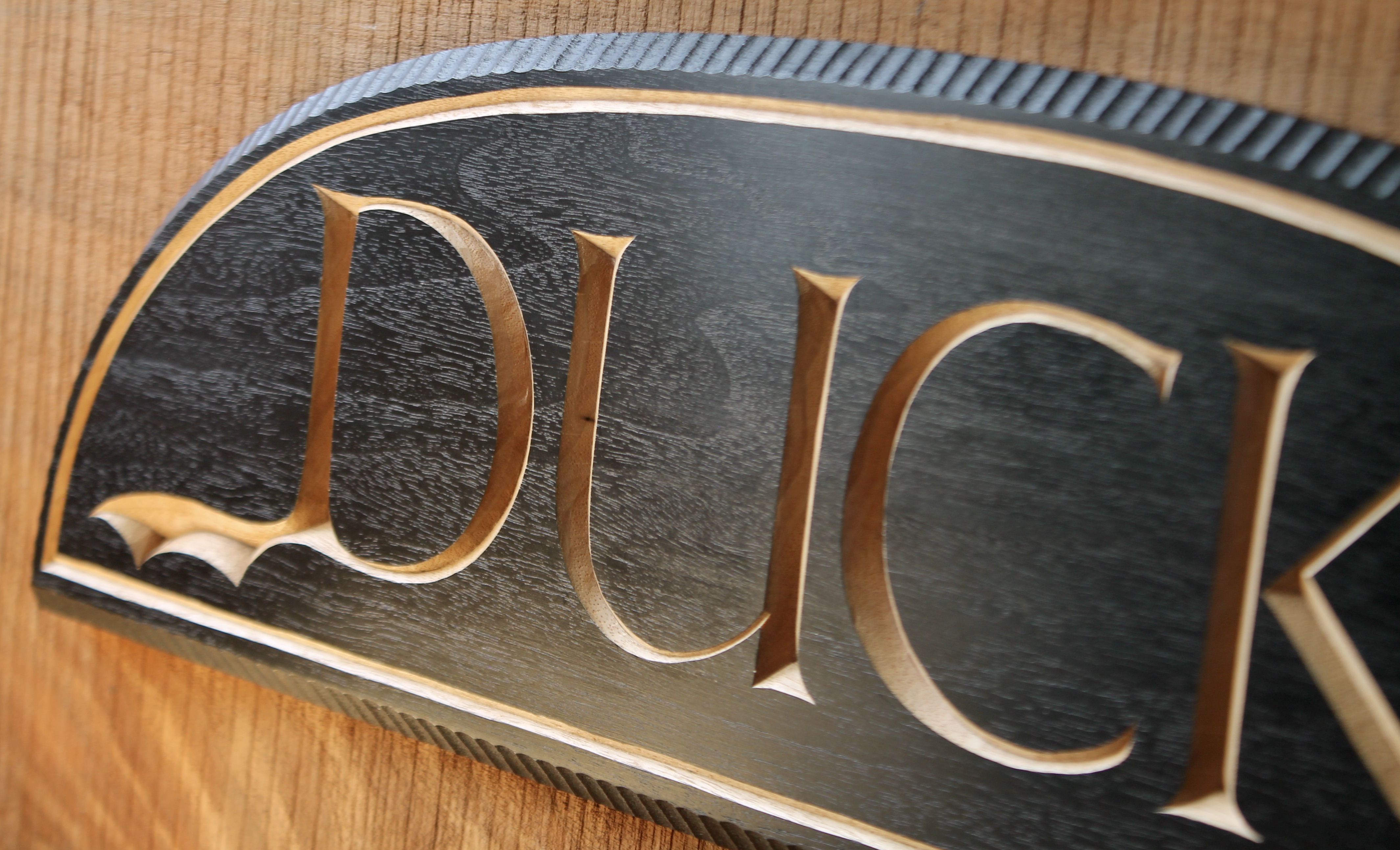
The other sign, nearly twice as long, is inspired by classic Roman lettering. More specifically, the forms from the base of the Trajan Column, carved in Rome early in the second century. The Roman alphabet had no U or K, so those letters have been designed to harmonize with the rest of the letter forms.

The Trajan inscription has been studied by many lettering experts. Possibly the most important studies were conducted by Father Edward Catich. His books on the subject are referenced at the link on his name.

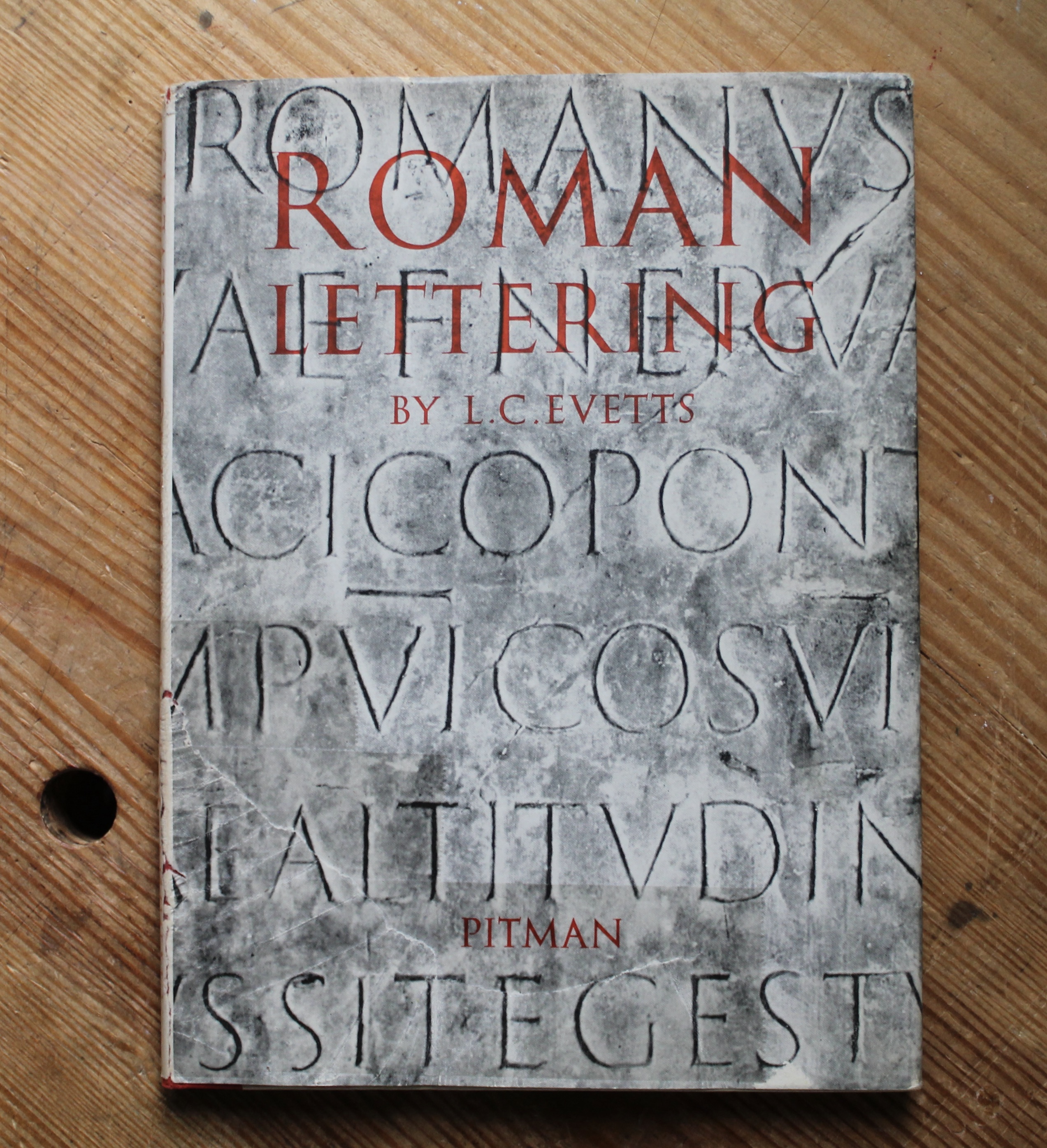
Among other great sources is the book (photo above) Roman Lettering by L.C. Evetts, first published in 1938.

Evetts offers a geometric context to the construction of the letters, but also discusses and demonstrates, through his clear illustrations, the important and consistent deviations from strict geometry. The book was recommended to me not long ago, and I’ve loved diving into it.

Carving setup. That’s the handle of a carver’s screw at the bottom of the photo.

When it came to the carving, I prepared two pieces from a relatively dense butternut board. I painted both pieces with a thin mix (not strictly black, more of a dark Payne’s Grey in reality) of acrylic artist paints. Then I carved through it.

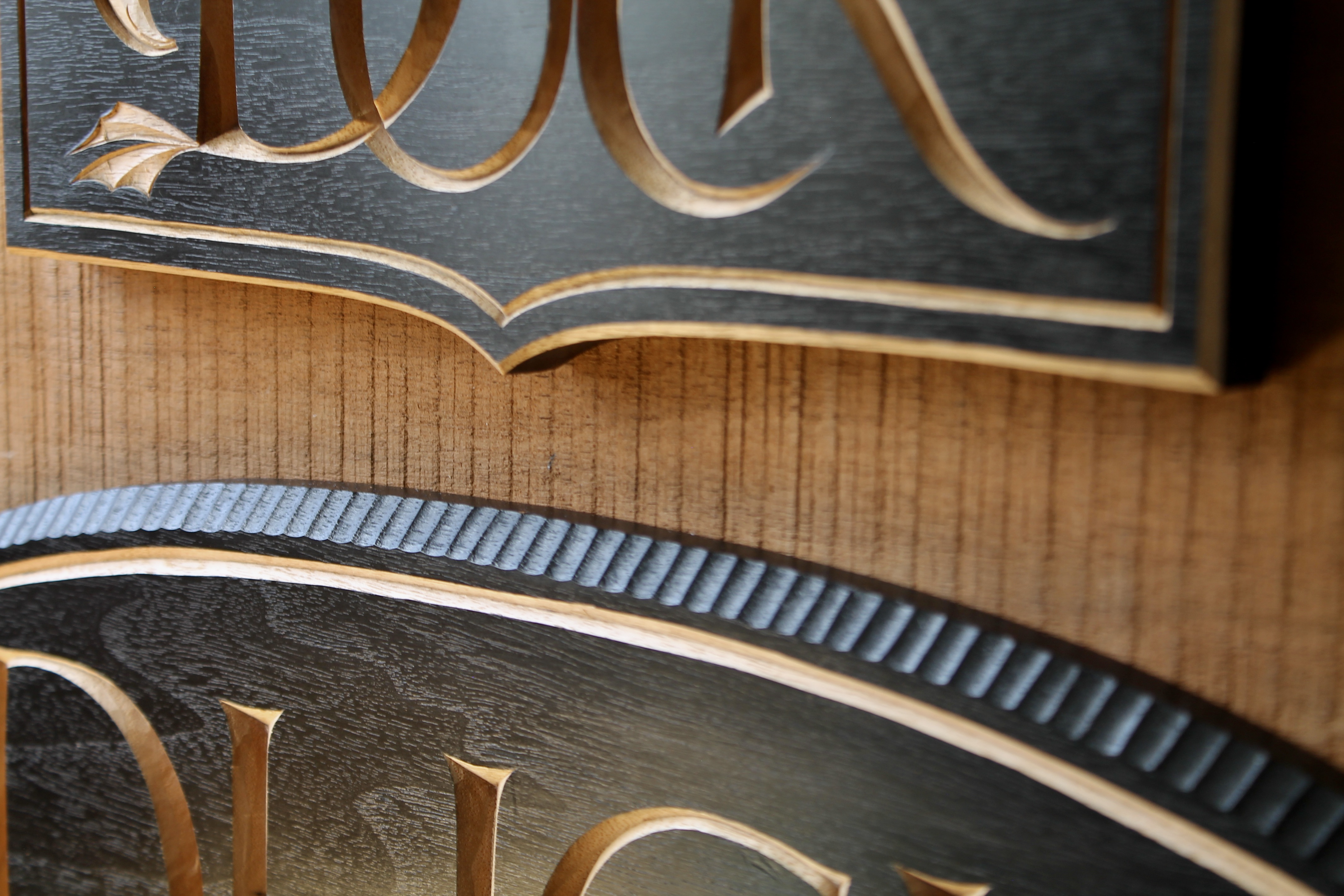
The shots above and below provide a better look at the painted surface. Thinning the paint made for an even coat that allowed the grain of the wood to read through. The detail on the edge of the larger sign was done by first shaving a large bevel, then carving across it with a gouge.

After the carving was done, I hit everything with a coat of paste wax. Ready to save heads. As usual, there are a couple details I wouldn’t mind revisiting, but overall I’m pleased with how they turned out. A fun project.

Posted in books, holding, Lettering, Uncategorized | Tagged , , | 22 Comments

Getting Colorful at Pete’s

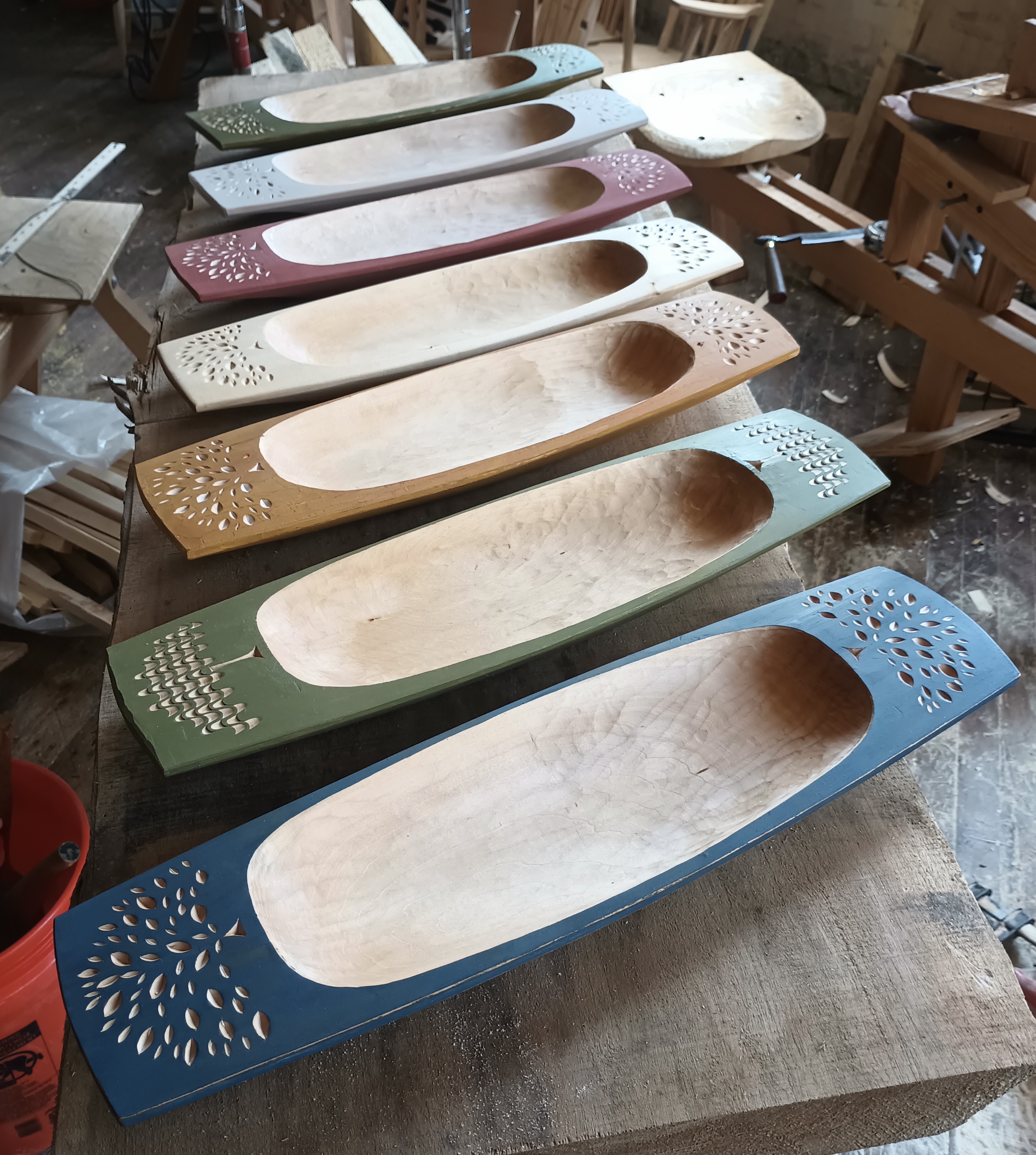
I returned home a week ago from the most recent Bowl Exploration class at Peter Galbert Workshops. This was the third time I’ve taught this class and each iteration has seen a change or two. This time around, we carved basswood and we also explored milk paint as an option. All of the students chose to paint their bowls before carving one of two tree designs. Only Lew decided to go au natural.

Bowl Exploration Class, March 2025

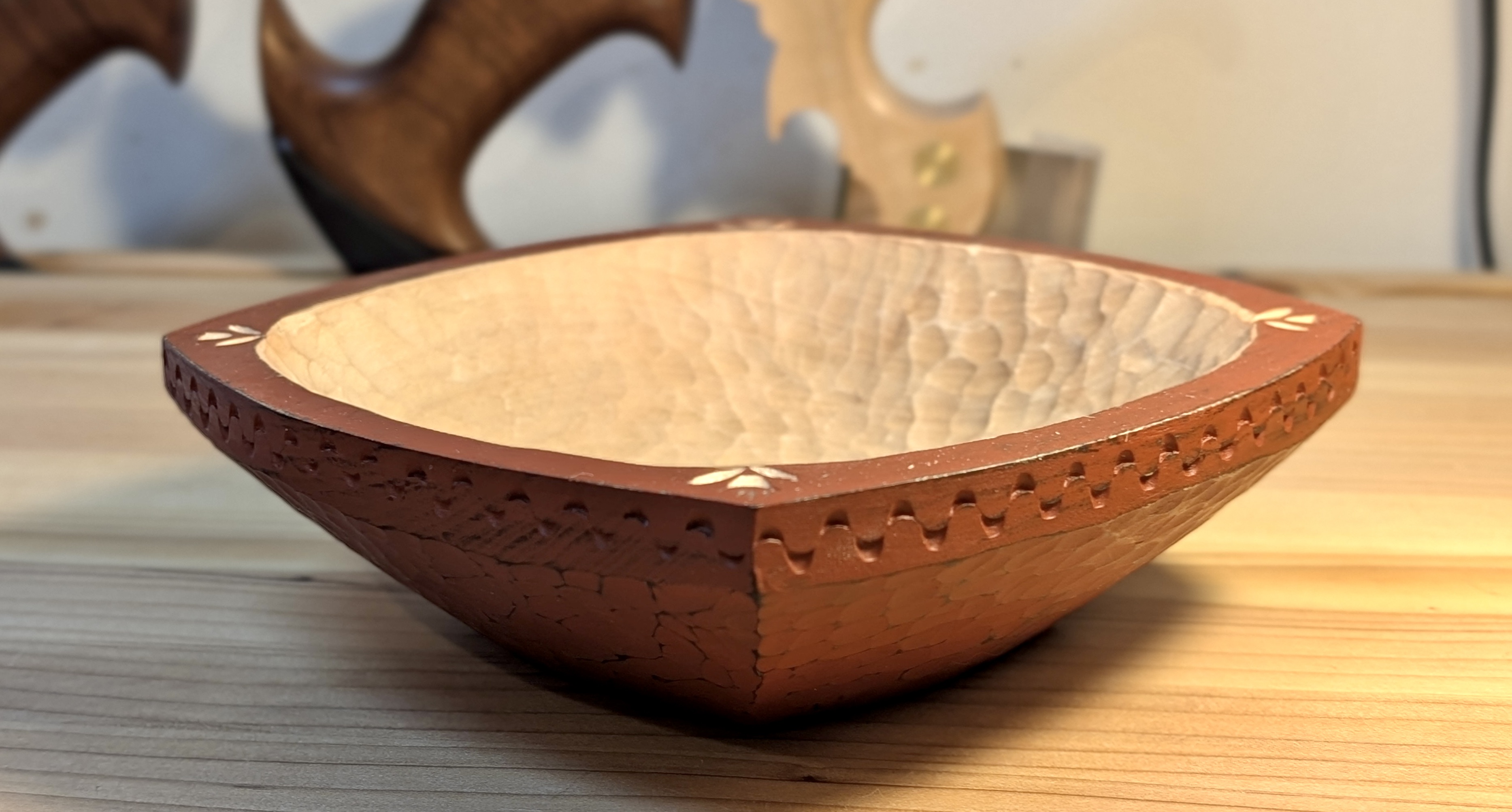
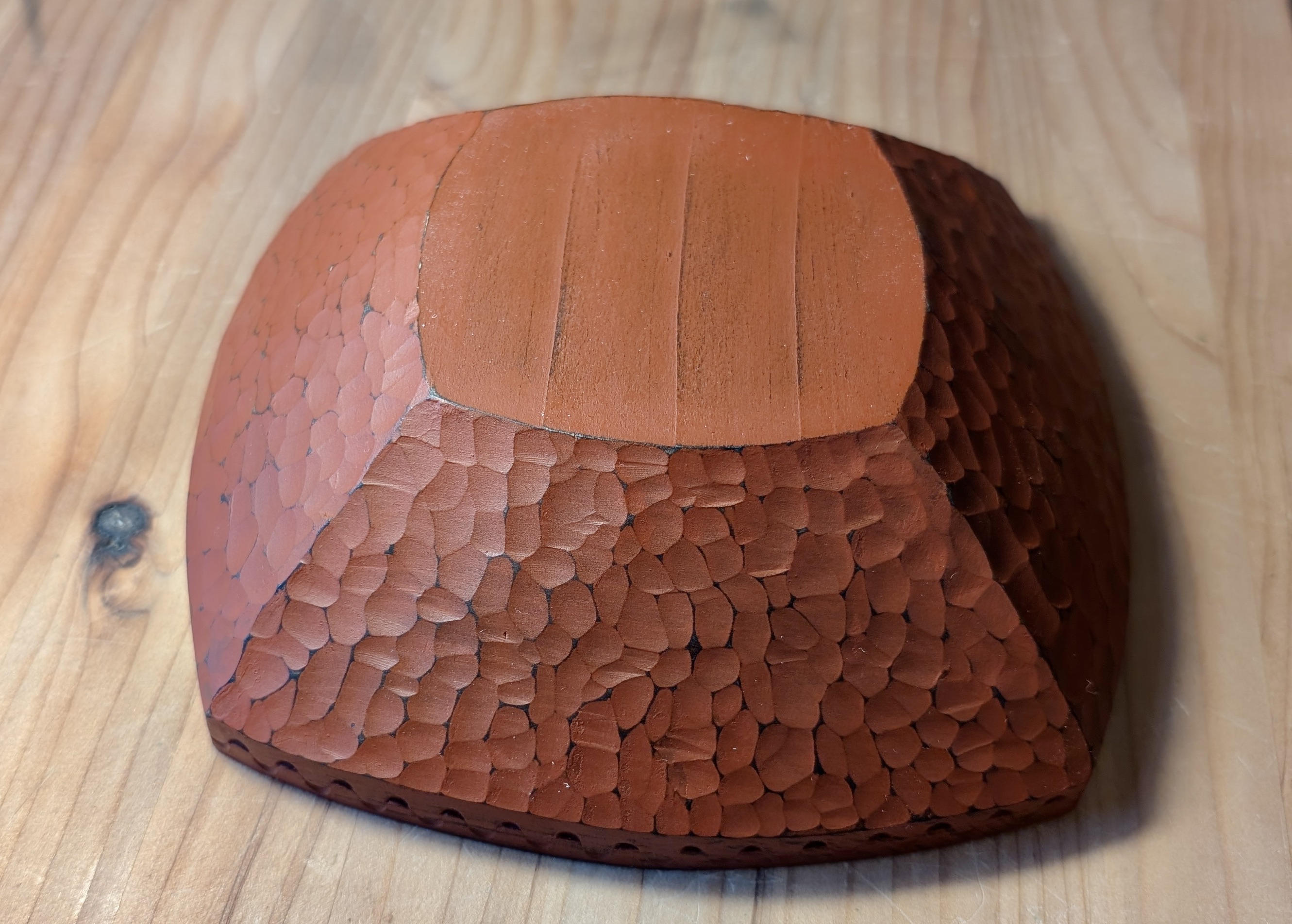
The basswood worked out well. It’s quite carvable, yet holds detail well. The blanks were consistent with no unwanted surprises inside. Compared to carving dry tulip poplar, we were able to move through the stages with the dry basswood more quickly, leaving enough time for us to explore another form, a squarish little bowl I called an ice-cream bowl.

Student bowls 2025

The bowls represent opportunities to learn and practice skills and concepts that will lead to many more bowls of all sorts after everyone returns home. Still, it’s always good when the class bowls themselves turn out this nice. I was thrilled to see them side by side.

We carved sample boards with various patterns using knife and gouge. When it came to the handles on the long bowls, all of the students but one chose to carve my original tree design. There’s Bix’s in blue.

Dan was the lone carver of the thumbnail tree.

With the long bowl and the sample boards under their belts, it was great to see everyone taking what they had learned and applying it in their own creative ways on their ice cream bowls. Nice corner detail there by George, whose daughter requested a purple bowl.

That orange that Jesse is applying looks pretty bold. But the milk paint dries quickly to a more muted shade, plus there was an undercoat of black beneath.

Jesse sent these photos, above and below, once he had rubbed the bowl down.

There was a lot more where that came from in terms of student work and ideas, but I was only able to get so many photos.

As always, I learned more than anybody and it’s a special thing to be part of a group of people coming together for a week of camaraderie and creating together.

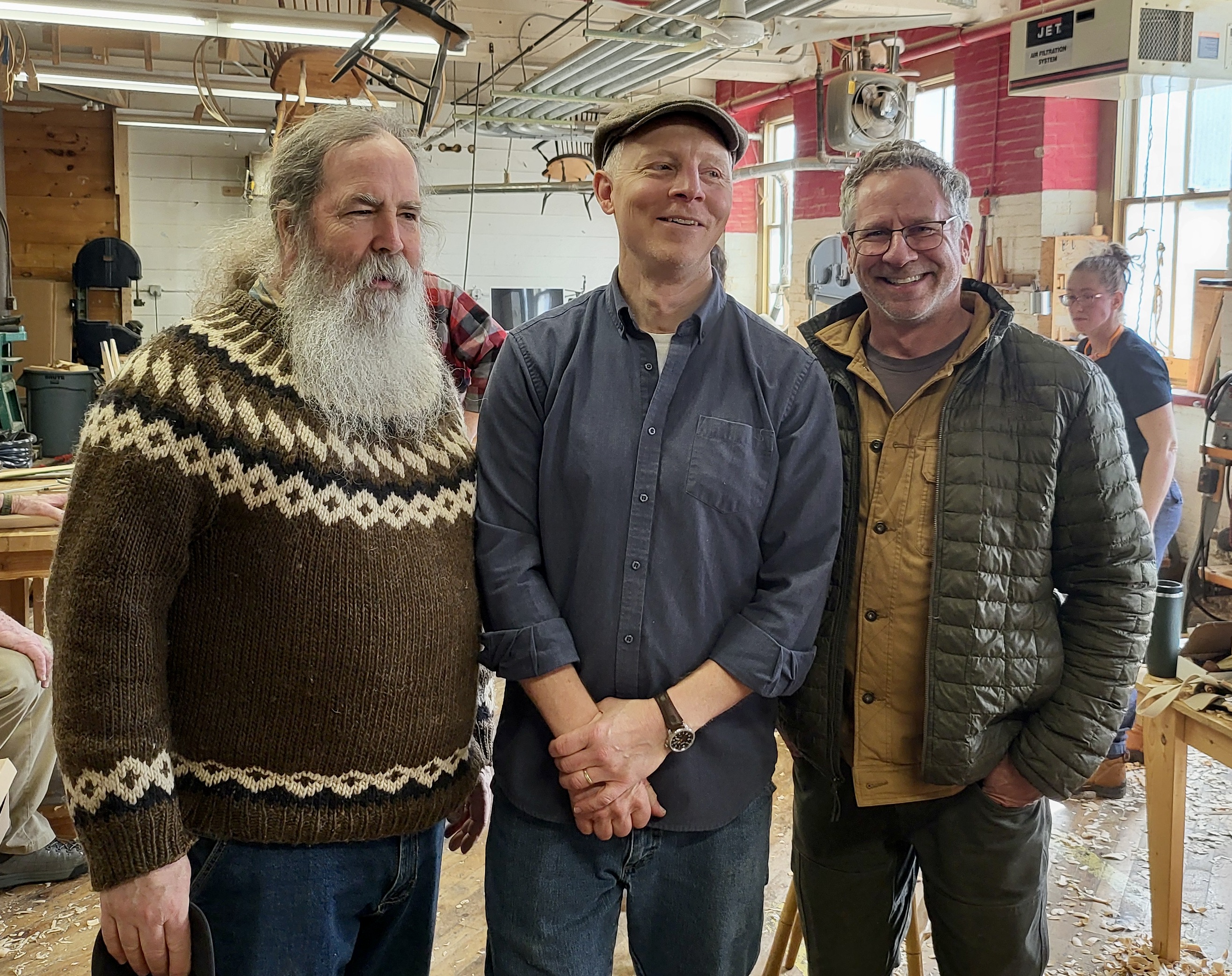
“Hi. I’m Dave and this is my brother Peter and that’s my other brother Peter.” (Peter Follansbee, Dave Fisher, Peter Galbert) Photo courtesy of Lew Kohl.

I was also thrilled to catch up a little with some old friends. Peter Lamb, Peter Follansbee, Peter Galbert, and even some others not called Peter.

There won’t be any more photos for me in that shop that will hold good memories. When I return in June, we’ll be in Pete’s new shop which is coming along well. Pete’s vision and tenacity is amazing, and the new workshop is the latest result. Looking forward to it.

Posted in bowls, classes, finding wood, paint, patterns, teaching, Uncategorized | 6 Comments

Round Brown Bird Bowl

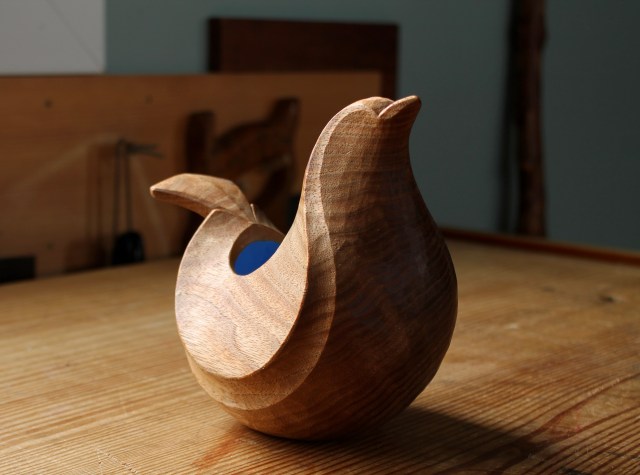
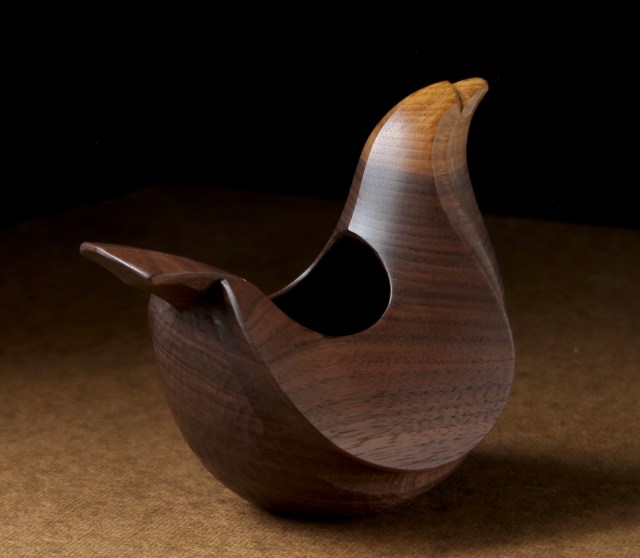
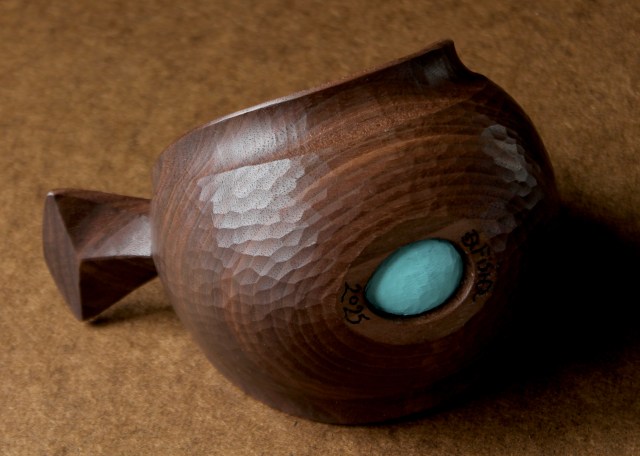
Walnut Bird Bowl 2025, 6″ x 5 3/4″ x 4 3/8″

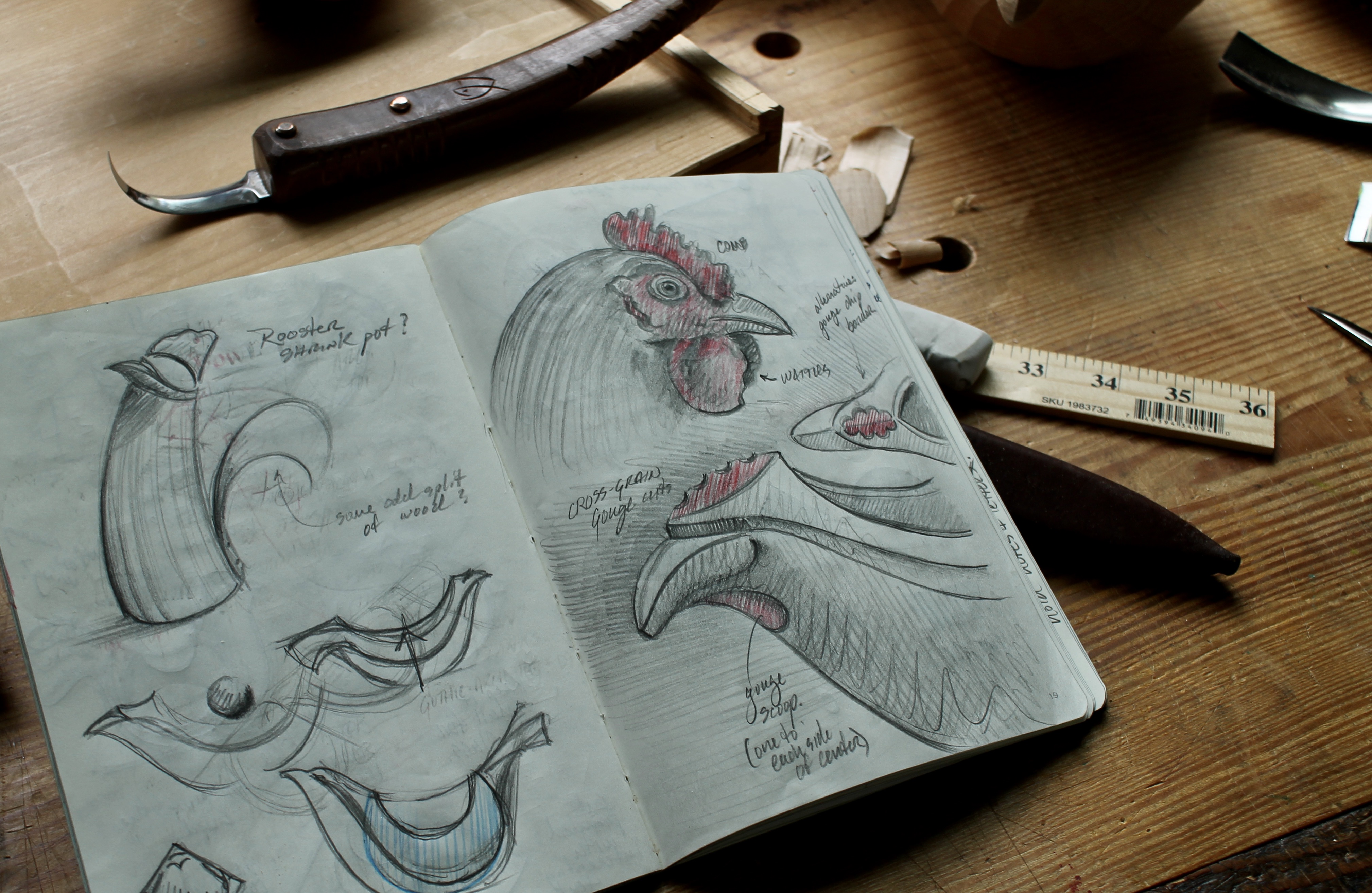
One of the reasons I keep a notebook is to play with ideas and save them for future reference. When I revisit an old notebook, I sometimes wonder what I was thinking, but sometimes I realize the circumstances are right to bring the old idea to fruition. That was the case with this bird bowl.

The notebook on the left is from 2018. I had been noticing the plumpness of the backyard birds and I looked up a photo of a chickadee and drew it in ballpoint pen. Then I started to think about a translation of that form and sketched a little idea on the opposite page. Then I did nothing about it for eight years. Then, this year, an exhibition request for a piece that had to fit within a theoretical 6″ cube got me thinking about that design again. I started playing with the idea some more, considering things like grain orientation and the forms of other songbirds as I doodled in my current notebook. That’s one of the recent sketches on the right.

My first experiment beyond the sketchbook was in butternut (above), a practice piece of sorts. Although I wasn’t happy with many of the details, it did give me a chance to learn and gain a better understanding of the form, how best to go about shaping it, and what changes I wanted to make. Also, this particular piece of butternut had some soft patches. I think a little decay had begun to settle in those areas while the log was still green. Even the more sound areas were a bit too soft to hold the edges I wanted for this form.

I reached for a walnut log. I split a piece from the log with the lighter sapwood at the top. The way that chunk is sitting, the bird’s tail is down against the chopping block and the breast is at the top.

I sketched on a few guidelines and began blocking out the form by splitting down to a couple saw cuts, then some shaping with an axe.

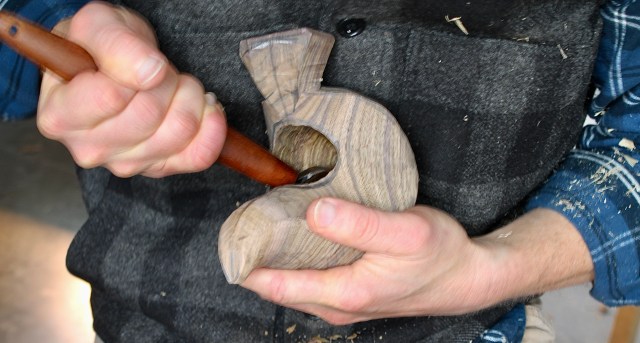
After lots more shaping with knives, chisels, and gouges, I started carving the deeply undercut hollow. Lots more to remove from in there when the photo was taken. When I was finished excavating the hollow, I let it dry for two or three weeks. By that time, it had stopped losing weight and was ready for the final carving stages.

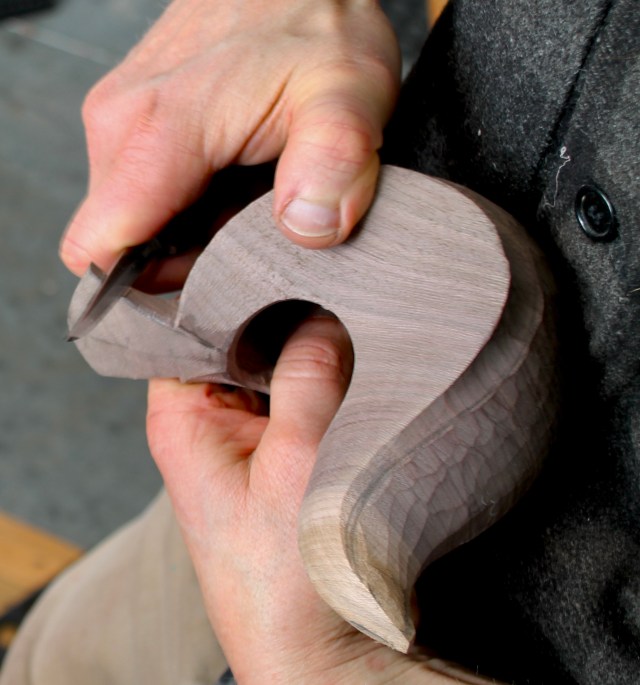
Plenty of knife work. The smooth surfaces of the wings up through the top of the head were achieved through a sequence of carving followed by fairing with a rasp and card scraper, then finishing up with very fine sandpaper. The other surfaces were left straight from knife and gouge.

This vise proved handy as it often does.

From March 16 through May 28, 2025, this bird, along with works from 47 other people from 11 countries (including one of my mentors, ,Jögge Sundqvist), will be on display in St. Paul, Minnesota at The AAW Gallery of Wood Art. Then all 48 pieces (individually) will be auctioned. Bids will be accepted online beginning May 31 and on through the live auction event on June 14 at the AAW Symposium in St. Paul, Minnesota. If you would like to receive an email reminder when online bidding opens, you can sign up at this Jotform link set up by Tib Shaw, AAW (American Association of Woodturners) Curator.

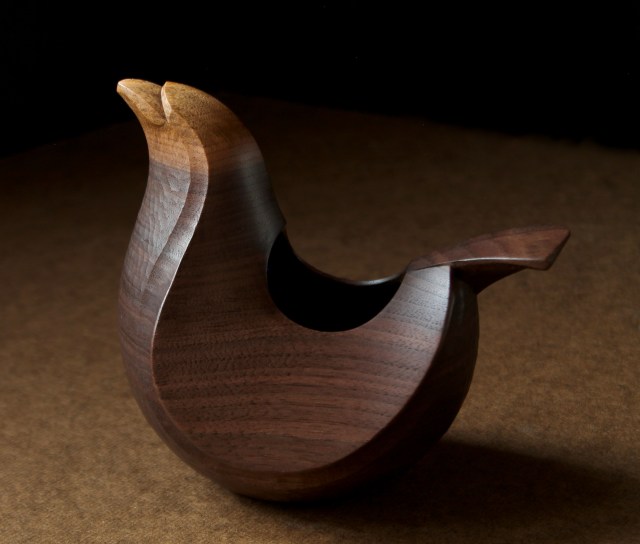
I’ll finish this post with two more photos, below.

Posted in bird bowls, events, holding, Uncategorized | Tagged , | 12 Comments

Adze Geometry Addition

Bowl Adze Bevel Geometry Guide

In my “Bowl Adze Primer” article (Part of the Adze Owner’s Manual materials), I discuss adze bevel geometry. After receiving a good question via email yesterday, I’ve just added this illustration to clarify the geometry that has worked well for me. So, while (as I explain in the article) there may be situations where deviating further from this would be advantageous, this is a good general guideline. I’ve added this illustration to the sharpening slideshow as well, because it fits in with the rest of the material there about how to establish/shape these bevels.

Posted in adze, sketch, tools, Uncategorized | Tagged , , , | 2 Comments

Just Do the Next Thing

Walnut Hen Bowl 2025, detail. 16″ x 8 3/4″ x 6 1/4″

I just finished a hen bowl from black walnut. I’ve made a bunch of these hen/chicken/fowl-inspired bowls over the years. No two of them have been quite the same. Every time I start one I have some uncertainty about how all of the elements are going to come together in the end. Considering all of the details at once can be overwhelming and stop progress.

Here’s that same bowl very early in the process. Roughly a quarter section of the log, but with the wide band of sapwood already split off. At this point, I don’t have to know what the beak is going to be shaped like, or how I’m going to texture the surfaces, or how wide the wings will be. I just put all of that out of my mind for now. I know that I can cross those bridges in time.

Granted, wood carving is a reductive process; once wood has been removed, it’s gone. So I try not to burn too many bridges along the way. There’s a balance and it becomes easier to manage with experience. Even after just going through a process a time or two, the familiarity is reassuring.

Knowing that this bowl will have a “rooftop” orientation, I needed to shave those upper surfaces and the bottom flat. While I’m shaving, the next necessary step is getting done and I can start to think about what overall proportions for layout would work well with this log — the next thing.

With the layout done, I can hollow and hew the piece to rough shape, then pause to think about an appropriate undercut for the wings. And as the bowl sits and dries, I’ll have plenty of time to consider that beak shape.

Keep things in perspective. You don’t have to make the perfect decision for it to be a good decision. There will be other pieces of wood. This is not a matter of whether to snip the red wire or the green wire. And if you’re temporarily stumped on what to do next, sharpen something. That is always a good next thing to do, and it will free up your mind.

Here’s an overall shot of the finished bowl.

Another of the tail section.

And one of the underside, with the egg-shaped foot. I already have a home for this one.

Before my first bird bowl class at Pete Galbert’s in June, I’m going to work on a version of the hen bowl form to bring to the class as a teaching example. Registration opened Monday for the two bird bowl classes this year. The June session is full but there is one opening left for the October session.

Meanwhile, I’m gathering things together to take to my Bowl Exploration class at Pete’s in a couple weeks. I’ve tweaked a few things for the class. In addition to making a long serving/bread/fruit bowl with decorated handles, we’re going to each make a smaller bowl that will introduce other techniques to transfer to all sorts of designs.

I’m calling it an “ice-cream bowl.” It’s just the right size, the wood insulates from the heat of your hand, and it just sounds better than a “broccoli bowl.” We’ve got a great group of people ready to go, but there’s room for one more if you can make it on brief notice. Starts March 10.

Posted in bird bowls, carving, layout, Uncategorized, walnut | Tagged , | 18 Comments

Mallets

Mallets are indispensable, and are made principally from the wood of the apple tree, plum tree, beech, and elm.

Paul N. Hasluck, Manual of Traditional Woodcarving (1911)

If you’re going to carve, you should have a mullet mallet. Sometimes they’re needed because you want to remove bigger chunks of wood much more quickly than you could with hand pressure. But, just as often, it will be appreciated for the additional control that mallet taps provide, such as when you’re negotiating a tight curve or you want to make sure you don’t push the cutting edge too far. A mallet delivers momentum in prescribed packages.

I reach for mine often. As I did so a couple days ago, it hit me (not the mallet) that I had never dedicated a blog post to these important carving tools. So I lined up my mallets and snapped a few photos. There they are again, above, labeled A-H. I’ve been using some of these for thirty years. I’ll mention a few things about each below:

  • A: Froe club or beetle. Hewn and shaved from green apple wood. 48oz. (1360g) Froe clubs usually last me a few years. Eventually all of that striking on the back of the fro blade wears ’em out. It’s easy and fun to make another.
  • B: Mallet with a sugar maple handle and an apple head. 40oz. (1134g) I don’t use this for general carving. But it comes in handy at those times when there’s a little more wood to remove or the cutting edge is extra wide. Not nearly as comfortable and to use as a round mallet.
  • C: Sugar Maple. 20oz. (567g) I think this was my first carving mallet, and the one that has seen the most use over the years. Thirty years ago, I turned it on my brother-in-law’s basement on his Shopsmith Mark 5 set up for lathe work. I made the blank by face-gluing two pieces of a thick maple plank. I was surprised just now to discover that Shop Smith is still making machines — now the Mark 7. Anyway, this is evidence that you don’t have to be a skilled turner to make a good mallet.
  • D: Apple. 17oz. (482g) I turned this from a piece I split from an apple log. Note, none of these round mallets have the pith (center of the tree) in them.
  • E. Maple (I think). 11 oz. (312g) Bought it at a yard sale. I think it might have been made to be a potato masher or something. Works well as a light mallet.
  • Wood is Good Mallet. Maple and Urethane. Labeled as 20oz., but mine weighs 23oz. (652g) . I got this several years ago. It has a solid maple core/handle wrapped with a thick shell of urethane. With apologies to my beloved first mallet (B), this is the one I reach for the most. It is just about perfect. Well-balanced, just the right amount of heft for most carving, easy on my joints, ears, and tool handles. The other mallets get less use now, but I still love them.
  • Wood is Good Mallet. Maple and Urethane. Labeled as 12oz., but mine weighs 14 oz. (397g) Doesn’t get used anywhere near as much as it’s bigger brother, but it’s nice when I’m doing something very delicate.
  • Trow and Holden “round hand hammer” (traditionally called a dummy). Ash and annealed steel. 24oz. (680g) I use this on those rare occasions when I do some letter carving in stone. It could also be used for wood carving though.

    Above and below are different shots of the mallets in the same order.

    So, use a mallet or push with your hands, but do not use your hand as a mallet (not often at least). Paul Hasluck warned about this back in 1911:

    It is a general practice of wood carvers to use the half-closed palm of the hand as a sort of mallet…. most experienced wood carvers have a large hoof in the middle of the palm as a result thereof, and, unfortunately, cannot open their right hands quite straight. In course of time the habit causes the fingers to become rigidly bent inwards, although the flexor tendons and joints are unaffected. Subcutaneous division of the contracted bands sets the fingers free, but a relapse is nearly sure to occur. An eminent surgeon states that there are quite half-a-dozen different operations for this deformity, but he does not know one that is really successful — that is to say, which results in a permanent cure.

    Photo by Lewis Hine, c. 1920s, Minneapolis Institute of Art

    The photo above was taken in the decade after Hasluck’s book was published. Nice Mallet.

    Historical note: the photograph was taken by Lewis Hine, especially known for his series of photographs of young factory workers (unlike this carver). His photographs raised consciousness and were influential in bringing about child labor laws in the United States.

    Posted in photography, quotes and excerpts, tools, Uncategorized | Tagged , , , , | 29 Comments

    Bird Brain Offers New Class

    I’ve got birds on my brain. They’ve been fluttering about in the cold bare branches just outside my shop window while I carve bowls inspired by them, inside. I’ve carved a lot of bird bowls over the years. Rather than go for photo-realism, I try to represent the bird through the flow of the lines and have some fun, whether it’s a hen, a wren, a goose, or whatever. There are some examples on my bowl gallery page, and I have a “bird bowl” category in the drop-down menu on the right side of the blog page.
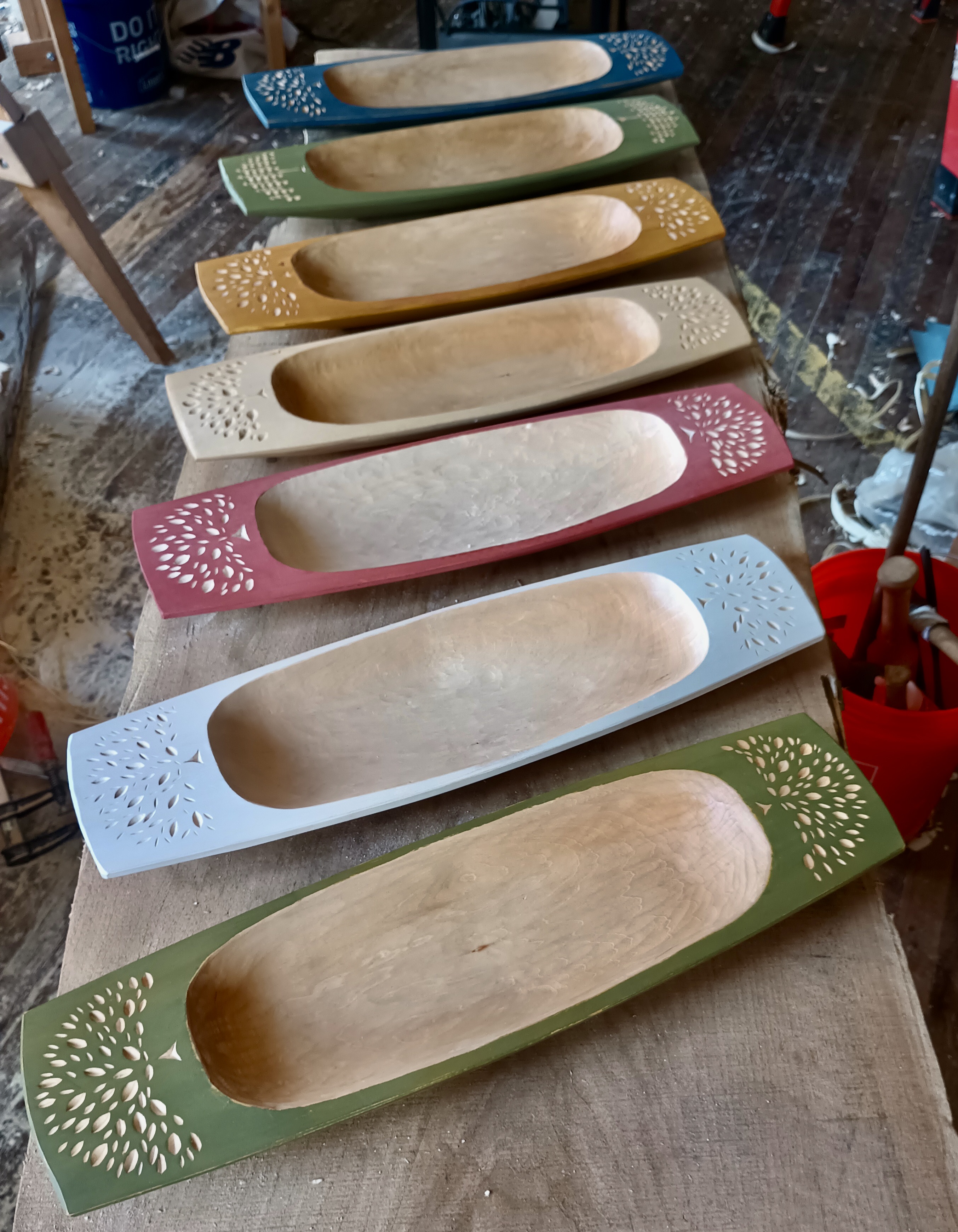
    I’ve been sketching and working on some new bird bowl designs, like this painted goose-inspired bowl, because I’m going to offer a new class at Pete Galbert’s School this year: Bird Bowls. Twice, once in June and again in October (those were links to the respective class sessions). Registration for both classes opens on Monday, February 17 at 8:00 am EST.

    This goose-inspired bowl will be flying to Pete’s. I carved it from a 3″ x 6″ x 18″ chunk of dry basswood (a.k.a. lime or linden). Basswood is commonly available is sizes like this, and even thicker, at hardwood lumber dealers and many feature online delivery. The same designs can be carved starting from a green log as well. Before June, I’m going to continue to experiment with other bird-inspired designs that will make their way to Pete’s new barn, and we may even work in a little bird time in my Bowl Exploration class next month.

    The general procedure and approach we’ll use to carve our bowls in class is the same as that I use to carve all of my bird bowls, so it will be adaptable to whatever forms students want to explore back at home with whatever wood they wish to use. Students will make their own decisions along the way, so each bowl will be as unique as they wish. While they’ll be going home with a couple bowls, it’s the knowledge and skills they’ll be taking with them that will mean the most: interpreting, visualizing, layout, understanding grain direction, decorative carving, creating texture, sharpening, painting and color possibilities…. lot’s of good stuff!

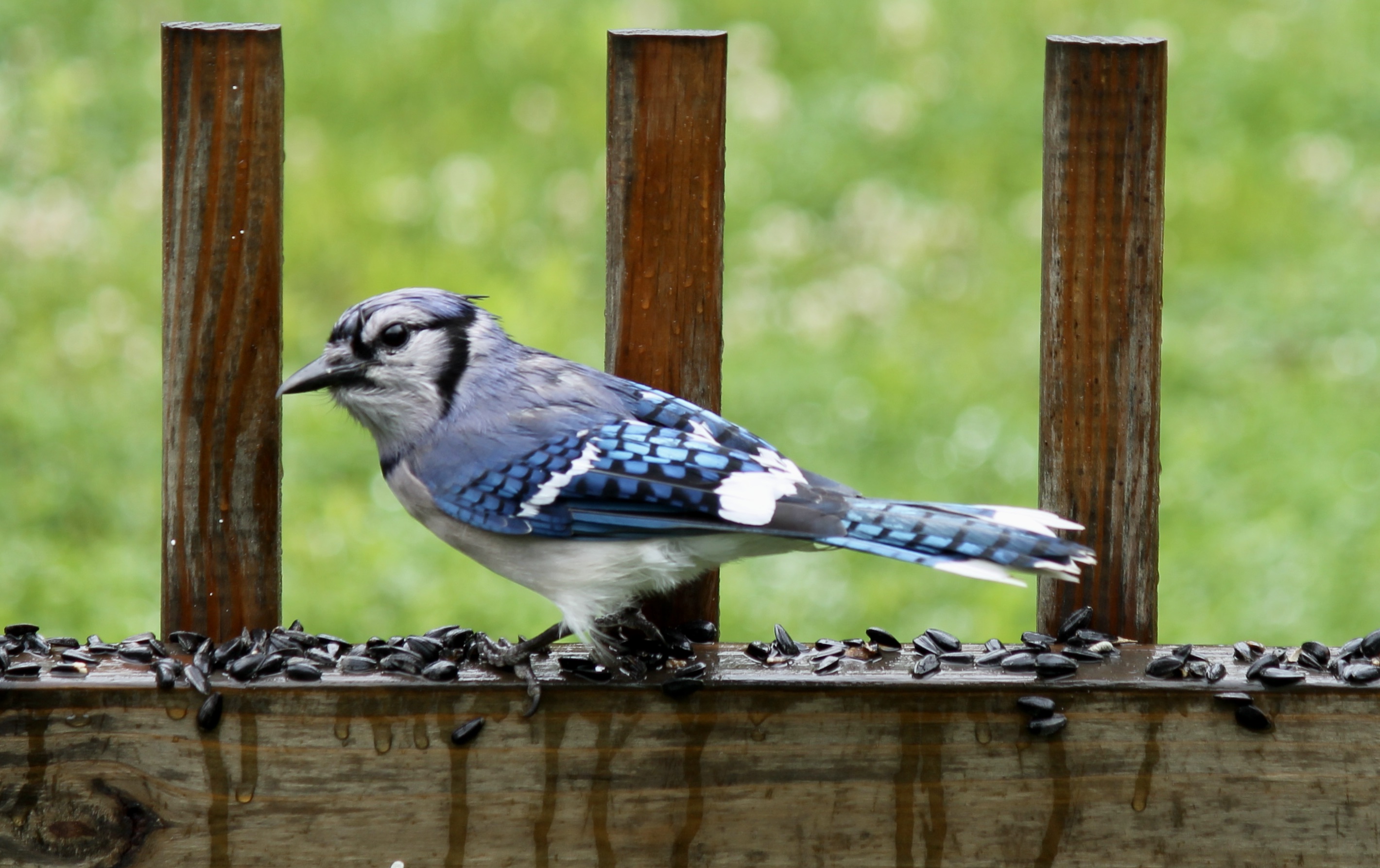
    Now, back to the real birds outside my shop window; a most pleasant distraction. This week, I set up the camera in the window and snapped a few photos. I’ll share this series of four photos featuring a pair of cardinals. Of course, the bright red males are well known for their striking color, but I especially appreciate the females with their subtle touches of red among the buff, yellows, and muted grays.

    That’s a female in the upper left of the photo below, minding her own business and enjoying her spot on a quaking aspen branch. The male is in the background with that bright red crest ready to impress. I’ll let the photos tell the story, a straightforward age-old tale.

    Happy Valentine’s Day.

    Posted in bird bowls, classes, Uncategorized | Tagged | 8 Comments

    A New Tree Design

    New tree pattern for the Bowl-from-a-Plank, freshly carved.

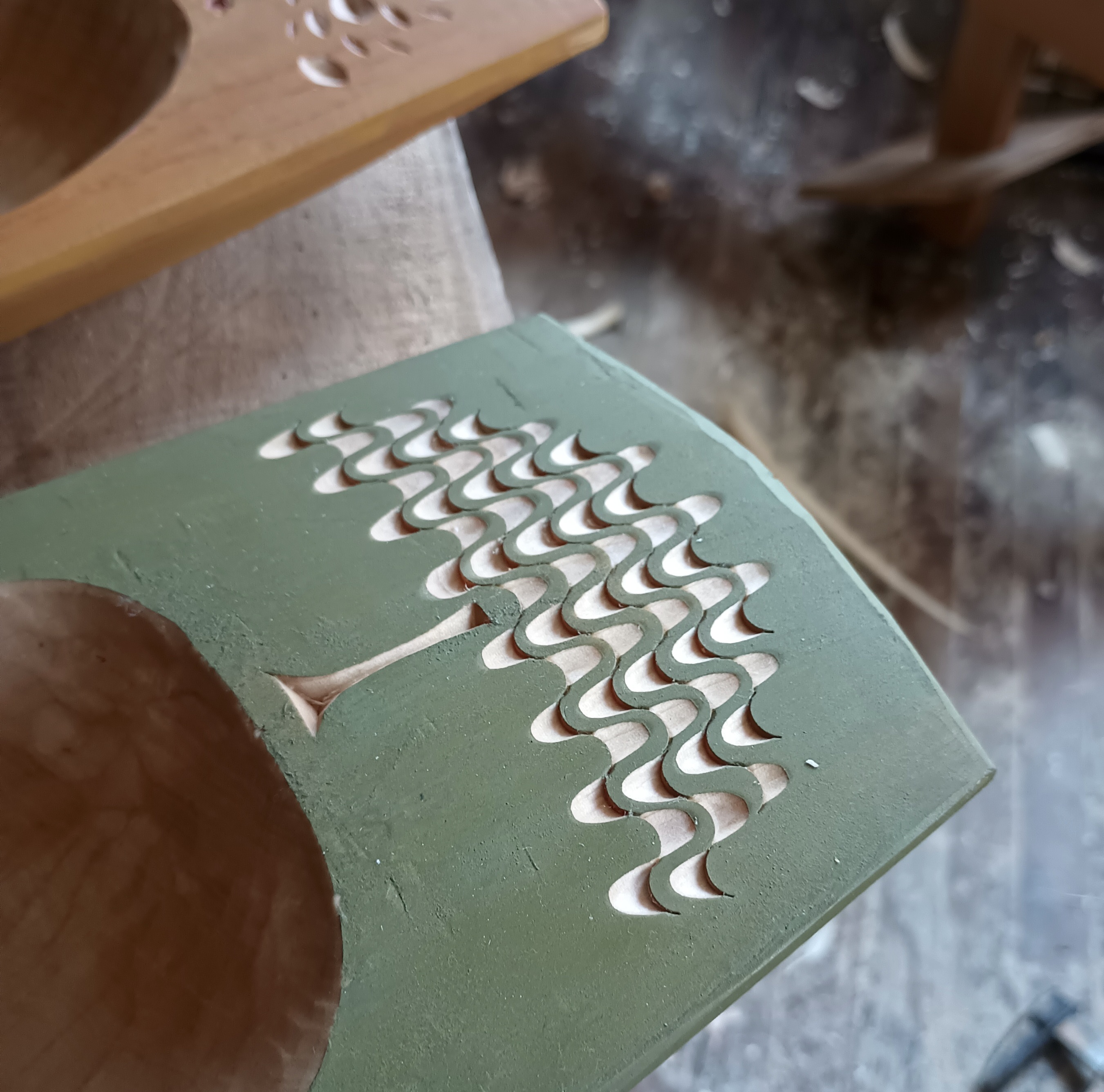
    With about six more weeks until my March class at Peter Galbert Workshops, I’ve designed an alternate pattern for the handles of the bowls we’ll be carving. We’ll practice the methods for both designs, and students will have the option of which one to carve on their bowl. The new tree motif is actually a bit easier to execute well, with a foolproof procedure that we’ll go through in class, and I like it at least as much as the old one.

    The six-day format of my class at Pete’s allows us to dive into and practice an assortment of decorative carving techniques, and one of the most thrilling moments is seeing students have such quick success with gouge “thumbnail” chip cuts and discovering the creative ways they can be used. Thus, I wanted to feature them in this new design.

    The bowl with milk paint and oiled.

    Regardless of which design they choose, students will also have the option of painting their bowls. One of the things I’m adding to this class session is a discussion and demonstration of various painting options for bowls.

    I’m excited to be working in Pete’s new facility. Pete and his crew have been working on the barn renovation for months now, and I know it is going to be top notch, like everything Pete does. The class is March 10-15 and no experience is necessary. There’s one opening.

    I’m also finalizing some plans to offer a class at Pete’s in the summer and in the fall. Something a bit different, I think. More on that soon.

    Posted in classes, paint, patterns, Uncategorized | 7 Comments

    Adze Owner’s Manual

    This idea was sparked a few months ago when I restored an adze. The owner wanted a new handle and some edge reshaping. The head was made by Hans Karlsson. The owner purchased it a couple decades ago from Country Workshops, back when you called or visited Drew Langsner if you wanted a good adze.

    As I made and fitted the handle, I took photos of the process.

    I took more photos as I straightened the edge, reshaped the bevels, honed, and stropped.

    Prints of my adze illustrations

    I started to think of other adze-related things that could be included and I decided to put together a bunch of adze-related resources in one place, including scans of illustrations that can be printed at full size. I also organized some links to blog posts and video demonstrations to create a package of stuff to help select, use, and maintain a hollowing adze. There’s a fee to access it, and you can see what all is there at this page. For lack of a better idea, I called it “Adze Owner’s Manual.”

    Let me know if you have any questions or problems. I’d be amazed if I didn’t screw up the the technological side of things somehow!

    Posted in adze, classes, publications, sketch, tools, Uncategorized, writing | Tagged , , , , , | 32 Comments