Being at Ease

IMG_2685

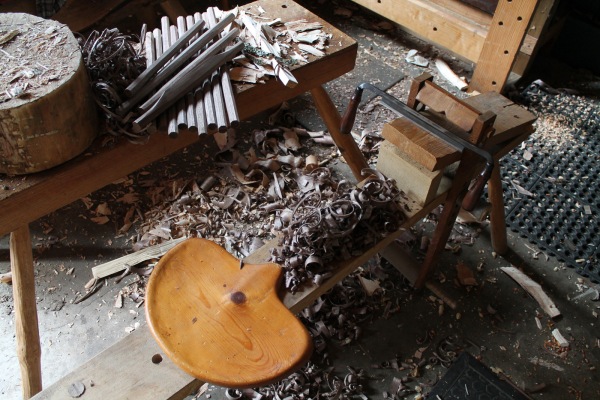
Every once-in-a-while, I get an itch to make another post-and-rung chair.  I really haven’t made too many, but I love the processes:  riving the parts, shaving at the horse, weaving the seat.  My first was fifteen years ago, following my discovery of the encouragement given to so many by Jennie Alexander through the book and video Make a Chair From a Tree.
IMG_1772

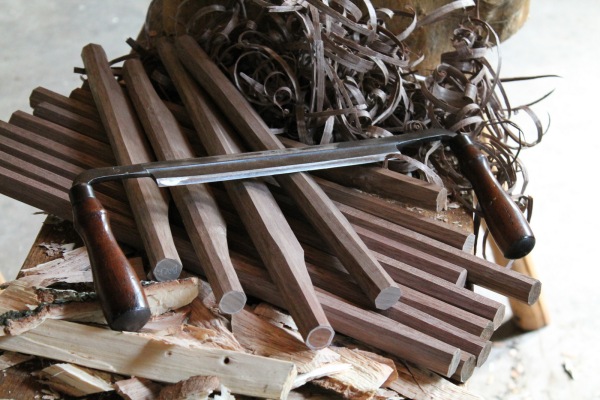
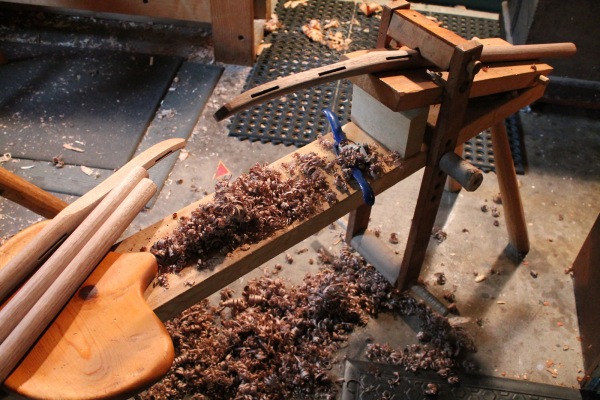
I started this one, a rocking chair, several months back with part of a straight-grained walnut log that also had a section with a natural bend just right for the back posts of a chair.  After the parts were riven, I began refining them at the shaving horse, beginning with the rungs so that they could begin drying.
IMG_1764

After the back posts had been shaved, mortised, and dried a bit, I had one more thing in mind for them prior to assembly.  I was making this chair for a friend who loves to pick a guitar and play a fiddle.  I wanted to personalize the chair with some carved lettering, and I had been thinking.
IMG_2675

My friend is a big John Steinbeck fan and has a signed copy of Cannery Row.  I hadn’t read that one, so I listened to the audio book while carving.  I loved it, and I felt like I knew the complex characters, including, of course, Doc.  Doc is the most respected figure on Cannery Row, admired by everyone including the otherwise self-serving Mack and the boys.

“Doc would listen to any kind of nonsense and turn it into wisdom. His mind had no horizon – and his sympathy had no warp. He could talk to children, telling them very profound things so that they understood. He lived in a world of wonders, of excitement. He was concupiscent as a rabbit and gentle as hell. Everyone who knew him was indebted to him. And everyone who thought of him thought next, ‘I really must do something nice for Doc.”

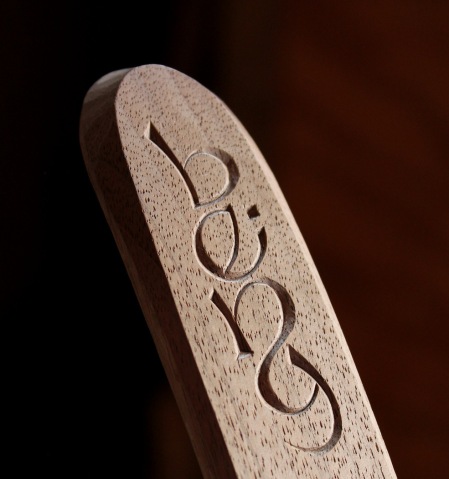
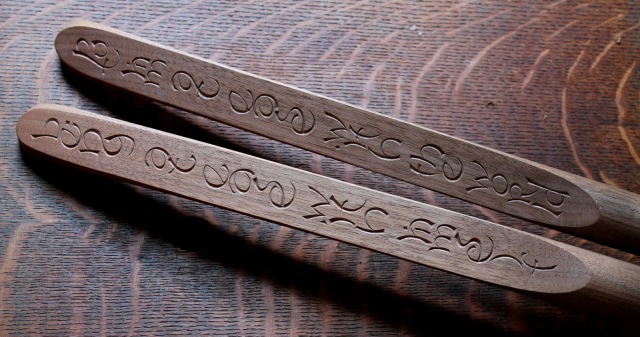
But it wasn’t until I followed up by listening to the sequel to Cannery Row, Sweet Thursday that “the line” jumped out at me.  It was in another description of Doc.  Steinbeck writes, “Being at ease with himself put him at ease with the world.”  I started sketching letters.
IMG_2696

I decided on curving forms that would read as a general pattern from a distance, but reveal itself as an inscription upon closer inspection.  I drew them on with pencil, then got to work with my knife.

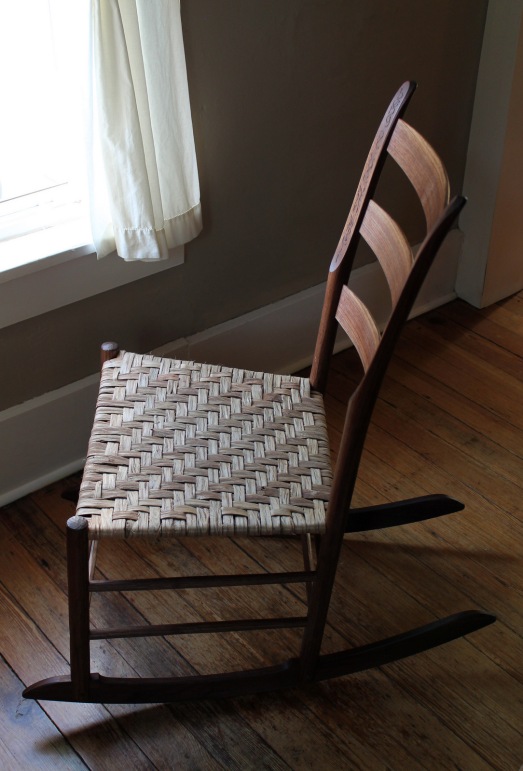
Overall, the work on the chair was very intermittent.  I finally got around to the bottoming a few days ago, when Kristin and I wove the hickory bark seat.
IMG_3506

I’m not going to get into the business of making chairs, and this one has it’s share of “character,” but I do like how it feels.  With fiddling and guitar playing in mind, I gave it a relatively low seat, no arms, and a supportive back that’s not too wide.  The fact that it’s a rocker gives it some versatility in positioning one’s body, as the seat angle changes when sitting forward to play a guitar, for example. Well, that’s my thinking anyway.

If you’d like to make a chair from a tree, grab your axe.  Here’s a short list of books to get you started:

The Chairmaker’s Workshop by Drew Langsner

Make a Chair from a Tree by John Alexander

Green Woodwork by Mike Abbott

Chairmaker’s Notebook by Peter Galbert

The Woodwright’s Workbook by Roy Underhill

Make a Joint Stool from a Tree by Jennie Alexander and Peter Follansbee
Posted in books, green woodworking, Lettering, quotes and excerpts, Uncategorized, walnut | Tagged , , , , , , | 17 Comments

Fine Woodworking

IMG_3425Like a lot of people, I have stacks of old Fine Woodworking Magazines in my house, and I owe a good deal of my woodworking education to them.  My copies, going back to the 90s, bring back a lot of memories for me.  When a new issue would land in the mailbox, everything slowed down a bit.
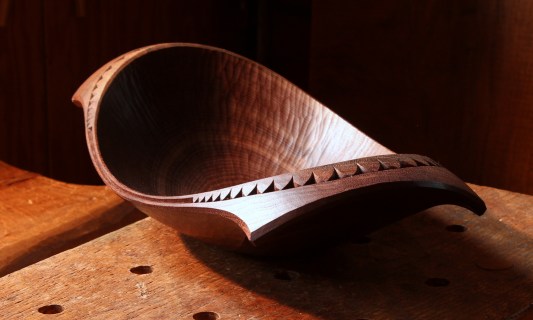
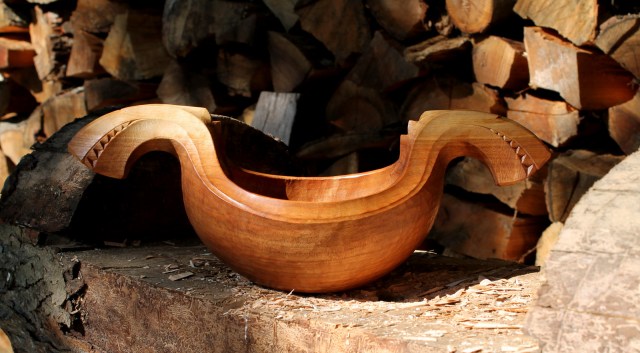
Now, about twenty years later, a couple articles I’ve written will appear in Issue #263, due out later this week.  One guides the reader along a carving journey from a log to a bowl like the one below,  illustrated with masterful photos and drawings by Jon Binzen and John Tetreault, respectively.

IMG_1626-001

The other teaches the layout and carving of the necklace around the rim.

IMG_1557-001

Of course, I’m amazed and thrilled.  It’s been an absolute pleasure to work with the folks from Fine Woodworking , and I’ll have more to mention later.  You’ll be able to read the new issue soon, either on your screen or in print.  I’m not here to tell you which option is better, but it’s print of course.


Posted in bowls, carving, patterns, teaching, Uncategorized, writing | Tagged , | 23 Comments

The Return of the Swallows

IMG_3384

This little guy was in the pear tree yesterday morning.  I hadn’t made any in awhile, which is a shame because they are a lot of fun to make.  I based the design on the swallow and their graceful curves in body and in flight.  I sometimes lay in the yard in the evening and watch the show above as they loop and dive for supper.  The neighbors don’t call 911… anymore.

IMG_3241As I was carving this one, I was thinking about how similar it is to spoon carving.  For those who have done some spoon carving, it will be a natural transition to carve little sculptural bowls like these — sort of a gateway drug.  Just think of the tail as the spoon handle and stick a bird head in the front.  Unlike a typical spoon bowl, the hollow is deepest in the front, even a bit undercut.
I prefer to carve these from branch crooks.  This one is from a cherry crook, and the grain goes straight along the thin tail, down through the body, then rises up toward the beak.  It’s an engaging challenge for working with contour, line, and grain direction.

IMG_3246

At the end of the green-stage of carving.

Size can vary greatly depending on the branch, but little one’s like these (8 1/2″ x 2 1/2″) don’t require any tools beyond a spoon carving kit of axe, knife, and hook knife.

This one has flown away, but others are sure to show up.


Posted in bird bowls, bowls, carving, cherry, patterns, spoons, tools, Uncategorized | Tagged , , | 11 Comments

Carving like Caron

IMG_3222

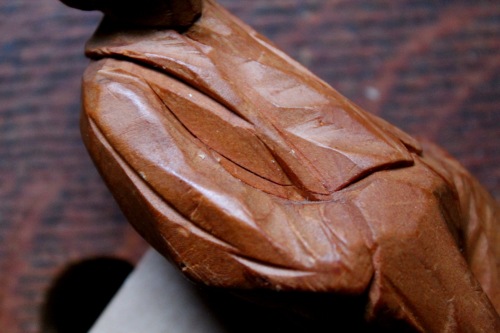
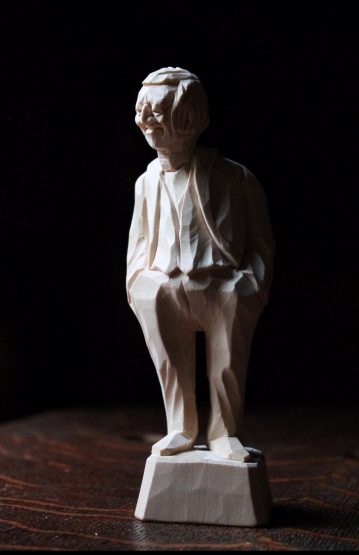
My version/copy, in basswood, of a carved figure by Paul Emile Caron

I often listen to audio books while carving in the shop, and I recently finished Irving Stone’s 1934 book Lust for Life, a biographical novel about the life and work of Vincent van Gogh.  Early on, as learning exercises, Vincent copied works that he admired and, as Stone writes, “Vincent learned that it is always the simplest piece of art which has practiced the most rigid elimination, and is therefore the most difficult to duplicate.”

I tried something similar a couple weeks ago when I carved the little (5 1/2 inches tall) figure to the left, my copy of a piece that I picked up several years ago by, I believe, Paul-Emile Caron (1915-1987).  He lived and worked in St.-Jean-Port-Joli, Quebec and most of his carvings were done in the 1950s and 60s.  I admire his figures and am fascinated by how much can be expressed with the cuts of the knife, a long tradition that can be seen in the work of famous Swedish carver Axel Petersson Döderhultarn and modern master Harley Refsal, among many others.

IMG_3209

Original carving by Paul-Emile Caron in pine

I’ve seen many of Caron’s pieces through photographs, and, as would be expected, he hit the sweet spot on some more than others.  I’ve been captivated by this one.  In fact, I made a sketch of it which I used in a post a couple years ago.

I had no desire for a duplicate, but I did want to learn from Caron by careful study and observation of this piece.  Making a copy forced me to look and consider much more deeply than I had in terms of both design and technique.    For every minute of cutting I, necessarily, spent at least three minutes studying the original.  In making it, I learned and developed a deeper appreciation.  As a bonus, I’ll have a reminder of the exercise in my shop, a sort of twin brother to the original, but with a somewhat different expression.  I documented on the bottom that it was a copied version of Caron’s design.

Here are just a couple detailed examples of things observed on Caron’s carving:

IMG_3228

The sweeping knife overcut indicates Caron’s method for removing the wedge of wood between the arm and body.

IMG_3230

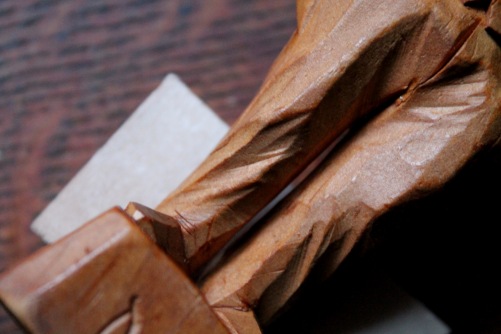
The chatter marks resulting from the knife blade twisting through the tight cut are left strategically and purposely to enhance the shadows of the folds in the cloth.

IMG_3229

The top of the shoe (end grain) was reduced through a series of thin cuts, as indicated by the knife marks on the bottom of the pant leg.

I found that the blades on this pocket knife served well to make all of the cuts other than a couple gouge cuts on the back that Caron used to indicate folds in the jacket.  Pleasant work while sitting outside.

IMG_3316

IMG_3218-002

I’ll never carve this particular piece again, but the realizations and lessons will last and be applied in who-knows-what ways.  And since this little guy, it’s been back to the adze for me; I have several bowls underway in various stages.  More on those later…


Posted in carving, figure, historical reference, tools, Uncategorized | Tagged , , , , , , | 10 Comments

Barn’s Spōn

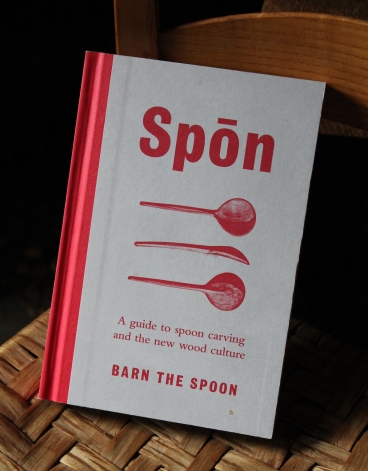
IMG_3166“In carving fresh, green wood for spoons I hope that the reader will discover trees; I hope they will discover that carving with basic edge tools, the knife and the axe, is a beautiful thing.  This book will suggest that spoons are really sculptural forms, with complex angles and facets requiring both measured and instinctive cuts — and often illusions of perspective — and that spoons are as subtle, varied and valid as any other type of sculpture.”
— Barn the Spoon, Spōn: A Guide to Spoon Carving and the New Wood Culture

One of the joys of Greenwood Fest was meeting Barn the Spoon. You’ll never meet a more authentic guy.  Barn has lived a fascinating life and approaches spoon carving with a great deal of thought and sensitivity.  Barn’s story, philosophy, and practical tutelage can all be found in his book, Spōn.  Spōn is the ancient Anglo-Saxon word for a chip of wood.

The book takes the reader through the philosophical side of working from nature, through the tools, grasps, and procedures of making a spoon, and on through sixteen designs of spoons to carve.  It will help anyone, carver or not, to develop an appreciation for the subtle beauty of these little utilitarian sculptures.

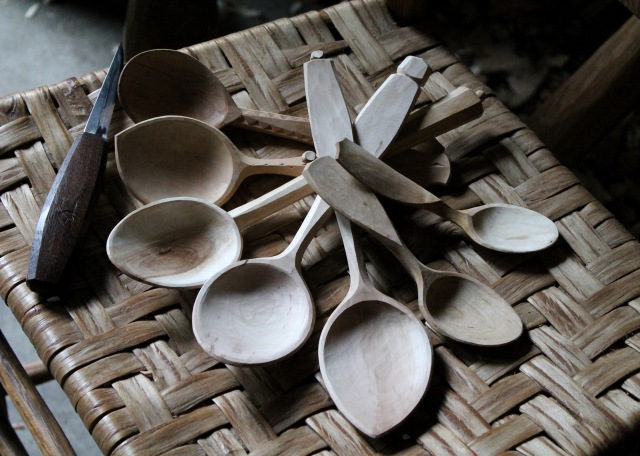
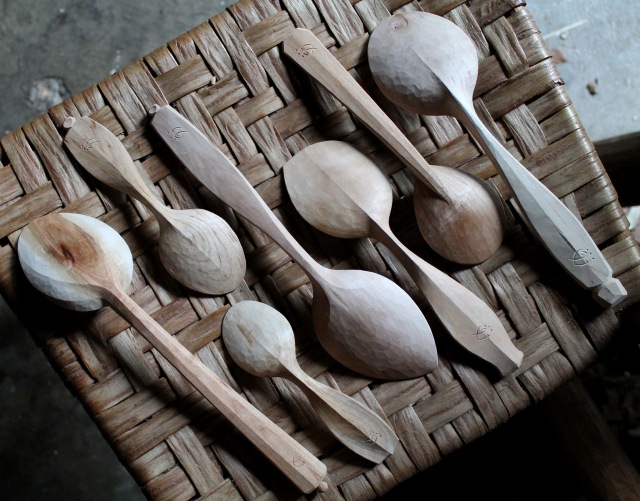
While on a trip with my family last week, I took some time away from bowls, but was still able to take a couple knives and some roughed-out blanks and get in some spoon carving.

IMG_3153

No workbench or heavy tools required — very peaceful, calming work.  At a relatively small scale, it is fun to play around with designs and subtle differences in form.

IMG_3164

After a few more touches here and there, these will be ready to take a swim in some flax-seed oil.

IMG_3158

Then the real journey begins.  As Barn writes, “This deep sense you get is almost analogous to listening to a song, where the effect may not be that obvious to begin with but, when meeting it every day, a feeling builds up over time.”

Posted in books, green woodworking, spoons, Uncategorized | Tagged , , | 11 Comments

Learning from Fred Astaire

IMG_2753

Seeing this ale bowl basking in the sun, my wife asked my daughter what she thought of the new dragon bowl.  Emma replied, “What dragon bowl?”  Wonderful.

IMG_2797

What Emma noticed were the flowing lines and the form, and only after looking more closely did she discover the dragons in their midst.  I like that.  Details and dragons are secondary.  I find the same can be true with calligraphy; regardless of the meaning, or if we even know the language, we appreciate the beauty of the form, the sweep of the line.

https://s-media-cache-ak0.pinimg.com/originals/1d/f8/33/1df8337fe1bbb571b9e98860dfeb4166.jpg

Japanese calligraphy “Love”.  I’m still trying to find the name of the calligrapher.

The overall question of what we find beautiful is full of fascination and mystery, and my wonder surrounding it grows all the time.  But we’ll leave that larger question for another time.  One thing that seems clear is that our eyes are drawn to beautiful lines and contours.  We appreciate the graceful lines of everything from cars to dancers.  Fred and Ginger certainly understood that idea.

Ginger-Rogers-and-Fred-Astaire

Now I’m entering dangerous territory.  Me writing about dancing is akin to a cat writing about canoeing.  Yet, I can still intuitively be awestruck by the beauty and flow of the lines, even if I can’t strike the pose.

Beatrix Stix-Brunell of The Royal Ballet Photo by Nathan Sayers ballet dance

Al Hirschfeld was known for dancing his pen across paper, speaking volumes and expressing beauty with the flow of line and subtle variations in its width.  Brilliant:

Image result for fred astaire lines dancing

Another Hirschfeld, just for Follansbee:

Related image

So I strive for the beauty of the line, the flow of the form.  Touch reveals flow and form as well.  Our fingertips can tell us as much as our eyes.  Although I sometimes understand the necessity, a “DO NOT TOUCH” sign is often a heavy blow.

IMG_2776

You can not only touch this bowl, you can drink from it.  This is my second exploration of this design, again in black cherry, with a bit of the lighter sapwood running through the heads.  This design is challenging; maintaining the flow of the flutes through the grain along the heads is just one example.  Below is a slideshow with a few additional photos.

This slideshow requires JavaScript.

13 1/4″ long, 6 1/4″ wide and 5″ high, and would hold 20 ounces.

Posted in ale bowls, bowls, cherry, patterns, proportions, Uncategorized | Tagged , , | 14 Comments

Tree Branch Holdfasts

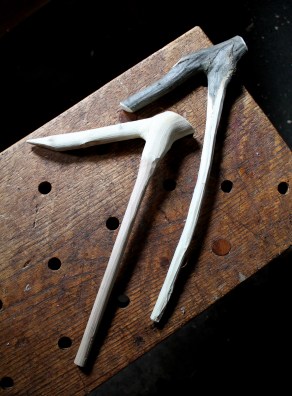
IMG_2707As I’ve mentioned  before, I use holdfasts a lot.  A few weeks ago, I started wondering about the possibility of wooden holdfasts, and I think I will experiment more with making some from two pieces of wood joined with a round mortise and tenon, as in chairs.  Hickory or ash should work very well.  Much lighter weight than steel, and maybe less holding power.  But maybe plenty strong enough.
I started with a quick experiment using branch junctions, utilizing their natural strength and flexibility.  As can be seen in the photo, very little work was done on them — just a bit of rough shaving to bring the shank down to something a bit under 3/4″.

They’ve dried for a couple weeks, and they work!  I’d like to make some more, a bit more carefully and with more consideration for the branch angles and so on.  It’s a fun and useful green woodworking project.  They’d also be ideal for some carved decoration; I can’t help picturing a bird with a long beak, like a heron.

I shot a quick bit of video showing them in action:

As I was patting myself on the back for my inventiveness, I thought I’d do a net search to see if I could find any references to wooden holdfasts.  Sure enough, somebody wrote about the idea in Popular Mechanics Magazine back in 1930.  Check it out here.  Note that S.E. MacNair suggests using a much larger diameter branch and hole (1 1/2″).  They work in the 3/4″ holes of my bench as well.

Posted in green woodworking, holding, tools, Uncategorized, video | Tagged | 16 Comments

It’s the People

SAM_3543

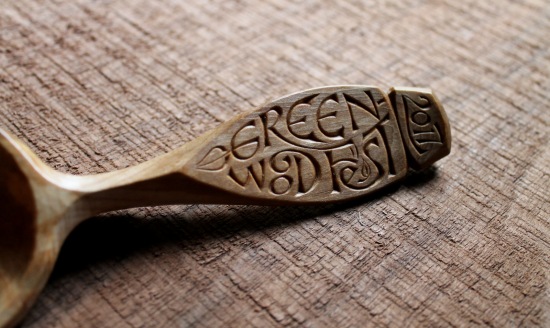
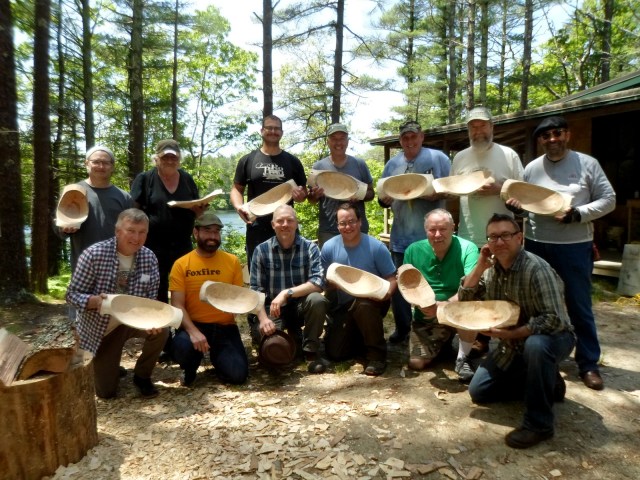
Pre-Fest Bowl Carving Class 2017. Bottom l-r: Tom, Joe, Yours Truly, Andrew, Bob, and Riley. Top l-r: Stoyan, Mike, Travis, Gene, Bill, Andy, and Henry.

Those three words are still resonating in my mind as I settle back into my workshop after returning from Greenwood Fest 2017.  During one of his addresses to the crowd, Peter Follansbee used those words to describe what he values most when reflecting on his years in woodworking.  It’s the people.  Words of wisdom.

The highlight among the pines and wood chips of the Fest is meeting and reconnecting with so many interesting and wonderful people.  The atmosphere of friendliness and comradery is like a tonic, soothing and warming.

I didn’t take many photos during the Fest itself, but there are many special moments locked in my memory, as clear and joyful as Barn’s laugh.

I was able to snap a few photos during the Pre-Fest bowl carving class, during which twelve great guys carved birch logs into bowls.  We celebrated on the final day by sharing Turkish Delight brought by class participant Henry from his home in Istanbul!

This slideshow requires JavaScript.

As you might be able to tell in the slideshow above, every bowl was based on the same general design, yet each was also unique.  The individuality of the logs, carvers, design decisions, and tools resulted in twelve special bowls ready for drying and further refinements.  As a perfect example of unique tools, notice the photo of Stoyan’s adze, made from a broken gouge and a yew branch.  It was an inspiring example of resourcefulness — and it was sharp!

At the Fest and beyond, making wood chips has connected me with many wonderful people, and I’m grateful.


Posted in classes, events, teaching, Uncategorized | Tagged , | 6 Comments

Woodblock Prints

IMG_2605-001

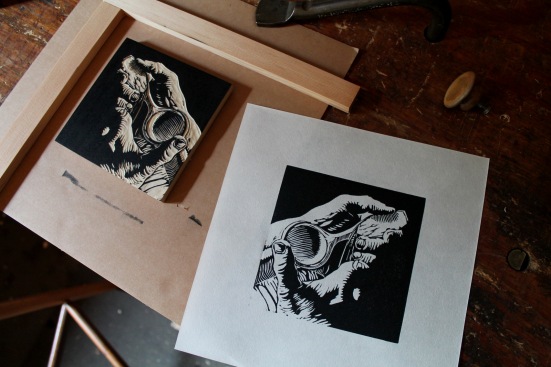
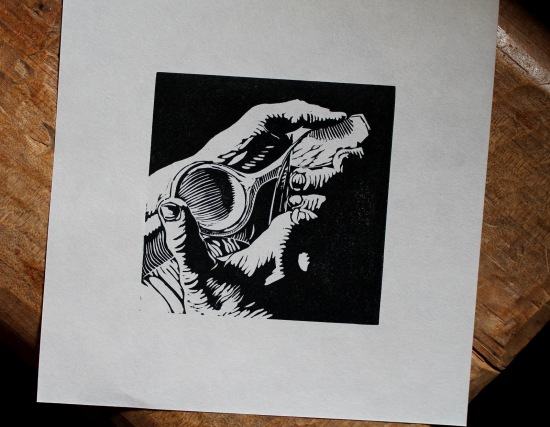
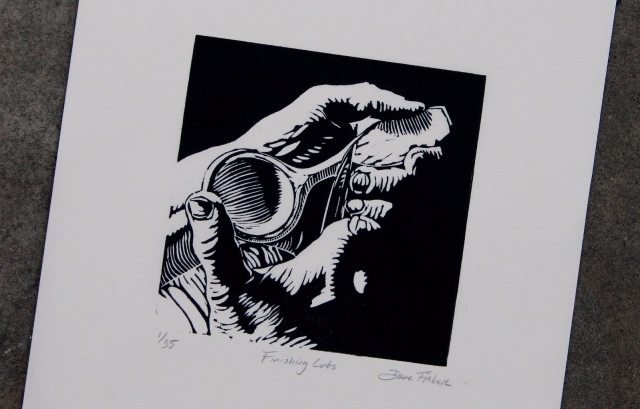
There’s a lot to like about woodblock prints; the centuries-old tradition, the direct nature of the process, the simplicity of the equipment, and the magic of pulling the print from the block.  I decided to give it a try a couple years ago,  I already had boards and carving tools after all.  Still, I’ve only made a few since then, but the upcoming Greenwood Fest inspired me to make this print that is hot off the block.

There are lots of technique and equipment options for making relief prints, and my explorations are very limited.  But the basic process is straightforward.  Here’s how I went about it.

IMG_2358

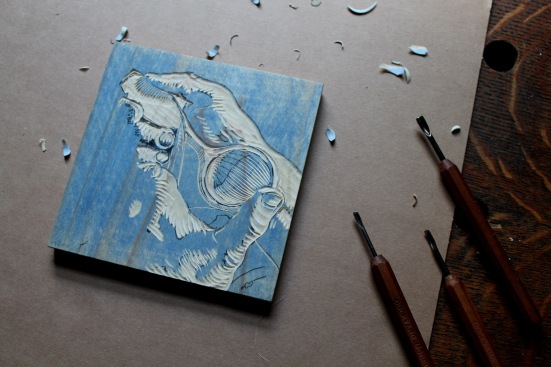
I started by flattening a 5″ x 5″ piece of wood (tulip poplar in this case) with a hand plane, then sanding that surface just with some very fine sandpaper and a block.  I painted on a light blue washcoat of artist oils that still allowed the drawing lines to show over it, but also provided some contrast once the cutting begins.

IMG_2360

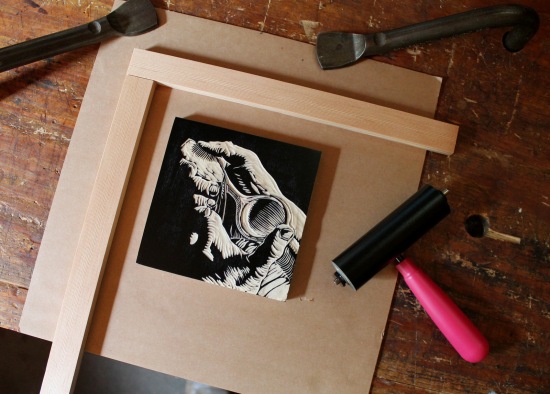
After lots of carving, oil-based printing ink is rolled onto a brayer (rubber roller) then over the block.  This applies ink only to the uncarved portions on the surface.  With a couple dabs of glue, I’ve attached the block to a piece of cardboard along with two registration sticks.

IMG_2363

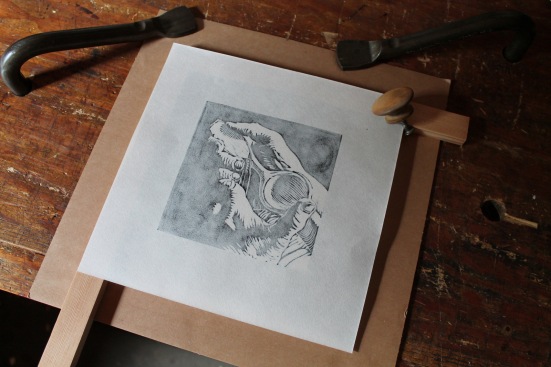
The paper is laid onto the inked block.  For this print, I used acid-free unbleached mulberry (kozo) and bamboo fiber paper.  The paper is lightly textured and strong, but thin.  As I burnish the back side of the paper with my baren, an old wooden knob, the impression is visible through the paper.

IMG_2366

Steadily pull the paper from the block, and, if all went well, a finished print is revealed.

IMG_2599

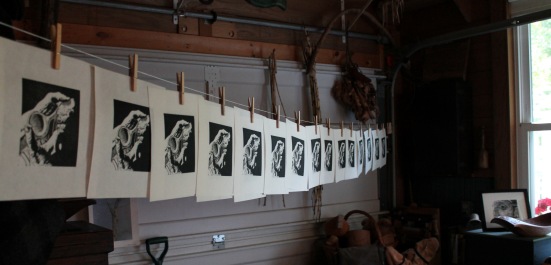
The oil-based ink can take a couple days to dry.  Due to the hand process there are often very subtle differences between the prints.

IMG_2369

I and the prints are just about ready to head to the Fest.

IMG_2273


Posted in events, sketch, spoons, tools, Uncategorized, woodblock prints | Tagged | 17 Comments

Your Daily Bowl

IMG_1898

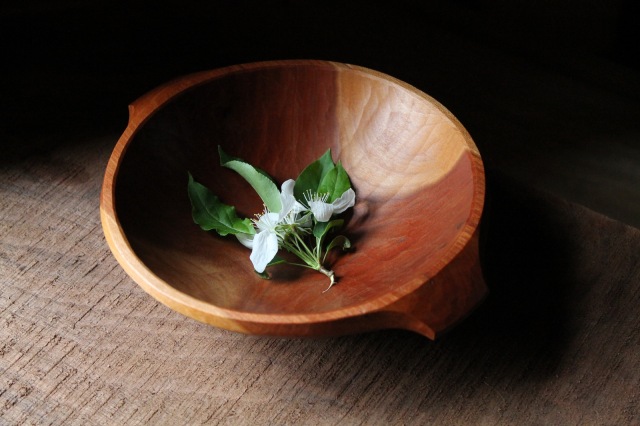
I’m a cereal lover and, although I’ve had to switch from Boo-Berry to Shredded Wheat over the years, I still eat cereal every day — from a wooden bowl.  Cereal or not, it makes for quiet eating, and the wood is insulating so your ice cream won’t melt as fast.  There’s something about the ritual of using the same bowl, then washing it, and putting it back in its place that I like.  The one in the photo above has been washed hundreds of times without being freshened up, but it could use a little oil now I guess.

It’s a pretty straightforward project to make an eating bowl.  For cereal, I like to cradle the bowl in one hand, and I find that a diameter of six or seven inches is ideal, with a height of two inches or so.  So all you need is a seven inch log.  Strike a circle on the upper side of the blank and a smaller one on the bottom (concentric to the one on top), hollow the inside, then hew the outside.  I wrote in more detail about that in this post.

IMG_2374

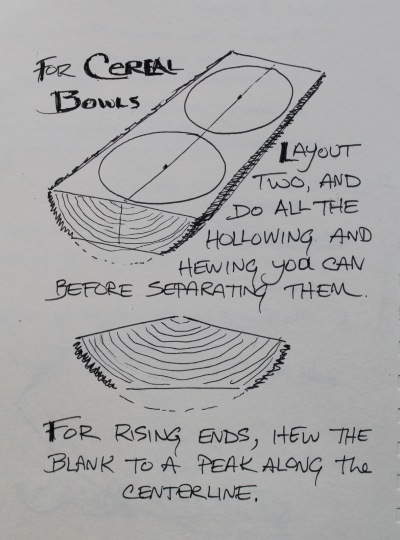
The biggest challenge is fiddling with the size of a small bowl.  Hands can get pretty close to those sharp edges.  The little sketch to the left shows how I handle that — and you end up with two bowls.

Whether hewing or clamping, it just makes it a lot easier to hold, then the two can be separated whenever it makes sense.  Or maybe leave them attached!  Could make for a romantic dinner — or you could have two bowls of ice cream.  Tough call.

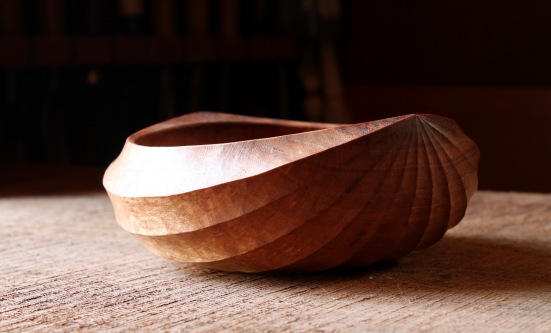
Below are a couple examples of small bowls I made recently with rising ends that should clarify what I mean in the lower part of the sketch.

IMG_1697

You can see how starting with a peaked blank creates sides that sweep down slightly from the higher ends.  This is very similar to the effect created by using an “upside-down” blank, and the same concept that I discussed in my Roof Top Bowl post — albeit with a larger bowl with some differences in form.

IMG_1717

The uppermost flute narrows the rim, creating a lip ideal for drinking — the cereal milk is the best part after all.

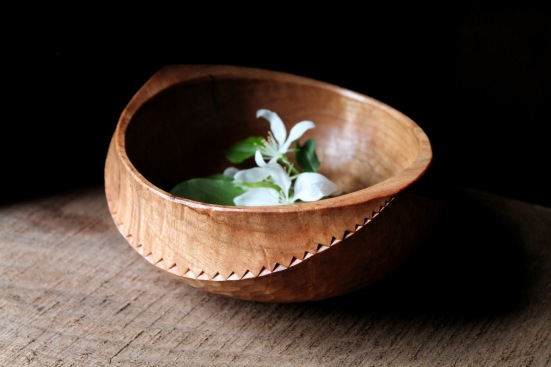
Here is another bowl using the same concept — but with a much broader drinking rim.  Again, in cherry.  All of the bowls in this post are cherry.

IMG_1863

And here is another “roof top” bowl, this one smaller and more delicate.  Not a great cereal bowl, but nice for something like yogurt.  The texture on the underside feels nice against the fingertips.


With a wooden bowl, you too may even look forward to shredded wheat.


Posted in bowls, cherry, holding, layout, patterns, sketch, Uncategorized | Tagged , | 17 Comments