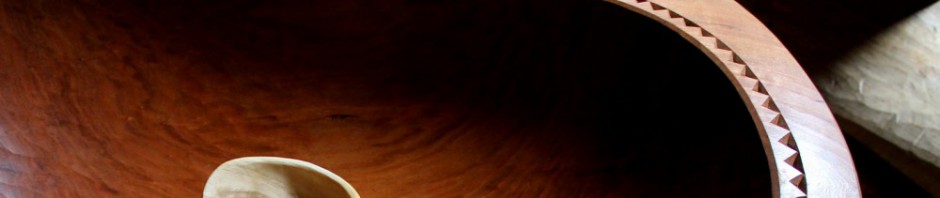
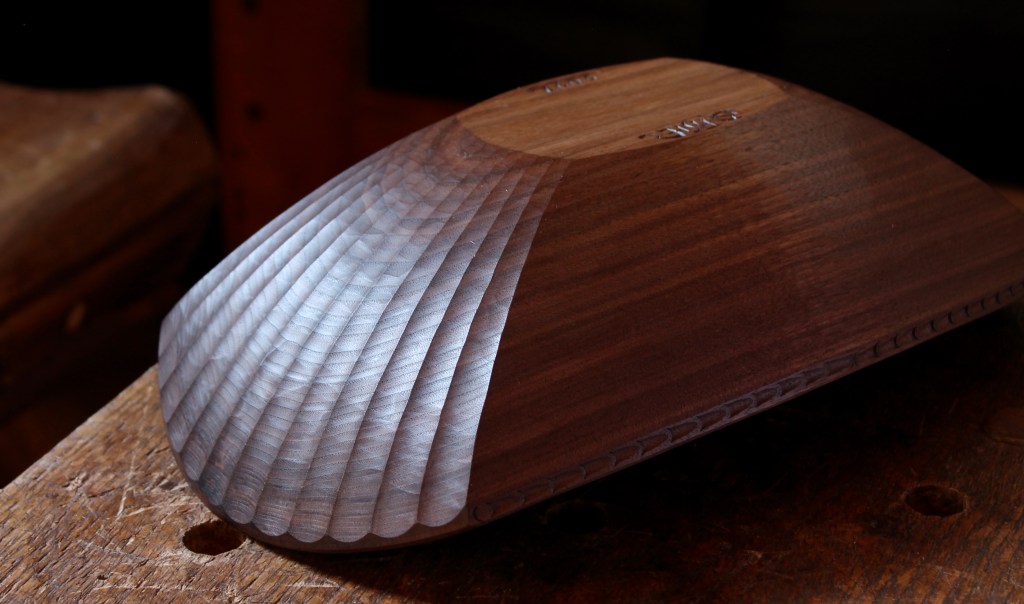
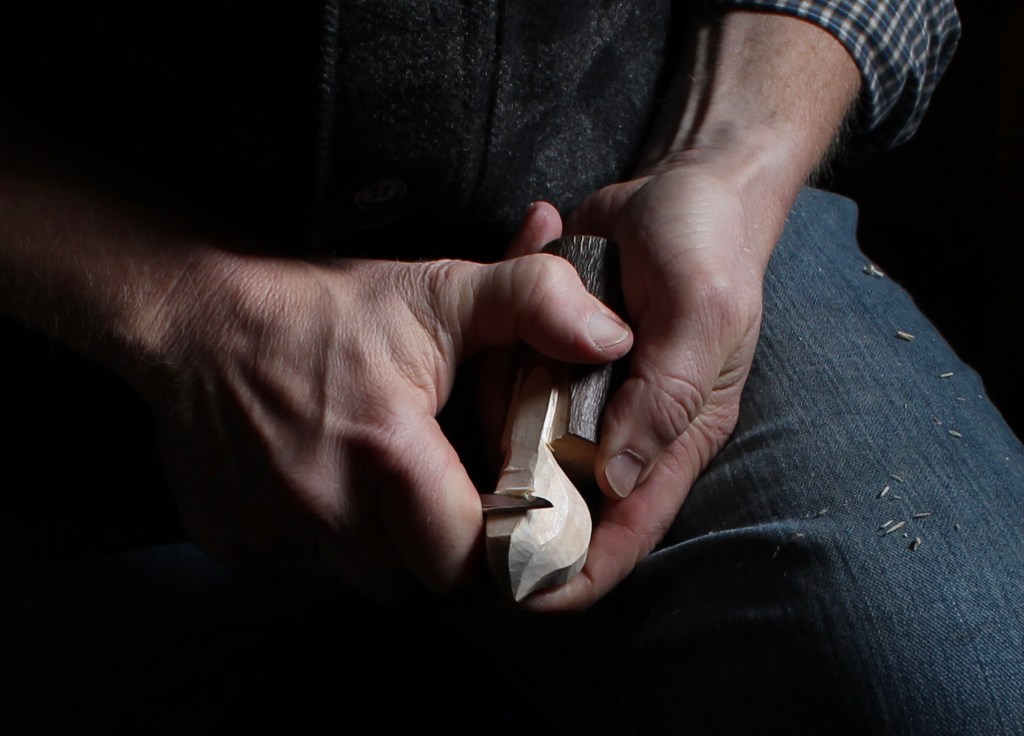
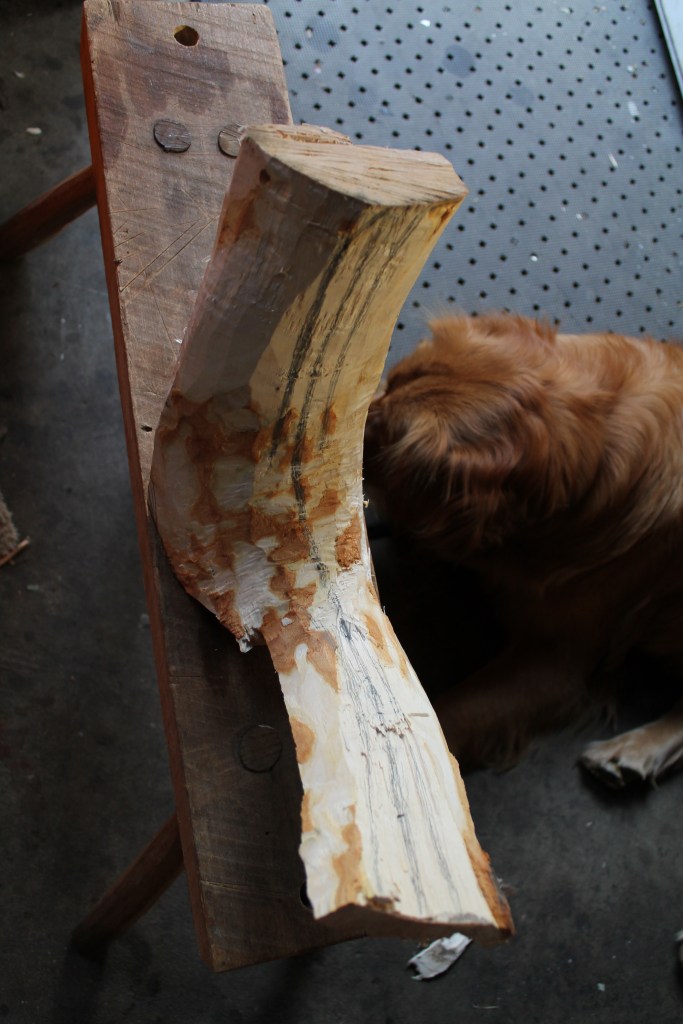
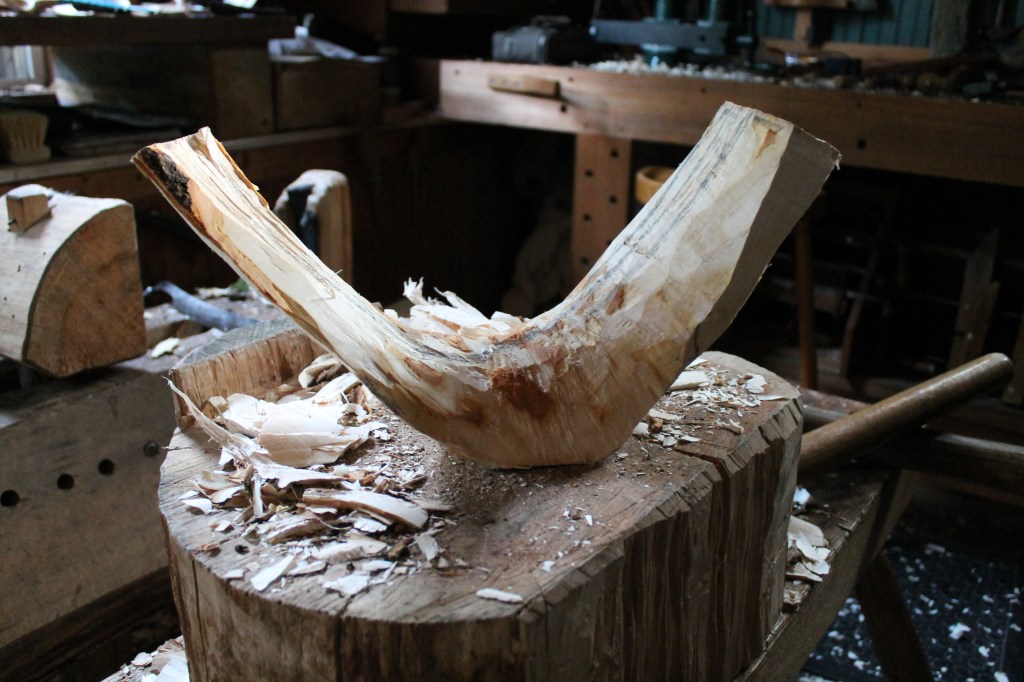
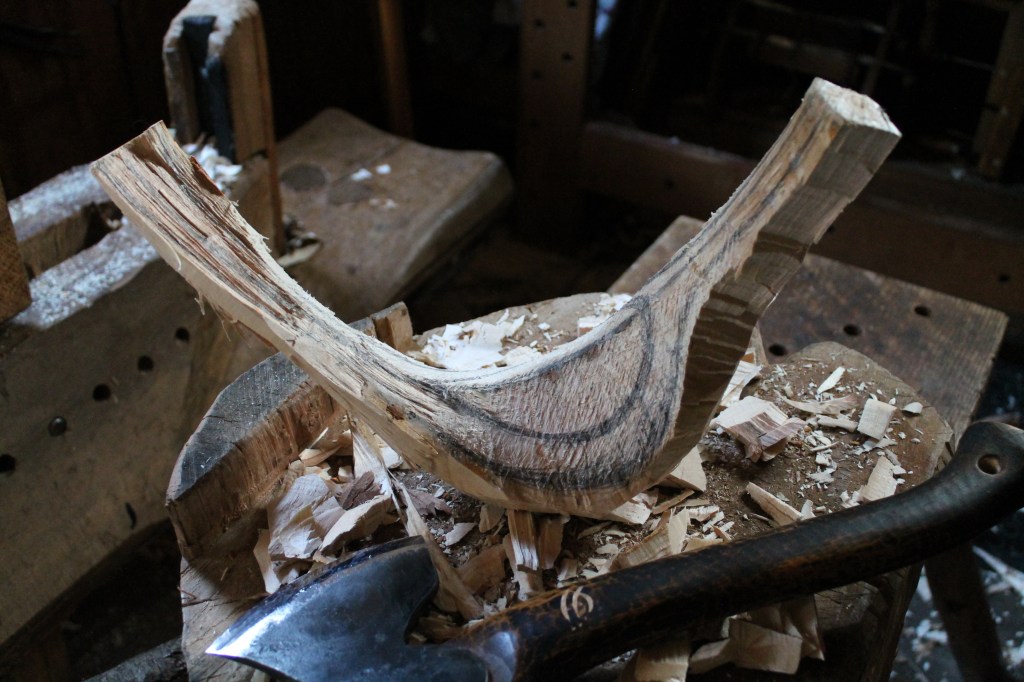
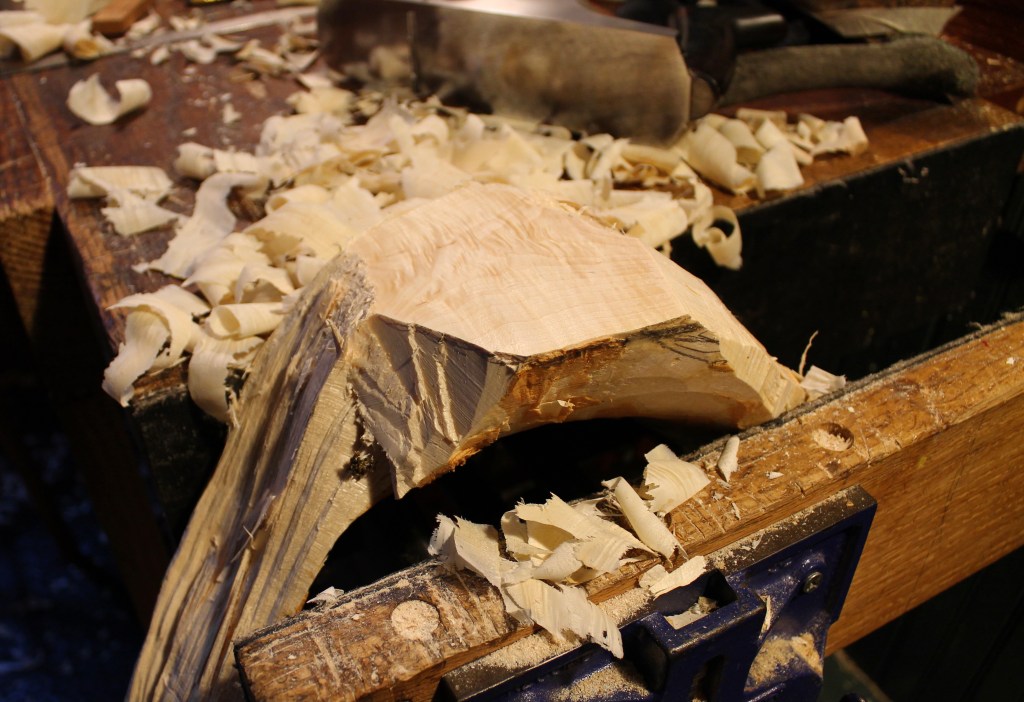
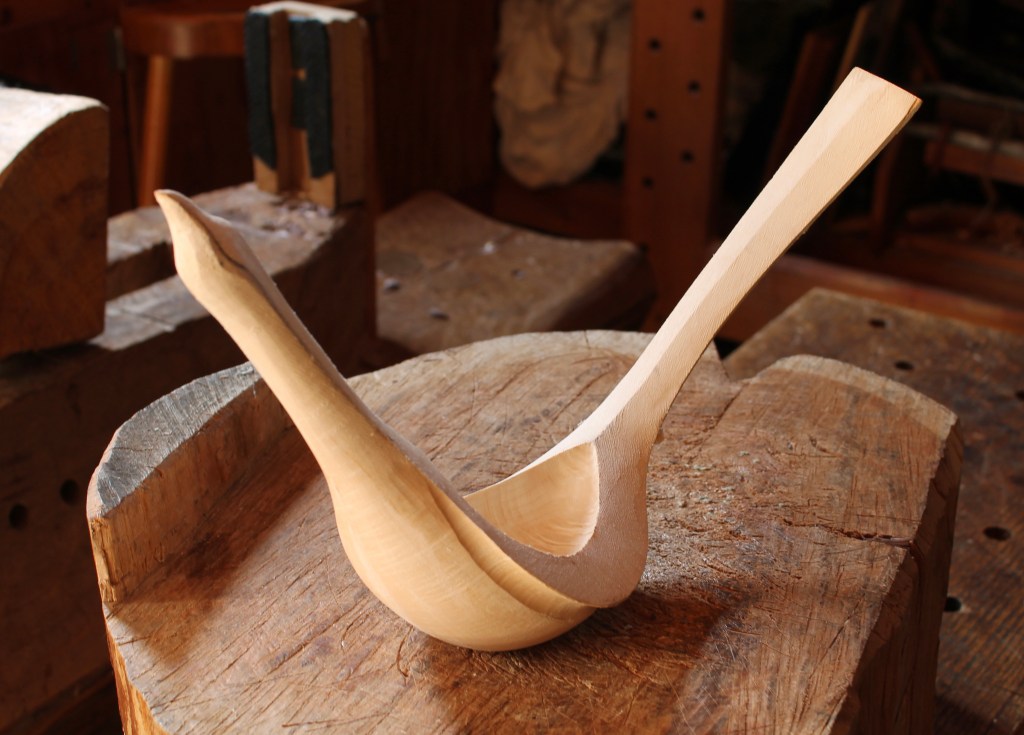
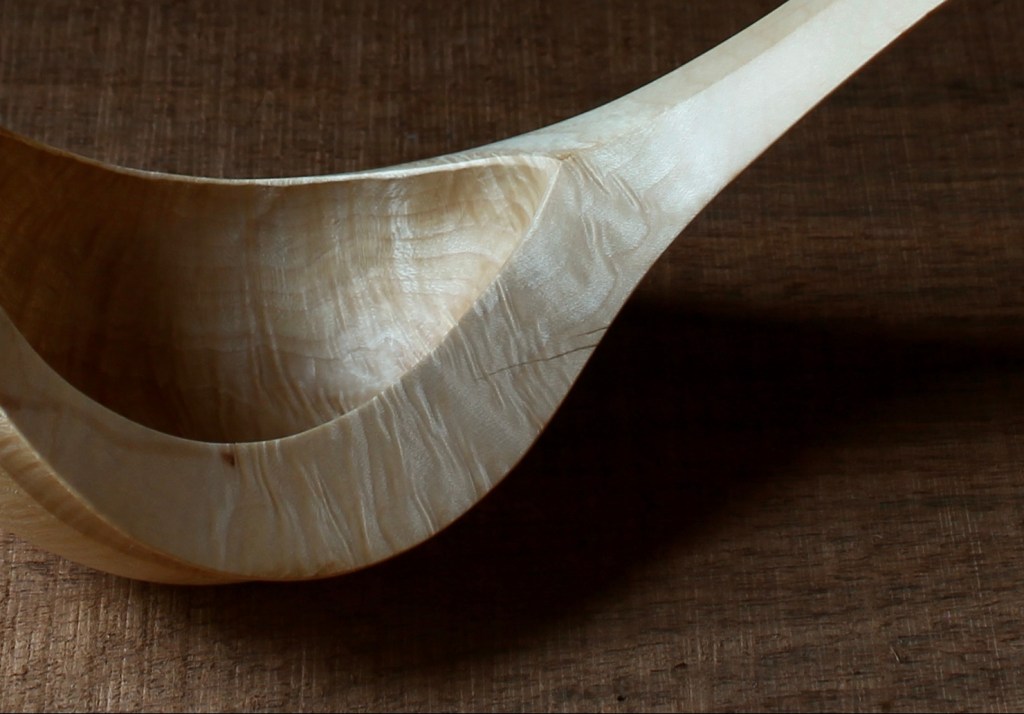
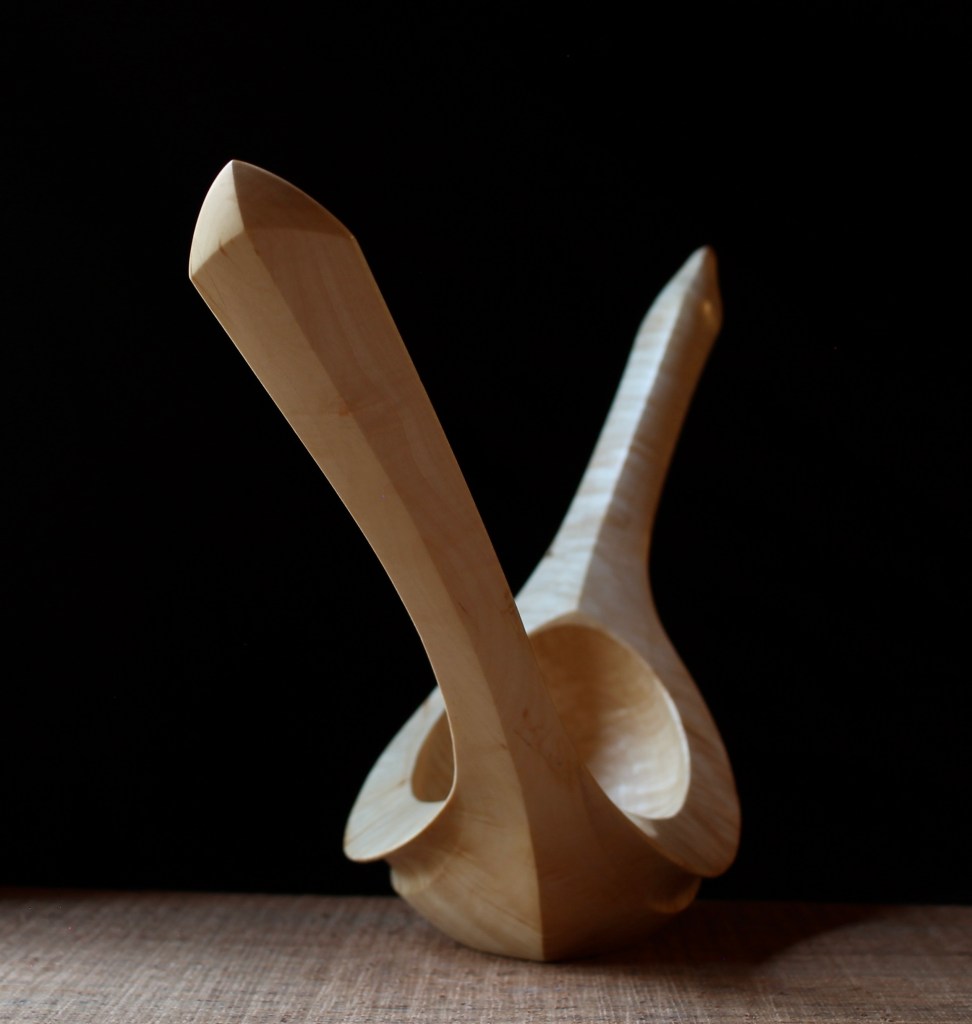
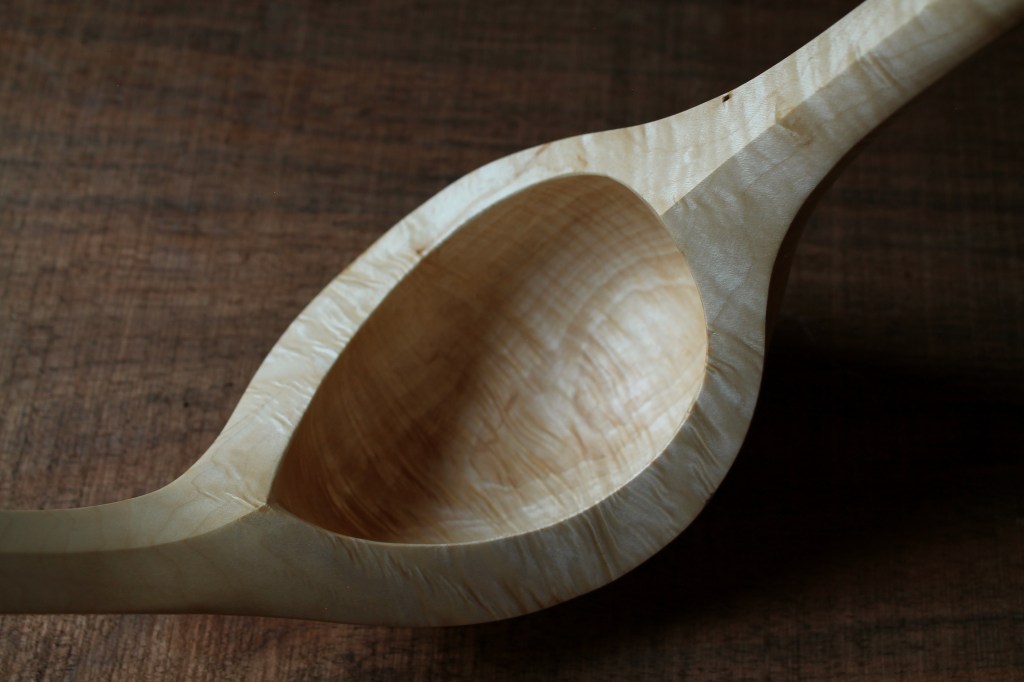
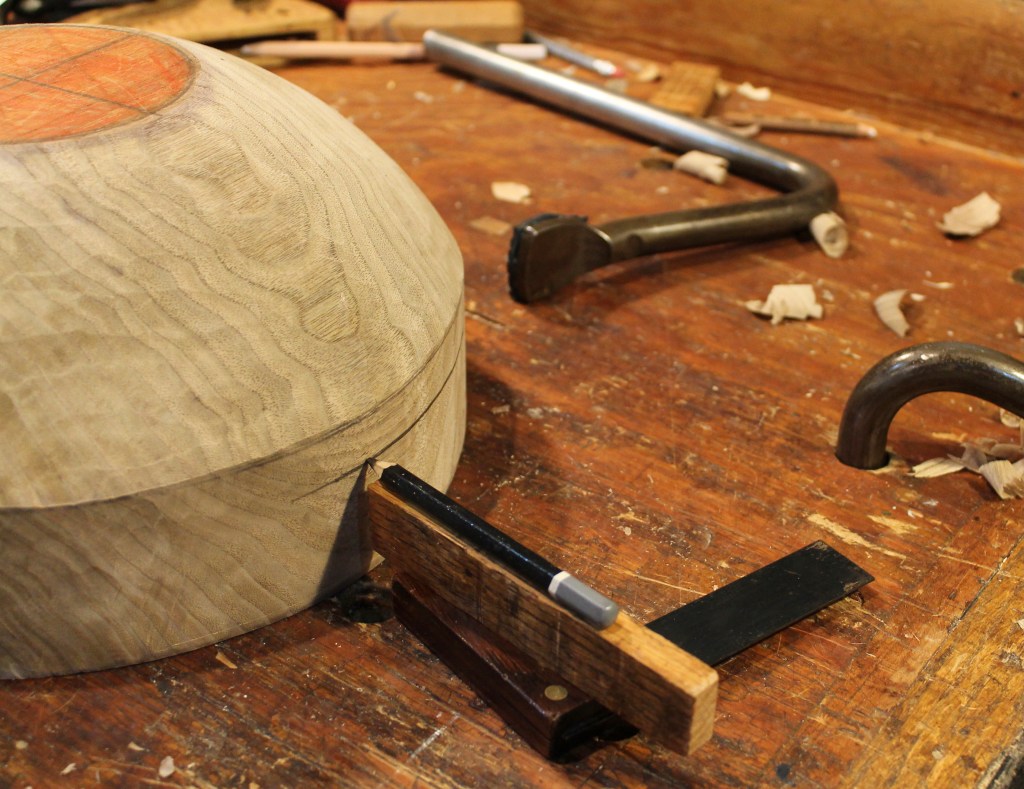
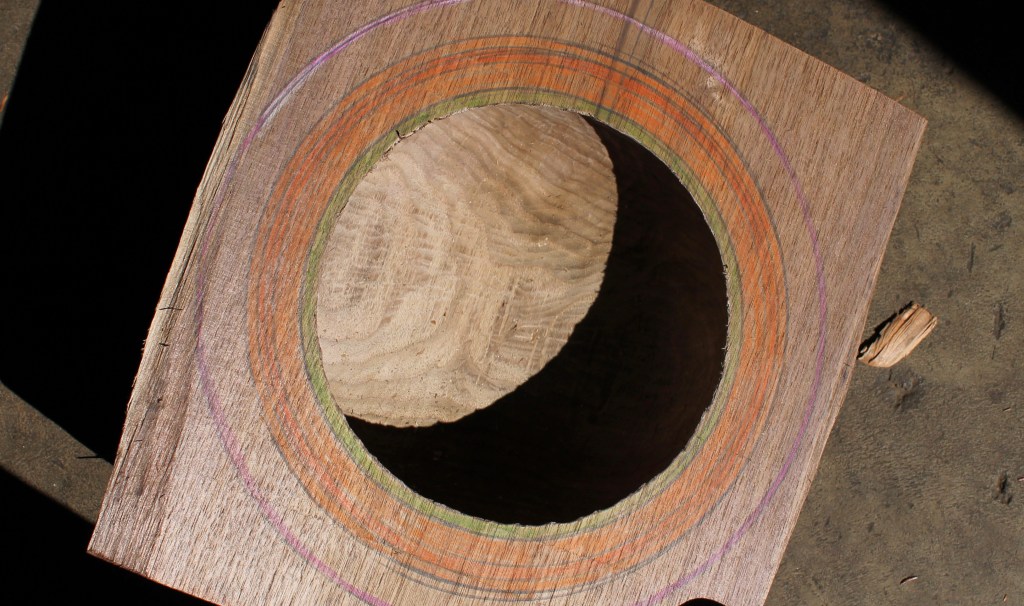
This bowl started with a black walnut log about 13″ in diameter but only 13″ long. I split it into quarters and was able to get this bowl out of one of those sections. Bark up orientation, so the flow of the growth rings is parallel to the rim.
I still haven’t found a log stretcher, so I decided to nix the handles on this one. With only so much real estate to work with, it was better to have a hollow without handles rather than the other way around. The absence of handles really exposes the exterior ends of the bowl, sort of like cutting your bangs to show off a beautiful forehead.
The layout is basically the same as for the bowl style featured in my video lessons with Elia Bizzarri, so all of the procedures we go through there can be applied directly to this design. When laying out, just reduce the space between the end of the bowl and the hollow to around 3/4″ or so.
In the photo above, the straightforward nature of the layout is evident, allowing you to focus on good execution and the joy of each cut.
And, should you decide to flute the end walls, the same arrangement seen in the photo above works well. You just work in one convex curve instead of transitioning from convex to concave as seen in the photo.
The light in the shot above shows the slight waviness and subtle texture left from the handwork of carving the flutes with the gouge. In this case, I used a #5 18mm gouge.
There is a narrow band below the rim all around the exterior. The flutes exit through it on the ends, creating a wave pattern.
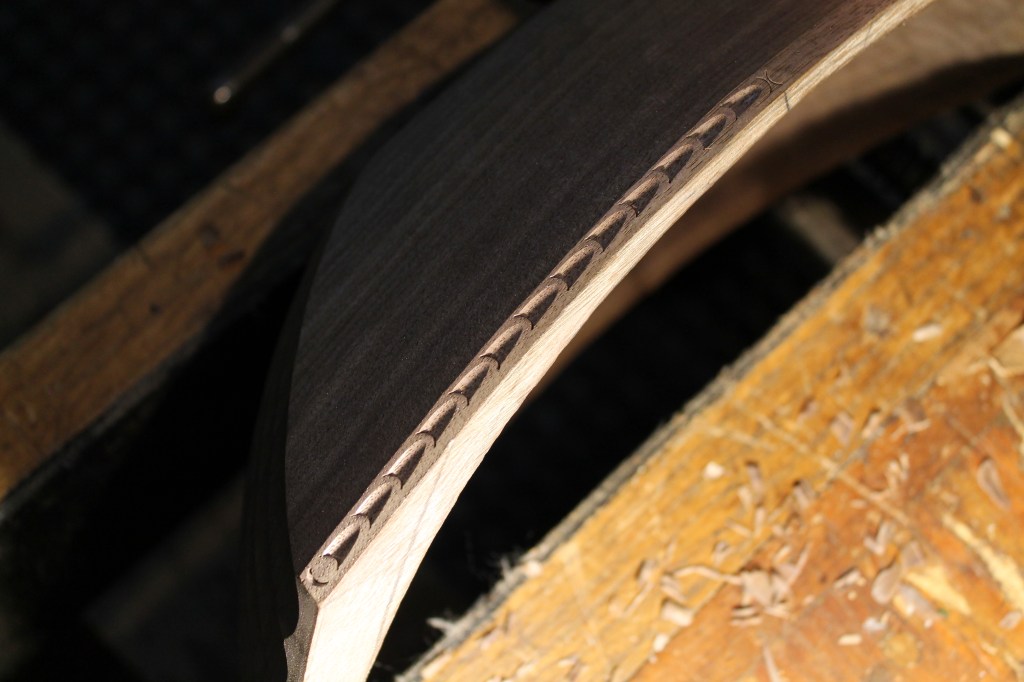
On the sides, I carved a series of fingernail chips. The short series of shots below shows that process.
I used a 4mm #8 gouge.
The fibers along the curved side of the bowl determined the direction of the cuts. In this case, I’m cutting downhill. If you orient the chips in the other direction, you may end up in a fight with the grain.
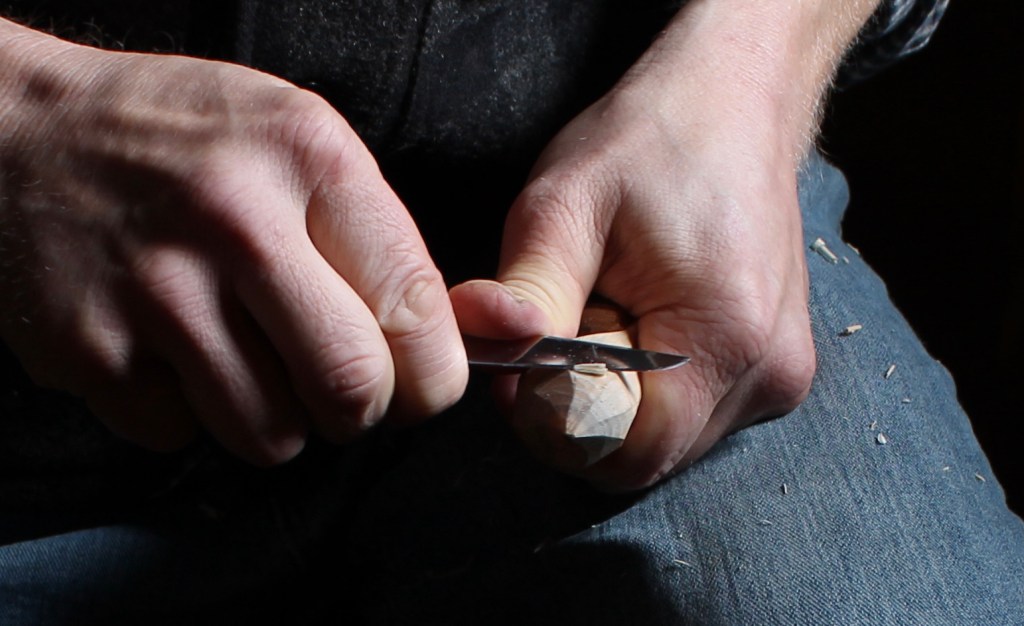
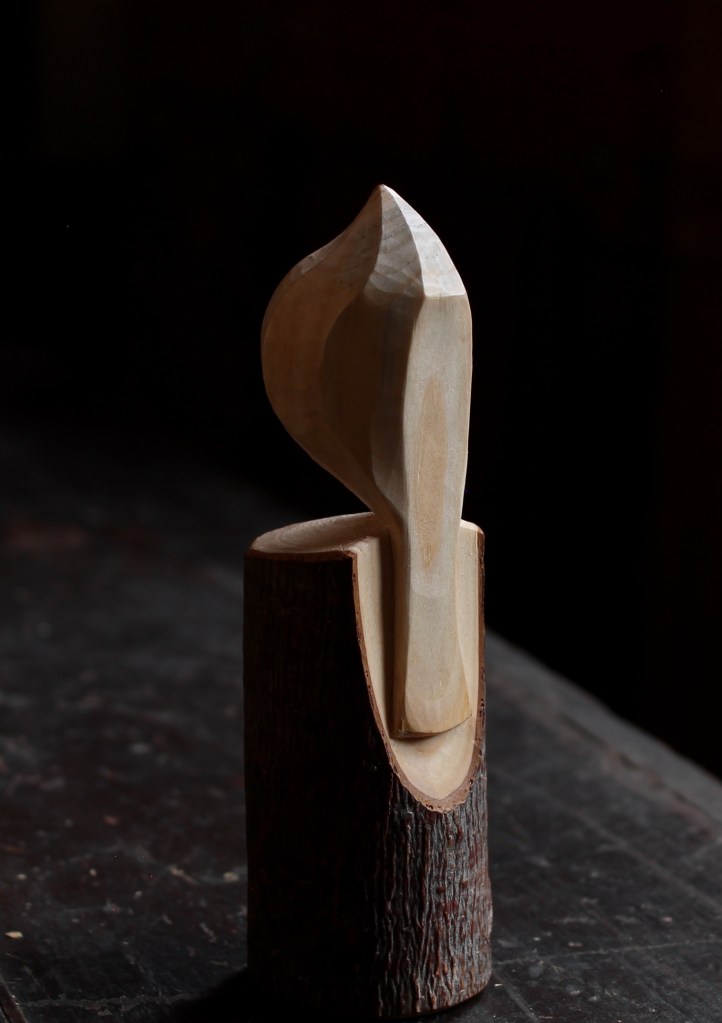
On a “cold, cold, wet day” this past weekend, I sat warm and dry in the shop by the window and whittled a little bird from a pine branch. Winter birds bring a special joy. It’s magical to be in the snowy woods and have an enthusiastic bunch of chickadees gleaning the twigs just overhead. Or to see the brilliant flashes of bluebirds darting around tattered brown stalks of goldenrod. A carved bird like this can bring a little of the magic inside.
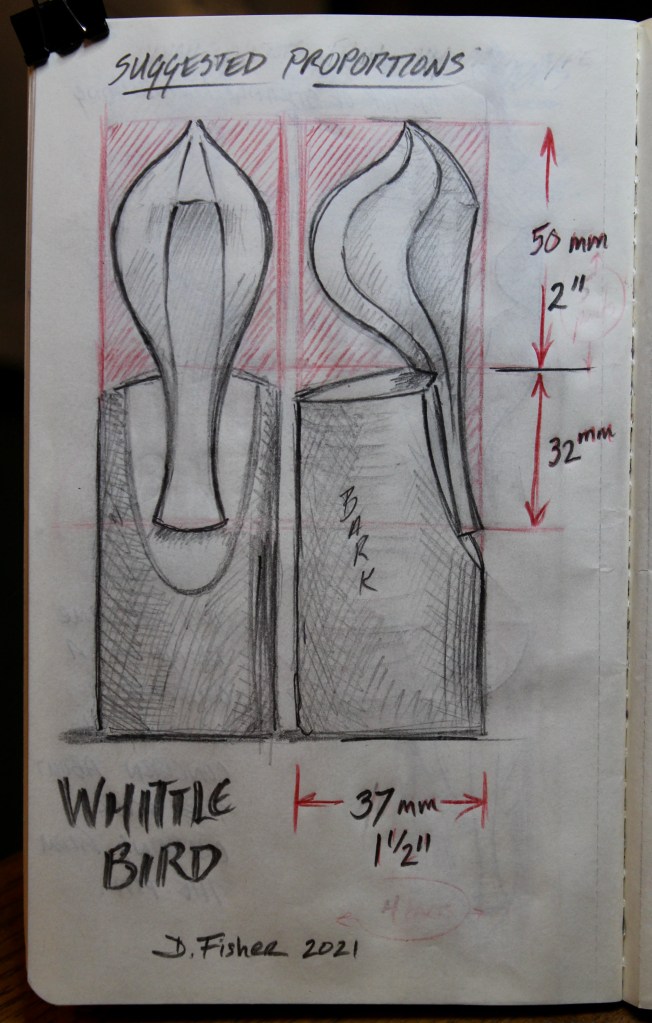
It’s a fun project any time of year, but maybe there’s even time to carve one or two before Christmas. I didn’t think to take any photos until I was quite a ways along, so I made some notes in my sketchbook showing the basic procedure and suggested dimensions.
All you need is a stick and a knife. Starting with a saw cut at the feet of the bird makes the initial roughing a little easier, but even that isn’t necessary.
I carved mine from a pine branch that had been around awhile and was dry. It was about 1 1/2″ in diameter. I think the relatively small size makes it possible to leave the pith in such a piece and not have it crack open. I’ve carved similar ones from green sticks, crack free. I suppose it would be best if the branch is harvested in winter. Experiment with what you have around, but species like aspen, poplar, basswood, birch, and many others would surely work well.
There’s no one right shape or size for a bird, but if you use a bigger or smaller diameter stick you could scale the other dimensions up or down accordingly. Or you can ignore even these few measurements altogether. It’s just a whittled bird. Relax and enjoy.
I worked eight long facets around the surface. In a sense, the form ends up as an octagon that has been pulled, pushed, and stretched. Then again, facets like this aren’t necessary at all. You could experiment with other textures, paint, or maybe designs or letters on the base.
If I have a choice, I prefer light coming from my left when I’m carving. In the final stages I work progressively around the bird from one facet to the next, concentrating on the flow of the ridge between them.
Warm up with the bird, then get inspiration from this fantastic episode of the Woodwright’s Shop with Roy Underhill’s fun wood toy ideas. And here’s a link to a toy post I wrote a few years ago with a few more ideas for carved toys, some of them also inspired by Roy. Another wonderful gift for yourself and friends is the 2022 Dickinsons Reach Calendar. Mine is on the way.
Wishing you a joyful holiday and a Happy New Year full of birds and wood chips!
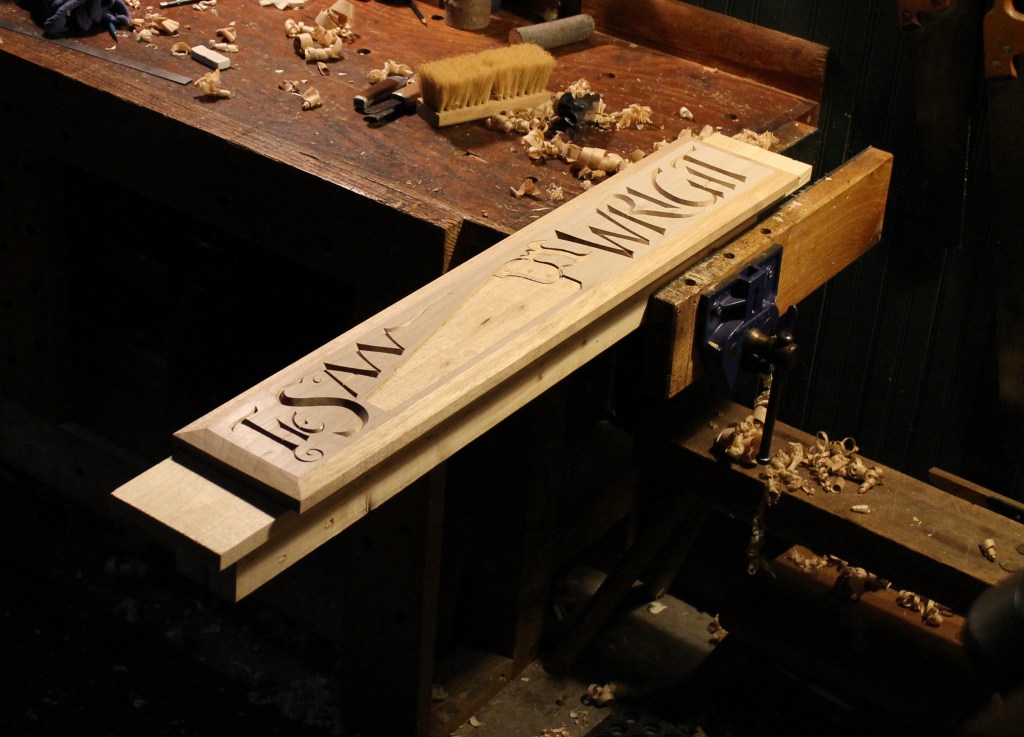
In the last month or so, I tried to knock a little bit of the rust off of my letter carving. I warmed up by completing a couple smaller projects, then tackled this long sign for Matt Cianci, a guy who really knows his way around a handsaw. Matt helped me out with some of my old backsaws that are now cutting sweeter than ever.
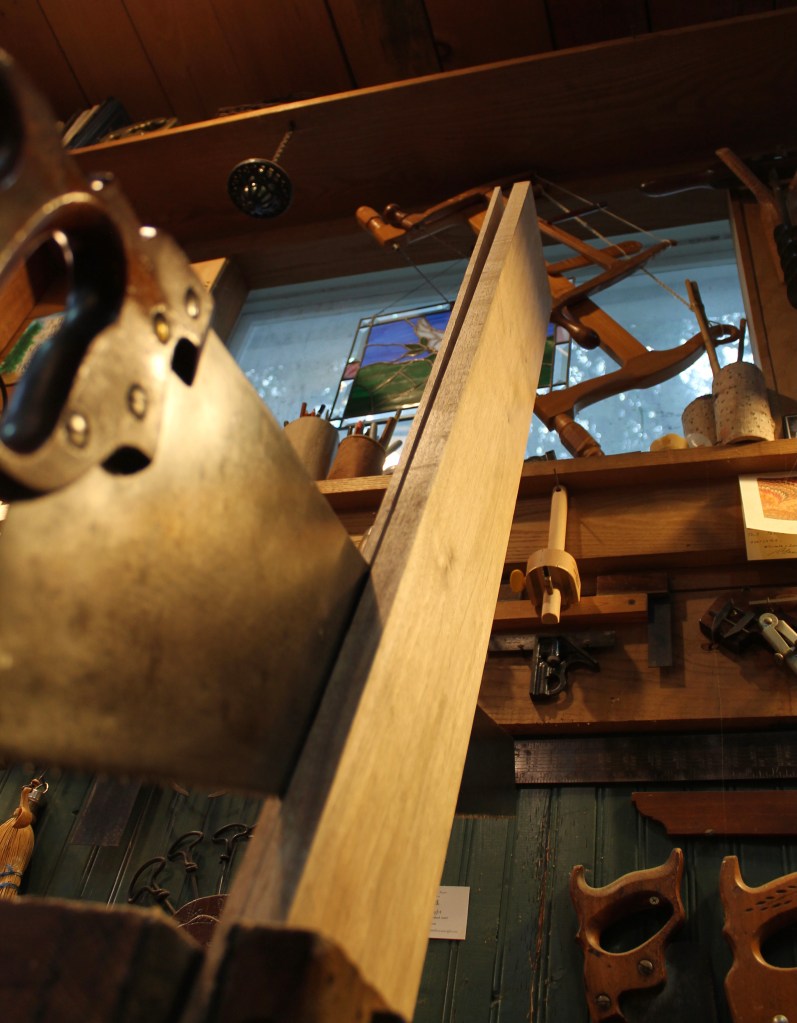
The sign is 37″ long and 6 1/2″ high. I had made a sketch and had an idea in mind, but, as is often the case, it evolved as I worked. The butternut plank I began with was nearly 5/4 (1 1/4″) thick, and my plan was to resaw it just to leave a surface textured from the cutting of the rip saw. So I planed the back side flat, struck a line around the edges, and sawed.
As it turned out, the texture left by the saw wasn’t what I was looking for, but I still wanted some contrast between the surface and the eventual carving, so I planed off all of the sawn texture and painted the entire surface with a wash of titanium white artist oil paint thinned with citrus solvent. I rubbed it back to allow the grain of the wood to peak through. Oiling the sign darkened the wood and enhanced the contrast.
All of that sawing was not for naught, however. I now have a 1/4″ butternut board for shrink pot bottoms and other things.
After carving the lettering and the saw, I planed a bevel around the edges and did some large chip carving around that border in a saw tooth pattern. More about that below.
And there’s the rest of the sign. Just pretend you don’t notice the little slip by the bowl of the R.
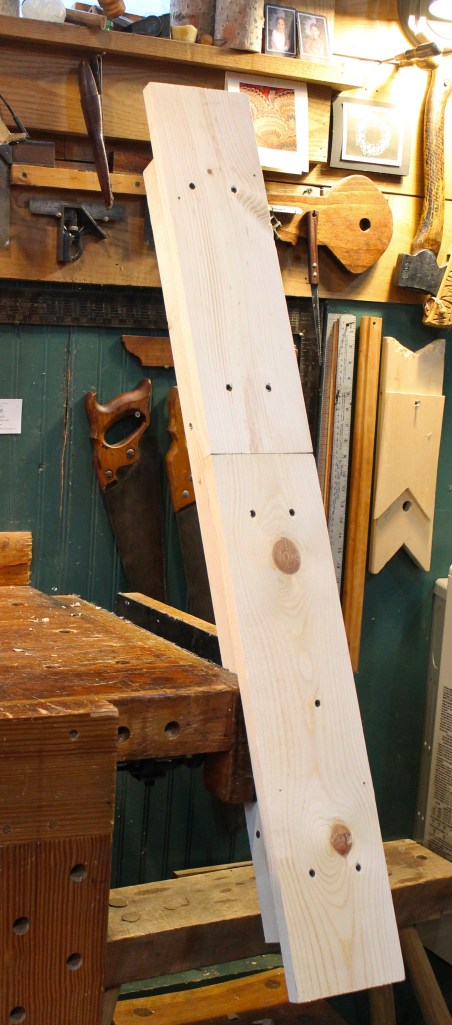
In order to have better access to this sign, I screwed together a few boards to serve as a bit of a workbench extension, which took about ten minutes. I started with two lengths of 2×4 sistered together with a 1×6 on top. I secured the sign to it with four screws through the 1×6 into the back side of the sign. I was able to pop the whole thing securely in the vise, flip it around, even angle it. Most importantly, I was able to have close access to the work from both sides.
These sort of things can be made quickly to suit individual projects and circumstances. I’ll leave this one together for now, though. I could even mount a piece to it and arrange it more vertically, as above.
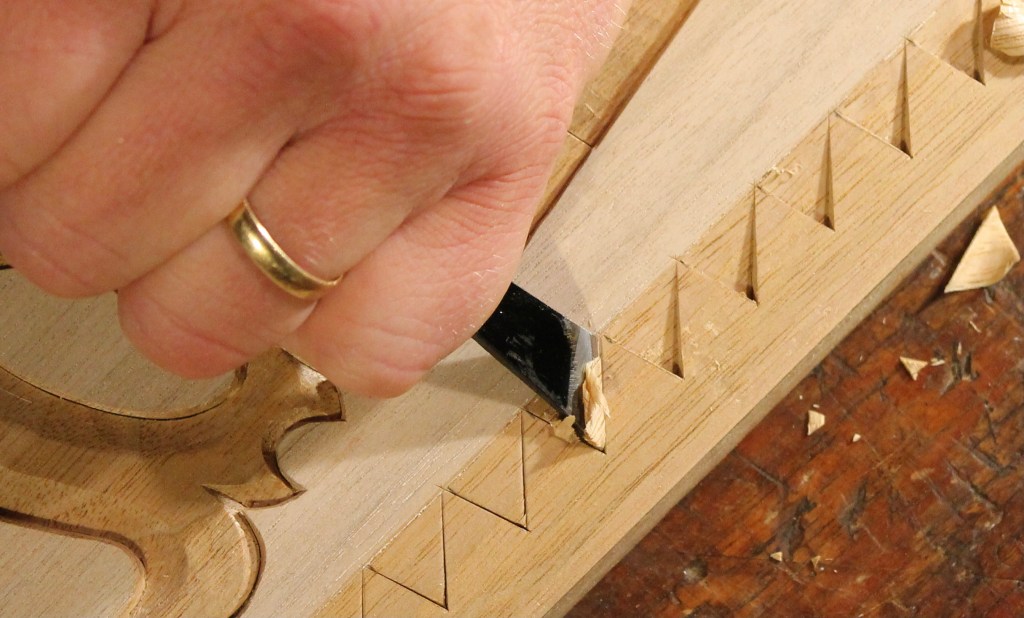
One last thing about that chip carved border. These chips have two vertical walls. I thought about making those vertical cuts with a chisel and mallet, but I wanted to avoid the wedging action and leave a nice sharp corner. So I used a standard utility knife, placing the tip of the blade at the apex of the chip and raising the edge at an angle to get more depth at the end of the blade. I struck the back of the knife with a rawhide mallet to make the cut. Did the trick.
Then it was just a matter of slicing the bottom surface down to the end walls.
Last Christmas, Phil Teeter sent me some cheer in the form of these delightful carvings. Phil explained that they are Julfågel (Swedish for Christmas Bird), “very rare and shy — they appear at Christmas and bring good fortune.”
With all of that Swedish experience, I assumed Phil’s Julfågel stemmed from some centuries-old Scandinavian tradition, but that wasn’t the case. They came out of Phil’s creative fire, sparked, in this case, by AnneLie Karlsson. AnneLie had carved some pencils from small branches and Phil purchased one. Back at home in Colorado, AnneLie’s pencil inspired Phil to explore the form and add the story, resulting in the Julfågel.
In the photo above, you can see the general progression Phil goes through in carving a Julfågel. Here’s a little more on the materials from Phil: “I have only used aspen for these. Pretty much the perfect wood. Easy to carve, the limbs grow the right way, it takes paint well and I have acres of it. I use artists oils for nearly everything but here I use acrylic. Dries fast and there are really nice transparent colors. The ones you see on my birds are alizarin crimson, Jenkins green, transparent yellow, iron oxide and bone black.”
Branches are all over the place — aspen not required. What a fun Christmas project, and maybe a good opportunity to introduce a kid, or an adult, to carving. Talk about good fortune.
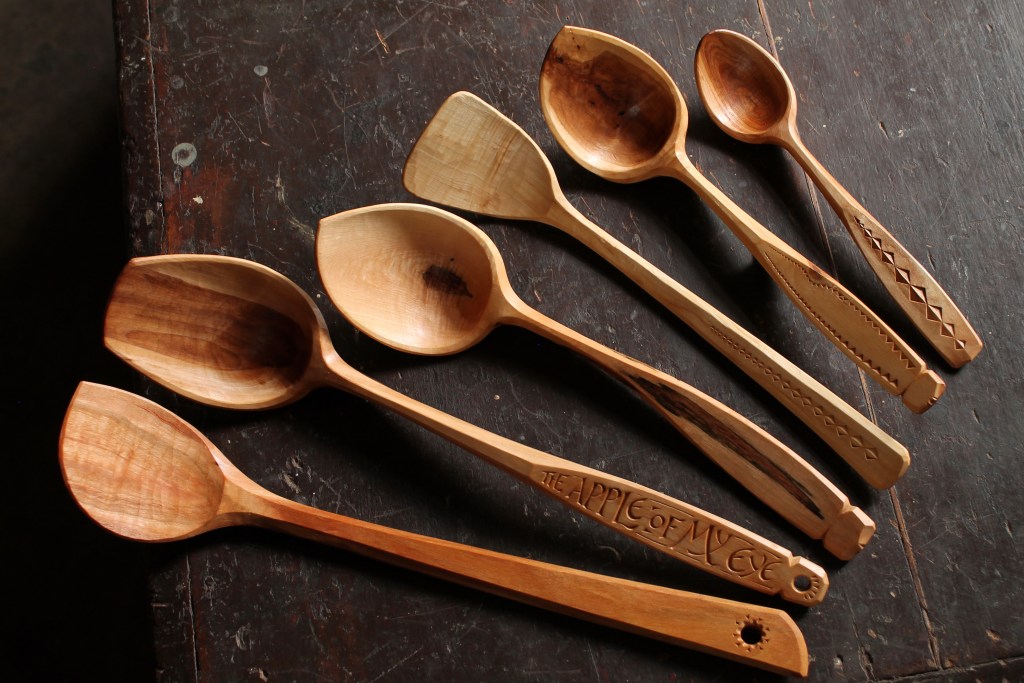
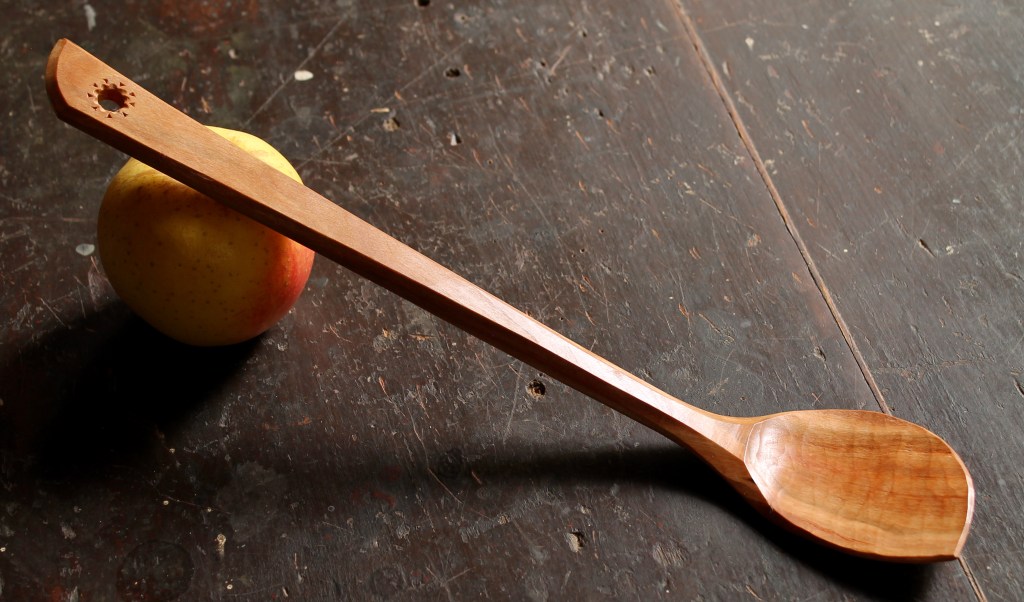
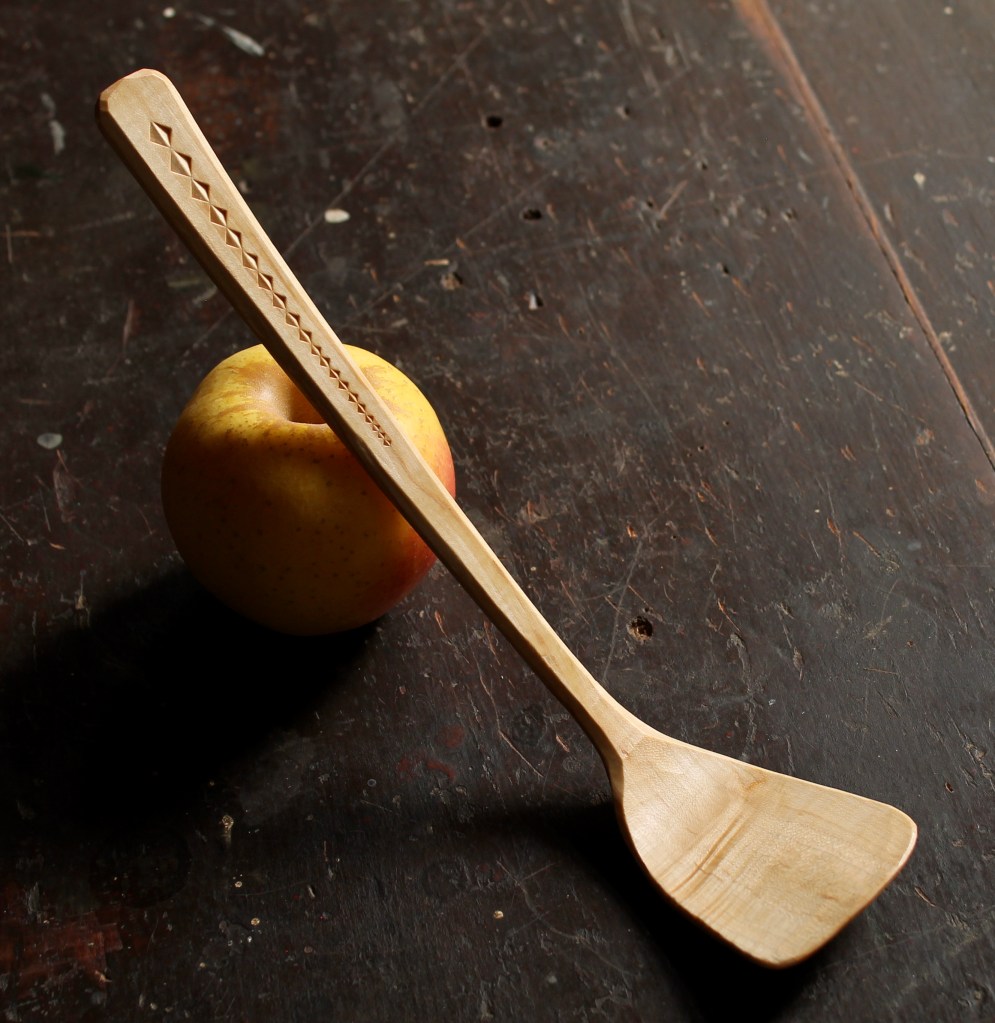
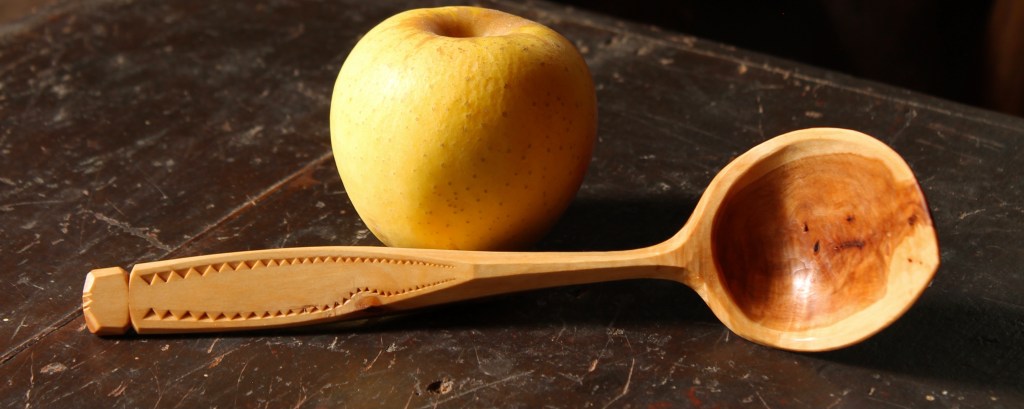
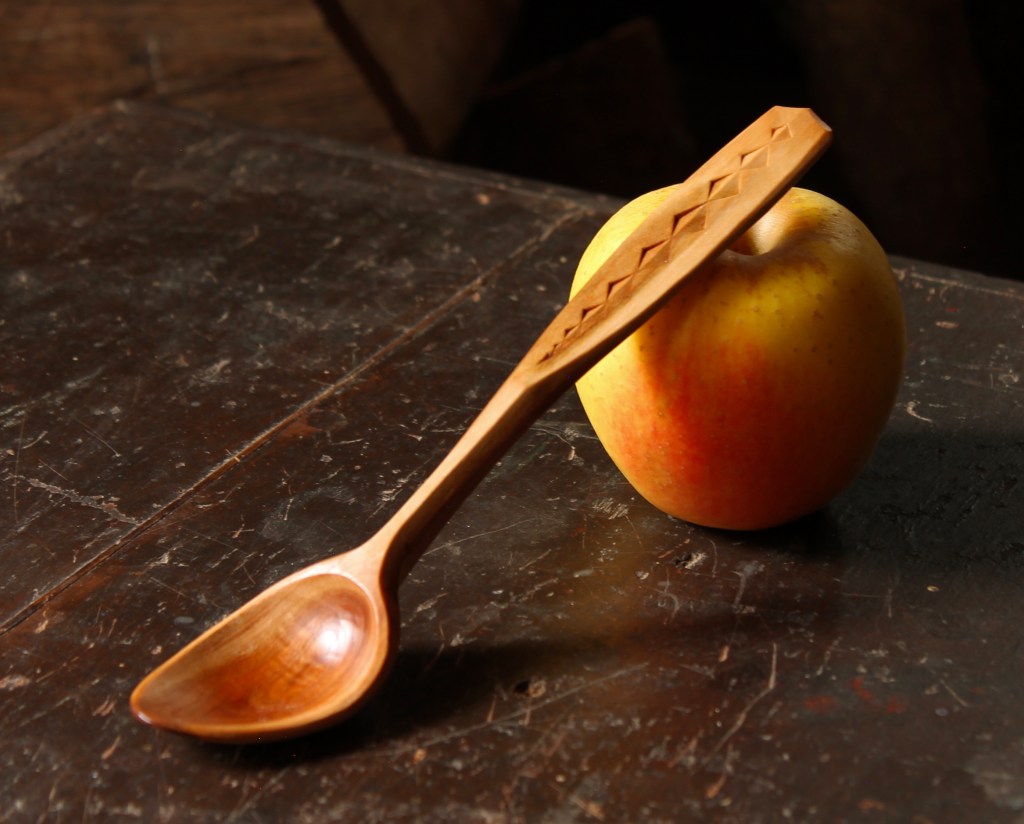
I’ve managed to fit in a few spoons from crooks that I found and couldn’t resist. I’ll post them below for sale, starting with the long cherry one on the bottom left and finishing with the little cherry one on the top right. If you’re interested, send me an email at dandkfish@gmail.com. All prices include shipping. Thank you.
#1: Cherry, 13″ x 2 1/2″. Sometimes, I’m able to split the usable split of a crook again, usually getting a thinner section. This is from one of those, and they can be good for handy stirrers/cookers/spatulas like this. They take significantly less time than more complex forms. $75 includes shipping. SOLD
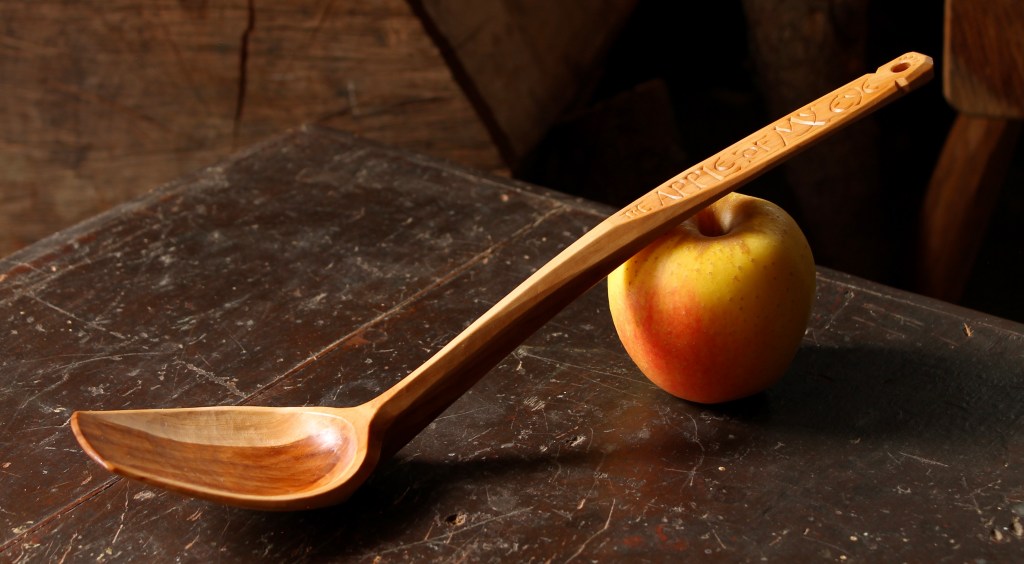
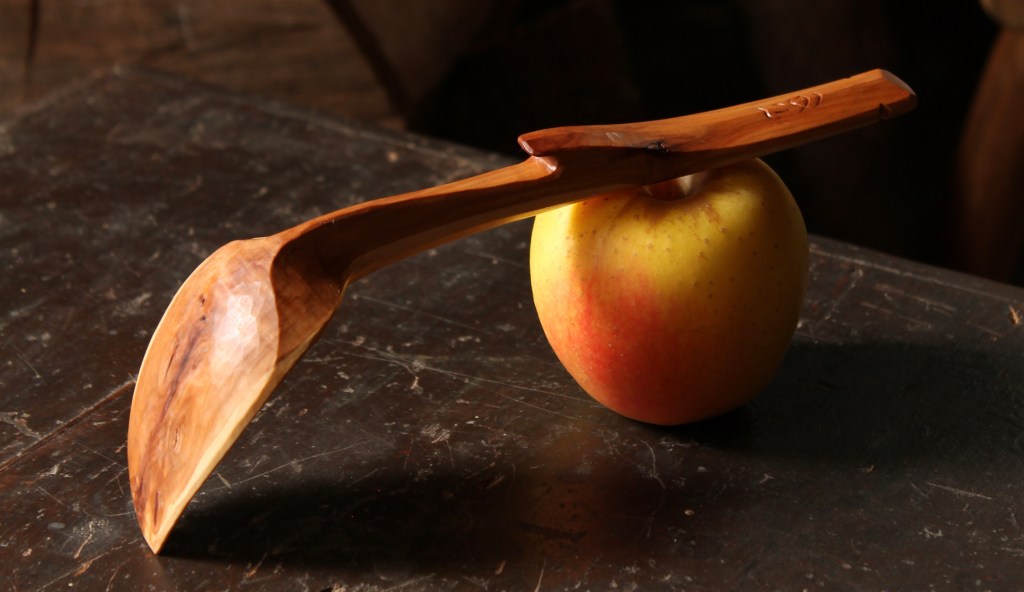
#2: Apple, 13″ x 2 3/4″. When I saw the apple branches laying there in a pile, this curved section practically lit up. It provided this large server with a shallow bowl that would slide nicely along the bottom of a broad pan or dish. $210 includes shipping. SOLD
I lettered an old expression on the handle, a little reminder of the tree species.
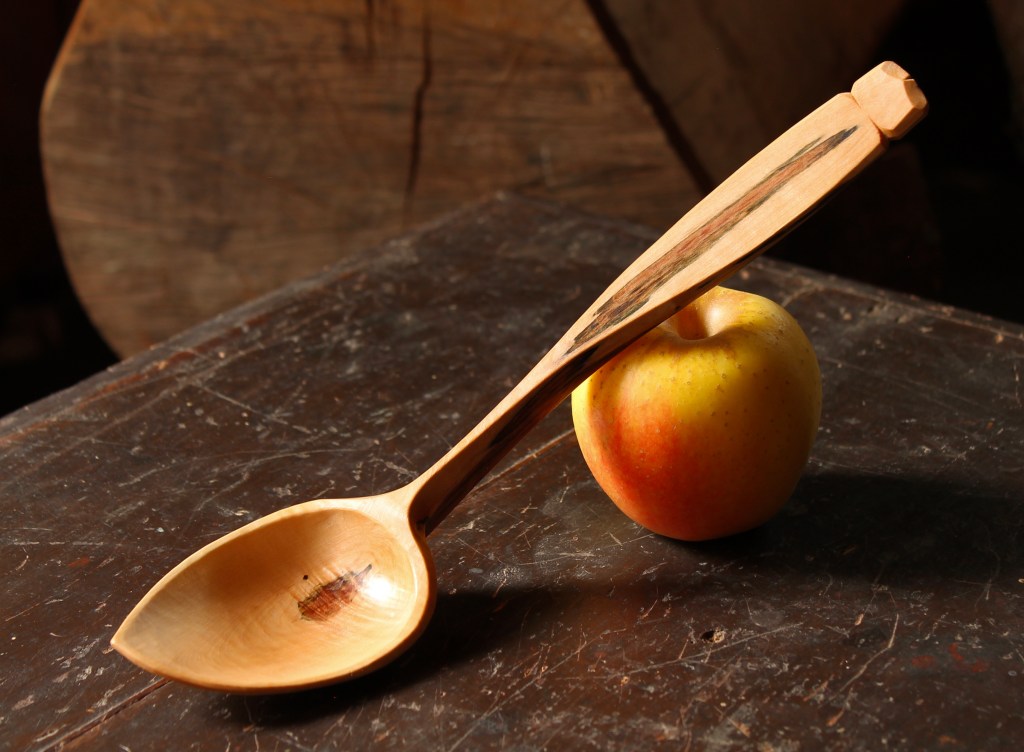
#3: Maple, 11″ x 2 5/8″. This maple crook had a nice dark streak that now peaks up through the handle and the bottom of the bowl. The handle of this server has a little lateral curve brought to it by the branch. $140 includes shipping. SOLD
#4: Maple, 10 1/2″ x 2 1/8″. This petite spatula with a sharp bend would work equally well for flipping pierogies in the pan or lifting cookies from the tray. $75 includes shipping. SOLD
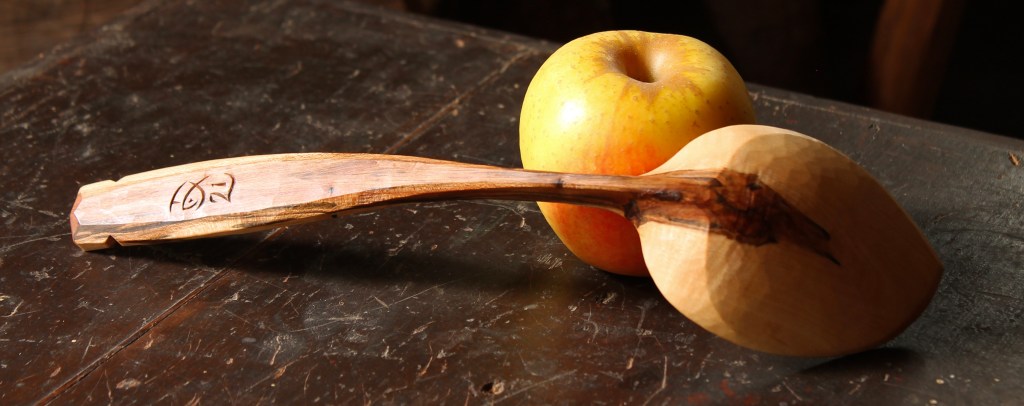
#5: Pear, 9 1/4″ x 2 3/8″. Another great fruitwood for spoons. This pear wood server has a lot of figure through the bowl. In fact, there are a couple tiny voids in the wild wood of the bowl, but they won’t let the beans through. I bent the line of chip carving around an area where the heartwood rises up to the surface of the handle. $155 includes shipping. SOLD
Below is a shot of the back side of the pear spoon, with a hook to catch over the edge of the pot.
#6: Cherry 7 3/4″ x 1 5/8″, This little crook could be a smaller serving spoon or a larger eating spoon. A little deeper bowl than I usually carve into an eating spoon, but some may like that for their cereal or soup. $100 includes shipping. SOLD
There’s another shot, below, of this little cherry spoon beneath the handles of three of the others.
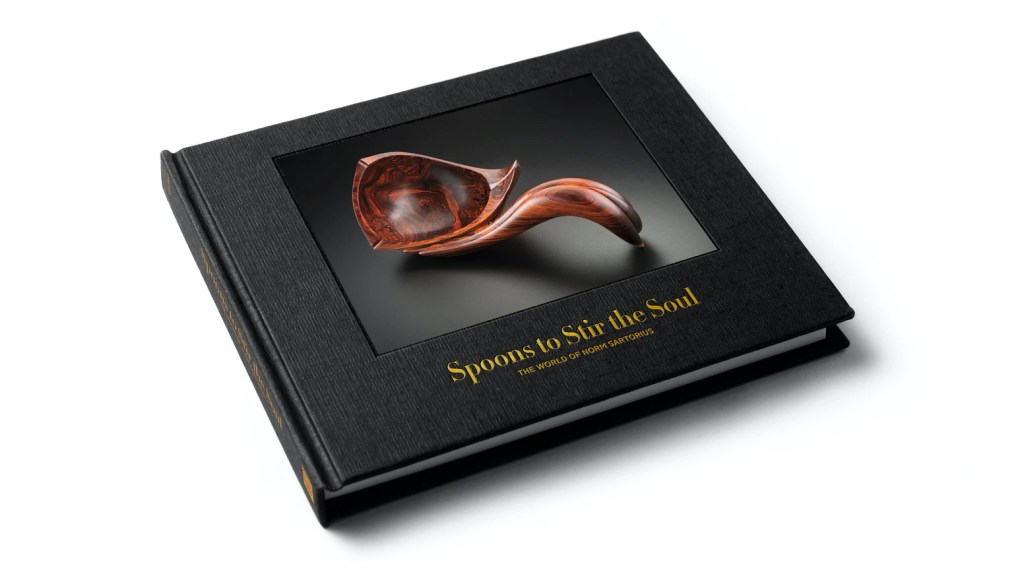
Norm Sartorius has been making wooden spoons since the 1970s, and he decided early on to dedicate himself to exploring the sculptural possibilities in these small wood pieces. Norm’s spoons reflect his sensitivity to each piece of tree that comes his way. Each one is a wonder to look upon and a lesson in itself. I had the pleasure of meeting Norm a few years ago. He’s a great guy and he gave me a lot of encouragement for my own carving.
I just wanted to help spread the word about a new book celebrating decades of work by Norm, soon to be published by The Center for Art in Wood. Information about the book and various options can be found here, and there is a pre-order form here available through December 31st.
And, looking ahead, The Center for Art in Wood is planning an exhibition of Norm’s work that will open on May 6, 2022 and run through July.
As I relentlessly bore down on the vibrating sander, I peered through the cloud of dust and saw Mr. McInturf motioning me toward him. As I turned off the machine and maneuvered between my high school Wood Shop classmates, I could see Mr. McInturf was holding a thin rectangle of metal, a shiny steel card of some sort. I watched, mystified, as he laid it near the end of his desk and rubbed what looked like a triangular file with no teeth against the faces and edge. Next, like some sorcerer in a green smock, he pushed that card along a board, lifting wispy curls before it and leaving a smooth surface behind. Then he handed it to me with a smile.
That was over thirty years ago, but I’m reminded of that magical moment every time I pick up a card scraper. I don’t use one often, but it is ideal for certain situations. If I remember right, chair maker John brown said it would be the tool he would grab if his workshop were on fire. I’d grab my adze, but I did pick up my card scraper recently for refining the surface of a bird bowl carved from a maple branch.
The photo above is from the post that I wrote about that bird bowl.
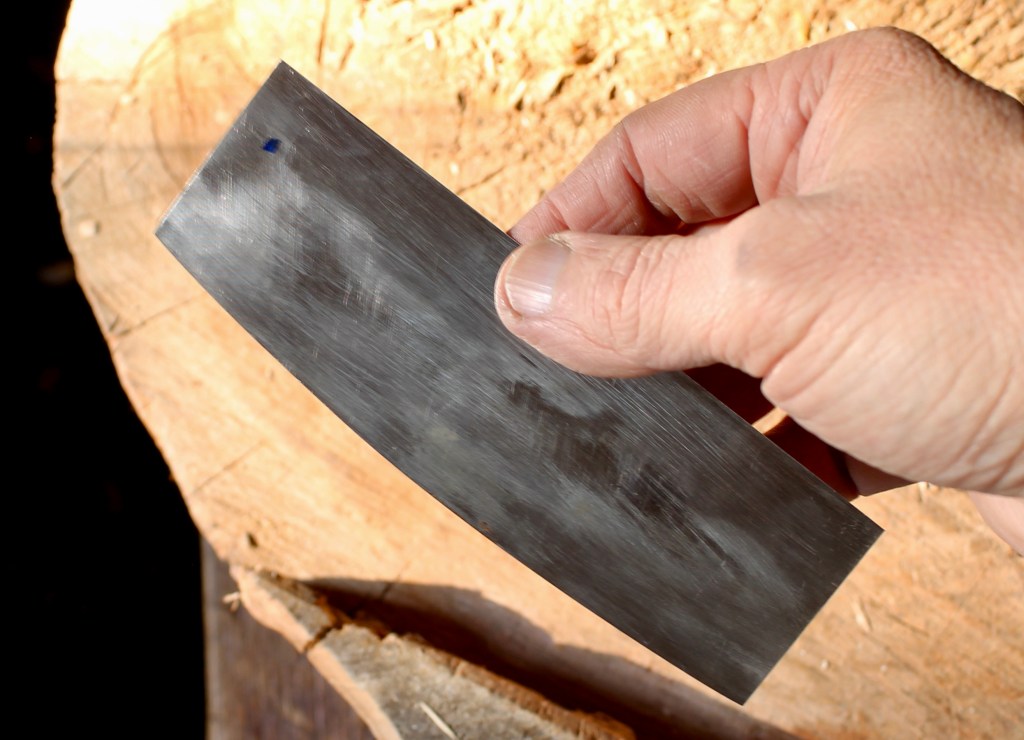
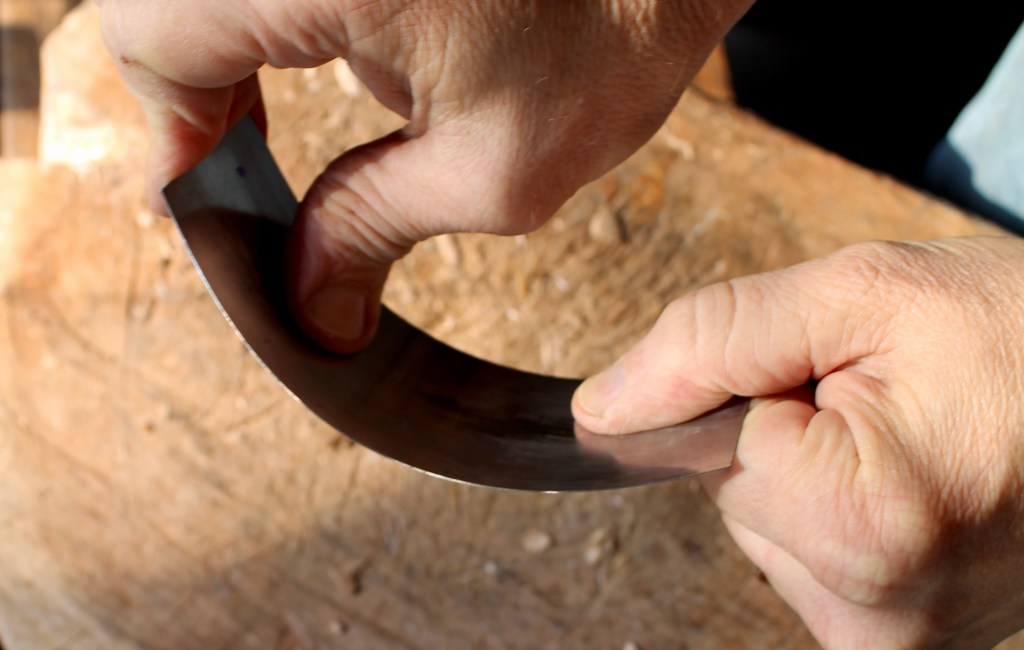
Here’s a shot of a scraper I like for sculptural shapes like this. I bought it years ago from Lee Valley, and I see they’re still selling them. This one is the thinnest of the four in that group (.016″ or .4mm). I’m sure there are other thin options from other suppliers out there, and you can also use an old handsaw blade. I’ve ground one edge to a gentle curve to add some versatility. I wrote a post a few years ago about using curved edges on scrapers for bowls.
The flexibility of this thin scraper allows it to conform to a variety of shapes and makes it light and nimble to handle. Thicker scrapers are better for heavier cuts and other situations.
honing/polishing the face of the scraper.
There are tons of articles and information out there on how to sharpen a card scraper. I’ll add to the confusion by showing you how I go about it.
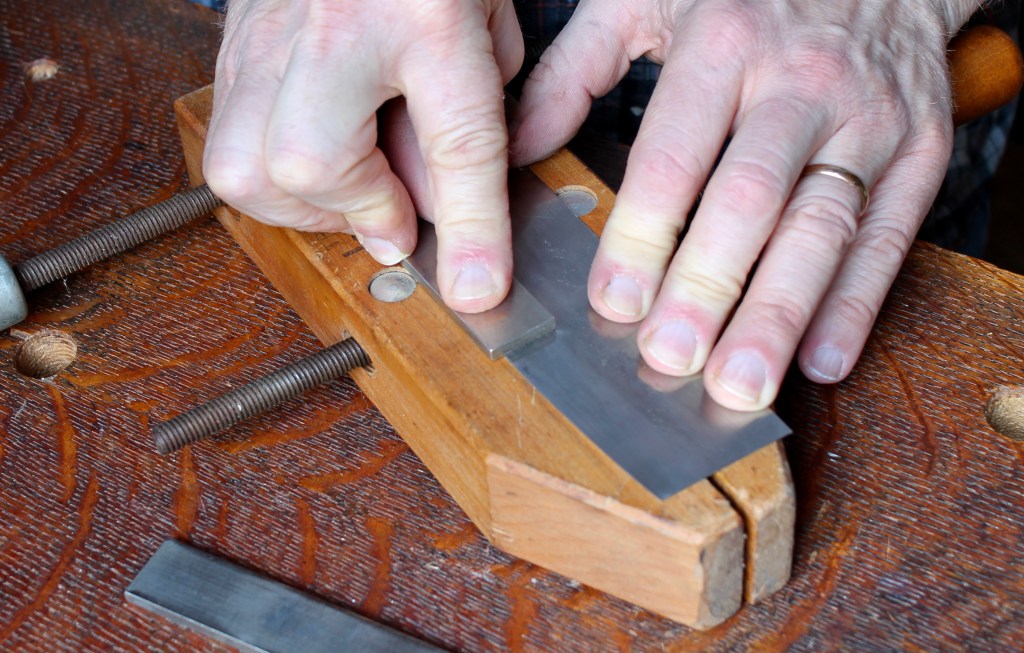
Regardless of the specific method, the main idea is to hone the edges and face and have them meet at 90 degrees. Then, using a harder piece of polished metal, deform that edge a bit to form a small burr toward the face.
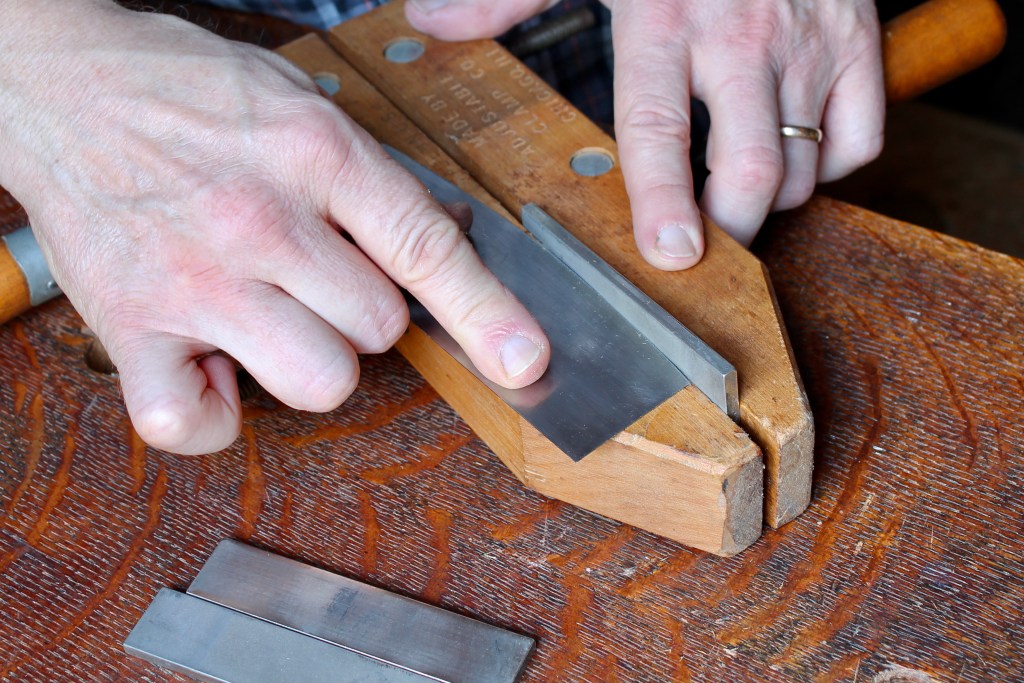
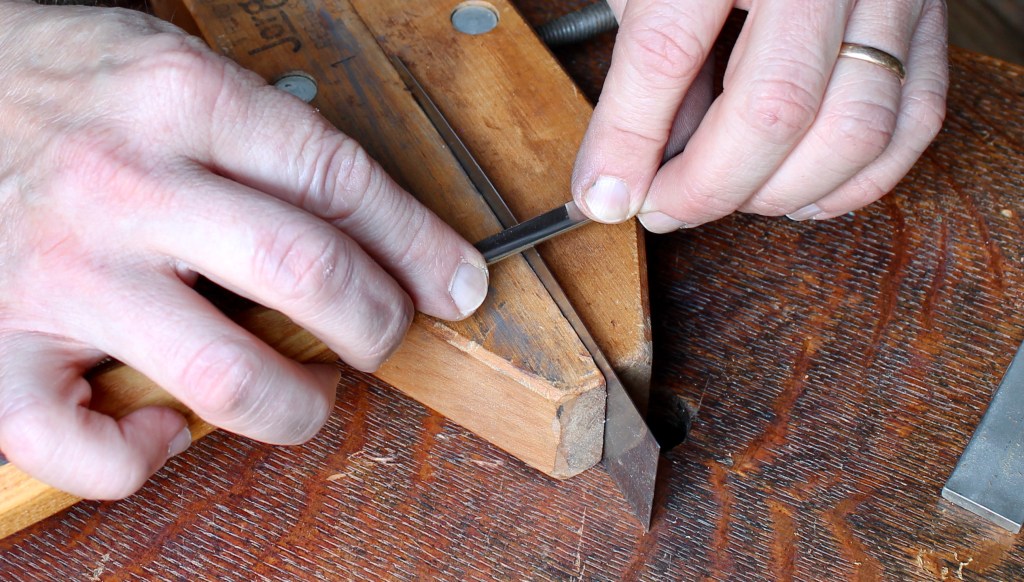
Above, I’m honing the face of the scraper to remove any of the old burr. I just lay the stone flat on the scraper and go back and forth near the edge. Then I clamp the same sharpening stone in a hand screw clamp.
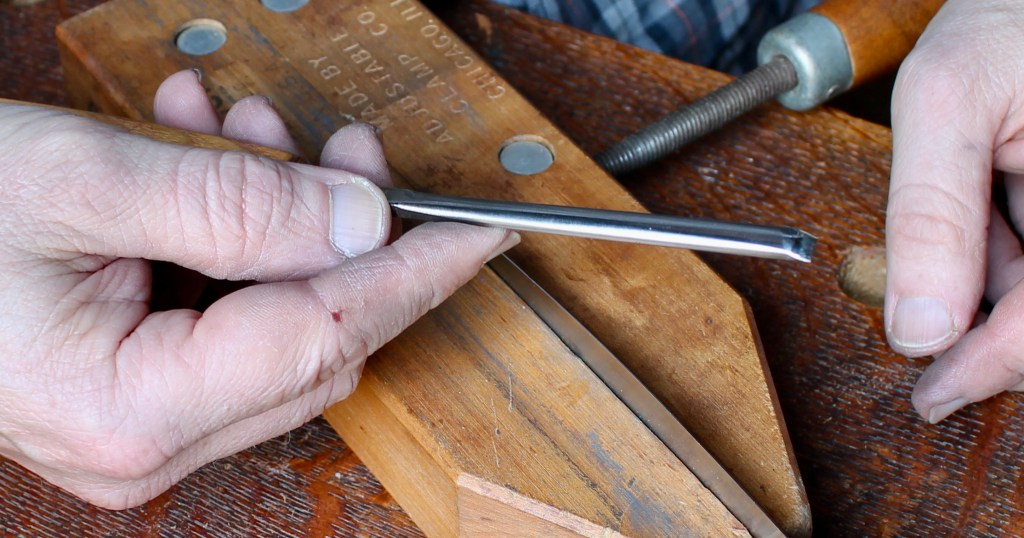
Honing the edge of the scraper.
I don’t remember if I’d seen this exact method somewhere before, but there are lots of ways to achieve 90 degrees. Diamond stones are ideal for this, since they won’t be gouged by the narrow edge of the scraper. Clamped like this, the stone is held at 90 degrees to the side of the adjacent surface of the clamp. I keep the scraper flat and go forward and back on the stone. In the case of the curved scraper, I just rotate slightly as I move the scraper. I progress quickly to the finest stone on face and edge.
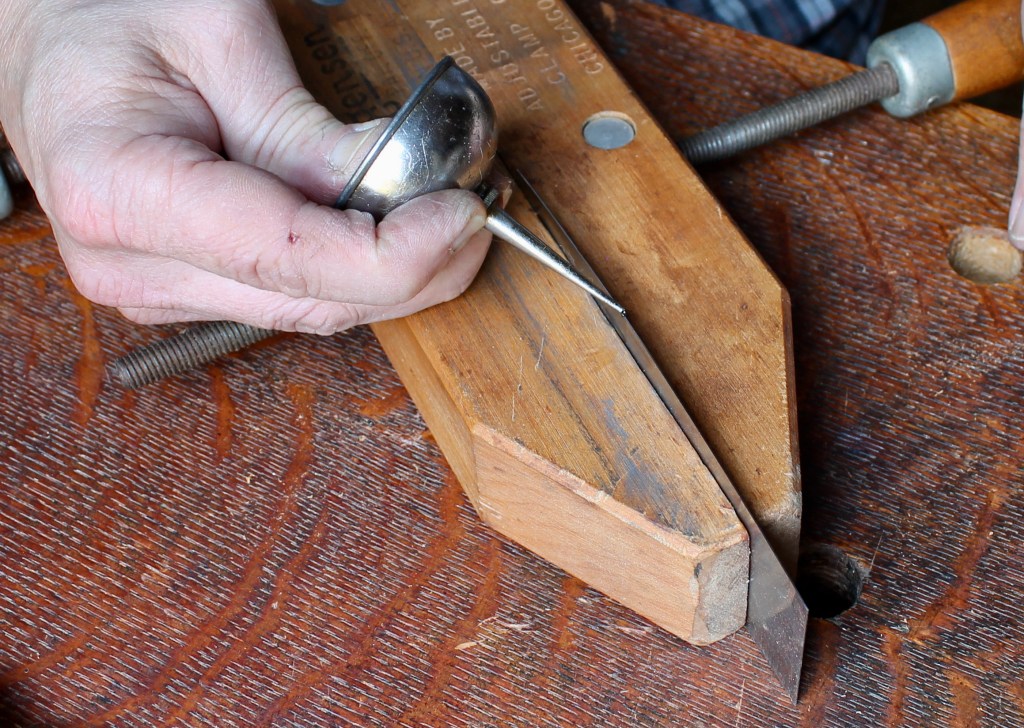
To create the burr, I usually use a burnishing rod, but you really just need any polished steel that is harder than the scraper. Here I’m using the backside of a carving gouge. Cover the tip of that gouge first for safety, or better yet, get something like this. I hope it goes without saying that I have no connections or deals with Lee Valley Tools, but I’ll make that clear anyway.
Put a drop of oil on and rub it along the edge.
Using a little pressure, run the burnisher along the edge smoothly, at 90 degrees a couple times. (I forgot to take a photo, but I rub the burnisher flat on the face a couple times before burnishing the edge.) Then tilt it a few degrees and run it again, then a few degrees toward the other face for one last time. Now both faces are ready to go. You can always use more pressure to make a more aggressive burr, but that is not necessarily better. Experiment and see what best suits your preferences and the situation. You can re-establish a burr a few times by burnishing before going back to the stones.
Typically, the scraper will be pushed with the thumbs supporting from behind, but all sorts of grips (and pulling) are possible, especially on oddly shaped pieces.
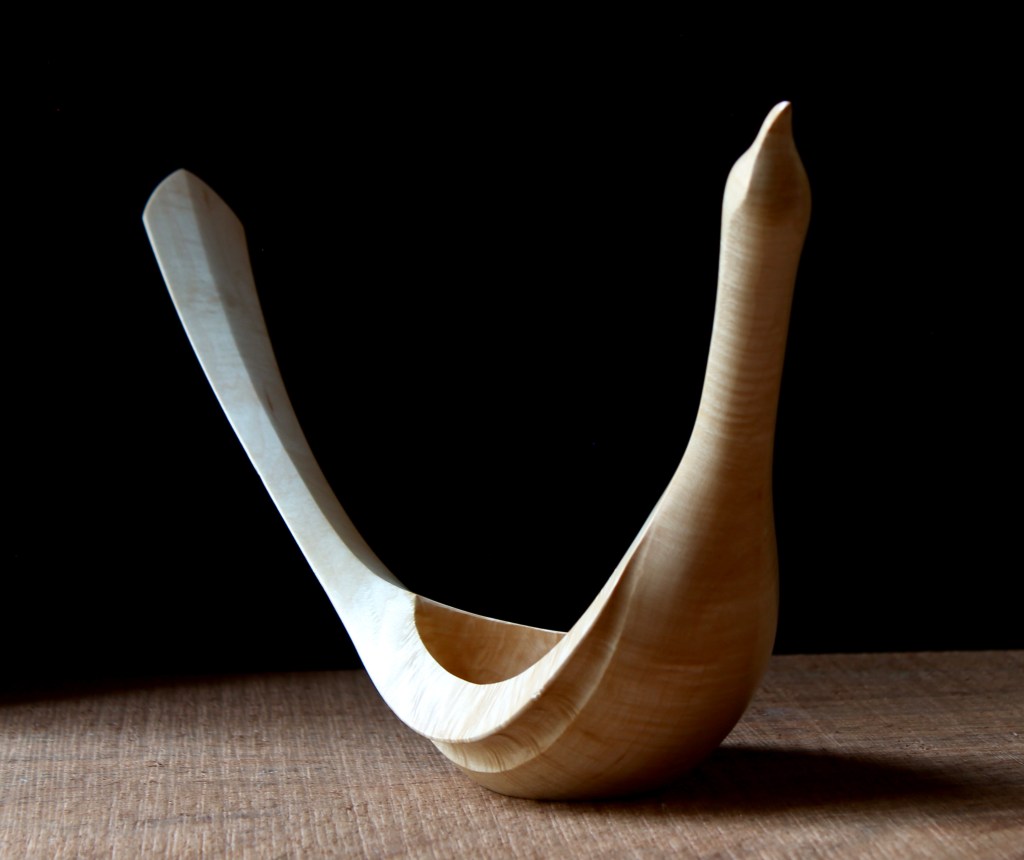
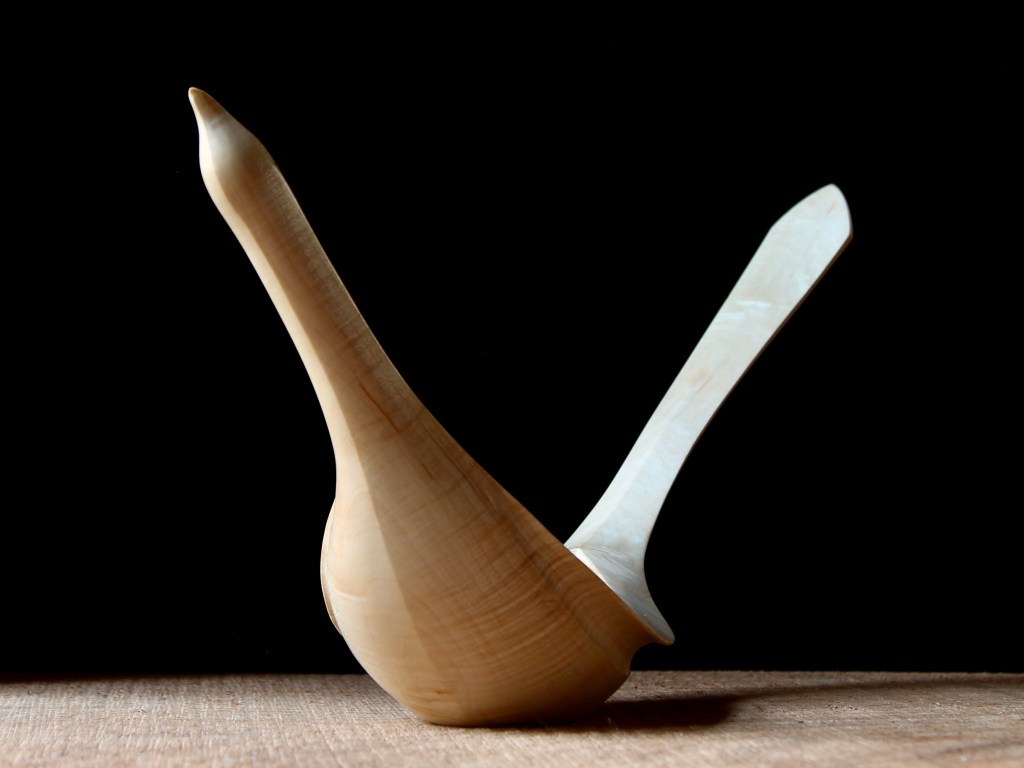
A blank canvas can be daunting. I like how the peculiarities in a piece of tree focus the possibilities for me. I just finished this bird bowl from a twisted maple branch and I thought I’d share some photos I took along the way.
Above is the piece after splitting the branch in half and roughly shaving the bark off. It was a tough split, and I probably should have relieved some of the tension by cutting along part of the pith with a rip saw first. Notice that area of torn fibers on the left side; we’ll revisit that spot later. I sketch a line on to get an idea for the flow of the piece.
One of the first things I do is to hew with the axe across the grain at the bottom of the crook to establish the general attitude of the bird.
In the shot above, I’ve shaped the parts of the upper surface with a drawknife and a very course rasp. The rasp works well across the grain especially in highly figured hard wood like this maple crook. I’ve also sketched on a rough outline and have chopped away some excess with the axe.
Now that the bird is taking form, I refine the foot by working across the grain with a plane. I go across the grain because the fibers are climbing from opposite directions as it approaches the foot.
Now a big jump to this photo. The shape is there and the bowl has been hollowed with gouges and hook knives. I left the hollow of the bowl and the flutes under the wings straight from the cutting edge. For this piece, I decided to make the other surfaces smooth beginning with a card scraper.
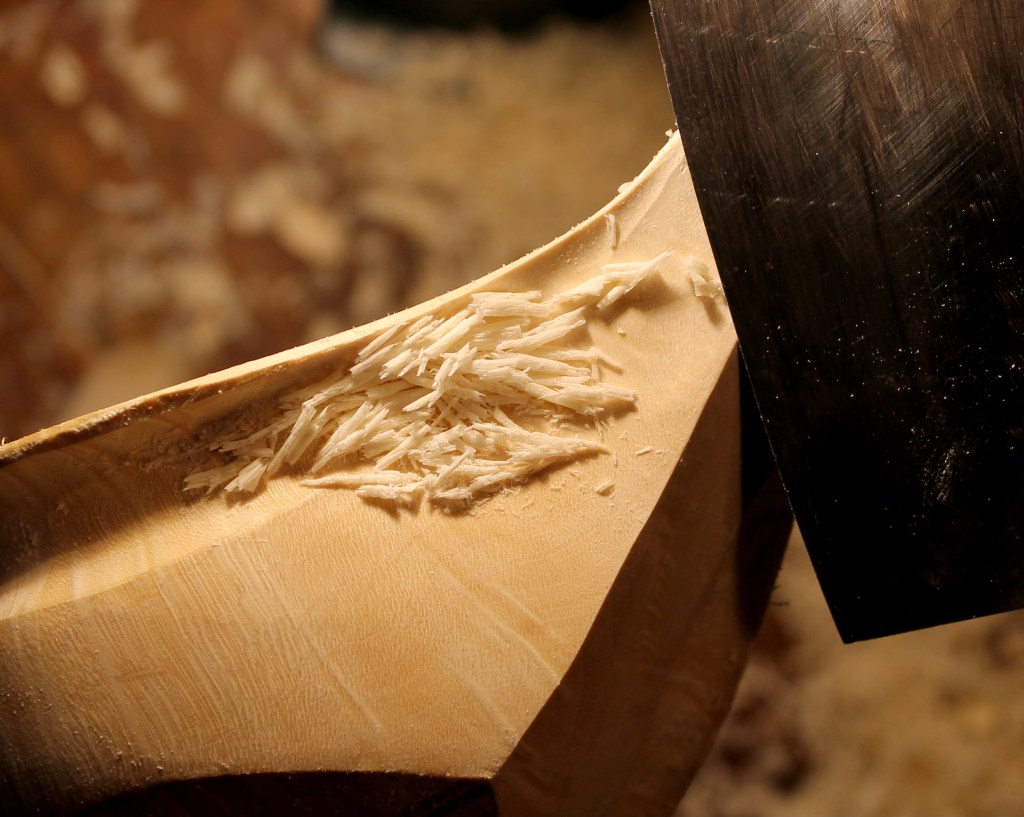
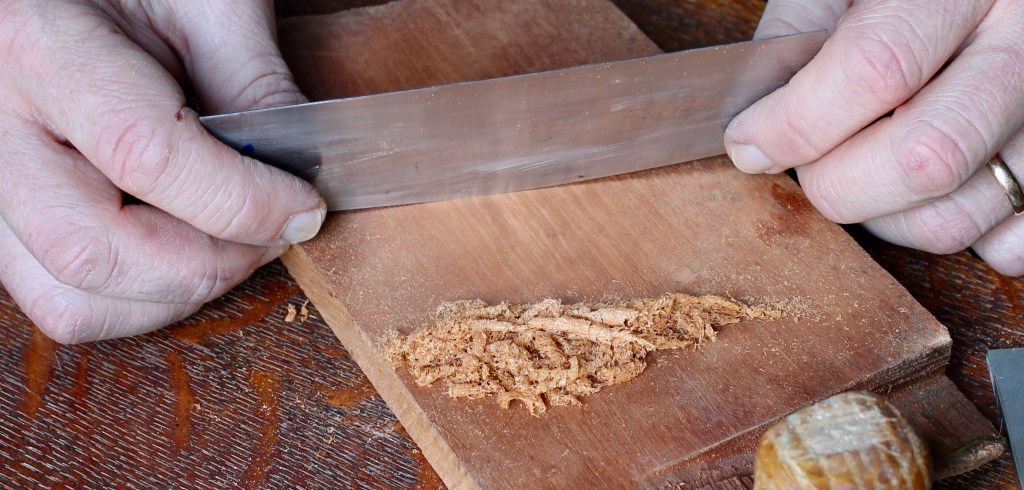
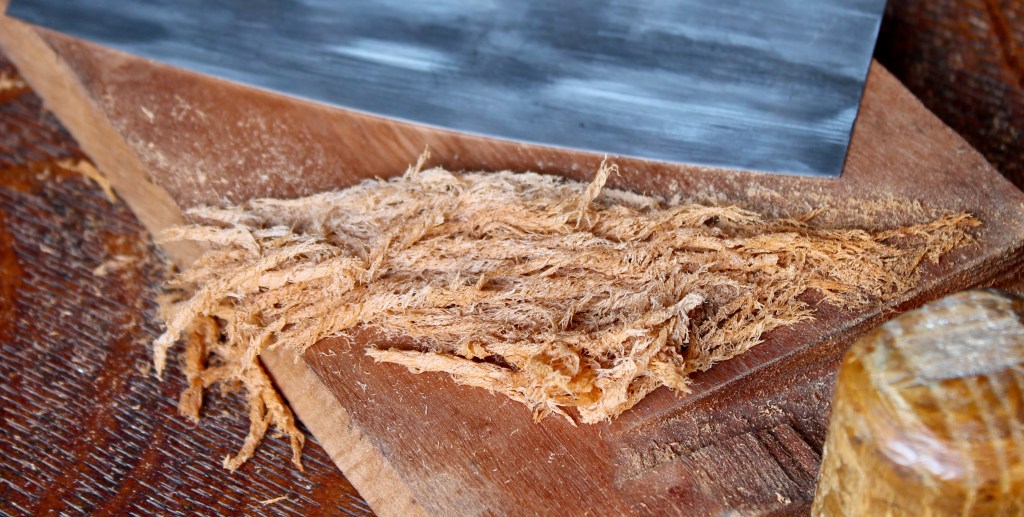
Here is a shot of the wispy shavings cut by the edge of the scraper. A sharp scraper can actually do some significant shaping and leave a smooth surface. Rather than make this post too long, I’ll follow up with another post soon about scrapers. On this piece, I followed the scraping by sanding with just very fine,400 and 600 grit, sandpaper.
Remember that ragged split I mentioned at the beginning? Those hairline splits in the back of the wing are the remnants of that — there since work first began on this piece. I let a little CA glue wick into them and they are solid, but dang. Oh well, I have a few scars too.
The perspective above gives a good idea of the wind that was present in the branch.
The surface of the hollow is left from lots of light cross-grain cuts from a hook knife.
This bird is 13″ long, 8″ high, and has a happy home waiting.
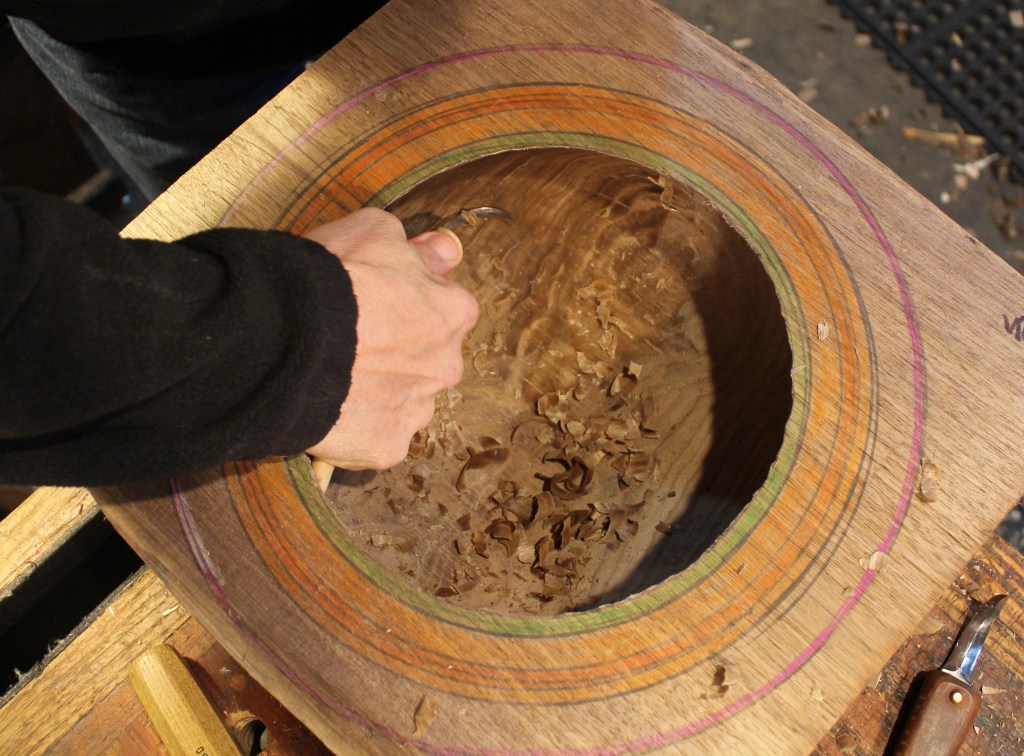
The plan is to carve a deep round bowl from black walnut with a wide surface below the rim for a lettered inscription. Here, I’m refining the hollow with a crooked knife after having done the rest of the hollowing with a little adze work and a lot of bent gouge work. In order to accommodate the outer shape I want, I carved a substantial undercut below the rim on the interior.
Laying out a round bowl is pretty straightforward. I wrote about it in this post. Sometimes I tweak that process as I did with this bowl. It may be hard to tell, but in the photo above, the “circle” is wider across the grain than with the grain — by about 3/8″ (10mm). I just use two focal points to strike the compass arc on each side of the center line — each focal point is 3/16″ (5mm) away from center. You end up with two semi-circles with a narrow gap between them to just bridge by eye.
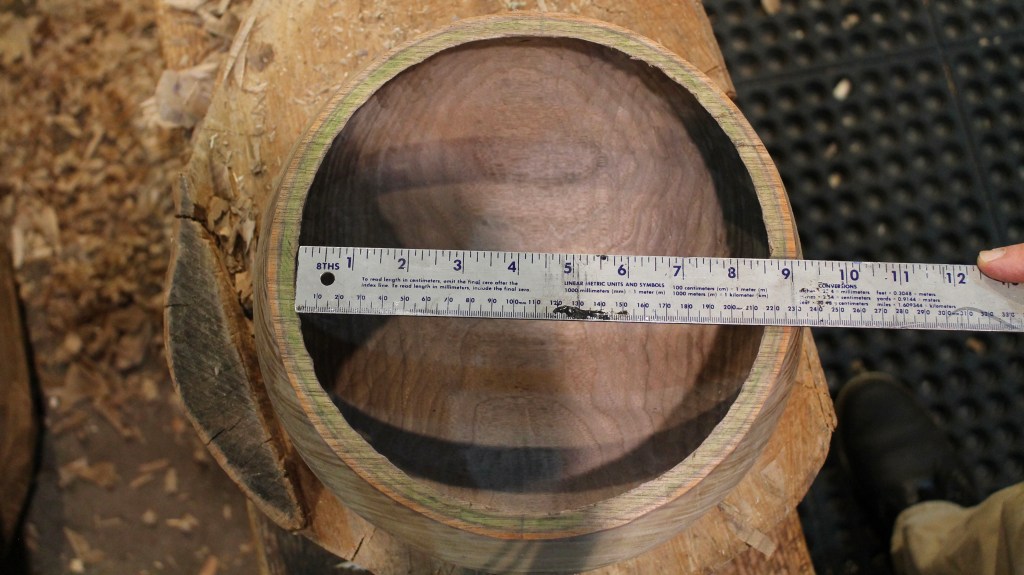
Before drying, fibers/grain running perpendicular to the ruler
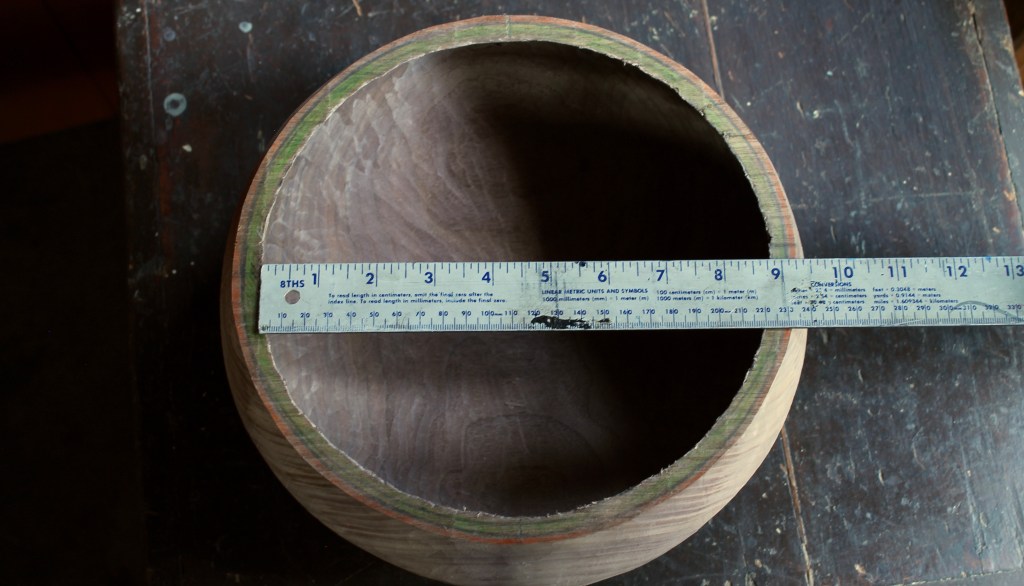
I stuck a ruler up to it while the bowl was still green. The shot above shows the inside measurement across the grain at about 9″.
Before drying, fibers/grain running parallel to the ruler.
While the measurement with the grain is about 8 5/8″. I know the bowl will shrink across the grain as it dries, but not in the direction of the grain. So the idea is that the bowl will start out as a bit of a wide oval but shrink to round. It’s not that important, but it’s really no trouble to do. You could look up expected shrinkage percentages on tables based on species and such, but I just took a guess since it’s not critical that the bowl end up absolutely round. Plus there are too many variables at play to predict with certainty.
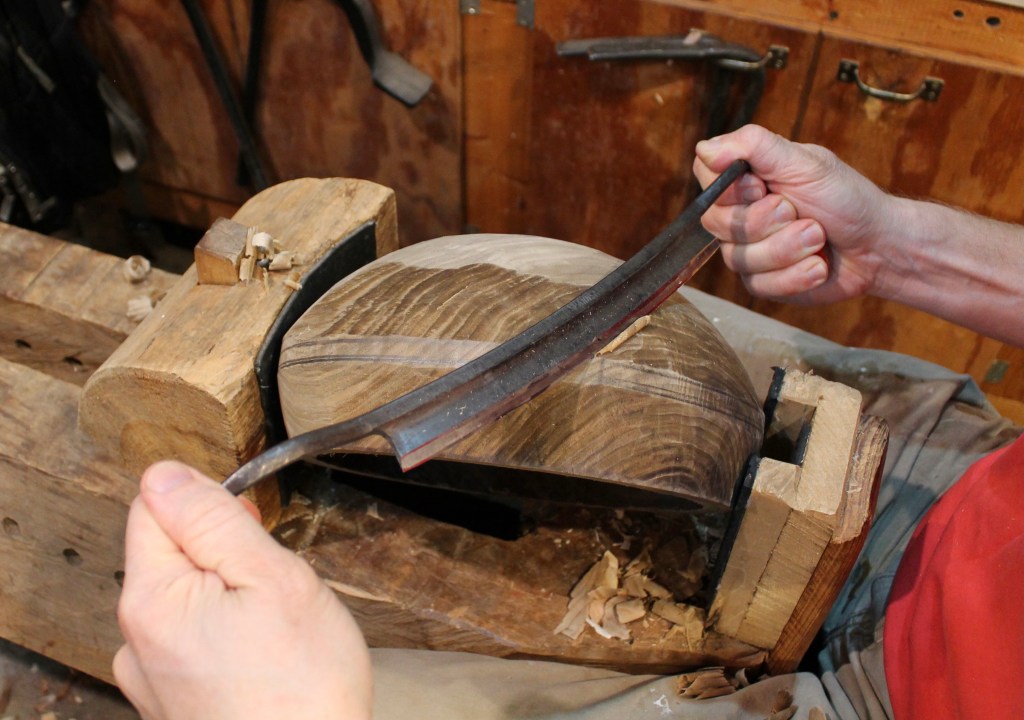
After hollowing the inside, I hewed away all of that excess from the outside with the axe. Just finishing that process in the photo above.
I followed up with a drawknife at the bowl horse. A spokeshave works well to fair these surfaces too.
To mark the guidelines around the bowl, I lay it on the bench and, using whatever is convenient as a spacer, I do a combination of spinning the bowl and sliding the pencil/spacer stack. You can accomplish the same thing with a pencil compass, a stack of books, or whatever.
After drying, fibers/grain running perpendicular to the ruler.
After roughing, I set the bowl aside wrapped in an old sheet for a for the first few days. After that, I removed the sheet and let the drying continue. It has now been nearly three weeks of drying. I’ve been weighing it periodically, which is unusual, so I might as well report the results. It is just about done losing weight, losing a third of it’s weight at this point — dropping from 3 lb. 4 oz. (1474g) to 2 lb. 1 oz. (934g). So that’s 1 lb. 3oz. of water evaporated, or, in terms of volume, about 2 1/4 cups (540ml)
It was able to move as it dried, resulting in the dimension across the grain decreasing from 9″ to 8 5/8″. It may end up around 8 1/2″, so I underestimated a bit. Close enough.
After drying, fibers/grain running parallel to the ruler.
With the grain, the bowl actually gained 1/8″, going from 8 5/8″ to 8 3/4″. Maybe it was the combination of the flexibility of the shape and the forces as it shrunk across the grain — sort of like squeezing a plastic cup. I guess.
That’s just the beginning. It’s waiting for the next stage when I get a chance.
You know, I’ve often said that every poem solves something for me in life. I go so far as to say that every poem is a momentary stay against the confusion of the world. But, of course, any psychiatrist will tell you that so is making a basket or making a horseshoe. Giving anything form gives you a confidence in the universe, that it has form.