
Unless stated otherwise, I finish my bowls and spoons with purified linseed oil and or a pure linseed oil and beeswax blend. Here are some straightforward guidelines for continued care of your bowl.
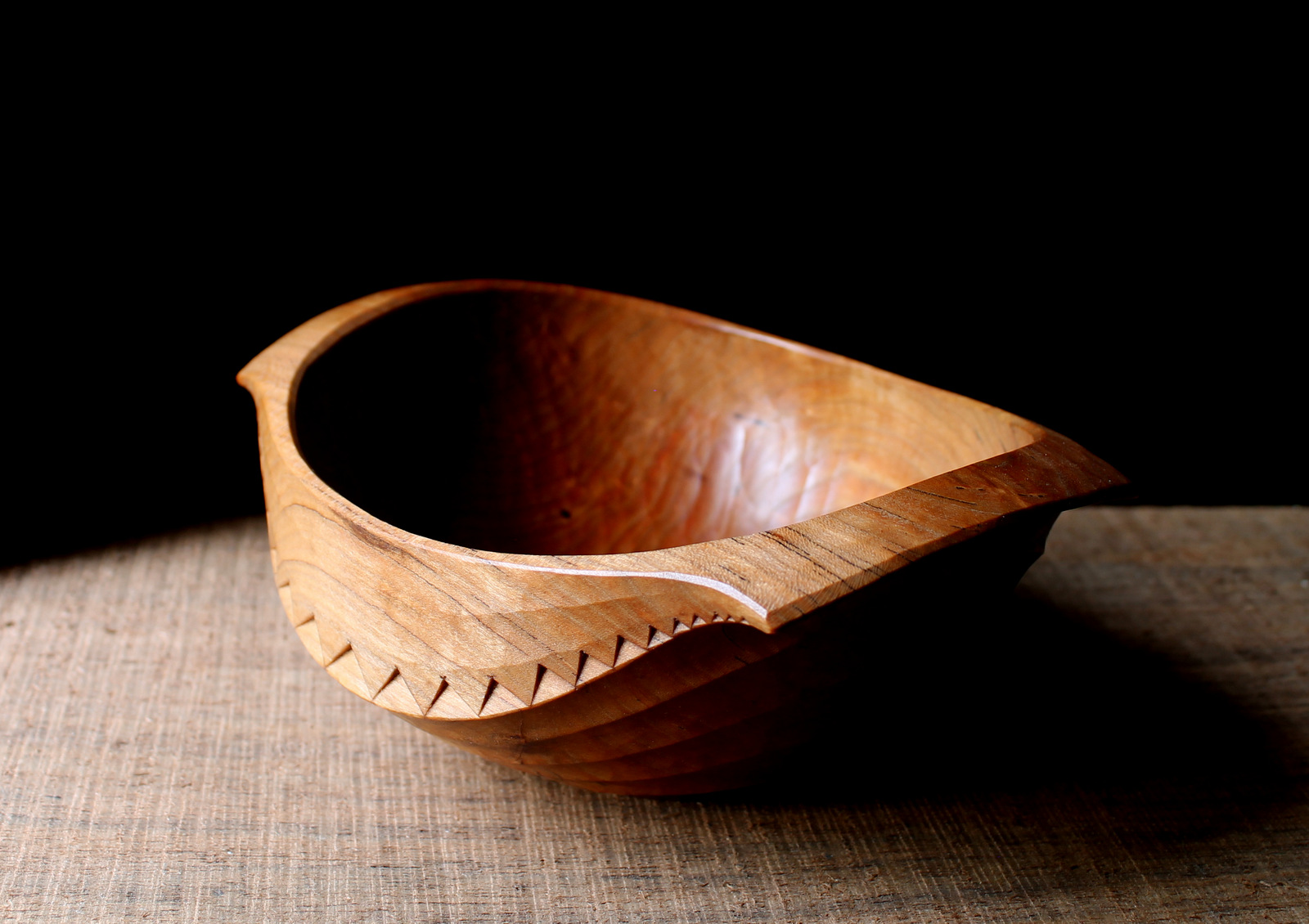
If the bowl or spoon is just used for dry things or no things, it will likely need no treatment at all. Just dust it off with a dry cloth occasionally.
Use with foods is fine and encouraged. If it needs to be washed after stirring the pot, holding salad, etc., then just wash it with a washcloth at the sink (with a little soap if necessary), rinse, and dry it with a towel. Avoid soaking and don’t put wood bowls or spoons in the dishwasher.
In any case, if the wood starts looking a little dull for your taste (there’s no need to finish the wood at all), you can reapply some oil or an oil/wax blend. To freshen with oil, just put a little on a lint-free rag and rub the bowl to deposit a thin amount into the surface of the wood, then buff away any excess. Same process for an oil/wax blend. I like Viking’s Linseed Oil Wax. There’s not much difference between the oil and the oil/wax blend other than a little more luster with the oil/wax blend (which you may prefer or not) and the fact that the blend seems to leave the surface feeling more immediately free of any oiliness. Either way: Easy peasy. Feels and looks great. Totally and immediately safe for your food, your hands, and the environment. I like the scent of linseed oil, but some find it objectionable. Pure tung oil or walnut oil are excellent alternatives. *Oily rags can combust. Soak them in water before disposal.*.
Of course, something that gets used is bound to show signs of use. This patina of use can make the object all the more beautiful. A spoon that is worn over the years from continually contacting the bottom of the pot has a character of its own. Ultimately it is up to the owner whether to “use” a piece.
So, that’s it. If you really want to know more about oil you may wish to read on.
For fellow woodworkers/carvers who want to dig much deeper into oil:
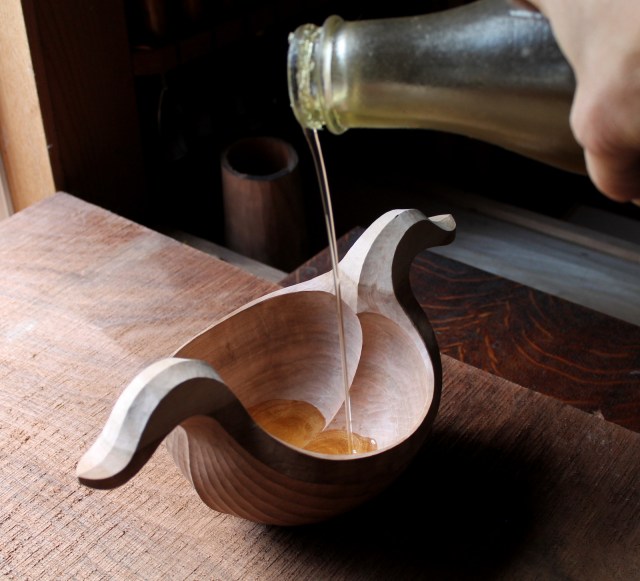
Some basic principles about oil (as I understand it!):
Both flax seed oil and linseed oil are the oil of flax seeds. Flax is a plant that was cultivated thousands of years ago and has been used for linen and oil since the beginning of civilization. The label “flax seed oil” is used for food-grade oil that is sold in health food stores as an edible product. Pure linseed oil may not have been produced with the idea of drinking it in mind, but it is still pure and safe for treating wooden ware for food contact. Conversely, hardware store “Boiled Linseed Oil” is not truly “boiled,” rather it has harmful ingredients added to speed drying time. Here is a simple break down of terminology as I understand it, but there are all sorts of labeling variations:
Cold pressed flax seed oil: Flax seeds are cold pressed and bottled in conditions that are so clean that the oil is fit for human consumption. Cold pressing simply means that the oil is removed from the seeds mechanically only. It is squeezed out.
Cold pressed linseed oil: The same thing as above, but not necessarily processed in a facility that meets the standards for human consumption. Still pure, cold pressed oil.
Refined linseed oil: Cold pressed oil that has been refined in some way, this could be through filtering, sun bleaching, heating (polymerizing), oxidizing with blown air, aging, or a combination of the above. There are many variations, and an entire article could be written about each of those processes, but I’m not qualified to do it. Looked at generally, these processes are intended to make the oil cure more completely and quickly, and/or be lighter in color.
Hardware store “Raw” Linseed Oil: I found the information on this after persistent pestering telephone calls to a production facility. They finally put me in touch with a very helpful employee who explained that after cold pressing, the seed mash still retains a significant amount of oil. This remaining oil is extracted through the addition of solvents such as hexane, resulting in a mixture of solvent and oil. The solvent is then evaporated off through the use of heat and careful processes, leaving behind 100% linseed oil. It is “raw” but not cold pressed.
Hardware store “Boiled” Linseed Oil: The name refers to the traditional practice of heating or polymerizing oil to make it dry faster, but this product is not truly boiled at all. Instead chemicals are added to the oil. Commonly these can be naptha, mineral spirits, or dipropylene glycol monomethyl. Cobalt and manganese are also usually added as drying agents. Even if you’re not in a hardware store, check and ask questions. For example, Allback’s Raw Organic Linseed Oil is pure, but Allback’s Boiled Organic Linseed Oil, while containing no solvents, does contain a manganese drying agent. Although that information is provided if one asks, it should be made absolutely evident and clear in the product description.
Whether called flax seed oil or linseed oil, these are drying oils that penetrate the wood fibers and then polymerize (cure). Therefore, they provides lasting protection since they harden within the wood. Pure tung oil, walnut oil, and hemp oil are also pure drying oils that are good choices. Mineral oil, while harmless and providing some initial protection, is not a drying oil. It never cures and evaporates over time.
I have tried various suppliers of purified/refined linseed oil . Some to try are Heritage Natural Finishes, Tried and True, and Viking. They refine and treat the oil through oxidation, blowing, filtering and/or heating. I bought a three gallon container of “Special Aged Linseed Oil” from Heritage Natural a while back, so that is what I’ve been using lately, and I like it a lot. Heritage Natural also has pure tung oil as does RMP Finishes (formerly known as Real Milk Paint Co.) There are many oil/wax blends available. One I like is Viking’s Linseed Oil Wax, a blend of pure linseed oil and beeswax.
Regardless of source of the oil, heat speeds up and improves polymerization. Setting a piece in the hot sun, by the wood stove, or in a light bulb kiln will all work. I usually keep my kiln at about 130 degrees Fahrenheit and keep spoons and bowls in there for a day or two. For an occasional light refresh of a piece with oil, the heat is not necessary.
Making Your Own oil/wax blend:
It’s actually pretty easy to make your own oil/beeswax blend. If you’d like to try it, here’s one idea:
Put about four fluid ounces (1/2 cup) of purified linseed oil in a glass jar along with about 1/2 ounce (by weight) of beeswax (about the size of a one inch cube). Put the jar into a pan of water on the stove and heat just until the wax has completely melted into the oil. Be careful with oil around flame. Stir to assure an even blending, set the jar aside and allow it to cool into a paste. Seal up the jar with a lid, and it is ready to go as you need it.
Just rub some into the wood, allow it to absorb for awhile (even overnight if you want), then buff off the excess with a paper towel.
You can also add just a touch of carnuba wax for a litte more toughness and luster.
Of course, you can make a bigger batch, or you can adjust the proportions of oil to wax to make a thicker or a thinner paste. To adjust the consistency , just add more oil or wax and remelt it.
 David Fisher, Carving Explorations