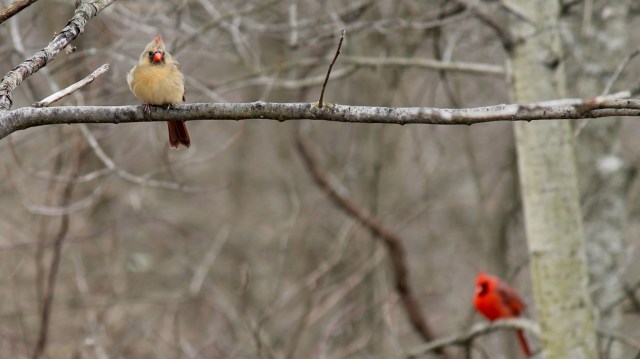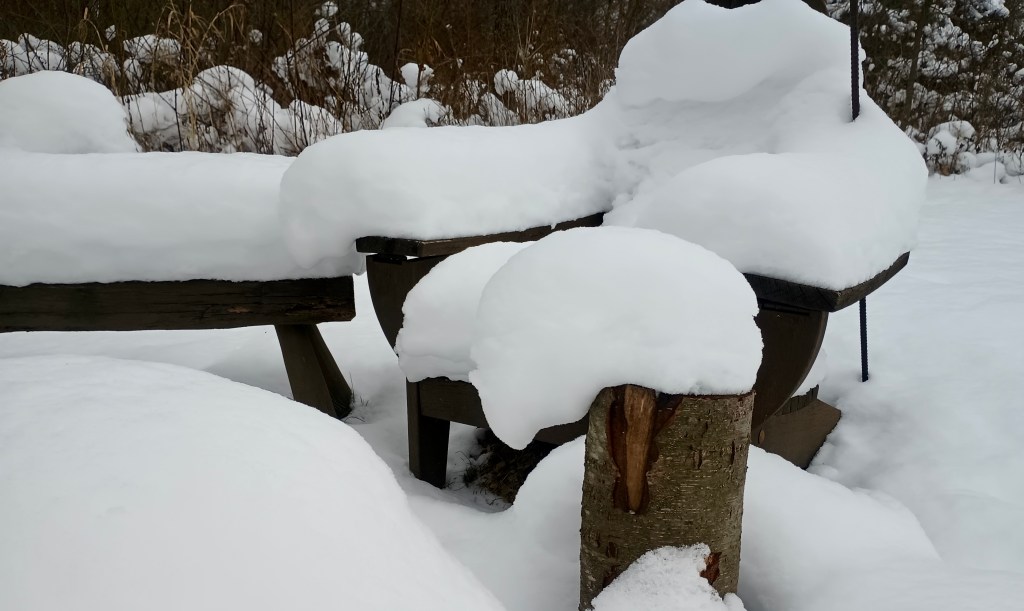
The perfect surface gone Criss-crossed and written on Where the wild creatures ranged While the moon rose and shone.
May Sarton, “December Moon” from Coming Into Eighty
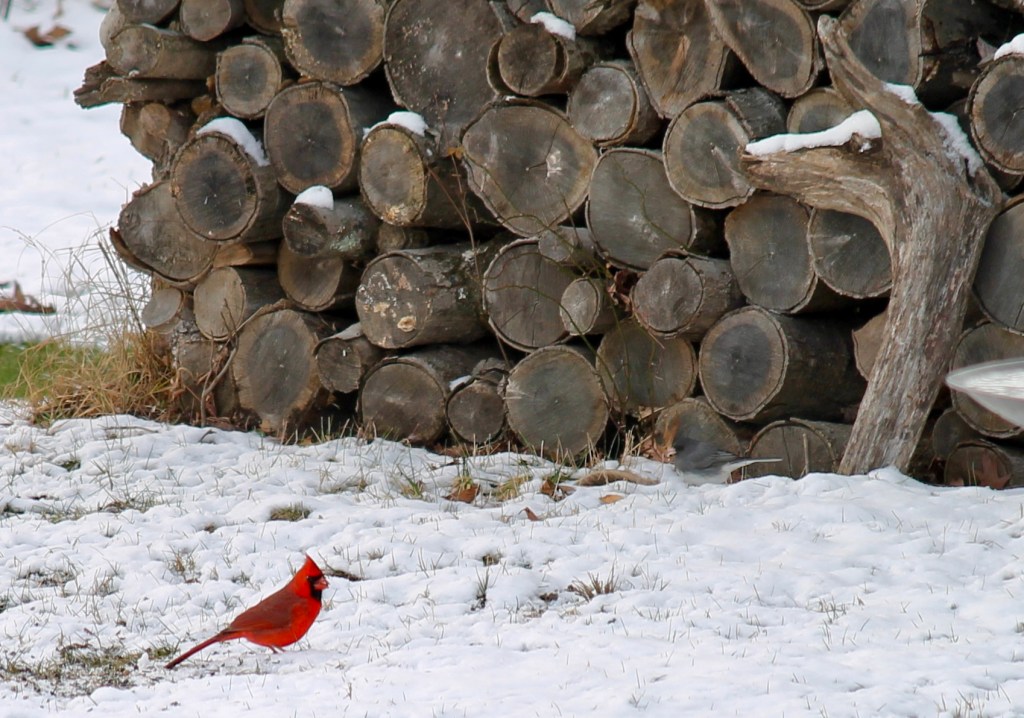
Looks like it will be a white Christmas here this year. The bird tracks in the snow yesterday brought May Sarton’s lines to mind. And another, heavier, blanket greeted us this morning.
Where has December gone? I’ll have lots of carving-related stuff to post about soon. For now, have a happy holiday and safe travels wherever you make tracks.
About a month ago I wrote a post about laying out this walnut bowl to account for the shrinking that would come with drying. Well, I got lucky and it dried pretty close to a circle, but there was still plenty to do. Not just the surface carving, but also dealing with some of the movement that takes place during drying.
After using a block plane to fair a bit of wonkiness out of the upper surface of the rim, I placed the point of my compass just inside the outer edge of the rim and adjusted the span by eye so that the pencil reached to what looked like the center of the bowl. I struck a short arc across the center area. Without changing the compass setting, I moved the compass point around the rim, striking a line each time.
The center of the space between the lines is the center of the bowl.
With the point of the compass placed gently at the center of the bowl, I struck two circles to finally define the rim, making sure both lines were completely within the available field.
With a fresh circle established on top, it was time to turn to the bottom. As expected, the bottom surface had cupped as the bowl dried. Before flattening it, I extended the axes down onto the outer walls of the bowl so that I would be able to re-establish the center point by connecting the lines.
I planed the bottom flat, flipping it over now and then to make sure the bowl sat evenly. In other words, to make sure the planes of the rim and foot were parallel.
Then I re-established the center point and struck the circle that defined the foot.
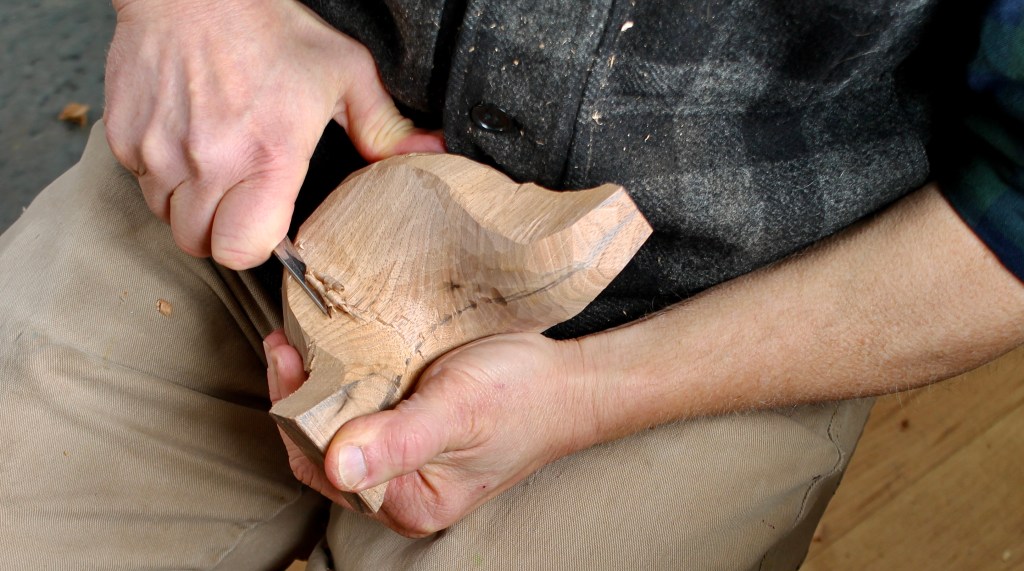
After more carving to get to the final form of the hollow, I worked my way around the whole interior surface with light push/paring cuts from a shallow gouge (just a small portion of the edge in this case). The subtle cleanly-cut surface will serve and clean up well. This is repetitive work, but each cut takes a certain amount of focus. As the grain orientation changes, adjustments to force and skew have to be made. Still, not a bad time for an audio book. I also textured the outside surface in a similar fashion, but with a steeper gouge. Have another audio book ready. I’ll recommend The Poet’s Corner by John Lithgow. What a world; Morgan Freeman will read poems to you while you carve.
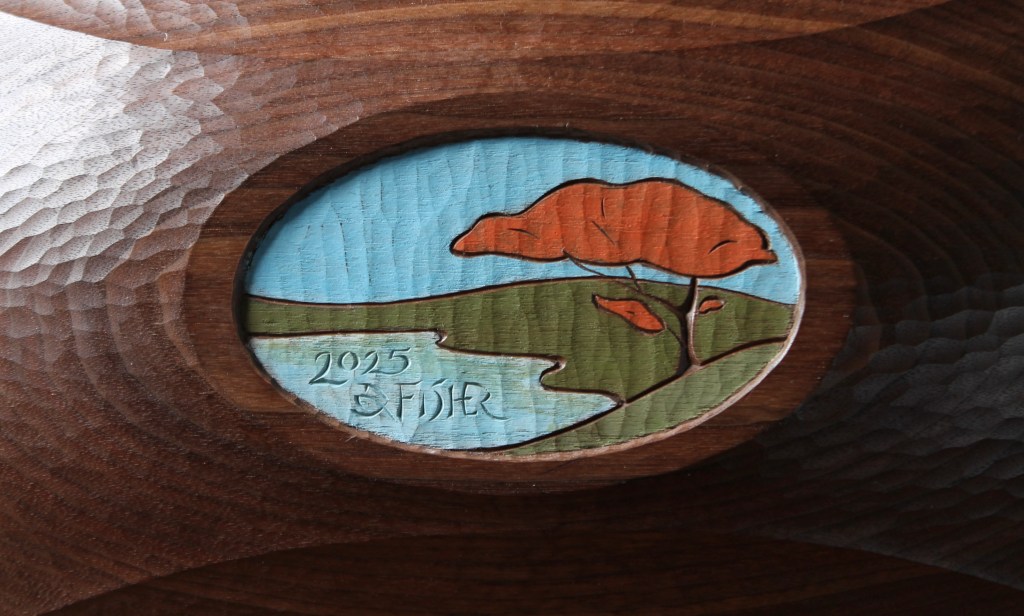
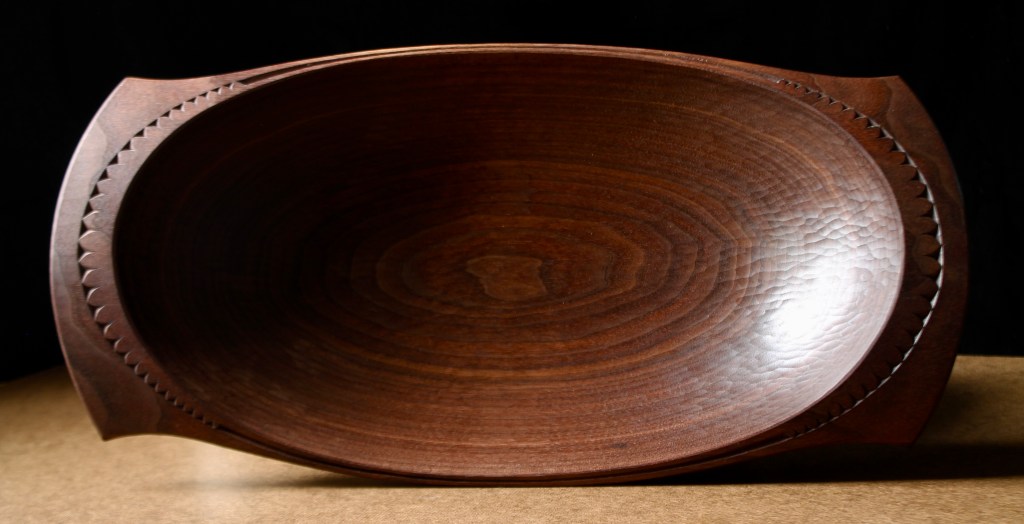
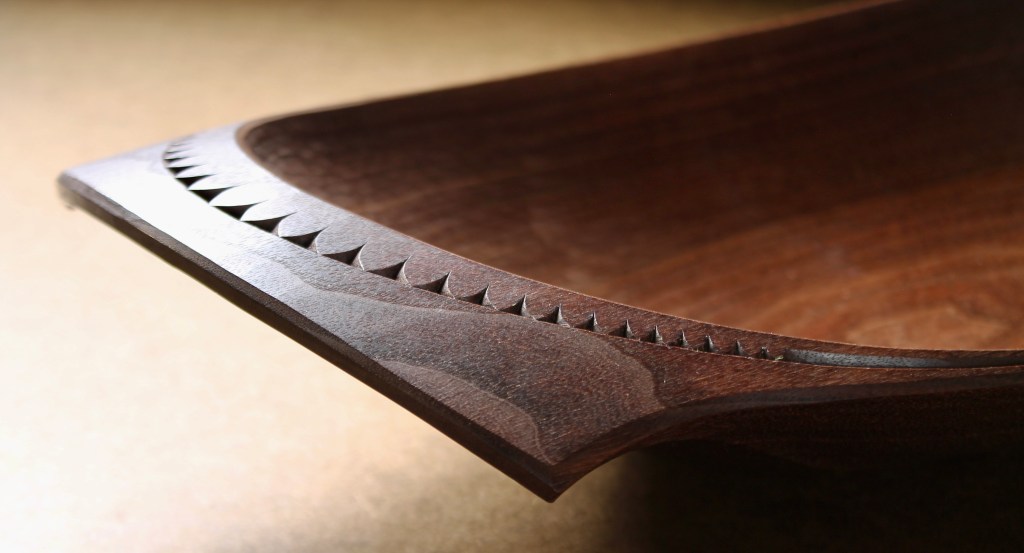
And the final touches. I’m carving (what I’m calling) a pie-crust detail around the inner rim. Notice the holdfasts. If you don’t know what to get that special someone for the holidays — holdfasts.
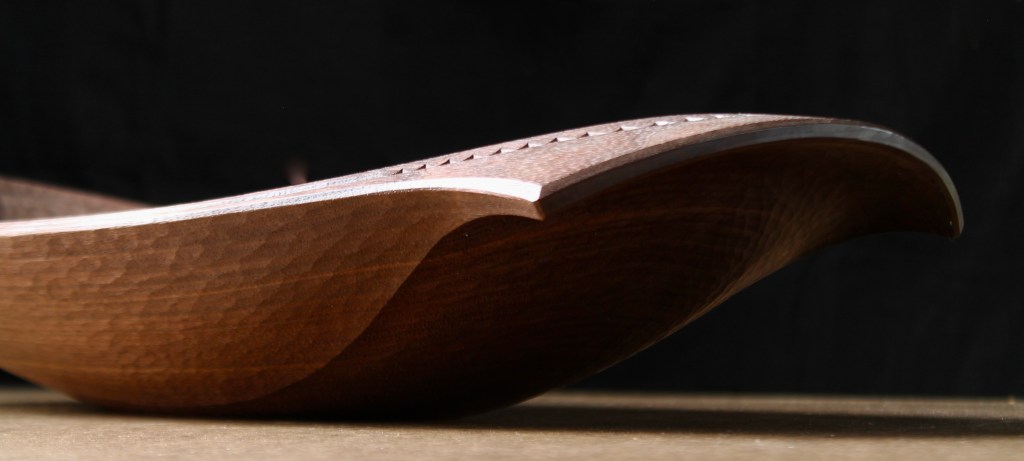
I’ll end this post with a few shots of the finished bowl. Finish is pure linseed oil, heat-cured over a radiator/space heater. At 18″ (46cm) diameter, this bowl wouldn’t fit in my kiln. This bowl already has a home.
Back in February, Jon Binzen came to my shop and shot photos as I carved a bowl from a board. It will all be in the next issue (#315) of Fine Woodworking magazine, which should go out in a week or so. I’m always amazed to see the final product in the magazine. Whatever I may contribute, Jon and his team surpass it with their photography, editing, and layout artistry. I have a list here of other articles I’ve done with Fine Woodworking.
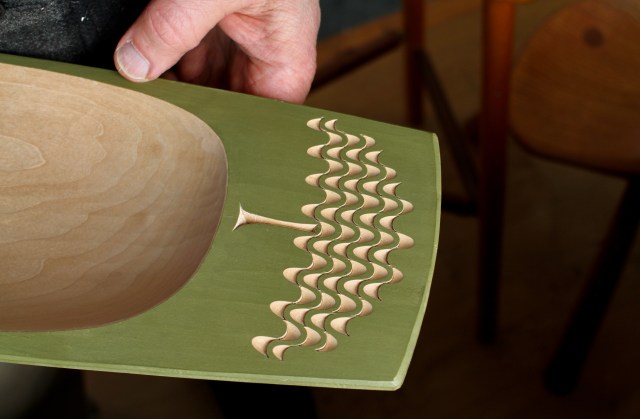
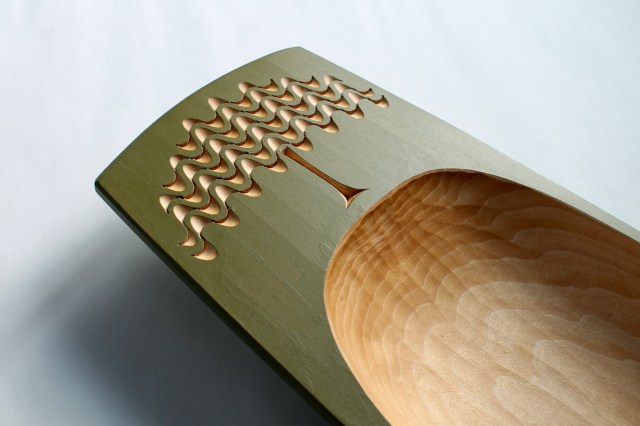
There are two separate articles in this same issue, one for the bowl, one for the tree. They let me draw layout plans for both. And there’s a lot more in the issue as well, including one on building a sweet tool tote designed by Mike Pekovich. I noticed it’s a nice size for carrying a kit of carving tools.
I first started playing with this design two years ago and I’ve written a few posts about it along the way. A search on the right under “Bowl from a Plank” will bring them up. Jon’s title, “Bowl from a Board” sounds much better, but I’m not going back and changing “plank” to “board” on everything now. This is the same design we carve in my Bowl Carving Exploration course at Pete Galbert’s, but the course, of course, goes well beyond the scope of the article in terms of bowl carving, decorative carving, design, sharpening…
I’ve been hanging on to this one until the issue went to print — just in case there was an emergency requiring more photos. No need to be concerned with that now, so I’m offering it for sale. This is the bowl that was carved from start to finish through the articles. Butternut, 21″ x 6″ x 2″. $750 includes shipping. And I’ll include a copy of issue #315. Email me at dandkfish@gmail.com if you’re interested. Thanks. SOLD
Ambrosia Maple Butterfly Bowl 2024. 16 1/4″ x 10″ x 3 5/8″.
I should take my own advice. I tell people to be careful to look for the tiniest checks in the end grain of a log because they will open up as the bowl dries. If a log section has been cut and sitting out in the sun for even a day or two, checks can sometimes run in further than one might think. I also warn against carving, during the green stage, in a breeze. You may have to close the shop windows on a windy day.
A good friend led me to some logs from a silver maple that had recently been taken down. This maple had been visited by ambrosia beetles. It seems that they share their name with the food of the gods because they create their own food within the tree. They bore a system of tunnels and chambers in a tree while carrying a fungus on their bodies. The fungus grows within the tree, generally following the path of the tunnels. The beetles, little farmers, cultivate the fungus growing on the tunnel walls and rely on it as their food source. I suppose the fungus looks less appetizing (to non-beetles) than the classic colorful ambrosia salad, but it sure does leave some bold streaks of color through the wood.
Seeing the abundance of streaks, I wanted to make the most out of this ambrosia maple log, so I resisted cutting off much end grain. As I shaved away gleefully on a breezy day, I noticed a couple narrow cracks working their way in from the ends of the handles (not long after the photo above was taken).
I walked across the shop calmly, pausing only to slam the bowl against my forehead a few times. I grabbed some liquid superglue and let it wick into the crack. I put a couple clamps across the handles for a day, then I removed the clamps and let the bowl dry as usual over the next few weeks. If the cracks were going to open up, I wanted to know now before investing any more time in the bowl. They stayed closed tight.
After the bowl was dry, I finished the inside and outside with gouges. On the exterior of this one, I worked the gouge straight around the bowl with cuts from a #6/12mm gouge.
When it came to the top of the handles, I wanted to add some mechanical assurance against those cracks ever opening up. A method I’ve used before is inlaying the classic butterfly keys, also known as bowties or dovetail keys.
Maple dovetail keys in a walnut table.
I decided to make these keys look more like butterflies. So, I drew up a design for a stylized butterfly. For the wood, I reached for a small box stuffed with ebony offcuts. The box was kindly sent to me by Norm Sartorius a couple years ago and this was a great use for some of it.
I cut and filed three different sized butterflies, about 1/4″ thick. I traced around each inlay with a finely-sharpened pencil, then excavated the wood. I worked mainly with a narrow shallow gouge to first sink a perimeter just a little inside the lines, then break up the wood with a series of stabbing cuts, then plowing the chips out with the gouge. A couple times, then trim up to the pencil line, leaving the line. Some glue, then tap the butterflies down in. After the glue dried, I shaved and scraped them flush to the surface.
Two on one end, large and small.
Medium on the other.
There are a few more shots of the finished bowl below. It’s available for purchase. $875 includes shipping to you. If you’re interested, please email me at dandkfish@gmail.com. Thanks. SOLD
It is 16 1/4″ long, 10″ wide, and 3 5/8″ high. This bowl will hold a lot of fruit, bread, chips and such, but probably not the best for salad; your dressing might leak out through a few beetle holes.
My workshop is our attached garage at one end of the house. While it’s not an idyllic cabin-shop among the trees, I did get pretty lucky that there is a grove of quaking aspens just outside one window. For much of the year the leaves, with their flat wispy stalks, “quake” and flutter in the slightest breeze. It’s such a soothing sound and the trees shimmer like sequined dancers.
In his essay “Listening Point,” Sigurd Olson described his personal discovery of the spot where he would build a small cabin as a base for his exploration and contemplation:
Wilderness sounds would be here, bird songs in the mornings and at dusk. The aspen leaves would whisper and the pines as well, and in the sound of water and wind I would hear all that is worth listening for.
Sigurd Olson, Listening Point (1958)
Aspen Trees in Spring outside of the shop window.
After the leafless winter, it’s a thrill to see the leaves emerge bright green in the spring and play on all through the summer.
Fall aspen leaves through the shop window.
In autumn, the leaves turn golden and begin to fall to the ground, leading me to listen and watch more closely.
Watching the fall leaves always takes me back to reading Peanuts collections when I was a kid. Some of my favorite strips were the ones related to the leaf-falling theme that Charles Schulz returned to again and again. Here’s a link to some of them.
Soon the leaves will have all fallen, but next year’s buds are waiting.
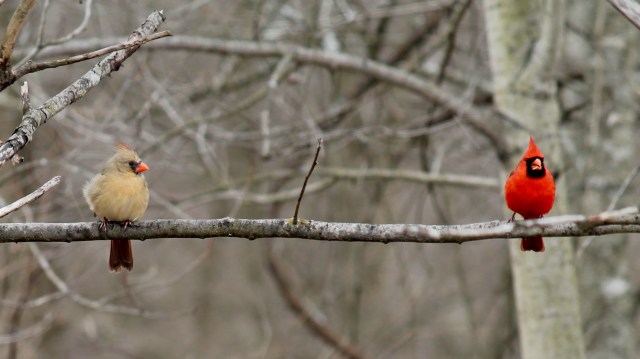
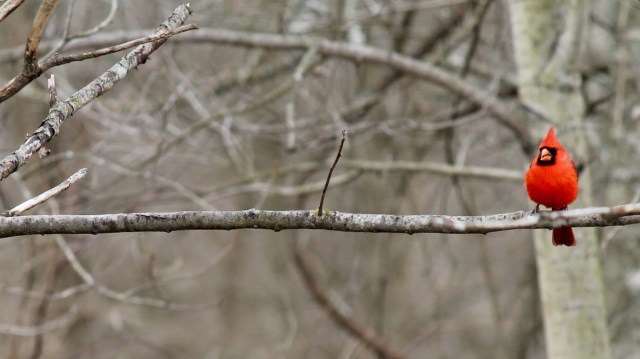
And the leaves aren’t the only things that flutter. These guys will be around all winter.
I’ll end this post with a thank-you to all of you who have been reading my blog. I wrote my first post on January 1, 2015, nearly 10 years ago. This post is number 500! What started it, especially, was all I had learned from Peter Follansbee’s blog. Peter has been a big influence and his example encouraged me to share through my blog and otherwise. He’s got a new blog now, but the old one is still up as well.
In most normal social situations, if I start going on and on about my excitement over a bowl design, or a carving technique, or fluttering leaves, people suddenly remember an important appointment they need to get to. So, thanks for reading and/or commenting on these posts over the years. I’m grateful.
Sometimes, after you’ve hogged away most of the wood and the hollow is nearing the final shape, your hands and eyes tell you that one end/side of the bowl has a steeper slope than the other. Your hands and eyes are usually right. But if you want to verify, here’s a simple technique that I started playing around with this year.
Place a slat of wood across the rim of the bowl. A yardstick works well, but it can be any straight stick. Make/choose a reference mark on the stick to line up with the rim of the bowl. Set an adjustable square so that the blade is somewhere about half of the overall depth of the bowl (It doesn’t matter as long as you keep the same setting when checking both ends). Register the shoulder of the square against the stick and slide it forward until the corner of the blade just touches the slope of the bowl hollow. Make a tick mark on the stick at the edge of the blade (or note the measurement if using a yard stick). Now do the same on the opposite end of the bowl. If the slopes are the same, then the blade of the square will register at the same tick mark. Adjust for any differences by shaving more wood away from the appropriate end until the slopes match. You can check different points on the curve by adjusting the blade of the square, but one reference point in the middle is probably plenty.
This same technique can be adjusted in many ways to check the exterior of a bowl and so on. None of this is necessary, but, especially on larger bowls, it can put your mind at ease that you’re where you want to be. Essentially, it’s a very simplified version of a “pointing machine” used for centuries to assure consistency between a sculpted model and a carving in progress. You can see one in use by a master stone carver in a short film called The Stone Carvers. Filmed in 1984, it documents the carving done for the National Cathedral in Washington D.C. The few minutes with the pointing machine begins at 3:45, but you’ll likely want to watch the whole 28 minute film. It won the Academy Award for Best Documentary Short. The Folkstreams website is a trove of unique films on a variety of subjects, and they have a category dedicated to Traditional Arts and Crafts.
I’ll end this post with a couple short video clips of my own. I set up the camera as I used the adze to do the last bit of shaping on the hollow of an oval walnut bowl a couple days ago. It looks a lot different when the same tool is roughing out big chunks earlier in the process. This isn’t a matter of 10,000 hours of practice or anything. It’s simply about referencing/feeling the bevel against the surface and making minor adjustments as the cut proceeds. The bevel provides control by registering against the surface it has just cut.
In the first (one-minute) clip, below, I’m working on the quadrant to my left. I do that with the bowl sitting flat. Notice, near the end, that the final chips will release at the cross-grain trench where the grain direction reverses. The intended boundary of the hollow is marked by a pencil line. Beyond the pencil line, I’ve scribbled with some red pencil to avoid any potential confusion for myself with any other layout lines.
In this final clip, I’m working on the right quadrant. Rather than try to hold the adze awkwardly (sort of backhanded), I hold the bowl up to allow for a more natural swing. This means I can’t quite see the line at times, thus I tilt the bowl back now and then to see how it’s going. After I make the pass inside the edge of the rim, I use that new surface as a landing zone as the adze begins each series of rows/passes that bring the surface of the rest of the quadrant to shape. Each of these passes ends near the bottom of the cross-grain trench. I don’t bother talking in this clip, either. It simply sounds like somebody knocking on your door for three minutes straight. Zero Academy Award nominations.
For those of you interested in an axe and/or a couple exhibitions of wood art in Philly, read on.
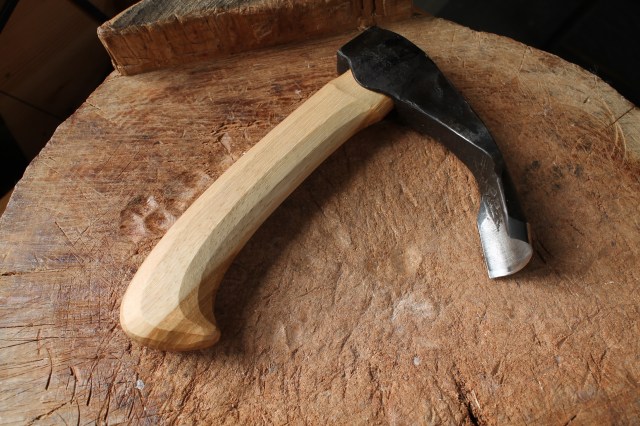
First, a few months ago, Robin Wood sent an axe to me to try out and provide him with some feedback. I’ve known Robin and his daughter, JoJo, now for several years. They’re friends of mine and I admire them as craftspersons and persons. This new axe of theirs, the Wood Tools Sheffield Axe, is forged in the historic steel city of Sheffield, England. It’s the one I’m using in the photo above. You can read more about it here.
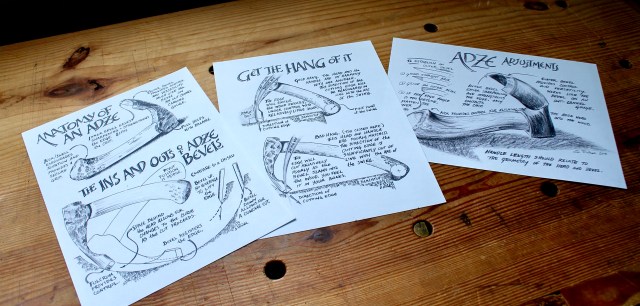
Robin didn’t ask or expect me to post any review or recommendation, but I recorded my observations in my notebook so I’ll share those pages below. Beats typing at a computer.
Two Mark Sfirri Exhibitions:
Last year I had some work included in an exhibition curated by Mark Sfirri, a highly-skilled and imaginative wood turner and carver, known especially for his multi-axis turning techniques. Mark has been making beautiful things from wood for over 50 years and he has two solo exhibitions coming up. One actually opened last night and the other opens December 14. If you can make it in person, there will be a lot to be inspired by and to learn from. Here are some links:
A wide walnut logs came my way a couple weeks ago, and I’ve been busy roughing out a few things from it. One of them will be a big open round bowl, 18 or 19 inches (46-48cm) in diameter. In the photo above, The pith of the tree is up, bark side down. I split the lower portion of this half log for another bowl blank. I chainsawed the corners off to form a rough circle, then hewed and planed the upper and lower surfaces flat and parallel, working across the grain with the plane.
This walnut is green, full of moisture. As it dries it will shrink across the grain but not with it. If I carve a circle, I’ll end up with an oval. So I laid out an oval in order to end up with a circle. I’ve mentioned this sort of layout before, but I think these marked-up photos may make it more clear.
Large round bowl layout — allowing for shrinkage across the grain.
Instead of using one central focal point for the compass, I established two focal points 3/4″ apart from each other along the cross-grain center line. The yellow and blue lines represent the radii forming the right and left boundaries, respectively. The two sides are sketched together in the area of the green boxes. The 3/4″ difference is a hopeful estimate. There are tables with simple shrinkage percentages for various wood species, but there are all sort of confounding variables at play (what time of year was the tree harvested, how long has the log been sitting around, variations in individual trees, etc.).
I’m confident it will shrink at least that much, maybe a little more. At any rate it will end up closer to a circle than it would have otherwise.
Long-handled adze with big round walnut bowl.
For a bowl this big, I began hollowing with this long-handled adze. I hadn’t used it in a while, but I wrote about it a couple years ago in this post.
Surveying the axe work on the outside of the round walnut bowl.
After much more adzing on the inside and axing on the outside, it’s much further along now. It’s wrapped in a couple old towels to control the rate of drying and I’ll keep my fingers crossed.
Drawknife work on walnut bowl blank at the bowl horse.
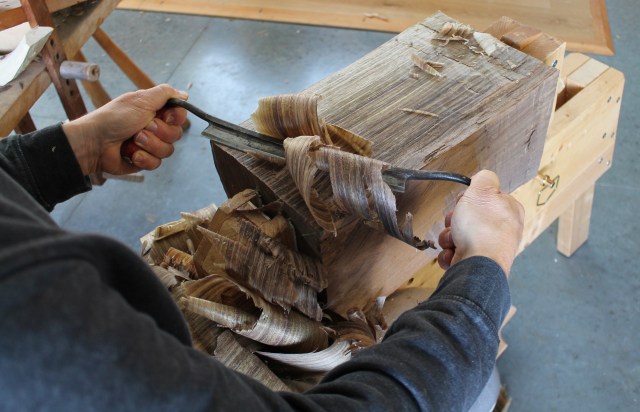
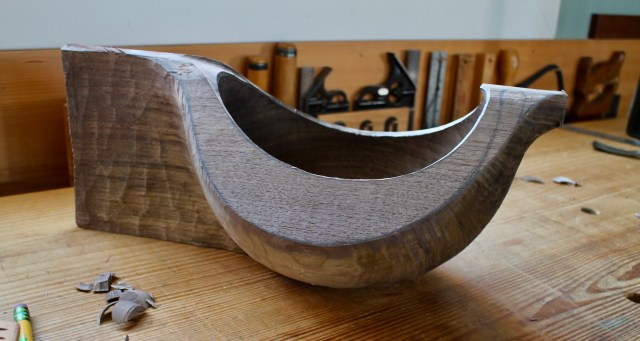
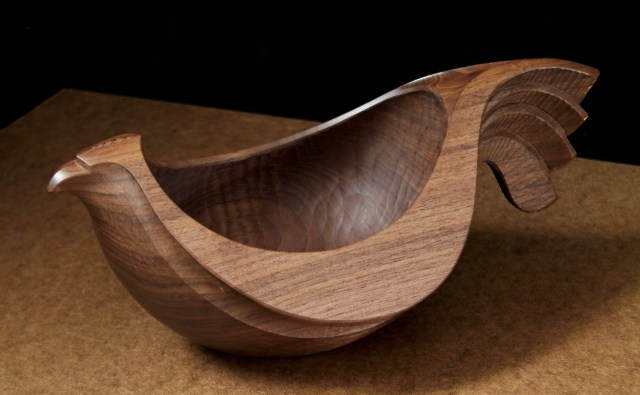
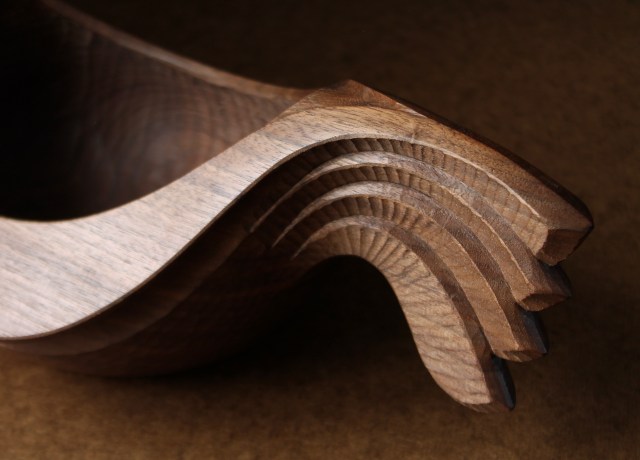
Meanwhile, I’ve been roughing out more pieces from this same walnut log. One of my strategies for storing green wood is to avoid storing it. Within reason and when possible, I rough out a bunch of pieces in succession, then return to them whenever it’s convenient, after they’ve dried. Above, I’m shaping up a quarter-log blank that should become a hen bowl. And there are a couple more in-process almost ready to begin drying. We’ll see all these bowls someday.
Walnut “A Crust — a Crumb” bowl 2024, 21″ x 6″ x 2″
It’s been a week since I’ve returned from teaching an October class at Peter Galbert Workshops. I carved this walnut bowl in July and took it along as an example for the students. I’ve decided to offer it for sale now, since I’ll have one or two new ones before the class in March. That class is full, but it’s a good idea to get on the waiting list if you’re interested. Even if nothing opens up for March, you’ll get first dibs on the next one.
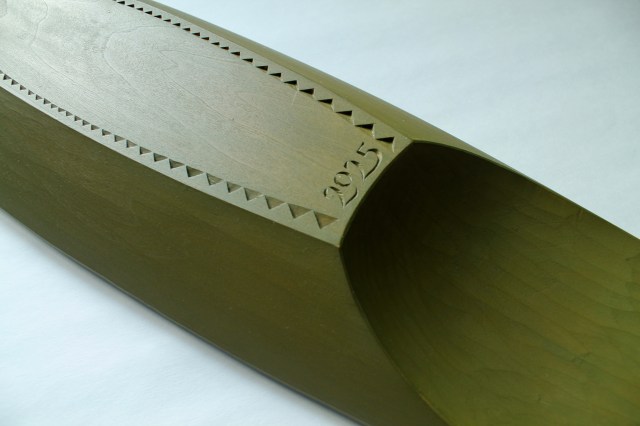
Departing from the tree design I’ve carved on the other Bowls-from-Planks, I carved an excerpt from an Emily Dickinson poem on the handles.
A little bread—a crust—a crumb— A little trust—a demijohn— Can keep the soul alive—
— Emily Dickinson, from Poem 159 (1896)
I adjust my letter carving technique depending on the size and style of the letters as well as according to the hardness of the wood. In the case of this walnut, I began with a v-tool after transferring my drawing to the wood with graphite paper.
I use a mallet for this v-tool work. The little taps provide controlled bursts that provide a lot of control.
I leave the lines and then some. Every wall and junction will be carved over. This just gets rid of the majority of the waste and goes relatively quickly.
There’s what it looks like after the v-tool work. Ready for the more painstaking knife and gouge stage.
There’s a shot of the foot and underside of the bowl. I carved flutes under the handles of this one, a technique I demonstrate in class that can be used in many other circumstances.
If you’re interested in purchasing this walnut bowl, please email me at dandkfish@gmail.com. It is 21″ long, 6″ wide, and 2″ high. The price of $950 includes shipping.SOLD
Tulip Poplar Bowl-from-a-Plank 2024, 21″ x 6″ x 2″
During class, I demonstrated each step on my own blank, but often only on half or a quarter of it. I brought it home with me and finished it up to take with me in March for an example. There it is, above. We used tulip poplar for this class, which is ideal in many ways. Softer than cherry and walnut, but harder than basswood (linden) and butternut, it works easily enough (even as a dry plank) while still holding crisp detail. It makes sense that it was such a traditional choice for bowls.
There’s one of the students, Jon, practicing his decorative carving on a sample board with his tulip poplar bowl, almost finished, beside him. Pete’s shop gets wonderful afternoon light coming through the windows. Ideal for carving. It was another wonderful group and we had a great week together.
The pale greenish hue of tulip poplar wood will mellow to a pleasing soft brown with subtle variations in the grain.
The tulip poplar leaves around here are mellowing pretty nicely as well.
Fall is here and I’m excited for my October class at Pete Galbert’s. I’ll burrow into the shop for the winter, then we’re going to do it again in spring. Registration for a class at Pete’s March 10-15 opens up on Monday, October 7 at 8:00 a.m. Through the week, we’ll carve the bowl above, right down to the final cuts and finish. But more importantly, we’ll learn how to adapt to make other bowl designs, sharpen gouges for optimal performance, lay out other bowl forms, carve decorative motifs, and more. In the August class, we even were able to touch upon the basics of letter carving. It’s really about the understanding and skills you take home with you, more so than the bowl. We call it Bowl Carving Exploration.
The trees are still mainly green around here, but some leaves have begun to fall.